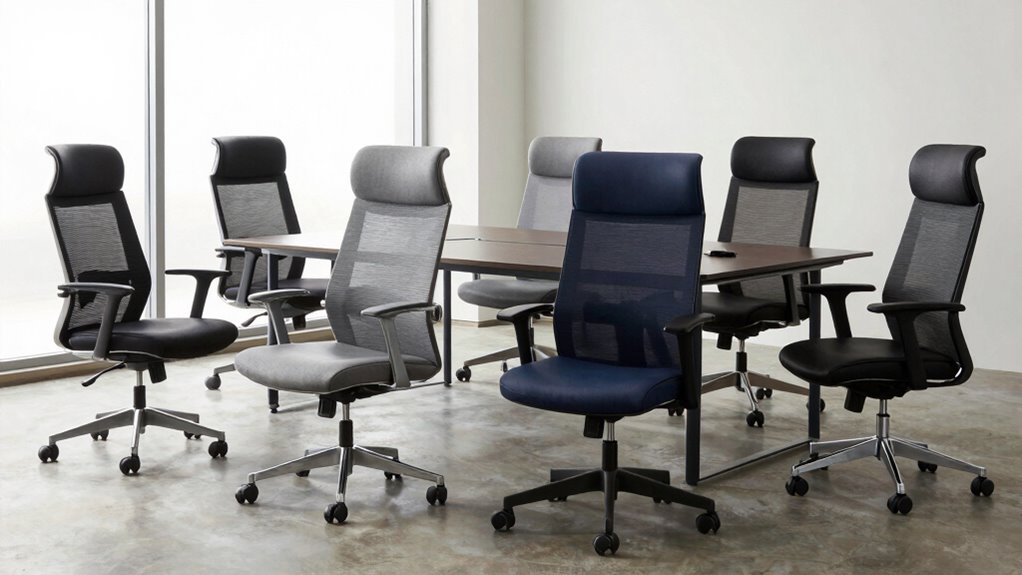

Choosing the right office chair with headrest requires balancing ergonomic precision with long-term durability, especially when neck support is a priority. The CAPOT Ergonomic Mesh Office Chair stands out as the best overall pick for its adjustable lumbar system and breathable mesh construction that prevents heat buildup during long sessions. For those prioritizing budget-friendly ergonomics, the SIHOO M18 offers a compelling blend of multi-directional adjustment and solid build quality without the premium price tag. Meanwhile, the COMHOMA Big and Tall model addresses a specific niche, providing enhanced weight capacity and an integrated footrest that larger frames genuinely need. The primary tradeoff in this category often lies between adjustability complexity and ease of use; highly adjustable chairs offer superior customization but can feel overwhelming or fragile if the mechanisms are cheap. I have analyzed these eight options to help you identify which chair aligns with your specific posture needs, body type, and work habits, ensuring you make an informed investment in your daily comfort.
Complete the kit


Key Takeaways
- Mesh backrests consistently outperform leather or fabric in breathability, making them the preferred choice for users who run hot or work in warmer climates.
- Headrest adjustability varies widely; top-tier models offer 3D or 4D adjustments (height, angle, depth), while budget options often lock the headrest in a fixed position.
- Lumbar support mechanisms that move with the spine (dynamic lumbar) provide better posture correction than static pillows, which often slip or feel intrusive.
- Flip-up armrests are a critical feature for users who need to slide under desks or use keyboard trays, a detail frequently overlooked in cheaper models.
- Weight capacity is not just about safety; chairs rated for higher weights typically feature reinforced gas lifts and thicker padding, extending the chair’s lifespan for all users.
| CAPOT Ergonomic Mesh Office Chair with Adjustable Lumbar Support |  | Best Overall for Adjustable Support | Brand and model: CAPOT OC.017 | Materials: Mesh, nylon, stainless steel | Seat dimensions: 19.3 in deep × 20 in wide | VIEW ON AMAZON | See Our Full Breakdown |
| Yaheetech Ergonomic Mesh Office Chair with Headrest, Lumbar Support, and Flip-Up Armrests |  | Best Value for Everyday Office Use | Brand and model: Yaheetech YT-001033885MY | Back material: Polyester mesh | Seat material: Foam | VIEW ON AMAZON | See Our Full Breakdown |
| SIHOO M18 Ergonomic Mesh Office Chair with Headrest |  | Best for Taller Users | Brand and model: SIHOO M18 | Materials: Mesh upholstery, stainless steel frame, memory foam seat | Adjustments: Seat height, headrest, lumbar support, back support, and tilt | VIEW ON AMAZON | See Our Full Breakdown |
| GABRYLLY Ergonomic High-Back Mesh Office Chair with Headrest and Flip-Up Arms |  | Best for Reclining and Desk Flexibility | Recommended user height: 5 ft 2 in–6 ft 1 in | Weight capacity: 300 lb | Chair dimensions: 24.5 in W × 27.5 in D × 46–56.4 in H | VIEW ON AMAZON | See Our Full Breakdown |
| COMHOMA Big and Tall Ergonomic Office Chair with Footrest |  | Best for Big-and-Tall Lounge Seating | Brand and model: COMHOMA CH511/CH510 | Upholstery: PU leather | Dimensions: 19.68 in D × 22 in W × 45.1 in H | VIEW ON AMAZON | See Our Full Breakdown |
| Marsail Ergonomic Office Chair with Mesh Back, Adjustable Lumbar Support, Headrest, and 3D Armrests |  | Best for Fine-Tuning Your Sitting Position | Model: RM-MSOC10B | Back material: Mesh | Headrest: 2D adjustable | VIEW ON AMAZON | See Our Full Breakdown |
| Marsail Ergonomic Office Chair with Lumbar Support and Adjustable Headrest |  | Best for Headrest Angle Adjustment | Model: MSOC28B | Backrest material: Breathable mesh | Headrest adjustment: 45° tilt; 2.8 inches in height | VIEW ON AMAZON | See Our Full Breakdown |
| GTPLAYER Gaming Chair with Footrest and Lumbar Support, Pearl White |  | Best for Reclining Breaks and a Footrest | Model: GT800A | Color: Pearl White | Upholstery: Faux leather | VIEW ON AMAZON | See Our Full Breakdown |
| office chair with headrest | Brand and model | Warranty | Weight capacity |
|---|---|---|---|
| CAPOT Ergonomic Mesh Office Ch | CAPOT OC.017 | 5 years | — |
| Yaheetech Ergonomic Mesh Offic | Yaheetech YT-001033885MY | — | — |
| SIHOO M18 Ergonomic Mesh Offic | SIHOO M18 | 3 years | 330 lb (150 kg) |
| GABRYLLY Ergonomic High-Back M | — | 3 years | 300 lb |
| COMHOMA Big and Tall Ergonomic | COMHOMA CH511/CH510 | 12 months | — |
| Marsail Ergonomic Office Chair | — | — | 330 lbs |
| Marsail Ergonomic Office Chair | — | — | 300 lbs |
| GTPLAYER Gaming Chair with Foo | — | — | — |
More Details on Our Top Picks
CAPOT Ergonomic Mesh Office Chair with Adjustable Lumbar Support
For buyers who want a headrest they can position rather than simply accept as fixed, the CAPOT OC.017 is my strongest all-around pick. Its headrest adjusts in height and depth, while the lumbar support moves across eight levels and a two-inch range, giving more scope to tune back and neck support than the Yaheetech’s listed adjustable support. The backrest locks at three angles, so it can serve upright desk work and a modest recline without relying on a free-rocking motion. Flip-up arms and silent PU wheels also suit desks where space and rolling noise matter. The tradeoff is a mesh design rather than the padded, footrest-equipped COMHOMA, and assembly is required. Its 400-pound capacity and five-year warranty make it the more support-focused choice for buyers who value adjustability and longer coverage.
Pros:- Headrest adjusts in both height and depth
- Lumbar support adjusts across eight levels and two inches
- Three backrest lock angles support upright and reclined sitting
- 400-pound capacity and five-year warranty
Cons:- Requires assembly, typically about 30 minutes
- Mesh construction lacks the plush, padded feel of the COMHOMA
Best for: Desk workers who want fine lumbar adjustment, a positionable headrest, and a higher stated weight capacity for daily office use.
Not ideal for: Buyers seeking a cushioned, lounge-style chair with an integrated footrest, or anyone who wants to avoid assembly.
- Brand and model:CAPOT OC.017
- Materials:Mesh, nylon, stainless steel
- Seat dimensions:19.3 in deep × 20 in wide
- Seat height:18.5–22.05 in
- Lumbar adjustment:2 in across 8 levels
- Backrest lock angles:90°, 110°, 125°
- Maximum weight recommendation:400 lb
- Recommended user height:5 ft 5 in–6 ft 2 in
- Warranty:5 years
Our verdict“Choose the CAPOT if adjustable head and lumbar support matter more than plush upholstery or an integrated footrest.”
Yaheetech Ergonomic Mesh Office Chair with Headrest, Lumbar Support, and Flip-Up Armrests
The Yaheetech makes sense for buyers who want the core headrest-chair setup without a long list of specialized adjustments. It combines a breathable mesh back, foam seat, adjustable headrest and lumbar support, and flip-up arms; the rocking function adds movement that the CAPOT’s lockable three-angle backrest does not emphasize. Its 20.5-inch-wide seat is also slightly wider than the CAPOT’s listed seat, though the Yaheetech provides fewer detailed adjustment specifications and has a 300-pound capacity rather than 400 pounds. That makes it a practical everyday option, not the strongest choice for shoppers who need a higher capacity or precisely defined lumbar positioning. Assembly is required, and the product data does not specify the headrest’s adjustment range, so buyers seeking a tailored fit may prefer the SIHOO M18 or CAPOT.
Pros:- Adjustable headrest and lumbar support
- Mesh back pairs with a foam seat
- Flip-up padded armrests can free up desk-side space
- Rocking function and 3.7-inch seat-height adjustment
Cons:- 300-pound capacity is lower than the CAPOT and COMHOMA
- Headrest and lumbar adjustment ranges are not specified
- Assembly is required
Best for: Home-office users who want a mesh-back chair with an adjustable headrest, lumbar support, and rocking function for regular desk work.
Not ideal for: Taller buyers who need a clearly specified headrest fit, or users who need a chair rated above 300 pounds.
- Brand and model:Yaheetech YT-001033885MY
- Back material:Polyester mesh
- Seat material:Foam
- Seat dimensions:20.5 in wide × 20 in deep
- Seat-height adjustment:3.7 in
- Maximum weight capacity:300 lb
- Features:Adjustable headrest and lumbar support, flip-up padded arms, rocking function
- Frame and base:Iron frame, nylon base
Our verdict“Pick the Yaheetech for straightforward mesh comfort and rocking, but choose the CAPOT if you need more precisely described support adjustments.”
SIHOO M18 Ergonomic Mesh Office Chair with Headrest
The SIHOO M18 stands out for buyers whose first question is whether a headrest chair is sized for a taller frame. Its recommended range of 5 ft 6 in to 6 ft 2 in overlaps with the CAPOT’s upper range, while its adjustable headrest, lumbar support, back support, and tilt offer a useful set of fit controls. 2D armrests add adjustability beyond the Yaheetech’s flip-up arms, which focus more on desk clearance than arm positioning. The M18 supports up to 330 pounds, between the Yaheetech’s 300-pound rating and the CAPOT’s 400-pound rating. Its mesh upholstery favors airflow over the plush feel of the COMHOMA, and the stated height range may leave shorter users with a less suitable fit. A three-year warranty is also shorter than CAPOT’s five-year coverage.
Pros:- Recommended height range is clearly stated for taller users
- Adjustable headrest, lumbar support, back support, and tilt
- 2D-adjustable armrests offer positioning beyond flip-up-only designs
- 330-pound capacity with a three-year warranty
Cons:- Recommended height range may not suit shorter users
- Three-year warranty is shorter than the CAPOT’s five-year coverage
- Assembly is required
Best for: Taller desk workers, especially those between 5 ft 6 in and 6 ft 2 in, who want mesh airflow and adjustable head, back, and arm support.
Not ideal for: Shorter users outside the stated height range, or shoppers who prioritize a higher capacity and longer warranty over 2D armrests.
- Brand and model:SIHOO M18
- Materials:Mesh upholstery, stainless steel frame, memory foam seat
- Adjustments:Seat height, headrest, lumbar support, back support, and tilt
- Armrests:2D adjustable
- Weight capacity:330 lb (150 kg)
- Recommended user height:5 ft 6 in–6 ft 2 in
- Warranty:3 years
- Color:Black
Our verdict“Choose the SIHOO M18 if you fall within its taller recommended height range and want adjustable armrests with a mesh headrest setup.”
GABRYLLY Ergonomic High-Back Mesh Office Chair with Headrest and Flip-Up Arms
Among these mesh options, the GABRYLLY is the clearest fit for someone who wants a headrest chair that can recline while still working as a conventional office seat. Its backrest moves from 90° to 120°, giving it a wider recline range than the CAPOT’s listed lock positions, while its headrest and seat height also adjust. The breathable mesh seat and back distinguish it from the upholstered COMHOMA, which offers a deeper 145-degree recline and footrest but takes a more lounge-oriented approach. The GABRYLLY’s flip-up arms can help it fit beneath a desk, and assembly is listed at about 15–20 minutes. Its 300-pound capacity is lower than the CAPOT’s and COMHOMA’s 400-pound ratings, and the recommended height range tops out at 6 ft 1 in.
Pros:- Backrest reclines from 90° to 120°
- Adjustable headrest and seat height
- Breathable mesh on both seat and back
- Flip-up arms and listed assembly time of about 15–20 minutes
Cons:- 300-pound capacity is below the CAPOT and COMHOMA
- Recommended height range is limited to 5 ft 2 in–6 ft 1 in
- Recline range is less than the COMHOMA’s listed 145°
Best for: Home-office workers who want a breathable mesh chair with a headrest, a defined recline range, and arms that flip up for desk clearance.
Not ideal for: Users over 6 ft 1 in or buyers who need a capacity above 300 pounds, a footrest, or a deeper recline.
- Recommended user height:5 ft 2 in–6 ft 1 in
- Weight capacity:300 lb
- Chair dimensions:24.5 in W × 27.5 in D × 46–56.4 in H
- Seat dimensions:20.5 in W × 20 in D
- Seat height:18.9–23.6 in
- Recline range:90°–120°
- Armrests:Flip up 45°
- Warranty:3 years
- Assembly time:About 15–20 minutes
Our verdict“Choose the GABRYLLY for breathable desk seating with a useful recline, but look to the COMHOMA for a deeper, footrest-equipped recline.”
COMHOMA Big and Tall Ergonomic Office Chair with Footrest
The COMHOMA is the outlier in this roundup: rather than a breathable mesh office chair, it pairs a wide padded seat and wider backrest with PU leather, pocket-spring lumbar support, and an integrated footrest. Its 145-degree maximum recline goes farther than the GABRYLLY’s 120 degrees, making it better suited to breaks and relaxed sitting than a posture-focused mesh setup. The headrest is not described as adjustable, though, so buyers who need to position neck support should favor the CAPOT, SIHOO M18, or GABRYLLY. A 400-pound recommendation gives it the same stated capacity as the CAPOT, but its 12-month warranty is shorter than the mesh options’ listed coverage. Choose it for space, padding, and recline—not for airflow or fine-tuned headrest adjustment.
Pros:- Wide padded seat and backrest
- Integrated footrest and recline up to 145°
- Pocket-spring lumbar support
- 400-pound maximum weight recommendation
Cons:- Headrest adjustment is not specified
- PU leather offers less breathability than the mesh chairs
- 12-month warranty is shorter than the other chairs’ listed coverage
Best for: Bigger-bodied users who want a wide padded seat, a footrest, and a deep recline for switching between desk work and relaxed breaks.
Not ideal for: Buyers who need a height- or depth-adjustable headrest, prefer breathable mesh, or want a longer stated warranty.
- Brand and model:COMHOMA CH511/CH510
- Upholstery:PU leather
- Dimensions:19.68 in D × 22 in W × 45.1 in H
- Maximum weight recommendation:400 lb
- Maximum recline:145°
- Reclining positions:3
- Features:Adjustable armrests, footrest, pocket-spring lumbar support
- Assembly:Required; hardware and tools included
- Warranty:12 months
Our verdict“Pick the COMHOMA for a roomy, footrest-equipped chair and deep recline, but choose a mesh model if adjustable head support is your priority.”
Marsail Ergonomic Office Chair with Mesh Back, Adjustable Lumbar Support, Headrest, and 3D Armrests
I’d choose this Marsail when adjustability matters more than having the simplest setup. Its lumbar support moves both vertically and forward or backward, while the 2D headrest and 3D armrests give more scope to tune upper-body support than the height-only armrests on the other Marsail in this batch. The mesh back and 90°–120° recline suit everyday desk work, and the 330-pound capacity is higher than that model’s 300-pound limit. The tradeoff is that the product’s listed seat and overall dimensions may be difficult to interpret when checking fit, so I’d verify measurements before choosing it. Compared with the SIHOO M18, this chair emphasizes adjustable lumbar positioning and armrests; buyers who want simpler feature choices may prefer a less adjustable option.
Pros:- Lumbar support adjusts vertically and forward or backward for a more tailored fit.
- 3D armrests and a 2D adjustable headrest allow several positioning changes.
- Breathable mesh back and a 90°–120° reclining range suit varied desk postures.
- Stated weight capacity is 330 pounds.
Cons:- Listed dimensions and seat measurements may make it hard to confirm fit before buying.
- Warranty details are not provided in the supplied product information.
- The many adjustment options may be more than buyers seeking a simple chair need.
Best for: Desk workers who want to adjust lumbar position and armrest orientation, and need a stated capacity up to 330 pounds.
Not ideal for: Buyers who need clear, easy-to-compare seat measurements or want warranty terms stated upfront; the supplied fit details may be hard to interpret, and warranty information requires contacting customer service.
- Model:RM-MSOC10B
- Back material:Mesh
- Headrest:2D adjustable
- Armrests:3D adjustable, flip-up, PU-padded
- Lumbar adjustment:1.18 inches forward/backward; 2.16 inches up/down
- Recline:90° to 120°
- Weight capacity:330 lbs
- Item weight:30.4 lbs
Our verdict“Choose this Marsail if you want fine-grained lumbar and armrest adjustment; skip it if unclear measurements make fit a deal-breaker.”
Marsail Ergonomic Office Chair with Lumbar Support and Adjustable Headrest
This Marsail is the headrest-focused pick: its support tilts 45 degrees and adjusts 2.8 inches in height, giving buyers more ways to position it than a fixed or height-only headrest. Its lumbar support has a stated 2.4-inch adjustment range, and the breathable mesh back pairs with a 3.15-inch foam cushion for a more cushioned seat than the other Marsail’s listed 3.14-inch seat. The tradeoff is less flexibility at the arms: they adjust in height only, unlike the other Marsail’s 3D armrests. Its 300-pound capacity is also lower than that chair’s 330-pound rating. I’d pick this model for headrest tuning, but compare seat fit carefully because the supplied dimensions don’t spell out the cushion’s measurements.
Pros:- Headrest adjusts 2.8 inches in height and tilts 45 degrees.
- Lumbar support has a stated 2.4-inch adjustment range.
- Breathable mesh back and 3.15-inch foam seat cushion.
- Metal base and 360° PU swivel casters are specified.
Cons:- Armrests adjust in height only.
- The 300-pound capacity is lower than the other Marsail chair in this batch.
- Supplied dimensions do not specify individual seat measurements.
Best for: People who want to adjust both headrest height and angle for desk work, reading, or reclining, and fit within the stated 300-pound capacity.
Not ideal for: Buyers who need armrests that move forward, backward, or sideways, or need a stated capacity above 300 pounds.
- Model:MSOC28B
- Backrest material:Breathable mesh
- Headrest adjustment:45° tilt; 2.8 inches in height
- Lumbar adjustment range:2.4 inches
- Seat cushion thickness:3.15 inches
- Weight capacity:300 lbs
- Base:Metal
- Dimensions:27.6 × 19.7 × 51.4 inches (D × W × H)
Our verdict“Pick this Marsail if adjustable headrest angle is your priority and height-only armrests meet your needs.”
GTPLAYER Gaming Chair with Footrest and Lumbar Support, Pearl White
Unlike the mesh-backed Marsail chairs, this GTPLAYER takes a cushioned gaming-chair approach: faux leather, foam padding, a lumbar pillow, and a retractable footrest create a setup for leaning back between tasks as well as sitting at a desk. The footrest is its clearest advantage over office-focused alternatives such as the SIHOO M18, which is presented as an ergonomic mesh chair rather than a chair with a leg rest. Faux leather is also easier to wipe clean than mesh, though it gives up the airflow of those mesh backs. I’d treat this as a comfort-oriented office option, not the safest choice for buyers who need verified fit details: the supplied information gives neither dimensions nor weight capacity. Assembly is required, and the headrest’s adjustment range is not specified.
Pros:- Retractable footrest supports a more reclined position during breaks.
- Includes a headrest and lumbar pillow.
- Faux leather upholstery can be wiped clean.
- Metal frame and legs are specified, with padded armrests and foam cushioning.
Cons:- No weight capacity or chair dimensions are provided.
- Faux leather does not offer the airflow of the mesh-backed Marsail chairs.
- Assembly is required, and headrest adjustability is not described.
Best for: People splitting time between desk work and gaming who want a wipe-clean cushioned chair with a retractable footrest and lumbar pillow.
Not ideal for: Buyers who prioritize a breathable mesh back, need confirmed chair dimensions or weight capacity, or want a headrest with a documented adjustment range.
- Model:GT800A
- Color:Pearl White
- Upholstery:Faux leather
- Frame:Metal
- Seat fill:Foam
- Cushion support:FSC-certified wood
- Features:Height adjustable, 360° swivel, footrest, headrest, lumbar pillow
- Recommended use:Office and gaming
Our verdict“Choose this GTPLAYER for a footrest and cushioned, wipe-clean gaming-chair feel, but not if you need confirmed fit or capacity information.”

How We Picked
I evaluated these eight chairs based on four core pillars: ergonomic adjustability, build quality, material comfort, and user-specific suitability. Adjustability was weighted heavily because a headrest that does not align with your specific neck curvature is useless; I looked for models offering independent control over height, tilt, and depth. Build quality was assessed by examining frame materials (steel vs. plastic), gas lift certifications, and wheel durability, as these determine whether the chair survives daily use over several years. Material comfort focused on the density of the seat foam and the tension of the mesh, ensuring neither bottoming out nor excessive firmness. Finally, I considered specific user needs, such as larger body frames or gamers who require recline angles beyond standard office limits.
The ranking logic prioritizes versatility and long-term value. A chair that fits 90% of users well ranks higher than one that fits 10% perfectly but fails everyone else. I also penalized models with poor headrest integration, where the headrest feels like an afterthought rather than part of the ergonomic system. This approach ensures that each recommendation serves a distinct buyer profile, from the budget-conscious beginner to the high-end executive requiring specific postural support.
| office chair with headrest | Brand and model |
|---|---|
| CAPOT Ergonomic Mesh Office Ch | CAPOT OC.017 |
| Yaheetech Ergonomic Mesh Offic | Yaheetech YT-001033885MY |
| SIHOO M18 Ergonomic Mesh Offic | SIHOO M18 |
| GABRYLLY Ergonomic High-Back M | — |
| COMHOMA Big and Tall Ergonomic | COMHOMA CH511/CH510 |
| Marsail Ergonomic Office Chair | — |
| Marsail Ergonomic Office Chair | — |
| GTPLAYER Gaming Chair with Foo | — |
Factors to Consider When Choosing Office Chair With Headrest
Beyond the specific features of each chair, several broader factors influence your long-term satisfaction. Understanding these elements helps you avoid common pitfalls and select a chair that matches your actual work style rather than just its marketing claims.Headrest Adjustability vs. Fixed Support
Many buyers assume any headrest provides adequate support, but fixed headrests often fail to align with the cervical spine unless your height matches the chair’s design perfectly. Adjustable headrests allow you to change the height and angle, which is necessary for maintaining proper posture when reclining. If you spend significant time leaning back to think or read, a fixed headrest will likely push your head forward, causing strain. Look for models with at least height adjustment; ideally, choose ones with tilt and depth control to customize the contact point. This level of customization ensures the headrest supports the base of your skull rather than pressing against your neck or shoulders.
Mesh Tension and Seat Foam Density
The material composition dictates how the chair feels after four or more hours of sitting. High-tension mesh provides firm support that keeps your spine aligned, preventing the ‘hammock effect’ where you sink into the backrest. However, if the mesh is too tight, it can create pressure points on the thighs. Conversely, dense foam seats offer plush comfort initially but may flatten over time if low-quality foam is used. A hybrid approach, such as a mesh back with a high-density foam seat, often provides the best balance of breathability and cushioning. Always check if the seat pan has a waterfall edge to reduce pressure on the back of your knees, which improves circulation during long workdays.
Lumbar Support Mechanics: Static vs. Dynamic
Lumbar support is not a one-size-fits-all feature. Static lumbar pillows are easy to install but often sit at the wrong height, forcing you to hunch forward to reach them. Dynamic lumbar systems move with your back as you shift positions, providing continuous support. This is particularly important for individuals with existing lower back issues, as inconsistent support can exacerbate pain. Chairs with adjustable lumbar height allow you to target the specific curve of your lower spine. If you cannot adjust the lumbar support, you risk developing poor posture habits as you unconsciously shift to avoid discomfort. Prioritize chairs where the lumbar mechanism feels integrated into the backrest rather than an add-on pillow.
Weight Capacity and Structural Integrity
While manufacturers list weight capacities, the real-world durability of a chair often depends on the quality of its gas lift and frame construction. Chairs rated for higher weights (e.g., 300+ lbs) typically use thicker steel frames and more robust base plates, which benefit all users by reducing wobble and creaking. If you are near the upper limit of a chair’s rating, the materials may degrade faster, leading to a shorter lifespan. Even for lighter users, a chair with a higher weight capacity often indicates better overall build quality and stability. Do not ignore the base design; a five-star base with dual-wheel casters distributes weight more evenly than cheaper plastic bases, which can crack under stress over time.
Armrest Functionality and Desk Compatibility
Armrests are frequently overlooked but play a significant role in shoulder health. Fixed armrests can force your shoulders up if they are too high, causing tension in the trapezius muscles. Flip-up armrests are ideal for users who need to slide their chair fully under a desk or use a keyboard tray. 3D or 4D armrests allow for height, width, pivot, and depth adjustments, enabling you to align your forearms perfectly with your keyboard. This alignment reduces strain on your wrists and elbows. If your desk has a shallow depth or a drawer underneath, flip-up arms are often a necessary feature to ensure your elbows remain supported while typing.
Frequently Asked Questions
Do I really need a headrest if I sit upright most of the time?
Yes, because even upright posture fatigues the neck muscles over time. A headrest provides a resting point for your cervical spine, allowing those muscles to relax during brief pauses. Without it, your head weight (about 10-12 pounds) is supported entirely by your neck and shoulder muscles, leading to chronic tension. A headrest encourages a slight backward tilt, which aligns the spine more naturally than a forward-leaning position. It acts as a safety net for your posture, ensuring you maintain alignment even when you shift positions unconsciously.Is mesh or leather better for an office chair with a headrest?
Mesh is generally superior for temperature regulation and spinal support, while leather offers a different aesthetic and easier cleaning. Mesh allows air circulation, preventing sweat and heat buildup against the back and head, which is common in leather chairs during long sessions. Leather can feel sticky in humid environments and often retains body heat. However, leather is more resistant to stains and spills, making it practical for certain environments. For ergonomic support, mesh tends to conform better to the body’s curves, whereas leather can feel rigid until it breaks in.How do I know if the headrest is adjustable enough for my height?
You need to check the adjustment range in inches and compare it to your neck height when seated. Measure the distance from the seat cushion to the base of your skull; the headrest should be able to move up and down to meet this point without forcing your chin up or pushing your head forward. Look for chairs with a wide vertical adjustment range, typically 2-3 inches or more. If the headrest only tilts but does not adjust in height, it may not align correctly unless your height falls within a narrow range. Always verify if the depth adjustment is available, as this allows you to move the headrest closer or farther from your head.Are gaming chairs with headrests suitable for office work?
Gaming chairs can work for office use, but they often prioritize aesthetics over ergonomic precision. Many gaming chairs feature a ‘bucket seat’ design that restricts leg movement and can push the shoulders forward, which is counterproductive for desk work. However, some modern gaming chairs incorporate ergonomic features like adjustable lumbar and head pillows that mimic office chairs. If you choose a gaming chair, ensure it has a wide seat and does not restrict your ability to sit in a neutral posture. Office-specific ergonomic chairs typically offer better adjustability for prolonged typing and computer use.How often should I replace my office chair?
A high-quality ergonomic chair should last 5-7 years with daily use, but signs of wear appear earlier if the build quality is poor. Watch for flattening of the seat foam, loosening of adjustment mechanisms, or creaking noises from the gas lift. If the mesh sags or the lumbar support no longer holds its shape, the chair is no longer providing adequate support. Regular maintenance, such as tightening bolts and cleaning the mesh, can extend the lifespan. When the chair no longer maintains your posture comfortably, it is time to replace it to prevent long-term health issues.Conclusion
Selecting the right office chair with headrest depends largely on your specific body mechanics and work habits. For most professionals seeking a balance of ergonomic precision and value, the CAPOT Ergonomic Mesh Office Chair is the best overall choice due to its comprehensive adjustability and breathable design. If you are on a tighter budget but still require solid support, the SIHOO M18 offers excellent features for its price point, making it the best value option. Those requiring extra space and durability should consider the COMHOMA Big and Tall for its reinforced structure and integrated footrest. Beginners or those new to ergonomic seating will find the Yaheetech Ergonomic Mesh Office Chair easy to set up and comfortable right out of the box. Finally, for those who prefer a sleek aesthetic and specific recline angles, the GTPLAYER Gaming Chair serves as a specialized alternative. I recommend prioritizing adjustability over brand name, ensuring the headrest and lumbar support can be customized to your exact posture for lasting comfort.