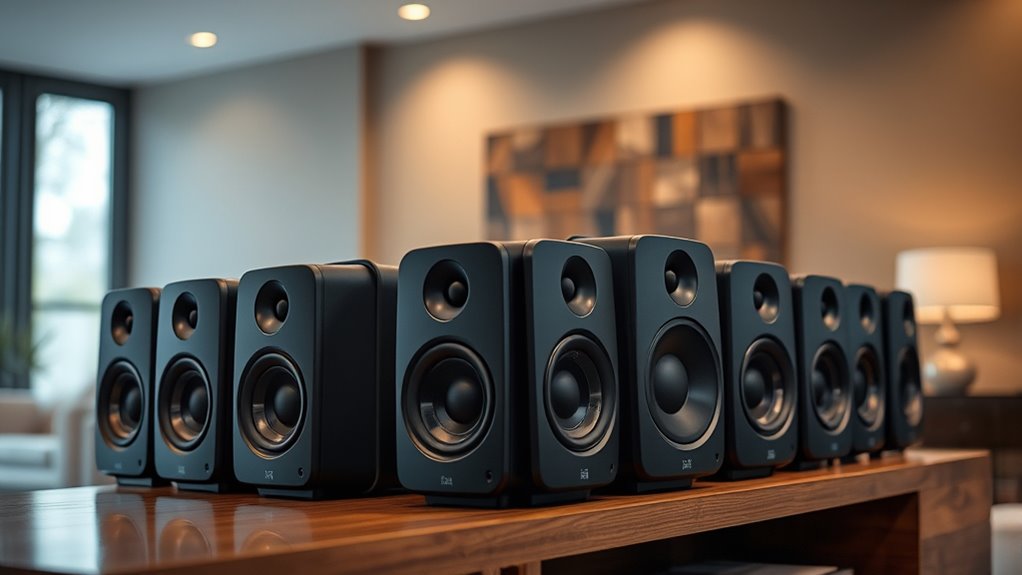

Powered bookshelf speakers combine amplification and speakers in one system, so you can play music without buying a separate receiver. Among these 13 options, I’d put the ELAC Debut ConneX DCB61 first for buyers who want a capable, feature-rich setup, while the Edifier R1280DBs stands out for Bluetooth and optical connectivity and the PreSonus Eris 3.5 suits near-field desktop listening. The main tradeoffs are connection flexibility, speaker size and placement, and whether you prefer speakers voiced for everyday listening or more focused monitoring. A compact pair may fit a desk but offer less room-filling presence; a larger or more connected model can take up more space and add complexity. Read on for the full breakdown and a guide to matching a pair to your room and sources.

Get the latest gadgets delivered free with Prime
- Fast, free delivery on millions of items
- Prime Video, Amazon Music and more included
- Member-only deals all year
Complete the kit



Key Takeaways
- The ELAC Debut ConneX DCB61 is the most feature-forward pick in this group, with Dolby Digital support that makes it a stronger candidate for a TV-centered setup than the simpler stereo options.
- Connectivity separates close alternatives: the Edifier R1280DBs adds Bluetooth and optical input, while the R1280T is a more straightforward choice for analog sources.
- Desktop listening calls for a different priority than living-room use: the PreSonus Eris 3.5 and Edifier MR4.5 are studio-monitor options, while larger bookshelf designs are better candidates for broader room coverage.
- There are two R1280T listings in the roundup. Their shared model name means buyers should check the specific listing and included configuration rather than assume they are different speaker designs.
- Several low-cost and compact options trade connection detail or flexibility for simplicity. Compare the Saiyin, VENTOSONIDO, and ULTIMEA listings against your actual source devices before choosing on form factor alone.
| Edifier R1280T Powered Bookshelf Speakers |  | Best for Simple, Flexible Connections | Speaker type: Powered bookshelf speakers | Audio channels: 2 | Maximum output power: 42 watts | VIEW ON AMAZON | See Our Full Breakdown |
| PreSonus Eris 3.5 Powered Studio Monitors, Pair — 3.5” Active Near |  | Best for Desktop Work and Monitoring | Speaker type: Active near-field studio monitors | Configuration: Stereo pair | Amplification: 50 watts onboard Class AB | VIEW ON AMAZON | See Our Full Breakdown |
| Klipsch Reference R-40PM Powered Bookshelf Speakers |  | Best for Source Flexibility | Speaker type: Powered bookshelf speakers | Audio output: Stereo | Tweeter: 1-inch LTS aluminum with 90° × 90° Tractrix horn | VIEW ON AMAZON | See Our Full Breakdown |
| Edifier R1280T Powered Bookshelf Speakers, 42W RMS, Black |  | Best for a Black-Finish Wired Setup | Model: Edifier R1280T | Audio output: Stereo, 2 channels | Maximum output power: 42 watts | VIEW ON AMAZON | See Our Full Breakdown |
| Edifier R980T 4-Inch Active Bookshelf Speakers, 2.0 Stereo Pair |  | Best for a Straightforward Budget-Friendly Setup | Model: Edifier R980T | Configuration: 2.0 stereo pair | Total output power: 24 watts | VIEW ON AMAZON | See Our Full Breakdown |
| ELAC Debut ConneX DCB61 6.5-Inch Powered Bookshelf Speakers with Dolby Digital, Black |  | Best for TV and Multi-Source Systems | Speaker type: Powered bookshelf | Woofer: 6.5 inches | Maximum output power: 160 watts | VIEW ON AMAZON | See Our Full Breakdown |
| VENTOSONIDO Active Bookshelf Speakers with 5-Inch Woofers and Bluetooth 5.4 |  | Best for Adjustable Everyday Listening | RMS power: 36 watts | Maximum output power: 110 watts | Woofer and tweeter: 5-inch carbon woofer; 1-inch silk tweeter | VIEW ON AMAZON | See Our Full Breakdown |
| Edifier MR4.5 Bi-Amped Studio Monitor Speakers, 80W RMS, Black |  | Best for Studio and Detailed Listening | Speaker type: Monitor | Total power: 80W RMS | Drivers: 4.5-inch mid-bass drivers; 1-inch silk dome tweeters | VIEW ON AMAZON | See Our Full Breakdown |
| Edifier R1280DBs Bluetooth Bookshelf Speakers with Optical Input |  | Best Value for a Simple TV-and-Music Setup | Speaker type: Powered bookshelf speakers | Maximum output power: 42 watts | Drivers: 4-inch woofer; 0.75-inch tweeter | VIEW ON AMAZON | See Our Full Breakdown |
| Audio-Technica AT-SP3XWH Powered Bookshelf Speakers, White | 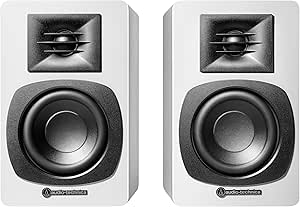 | Best Compact Pick | Speaker type: Powered bookshelf | Drivers: 3-inch woofer; 1.1-inch tweeter | Connectivity: Bluetooth and dual RCA inputs | VIEW ON AMAZON | See Our Full Breakdown |
| Saiyin Powered Bluetooth Bookshelf Speakers |  | Best for Flexible Everyday Connections | Speaker type: Powered bookshelf speakers | Bluetooth: Version 5.3 | Inputs: Optical, coaxial, 3.5 mm, RCA | VIEW ON AMAZON | See Our Full Breakdown |
| Saiyin Powered Bluetooth Bookshelf Speakers |  | Best Saiyin Pick for Subwoofer Expansion | Bluetooth: Version 5.3 | Inputs: Bluetooth, optical, coaxial, auxiliary, RCA | Woofer: 4 inches | VIEW ON AMAZON | See Our Full Breakdown |
| ULTIMEA BS-3 3-Way Powered Bookshelf Speakers |  | Best Feature-Rich TV and Music Upgrade | Speaker type: Powered bookshelf speakers | Audio output: Stereo, 2 channels | Drivers: 5.25-inch woofer, dedicated midrange driver, 1-inch tweeter | VIEW ON AMAZON | See Our Full Breakdown |
| bookshelf speakers powered | Speaker type | Dimensions | Woofer | Inputs |
|---|---|---|---|---|
| Edifier R1280T Powered Bookshe | Powered bookshelf speakers | — | 4 inches | 2 AUX inputs; RCA and PC audio inputs |
| PreSonus Eris 3.5 Powered Stud | Active near-field studio monitors | 5.5 × 6 × 8.3 inches | 3.5-inch woven-composite | Balanced TRS, RCA, and front-panel AUX |
| Klipsch Reference R-40PM Power | Powered bookshelf speakers | 10.1 × 5.7 × 11.8 inches | 4-inch copper-spun TCP | — |
| Edifier R1280T Powered Bookshe | — | 17 × 12.6 × 7.2 inches | 4 inches | 2 AUX inputs |
| Edifier R980T 4-Inch Active Bo | — | — | 4 inches | 2 AUX inputs; RCA and 3.5 mm |
| ELAC Debut ConneX DCB61 6.5-In | Powered bookshelf | 9.57 × 8.07 × 12.9 inches | 6.5 inches | — |
| VENTOSONIDO Active Bookshelf S | — | 6.1 × 10.4 × 6.1 inches | — | — |
| Edifier MR4.5 Bi-Amped Studio | Monitor | 8.19 × 5.51 × 9.61 inches | — | XLR, TRS, RCA, AUX, Bluetooth 6.0 |
| Edifier R1280DBs Bluetooth Boo | Powered bookshelf speakers | — | — | Optical, coaxial, RCA, Bluetooth |
| Audio-Technica AT-SP3XWH Power | Powered bookshelf | 5.4 × 4.9 × 7.9 inches | — | — |
| Saiyin Powered Bluetooth Books | Powered bookshelf speakers | 6.5 × 10.6 × 8.5 inches (D × W × H) | 3.75 inches | Optical, coaxial, 3.5 mm, RCA |
| Saiyin Powered Bluetooth Books | — | 150 × 170 × 240 mm | 4 inches | Bluetooth, optical, coaxial, auxiliary, RCA |
| ULTIMEA BS-3 3-Way Powered Boo | Powered bookshelf speakers | — | — | — |
More Details on Our Top Picks
Edifier R1280T Powered Bookshelf Speakers
The Edifier R1280T is a practical pick for listeners who want powered stereo sound and straightforward control without adding a receiver. Its two AUX inputs let you keep two wired sources connected, while the remote and speaker-side bass, treble, and volume controls make everyday adjustments easy. Compared with the PreSonus Eris 3.5, it uses larger 4-inch drivers and a wood-finish cabinet, but lacks the PreSonus’s front headphone jack and acoustic tuning controls. The tradeoff is a more conventional, living-room-friendly setup rather than a monitor-style desktop feature set. There’s no listed wireless connectivity, so buyers who want Bluetooth should look elsewhere; the R1280T is best when simple wired connections and accessible tone controls matter more.
Pros:- Two AUX inputs allow two compatible sources to remain connected
- Remote control supports convenient listening adjustments
- Bass, treble, and volume controls are built in
- Wood-finish MDF enclosure suits indoor stereo setups
Cons:- No wireless connectivity is listed
- Not water resistant
- The 80 Hz listed frequency response gives limited information about deep-bass performance
Best for: Listeners setting up a small living-room or desk stereo who want two wired sources connected and remote tone control.
Not ideal for: Buyers who want Bluetooth streaming, headphone output, or studio-style acoustic tuning in the speaker.
- Speaker type:Powered bookshelf speakers
- Audio channels:2
- Maximum output power:42 watts
- Tweeter:13 mm silk dome
- Woofer:4 inches
- Inputs:2 AUX inputs; RCA and PC audio inputs
- Controls:Remote; on-speaker volume, bass, and treble
- Enclosure:Wood-finish MDF
Our verdict“Choose the R1280T if you want flexible wired inputs and remote tone control, but skip it if wireless streaming is a priority.”
PreSonus Eris 3.5 Powered Studio Monitors, Pair — 3.5” Active Near
The PreSonus Eris 3.5 earns its place for desk-based listening where connection options and sound adjustment are more useful than larger drivers. Its balanced TRS, RCA, and front AUX inputs suit computers, interfaces, consoles, and portable sources; the front headphone jack also makes private listening easy. High- and low-frequency tuning controls offer more room-matching flexibility than the Edifier R1280T, while its 3.5-inch woofers are smaller than the Edifier’s 4-inch drivers. That makes the Eris a more work-focused choice, not an obvious pick for listeners seeking fuller bass from a living-room pair. The stated 50 watts of built-in amplification and near-field design fit desktop use, though buyers should expect a corded, non-water-resistant setup.
Pros:- Balanced TRS, RCA, and front AUX connections accommodate varied audio sources
- High- and low-frequency controls help tailor response to a desk or room
- Front headphone jack supports private listening
- Sold as a stereo pair with 50 watts of onboard amplification
Cons:- 3.5-inch woofers are smaller than the 4-inch drivers in the Edifier R1280T
- No Bluetooth connectivity is listed
- Not water resistant
Best for: Desktop producers, gamers, and computer listeners who need balanced inputs, adjustable sound, and a front headphone connection.
Not ideal for: Listeners prioritizing larger woofers or a simple living-room speaker pair with a remote control.
- Speaker type:Active near-field studio monitors
- Configuration:Stereo pair
- Amplification:50 watts onboard Class AB
- Woofer:3.5-inch woven-composite
- Tweeter:1-inch silk dome
- Frequency range:80 Hz–20 kHz
- Inputs:Balanced TRS, RCA, and front-panel AUX
- Additional connection:Front headphone output
- Dimensions:5.5 × 6 × 8.3 inches
Our verdict“Pick the Eris 3.5 for an adjustable, well-connected desktop setup, but choose a larger-driver alternative if fuller bass is the priority.”
Klipsch Reference R-40PM Powered Bookshelf Speakers
The Klipsch Reference R-40PM is the most connection-flexible choice here for buyers building a mixed-source system. Its built-in amplification avoids a separate receiver, and Bluetooth, phono, digital, and analog inputs let it handle wireless listening, a turntable, and other gear in one pair. That range is broader than the wired-only Edifier R1280T, which is simpler but does not list Bluetooth or phono connectivity. Klipsch also pairs a 1-inch LTS tweeter with a Tractrix horn and 4-inch copper-spun woofers, giving the design a distinct monitor-and-hi-fi focus. The tradeoffs are its corded power requirement and tabletop placement; it is not water resistant, and buyers who only need basic AUX connections may find its varied input options unnecessary.
Pros:- Built-in amplification removes the need for a separate receiver
- Bluetooth, phono, digital, and analog connectivity support varied sources
- LTS tweeters with Tractrix horns are designed to reduce distortion
- Compact tabletop bookshelf format
Cons:- Requires corded power
- Not water resistant
- The broad input selection may be unnecessary for listeners who only need simple wired connections
Best for: Listeners combining a turntable, digital source, and Bluetooth device who want powered speakers without a separate receiver.
Not ideal for: Buyers seeking a basic low-complexity AUX pair, or anyone needing speakers for outdoor or damp locations.
- Speaker type:Powered bookshelf speakers
- Audio output:Stereo
- Tweeter:1-inch LTS aluminum with 90° × 90° Tractrix horn
- Woofer:4-inch copper-spun TCP
- Connectivity:Bluetooth, phono, digital, and analog
- Bluetooth range:10 meters
- Dimensions:10.1 × 5.7 × 11.8 inches
- Power source:Corded electric
Our verdict“Choose the R-40PM if your system mixes wireless, turntable, and digital sources; choose the R1280T for a simpler wired setup.”
Edifier R1280T Powered Bookshelf Speakers, 42W RMS, Black
This black-finish version of the Edifier R1280T suits buyers who want the same straightforward powered-speaker layout in a darker cabinet. Its 42-watt stereo output, dual AUX inputs, remote, and adjustable bass and treble make it a familiar all-rounder for TVs, computers, and other wired sources. Compared with the Edifier R980T, it offers a remote and explicit side-panel tone controls, while both models use 4-inch drivers and wired connections. The R1280T’s main advantage is day-to-day control, not wireless convenience: the listed inputs are wired, and the cabinet is for indoor use. Choose this version over the other R1280T listing when the black finish and stated dimensions better fit your setup; its core feature set is otherwise closely matched.
Pros:- Two AUX inputs support simultaneous wired source connections
- Remote and side-panel bass, treble, and volume controls
- 42 watts of maximum output power in a stereo pair
- Black wood-effect MDF finish fits darker equipment setups
Cons:- No wireless connectivity is listed
- Not water resistant
- The wired AUX-focused setup is less convenient for wireless-first listening
Best for: Listeners who want a black-finish stereo pair for a TV, computer, or indoor music setup with remote and tone controls.
Not ideal for: Buyers who need Bluetooth, water resistance, or a meaningful upgrade over another R1280T configuration they already own.
- Model:Edifier R1280T
- Audio output:Stereo, 2 channels
- Maximum output power:42 watts
- Tweeter:13 mm
- Woofer:4 inches
- Inputs:2 AUX inputs
- Controls:Remote; side-panel volume, bass, and treble
- Dimensions:17 × 12.6 × 7.2 inches
- Enclosure:MDF with wood-effect vinyl finish
Our verdict“Select this R1280T configuration for its black finish and remote-controlled wired flexibility, not for features beyond the closely related R1280T listing.”
Edifier R980T 4-Inch Active Bookshelf Speakers, 2.0 Stereo Pair
The Edifier R980T is the pared-back option for buyers who want active stereo speakers and familiar wired connections without extra control features. It provides 24 watts of total output, two AUX inputs, and included RCA, 3.5 mm, and speaker-wire cables, so basic connections are covered out of the box. Its front-facing bass reflex ports can make placement more forgiving when the speakers sit near a wall. Compared with the Edifier R1280T, the R980T gives up the included remote and explicit bass and treble controls, as well as some listed output power. That tradeoff makes sense for a simple computer or compact-room system, but less so for listeners who want to tune the sound from their seat. It remains a wired, indoor-only choice rather than a wireless or portable speaker.
Pros:- Two AUX inputs support simultaneous connections to compatible devices
- RCA, 3.5 mm, and speaker-wire cables are included
- Front-facing bass reflex ports can help with placement near a wall
- Wooden enclosures are designed to minimize acoustic resonance
Cons:- 24 watts of total output is lower than the R1280T’s listed 42 watts
- No remote or bass and treble controls are listed
- Wired connectivity only; not waterproof
Best for: First-time powered-speaker buyers who want a simple wired stereo pair for a computer or small indoor listening area.
Not ideal for: Listeners who want a remote, adjustable bass and treble, Bluetooth, or stronger listed output than the R980T provides.
- Model:Edifier R980T
- Configuration:2.0 stereo pair
- Total output power:24 watts
- Woofer:4 inches
- Inputs:2 AUX inputs; RCA and 3.5 mm
- Enclosure:Wood
- Power supply:110–240 V
- Weight:7.8 pounds
- Warranty:2 years
Our verdict“Choose the R980T for a simple wired stereo pair with useful cables included, but move up to the R1280T if remote control and tone adjustment matter.”
ELAC Debut ConneX DCB61 6.5-Inch Powered Bookshelf Speakers with Dolby Digital, Black
The ELAC Debut ConneX DCB61 is the most TV-ready choice here: HDMI ARC and Dolby Digital decoding let it connect directly to a compatible television, while optical, USB, analog/phono, and Bluetooth cover other sources. Its 6.5-inch woofer and 160-watt maximum output give it a larger-scale brief than the smaller Edifier R1280DBs, which is useful when you want fuller sound without adding a separate amplifier. App and remote controls, including EQ and placement settings, offer more flexibility than the simpler controls on the R1280DBs. The tradeoff is size and placement: at 24 pounds for the pair and with rear-facing bass ports, it needs more room behind the cabinets than a compact desktop option such as the Audio-Technica AT-SP3XWH. It also costs you a more involved setup than a basic Bluetooth pair.
Pros:- HDMI ARC and Dolby Digital decoding simplify connection to compatible TVs
- Multiple inputs include analog/phono, optical, USB, and Bluetooth
- App and remote controls provide EQ and placement adjustments
- 6.5-inch woofer offers a larger-driver alternative to compact bookshelf models
Cons:- Rear-facing bass ports can limit placement close to a wall
- The 24-pound system takes more shelf space than compact options
- Its mix of connections and settings may be more than a basic desktop setup needs
Best for: TV owners who want powered stereo speakers with HDMI ARC, Dolby Digital decoding, and several ways to connect music sources
Not ideal for: Small desks or shelves with little rear clearance, because the speakers are relatively large and their bass ports face backward
- Speaker type:Powered bookshelf
- Woofer:6.5 inches
- Maximum output power:160 watts
- Connectivity:HDMI ARC, analog/phono, optical, USB, Bluetooth
- Audio feature:Dolby Digital decoding
- Controls:App and remote
- Dimensions:9.57 × 8.07 × 12.9 inches
- Weight:24 pounds
Our verdict“Choose the DCB61 if your powered bookshelf speakers need to serve a TV and several other sources, and you have room to place them properly.”
VENTOSONIDO Active Bookshelf Speakers with 5-Inch Woofers and Bluetooth 5.4
The VENTOSONIDO active bookshelf speakers suit listeners who want hands-on tone adjustment without moving up to the more studio-focused Edifier MR4.5. Their 10-level bass and treble controls make it easy to tailor playback for a desk, casual music listening, or a small living space, and Bluetooth 5.4, USB, AUX, and dual RCA cover common sources. The 5-inch carbon woofers are larger than the 4-inch drivers in the Edifier R1280DBs, but the listed frequency response is only stated as 80 Hz, so buyers should not read that figure as a full response range or assume deep bass. The speakers also need a 6.5-foot cable between them, unlike a truly wireless stereo pair. USB depends on host audio support, and Dolby is not supported, making these less suited to a TV-centered system than the ELAC DCB61.
Pros:- Bluetooth 5.4, USB, AUX, and dual RCA support varied sources
- 10-level bass and treble adjustment allows straightforward tonal changes
- 5-inch carbon woofers are larger than the R1280DBs’ 4-inch drivers
- Includes a remote and removable fabric grille
Cons:- The USB input requires a host device with audio support
- A 6.5-foot cable connects the two speakers, limiting separation
- Dolby is not supported, reducing suitability for some TV setups
Best for: Desk and small-room listeners who want several everyday input options and direct bass and treble adjustment
Not ideal for: TV users seeking Dolby decoding or buyers who need a wireless link between the left and right speakers
- RMS power:36 watts
- Maximum output power:110 watts
- Woofer and tweeter:5-inch carbon woofer; 1-inch silk tweeter
- Frequency response:80 Hz (range not specified)
- Connectivity:USB, Bluetooth 5.4, AUX, dual RCA
- Cabinet material:Acoustic MDF wood
- Speaker-to-speaker cable:6.5 feet
- Dimensions:6.1 × 10.4 × 6.1 inches
Our verdict“Pick the VENTOSONIDO pair for flexible everyday connections and tone controls, but choose the ELAC DCB61 for a more capable TV connection.”
Edifier MR4.5 Bi-Amped Studio Monitor Speakers, 80W RMS, Black
The Edifier MR4.5 is the pick for listeners who want monitor-style control rather than a straightforward TV speaker. Its bi-amped 80W RMS design, 24-bit/96kHz DSP, and adjustable EQ and room compensation offer tools for shaping sound around a desk or listening space. XLR and TRS inputs add a practical advantage for audio equipment that the Edifier R1280DBs, with its consumer-oriented optical, coaxial, and RCA connections, does not provide. Bluetooth 6.0 with LDAC also gives the MR4.5 a wireless option without making it just a casual Bluetooth speaker. The 4.5-inch drivers are smaller than the ELAC DCB61’s 6.5-inch woofer, so this is less compelling if your priority is room-filling output or bigger bass. Its monitor focus may also be unnecessary for listeners who want simple TV controls and a subwoofer output.
Pros:- Bi-amped 80W RMS stereo design with 24-bit/96kHz DSP
- XLR and TRS inputs suit studio and recording gear
- Bluetooth 6.0 with LDAC adds a higher-quality wireless option
- Adjustable EQ and room compensation support placement tuning
Cons:- The 4.5-inch woofer is smaller than the ELAC DCB61’s 6.5-inch driver
- No HDMI ARC or subwoofer output is listed
- Monitor-oriented controls may be less convenient for simple living-room use
Best for: Home-recording users and detail-focused listeners who need balanced desktop speakers with professional wired inputs
Not ideal for: Buyers prioritizing larger-room bass, HDMI ARC, or a built-in subwoofer connection
- Speaker type:Monitor
- Total power:80W RMS
- Drivers:4.5-inch mid-bass drivers; 1-inch silk dome tweeters
- Frequency response:50Hz–40kHz
- Audio processing:24-bit/96kHz DSP
- Inputs:XLR, TRS, RCA, AUX, Bluetooth 6.0
- Bluetooth codec:LDAC
- Dimensions:8.19 × 5.51 × 9.61 inches
Our verdict“Choose the MR4.5 for desktop production or careful listening with studio connections; for TV-first use, the ELAC DCB61 is a better fit.”
Edifier R1280DBs Bluetooth Bookshelf Speakers with Optical Input
The Edifier R1280DBs is a practical choice for buyers who want familiar connections and the option to add a subwoofer later. Optical and coaxial inputs make it easy to connect compatible TVs and other digital sources, while Bluetooth 5.0 and RCA handle music devices. Its wired subwoofer output with automatic detection and crossover gives it an upgrade path that the Audio-Technica AT-SP3XWH lacks. The tradeoff is scale: a 4-inch woofer and 42-watt maximum output suit near-field or modest-room listening better than the larger ELAC DCB61, which also adds HDMI ARC and Dolby Digital decoding. Side-panel bass, treble, and volume controls plus a remote keep operation simple, though the wired sub connection and lack of HDMI ARC make this a less direct fit for some living-room systems.
Pros:- Optical, coaxial, RCA, and Bluetooth inputs cover common sources
- Wired subwoofer output supports a future bass upgrade
- Side-panel bass, treble, and volume controls provide direct adjustment
- Wireless remote makes everyday operation easier
Cons:- The 4-inch woofer is smaller than the ELAC DCB61’s 6.5-inch driver
- Subwoofer connection is wired
- No HDMI ARC or Dolby Digital decoding is listed
Best for: Listeners setting up a modest TV or music system who want optical input, Bluetooth, and a wired subwoofer upgrade option
Not ideal for: Buyers who need HDMI ARC, Dolby Digital decoding, or stronger low-frequency output without adding a subwoofer
- Speaker type:Powered bookshelf speakers
- Maximum output power:42 watts
- Drivers:4-inch woofer; 0.75-inch tweeter
- Bluetooth:Version 5.0; range up to 30 feet
- Inputs:Optical, coaxial, RCA, Bluetooth
- Subwoofer output:Wired, with automatic detection and built-in crossover
- Signal-to-noise ratio:85 dB
- Warranty:2 years
Our verdict“Choose the R1280DBs for straightforward digital inputs and a subwoofer upgrade path, but step up to the ELAC DCB61 for more TV-specific features.”
Audio-Technica AT-SP3XWH Powered Bookshelf Speakers, White
The Audio-Technica AT-SP3XWH makes sense when shelf or desk space matters more than a long list of inputs. At 5.4 × 4.9 × 7.9 inches, it is the most compact choice in this batch, and its built-in amplification means a turntable, computer, or other wired source can connect without a separate receiver. Bluetooth multipoint pairing lets two devices stay connected, a useful convenience for a shared desk. Compared with the Edifier R1280DBs, it gives up optical and coaxial inputs as well as a subwoofer output; compared with the VENTOSONIDO, it has a smaller 3-inch woofer and fewer wired input types. The plastic enclosure and corded power also temper its appeal, but the included adapter and speaker cable keep the basic setup uncomplicated.
Pros:- Compact dimensions suit crowded desks and small shelves
- Bluetooth multipoint pairs with two devices
- Built-in amplification removes the need for an external receiver
- Includes an AC adapter and 6.6-foot speaker cable
Cons:- 3-inch woofer is smaller than the drivers in the Edifier R1280DBs and VENTOSONIDO
- Dual RCA and Bluetooth are the listed connection options, with no optical input
- Plastic enclosure and corded power may not suit every setup
Best for: Desk users and small-room listeners who need compact powered speakers for Bluetooth devices and a single RCA source
Not ideal for: Buyers who want optical TV input, a subwoofer connection, a larger woofer, or a wood cabinet
- Speaker type:Powered bookshelf
- Drivers:3-inch woofer; 1.1-inch tweeter
- Connectivity:Bluetooth and dual RCA inputs
- Bluetooth range:10 meters
- Multipoint pairing:Connects to two Bluetooth devices
- Dimensions:5.4 × 4.9 × 7.9 inches
- Power source:Corded electric
- Enclosure material:Plastic
Our verdict“Choose the AT-SP3XWH when compact size and Bluetooth multipoint matter more than deeper bass or broader TV connectivity.”
Saiyin Powered Bluetooth Bookshelf Speakers
The B0BZPD48R6 is a straightforward fit for listeners who want one speaker pair for a phone, computer, or TV without adding a separate amplifier. Bluetooth 5.3 handles wireless playback, while optical, coaxial, 3.5 mm, and RCA inputs give it more wired connection choices than a basic Bluetooth-only setup. A remote and top-panel buttons make switching and volume adjustment convenient. Its 3.75-inch woofer keeps the cabinet relatively compact, though it is less suited to weighty low-end than the larger-driver ULTIMEA BS-3. Compared with the Saiyin B0BJK7B1GR, this model has a slightly smaller woofer and no listed subwoofer output, so it is the simpler choice rather than the more expandable one. A phono-only turntable needs a separate preamplifier, and wireless turntable playback requires a transmitter.
Pros:- Bluetooth 5.3 plus optical, coaxial, 3.5 mm, and RCA connections
- Powered design works without a separate amplifier
- Remote and top-panel controls make everyday operation convenient
- Compact 3.75-inch woofer design suits modest shelf setups
Cons:- A phono-only turntable requires a separate preamplifier
- No subwoofer output is listed for future bass-system expansion
- Smaller woofer offers less low-frequency potential than the ULTIMEA BS-3’s 5.25-inch driver
Best for: Listeners setting up compact powered speakers for a TV, computer, and Bluetooth playback who value several input options and a remote.
Not ideal for: Turntable owners with only a phono output who want a direct connection, or listeners planning to add a subwoofer for stronger bass.
- Speaker type:Powered bookshelf speakers
- Bluetooth:Version 5.3
- Inputs:Optical, coaxial, 3.5 mm, RCA
- Woofer:3.75 inches
- Tweeter:0.5 inches
- Audio output mode:Stereo
- Controls:Remote control and top-panel buttons
- Dimensions:6.5 × 10.6 × 8.5 inches (D × W × H)
Our verdict“Choose this Saiyin pair for a compact, flexible connection hub, but pick the B0BJK7B1GR or ULTIMEA BS-3 if subwoofer expansion or a larger woofer matters more.”
Saiyin Powered Bluetooth Bookshelf Speakers
This Saiyin model makes the most sense for buyers who want versatile connections now and a clear route to add a powered subwoofer later. Its subwoofer output sets it apart from the other Saiyin pair here, while Bluetooth 5.3, optical, coaxial, auxiliary, and RCA inputs cover common phones, computers, TVs, and compatible turntables. The 4-inch woofer is a modest step up from the B0BZPD48R6’s 3.75-inch driver, though neither is a substitute for the ULTIMEA BS-3’s three-way layout and larger woofer. Remote and top-button controls keep operation accessible without a separate amplifier. There are setup limits: a phono-only turntable needs a preamplifier, wireless turntable use needs Bluetooth output, and digital sources may need to be set to PCM or stereo rather than surround audio.
Pros:- Subwoofer output supports future bass expansion
- Bluetooth 5.3 and several wired inputs accommodate varied sources
- 4-inch woofer is slightly larger than the B0BZPD48R6’s
- Remote and onboard controls simplify daily use
Cons:- Phono-only turntables need a separate preamplifier
- Wireless turntable playback requires a Bluetooth output
- Some digital sources must be set to PCM, stereo, or non-surround output
Best for: Apartment listeners and TV or computer owners who want powered speakers with broad input support and the option to add a powered subwoofer.
Not ideal for: Buyers seeking a plug-and-play phono connection, surround decoding, or the larger driver and three-way design of the ULTIMEA BS-3.
- Bluetooth:Version 5.3
- Inputs:Bluetooth, optical, coaxial, auxiliary, RCA
- Woofer:4 inches
- Tweeter:12.7 mm (0.5 inches)
- Subwoofer output:Yes
- Bluetooth range:10 meters
- Dimensions:150 × 170 × 240 mm
- Amplifier required:No
Our verdict“Pick this Saiyin pair over the B0BZPD48R6 if you want a subwoofer connection, but choose the ULTIMEA BS-3 for a three-way speaker design and HDMI ARC.”
ULTIMEA BS-3 3-Way Powered Bookshelf Speakers
The ULTIMEA BS-3 is the most ambitious option in this group for a buyer who wants powered bookshelf speakers to serve both a TV and a music setup. Its HDMI ARC connection can simplify TV hookup, while optical, RCA, USB, and Bluetooth 6.0 add useful alternatives. A three-way design assigns bass, midrange, and treble to separate drivers, a different approach from the two-way Saiyin pairs; this can help keep vocals distinct without asking one small driver to cover every range. App-based EQ also gives listeners more control over the sound. At 70W RMS, it is the most feature-rich pick here, but its larger 5.25-inch woofer and extra controls may be more than a simple desktop setup needs. The subwoofer output allows expansion, though deeper bass still calls for an optional subwoofer.
Pros:- Three-way driver arrangement separates woofer, midrange, and treble duties
- HDMI ARC offers a direct connection option for compatible TVs
- App-based EQ allows sound adjustments to suit the room and source
- Subwoofer output supports a later system upgrade
Cons:- An external subwoofer is needed for additional low-bass output
- Its broader feature set may be unnecessary for a basic desktop listening setup
- Not water resistant
Best for: TV and music listeners who want HDMI ARC, app-based EQ, a three-way powered speaker design, and room to add a subwoofer.
Not ideal for: Buyers seeking the simplest compact desktop pair, or listeners who expect built-in speakers alone to provide deep bass.
- Speaker type:Powered bookshelf speakers
- Audio output:Stereo, 2 channels
- Drivers:5.25-inch woofer, dedicated midrange driver, 1-inch tweeter
- Amplifier output:70W RMS
- Frequency response:50 Hz
- Connectivity:HDMI ARC, optical, RCA, USB, Bluetooth 6.0
- Additional features:App EQ, BassMX, Edge Horn Technology, subwoofer output
- Enclosure materials:Engineered wood, ABS, fabric
Our verdict“Choose the ULTIMEA BS-3 for TV-friendly connectivity and sound-shaping options, while the Saiyin models are simpler choices for basic Bluetooth and wired playback.”

How We Picked
I ranked these powered bookshelf speakers by how well their stated design and connections match common setups: desktop music, TV audio, Bluetooth playback, and general stereo listening. I weighed the practical value of inputs and formats alongside speaker size, stated power or driver details where supplied, and whether the product’s positioning points toward casual listening or near-field monitoring. These are category-based comparisons, not claims of firsthand testing.
The order favors options that can serve a clear use case without forcing buyers into an unnecessarily narrow setup. The ELAC leads for its broader TV-oriented feature set; the Edifier R1280DBs ranks highly for source flexibility, and the Eris 3.5 earns its place for a desk-focused role. Simpler or less clearly differentiated listings sit lower because buyers have fewer stated reasons to choose them over better-defined alternatives. I also treat the two R1280T entries as separate listings, while noting that their shared model name calls for careful listing checks.
| bookshelf speakers powered | Speaker type |
|---|---|
| Edifier R1280T Powered Bookshe | Powered bookshelf speakers |
| PreSonus Eris 3.5 Powered Stud | Active near-field studio monitors |
| Klipsch Reference R-40PM Power | Powered bookshelf speakers |
| Edifier R1280T Powered Bookshe | — |
| Edifier R980T 4-Inch Active Bo | — |
| ELAC Debut ConneX DCB61 6.5-In | Powered bookshelf |
| VENTOSONIDO Active Bookshelf S | — |
| Edifier MR4.5 Bi-Amped Studio | Monitor |
| Edifier R1280DBs Bluetooth Boo | Powered bookshelf speakers |
| Audio-Technica AT-SP3XWH Power | Powered bookshelf |
| Saiyin Powered Bluetooth Books | Powered bookshelf speakers |
| Saiyin Powered Bluetooth Books | — |
| ULTIMEA BS-3 3-Way Powered Boo | Powered bookshelf speakers |
Factors to Consider When Choosing Bookshelf Speakers Powered
Choosing powered speakers is less about finding the longest feature list and more about avoiding a mismatch between the speakers, your room, and your sources. I’d start with how you plan to connect them, then check placement and listening distance before comparing sound-oriented labels or headline specifications.
Match the Inputs to Your Actual Sources
Write down every device you expect to connect, such as a TV, computer, turntable, phone, or game console. Then check which outputs those devices provide and whether the speakers accept them directly. An optical input can simplify a TV connection, while Bluetooth is handy for casual phone playback but may not replace a wired connection for every source. A common mistake is to choose based on a single attractive connection and later discover there is no convenient way to attach a second device. If you expect to switch often, prioritize input variety or plan for an external switcher before buying.
Choose for Listening Distance and Room Size
Speaker size and placement matter as much as the room’s floor area. A compact pair near a monitor can make sense at short range, while speakers intended for a broader room need enough space to sit apart and aim toward the listening position. Do not assume that a bigger cabinet automatically suits every room: close placement can make bass feel excessive, and a small desk can leave little room for useful positioning. Check the dimensions and leave space around the cabinets rather than measuring only whether they physically fit. If you want both desk and room use, decide which position matters most instead of expecting one placement to excel at both.
Know the Difference Between Monitor and Living-Room Priorities
Studio monitors are generally presented for more focused, near-field listening, which can suit a desk, editing work, or close attention to audio. Everyday powered bookshelf speakers are often framed around convenient music and home playback instead. Neither label guarantees that a speaker will suit your taste, so treat it as a clue to intended use rather than a promise about sound. Buyers sometimes choose monitors for casual listening without considering whether they want a more relaxed presentation or extra connectivity. Pay for the role you will use: precise desktop placement is of little value if the speakers will sit across a living room.
Treat Power and Driver Size as Context, Not a Score
Power figures and woofer diameter can help distinguish designs, but they do not tell the whole story about loudness, tonal balance, or sound quality. Manufacturers may state specifications differently, and a larger driver does not automatically mean better bass in a particular room. Consider how far away you sit, how loud you listen, and whether you need low-frequency impact or mainly clear speech and music. A frequent buying error is to rank speakers by the largest number on the product page without checking connections, size, and intended use. Use specifications to narrow the field, then choose the design that fits your listening conditions.
Decide Whether Bluetooth Is a Convenience or a Requirement
Bluetooth can make a powered pair easier to share among phones and tablets, especially when the speakers are not tied to one computer or TV. It does not, by itself, make a speaker more versatile for wired equipment, so check the full input list before treating wireless playback as a deciding feature. If you mainly stream from one nearby device, Bluetooth may be enough; if the pair will serve a TV, computer, and other sources, wired connections can matter more. Also think about who will use the system and how often they will reconnect devices. Paying for wireless features is sensible when they simplify regular use, not just because they appear on the spec sheet.
Pay More for a Better Fit, Not Just More Features
A more advanced pair makes sense when its extra capabilities solve a real problem, such as connecting a TV directly or serving several sources without extra boxes. For a basic computer setup, a simpler pair may leave more room on the desk and fewer settings to manage. Before moving up, ask whether the added inputs, formats, or larger design will be used in your home. Another common mistake is overlooking the cost and effort of any gear needed to fill connection gaps. Match the added complexity to a specific benefit you will notice day to day.
Frequently Asked Questions
Can I connect powered bookshelf speakers directly to my TV?
Yes, if the TV and speakers share a compatible output and input, or if you add a suitable converter. The Edifier R1280DBs lists an optical input, and the ELAC Debut ConneX DCB61 is the standout TV-oriented option in this roundup because it lists Dolby Digital support. Check the TV’s audio output settings and the speaker’s supported connection format before ordering. If the TV only offers a connection the speakers do not accept, you may need an adapter or a different speaker. Also check whether your TV can control speaker volume through the chosen connection.
Should I choose studio monitors or regular powered bookshelf speakers for a computer desk?
Studio-monitor models such as the PreSonus Eris 3.5 and Edifier MR4.5 are the more desk-focused choices in this lineup. Their near-field positioning makes sense when you sit close and want speakers aimed at a defined listening spot. A general-use pair may be a better fit if Bluetooth or home-audio connections matter more than a monitor-oriented setup. Before choosing, measure desk space and check where cables and controls will sit. The right label matters less than whether the speakers match your listening distance and daily sources.
Is Bluetooth enough, or should my powered speakers have wired inputs too?
Bluetooth can cover convenient playback from a phone or tablet, but it may not connect every device you use. A TV, desktop computer, turntable, or console can call for a particular wired input, so compare the speaker connections with your device outputs. The R1280DBs is a more flexible Edifier choice than the analog-focused R1280T listing because it adds Bluetooth and optical input. If you only stream from a phone, a simpler wireless setup may be all you need. If several devices will share the speakers, make a connection plan before buying.
Do I need a subwoofer with powered bookshelf speakers?
Not always. For desk listening, speech, and everyday music at moderate levels, a pair may be enough without adding another component. A subwoofer becomes more relevant if you want stronger low-frequency impact for films or bass-heavy music, though the result depends on the room and speaker design. Check whether the speaker system supports a subwoofer connection before assuming one can be added easily. Also plan where the extra unit will go; limited floor space can make a subwoofer less practical than a better-placed speaker pair.
Why are there two Edifier R1280T listings, and how should I choose between them?
This roundup includes two listings with the same R1280T model name, one of which specifies 42W RMS and a black finish. The shared model name does not establish a meaningful design difference on its own, so check the listing details for the exact configuration, finish, included accessories, and seller-specific information. If Bluetooth or optical input is a requirement, compare the R1280DBs instead of assuming either R1280T listing has those connections. Choose between the R1280T listings only after confirming the one you plan to buy matches your setup. This avoids treating duplicate or differently presented listings as separate speaker designs.
Conclusion
For the strongest all-around feature set, I’d choose the ELAC Debut ConneX DCB61, especially for a TV-centered system. The Edifier R1280T is my value-oriented pick for buyers who want a straightforward powered stereo pair, while the Edifier R1280DBs is the better choice when Bluetooth and optical input matter. Beginners who want a simple desktop setup should compare the PreSonus Eris 3.5 with the basic Edifier options, choosing based on near-field use versus home listening. For a premium, more feature-led direction, the ELAC is the clearest fit in this group; for focused desk monitoring, consider the Edifier MR4.5 or PreSonus. If your priority is a specific connection or compact setup, verify the exact inputs and dimensions of the VENTOSONIDO, Saiyin, Audio-Technica, and ULTIMEA listings before deciding.
Fall Picks
fall essentials
As an affiliate, we earn on qualifying purchases.