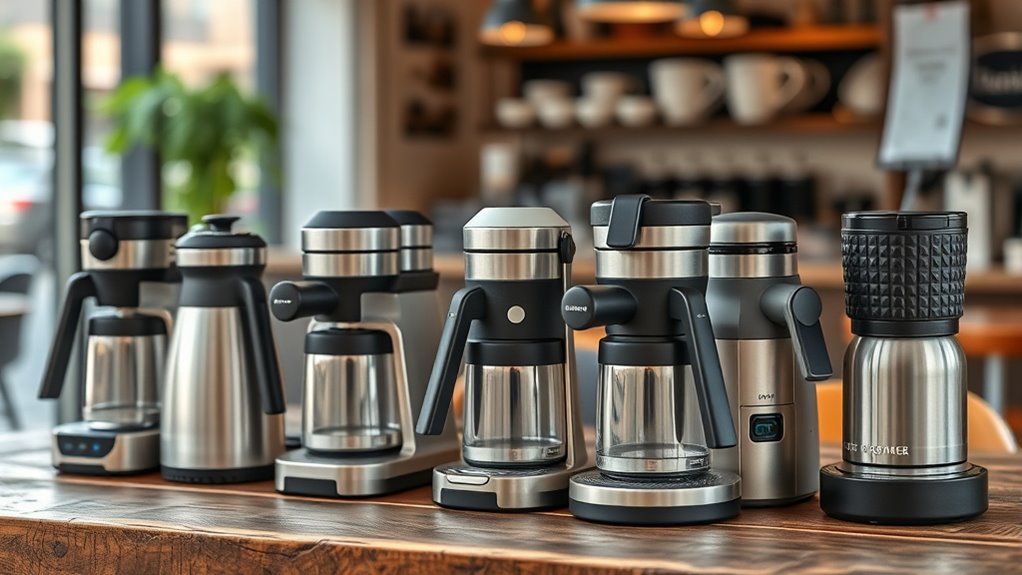

Among these portable espresso makers, I’d put the OutIn Nano first for travelers who want electric heating and a straightforward brewing routine. The WACACO Minipresso GR2 is a compelling manual pick for lighter packing, while the CERA+ PCM03S suits buyers who value a larger self-heating battery. The main choice is between manual models that need no charging and electric brewers that add heat and convenience but bring more weight and charging needs. Coffee format, cleanup, and how you’ll power the machine matter as much as pressure claims. Read on for how the 12 options compare and which one fits your trips.

Get the latest gadgets delivered free with Prime
- Fast, free delivery on millions of items
- Prime Video, Amazon Music and more included
- Member-only deals all year
Complete the kit


Key Takeaways
- Electric heating changes the travel routine: Models such as the OutIn Nano and CERA+ can heat water, while manual Minipresso makers depend on a separate hot-water source.
- Manual brewing favors simpler packing: The Minipresso GR2 and Minipresso GR avoid battery charging, but they ask you to supply hot water and operate the pump.
- Battery capacity is a practical differentiator: The CERA+ PCM03S and 13,500mAh generic model advertise larger batteries, which may suit longer stretches away from outlets, though actual brew counts depend on conditions.
- Coffee format can narrow the choice: Ground-coffee models offer more control over what you pack, while 2-in-1 or multi-format designs may suit travelers who value flexibility.
- Repeated OutIn Nano listings are not separate designs: The Nano appears multiple times in this lineup, so its presence should not be read as evidence of several distinct alternatives outperforming the rest.
| OutIn Mino Portable Self-Heating Espresso Machine |  | Best for Rugged Travel | Dimensions: 2.64 × 7.68 in | Weight: 685 g | Battery: 3000 mAh | VIEW ON AMAZON | See Our Full Breakdown |
| Loezora Portable Espresso Machine, 20 Bar |  | Best for Capsule Flexibility | Pressure: 20 bar | Battery: 7500 mAh rechargeable | Shots per charge: 6–8 | VIEW ON AMAZON | See Our Full Breakdown |
| OutIn Nano Portable Electric Espresso Machine, Travel Coffee Maker |  | Best Lightweight Pick | Weight: 670 g | Material: Food-grade stainless steel | Water heated: 1.7 oz | VIEW ON AMAZON | See Our Full Breakdown |
| CERA+ PCM03S Portable Espresso Machine with 13500mAh Self-Heating Battery |  | Best Battery Endurance | Battery: 3 × 4500 mAh (13,500 mAh) | Hot cups per charge: Up to 8 with cold water | Water capacity: 1.7 oz (50 ml) | VIEW ON AMAZON | See Our Full Breakdown |
| AMZCHEF Portable Coffee Maker – Rechargeable 2-in-1 Single Serve Espresso Brewer |  | Best for a Longer Single Brew | Water capacity: 2.7 oz | Brew size: 1.35 oz | Heating time: About 200 seconds for 2.7 oz from 77°F to 198°F | VIEW ON AMAZON | See Our Full Breakdown |
| OutIn Nano Portable Electric Espresso Machine, Travel Coffee Maker |  | Best for Simplicity | Weight: 670 g | Pressure: 20 bar | Water capacity: 1.7 oz | VIEW ON AMAZON | See Our Full Breakdown |
| Fanttik Cafein 11 Portable Espresso Maker, 20 Bar, USB-C |  | Best for Faster Cold-Water Brewing | Weight: 825 g | Pressure: 20 bar | Heating time: 135 seconds from room temperature to about 92°C | VIEW ON AMAZON | See Our Full Breakdown |
| Portable 3-in-1 Espresso Coffee Maker, 20-Bar Travel Machine with 7500mAh Battery |  | Best for Brewing Flexibility | Weight: 700 g | Pressure: 20 bar | Battery capacity: 7500mAh | VIEW ON AMAZON | See Our Full Breakdown |
| WACACO Minipresso GR2 Portable Espresso Maker for Ground Coffee, Gray Olive |  | Best Manual Pick | Weight: 285 g | Length: 12.5 cm | Operation: Manual, no electricity or battery | VIEW ON AMAZON | See Our Full Breakdown |
| Portable Espresso Maker – 13500mAh Self-Heating Electric Espresso Machine, 20 Bar |  | Best for Longer Trips | Weight: 906 g | Battery capacity: 13,500mAh | Pressure: 20 bar | VIEW ON AMAZON | See Our Full Breakdown |
| OutIn Nano Portable Electric Espresso Machine, Travel Coffee Maker |  | Best for Self-Heating Convenience | Weight: 670 grams | Material: Food-grade stainless steel | Heating: Heats 1.7 oz of water from 77°F to 198°F in 200 seconds | VIEW ON AMAZON | See Our Full Breakdown |
| Wacaco Minipresso GR Portable Manual Espresso Machine |  | Best for Battery-Free Simplicity | Operation: Manual | Coffee type: Ground coffee | Capacity: Up to 50 ml | VIEW ON AMAZON | See Our Full Breakdown |
| portable espresso maker | Pressure | Weight | Charging | Battery |
|---|---|---|---|---|
| OutIn Mino Portable Self-Heati | — | 685 g | USB-C; about 90 minutes for a full charge | 3000 mAh |
| Loezora Portable Espresso Mach | 20 bar | — | USB-C; full charge in about 3 hours | 7500 mAh rechargeable |
| OutIn Nano Portable Electric E | 20 bar | 670 g | — | 2500 mAh 3s lithium |
| CERA+ PCM03S Portable Espresso | 20 bar | — | 30W Type-C; about 1.5 hours for a full charge | 3 × 4500 mAh (13,500 mAh) |
| AMZCHEF Portable Coffee Maker | 20 bar | — | — | 9000 mAh rechargeable |
| OutIn Nano Portable Electric E | 20 bar | 670 g | USB-C, 10–15 W | — |
| Fanttik Cafein 11 Portable Esp | 20 bar | 825 g | 30 W USB-C | — |
| Portable 3-in-1 Espresso Coffe | 20 bar | 700 g | USB-C or 12V car adapter | — |
| WACACO Minipresso GR2 Portable | — | 285 g | — | — |
| Portable Espresso Maker | 20 bar | 906 g | — | — |
| OutIn Nano Portable Electric E | 20 bar | 670 grams | USB-C, 10–15W compatible | 2500mAh 3s lithium |
| Wacaco Minipresso GR Portable | — | — | — | — |
More Details on Our Top Picks
OutIn Mino Portable Self-Heating Espresso Machine
The OutIn Mino suits trips where dust, splashes, and pack space matter as much as the coffee. Its IP67 water and dust resistance gives it an advantage over the Loezora, which is rated IPX4 for splashes, while its 685 g weight keeps it practical to carry. It accepts both grounds and capsules, so you can choose your coffee supply instead of relying on one format. The tradeoff is serving size: its room-temperature water capacity is just 50 ml, and the battery makes up to six cups with cold water. The OutIn Nano is slightly lighter and also supports both inputs, but the Mino’s tougher resistance rating makes it the better fit for rougher outdoor use.
Pros:- IP67 water and dust resistance suits outdoor trips
- Accepts both ground coffee and capsules
- Compact 685 g body is easy to pack
- USB-C charging reaches 80% in about 45 minutes
Cons:- 50 ml room-temperature water serving makes a small drink
- Provides up to six cups per charge with room-temperature water
Best for: Campers and hikers who want a compact espresso maker with strong dust and water protection and flexible coffee inputs.
Not ideal for: People who want larger drinks or several cold-water brews between charges; its serving and battery capacity are limited.
- Dimensions:2.64 × 7.68 in
- Weight:685 g
- Battery:3000 mAh
- Coffee input:Capsules or ground coffee
- Charging:USB-C; about 90 minutes for a full charge
- Water and dust resistance:IP67
- Capacity per charge:Up to 6 cups with 50 ml room-temperature water
Our verdict“Choose the OutIn Mino for rugged trips where weather protection and flexible coffee inputs matter more than a larger serving.”
Loezora Portable Espresso Machine, 20 Bar
The Loezora Portable Espresso Machine stands out for carrying three coffee formats: Nespresso Original capsules, Dolce Gusto capsules, and ground coffee. That breadth makes it more adaptable to shared trips than the OutIn Nano, which supports grounds and capsules but does not list Dolce Gusto compatibility. Its fully automatic operation also simplifies brewing, though you still wait 2–3 minutes to heat water. The stainless steel body is described as having no plastic contact with coffee, but the listed materials also include food-grade ABS, so buyers should check which parts touch the brew if that distinction matters to them. Its IPX4 rating handles splashes, while the OutIn Mino’s IP67 rating is better suited to dustier or wetter outings.
Pros:- Compatible with Nespresso Original and Dolce Gusto capsules plus grounds
- Fully automatic operation reduces manual steps
- 7500 mAh battery is listed for 6–8 shots per charge
- Compact, leakproof design fits car cup holders
Cons:- Takes 2–3 minutes to heat water
- IPX4 splash resistance is less protective than the OutIn Mino’s IP67 rating
- Listed materials include food-grade ABS alongside stainless steel
Best for: Travelers who switch among Nespresso Original, Dolce Gusto, and ground coffee and want automatic operation.
Not ideal for: Hikers expecting heavy rain or dusty conditions, or buyers seeking a very fast cold-water brew.
- Pressure:20 bar
- Battery:7500 mAh rechargeable
- Shots per charge:6–8
- Heating time:2–3 minutes
- Coffee input:Nespresso Original capsules, Dolce Gusto capsules, or ground coffee
- Charging:USB-C; full charge in about 3 hours
- Water resistance:IPX4 splash-proof
- Operation:Fully automatic
Our verdict“Pick the Loezora if your travel group uses different capsule systems and you value automatic brewing over stronger weather protection.”
OutIn Nano Portable Electric Espresso Machine, Travel Coffee Maker
At 670 g, the OutIn Nano is the lightest clearly specified option in this group, making it a natural choice when every item in a day pack counts. It heats 1.7 oz of water to 198°F in 200 seconds and supports both ground coffee and capsules, giving it more input flexibility than the ground-only Wacaco Minipresso GR2. Compared with the CERA+ PCM03S, however, it has a smaller 2500 mAh battery and provides up to five hot shots per charge rather than up to eight. Its compact format also means a small brew, and cold-water heating takes several minutes before the 3–4 minute brew time. Choose it for portability; skip it if battery endurance or a larger drink matters more.
Pros:- Light 670 g body is easy to carry
- Works with ground coffee and capsules
- Heats 1.7 oz of room-temperature water to 198°F in 200 seconds
- USB-C charging supports compatible power sources
Cons:- Small 1.7 oz water capacity limits serving size
- Up to five hot shots per charge is less than the CERA+ PCM03S listing
- Heating and brewing take several minutes
Best for: Solo travelers and day hikers who prioritize low carry weight and want the choice of capsules or ground coffee.
Not ideal for: People making several hot drinks between charges or seeking a larger serving than 1.7 oz.
- Weight:670 g
- Material:Food-grade stainless steel
- Water heated:1.7 oz
- Heating:77°F to 198°F in 200 seconds
- Pressure:20 bar
- Battery:2500 mAh 3s lithium
- Capacity per charge:Up to 5 hot shots
- Coffee input:Ground coffee or capsules
Our verdict“Choose the OutIn Nano when minimizing carry weight matters more than serving size or battery capacity.”
CERA+ PCM03S Portable Espresso Machine with 13500mAh Self-Heating Battery
The CERA+ PCM03S is the battery-focused choice here: its 13,500 mAh pack is listed for up to eight hot cups using cold water, more than the OutIn Nano’s five hot shots. It also heats 1.7 oz from 77°F to 198°F in 140 seconds, which is faster than the Nano’s stated 200 seconds for the same water amount. Both models accept pods and ground coffee, so the deciding difference is battery capacity and heating time. The CERA+ still makes a small 50 ml serving, and its larger battery may mean more to carry; the product data does not give a weight for comparison. It is best for repeated stops where outlet access is limited, rather than for buyers focused on the lightest pack.
Pros:- 13,500 mAh battery is listed for up to 8 hot cups per charge
- Heats 50 ml of cold water in 140 seconds
- Accepts NS-compatible pods and ground coffee
- One-button operation works without an app or external power
Cons:- 50 ml water capacity limits serving size
- Battery weight is not provided, making pack-weight comparison difficult
- Battery durability over extended heavy use is not specified
Best for: Road trippers and campers who expect to make multiple hot espresso servings between charges.
Not ideal for: Minimalist hikers who prioritize low pack weight or anyone wanting a larger drink from one brew.
- Battery:3 × 4500 mAh (13,500 mAh)
- Hot cups per charge:Up to 8 with cold water
- Water capacity:1.7 oz (50 ml)
- Heating time:140 seconds from 77°F to 198°F
- Pressure:20 bar
- Coffee input:NS-compatible pods or ground coffee
- Charging:30W Type-C; about 1.5 hours for a full charge
- Connectivity:None; no app required
Our verdict“Choose the CERA+ PCM03S for more hot brews between charges, provided its small serving size suits your routine.”
AMZCHEF Portable Coffee Maker – Rechargeable 2-in-1 Single Serve Espresso Brewer
The AMZCHEF gives you more water per cycle than the OutIn Nano or CERA+ PCM03S: its 2.7 oz capacity is paired with a stated 1.35 oz brew size. That makes it the more fitting pick if you want a longer single serving, though it still brews one at a time. Its LCD shows battery level and water temperature, useful when you are away from a kitchen, and the 9000 mAh battery is listed for six or more self-heated brews. The tradeoff is a roughly 200-second heat-up, similar to the Nano, and the listed output remains modest. Like those OutIn and CERA+ models, it accepts grounds and NS capsules, but its display makes brewing status easier to track.
Pros:- 2.7 oz water capacity supports a stated 1.35 oz brew size
- Works with ground coffee and NS capsules
- LCD displays battery level and water temperature
- 9000 mAh battery is listed for 6+ self-heated brews
Cons:- Takes about 200 seconds to heat 2.7 oz of room-temperature water
- 1.35 oz brew size remains small
- Single-serve design requires another cycle for another drink
Best for: Commuters and RV travelers who want a somewhat larger single serving and a display for battery and water temperature.
Not ideal for: Buyers who want a full-size coffee, very fast cold-water heating, or a machine for multiple servings at once.
- Water capacity:2.7 oz
- Brew size:1.35 oz
- Heating time:About 200 seconds for 2.7 oz from 77°F to 198°F
- Battery:9000 mAh rechargeable
- Brews per charge:6+ self-heated brews
- Pressure:20 bar
- Coffee input:Ground coffee or NS capsules
- Display:LCD for battery level and water temperature
Our verdict“Choose the AMZCHEF if you want a longer single serving and useful status information in a portable brewer.”
OutIn Nano Portable Electric Espresso Machine, Travel Coffee Maker
The OutIn Nano suits travelers who want self-heated espresso without a complicated setup. It handles grounds or capsules with one button, and its 670 g weight is lighter than the Fanttik Cafein 11. From room temperature, it heats a small water dose to 198°F in under 200 seconds, so you can brew without a kettle, though each cycle makes only 1.7 oz. The Nano’s five hot shots per charge with cold water offer less battery capacity than the Fanttik’s stated eight, while its dual input gives it more flexibility than a grounds-only manual brewer such as the WACACO Minipresso GR2. Choose it for straightforward, compact convenience; skip it if you need larger servings or frequent cold-water brewing away from a charger.
Pros:- Light 670 g body is easy to pack
- Brews ground coffee and capsules
- Self-heats water without a separate kettle
- One-button operation keeps brewing simple
Cons:- The 1.7 oz water capacity limits each serving
- Cold-water brewing yields up to five hot shots per charge
- Flying with it requires carry-on luggage
Best for: Travelers who want a light, one-button machine that can brew either ground coffee or capsules.
Not ideal for: Frequent espresso drinkers who need multiple cold-water brews between charges or larger servings per cycle.
- Weight:670 g
- Pressure:20 bar
- Water capacity:1.7 oz
- Heating time:Under 200 seconds to 198°F
- Coffee compatibility:Ground coffee and capsules
- Shots per charge:Up to 5 hot shots with cold water
- Charging:USB-C, 10–15 W
- Warranty:12 months
Our verdict“Pick the OutIn Nano for simple, light travel brewing with grounds or capsules, provided its small serving and limited cold-water shot count suit your routine.”
Fanttik Cafein 11 Portable Espresso Maker, 20 Bar, USB-C
For travelers who want hot espresso without packing a kettle, the Fanttik Cafein 11 combines self-heating with a relatively quick 135-second heat-up from room temperature. That is faster than the OutIn Nano’s stated heating time, and the Fanttik claims up to eight room-temperature-water shots per charge compared with the Nano’s five. It also supports charging while brewing, which can help when an outlet is available. At 825 g, it weighs more than the Nano, and its capsule support is limited to Nespresso Original; the Nano offers broader capsule compatibility as described in its product data. Grounds remain an option, so capsule limits matter mainly to buyers who rely on pods. Its 20-bar pressure and brief pre-soak add brewing steps, but water temperature still shapes the claimed shot count.
Pros:- Heats room-temperature water in about 135 seconds
- Supports grounds and Nespresso Original capsules
- Can charge while brewing
- Eight-second pre-soak and 20-bar pressure
Cons:- Capsule compatibility is limited to Nespresso Original
- Weighs more than the OutIn Nano
- Claimed shots per charge vary with starting water temperature
Best for: Campers and commuters who want self-heating espresso, a quicker stated warm-up, and the option to brew grounds.
Not ideal for: Pod users with capsules outside the Nespresso Original format, or packers prioritizing the lightest electric brewer.
- Weight:825 g
- Pressure:20 bar
- Heating time:135 seconds from room temperature to about 92°C
- Coffee compatibility:Ground coffee and Nespresso Original capsules
- Shots per charge:About 8 with room-temperature water; up to 500 with hot water
- Charging:30 W USB-C
- Pre-soak:8 seconds
- Material:Food-grade stainless steel
Our verdict“Choose the Fanttik Cafein 11 if quicker self-heating and charging during brewing matter more than minimum weight or broad capsule choice.”
Portable 3-in-1 Espresso Coffee Maker, 20-Bar Travel Machine with 7500mAh Battery
The 3-in-1 Portable Espresso Maker stands out for accepting ground coffee, Nespresso-style capsules, and Dolce Gusto-style pods. That broader input choice is useful for households or trips where coffee preferences vary; the OutIn Nano handles grounds and capsules, while this model adds a third format. Its 700 g weight keeps it close to the Nano, and USB-C or 12V car charging suits road trips. The tradeoff is a slower cold-water routine: self-heating takes about five minutes, versus the Fanttik Cafein 11’s stated 135 seconds. The 7500mAh battery is listed for up to four cold-water cups per charge, so its 50-plus figure applies to preheated water. Pick this for format flexibility and car use; skip it if quick cold-water brewing is the priority.
Pros:- Accepts grounds and two named pod styles
- USB-C and 12V car adapter charging options
- 700 g body fits a backpack or car cup holder
- 7500mAh battery supports up to four cold-water cups per charge
Cons:- Cold-water heating takes about five minutes
- Capsule support is limited to Nespresso-style and Dolce Gusto-style pods
- The 50-plus cup claim depends on using preheated water
Best for: Road trippers or shared-use buyers who want one compact brewer for grounds, Nespresso-style capsules, and Dolce Gusto-style pods.
Not ideal for: Hikers seeking the fastest cold-water brew or users who need capsule formats beyond those specified.
- Weight:700 g
- Pressure:20 bar
- Battery capacity:7500mAh
- Cups per charge:Up to 4 with cold water; 50+ with preheated water
- Heating time:About 5 minutes
- Compatibility:Ground coffee, Nespresso-style capsules, Dolce Gusto-style pods
- Charging:USB-C or 12V car adapter
- Materials:Food-grade ABS and stainless steel
Our verdict“Choose this model for varied coffee formats and car-friendly charging, if you can wait longer when starting with cold water.”
WACACO Minipresso GR2 Portable Espresso Maker for Ground Coffee, Gray Olive
The WACACO Minipresso GR2 is the choice here for travelers who want to leave batteries and charging cables behind. Its manual pump needs no electricity, making it a simpler companion off-grid than the self-heating OutIn Nano or Fanttik Cafein 11. That independence comes with a catch: you must bring hot water and a way to heat it. At 285 g and 12.5 cm long, it is also far lighter and shorter than those electric models, but it brews only a single espresso, up to 60 ml. The adjustable 8–12 g basket lets users tune the coffee dose, while the 80 ml tank sets a clear ceiling on output. Choose the GR2 for compact, battery-free brewing; pass if self-heating or capsule convenience matters more.
Pros:- Manual operation needs no battery or electricity
- At 285 g and 12.5 cm, it is smaller and lighter than the electric picks
- Adjustable basket holds 8–12 g of coffee
- Uses ground or pre-ground coffee
Cons:- Requires a separate source of hot water
- Produces only a single espresso of up to 60 ml
- Does not brew capsules
Best for: Backpackers and campers who already carry a way to heat water and prefer a light, battery-free brewer for single espressos.
Not ideal for: Travelers who want self-heating, capsule brewing, or several servings without refilling and repacking coffee.
- Weight:285 g
- Length:12.5 cm
- Operation:Manual, no electricity or battery
- Maximum pressure:18 bar
- Water tank capacity:80 ml
- Espresso yield:Up to 60 ml
- Basket capacity:8–12 g
- Outer shell:Wheat-composed polymers with 20% biomass
Our verdict“Pick the Minipresso GR2 for the smallest, battery-free setup if you can supply hot water and only need single espressos.”
Portable Espresso Maker – 13500mAh Self-Heating Electric Espresso Machine, 20 Bar
With a 13,500mAh battery, this self-heating brewer is built for buyers who want more cold-water cycles between charges than the OutIn Nano’s stated five. It claims about eight shots from room-temperature water, tying the Fanttik Cafein 11 on that measure, while its battery capacity exceeds the Fanttik’s listed specs. That makes it a practical fit for longer trips when charging is inconvenient. The tradeoff is weight: at 906 g, it is the heaviest of these electric options. Its 1.7 oz brew size also keeps each serving small, and the up-to-500-shot claim applies to hot water, not cold starts. Grounds and NS capsules give it two brewing paths, but the WACACO Minipresso GR2 is much lighter for buyers willing to supply hot water themselves.
Pros:- 13,500mAh rechargeable battery
- Heats room-temperature water without a separate kettle
- Works with ground coffee and NS capsules
- USB-C charging
Cons:- At 906 g, it is heavier than the other electric models in this batch
- Room-temperature water yields about eight shots per charge
- Each brew uses only 1.7 oz of water
Best for: Travelers or campers who want a large battery and self-heating for repeated small servings away from regular charging.
Not ideal for: Ultralight packers, or people who need larger servings per brew than 1.7 oz.
- Weight:906 g
- Battery capacity:13,500mAh
- Pressure:20 bar
- Wattage:150 W
- Heating:Heats 1.7 oz from 77°F to 198°F in under 3 minutes
- Shots per charge:About 8 with room-temperature water; up to 500 with hot water
- Coffee compatibility:Ground coffee and NS capsules
- Materials:Aluminum and stainless steel
Our verdict“Choose this machine for a large battery and self-heating on longer trips, if its weight and small brew size fit your packing plans.”
OutIn Nano Portable Electric Espresso Machine, Travel Coffee Maker
The OutIn Nano suits travelers who want espresso without packing a kettle: it heats water inside the machine and works with ground coffee or capsules. Its 670-gram weight and USB-C charging make it easier to carry than a countertop brewer, while one-button operation keeps preparation simple. Compared with the manual Wacaco Minipresso GR, the Nano adds on-board heating but depends on a charged battery. It can heat 1.7 ounces of water to 198°F in about 200 seconds, so its output is a compact espresso serving rather than a larger coffee. A full charge supports up to five hot-water shots from cold; using already-hot water can extend shot count substantially. Choose it for power-free access to hot water on the go, and skip it if you want larger servings or no battery upkeep.
Pros:- Heats water onboard, so a separate kettle is unnecessary
- Accepts both ground coffee and capsules
- Light 670-gram build and USB-C charging suit travel
- Up to five hot-water shots per charge when starting with cold water
Cons:- Heats only 1.7 ounces of water per preparation
- Cold-water brewing is limited to about five shots per charge
- Requires charging and access to a compatible USB-C power source
Best for: Travelers and commuters who want a self-heating espresso maker with both capsule and ground-coffee options
Not ideal for: People making several cold-water shots between charges or seeking more than a compact espresso serving per brew
- Weight:670 grams
- Material:Food-grade stainless steel
- Heating:Heats 1.7 oz of water from 77°F to 198°F in 200 seconds
- Pressure:20 bar
- Battery:2500mAh 3s lithium
- Charging:USB-C, 10–15W compatible
- Coffee compatibility:Ground coffee and capsules
- Shots per charge:Up to 5 hot shots with cold water, or 200+ shots with hot water
- Warranty:12 months
Our verdict“Pick the OutIn Nano if you want a portable machine that heats its own water and accepts either capsules or grounds.”
Wacaco Minipresso GR Portable Manual Espresso Machine
The Wacaco Minipresso GR is a straightforward choice for people who already have access to hot water and want to leave batteries behind. It uses ground coffee and manual pumping, producing up to 50 ml per preparation without electricity. That makes it simpler to keep ready than the self-heating OutIn Nano, which can heat water on its own but needs charging. The tradeoff is that the Minipresso cannot heat water, so a kettle or thermos becomes part of the travel setup. Its 50 ml capacity also favors a small espresso serving; anyone wanting a larger drink will need another brew or a different format. This model makes sense for hikers, campers, and travelers who value mechanical simplicity over all-in-one convenience, but less so for people who want coffee with minimal preparation.
Pros:- Works without batteries or an electrical connection
- Uses ground coffee, allowing a choice of coffee type
- Manual pumping keeps the brewing mechanism simple
- Makes up to 50 ml per preparation
Cons:- Requires hot water prepared separately
- Accessories are sold separately
- Limited to a 50 ml preparation
Best for: Campers and travelers who carry hot water and prefer a compact, battery-free brewer for ground coffee
Not ideal for: Commuters or road travelers who need the machine to heat water, or buyers seeking larger servings
- Operation:Manual
- Coffee type:Ground coffee
- Capacity:Up to 50 ml
- Power source:None required
- Water requirement:Add hot water
Our verdict“Choose the Minipresso GR if you can bring hot water and want a manual espresso maker without charging needs.”

How We Picked
I ranked these makers by how well their design answers the practical needs of portable espresso: brewing away from a kitchen, managing water temperature, carrying and charging the device, and cleaning it between uses. I gave weight to the difference between a manual pump and a self-heating electric brewer because they solve different travel problems. Coffee compatibility, stated battery capacity, and the number of steps needed to make a cup also informed the order.
The OutIn Nano leads as a balanced electric option for buyers who want integrated heating; the Minipresso GR2 ranks as a strong manual alternative for people who prioritize independence from batteries. Larger-battery electric models follow for travelers who value longer use between charges, while multi-format brewers earn a place for flexibility. I treat pressure figures and battery claims as specifications rather than guarantees of cup quality or real-world runtime. The lineup includes repeated OutIn Nano entries, which I treat as the same model rather than distinct picks.
Factors to Consider When Choosing Portable Espresso Makers
Before choosing a portable espresso maker, I’d start with the conditions where you plan to brew. A machine for a car trip with access to hot water has different demands from one used on a trail or during a hotel stay. These broader tradeoffs can help you avoid carrying features you won’t use.
Decide Where the Hot Water Comes From
A self-heating machine can simplify brewing when you have cold water and no kettle, but it shifts the work to the battery. A manual brewer can be lighter and ready without charging, provided you can get hot water before you start. A common mistake is choosing by pressure rating while overlooking this basic dependency. For camping, check whether your stove or campsite routine already covers water heating. For a commute or hotel room, integrated heating may save an extra step. Match the machine to your water source first, then compare brewing features.
Think About Charging, Not Just Battery Size
Battery capacity gives a rough indication of stored energy, but it does not tell you exactly how many drinks you’ll make. Heating colder water uses more power, and charging access varies between a road trip, a campsite, and an airport lounge. USB-C can make charging more convenient when it matches the cables and power bank you already carry. Check the maker’s charging guidance and whether brewing is possible while plugged in. If you travel without reliable power, a manual pump avoids that dependency entirely. Choose based on your charging routine, not the largest number on a product page.
Choose a Coffee Format You’ll Keep Using
Ground coffee lets you select a roast and grind, but it also means packing grounds and managing loose coffee after brewing. Capsule-compatible or multi-format machines can reduce preparation at the cost of carrying the right capsules or additional parts. Check which formats are supported directly; a product described as versatile may still require a specific basket or adapter. Think through where you’ll store coffee, how you’ll dispose of used grounds, and whether you want to bring a grinder. Travelers who value a familiar routine may prefer fewer compatible formats and fewer pieces to track. Flexibility is useful only when you plan to use it.
Measure the Whole Travel Kit
The brewer is only part of the load: water, coffee, a charging cable, and cleaning supplies may all travel with it. Compare the packed dimensions and weight of the complete setup, especially if you carry it in a small daypack. A compact manual maker can still be inconvenient if it requires a separate thermos or several loose components. Conversely, a heavier electric brewer may replace gear you would otherwise bring. Check whether the cup or accessories are included and how securely small parts store. The best fit depends on the kit you actually carry.
Plan for Cleaning Away From a Sink
Espresso leaves wet grounds and residue, so cleaning affects whether a portable brewer stays practical after the first cup. Look for parts that can be rinsed or separated without special tools, and consider where you’ll discard grounds when traveling. A machine with several baskets or attachments may support more brewing choices but adds pieces to wash and keep together. If you’ll brew in a car or at a desk, a simple cleanup routine can matter more than extra modes. Check the care instructions before buying, particularly for battery-powered models. A design that is easy to clean is more likely to fit frequent travel.
Frequently Asked Questions
Should I choose a self-heating portable espresso maker or a manual one?
I’d choose self-heating when you often have water but no way to heat it, and manual when you can bring hot water and want to avoid charging. Electric models combine more steps into one device, but heating draws on the battery and can make the brewer bulkier. Manual options shift the burden to a kettle, stove, or thermos. Consider your usual stop, not just your most adventurous trip. That will tell you which tradeoff you’ll face most often.
Can a portable espresso maker make coffee without hot water?
Only a model with a self-heating function can heat water itself; a manual pump maker generally needs hot water supplied separately. Some electric models can also extract with water you have already heated, depending on their instructions. Check the product’s operating directions for its supported water temperature and heating method. Don’t assume that a high pressure figure means the machine heats water. Water temperature and extraction pressure are separate parts of the brewing process.
Are portable espresso makers that claim 20 bar automatically better?
No. A stated pressure figure describes one part of the machine’s design, but it does not by itself establish the taste or consistency of the espresso. Coffee dose, grind, water temperature, and how evenly the water passes through the grounds also affect the cup. Compare brewing controls and coffee compatibility alongside pressure. A simpler model that fits your routine may be a better travel choice than one with a bigger specification. Treat the figure as one data point rather than a ranking on its own.
How should I choose between the OutIn Nano and WACACO Minipresso GR2?
I’d favor the OutIn Nano if integrated electric heating is the feature that makes travel brewing workable for you. The Minipresso GR2 makes more sense if you can supply hot water and would rather avoid battery charging. That choice also changes what you pack: the Nano needs charging access, while the manual brewer may call for a thermos or separate heater. Both approaches ask you to manage coffee and cleanup on the go. Decide which added item is easier to accommodate on your trips.
Is a larger battery worth choosing for travel?
A larger battery can be appealing when you plan to make multiple drinks or spend time away from outlets, but advertised capacity alone does not establish the number of brews you’ll get. Water temperature, serving frequency, and charging habits all affect how useful that capacity is. For trips with a power bank or regular charging stops, a smaller battery may be enough. For remote travel, compare the machine’s charging method with the gear you already own. If you cannot rely on charging at all, a manual brewer avoids the battery question.
Conclusion
For most travelers who want an electric brewer with integrated heating, I’d start with the OutIn Nano as the best overall fit in this lineup. The Minipresso GR2 is my best value in practical simplicity for buyers who already have hot water, and its manual operation also makes it a natural pick for beginners who prefer fewer power requirements. For a battery-focused premium choice, compare the CERA+ PCM03S with the 13,500mAh portable model and weigh their charging needs against your trip length. Choose the AMZCHEF 2-in-1 or the multi-format brewer if compatibility matters more than keeping the setup minimal. If avoiding batteries is your specific priority, the Minipresso GR keeps the decision straightforward: bring hot water, ground coffee, and a willingness to pump.