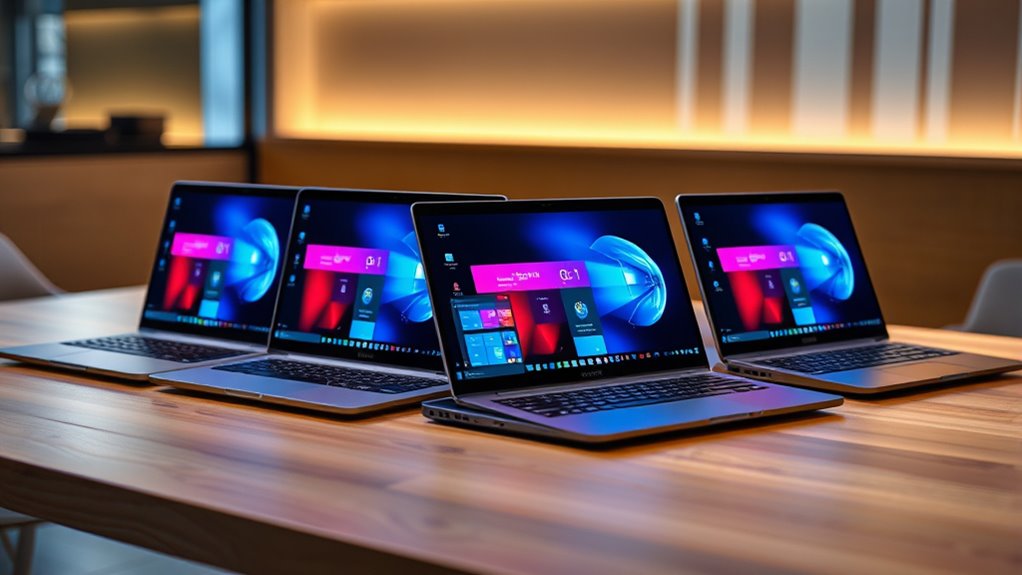

For most buyers seeking an ARM-based Windows laptop, I rank the Lenovo Yoga Slim 7X first. Its Snapdragon X Elite processor, 3K OLED touch display, 1TB SSD, and 2.82-pound build create the strongest balance of speed, screen quality, storage, and portability in this group. The Microsoft Surface Laptop 2024 is my compact alternative, pairing a smaller 13.8-inch touchscreen with up to 20 hours of claimed battery life, though its 256GB SSD is restrictive. Buyers wanting more screen and storage should examine the Lenovo IdeaPad Slim 3X, which supplies a 15.3-inch touchscreen and 1TB SSD without pushing into creator-focused display territory.

Get the latest gadgets delivered free with Prime
- Fast, free delivery on millions of items
- Prime Video, Amazon Music and more included
- Member-only deals all year
The main choice is not simply between five sizes. It is between premium Snapdragon X Elite performance, larger everyday workspaces, storage capacity, and Windows editions. ARM-based Windows machines can offer responsive everyday computing and long battery claims, but some older applications, games, drivers, and accessories may still favor x86 hardware. I rank these models by how well their complete configurations support real buyer needs, not by processor branding alone.
Complete the kit


Key Takeaways
- I rank the Lenovo Yoga Slim 7X first because it combines Snapdragon X Elite performance, a 3K OLED touchscreen, 1TB of storage, and the lowest stated weight.
- The Surface Laptop 2024 is the better compact pick, but its 256GB SSD is far less accommodating than either Lenovo model’s 1TB drive.
- The IdeaPad Slim 3X makes more sense for buyers who prefer a large touchscreen, ample local storage, and practical security features over an OLED panel.
- The two HP OmniBook 3 configurations share the same core hardware; Windows 11 Pro is the meaningful reason to select the higher-ranked business version.
- Every model uses integrated Qualcomm graphics, so I would choose these laptops for productivity, media, and mobility rather than demanding gaming or GPU-heavy production.
| Lenovo Yoga Slim 7X with Snapdragon X Elite |  | Best Overall | Display: 14.5-inch 3K OLED touch, HDR 600, Dolby Vision | Processor: Snapdragon X Elite X1E-78-100 | RAM: 16GB | VIEW ON AMAZON | See Our Full Breakdown |
| Microsoft Surface Laptop 2024 with 13.8-Inch Touchscreen |  | Best Compact | Display: 13.8-inch HDR touchscreen | Processor: 12-core Snapdragon X Elite | RAM: 16GB | VIEW ON AMAZON | See Our Full Breakdown |
| Lenovo IdeaPad Slim 3X 15.3-Inch Touchscreen Laptop |  | Best for Storage and Everyday Touch Use | Display: 15.3-inch WUXGA IPS anti-glare touchscreen | Resolution: 1920 x 1200 at 60Hz | Processor: Qualcomm Snapdragon X at up to 2.97GHz | VIEW ON AMAZON | See Our Full Breakdown |
| HP OmniBook 3 16-Inch Laptop with Windows 11 Pro |  | Best for Windows 11 Pro Buyers | Display: 16-inch WUXGA, 1920 x 1200 | Processor: Qualcomm Snapdragon X1-26-100 | RAM: 16GB DDR5 | VIEW ON AMAZON | See Our Full Breakdown |
| HP OmniBook 3 16-Inch Laptop with Windows 11 Home | | Best Straightforward 16-Inch Option | Display: 16-inch WUXGA, 1920 x 1200 | Aspect Ratio: 16:10 | Processor: Qualcomm Snapdragon X1-26-100 | VIEW ON AMAZON | See Our Full Breakdown |
| arm windows laptop | Display | Processor | RAM | Storage |
|---|---|---|---|---|
| Lenovo Yoga Slim 7X with Snapd | 14.5-inch 3K OLED touch, HDR 600, Dolby Vision | Snapdragon X Elite X1E-78-100 | 16GB | 1TB SSD |
| Microsoft Surface Laptop 2024 | 13.8-inch HDR touchscreen | 12-core Snapdragon X Elite | 16GB | 256GB SSD |
| Lenovo IdeaPad Slim 3X 15.3-In | 15.3-inch WUXGA IPS anti-glare touchscreen | Qualcomm Snapdragon X at up to 2.97GHz | 16GB LPDDR5X | 1TB SSD |
| HP OmniBook 3 16-Inch Laptop w | 16-inch WUXGA, 1920 x 1200 | Qualcomm Snapdragon X1-26-100 | 16GB DDR5 | 512GB SSD |
| HP OmniBook 3 16-Inch Laptop w | 16-inch WUXGA, 1920 x 1200 | Qualcomm Snapdragon X1-26-100 | 16GB DDR5 | 512GB SSD |
More Details on Our Top Picks
Lenovo Yoga Slim 7X with Snapdragon X Elite
The Lenovo Yoga Slim 7X takes my top position because it has the fewest major compromises for a buyer committed to an ARM-based Windows laptop. Its Snapdragon X Elite X1E-78-100 processor is paired with 16GB of RAM and a roomy 1TB SSD, while the 14.5-inch 3K OLED touchscreen offers a sharper, richer viewing experience than the WUXGA IPS panels on the IdeaPad and HP models. At 2.82 pounds, it is also easier to carry than its screen size might suggest.
Compared with the Surface Laptop, the Yoga supplies twice the visual ambition and four times the listed storage, making it better suited to mobile creators and buyers who retain substantial files locally. The Surface remains more appealing when a smaller footprint is the priority. The Yoga’s drawbacks center on expansion and cost positioning: its three ports are all USB-C, so existing USB-A devices need an adapter or dock, and a premium OLED build is unlikely to suit a tightly limited budget. Its up to 23.5-hour video-playback claim is encouraging, but mixed daily work will produce a different result. I would also steer serious gamers toward a machine with discrete graphics.
Pros:- 3K OLED touchscreen with HDR 600 and Dolby Vision
- Snapdragon X Elite processor paired with 16GB RAM
- 1TB SSD offers ample room for local files
- 2.82-pound build with published durability credentials
Cons:- USB-C-only port selection may require adapters
- Integrated graphics are a poor match for demanding games
- Premium display and construction may carry a higher price
Best for: I recommend it for mobile professionals and creators who want the strongest blend of display quality, Snapdragon X Elite performance, storage, and low weight.
Not ideal for: I would skip it if legacy USB-A connectivity, demanding gaming, or the lowest possible purchase price matters more than OLED quality.
- Display:14.5-inch 3K OLED touch, HDR 600, Dolby Vision
- Processor:Snapdragon X Elite X1E-78-100
- RAM:16GB
- Storage:1TB SSD
- Battery Claim:Up to 23.5 hours of video playback
- Weight:2.82 pounds
- Ports:3 USB-C ports with USB4
- Durability:Passed 21 MIL-STD-810H tests
Our verdict“This is my leading ARM-based Windows pick for buyers who want premium performance, an exceptional screen, useful storage, and travel-friendly weight in one machine.”
Microsoft Surface Laptop 2024 with 13.8-Inch Touchscreen
The Microsoft Surface Laptop 2024 earns second place by offering a focused combination of portability, touch input, and Snapdragon X Elite performance. Its 13.8-inch display gives it a smaller working area than every other model here, but that is also its purpose: this pick makes the most sense for commuters, students, and professionals who value a compact daily machine. The 12-core Snapdragon X Elite and 16GB of RAM provide a stronger performance foundation than the standard Snapdragon X configurations in the IdeaPad and OmniBook models.
The Surface competes most closely with the Yoga Slim 7X. I place it below Lenovo because the 256GB SSD is a real constraint at this level, especially beside the Yoga’s 1TB drive. Cloud-based work can reduce that pressure, but large media libraries and offline project folders will fill the drive quickly. Its up to 20-hour battery claim strengthens its mobility case, while the bright HDR touchscreen supports comfortable everyday work. Buyers paying mainly for screen richness or local capacity receive more from the Yoga; buyers who want a clean, smaller Copilot+ PC may prefer the Surface.
Pros:- Compact 13.8-inch touchscreen design
- 12-core Snapdragon X Elite processor
- Up to 20 hours of claimed battery life
- 16GB RAM supports everyday multitasking
Cons:- 256GB SSD is the smallest storage allocation in the lineup
- Premium positioning may deter budget-focused buyers
- Smaller display offers less room for dense multitasking
Best for: I recommend it for commuters and cloud-based productivity users who want Snapdragon X Elite power in a smaller touchscreen laptop.
Not ideal for: I would not choose it for buyers who keep large photo, video, game, or project libraries on the internal drive.
- Display:13.8-inch HDR touchscreen
- Processor:12-core Snapdragon X Elite
- RAM:16GB
- Storage:256GB SSD
- Operating System:Windows 11 Copilot+
- Battery Claim:Up to 20 hours
Our verdict“I recommend this ARM-based Windows laptop for compact, cloud-centered work, provided the limited 256GB SSD fits the buyer’s file habits.”
Lenovo IdeaPad Slim 3X 15.3-Inch Touchscreen Laptop
I rank the Lenovo IdeaPad Slim 3X third because it packages the lineup’s practical sweet spots into a larger everyday format. The 15.3-inch WUXGA IPS touchscreen offers more working room than the Yoga or Surface, and the 1TB SSD matches the Yoga while far exceeding both HP models and the Surface. Wi-Fi 7, a fingerprint reader, a webcam shutter, and a backlit keyboard add everyday convenience that matters beyond raw benchmark potential.
This model is not a lower-cost version of the Yoga in every respect. Its standard Snapdragon X processor sits below the Yoga’s X Elite tier, its 60Hz IPS screen cannot reproduce the same contrast or motion character as the Yoga’s 3K OLED panel, and its integrated Adreno graphics remain aimed at ordinary productivity rather than heavy gaming. Against the 16-inch OmniBooks, however, the IdeaPad offers touch input, double the storage, newer wireless specifications, and more clearly described security features. I see it as the balanced option for home offices, schoolwork, browsing, and document-heavy users who want a large touch display without paying primarily for creator-grade visuals.
Pros:- 15.3-inch WUXGA anti-glare touchscreen
- 1TB SSD provides generous local storage
- Wi-Fi 7, fingerprint reader, and webcam privacy shutter
- 16GB LPDDR5X memory and 60Wh battery
Cons:- Standard Snapdragon X trails the X Elite models
- 60Hz IPS display is less ambitious than the Yoga’s OLED panel
- Integrated graphics limit demanding gaming and GPU work
Best for: I recommend it for home, school, and office buyers who want a roomy touchscreen, 1TB of storage, and useful security hardware.
Not ideal for: I would skip it for buyers seeking X Elite performance, high-refresh gaming, OLED contrast, or dedicated graphics.
- Display:15.3-inch WUXGA IPS anti-glare touchscreen
- Resolution:1920 x 1200 at 60Hz
- Processor:Qualcomm Snapdragon X at up to 2.97GHz
- RAM:16GB LPDDR5X
- Storage:1TB SSD
- Battery:60Wh, claimed all-day life
- Wireless:Wi-Fi 7 and Bluetooth 5.4
- Security:Fingerprint reader and webcam privacy shutter
- Graphics:Integrated Qualcomm Adreno GPU
Our verdict“This ARM-based Windows model is my practical large-screen choice for buyers whose priorities are touch control, 1TB storage, and everyday productivity.”
HP OmniBook 3 16-Inch Laptop with Windows 11 Pro
The HP OmniBook 3 with Windows 11 Pro occupies a narrow but clear place in my ranking. It combines a spacious 16-inch, 1920-by-1200 display with a Snapdragon X1-26-100 processor, 16GB of DDR5 memory, and a 512GB SSD. That configuration is suitable for browser-based work, office documents, video meetings, and side-by-side windows. The bundled USB 3.0 hub expands connectivity, which is useful for a desk-based setup with several conventional peripherals.
Its main comparison is the nearly identical Windows 11 Home OmniBook. I rank this version higher only for buyers who specifically need Windows 11 Pro for an employer or managed professional workflow; otherwise, their processor, memory, storage, display, and graphics are effectively the same on the supplied specifications. Both HP models lack a stated battery figure, have no touchscreen listed, and use integrated Adreno graphics. Compared with the IdeaPad Slim 3X, this OmniBook gives up touch capability, modern wireless details, and half the storage. It earns its place through the large display, Pro edition, and included hub rather than category-leading hardware.
Pros:- Large 16-inch WUXGA display with a 16:10 shape
- Windows 11 Pro suits buyers with a specific Pro requirement
- 16GB DDR5 memory and 512GB SSD
- USB 3.0 hub is included
Cons:- No stated battery-life figure
- ARM architecture may conflict with some older software or peripherals
- Integrated graphics are unsuitable for intensive gaming
Best for: I recommend it for desk-based professionals who need Windows 11 Pro, a 16-inch workspace, and a bundled hub.
Not ideal for: I would skip it if touch input, a published battery claim, 1TB storage, or demanding graphics performance is required.
- Display:16-inch WUXGA, 1920 x 1200
- Processor:Qualcomm Snapdragon X1-26-100
- RAM:16GB DDR5
- Storage:512GB SSD
- Graphics:Integrated Qualcomm Adreno GPU
- Operating System:Windows 11 Pro
- Included Accessory:USB 3.0 hub
Our verdict“I would choose this ARM-based Windows laptop over the Home version only when Windows 11 Pro directly supports the buyer’s work requirements.”
HP OmniBook 3 16-Inch Laptop with Windows 11 Home
I place the Windows 11 Home HP OmniBook 3 fifth, although it remains a sensible option for a specific buyer. Its 16-inch WUXGA display provides the largest listed diagonal here, tied with the Pro configuration, and the 16:10 aspect ratio creates more vertical room than a conventional widescreen panel. With 16GB of DDR5 RAM and a 512GB SSD, it has a sound everyday configuration for web-based tasks, streaming, documents, and study.
The reason for its position is differentiation, not a fatal flaw. The Pro OmniBook offers the same supplied hardware with a more business-oriented Windows edition, while the IdeaPad Slim 3X adds touch input, 1TB of storage, Wi-Fi 7, and biometric security details in a slightly smaller chassis. The Home OmniBook can still be the better fit when a buyer wants simple big-screen Windows use and does not need Pro features. Its included USB hub adds desk utility, but the absent battery estimate makes mobility harder to judge. Buyers dependent on older specialist software should also confirm ARM compatibility before ordering.
Pros:- Large 16-inch WUXGA display
- 16GB DDR5 memory supports routine multitasking
- 512GB SSD offers reasonable everyday capacity
- Bundled USB 3.0 hub adds peripheral connections
Cons:- No published battery-life claim in the supplied details
- Less storage and fewer listed extras than the IdeaPad Slim 3X
- ARM compatibility and integrated graphics limit some specialist uses
Best for: I recommend it for home users who want a straightforward 16-inch ARM-based Windows machine for browsing, documents, and media.
Not ideal for: I would avoid it for business buyers needing Windows 11 Pro, frequent travelers needing a clear battery estimate, or users wanting touch input.
- Display:16-inch WUXGA, 1920 x 1200
- Aspect Ratio:16:10
- Processor:Qualcomm Snapdragon X1-26-100
- RAM:16GB DDR5
- Storage:512GB SSD
- Graphics:Integrated Qualcomm Adreno GPU
- Operating System:Windows 11 Home
- Included Accessory:USB 3.0 hub
Our verdict“This is the ARM-based Windows choice I would reserve for buyers seeking a simple 16-inch Home setup without paying for features they will not use.”

How We Picked
I built the ranking around the question that matters for this category: how successfully does each laptop turn ARM hardware into a useful Windows system? Processor class came first, with Snapdragon X Elite models receiving an advantage for buyers running heavier multitasking and creative workflows. I then weighed memory, storage, display quality, stated battery life, weight, connectivity, and operating-system edition. All five machines include 16GB of memory, so storage, screen design, processor tier, and mobility do more to separate them.
I also treated software compatibility as a purchase filter, not a footnote. ARM-based Windows supports mainstream productivity well, but buyers with older plug-ins, specialized workplace programs, uncommon printer drivers, anti-cheat gaming software, or niche accessories should verify support before buying. A fast processor cannot compensate for an application that will not run correctly.
Finally, I compared claimed battery figures carefully. The Yoga’s figure refers to video playback, the Surface has a general claim of up to 20 hours, the IdeaPad promises all-day use, and HP supplies no figure here. Those statements are not directly interchangeable. I gave greater weight to clear configuration advantages such as the Yoga’s 3K OLED screen, the Surface’s compact body, the IdeaPad’s 1TB SSD, and the OmniBook Pro model’s business-oriented Windows edition.
| arm windows laptop | Operating System |
|---|---|
| Lenovo Yoga Slim 7X with Snapd | — |
| Microsoft Surface Laptop 2024 | Windows 11 Copilot+ |
| Lenovo IdeaPad Slim 3X 15.3-In | — |
| HP OmniBook 3 16-Inch Laptop w | Windows 11 Pro |
| HP OmniBook 3 16-Inch Laptop w | Windows 11 Home |
Factors to Consider When Choosing Arm Windows Laptops
I would begin an ARM-based Windows laptop purchase with software, portability, and workload rather than screen size alone. Once those needs are clear, the differences between these five models become much easier to judge.
Check ARM Compatibility Before Comparing Speed
Application support is the first filter I would apply. Mainstream browsers, Microsoft productivity tools, streaming services, and many current applications are suited to Windows on ARM, while emulation can handle additional software. The risk lies with older business programs, specialist plug-ins, uncommon device drivers, some VPN components, and games using particular anti-cheat systems. I would list every indispensable application and peripheral, then check each vendor’s ARM support. If one irreplaceable tool depends on unsupported x86 code or drivers, a conventional Intel or AMD laptop may be the safer purchase regardless of the Snapdragon model’s battery or speed claims.
Choose Snapdragon X Elite for Heavier Work
The Yoga Slim 7X and Surface Laptop use Snapdragon X Elite, making them the more compelling choices for sustained multitasking, creative applications, and buyers who want greater performance headroom. The IdeaPad and OmniBook configurations use standard Snapdragon X processors that are better matched to browsing, office work, media, and general home computing. I would not pay for the Elite label in isolation: the Surface’s small SSD may hurt a file-heavy workflow more than its faster processor helps. The Yoga pairs the higher processor tier with 1TB of storage and the best display, which is why it leads my ranking.
Match the Display to the Way You Work
Screen quality and screen area solve different problems. The Yoga’s 14.5-inch 3K OLED touchscreen is the clear choice for deep contrast, sharp detail, HDR media, and visually focused work. The Surface is smaller and easier to carry, while its touchscreen still supports direct interaction. The IdeaPad offers a larger touch surface with an anti-glare IPS panel, making it well suited to general home and office tasks. Both OmniBooks provide the largest 16-inch canvas, but neither lists touch support. I would pick the HP models for static desk productivity, not because their panels outperform the Yoga.
Balance Storage, Ports, and Mobility
I treat 256GB as cloud-oriented capacity, 512GB as a workable middle ground, and 1TB as the better choice for large offline collections. That puts the Surface at a disadvantage and gives both Lenovo models more flexibility. Port needs matter just as much: the Yoga’s three USB-C connections are fast and modern, but adapters may be needed for older devices. HP addresses that problem with an included USB 3.0 hub. For mobility, the Yoga has the clearest combination of low weight and a long video-playback claim; the Surface also publishes a strong battery estimate. I would be more cautious about predicting unplugged life for either OmniBook because no figure is supplied.
Frequently Asked Questions
Is an ARM-based Windows laptop a good choice in 2026?
I see an ARM-based Windows laptop as a strong fit for buyers centered on web applications, Microsoft productivity, communication, streaming, and mobile work. Snapdragon machines can combine responsive performance with appealing battery claims and thin designs. The category is less suitable when a buyer relies on old software, specialized hardware drivers, uncommon workplace tools, or particular PC games. I would verify those dependencies before focusing on price or display quality. If the required programs support ARM natively or run properly through Windows emulation, the Yoga, Surface, IdeaPad, and OmniBook models can all serve credible everyday roles.
Will regular Windows applications run on Snapdragon laptops?
Many regular Windows applications can run, either through ARM-native versions or Windows emulation, but compatibility is not universal. I would pay special attention to programs that install drivers, connect to specialist equipment, use older plug-ins, or depend on low-level system components. Printers, scanners, audio interfaces, corporate security software, and gaming anti-cheat tools deserve individual checks. A product page stating Windows 11 support does not automatically confirm ARM support. Buyers whose work depends on one niche application should consult that application’s publisher and check the exact peripheral model before choosing any of these laptops.
Is Snapdragon X Elite worth choosing over Snapdragon X?
I would choose Snapdragon X Elite for heavier multitasking, more demanding creative work, or greater performance headroom over several years. That favors the Yoga Slim 7X and Surface Laptop. Standard Snapdragon X models such as the IdeaPad Slim 3X and OmniBook 3 can still make sense for documents, browser tabs, meetings, and entertainment. The surrounding configuration remains decisive. The IdeaPad’s 1TB SSD and large touchscreen may deliver more practical value to a general user than the Surface’s faster processor and 256GB drive. Processor tier should support the workload rather than dictate the purchase by itself.
How much RAM and storage should an ARM Windows laptop have?
All five picks provide 16GB of RAM, which is the baseline I favor for modern multitasking and a longer useful life. Storage requires a more personal decision. The Surface’s 256GB drive suits cloud-based documents and streaming but leaves limited room for large local libraries. The 512GB OmniBooks offer a reasonable middle ground, while the 1TB Lenovo models are better for photos, video, project archives, and offline media. I would rather buy sufficient internal storage at the start than depend on carrying an external drive, especially on a travel-focused machine with limited ports.
Can these ARM-based laptops handle gaming and creative work?
I would classify all five as productivity-first laptops with integrated Adreno graphics. They can support media consumption, light image work, ordinary creative applications, and compatible casual games, but none is a substitute for a gaming laptop or mobile workstation with discrete graphics. Game compatibility may also depend on ARM support and anti-cheat software, not merely frame-rate potential. Among these choices, the Yoga Slim 7X has the strongest creator case because of its Snapdragon X Elite processor, 3K OLED display, and 1TB SSD. Buyers rendering complex 3D scenes or editing demanding professional video projects should seek stronger dedicated graphics.
Conclusion
For the best all-around ARM-based Windows system, I would buy the Lenovo Yoga Slim 7X; it leads through its X Elite processor, OLED touchscreen, 1TB SSD, and light build. I would choose the Surface Laptop 2024 for a compact, cloud-based workflow where 256GB is sufficient. The IdeaPad Slim 3X is my recommendation for families, students, and home-office buyers who value a large touchscreen and abundant storage.
For a desk-centered professional setup that specifically calls for Windows 11 Pro, the HP OmniBook 3 Pro configuration has the clearest role. The Home version is better reserved for straightforward 16-inch household computing. Whichever model fits the buyer type, I would confirm required application and peripheral support before purchasing; compatibility remains the dividing line between a satisfying ARM-based laptop and the wrong platform for a specialized workflow.
Halloween Picks
halloween
As an affiliate, we earn on qualifying purchases.