
The best high-end tablet overall in this lineup is the Apple iPad Pro 11-inch (M5), a strong fit for buyers who want a premium display and performance in a more portable size. The Samsung Galaxy Tab S11 Ultra stands out for a much larger screen and included S Pen, while the Microsoft Surface Pro suits people who need a Windows 2-in-1 rather than a tablet-first device. The biggest tradeoffs are portability versus workspace, tablet simplicity versus desktop software, and whether a premium display or included accessories matter more than storage and flexibility. I compare those differences below so you can match the hardware to the way you plan to work, create, study, or relax. Read on for the full breakdown and buying advice.

Get the latest gadgets delivered free with Prime
- Fast, free delivery on millions of items
- Prime Video, Amazon Music and more included
- Member-only deals all year
Complete the kit



Key Takeaways
- The iPad Pro 11-inch (M5) is the most balanced premium pick for buyers who want a powerful tablet without committing to a large, less portable screen.
- The Galaxy Tab S11 Ultra prioritizes workspace: its 14.6-inch display and included S Pen make it a better fit for drawing, split-screen work, and handwritten notes than compact tablet use.
- Windows changes the category. The Surface Pro is the clearest choice for desktop applications and laptop-style work, but its 2-in-1 format brings different software and accessory tradeoffs.
- The iPad Air 13-inch and Lenovo Idea Tab Pro offer different routes to a big screen. The Air suits buyers invested in Apple’s ecosystem; the Lenovo’s pen and folio bundle make it more study-oriented.
- Several Samsung options overlap heavily. The Tab S11, S10+, S12+, and two S11 Ultra listings call for careful comparison of screen size, storage, included pen, and exact model configuration before choosing.




| high-end tablet | Display | Storage | Processor | Battery life |
|---|---|---|---|---|
| Samsung Galaxy Tab S11 128GB W | 11-inch Dynamic AMOLED 2X | 128GB | MediaTek 3nm | — |
| Samsung Galaxy Tab S12+ 512GB | 12.6-inch Dynamic AMOLED 2X | 512GB | MediaTek Dimensity 9500 | Up to 21 hours |
| Apple iPad Pro 11-inch | 11-inch Ultra Retina XDR with ProMotion | 256GB | — | — |
| Lenovo Idea Tab Pro with Googl | 12.7-inch 3K LCD | 128GB | MediaTek Dimensity 8300 | 11 hours |
| Samsung Galaxy Tab S10+ Plus 1 | 12.4-inch AMOLED 2X | 512GB | MediaTek Dimensity 9300+ | — |
| Apple iPad Pro 13-inch | 13-inch Ultra Retina XDR | 512GB | Apple M5 chip | All-day |
| Apple iPad Air 13-inch | 13-inch Liquid Retina | 128GB | Apple M4 chip | All-day |
| Samsung Galaxy Tab S11 Ultra w | 14.6-inch AMOLED, 120Hz, HDR10+ | 256GB | MediaTek Dimensity 9400+ | — |
| Samsung Galaxy Tab S11 Ultra | 14.6-inch Dynamic AMOLED 2X, 120Hz | 512GB stated total: 256GB internal plus 256GB SD card | Exynos, 2.4 GHz | — |
| Microsoft Surface Pro | 13-inch OLED touchscreen, 120Hz | 512GB SSD | Qualcomm Snapdragon X2 Plus with dedicated AI chip | Up to 15.5 hours of video playback |
More Details on Our Top Picks
Samsung Galaxy Tab S11 128GB WiFi Android Tablet, Silver
The Galaxy Tab S11 makes the most sense for buyers who want high-end Android features without stepping up to a larger screen. Its 11-inch Dynamic AMOLED 2X display keeps movies, reading, and drawing vivid while making the tablet easier to carry than the Tab S12+ or Tab S10+. The included S Pen adds real value for handwritten notes and sketching, and 12GB of RAM suits switching among demanding apps. Its IP68 rating also offers reassurance around splashes and dust. The tradeoff is the 128GB of storage, which is modest beside the 512GB options in this roundup, and this Wi-Fi model has no cellular connection. Choose it over the larger Samsung tablets for portability; choose the S12+ if screen space and storage matter more.
Pros:- Vivid 11-inch Dynamic AMOLED 2X display in a more portable size
- 12GB RAM supports smooth app switching
- S Pen is included for notes and drawing
- IP68-rated construction adds water and dust resistance
Cons:- 128GB storage is less generous than the 512GB Tab S12+ and Tab S10+
- Wi-Fi-only connectivity limits use away from available networks
- The smaller screen gives less room for side-by-side work than larger models
Best for: Android buyers who want a premium, pen-ready tablet that is easier to carry than a 12-inch model
Not ideal for: People who keep large offline media libraries, need cellular data, or want the broadest workspace for multitasking
- Display:11-inch Dynamic AMOLED 2X
- Storage:128GB
- RAM:12GB
- Processor:MediaTek 3nm
- Durability:IP68
- Included accessory:S Pen
- Model year:2025
Our verdict“Pick the Tab S11 if you want premium Android features and an included pen in a more portable package than the Tab S12+.”
Samsung Galaxy Tab S12+ 512GB WiFi Android Tablet
The Galaxy Tab S12+ is the Samsung pick for buyers who want a generous work surface without moving to an ultra-sized tablet. Its 12.6-inch Dynamic AMOLED 2X display gives notes, documents, and video more room than the Tab S11, while 512GB storage suits users with substantial app and media collections. The included S Pen and note-focused AI features reinforce its productivity role, and the listed battery life of up to 21 hours supports long stretches away from a charger. At 5.3mm thick, it is slim, though a larger screen still takes up more space than the 11-inch S11. Compared with the older Tab S10+, this model lists a newer processor and longer battery figure; buyers who prioritize a more compact tablet should choose the S11 instead.
Pros:- 12.6-inch AMOLED 2X screen provides room for documents and split-screen apps
- 512GB storage accommodates larger app and media libraries
- S Pen is included for handwriting and sketching
- Listed battery life of up to 21 hours and fast charging support
Cons:- Larger footprint is less convenient to carry than the Tab S11
- Wi-Fi-only configuration does not provide cellular access
- AI features may take time to learn and may not suit every workflow
Best for: Professionals and students who want a spacious Android tablet, included pen, and ample built-in storage for daily work
Not ideal for: People who favor one-handed portability, need cellular connectivity, or do not expect to use the AI note tools
- Display:12.6-inch Dynamic AMOLED 2X
- Storage:512GB
- Processor:MediaTek Dimensity 9500
- Battery life:Up to 21 hours
- Water and dust resistance:IP68
- Thickness:5.3mm
- Included accessory:S Pen
- Model year:2026
Our verdict“Choose the Tab S12+ over the Tab S11 if screen space, 512GB storage, and long listed battery life matter more than compact size.”
Apple iPad Pro 11-inch (M5) – Ultra Retina XDR Display, 256GB, Landscape 12MP Front and Back Cameras, LiDAR Scanner, Wi‑Fi 7 with Apple N1, Face ID, All‑Day Battery – Space Black
The 11-inch iPad Pro with M5 is the strongest fit here for buyers whose tablet must handle demanding creative or professional workflows. The M5 chip with Neural Accelerators targets high-performance apps and on-device AI, while the Ultra Retina XDR display with ProMotion pairs detailed visuals with a responsive feel. Its landscape Center Stage camera, LiDAR scanner, and four-speaker audio add practical advantages for video calls, spatial workflows, and media. Compared with the Android Galaxy Tab S12+, this iPad offers a different strength: Apple’s pro-app ecosystem and M5 performance rather than an included S Pen and 512GB of storage. The main catch is that the Apple Pencil and Magic Keyboard are sold separately, so buyers building a complete workstation need to account for those additions.
Pros:- M5 chip and Neural Accelerators target demanding apps and on-device AI
- Ultra Retina XDR display with ProMotion supports detailed, fluid visuals
- Landscape Center Stage camera is suited to video calls
- LiDAR scanner and four-speaker audio broaden creative and media uses
Cons:- Apple Pencil and Magic Keyboard are sold separately
- 256GB storage is below the 512GB capacity of the Tab S12+ and Tab S10+
- Apple-centric software may not suit buyers invested in Android workflows
Best for: Creative professionals and power users who need high-end iPad apps, fast processing, and advanced camera or LiDAR tools
Not ideal for: Buyers who want a pen and keyboard included, prefer Android, or need more than 256GB of built-in storage
- Chip:Apple M5
- Display:11-inch Ultra Retina XDR with ProMotion
- Storage:256GB
- Memory:16GB RAM
- Front camera:12MP landscape with Center Stage
- Rear camera:12MP wide with Adaptive True Tone flash
- Connectivity:Wi-Fi 7 with Apple N1
- Security:Face ID
- Operating system:iPadOS 26
Our verdict“Choose the iPad Pro if demanding iPad software and M5 performance matter more than included accessories or the Samsung tablets’ larger storage.”
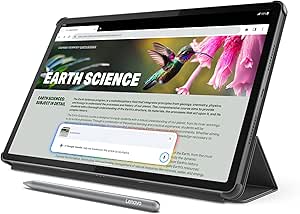
Lenovo Idea Tab Pro with Google Gemini – 12.7” 3K LCD Student Tablet with Pen and Folio Case
The Lenovo Idea Tab Pro is the practical pick for students who want a large study screen and useful accessories in the box, rather than the most advanced display in the roundup. Its 12.7-inch 3K LCD offers plenty of room for lecture notes, reading, and videos, while the included Tab Plus Pen and folio case make it ready for schoolwork without a separate accessory purchase. Quad JBL Dolby Atmos speakers also make it a stronger entertainment companion than a bare-bones study tablet. It is not a direct performance rival to the M5 iPad Pro or the Samsung Tab S12+: the 8GB of memory and LCD panel signal a more student-focused balance. Battery life is listed at 11 hours, and its weight may make long handheld sessions tiring.
Pros:- 12.7-inch 3K display gives study materials and videos ample screen area
- Folio case and Lenovo Tab Plus Pen are included
- Quad JBL Dolby Atmos speakers support immersive media playback
- 45W quick charging helps shorten time connected to a charger
Cons:- LCD display does not offer the AMOLED or Ultra Retina XDR technology of pricier alternatives
- 8GB memory is less than the 12GB in the Galaxy Tab S11
- Listed 11-hour battery life is shorter than the Tab S12+’s stated figure, and the tablet may feel heavy when held
Best for: Students who want a large screen for reading and notes, plus a pen and protective folio included
Not ideal for: Creative professionals seeking an OLED-class display or demanding performance, and readers who need a light tablet for extended handheld use
- Display:12.7-inch 3K LCD
- Processor:MediaTek Dimensity 8300
- Memory:8GB
- Storage:128GB
- Battery life:11 hours
- Charging:45W quick charge
- Speakers:Quad JBL Dolby Atmos
- Included accessories:Folio case and Lenovo Tab Plus Pen
Our verdict“Choose the Lenovo over the Tab S12+ if your priority is a student-ready large-screen bundle with pen and folio rather than flagship display technology.”
Samsung Galaxy Tab S10+ Plus 12.4” 512GB Android Tablet, Platinum Silver
The Galaxy Tab S10+ remains a capable premium Android choice for buyers who want a large AMOLED screen, pen, and roomy storage in one package. Its 12.4-inch AMOLED 2X display is well suited to films and split-screen work, while 512GB gives substantially more space than the 128GB Tab S11. The included S Pen, Armor Aluminum frame, and stated water and dust resistance make it a flexible option for both work and travel. Compared with the newer Tab S12+, it has a previous-generation Dimensity 9300+ processor and lacks the newer model’s stated 21-hour battery figure. Still, buyers who do not need the latest platform may prefer its established feature mix. Its large chassis is less comfortable for handheld use, and some AI tools require a network connection and Samsung account.
Pros:- 12.4-inch AMOLED 2X display suits movies and side-by-side apps
- 512GB storage offers room for substantial files and media
- S Pen is included for writing and drawing
- Armor Aluminum frame and stated water and dust resistance support travel use
Cons:- Dimensity 9300+ is an older platform than the Tab S12+’s Dimensity 9500
- Large size can be tiring for extended handheld use
- Some AI features require a network connection and Samsung account
Best for: Android users who want a large AMOLED display, 512GB storage, and an included S Pen for work and entertainment
Not ideal for: Buyers seeking the latest Samsung processor, a compact tablet, or AI tools that work without an internet connection and Samsung account
- Display:12.4-inch AMOLED 2X
- Storage:512GB
- Processor:MediaTek Dimensity 9300+
- Processor speed:3050MHz
- Water and dust resistance:Yes
- Frame material:Armor Aluminum
- Included accessory:S Pen
- Model year:2024
- Warranty:1 year
Our verdict“Pick the Tab S10+ if you want a large, pen-equipped Samsung tablet with 512GB storage and do not need the newer Tab S12+ platform.”
Apple iPad Pro 13-inch (M5) with Ultra Retina XDR Display, 512GB, Space Black
The 13-inch iPad Pro is the strongest fit here for demanding creative work: its M5 chip, 512GB of storage, and Ultra Retina XDR display combine speed and screen quality for editing, illustration, and detailed visual review. Compared with the 13-inch iPad Air, it offers a more advanced display and a larger storage allotment in this configuration, making it easier to justify for sustained professional workflows. The tradeoff is that the Air may be the more sensible pick for everyday productivity, while this Pro’s 1.28-pound body can feel substantial when held for long sessions. Apple Pencil and Magic Keyboard support broaden its uses, but those accessories are separate, and iPadOS may not suit buyers who need desktop software flexibility.
Pros:- M5 chip is suited to demanding creative and multitasking workloads
- 13-inch Ultra Retina XDR display with ProMotion and P3 wide color
- 512GB storage gives larger projects more room than the listed iPad Air configuration
- 12MP cameras and LiDAR Scanner support advanced capture and spatial workflows
Cons:- Premium features may be unnecessary for routine tablet tasks
- At 1.28 pounds, it is not the most comfortable choice for prolonged handheld use
- iPadOS differs from desktop systems, and key accessories are sold separately
Best for: Creative professionals who want a large, color-rich display, strong processing power, and 512GB of built-in storage for demanding tablet-based work
Not ideal for: Buyers who mainly browse, stream, or take notes, or anyone who needs Windows desktop apps or a lighter tablet for extended handheld use
- Display:13-inch Ultra Retina XDR
- Processor:Apple M5 chip
- Storage:512GB
- Cameras:12MP front; 12MP rear with LiDAR Scanner
- Connectivity:Wi-Fi 7 with Apple N1
- Battery life:All-day
- Weight:1.28 pounds
- Color:Space Black
Our verdict“Choose this iPad Pro for demanding creative work that benefits from its display, M5 chip, and 512GB storage, but pick the iPad Air if those advantages are more than you need.”
Apple iPad Air 13-inch (M4) with Liquid Retina Display, 128GB, Wi-Fi 7, Touch ID, Space Gray
This 13-inch iPad Air brings a large workspace and the M4 chip to buyers who want a capable Apple tablet without choosing the more specialized iPad Pro. Its Liquid Retina display, Wi-Fi 7, and support for Apple Pencil and Magic Keyboard make it a flexible option for note-taking, office tasks, and creative projects. Against the 13-inch iPad Pro, the Air gives up the Ultra Retina XDR screen and the Pro’s 512GB capacity in this comparison, but its performance should still suit many general workflows. The sharper compromise is 128GB of storage: people keeping large video, photo, or app libraries may run short sooner. At 1.36 pounds, it is also not a particularly compact handheld choice, and keyboard productivity requires an added accessory.
Pros:- M4 chip provides capable performance for multitasking and creative apps
- 13-inch Liquid Retina display offers a generous workspace
- Wi-Fi 7 with Apple N1 supports current high-speed wireless connectivity
- Compatible with Apple Pencil and Magic Keyboard
Cons:- 128GB may constrain users with large apps or offline media libraries
- Display lacks the iPad Pro’s Ultra Retina XDR and ProMotion features
- Magic Keyboard and Apple Pencil add-ons are needed for a fuller productivity setup
Best for: Apple users who want a large-screen tablet for school, office work, media, and moderate creative tasks without needing the iPad Pro’s highest-end display
Not ideal for: People who store large creative projects locally, need a Pro-class display, or want a complete laptop-style setup without buying accessories
- Display:13-inch Liquid Retina
- Processor:Apple M4 chip
- Storage:128GB
- Front camera:12MP with Center Stage
- Rear camera:12MP Wide with 4K video
- Connectivity:Wi-Fi 7 with Apple N1
- Weight:1.36 pounds
- Battery life:All-day
Our verdict“Choose the iPad Air for a large, capable Apple tablet for everyday work, but opt for the iPad Pro if display quality and more built-in storage matter more.”
Samsung Galaxy Tab S11 Ultra with S-Pen (2025, 256GB, 12GB RAM, Wi-Fi Only, Moonstone Gray)
The Galaxy Tab S11 Ultra is the pick for buyers who want a tablet-sized canvas that feels expansive for movies, split-screen work, or drawing. Its 14.6-inch 120Hz AMOLED display is larger than the screens on the 13-inch iPad Pro and Surface Pro, while the included S Pen means handwriting and sketching do not require a separate stylus purchase. The 12GB of RAM and Dimensity 9400+ chip support multitasking, and the 11,600 mAh battery is built for extended sessions. This listing is a Wi-Fi-only international model, though, and its stated Wi-Fi 6E is behind the Wi-Fi 7 connectivity specified for the iPad Pro and iPad Air. Its size also makes it less convenient to carry or hold one-handed, and warranty coverage may be less straightforward for U.S. buyers.
Pros:- 14.6-inch AMOLED display with 120Hz refresh and HDR10+
- S Pen is included for writing, drawing, and navigation
- 12GB RAM and Dimensity 9400+ processor support multitasking
- 11,600 mAh battery provides substantial capacity for extended use
Cons:- Wi-Fi-only configuration has no cellular connection
- International version may not include U.S. warranty coverage
- Large display and chassis are less convenient for handheld use
Best for: Android users who prioritize a very large, high-refresh AMOLED screen for media, drawing, and multitasking, and are comfortable with Wi-Fi-only connectivity
Not ideal for: Buyers who need cellular data, prefer a compact tablet, or want the clearer domestic warranty arrangements of a locally sold model
- Display:14.6-inch AMOLED, 120Hz, HDR10+
- Processor:MediaTek Dimensity 9400+
- Memory:12GB RAM
- Storage:256GB
- Battery:11,600 mAh
- Rear cameras:13MP wide and 8MP ultrawide
- Connectivity:Wi-Fi 6E, Bluetooth 5.4, USB Type-C 3.2
- Included components:S Pen and 25W fast charger
Our verdict“Pick this Tab S11 Ultra for its huge AMOLED screen and included S Pen, but favor the iPad Pro or Air if you want Wi-Fi 7 or a more familiar U.S. warranty path.”
Samsung Galaxy Tab S11 Ultra, 11th Gen, AI Tablet, WiFi, 12GB RAM, 512GB Storage, Gray, 14.6 Inch, 120Hz Display, Includes S Pen, IP68
This Galaxy Tab S11 Ultra configuration pairs a 14.6-inch 120Hz Dynamic AMOLED 2X display with an included S Pen, IP68 water resistance, and a stated 512GB of storage. That makes it a strong match for artists and mobile professionals who want Samsung’s large-screen workspace with some added protection from dust and water. Compared with the other Tab S11 Ultra in this roundup, this listing highlights IP68 and a higher stated storage figure, while the other version specifies a Dimensity 9400+ processor and Wi-Fi 6E. Here, the storage description says 256GB internal plus 256GB SD card, so buyers should verify what is included and how that capacity is delivered. It is still Wi-Fi only, and its 14.6-inch body is less suited to handheld reading than the smaller iPad Air.
Pros:- 14.6-inch Dynamic AMOLED 2X display with 120Hz refresh
- S Pen is included for drawing and note-taking
- IP68 water-resistance rating adds protection for varied work settings
- Listing specifies 512GB total storage and 12GB RAM
Cons:- Wi-Fi-only connectivity is not suited to users who need mobile data
- 512GB is described as 256GB internal plus 256GB SD card, so the configuration should be checked
- Large display and chassis can be cumbersome for prolonged handheld use
Best for: Samsung users who want a large drawing and productivity screen, an included S Pen, water resistance, and the listed 512GB combined storage
Not ideal for: Buyers who need cellular service, want an especially portable tablet, or require unambiguous confirmation of the storage configuration and processor
- Display:14.6-inch Dynamic AMOLED 2X, 120Hz
- Generation:11th Generation
- Processor:Exynos, 2.4 GHz
- Memory:12GB RAM
- Storage:512GB stated total: 256GB internal plus 256GB SD card
- Connectivity:Wi-Fi
- Water resistance:IP68
- Battery:11,600 mAh; up to 23 hours of video playback
Our verdict“Choose this Tab S11 Ultra if the large AMOLED screen, S Pen, and IP68 rating fit your work, but confirm the storage details before buying.”
Microsoft Surface Pro (2026) 13-inch Premium Performance 2-in-1 Laptop Snapdragon X2 Plus Processor Touchscreen Display 16GB RAM 512GB SSD Windows 11 Copilot+ PC Black
The Surface Pro is the clearest choice here for buyers who want a high-end tablet that can also run a Windows 11 workflow. Its 13-inch OLED touchscreen, 16GB of RAM, and 512GB SSD give it a more conventional PC setup than the iPad Pro or either Galaxy Tab, while two USB-C/USB4 ports and support for up to three 4K monitors suit desk-based work. The Snapdragon X2 Plus chip is paired with a dedicated AI chip, and the listed battery life reaches 15.5 hours of video playback. Unlike the iPad Pro, this is designed to shift between tablet, laptop, and studio modes—but the keyboard and Surface Slim Pen are sold separately. At 1.97 pounds, it is also heavier than the listed iPad models, so it is less appealing as a tablet for extended handheld reading.
Pros:- Windows 11 supports a PC-style software and file workflow
- 13-inch OLED touchscreen with 120Hz refresh
- 16GB RAM and 512GB SSD provide room for multitasking and files
- Two USB-C/USB4 ports and support for up to three 4K monitors
Cons:- Keyboard and Surface Slim Pen are sold separately
- At 1.97 pounds, it is heavier than the listed iPad models
- The tablet form is less useful for laptop-style work without an added keyboard
Best for: Professionals and students who need Windows apps, PC-style file handling, USB4 connectivity, and a tablet that can serve as a laptop with optional accessories
Not ideal for: Tablet-first users who want a light device for handheld use or buyers who expect a keyboard and stylus to be included
- Display:13-inch OLED touchscreen, 120Hz
- Processor:Qualcomm Snapdragon X2 Plus with dedicated AI chip
- Memory:16GB RAM
- Storage:512GB SSD
- Operating system:Windows 11 Copilot+
- Battery life:Up to 15.5 hours of video playback
- Ports:Two USB-C/USB4; supports up to three 4K monitors
- Weight:1.97 pounds (895 g)
- Wireless:Wi-Fi 7
Our verdict“Choose the Surface Pro if Windows software and laptop flexibility matter more than a light, accessory-ready tablet experience.”

How We Picked
I ranked these tablets by how well their performance, screen, software, portability, and included tools serve distinct high-end buying needs. A premium chip or a large display mattered only when it produced a clear buyer benefit: demanding creative work, more comfortable multitasking, better portability, or access to desktop software. I also weighed storage capacity and practical extras such as an included pen or folio, since these can affect what a buyer needs to add later.
The order reflects versatility first, then specialization. The iPad Pro 11-inch takes the lead as a compact, powerful tablet; larger iPad and Samsung models follow for buyers who value screen space or a specific ecosystem. The Surface Pro earns a distinct role for Windows-first workflows, while the Lenovo is a more focused study pick. The Samsung S11 Ultra appears twice in the supplied list with different stated storage and configuration details, so I treat those listings as separate buying options and advise checking the exact model rather than assuming their specifications are interchangeable.
| high-end tablet | Connectivity |
|---|---|
| Samsung Galaxy Tab S11 128GB W | — |
| Samsung Galaxy Tab S12+ 512GB | — |
| Apple iPad Pro 11-inch | Wi-Fi 7 with Apple N1 |
| Lenovo Idea Tab Pro with Googl | — |
| Samsung Galaxy Tab S10+ Plus 1 | — |
| Apple iPad Pro 13-inch | Wi-Fi 7 with Apple N1 |
| Apple iPad Air 13-inch | Wi-Fi 7 with Apple N1 |
| Samsung Galaxy Tab S11 Ultra w | Wi-Fi 6E, Bluetooth 5.4, USB Type-C 3.2 |
| Samsung Galaxy Tab S11 Ultra | Wi-Fi |
| Microsoft Surface Pro | — |
Factors to Consider When Choosing Best High-end Tablets
A high-end tablet can be a portable screen, a drawing surface, a study tool, or a laptop substitute—but no single model does all four equally well. I’d start with the task that would be hardest to do on your current device, then check whether the tablet’s software and accessories support it without extra compromises.
Choose the Operating System Around Your Work
Start with the applications you rely on, not processor claims. iPadOS and Android are built around touch and tablet apps, while Windows can run desktop software that may be necessary for work or school. A Windows 2-in-1 can feel more familiar for file-heavy tasks, but touch-first tablet use may not be as smooth across every desktop application. Before buying, check that your must-have apps support the platform and the features you need. If you already use a phone, computer, cloud service, or accessories from one ecosystem, staying compatible may save more friction than choosing a tablet with a stronger headline specification.
Match Screen Size to Where You’ll Use It
A large display gives documents, timelines, and split-screen apps more room, but it also takes up more bag space and can be tiring to hold for long sessions. Compact models are easier to carry and use casually, yet may feel cramped when you want two apps open side by side. Think about whether the tablet will spend most of its time on a desk, in your hands, or in transit. For a work surface, prioritize comfortable viewing and a stand; for reading and travel, weight and one-handed handling deserve more attention. Avoid choosing the largest screen just because it looks impressive if your everyday use is mostly handheld.
Budget for the Complete Setup, Not Just the Tablet
A tablet’s real usefulness can depend on a keyboard, stylus, case, stand, or hub. Some listings include a pen or folio, while other setups may require separate accessories, so compare what is in the box before treating two configurations as equivalent. A keyboard can improve long-form writing but add bulk; a stylus is valuable for handwriting and illustration but unnecessary for many media-focused buyers. Check whether the accessory supports the functions you expect, including pressure sensitivity, shortcut keys, or a stable viewing angle. A bundled accessory is only a benefit if it fits your use and does not force a compromise in comfort or compatibility.
Buy Storage for the Files You Keep Offline
Cloud storage can reduce the need for local capacity, but it cannot replace offline space when you travel, work with large creative files, or download media. Consider how much room your apps, photos, videos, and active projects occupy now, then leave space for growth. Higher storage tiers can make sense for a device you plan to keep for years, but they add little value if most files live in the cloud and your usage stays light. Check whether the model supports expandable storage or relies entirely on built-in capacity. Choosing too little can create recurring cleanup; choosing far more than you use can divert budget from a keyboard or pen.
Separate Premium Screen Features From Everyday Needs
Display quality matters most when you spend long sessions reading, editing images, watching video, or comparing fine visual detail. A high-end screen can make those tasks more comfortable and engaging, but it does not automatically improve software compatibility or make a tablet a better laptop replacement. Match the display to your work: creators may value accurate, detailed viewing, while note-taking and browsing may be served well by a less elaborate panel. Also think about reflections, brightness, and whether you usually work indoors or outdoors. Paying for screen capability makes the most sense when it improves the activity you do often, not just a specification you rarely notice.
Treat Laptop Replacement Claims as a Workflow Test
A tablet can replace a laptop for many people, but the deciding factor is usually software and workflow rather than raw speed. List the tasks you perform in a typical week: file management, spreadsheets, video calls, external displays, specialist applications, and extended typing can each expose limits. Try to identify any desktop-only program or peripheral you cannot give up before choosing a tablet-first system. A 2-in-1 offers a more laptop-like route, though its weight, keyboard setup, and touch experience may differ from a conventional tablet. If you still need a laptop for one regular task, buying a premium tablet as a replacement may add cost without removing a device.
Frequently Asked Questions
Should I choose the 11-inch iPad Pro or a larger tablet for work?
Choose the 11-inch iPad Pro if portability and comfortable handheld use matter alongside demanding apps. A larger tablet is a better fit when you regularly work with two windows, draw on a broad canvas, or review documents at a desk. Screen area can reduce the need to zoom and rearrange content, but it cannot make an app more capable or replace desktop software. Think about where you work most often and whether you will carry the tablet daily. If both uses matter, a compact tablet with an external display may be more practical than carrying a large model everywhere.
Is the Microsoft Surface Pro a better laptop replacement than an iPad or Android tablet?
It is a stronger candidate when your work depends on Windows desktop applications, established file workflows, or familiar PC tools. An iPad or Android tablet may feel more natural for pen input, casual use, and touch-first apps, but some desktop tasks can require workarounds. The Surface Pro still needs to be judged as a complete setup: keyboard use, lap comfort, ports, and the software you need all affect its role. Check that your specific programs and peripherals work as expected before making the switch. If your laptop tasks are mostly browser-based, a tablet-first option may be simpler and more portable.
Do I need 512GB of storage on a premium tablet?
Not automatically. A large local capacity is useful if you keep extensive video, photo libraries, creative projects, or work files on the device, especially when you need them offline. Buyers who stream media, use cloud storage, and install a modest set of apps may be comfortable with less. Remember that video and design files can grow quickly, while apps and system data also occupy space over time. Review your current device’s storage use and account for files you want available without internet access. If you are unsure, favor a realistic estimate of offline needs rather than paying for capacity you will not use.
Are the two Galaxy Tab S11 Ultra listings interchangeable?
The supplied listings describe the same broad tablet family but state different storage and configuration details, so I would not treat them as identical without checking the exact product page. Compare storage, memory, connectivity, included S Pen, model identifier, and regional specifications before choosing. A difference in storage can matter for offline media and creative work, while network options affect how useful the tablet is away from Wi-Fi. Confirm the contents of the box as well; bundles and configurations can vary. If the specifications match your needs, choose based on the exact configuration rather than the listing title alone.
Is a bundled pen or folio worth prioritizing over a faster tablet?
For handwriting, sketching, or annotation, an included pen can add more day-to-day value than a modest performance increase you may never notice. A folio can also provide basic protection and a viewing angle, though it may not replace a comfortable keyboard. For gaming, demanding creative apps, or long-term use, performance and storage may deserve more weight. Check that the bundled accessory supports the features your work needs and fits your preferred grip or typing style. The best choice depends on whether your main bottleneck is the tablet’s capability or the lack of a useful input tool.
Conclusion
For most buyers seeking one premium tablet, I recommend the Apple iPad Pro 11-inch (M5) as the best overall because it balances portability with high-end capability. The best value-oriented choice is the Lenovo Idea Tab Pro for students who can use its included pen and folio and do not need a flagship creative workstation. For a best premium, big-screen experience, choose the Samsung Galaxy Tab S11 Ultra; confirm the exact storage configuration before ordering. The best option for beginners is the Apple iPad Air 13-inch, which offers a straightforward tablet experience and generous screen space without the Pro positioning. For Windows-specific work, pick the Surface Pro; for a compact premium Android tablet, compare the Galaxy Tab S11 with the larger Samsung alternatives. Let your software, screen-size preference, and need for included accessories settle the choice.