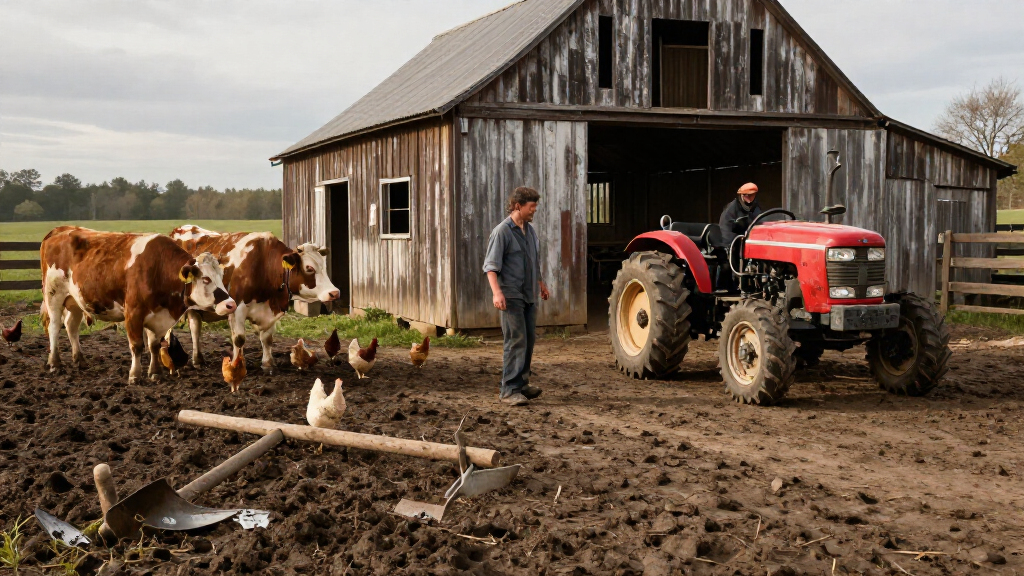

🔍 Read the full analysis: When Tractors Took Over: The Fate Of Farm Animals on ThorstenMeyerAI.com

Get the latest gadgets delivered free with Prime
- Fast, free delivery on millions of items
- Prime Video, Amazon Music and more included
- Member-only deals all year
TL;DR
U.S. farm horses and mules peaked at 26.7 million in 1918, then fell to 3.1 million by 1960 as tractors and other machinery took over farm work. The shift released land used to grow animal feed and coincided with a sharp decline in farm employment, but the historical account does not establish that automation alone caused those changes.
U.S. farm horses and mules fell from a peak of 26.7 million in 1918 to 3.1 million in 1960 as tractors and other machinery replaced animal power, according to historical government statistics summarized by ThorstenMeyerAI.com on November 4, 2026. The change reshaped farming and reduced the acreage devoted to animal feed, while raising a question that remains relevant as automation advances: what happens to workers when machines take over a task?
The figures come from the U.S. Census Bureau’s 1975 compilation of historical statistics, which reprints Agriculture Department estimates of farm horses and mules. Horses alone peaked at 21.4 million in 1915; the combined total peaked three years later at 26.7 million, including 5.5 million mules. By 1960, the combined count was 3.1 million, a decline of almost 90% from the peak.
The animals required substantial feed. In 1915, farmers grew about 93 million acres of crops to feed horses and mules, out of 340 million harvested crop acres. The acreage devoted to their feed was still about 90 million in 1920, then fell to roughly 5 million by 1960. The account describes the land freed from feed production as available for crops for people, though it does not quantify how much of it was put to any particular use.
Tractor numbers rose as the working-animal count declined: about 1,000 tractors in 1910, 246,000 in 1920 and 4.69 million in 1960. Around 1955, tractors outnumbered farm horses and mules for the first time. Other machinery also spread: combine harvesters rose from about 4,000 in 1920 to more than one million in 1960. These counts come from historical series with differing dates and definitions, and the source notes that the government’s yearly horse and mule estimates ended soon after 1960.
The Cost of Replacing Animal Power
The shift affected more than the animals. U.S. farm employment reached 13.6 million in 1916 and stood at 4.5 million in 1970, while the overall U.S. labor force doubled, according to the figures in the account. That contrast illustrates the scale of agriculture’s changing workforce, but it does not by itself show that tractors caused every job loss or explain where each former farm worker went.
Mechanization also raised farm output per worker. The Agriculture Department estimated that one farm worker supplied 7.1 people in 1910, 10.7 in 1940 and 47.1 in 1970; the last figure includes people abroad supplied through exports. Higher output and fewer workers on farms changed both the rural economy and the food system. For readers weighing the effects of current automation, the episode offers a historical case of a major occupational shift, not a precise forecast of what will happen next.
Products Worth Considering

LG UltraGear 27GX704A-B 27-inch QHD OLED Gaming Monitor

LG UltraGear 32GX850A-B 32-inch 4K UHD Glossy OLED Gaming Monitor

Bose TV Speaker Compact Soundbar with Bluetooth and HDMI-ARC, Black
As an affiliate, we earn on qualifying purchases.
From Fordson to Farm Machinery
Gasoline tractors existed before World War I, but the account says early models were heavy, costly and better suited to large farms. Ford introduced the Fordson in 1917. The Henry Ford museum describes it as the first mass-produced, inexpensive lightweight tractor designed for small farmers; it also says the model rapidly became America’s most popular tractor. The 100,000th Fordson left the assembly line on February 21, 1920.
Tractors were part of a broader mechanization process rather than a single replacement event. Combines cut, threshed and cleaned grain in one pass; corn pickers, balers and milking machines also spread, alongside fertilizer and improved seed. The account presents automation as a gradual economic change: farmers stopped breeding replacement work animals, and their numbers declined over time rather than through one sudden mass event.
The horse comparison is also used in debates about human employment. In 1983, economist Wassily Leontief compared workers with horses displaced by tractors. The account notes a limitation Leontief himself identified: horses could not vote. The comparison can frame questions about technological change, but it cannot settle how modern labor markets, institutions or public policy will respond.
What the Historical Record Cannot Show
The figures document the decline in farm horses and mules and the growth in tractor numbers, but they do not establish that tractors alone caused the fall in farm employment. The same period brought combines, other farm equipment, fertilizers and improved seed. The account does not provide a detailed breakdown of how each development affected particular jobs, communities or individual animals.
Nor does it give a complete account of what happened to every horse and mule as farms stopped breeding replacements. It describes the working population as aging out, but provides no breakdown of animals’ destinations or treatment. Comparisons with present-day automation also remain limited: the source says that John Deere’s 16-camera autonomy kit, reported in February 2025, performs tillage on select large tractors, and cites China’s claim that about 74% of ploughing, sowing and harvesting was mechanized in 2023. Those claims do not establish how quickly autonomous systems will spread or what their effects on workers will be.
The Next Test for Farm Automation
The historical episode sets a point of comparison for the current use of driverless equipment, but the source does not report a new product launch, policy decision or scheduled milestone. It says that modern farm robots have narrower capabilities than the broad transformation associated with tractors. The next developments to watch are the expansion of autonomous equipment beyond select machines and tasks, and evidence about adoption, costs and changes to farm work.
For now, the historical record offers measurements of a completed shift, while the consequences of newer systems remain unsettled. Claims about mechanization should be dated and tied to the specific tasks and places they describe; the horse-to-tractor story alone cannot establish what future automation will mean for workers.
Key Questions
How many horses and mules worked on U.S. farms at the peak?
The combined farm population peaked at 26.7 million on January 1, 1918, according to historical estimates cited in the account. Horses alone peaked at 21.4 million in 1915.
How much did the number fall by 1960?
The count declined to 3.1 million in 1960, almost 90% below the 1918 combined peak.
What happened to land previously used to grow feed?
The acreage devoted to feed for farm horses and mules fell from about 93 million acres in 1915 to roughly 5 million in 1960. The source says the land could grow food for people but does not specify its full later use.
Does the horse-to-tractor shift prove automation will eliminate human jobs?
No. It is a historical analogy, not a rule or a forecast. Farm employment fell during a period of broad mechanization and other agricultural changes, but the account does not isolate the effect of tractors or predict the impact of current automation.
Source: ThorstenMeyerAI.com