
🔍 Read the full analysis: Inside The Primary Sector’s Growing Use Of AI on ThorstenMeyerAI.com

Get the latest gadgets delivered free with Prime
- Fast, free delivery on millions of items
- Prime Video, Amazon Music and more included
- Member-only deals all year
TL;DR
Farm machinery increasingly uses satellite guidance, precision tools and robotic milking, but adoption is uneven and labor-intensive soft-fruit harvesting still relies heavily on people. U.S. data show precision practices on 22% of farms in 2025, while labor demand is reflected in 398,258 H-2A jobs certified that fiscal year.
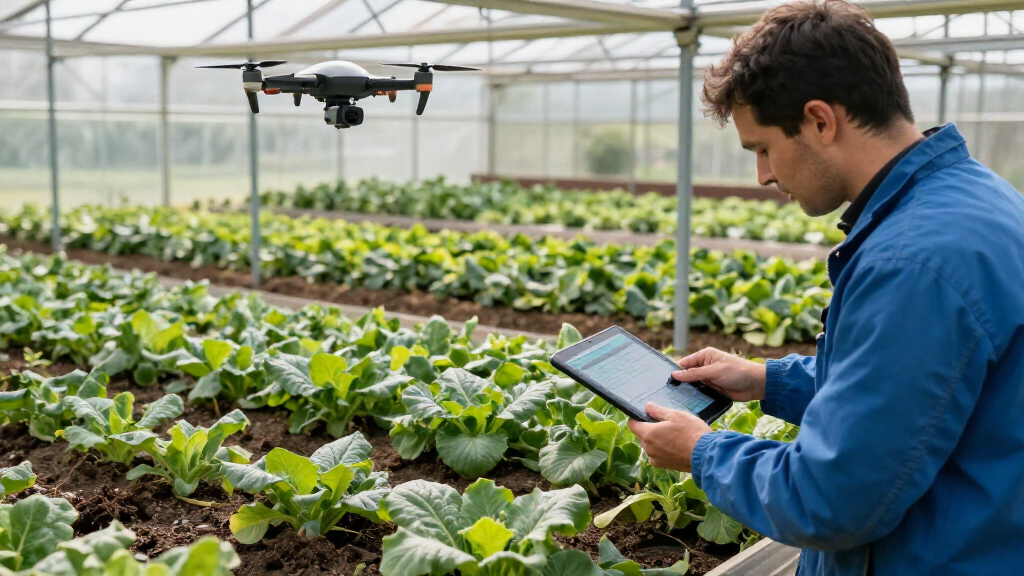
Farm automation is advancing unevenly: satellite-guided tractors and robotic milking are established on some farms, while many crops still require hand labor. A November 29 report by ThorstenMeyerAI.com says the gap is particularly clear in strawberry harvesting, where robots have begun commercial work in limited systems but have not displaced workers picking fruit in soil-grown fields.
U.S. Department of Agriculture figures cited in the report show that 22% of U.S. farms used at least one precision-farming practice in 2025, down from 27% in 2023. The category includes GPS guidance, yield monitoring, soil mapping, variable-rate applications, drones, electronic tagging, precision feeding and robotic milking. The figures count farms, not the share of farmland covered by those tools.
Automation is much more common across some major crops. USDA data show guidance systems were used on more than half of U.S. acres planted to corn, soybeans, winter wheat and cotton in the latest year cited for each crop: 2016 for corn, 2018 for soybeans, 2017 for winter wheat and 2019 for cotton. The report says larger farms adopted guidance earlier and more often; in 2016, 73% of the largest corn farms used it, compared with 10% of the smallest.
Dairy barns are also changing. Germany’s statistics office, Destatis, counted 8,800 farms using automatic milking systems in 2023, or 19% of the country’s dairy farms. By contrast, strawberry harvesting remains a difficult task to automate because fruit must be identified and handled without damage. The report cites a 2024 University of California cost study finding harvest represented about two-thirds of costs for organic strawberries.
Infographic 01 · Precision farming
Most acres, not most farms
Satellite steering took over most of America’s big crop fields, but only about one US farm in five uses any precision farming. The big farms adopt first.
US corn · share of planted acres with auto-steer (ERS, ARMS)
Guidance systems by 2019 · share of planted acres (ERS)
US farms using any precision agriculture practice · share of farms (NASS)
US corn farms using guidance, 2016 · by farm size (ERS)
Germany, 2023 · dairy farms with milking robots (Destatis)
Acre shares (ERS, by crop and survey year) and farm shares (NASS) are different measures and not directly comparable. Before 2018, ERS “guidance” means auto-steer without lightbars. NASS counts GPS guidance, yield monitoring, soil mapping, variable rate, drones, electronic tagging, precision feeding and robotic milking.
Sources: USDA ERS, EIB-248 (2023); USDA ERS, Amber Waves (April 2023); USDA NASS, Technology Use (August 2025); Destatis press release 204 (23 May 2024).
Powered by Thorsten Meyer AI
Automation Favors Large Farms
The figures show why “farming is automated” is an incomplete description. Machine adoption depends on the task, crop and scale: guidance systems can cover broad, relatively uniform fields, while picking delicate fruit requires a machine to locate ripe produce and handle it gently, often in variable conditions.
The divide matters for farm workers and producers. Where machines take over steering or milking, they can change the timing and type of labor needed. But the persistence of hand harvesting means automation has not removed the need for seasonal workers across the sector. The U.S. Department of Labor certified 398,258 H-2A temporary farm jobs in fiscal 2025, compared with just over 48,000 in fiscal 2005, according to the report. Those totals indicate a change in certified job demand over time; they do not, by themselves, explain its causes or establish how many positions were ultimately filled.
Adoption rates also conceal who benefits first. A tool may be used on a large share of acres even while most farms do not use it, because large operators cultivate more land and may have greater capacity to invest. The report cites USDA analysis suggesting that precision tools can offer greater returns at larger scales.
Products Worth Considering

Samsung Galaxy Tab A11+ 11-Inch Tablet, 6GB RAM, 128GB Storage, Expandable Storage, Gray

Apple AirPods Pro 3 Wireless Earbuds with Active Noise Cancellation

Jackery Explorer 300 Portable Power Station, 292Wh
As an affiliate, we earn on qualifying purchases.
From GPS to Robotic Milking
Precision farming developed over decades rather than arriving as a single AI breakthrough. The report says yield monitors reached the market in 1993, followed by yield and soil maps and variable-rate technology, which changes the amount of seed or other inputs applied across a field. GPS-based steering tools emerged during the 1990s. The U.S. government’s May 1, 2000, decision to stop deliberately degrading the civilian GPS signal improved positioning for users including farm equipment.
USDA data cited in the report chart the spread of automatic steering: it was used on 5.3% of planted U.S. corn acres in 2001 and 58% in 2016. These are measures of acreage, not the proportion of farms using the technology. In dairy, the report traces commercial robotic milking to systems developed in the Netherlands in the 1990s. In a robotic system, a cow enters a milking stall and sensors and a robot arm attach the milking equipment.
Soft-fruit picking remains a different engineering challenge. A review published in 2014 examined 50 harvesting robots developed over three decades and reported an average success rate of 66% and 33 seconds per fruit; it found no robot then on the market. The report says commercial strawberry robots now operate in table-top growing systems, but not broadly in soil-grown fields. That distinction limits what can be inferred about automation’s reach across strawberry production.
“Most acres, not most farms.”
— ThorstenMeyerAI.com report, published November 29, 2026
Where Adoption Still Falls Short
The figures cover different years, countries and measures, so they do not provide a single current global adoption rate. In particular, farm-level adoption and acreage coverage are not interchangeable. The report does not establish why the share of U.S. farms reporting precision practices fell from 27% in 2023 to 22% in 2025, or whether the change reflects survey variation, investment decisions or other factors.
It is also unclear how many strawberry robots are operating commercially, how much fruit they pick, and whether their economics work in soil-grown production at scale. The report describes commercial use in table-top systems but gives no deployment total or independent comparison of costs and productivity. The H-2A certification count likewise does not show how many workers were hired or how labor demand would have changed without automation.
Although the report frames the subject around AI, many examples it discusses—GPS guidance, automated feeding and robotic milking—are forms of automation or precision technology and are not necessarily AI systems. The material does not quantify which tasks use machine-learning systems specifically, or measure AI’s effect on farm employment.
Tracking Robots in the Fields
The next useful indicators are updated USDA adoption data, future Destatis counts for robotic milking, and independent measurements of commercial fruit-harvesting systems. Those sources could show whether the recent farm-level adoption decline continues and whether robots move beyond controlled table-top strawberry production.
For labor, later H-2A certification figures and data on actual placements would help distinguish certified demand from jobs filled. Until those measures are available, the evidence supports a narrower conclusion: automation is established in selected farm tasks, while the extent to which AI itself is changing employment—and whether it can take on delicate hand harvesting—remains unsettled.
Key Questions
How many U.S. farms used precision-farming practices in 2025?
The report cites USDA data showing 22% of U.S. farms used at least one precision-farming practice in 2025, down from 27% in 2023.
Does the report say most U.S. farmland is automated?
No. It reports guidance systems on more than half of the acres planted to several major crops in particular survey years, but only 22% of farms reported using any precision practice in 2025. Acreage coverage and the share of farms are different measures.
Are robots replacing strawberry pickers?
Not broadly, according to the report. It says commercial strawberry robots are working in table-top systems, while harvesting in soil-grown fields remains difficult to automate and relies on hand picking.
How common is robotic milking in Germany?
Destatis counted 8,800 German farms using automatic milking systems in 2023, equal to 19% of the country’s dairy farms.
Does the report measure AI’s effect on farm jobs?
No. It describes several forms of automation and cites H-2A job certifications, but does not isolate AI’s employment effects or show how many certified positions were filled.
Source: ThorstenMeyerAI.com