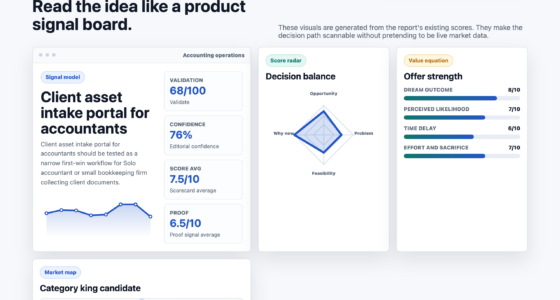
🔍 Read the full analysis: How Our Idea Council Evaluated The AI Agent Cost Tracker on ThorstenMeyerAI.com

Get the latest gadgets delivered free with Prime
- Fast, free delivery on millions of items
- Prime Video, Amazon Music and more included
- Member-only deals all year
TL;DR
IdeaClyst, the review council behind ThorstenMeyerAI.com’s new business-ideas series, assessed a proposed AI agent cost tracker in two blind reviews. Both recommended a pivot toward reconciling agent-level costs with provider invoices for agencies and software makers that resell AI work; whether customers will pay for that product remains untested.
IdeaClyst, a review council associated with ThorstenMeyerAI.com, has assessed a proposed AI agent cost tracker and recommended that its creators pivot from a broad cost-visibility product to a narrower ledger that reconciles agent costs with provider invoices. The two reviews were conducted blind, according to the publication, and the suggested target buyers are agencies and software makers reselling agent work; willingness to pay has not been established.
The proposal addresses a mismatch between how AI services are used and how providers bill for them. An agent can make many model calls for one task, including calls to plan, use tools, check results or retry. A provider invoice may summarize charges by API key, workspace or model, while the business using the agent needs to understand costs by task and customer. That can make it difficult for a company charging clients a flat fee to identify which engagements are profitable.
The idea brief says existing products already cover parts of the problem. Gateways including LiteLLM and Portkey offer budget controls; Langfuse provides tracing and cost views by model, user and tag. The brief also points to billing products and Stripe documentation for token-based billing. Its proposed opening is not another general dashboard, but a ledger that reads existing traces, prices calls, totals them by task and client, and checks those totals against the provider’s cost report.
The council’s recommendation is still a product hypothesis, not evidence of a launched service or paying customers. The proposed next step is a 30-day test: interview ten businesses that resell agent work and manually produce one report from their exports. The brief says to stop if three interviewees report that their current tools already provide the same reconciliation. No results from those interviews or paid pilots are reported.
The Case for Invoice Reconciliation
The assessment highlights a practical distinction for businesses adopting AI agents: knowing that model usage costs money is not the same as being able to assign each charge to a deliverable or client. For a company that resells agent work at a fixed price, inaccurate or incomplete cost allocation could make it harder to set prices, monitor margins and explain charges internally. A tool that links usage records to provider bills could help address that accounting gap, if it works reliably.
The recommendation also matters to prospective founders because it identifies competition as a constraint. Budgets, tracing and usage dashboards already exist, according to the brief. A new product would need to show that its reconciliation function solves a specific buyer’s problem better than combining existing tools or handling the work manually. The publication reports that the two reviewers disagreed over whether customers would buy the ledger as a standalone product, making interviews and paid pilots more informative than broad interest in AI cost visibility.
Products Worth Considering

Jackery Explorer 300 Portable Power Station, 292Wh

Logitech MX Master 4 Ergonomic Wireless Mouse with Haptic Feedback, Graphite

Samsung 32-Inch Odyssey G5 (G51F) QHD 180Hz Gaming Monitor
As an affiliate, we earn on qualifying purchases.
Existing Tools Cover Parts of the Gap
The business idea appears as The Next 90 Businesses #001, a series from ThorstenMeyerAI.com presenting one business idea a day. Its supporting brief describes tokens as pieces of text that models process and notes that providers bill for model use. It also cites Anthropic documentation describing how agent workflows can involve repeated calls. The documentation is provider guidance, not an endorsement of the proposed tracker.
The brief cites the FinOps Foundation’s 2026 survey as evidence that organizations are paying attention to AI spending: 98% of respondents said they manage AI spend, compared with 31% two years earlier. That figure indicates reported management of spending, not demand for this specific product. The FinOps Foundation’s guidance, as summarized in the brief, also identifies difficulty attributing usage to features or agents and the lack of an accepted method for accounting across many cooperating agents.
In describing its process, ThorstenMeyerAI.com says the work was researched and drafted with AI assistance, including Anthropic’s Claude. It identifies IdeaClyst and IdeaNavigatorAI as its own projects and says the business brief, including sources, scores and the proposed test plan, is available through IdeaNavigatorAI. The publication says the piece has no sponsor or affiliate links.
“Both said: pivot.”
— IdeaClyst, as reported by ThorstenMeyerAI.com
Demand and Product Fit Remain Untested
The key open question is whether agencies and software makers will pay separately for a cost ledger, or whether they consider the function adequately covered by current tracing, billing and gateway tools. The publication says its two reviewers disagreed on standalone willingness to pay. It reports no customer interviews, paid pilots, product launch, pricing or measured reconciliation results.
The market-gap claim also needs verification. The brief says it found no existing product promising a line-by-line match to provider bills, but does not provide a full market inventory in the article itself. It is also unclear which providers, invoice formats and agent frameworks the proposed ledger would support, how it would handle differences between trace data and provider reports, or how much manual configuration customers would need.
Interviews and a Manual Ledger Test
The next step set out in the brief is to interview ten agent resellers and build one cost report manually using their exported data. The stated stop condition is that the idea should be halted if three of those ten businesses say their existing tools already perform the same task. The article does not say that the test has begun or provide a completion date.
If interviews show a persistent problem, paid pilots would test whether customers will spend money on the proposed reconciliation workflow. Until those results are available, the idea remains an early-stage business concept. The article’s final sourcing and process note is:
Source: ThorstenMeyerAI.com
Key Questions
What did IdeaClyst recommend?
The two blind reviews recommended pivoting from a broad AI cost tracker to a narrower ledger that matches agent usage costs by task and client against provider invoices.
Who is the proposed product for?
The proposed first customers are agencies and software makers that resell agent work, particularly businesses that charge clients a flat fee and need to understand costs by engagement.
Does the idea have paying customers?
No paying customers or completed pilots are reported. Whether buyers will pay for the ledger on its own remains an open question.
How would the idea be tested?
The brief proposes interviewing ten agent resellers and manually preparing one report from their exported usage data. It says to stop if three interviewees report that their current tools already do the same job.
Source: ThorstenMeyerAI.com