📊 Full opportunity report: Acoustic Dampening, Placement, and the “Rig in the Closet” Setup on ThorstenMeyerAI.com — validation score, market gap, and execution plan.

TL;DR

Moving your high-power rig into a closet significantly reduces noise and reflections when combined with proper placement, sealing, and ventilation. This guide explains best practices for creating a quiet, safe workspace.

Moving a high-powered rig into a closet is the most effective method to reduce noise and reflections, according to experts. Proper placement, sealing gaps, and ventilation are essential to create a quiet, safe workspace, especially for voice recording or AI workloads. For detailed guidance, see Acoustic Dampening, Placement, and the “Rig in the Closet” Setup.Experts emphasize that relocating a rig into a closet drastically cuts noise and echo more effectively than just adding foam treatments. Strategic placement of acoustic panels—especially at reflection points behind the mic, on side walls, and the ceiling—helps shape the room’s sound environment. Sealing gaps around the door with weatherstripping and blankets prevents sound leaks, further improving isolation. Additionally, heat buildup is a major concern; installing ventilation such as exhaust fans or ducted airflow is critical to prevent overheating of high-performance hardware. DIY materials like blankets, rugs, and foam can be effective when placed strategically, but balancing sound absorption with proper airflow is key to maintaining hardware safety and acoustic quality.
Acoustic Dampening & Placement — Interactive Infographic
ThorstenMeyerAI.com · AI Workstation Guides
Lever 5 of 5 · Placement · Interactive
The last lever · move it out

Acoustic dampening
& the rig in the closet.

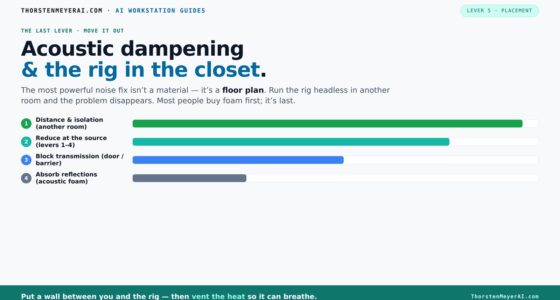
The most powerful noise fix isn’t a material — it’s a floor plan. A rig you can’t hear because it’s in another room beats any amount of foam. Tap the approaches in Part 1 to see what actually works.

1 The hierarchy people get backwards
Distance beats foam — by a lot
Acoustic treatment has a clear order of effectiveness. Most people buy foam first — it’s last. Tap a row for why.
1Distance & isolation
(another room)
most
2Reduce at the source
(levers 1–4)
high
3Block transmission
(door / barrier)
medium
4Absorb reflections
(acoustic foam)
least
#1 · Distance & isolationThe best soundproofing is a wall. Move the rig to another room and run it headless — the noise problem disappears instead of being mitigated.
2 Two kinds of noise, two fixes
Foam and pads solve different problems
Pick the wrong fix and you treat noise that was never going to respond to it.
Airborne
The whoosh of fans, the GPU hum — traveling through air.
Foam absorbs it (less echo in the room)
A barrier blocks it (stops it leaving)
×Foam alone won’t stop it passing through a wall
Structure-borne
The low hum the machine sends into the desk, floor & walls.
Anti-vibration pads / rubber feet decouple it
Soft-mount drives, or use silent SSDs
×Foam does nothing for this — it’s mechanical
3 The rig in the closet
Great noise fix — with one catch
Enclosing a hot rig works beautifully for noise. But a sealed space traps heat — the same trap as a sealed case, scaled to a room.
GPU rig cool in hot out (fan) it must breathe

Contain the noise, not the heat

Vent it — a passive path, or a quiet exhaust fan pulling hot air out.
Soundproof cabinets do both: foam lining + thermostat-controlled exhaust.
An AIO helps here — it exports CPU heat out a radiator.
⚠ Never fully seal a 24/7 rig. Trapped 600W+ of heat = the GPU breathing its own exhaust = throttling & roaring fans.
4 The few products worth it
Mostly free technique — a handful of items help
Anti-vibration pads
Best value here. Kills structure-borne hum for a few dollars.
Soundproof server cabinet
The engineered quiet + cool answer, with built-in exhaust.
Acoustic foam panels
Tames reflections in the room — not for blocking transmission.
Quiet exhaust fan
Ventilates a closet or cabinet so the heat can leave.
5 The numbers
What containment can buy
Counts animate to typical figures.
Soundproof cabinet cuts
~36%
of perceived noise — while still dissipating kilowatts.
Serious enclosures reach
30 dB
of reduction — up to 5× quieter than an open rack.
A wall between you & it
100%
of the problem, gone — the cheapest fix there is.
Acoustic principles from server-room and quiet-PC soundproofing references; cabinet figures from manufacturer specs (StarTech, SysRacks, UCoustic). Figures vary by enclosure and environment. Affiliate disclosure on page.
ThorstenMeyerAI.com

Why Proper Setup Is Critical for Quiet, Safe Rigs

This matters because many users attempt to reduce noise with foam alone, often neglecting placement and ventilation. Proper setup not only minimizes sound leakage and echo but also prevents overheating, ensuring hardware longevity and sound clarity. These practices enable quieter, more professional-quality recordings and work environments, especially in small spaces like closets.
12 Pack Self-Adhesive Sound Proof Foam Panels for Walls 12"x12"x0.4" Fabric

12 Pack Self-Adhesive Sound Proof Foam Panels for Walls 12"x12"x0.4" Fabric

  • Effective Noise Reduction: Absorbs noise and reduces echo
  • Easy Peel & Stick Installation: No tools needed, quick DIY setup
  • Premium Eco-Friendly Material: Long-lasting, non-shedding polyester fiber

As an affiliate, we earn on qualifying purchases.

As an affiliate, we earn on qualifying purchases.
Current Best Practices for Closet-Based Rigs

Many content creators and AI practitioners have adopted closet setups to contain noise. Learn more about best practices in Acoustic Dampening, Placement, and the “Rig in the Closet” Setup. Industry experts recommend moving rigs into a separate room or closet for maximum noise reduction. Acoustic dampening involves placing absorption materials at reflection points, while sealing gaps enhances sound isolation. Heat management is often overlooked but is crucial; ventilation solutions like exhaust fans or ducted airflow are standard recommendations. Previous efforts focused mainly on foam treatments, but recent guidance emphasizes the importance of placement, sealing, and airflow to achieve optimal results.

"Moving your rig into a closet can drastically cut noise, but proper placement and sealing are essential to prevent sound leaks and heat buildup."

— Thorsten Meyer, acoustic expert

Remaining Questions About Optimal Closet Rig Setups

Details about the ideal combination of materials, ventilation systems, and exact placement strategies vary depending on room size, hardware, and noise levels. The long-term effects of certain DIY solutions on hardware lifespan and acoustic quality are still being studied. More empirical data is needed to establish standardized guidelines for different setups.

Next Steps for Users Setting Up Closet Rigs

Users should experiment with placement and sealing techniques tailored to their specific space, hardware, and noise requirements. Further research and case studies are expected to refine best practices, especially regarding ventilation solutions and material choices. Manufacturers may also develop specialized enclosures designed for noise reduction and heat dissipation, which could become standard in future setups.

Key Questions

Does moving my rig into a closet eliminate all noise?

Moving your rig into a closet significantly reduces noise and reflections, but complete silence depends on sealing gaps and ventilation. Some noise may still escape if gaps are unsealed.

What materials are best for acoustic dampening in a closet?

Thick foam panels, moving blankets, rugs, and bass traps are effective. Placing these at reflection points and corners helps control echo and low-frequency buildup.

How can I prevent my hardware from overheating in a closet?

Install ventilation such as exhaust fans or ducted airflow to maintain proper temperature. Using fans at intake and exhaust points creates a gentle airflow that cools hardware without increasing noise.

Is sealing gaps enough to make a closet soundproof?

Sealing gaps improves sound isolation but does not make the space completely soundproof. Combining sealing with acoustic dampening provides the best results.

How much acoustic treatment do I need for a closet setup?

About 20-30% wall coverage with absorption panels and bass traps in corners is generally effective, but the exact amount depends on your specific space and noise levels.

Source: ThorstenMeyerAI.com

You May Also Like

Electric Desk Frames Can Be Smarter Than Full Desk Replacements

Meta description: “Many prefer electric desk frames over full replacements for their flexibility and smart features—discover how they can transform your workspace.

Home Backup Servers Are More Useful Than You Think

I never realized how a home backup server could transform your digital security and convenience—discover the full benefits and why you need one.

Outdoor Camera Systems Need More Planning Than Most Buyers Expect

Understanding the complexities of outdoor camera systems reveals why thorough planning is essential for effective security.

When-to-replace planner for data center equipment

A new SaaS tool aims to help data center managers optimize hardware replacement timing, balancing costs and efficiency amid rising energy prices.