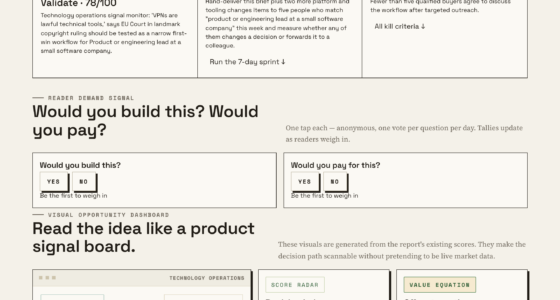

📊 Full opportunity report: Aleph Alpha. The retrospective case. on ThorstenMeyerAI.com — validation score, market gap, and execution plan.

Get the latest gadgets delivered free — and shop member deals
- Fast, free delivery on millions of items
- Access to Prime Big Deal Days deals on October 6–7
- Prime Video, Amazon Music and more included
TL;DR
Aleph Alpha, once a leading European AI firm, shifted from frontier-model competition to enterprise sovereignty before its 2026 merger with Cohere. Its trajectory highlights the costs of late strategic adaptation in AI development.
Aleph Alpha, founded in 2019 as Europe’s response to American AI labs, announced its acquisition by Canadian firm Cohere in April 2026 in a $20 billion deal, marking a pivotal shift in its strategic trajectory and highlighting the high costs of delayed adaptation.
Founded in Heidelberg by Jonas Andrulis and Samuel Weinbach, Aleph Alpha aimed to develop sovereign, explainable AI solutions for European entities, positioning itself as a European alternative to US-based hyperscalers. The company secured over €500 million in Series B funding by November 2023, reflecting substantial institutional ambition.
However, by mid-2024, Aleph Alpha pivoted away from frontier-model race, focusing instead on enterprise sovereignty and compliance, a strategic shift driven by the recognition that current resource scales were insufficient for building competitive frontier models independently. Leadership changes and a 17% workforce reduction in early 2026 underscored the internal challenges faced during this transition.
The April 2026 merger with Cohere, in which Aleph Alpha shareholders received a 10% stake, is viewed as the most significant European sovereign-AI deal of 2026. It exemplifies the structural lesson that attempting frontier capabilities without adequate scale incurs high costs, including delayed pivots and leadership upheavals.
Aleph Alpha.
The retrospective
case.
Founded January 2019. Once “Germany’s OpenAI.” Mid-2024 pivot away from frontier-model competition. April 2026 acquisition by Canadian Cohere in a $20B deal — Aleph Alpha shareholders 10%. The cost of getting the structural lesson right late.
Aleph Alpha is structurally distinct from the prior four essays in this track. It is not a forward-looking case study. It is a retrospective one — the company already navigated the strategic question Essays 01-04 documented, made the pivot from frontier-capability competition to enterprise-sovereignty positioning in mid-2024, and culminated in the most institutionally important European sovereign-AI deal of 2026: the April 24, 2026 Cohere merger. Founder Jonas Andrulis’s December 2025 Handelsblatt statement is the canonical retrospective acknowledgment that Mistral’s empirical results demonstrated and the four-way essay track empirically validated. The work was real. The lesson is real. Both can be true at once.
The founder said it. Out loud. In Handelsblatt.
From Jonas Andrulis’s December 2025 Handelsblatt interview, two months after announcing his CEO departure. The single most important sentence in the public Aleph Alpha record. Public acknowledgment from the founder of the company that exited the frontier-capability race that the structural finding from Essay 04 is correct.
Handelsblatt interview · December 2025
Five phases. Seven years.
Aleph Alpha’s trajectory through five distinct phases provides the European sovereign-AI movement with a complete reference case for what happens when companies attempt frontier-capability competition at insufficient resource scale. The prior four essay-track projects are still in earlier phases of their respective trajectories.
$20 billion combined entity. 10% Aleph Alpha shareholders.
The most institutionally important European sovereign-AI deal of 2026. This is not a merger of equals despite the “merger” terminology. It is a transatlantic acquisition of Aleph Alpha by Cohere, with Schwarz Group’s $600M commitment functioning as the down payment on European public-sector market access.
Five answers. Five structural findings.
Extending the four-way comparison from Essay 04 with the Aleph Alpha retrospective case. Aleph Alpha is the only project with a completed strategic outcome. The other four are still in earlier phases of their respective trajectories.
Five projects. Five findings. Each one harder than the framing it’s wrapped in. Aleph Alpha is the only project with a completed strategic outcome — the retrospective grounding the four forward-looking cases need to integrate. What Phase 4 and Phase 5 look like for the prior four is what the Aleph Alpha case suggests.
Five lessons. The retrospective grounding.
Strategic lessons the European sovereign-AI movement should integrate. This is not a counsel of despair. It is the operational reference case the four forward-looking essays’ strategic recommendations should be grounded against.
The work was real. The lesson is real. Both can be true at once. Aleph Alpha’s contribution to the framework is the retrospective acknowledgment that the European AI strategic discourse needed — Andrulis’s Handelsblatt formulation is the public-record statement from the founder of the company that empirically tested the proposition and concluded it could not be sustained. The discourse should integrate this acknowledgment. Better to pivot to Position 2 + Position 4 deliberately than to be forced into the pivot by structural reality.
Implications of Aleph Alpha’s Strategic Shift for European AI
Aleph Alpha’s experience underscores the structural challenge facing European AI development: current funding and compute resources are insufficient for independent frontier-model creation. The company’s late pivot and subsequent merger highlight the importance of timely strategic decisions to avoid costly delays and leadership disruptions. This case serves as a cautionary tale for other European AI initiatives, emphasizing the need for scaled partnerships and resource alignment to remain competitive in frontier AI.
European sovereign AI language models
As an affiliate, we earn on qualifying purchases.
As an affiliate, we earn on qualifying purchases.
European Sovereign AI Development and Aleph Alpha’s Role
Since its inception in 2019, Aleph Alpha aimed to position itself as Europe’s answer to US dominance in AI, emphasizing explainability and regulatory compliance. Its early funding trajectory, culminating in over €500 million by late 2023, reflected high institutional expectations. The company’s initial focus on frontier-model building faced structural limitations due to resource constraints, a challenge shared across European efforts to develop independent large-language models.
The broader European sovereign-LLM landscape includes initiatives like Portugal’s AMÁLIA, Italy’s Minerva, and France’s Mistral, all of which explore different institutional architectures to foster AI sovereignty. Aleph Alpha’s pivot and eventual merger exemplify the risks of pursuing frontier capabilities without sufficient scale, validating prior analyses that resource constraints are a fundamental barrier.
“”The Aleph Alpha case demonstrates the high costs of late strategic adaptation, including leadership upheaval and shareholder dilution, emphasizing the importance of timely resource scaling.””
— Thorsten Meyer
Unresolved Questions About the Cohere Integration
It remains unclear how the integration of Aleph Alpha into Cohere will impact the European AI landscape and operational capabilities. The long-term trajectory of the merged company and whether it can successfully leverage European sovereign AI principles are still developing issues.
Future Developments in European Sovereign AI Strategy
The next steps include monitoring the integration process of Cohere and Aleph Alpha, evaluating how the combined entity addresses resource and scale challenges, and observing whether other European initiatives adapt their strategies accordingly. Further analysis will reveal if the structural lessons from Aleph Alpha influence broader policy and funding decisions in Europe.
Key Questions
Why did Aleph Alpha pivot away from frontier-model competition?
The company recognized that current resource scales were insufficient for independent large-language model development, prompting a strategic shift toward enterprise sovereignty and compliance focus.
What does the Cohere merger mean for European AI sovereignty?
The merger signifies a recognition that European companies may need to form strategic alliances with international partners to compete effectively, highlighting the resource constraints faced by independent European AI firms.
What lessons does Aleph Alpha’s trajectory offer to other European AI projects?
It emphasizes the importance of scaling resources early, making timely strategic pivots, and forming strong partnerships to avoid costly delays and leadership disruptions.
Will Aleph Alpha’s approach to explainability and regulation influence future European AI policies?
While its technical and strategic choices set a precedent, the broader impact on policy will depend on how European regulators and institutions adapt to the resource and scale challenges demonstrated by Aleph Alpha’s experience.
Source: ThorstenMeyerAI.com
Fall Picks
fall essentials
As an affiliate, we earn on qualifying purchases.