📊 Full opportunity report: A Closer Look At 'SINGULARITY': The AI Technique Of Particle Geometry Mapping on ThorstenMeyerAI.com — validation score, market gap, and execution plan.

Get the latest gadgets delivered free with Prime
- Fast, free delivery on millions of items
- Prime Video, Amazon Music and more included
- Member-only deals all year
TL;DR
The ‘SINGULARITY’ project showcases a new AI technique called Particle Geometry Mapping, transforming abstract data into immersive spatial designs. This development highlights the intersection of AI, art, and architecture, with potential applications in intelligent environments.
‘SINGULARITY’ is a groundbreaking AI-driven design project that employs Particle Geometry Mapping to craft immersive environments. The project, showcased through a live space, exemplifies how advanced algorithms can translate complex data into tangible visual forms, as detailed in the original analysis, transforming a stark black room into a dynamic data and geometry symphony. This development matters because it offers a new paradigm for integrating AI into spatial design, with potential applications across architecture, art, and virtual environments.
The ‘SINGULARITY’ project, developed by a design team and exhibited in a controlled space, utilizes Particle Geometry Mapping—an innovative AI technique that converts data points into geometric particles, which are then manipulated to form intricate spatial structures. According to Thorsten Meyer, the project demonstrates how this method can produce highly detailed, immersive environments that challenge traditional notions of form and function.
During the live demonstration, the space was transformed from a minimal black room into a vibrant, data-driven visual landscape. For more insights, see the detailed coverage. The process involved complex algorithms that dynamically generated forms based on input data, creating a seamless blend of art and technology. The project aims to serve as a blueprint for future applications where AI can shape physical and virtual spaces in real-time, offering new avenues for design and interaction.
A Closer Look at “SINGULARITY”The AI Technique of Particle Geometry Mapping
Particle Geometry Mapping translates abstract data into geometric particles, then orchestrates those particles into immersive spatial designs. “SINGULARITY” presents the technique as a new bridge between algorithms, visual expression, and responsive architecture.
How data becomes spatial form
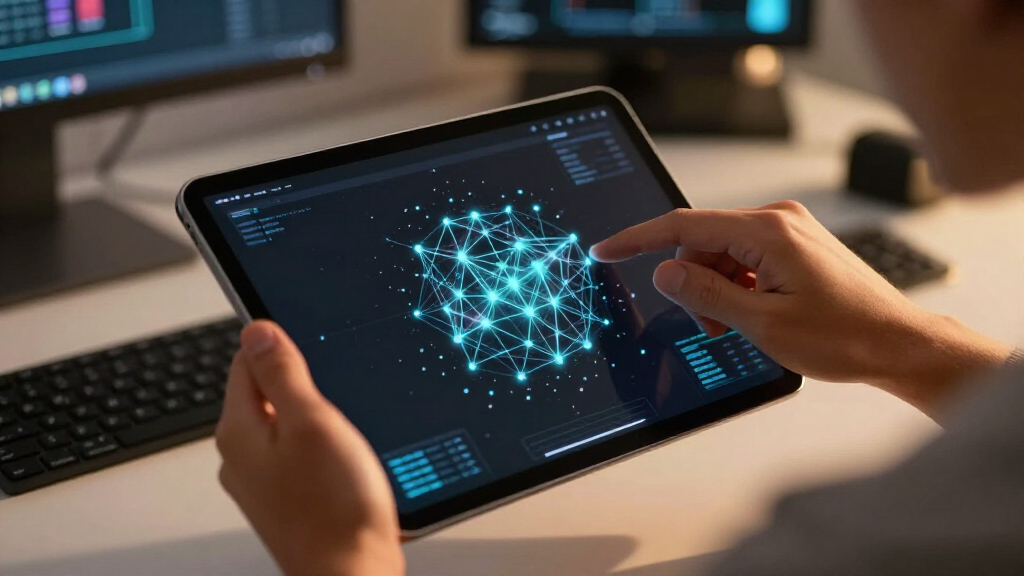
Particle Geometry Mapping treats information as a manipulable material. Algorithms interpret data points, assign spatial relationships, generate particle structures, and render the result as a physical or virtual environment.
Ingest
Complex datasets enter the system as values, coordinates, relationships, or changing signals.
Map
Each data point is translated into a geometric particle with defined spatial behavior.
Compose
Algorithms organize particles into coherent fields, surfaces, volumes, and structures.
Experience
The generated geometry becomes an immersive visual environment that can continue adapting.
From black room to data symphony
The controlled demonstration began with a stark, minimal space. Algorithmically generated particle geometry then transformed it into a layered visual landscape—a direct encounter with data as form, motion, and atmosphere.
Particles operate as both information carriers and building blocks, linking computational logic to visible structure.
Where particle geometry could matter
The project points beyond a single installation. Its deeper promise is a design system capable of interpreting changing information and reshaping environments around people, context, and purpose.
Adaptive spaces
Buildings and interiors could respond to occupancy, environmental conditions, or behavioral data with evolving spatial layers.
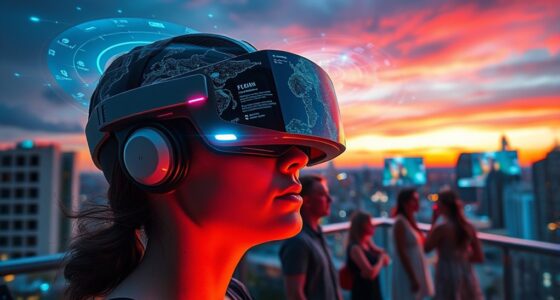
VR and AR worlds
Data-driven geometry could generate personalized virtual environments or augment physical locations in real time.
Data you inhabit
Complex systems could be explored spatially, turning abstract relationships into navigable structures.
Immersive art
Artists gain a responsive medium in which datasets become material, choreography, atmosphere, and form.
Responsive planning
Mobility, energy, density, and environmental inputs could inform dynamic simulations of future cities.
AI co-creation
Algorithms can expand the designer’s option space while reducing manual construction of highly intricate forms.
Traditional design versus particle mapping
The difference is not simply aesthetic. Particle Geometry Mapping changes the design unit, the production process, and the potential relationship between an environment and its underlying information.
| Design dimension | Traditional method | Particle Geometry Mapping | Current confidence |
|---|---|---|---|
| Primary building block | Fixed lines, surfaces, and volumes | Data-linked geometric particles | ✓ Demonstrated |
| Response to new data | Manual redesign is usually required | Forms may update algorithmically | ~ Emerging |
| Personalization | Defined during the design phase | Potentially continuous and contextual | ~ Unproven at scale |
| Geometric complexity | Constrained by manual production | High-detail structures generated rapidly | ✓ Strong potential |
| Workflow maturity | Established tools and standards | Integration details still developing | × Not established |
Promising, but not yet proven at scale
The demonstration establishes a compelling creative direction. It does not yet answer how consistently the technique performs across different environments, hardware constraints, or production workflows.
Computational demand
Dense particles and real-time transformations may require substantial processing and rendering capacity.
Scalability
Performance outside controlled demonstrations remains an open technical and operational question.
Workflow integration
Compatibility with established architecture and design systems has not yet been fully documented.
Reliable real-time behavior
Complex environments must remain coherent, responsive, and safe as their input data changes.
The path from signal to intelligent environment
The technique’s value rests on a continuous chain: meaningful inputs must become stable geometry, coherent experience, and ultimately useful adaptation.
What is Particle Geometry Mapping?
An AI technique that converts complex datasets into geometric particles and organizes them into immersive spatial environments.
How is SINGULARITY different?
It uses algorithmically generated, data-driven forms that can be dynamic and personalized rather than entirely static.
Can it be used elsewhere?
Potentially, but scalability, performance, and integration with existing tools still require broader testing.
What comes next?
Algorithm refinement, diverse field trials, academic documentation, and integration with virtual and augmented reality platforms.
Why does this development matter?
It reframes AI as a spatial collaborator: a system that can translate information into environments people experience physically or virtually.
Particle Geometry Mapping allows AI to translate complex data into detailed, spatially coherent forms that can be experienced physically or virtually.
Implications for AI-Driven Spatial Design
The ‘SINGULARITY’ project highlights a significant shift in how AI can influence spatial design and environmental architecture. By translating abstract data into tangible forms, this technique opens possibilities for creating highly personalized, adaptive spaces in real-time. It also demonstrates the potential for AI to serve as a creative partner in design processes, reducing manual effort while expanding artistic and functional possibilities. This approach could impact fields ranging from virtual reality to urban planning, where data-driven environments become increasingly relevant.
As an affiliate, we earn on qualifying purchases.
Advances in AI and Data-Driven Design
Particle Geometry Mapping is part of a broader trend toward integrating AI with creative design. Previous efforts have focused on generative art and virtual environments; however, ‘SINGULARITY’ pushes this further by enabling real-world spatial transformations. The project builds on recent developments in AI algorithms that interpret complex data sets into visual and structural outputs, reflecting a growing interest in AI as a tool for innovative architecture and immersive experiences. The project’s live demonstration and case study mark a notable milestone in this evolution.
“Particle Geometry Mapping allows AI to translate complex data into detailed, spatially coherent forms that can be experienced physically or virtually.”
— an anonymous researcher
Technical and Practical Limitations of Particle Geometry Mapping
While the ‘SINGULARITY’ project demonstrates promising results, it remains unclear how scalable and adaptable the Particle Geometry Mapping technique is for broader applications. Details about its performance in different environments, the computational resources required, and its integration into existing design workflows are still emerging. Experts have yet to confirm whether this approach can be widely adopted outside controlled demonstrations.
Future Development and Broader Applications
Next steps include further refining the algorithms for scalability, testing the technique in diverse environments, and exploring integration with virtual and augmented reality platforms. Researchers and designers are expected to investigate how Particle Geometry Mapping can enhance real-time adaptive spaces, potentially influencing architecture, urban planning, and immersive media. Public demonstrations and academic publications are anticipated to expand understanding of its capabilities and limitations.
Key Questions
What is Particle Geometry Mapping?
Particle Geometry Mapping is an AI technique that converts complex data sets into geometric particles, which are then manipulated to create immersive spatial environments.
How does ‘SINGULARITY’ differ from traditional design methods?
It uses AI algorithms to generate and manipulate data-driven forms in real-time, producing environments that are highly personalized and dynamic, unlike static traditional designs.
Can this technique be used outside the ‘SINGULARITY’ project?
While promising, its broader application is still under development. Scalability and integration into existing workflows are areas of ongoing research.
What are potential applications of Particle Geometry Mapping?
Potential uses include virtual reality environments, adaptive architecture, data visualization, and immersive art installations.
What are the main challenges facing this technology?
Current challenges include computational demands, scalability, and ensuring real-time performance in complex environments.
Source: ThorstenMeyerAI.com
Fall Picks
fall essentials
As an affiliate, we earn on qualifying purchases.