Portable thermal cameras turn a phone or compact handheld device into a tool for spotting temperature differences, but the right pick depends on whether you value detail, convenience, or standalone operation. I name the Thermal Master P1 320 × 240 my best overall choice for its balance of resolution and phone-based portability; the FLIR ONE Pro stands out for its higher stated super-resolution, while the TOPDON TC004 suits buyers who prefer a dedicated handheld camera. The tradeoffs are real: phone attachments are compact but depend on device compatibility, while handheld models are easier to operate independently but take up more space. Resolution claims and image-processing methods also vary, so headline numbers do not tell the whole story. Read on for my rankings, selection criteria, and advice on choosing among these 15 portable thermal cameras.

Get the latest gadgets delivered free with Prime
- Fast, free delivery on millions of items
- Prime Video, Amazon Music and more included
- Member-only deals all year
Complete the kit


Key Takeaways
- The lineup splits into two practical formats: phone-connected cameras favor a small carry footprint, while handheld models such as the TOPDON TC004 have their own screen and controls.
- The Thermal Master P1 320 × 240 is my best overall pick because its stated resolution offers a useful balance between portability and image detail for general inspection.
- The FLIR ONE Pro makes the strongest case for a premium phone attachment with its stated 480 × 360 Super Resolution, but buyers must check its iPhone USB-C compatibility.
- Resolution labels need context: models using terms such as TISR, Super IR, or QuadIR may rely on image processing, so buyers should distinguish native sensor resolution from enhanced output.
- There is no single best format for every job: compact phone modules suit quick checks, while standalone cameras are a better fit when a separate screen, controls, or phone-free operation matters.
| Thermal Master P1 USB-C Thermal Camera, 320 × 240 Resolution |  | Best Overall for USB-C Phone Users | Resolution: 320 × 240 | Refresh rate: 25 Hz | Temperature range: -4°F to 1112°F (-20°C to 600°C) | VIEW LATEST PRICE | See Our Full Breakdown |
| AMPBANK M192 USB-C Thermal Camera |  | Best for PC-Based Reporting | IR resolution: 192 × 192 | Enhanced resolution: Up to 384 × 384 | Refresh rate: 25 Hz | VIEW LATEST PRICE | See Our Full Breakdown |
| Mefape Mini Handheld Thermal Camera |  | Best for Standalone Simplicity | Thermal resolution: 32 × 24 | Display: 2.8-inch TFT, 320 × 240 | Temperature range: -40°C to 300°C | VIEW LATEST PRICE | See Our Full Breakdown |
| RISIÓN Magic Thermal Camera, 320 × 240 QuadIR |  | Best for Image-Fusion Inspection | Native resolution: 160 × 120 | Enhanced resolution: 320 × 240 QuadIR | Refresh rate: 25 Hz | VIEW LATEST PRICE | See Our Full Breakdown |
| Thermal Master Thor002 Thermal Camera |  | Best for Long Field Sessions | Display: 3.5-inch IPS | Native thermal resolution: 256 × 192 | Upscaled resolution: 512 × 384 | VIEW LATEST PRICE | See Our Full Breakdown |
| TOPDON TC004 Thermal Imaging Camera |  | Best for Field Inspections | Display: 3.5 inches | Native infrared resolution: 256 × 192 | Enhanced resolution: Up to 512 × 384 with TISR | VIEW LATEST PRICE | See Our Full Breakdown |
| AccuMEMS GT14S Thermal Imaging Camera with Thermometer Mode |  | Best for Long Inspection Sessions | Weight: 240 g (14.9 ounces) | Temperature range: -4°F to 1022°F | Thermal sensitivity: NETD < 50 mK | VIEW LATEST PRICE | See Our Full Breakdown |
| FLIR ONE Pro Thermal Imaging Camera for iPhone 15 and Newer (USB-C), 480 × 360 Super Resolution |  | Best for Guided iPhone Inspections | Compatibility: iPhone 15 and newer with USB-C | Native infrared resolution: 160 × 120 | Super resolution: 480 × 360 | VIEW LATEST PRICE | See Our Full Breakdown |
| Thermal Master P1 USB-C Thermal Camera for iPhone and Android |  | Best Cross-Device Phone Attachment | Native infrared resolution: 160 × 120 | Enhanced resolution: 320 × 240 | Thermal sensitivity: 0.04°C NETD | VIEW LATEST PRICE | See Our Full Breakdown |
| TOPDON TC004 Mini Thermal Imaging Camera |  | Best Compact Standalone Camera | Native infrared resolution: 128 × 128 | Enhanced resolution: 240 × 240 with TISR | Field of view: 40° × 30° | VIEW LATEST PRICE | See Our Full Breakdown |
| ANXTECH Mini Thermal Camera with Dual Lens |  | Best Standalone Pocket Pick | Brand: ANXTECH | Model: AMZ-AD19-B | Weight: 1.4 oz | VIEW LATEST PRICE | See Our Full Breakdown |
| Elrdvi Q3 Mini Thermal Camera, 32 × 32 Resolution, 1.69-Inch Touchscreen |  | Best for Simple Indoor Checks | Model: Q3 | Thermal resolution: 32 × 32 | Display: 1.69-inch touchscreen | VIEW LATEST PRICE | See Our Full Breakdown |
| Flagfront YXI96 Handheld Thermal Camera, 240 × 240 Resolution |  | Best for Rugged Field Inspections | Model: YXI96 | Resolution: 240 × 240 | Refresh rate: 25 Hz | VIEW LATEST PRICE | See Our Full Breakdown |
| AMPBANK H128 Thermal Camera with 240 × 240 TISR Resolution |  | Best for Long Inspection Sessions | Model: H128 | Thermal resolution: 240 × 240 TISR | Frame rate: 25 Hz | VIEW LATEST PRICE | See Our Full Breakdown |
| REVASRI Thermal Camera for iPhone and Android, 320 × 240 Super IR Resolution | 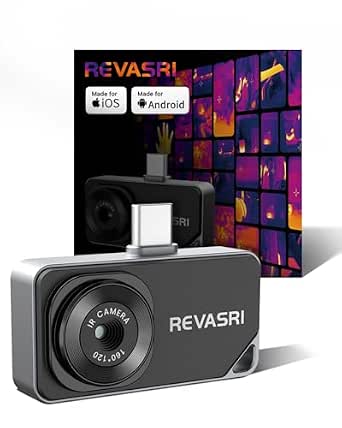 | Best Phone-Powered Detail | Model: RV-160 | Connectivity: USB-C | Compatibility: iOS, Android, and Windows devices with USB-C | VIEW LATEST PRICE | See Our Full Breakdown |
| portable thermal camera | Temperature range | Weight | Temperature accuracy |
|---|---|---|---|
| Thermal Master P1 USB-C Therma | -4°F to 1112°F (-20°C to 600°C) | 0.62 oz (17 g) | ±3.6°F |
| AMPBANK M192 USB-C Thermal Cam | — | 1.06 oz (30 g) | ±3.6°F (±2°C) or 2% |
| Mefape Mini Handheld Thermal C | -40°C to 300°C | — | — |
| RISIÓN Magic Thermal Camera | -4°F to 1112°F (-20°C to 600°C) | 0.8 oz | — |
| Thermal Master Thor002 Thermal | -4°F to 1022°F | 4.2 pounds | — |
| TOPDON TC004 Thermal Imaging C | -4°F to 1022°F | 2.11 pounds | — |
| AccuMEMS GT14S Thermal Imaging | -4°F to 1022°F | 240 g (14.9 ounces) | — |
| FLIR ONE Pro Thermal Imaging C | — | 1.29 ounces | ±3°C or ±5% under specified conditions |
| Thermal Master P1 USB-C Therma | -4°F to 1112°F (-20°C to 600°C) | 0.6 ounces | ±2°C / ±3.6°F |
| TOPDON TC004 Mini Thermal Imag | -4°F to 842°F (-20°C to 450°C) | — | ±3.6°F or ±2% |
| ANXTECH Mini Thermal Camera wi | — | 1.4 oz | — |
| Elrdvi Q3 Mini Thermal Camera | 30–212°F | 40 g (1.41 oz) | — |
| Flagfront YXI96 Handheld Therm | -4°F to 1022°F | — | Within 2% |
| AMPBANK H128 Thermal Camera wi | — | — | ±1% |
| REVASRI Thermal Camera for iPh | -4°F to 842°F (-20°C to 450°C) | — | ±2°C or ±2% |
More Details on Our Top Picks
Thermal Master P1 USB-C Thermal Camera, 320 × 240 Resolution
The P1 is the strongest fit here for buyers who want a small phone-connected camera without giving up useful image detail. Its 320 × 240 resolution and 25 Hz refresh rate make it better suited to following heat patterns across a moving inspection than the standalone Mefape, whose 32 × 24 sensor is far less detailed and refreshes at 8 Hz. The P1 also covers a broad -4°F to 1112°F range, with alarms and 15× digital zoom for checking specific areas. At just 0.62 ounces, it adds little bulk to a phone kit. The tradeoff is phone dependence: unlike the handheld Mefape, it has no built-in screen, and Lightning iPhones need a separate adapter. Its ±3.6°F accuracy also calls for care when readings must be precise.
Pros:- 320 × 240 resolution and 25 Hz refresh rate support detailed, responsive inspections.
- Broad temperature range covers both low-temperature checks and very hot surfaces.
- 15× digital zoom and temperature alarms add useful inspection controls.
- Weighs 0.62 ounces and includes a case and extension cable.
Cons:- Lightning iPhones require a separate adapter.
- ±3.6°F accuracy may not suit work that depends on tighter measurement tolerances.
- Requires a compatible phone or computer rather than operating as a standalone camera.
Best for: HVAC, electrical, and automotive inspectors who use a USB-C phone or computer and want a lightweight camera with detailed live imaging.
Not ideal for: Lightning iPhone owners who do not want to buy an adapter, or buyers who need a standalone camera with its own screen.
- Resolution:320 × 240
- Refresh rate:25 Hz
- Temperature range:-4°F to 1112°F (-20°C to 600°C)
- Temperature accuracy:±3.6°F
- Digital zoom:15×
- Weight:0.62 oz (17 g)
- Compatibility:USB-C smartphones and computers; Lightning iPhones require a separate adapter
- Continuous operation:5–8 hours
Our verdict“Choose the P1 for detailed, portable inspections from a USB-C device, but skip it if you need a built-in display or native Lightning support.”
AMPBANK M192 USB-C Thermal Camera
The M192 makes the most sense for buyers who need portable capture followed by organized analysis on a Windows PC. Its PC software and Excel data export give it a reporting advantage over the phone-focused Thermal Master P1, while temperature alarms and adjustable emissivity support more deliberate measurements. It connects to compatible USB-C iOS, Android, and Windows devices without a separate battery, and its 25 Hz refresh rate keeps live viewing responsive. The listed 192 × 192 sensor is below the P1’s 320 × 240 resolution, though selectable super-resolution modes can reach 384 × 384; that enhanced output depends on the device and mode, so it is not the same as native sensor detail. Mac users should skip it, since Mac compatibility is not supported.
Pros:- PC analysis software supports thermal reports and Excel data export.
- Works with compatible USB-C iOS, Android, and Windows devices without a separate battery.
- Includes high and low temperature alarms and adjustable emissivity.
- Compact 1.06-ounce body includes an extension cable and carrying case.
Cons:- Not compatible with Mac.
- Native infrared resolution is 192 × 192; enhanced resolution depends on device and mode.
- ±3.6°F (±2°C) or 2% accuracy may be too broad for tightly controlled measurement tasks.
Best for: Windows-based inspectors and technicians who want a compact USB-C camera with temperature alarms and a workflow for exporting thermal data.
Not ideal for: Mac users, or buyers who prioritize higher native sensor resolution over PC reporting tools.
- IR resolution:192 × 192
- Enhanced resolution:Up to 384 × 384
- Refresh rate:25 Hz
- Thermal sensitivity:40 mK
- Temperature accuracy:±3.6°F (±2°C) or 2%
- Weight:1.06 oz (30 g)
- Compatibility:USB-C iOS, Android, and Windows devices; not compatible with Mac
- Analysis features:PC analysis software, Excel data export, adjustable emissivity, and temperature alarms
Our verdict“Pick the M192 if PC analysis and data export matter more than native resolution, and avoid it if your workflow depends on Mac.”
Mefape Mini Handheld Thermal Camera
Unlike the Thermal Master P1 and AMPBANK M192, the Mefape does not depend on a phone to show thermal images: its 2.8-inch built-in screen makes it a self-contained option for quick checks around a home or workshop. It can store up to 100 images for later review and transfer them to a PC over USB-C. Its -40°C to 300°C measurement range and ±2°C accuracy cover many basic inspection tasks. The cost of that independence is a very low 32 × 24 thermal resolution and an 8 Hz refresh rate, which provide much less image detail and motion responsiveness than the P1’s 320 × 240, 25 Hz output. It also displays temperatures in Celsius only, limiting convenience for Fahrenheit-first users.
Pros:- Built-in 2.8-inch display works without a phone.
- Stores up to 100 images for later review.
- Rechargeable battery and USB-C PC transfer support portable use.
- Measures temperatures without contact across a -40°C to 300°C range.
Cons:- 32 × 24 thermal resolution provides far less image detail than the P1 or M192.
- 8 Hz refresh rate is slower than the 25 Hz phone-connected options.
- Temperature units are Celsius only.
Best for: Homeowners and maintenance staff who want a simple handheld tool for occasional checks without connecting a phone.
Not ideal for: Inspectors who need fine image detail, faster live updates, Fahrenheit readings, or extensive on-device storage.
- Thermal resolution:32 × 24
- Display:2.8-inch TFT, 320 × 240
- Temperature range:-40°C to 300°C
- Accuracy:±2°C
- Refresh rate:8 Hz
- Image storage:Up to 100 images
- Battery:3.7V 800mAh rechargeable lithium-ion
- Temperature unit:Celsius only
Our verdict“Choose the Mefape for simple standalone spot checks, but choose the P1 or M192 if image detail and responsive live viewing matter more.”
RISIÓN Magic Thermal Camera, 320 × 240 QuadIR
The RISIÓN Magic suits buyers who want image-fusion tools in a compact phone-connected camera. It combines thermal imagery with visible-light fusion and offers 12 color palettes, adjustable emissivity, and analysis tools, which can help users relate a heat pattern to the object around it. Compared with the Thermal Master P1, the RISIÓN adds that fusion-oriented workflow and broad compatibility with USB-C iOS, Android, and Windows devices. The headline 320 × 240 QuadIR image is enhanced from a native 160 × 120 sensor, however, so buyers seeking native 320 × 240 detail should not treat the two specifications as equivalent. It also does not support Mac. At 0.8 ounces, it remains easy to carry, but the P1 offers higher stated sensor resolution for buyers who place detail first.
Pros:- Image fusion helps place thermal patterns in visible scene context.
- Offers 12 color palettes, adjustable emissivity, and thermal analysis tools.
- Broad temperature range supports varied home, mechanical, and electrical checks.
- Lightweight 0.8-ounce design connects to compatible iOS, Android, and Windows devices.
Cons:- 320 × 240 output is enhanced from a native 160 × 120 sensor.
- Mac devices are not supported.
- ±3.6°F accuracy may limit confidence in tasks requiring tighter readings.
Best for: Home energy, HVAC, and vehicle inspectors who want thermal patterns combined with visible-light context on a compatible USB-C device.
Not ideal for: Mac users or technicians who need native 320 × 240 sensor resolution rather than enhanced imagery.
- Native resolution:160 × 120
- Enhanced resolution:320 × 240 QuadIR
- Refresh rate:25 Hz
- Temperature range:-4°F to 1112°F (-20°C to 600°C)
- Accuracy:±3.6°F
- Field of view:52° × 39°
- Compatibility:USB-C iOS, Android, and Windows; Mac not supported
- Weight:0.8 oz
Our verdict“Choose the RISIÓN for image-fusion tools and broad USB-C device support, but favor the P1 if native sensor detail is your priority.”
Thermal Master Thor002 Thermal Camera
The Thor002 is the most self-contained and ruggedly equipped option in this group, with a 3.5-inch IPS display, Wi-Fi, a 32GB memory card, and up to 10.5 hours of stated runtime. Its IP54 rating and 2-meter drop test make it a better match for longer site visits than the phone-powered P1, which is far lighter but relies on a connected device. Five imaging modes, six temperature measurement points, and 8× digital zoom add flexibility for comparing areas on the screen. The main portability compromise is substantial: at 4.2 pounds, it is much heavier than the handheld Mefape or pocket-sized USB-C cameras. Its 512 × 384 image is upscaled from a 256 × 192 sensor, and fixed focus gives less control over image sharpness than a focusing design.
Pros:- Built-in 3.5-inch display and Wi-Fi allow standalone viewing and connectivity.
- Up to 10.5 hours of runtime supports extended inspection sessions.
- IP54 rating and 2-meter drop testing suit tougher field conditions.
- Five imaging modes, six measurement points, and 8× digital zoom offer flexible viewing.
Cons:- At 4.2 pounds, it is much heavier than the phone-connected cameras in this roundup.
- 512 × 384 output is upscaled from a native 256 × 192 sensor.
- Fixed focus limits control over image sharpness.
Best for: Field technicians who need a standalone screen, long battery runtime, onboard storage, and a more rugged camera for extended inspections.
Not ideal for: Buyers who want a genuinely pocketable thermal camera, or those who need native 512 × 384 sensor detail or adjustable focus.
- Display:3.5-inch IPS
- Native thermal resolution:256 × 192
- Upscaled resolution:512 × 384
- Temperature range:-4°F to 1022°F
- Accuracy:±3.6°F
- Runtime:Up to 10.5 hours
- Protection:IP54; drop-tested to 2 meters
- Weight:4.2 pounds
Our verdict“Choose the Thor002 for long, standalone field inspections and rugged handling, but skip it if low weight and pocket portability lead your priorities.”
TOPDON TC004 Thermal Imaging Camera
The TOPDON TC004 suits buyers who want a standalone handheld camera with room to save inspection images, rather than a phone attachment. Its 3.5-inch display is larger than the screen-dependent setup of the Thermal Master P1, and 64GB of storage gives it a practical advantage for collecting images on jobs without relying on a connected phone. TISR boosts the image to 512 × 384, but the native sensor is 256 × 192, so buyers should distinguish enhanced output from captured sensor resolution. The IP54 protection, 2-meter drop resistance, and built-in LED suit work in less controlled spaces. The tradeoff is its 2.11-pound listed weight: this is a more substantial tool to carry than compact phone-connected models, and its enhanced resolution does not change the native sensor detail.
Pros:- 3.5-inch display makes on-camera inspection easier without a phone.
- 64GB storage and Wi-Fi support image saving and transfer.
- TISR enhances images up to 512 × 384 from a 256 × 192 sensor.
- IP54 protection, 2-meter drop resistance, and an LED light support field use.
Cons:- Native infrared resolution is 256 × 192; the higher figure is software-enhanced.
- At 2.11 pounds, it is heavier than phone-connected alternatives.
- Requires carrying a dedicated handheld device rather than using a compatible phone.
Best for: Tradespeople and building inspectors who want a standalone camera, a large viewing screen, and substantial onboard storage for field documentation.
Not ideal for: Buyers prioritizing the lightest pocketable setup or native resolution above 256 × 192; its listed weight is 2.11 pounds and TISR enhancement is not native sensor resolution.
- Display:3.5 inches
- Native infrared resolution:256 × 192
- Enhanced resolution:Up to 512 × 384 with TISR
- Temperature range:-4°F to 1022°F
- Storage:64GB
- Connectivity:Wi-Fi
- Protection:IP54; 2-meter drop resistance
- Weight:2.11 pounds
Our verdict“Choose the TC004 if a large onboard display and rugged standalone workflow matter more than low carry weight or higher native resolution.”
AccuMEMS GT14S Thermal Imaging Camera with Thermometer Mode
The AccuMEMS GT14S is a fit for buyers who put long runtime and direct temperature checks ahead of a well-documented imaging workflow. It combines live thermal viewing with a thermometer mode, adjustable emissivity and distance, and high/low alerts, giving inspectors more control over readings than the simpler feature set described for the TOPDON TC004 Mini. Its up to 14-hour battery life is useful for extended rounds without frequent charging, while the 50° field of view covers a broad area at once. The main limitation is missing detail in the supplied specifications: there is no display resolution, image storage, or connectivity information, which makes it harder to judge how useful it is for saving and sharing findings. At 240 g, it is portable, though less pocket-friendly than a phone attachment.
Pros:- Thermal imaging and thermometer modes support both scanning and point readings.
- Up to 14 hours of stated battery life suits long inspection sessions.
- Adjustable emissivity and distance allow measurement settings to be tailored.
- High and low temperature alerts help flag readings outside set limits.
Cons:- Display resolution is not provided, limiting comparison of image detail.
- Image storage and transfer options are not specified.
- At 240 g, it is heavier than very small phone-connected thermal cameras.
Best for: Maintenance technicians who need extended handheld scanning, adjustable measurement settings, and temperature alarms during long inspection shifts.
Not ideal for: Inspectors who need confirmed image resolution, onboard image storage, or phone-based reporting; those capabilities are not specified here.
- Weight:240 g (14.9 ounces)
- Temperature range:-4°F to 1022°F
- Thermal sensitivity:NETD < 50 mK
- Temperature detection:Down to 0.05°C
- Field of view:50°
- Color palettes:7
- Battery life:Up to 14 hours
- Warranty:1 year
Our verdict“Pick the GT14S for long handheld inspection sessions and measurement controls, but skip it if image saving and reporting are central to your workflow.”
FLIR ONE Pro Thermal Imaging Camera for iPhone 15 and Newer (USB-C), 480 × 360 Super Resolution
The FLIR ONE Pro makes the most sense for iPhone 15 and newer owners who want guided inspection steps in a compact phone-connected camera. Its app is a key distinction from the standalone TOPDON TC004: rather than bringing its own large display and storage, this FLIR relies on a compatible iPhone and pairs thermal imaging with prompts for tasks such as checking air leaks and moisture. VividIR and MSX enhance image detail, with the stated 480 × 360 super resolution built from a 160 × 120 native sensor. That distinction matters if buyers are comparing headline image figures. At just 1.29 ounces, it is much easier to carry than a handheld unit, and its 1.5-meter drop rating adds some jobsite resilience. The tradeoff is strict device compatibility and temperature accuracy that depends on operating and scene conditions.
Pros:- Compact 1.29-ounce design is easy to carry with a phone.
- App includes guided inspections for issues such as air leaks and moisture.
- VividIR and MSX enhance images from the 160 × 120 native sensor.
- Rated to withstand drops from up to 1.5 meters.
Cons:- Compatible only with iPhone 15 and newer models with USB-C.
- 480 × 360 super resolution is enhanced, not native sensor resolution.
- Temperature accuracy varies with operating and scene conditions.
Best for: Home inspectors and DIY renovators who own a USB-C iPhone 15 or newer and want app-guided checks for common building issues.
Not ideal for: Android users, owners of older or non-USB-C iPhones, and buyers who want a standalone camera with its own screen.
- Compatibility:iPhone 15 and newer with USB-C
- Native infrared resolution:160 × 120
- Super resolution:480 × 360
- Temperature accuracy:±3°C or ±5% under specified conditions
- Operating conditions:Unit: 15°C–35°C; scene: 5°C–120°C
- Dimensions:2.6 × 1.3 × 0.6 inches
- Weight:1.29 ounces
- Drop resistance:Up to 1.5 meters
Our verdict“Choose the FLIR ONE Pro for app-guided inspections if you have a compatible iPhone, but select a standalone camera if you need device-independent viewing.”
Thermal Master P1 USB-C Thermal Camera for iPhone and Android
The Thermal Master P1 stands out for buyers who want one USB-C thermal module for multiple device types: compatible phones, tablets, and Windows devices are listed, giving it broader platform reach than the FLIR ONE Pro, which is limited to newer USB-C iPhones. Its 160 × 120 native sensor is enhanced to 320 × 240, while the 52° × 39° field of view helps cover a broad scene and 15× zoom can help inspect a smaller area on screen. The P1 also reaches 1112°F, exceeding the listed upper range of both TOPDON cameras in this group. It draws power from the connected device, so there is no separate camera battery to charge, but that puts runtime and convenience in the hands of the host device. The USB-C requirement still excludes incompatible hardware.
Pros:- Works with compatible USB-C phones, tablets, and Windows devices.
- 15× zoom and a 52° × 39° field of view support close and broad-scene inspection.
- Temperature range extends to 1112°F, higher than the TOPDON models listed here.
- Powered by the connected device, so no separate camera charging is required.
Cons:- Requires a compatible USB-C host and depends on that device for operation.
- Native resolution is 160 × 120; 320 × 240 is enhanced output.
- Does not detect heat through walls.
Best for: Inspectors who use compatible USB-C phones, tablets, or Windows devices and want a compact module with zoom and a broad stated temperature range.
Not ideal for: Buyers without a compatible USB-C host, or anyone seeking a self-contained camera with its own screen and independent battery.
- Native infrared resolution:160 × 120
- Enhanced resolution:320 × 240
- Thermal sensitivity:0.04°C NETD
- Temperature range:-4°F to 1112°F (-20°C to 600°C)
- Temperature accuracy:±2°C / ±3.6°F
- Zoom:1–15×
- Field of view:52° × 39°
- Protection:IP54; 1-meter drop protection
- Weight:0.6 ounces
Our verdict“Choose the P1 if you need a flexible USB-C attachment across supported devices, and avoid it if you need a standalone thermal camera.”
TOPDON TC004 Mini Thermal Imaging Camera
The TC004 Mini is the better fit than the full-size TOPDON TC004 for buyers who want a dedicated handheld device without carrying a phone attachment or a heavier camera. It weighs 1.03 pounds and offers up to 15 hours of runtime, plus automatic photo capture when configured temperature alerts trigger. Storage is rated for up to 8,000 photos, so it can document a series of checks without depending on a phone or Wi-Fi workflow. Its 240 × 240 TISR image comes from a 128 × 128 native sensor, a meaningful limitation for buyers focused on sensor detail. The temperature range also tops out at 842°F, below the full-size TC004 and the Thermal Master P1. For routine building and equipment checks, its rugged, self-contained design is the draw; demanding high-temperature work points elsewhere.
Pros:- Standalone handheld format does not require a compatible phone.
- Up to 15 hours of runtime supports extended inspection use.
- Temperature alerts can trigger automatic photo capture, with storage for up to 8,000 images.
- IP54 rating and 2-meter drop resistance suit field work.
Cons:- Native infrared resolution is 128 × 128; 240 × 240 is TISR-enhanced.
- 842°F maximum temperature is lower than the full-size TOPDON TC004 and Thermal Master P1.
- Charging head is not included, and the paper manual is unavailable.
Best for: Building maintenance staff and homeowners who want a compact standalone camera with long runtime, alert-triggered photos, and onboard image storage.
Not ideal for: Inspectors who need a higher native sensor resolution or readings above 842°F; the P1 and full-size TC004 offer higher listed temperature ceilings.
- Native infrared resolution:128 × 128
- Enhanced resolution:240 × 240 with TISR
- Field of view:40° × 30°
- Refresh rate:25 Hz
- Temperature range:-4°F to 842°F (-20°C to 450°C)
- Temperature accuracy:±3.6°F or ±2%
- Storage:512 MB eMMC; up to 8,000 photos
- Battery life:Up to 15 hours
- Protection:IP54; up to 2-meter drop resistance
Our verdict“Pick the TC004 Mini for a durable, self-contained camera with long battery life and automatic image capture, but not for higher native resolution or high-temperature inspections.”
ANXTECH Mini Thermal Camera with Dual Lens
The ANXTECH Mini is the easiest fit for someone who wants a compact thermal camera that works on its own: its touchscreen needs no phone or app, and the listed weight is just 1.4 ounces. That makes quick checks around appliances, walls, or HVAC equipment less dependent on carrying another device. Compared with the Elrdvi Q3, it has no stated thermal resolution or temperature range, so I would choose the Elrdvi when those imaging details matter more than standalone convenience. The autofocus and stated 150 cm focus range add flexibility, but the product information gives little detail about thermal performance, making it harder to judge inspection precision. It is also not water resistant, so outdoor use should stay dry and cautious.
Pros:- Very light at a listed 1.4 ounces
- Touchscreen controls work without a phone or app
- Autofocus is specified, with a 150 cm focus range
- Suitable for assorted home and travel heat-source checks
Cons:- Thermal resolution and temperature measurement range are not provided
- Not water resistant
- Limited performance information makes it difficult to judge inspection detail
Best for: People who want an ultra-light, standalone camera for occasional indoor checks and do not want to operate a phone app.
Not ideal for: Buyers who need documented thermal resolution, known temperature limits, or weather protection for regular outdoor inspections.
- Brand:ANXTECH
- Model:AMZ-AD19-B
- Weight:1.4 oz
- Sensor type:Infrared
- Display:LCD touchscreen
- Focus:Autofocus; 150 cm focus range
- Effective still resolution:2 MP
- Water resistance:Not water resistant
Our verdict“Choose the ANXTECH for pocketable, phone-free checks, but pick the Elrdvi Q3 or a higher-resolution model when thermal specifications are a priority.”
Elrdvi Q3 Mini Thermal Camera, 32 × 32 Resolution, 1.69-Inch Touchscreen
The Elrdvi Q3 makes its limits clear: its 32 × 32 thermal resolution is suited to spotting broad hot and cold areas, not fine detail. For straightforward indoor checks, its 1.69-inch touchscreen, point readings, and automatic maximum/minimum tracking make basic inspection easier without requiring a separate phone display. Five palettes and on-device screenshots add useful ways to view and save findings. Compared with the Flagfront YXI96, the Q3 is much smaller and lighter, but the Flagfront’s 240 × 240 resolution is a better match for distinguishing smaller patterns. Elrdvi also lists a defined 30–212°F range, though that excludes many high-temperature applications. Its indoor-only use and low resolution keep this in the simple-check category.
Pros:- Compact body weighs 40 g
- Touchscreen supports point readings and maximum/minimum tracking
- Five palettes and on-device screenshot capture
- USB-C charging
Cons:- 32 × 32 thermal resolution offers limited image detail
- Listed for indoor use only
- 30–212°F range rules out many hotter inspection tasks
Best for: Homeowners who want a small, self-contained device for basic indoor HVAC, heating, or electrical checks and broad temperature patterns.
Not ideal for: Technicians who need to identify small thermal features, inspect outdoors, or measure temperatures outside the listed 30–212°F range.
- Model:Q3
- Thermal resolution:32 × 32
- Display:1.69-inch touchscreen
- Dimensions:1.77 × 1.50 × 0.87 in
- Weight:40 g (1.41 oz)
- Temperature range:30–212°F
- Color palettes:5
- Charging:USB-C
Our verdict“Pick the Elrdvi Q3 for uncomplicated indoor checks and portability, not for detailed imaging or broad temperature coverage.”
Flagfront YXI96 Handheld Thermal Camera, 240 × 240 Resolution
The Flagfront YXI96 balances useful image detail with protection for rougher handling. Its 240 × 240 imaging and 25 Hz refresh rate give it a clearer, smoother view than the Elrdvi Q3’s 32 × 32 sensor, while its 50° field of view covers a broad area during home, automotive, or circuit checks. High and low temperature alarms, plus center readings, help surface unusual heat without relying on a phone. The IP54 rating and 6.6-foot drop resistance are practical advantages over the ANXTECH Mini, which is not water resistant. The tradeoff is measurement certainty: the stated accuracy is within 2%, which may be too loose for tighter work. Its product information also lists indoor use, despite the protective rating.
Pros:- 240 × 240 imaging with a 25 Hz refresh rate
- High and low temperature alarms with center readings
- IP54 resistance and stated 6.6-foot drop resistance
- Six color palettes and a 50° field of view
Cons:- Stated accuracy within 2% may not suit precision-focused work
- Product information lists indoor use only
- No onboard storage capacity is specified
Best for: Home and automotive inspectors who want a handheld camera with clearer thermal imagery, alarms, and protection against dust, splashes, and accidental drops.
Not ideal for: Users requiring tighter temperature accuracy, a documented outdoor-use designation, or higher resolution than 240 × 240.
- Model:YXI96
- Resolution:240 × 240
- Refresh rate:25 Hz
- Temperature range:-4°F to 1022°F
- Temperature accuracy:Within 2%
- Field of view:50°
- Ingress protection:IP54
- Drop resistance:6.6 ft
Our verdict“Choose the Flagfront over the Elrdvi Q3 when clearer handheld imaging and physical protection matter more than tighter stated accuracy.”
AMPBANK H128 Thermal Camera with 240 × 240 TISR Resolution
The AMPBANK H128 is the strongest fit here for extended inspection rounds: it lists up to 24 hours of battery life, onboard storage for as many as 8,000 photos, and automatic maximum, minimum, and center temperature tracking. That makes it easier to document HVAC, electrical, automotive, or building checks without continually transferring files. Its 240 × 240 TISR imaging and 25 Hz frame rate put it well ahead of the Elrdvi Q3 for image detail and motion smoothness. Compared with the REVASRI RV-160, the H128 is a standalone handheld rather than a phone-powered attachment, but it is also much heavier at 1.03 pounds. IP65 protection and drop resistance add field durability; the stated ±1% accuracy still may not meet every precision requirement.
Pros:- Up to 24 hours of stated battery life
- 240 × 240 TISR imaging at 25 Hz
- IP65 protection and 6.6-foot drop resistance
- 512 MB storage supports up to 8,000 photos
Cons:- Listed weight of 1.03 pounds is heavier than the mini cameras
- Built-in storage is limited to 512 MB and no removable storage is specified
- Stated temperature accuracy is ±1%
Best for: Inspectors who need a standalone handheld for long work sessions, repeat readings, and saving many inspection photos on the device.
Not ideal for: Travelers prioritizing pocket-size carry, or specialists who need accuracy beyond the stated ±1% or removable storage.
- Model:H128
- Thermal resolution:240 × 240 TISR
- Frame rate:25 Hz
- Thermal sensitivity:40 mK
- Temperature accuracy:±1%
- Battery life:Up to 24 hours
- Protection:IP65; 6.6 ft drop resistance
- Storage:512 MB eMMC; up to 8,000 photos
Our verdict“Choose the H128 for long, documented inspection sessions; choose the lighter REVASRI if phone-powered portability matters more.”
REVASRI Thermal Camera for iPhone and Android, 320 × 240 Super IR Resolution
The REVASRI RV-160 is the pick for buyers who want 320 × 240 Super IR imaging in a compact attachment rather than another handheld device to charge. It draws power from a compatible USB-C phone, tablet, or computer and adds temperature alarms, tracking, picture-in-picture, and 15× digital zoom for inspection work. Compared with the standalone AMPBANK H128, it has higher listed image resolution and a much lighter carry setup, but the H128 does not depend on a host device or a dedicated app. REVASRI’s 25 Hz refresh rate and IP54 rating suit home, HVAC, electrical, and automotive checks, while the stated ±2°C or ±2% accuracy is less compelling for precision-focused readings. Compatibility and app setup are part of the deal.
Pros:- 320 × 240 Super IR image resolution and 25 Hz refresh rate
- Powered by the connected device, so no separate camera battery is needed
- Temperature alarms, tracking, picture-in-picture, and 15× digital zoom
- IP54 rating and stated 1-meter drop protection
Cons:- Requires a compatible USB-C host device
- Requires the dedicated Camera + app
- Temperature accuracy is stated as ±2°C or ±2%
Best for: Phone and tablet users who want higher-resolution thermal imaging and inspection tools without carrying a separate battery-powered camera.
Not ideal for: Buyers without a compatible USB-C device, people who prefer a standalone camera, or users who do not want to install the dedicated app.
- Model:RV-160
- Connectivity:USB-C
- Compatibility:iOS, Android, and Windows devices with USB-C
- Image resolution:320 × 240 Super IR
- Refresh rate:25 Hz
- Temperature range:-4°F to 842°F (-20°C to 450°C)
- Temperature accuracy:±2°C or ±2%
- Power source:Powered by connected device; no battery required
Our verdict“Choose the REVASRI for detailed thermal imaging through a compatible device, but pick the AMPBANK H128 if standalone operation is your priority.”

How We Picked
I ranked these cameras by how well their format and stated capabilities match common portable inspection tasks. I weighed stated thermal resolution and image-enhancement claims alongside usability: a camera that connects easily to a compatible phone can be convenient for quick checks, while a handheld model with its own display can reduce reliance on a phone. I also considered portability, control layout, and whether the product’s positioning makes it a practical choice for beginners, frequent users, or buyers with a specific device requirement.
The order reflects the balance of those factors, not a claim that one specification predicts image quality on its own. The P1 320 × 240 leads as a versatile phone-connected choice; the FLIR ONE Pro ranks highly for buyers who prioritize its stated higher super-resolution, while standalone options such as the TOPDON TC004 serve a different workflow. Models with enhanced-resolution labels are judged with caution because processed output is not the same as native sensor detail. I also treated exact phone compatibility as a ranking factor: a camera is only portable and useful if it works with the device a buyer intends to carry.
Factors to Consider When Choosing Portable Thermal Cameras
Choosing among portable thermal cameras is less about finding the biggest number on a product page and more about matching the camera to your inspection routine. I would settle the phone-versus-handheld question first, then check how resolution claims are described and whether the camera supports the way you plan to save or review images.
Choose Phone Attachment or Standalone Handheld
A phone-connected camera keeps the kit small and can make it convenient to review images alongside other phone-based notes. Its tradeoff is dependence on a compatible device, connector, and app; a compact camera that does not fit your phone setup is not a useful travel tool. Standalone cameras add a screen and controls, which can be easier when inspecting a space without juggling a phone. They usually occupy more room and may duplicate features you already have on your phone. Think about where you will hold the camera, whether you need to share the display with someone nearby, and whether carrying a second device is acceptable. Avoid choosing by size alone if your work calls for hands-free image review or frequent phone-free operation.
Read Resolution Claims With Care
Thermal resolution describes the number of temperature-sensing points, but product pages may also advertise enhanced or super-resolution output. Those labels can describe processing that sharpens or enlarges an image rather than a sensor with the same number of native thermal pixels. That difference matters when you need to distinguish small temperature patterns or inspect objects from farther away. Compare native sensor figures where available, then treat processing features as a possible aid rather than a substitute for sensor detail. A higher headline figure is not automatically the best match for broad home checks, where a wider view and simple operation may matter more. If your work depends on fine detail, look for clear documentation of both native resolution and enhancement methods.
Check Compatibility Before Buying
Phone attachments can be limited by connector type, operating system, phone model, or app support. A listing that mentions USB-C does not by itself confirm that every USB-C phone will work with the camera and its software. Check the maker’s compatibility list for your exact device, and confirm that the app is available and supported on your operating system. This check is especially relevant for the FLIR ONE Pro listing, which specifies iPhone 15 and newer, and for any phone-based camera you plan to use across multiple devices. If you expect to change phones soon, a standalone camera may offer more flexibility than a model tied to a particular mobile setup. Also check whether a case or phone port layout could obstruct a direct connection.
Match the Camera to the Inspection Distance
The size of the target and the distance from it affect how useful a thermal image will be. A camera suited to scanning a wall or checking a large mechanical surface may not resolve a small component from across a room. Before choosing, list the smallest target you need to inspect and the distance at which you can safely approach it. A higher-resolution model may help with small patterns, but it cannot remove limits caused by distance, focus, or the camera’s field of view. For general household checks, a comfortable viewing angle and quick controls may save more time than chasing the highest stated resolution. For close work, confirm that the camera can focus appropriately at the distances you expect to use.
Prioritize Workflow and Image Handling
Thermal cameras differ not only in how they capture heat patterns but also in how easily you can interpret and keep the results. Consider whether you need still images, reports, shareable files, or simple on-screen checks; the software can shape the usefulness of an otherwise capable sensor. Phone-based models may make it convenient to save and share images, while handheld models may provide a more direct viewing experience. Check file export options, app permissions, and whether saved images retain the information you need for later comparison. A common mistake is choosing a camera for capture quality alone, then discovering its workflow slows down documentation. If you only need occasional checks, uncomplicated controls may be a better fit than extra software features you will rarely use.
Decide Which Tradeoffs Merit Paying More
Spend more attention on features tied to your actual task than on a long list of headline functions. A higher-resolution or premium phone attachment may make sense when you need more image detail and your phone is supported, while a basic compact module can be sufficient for quick scans. A standalone camera can justify its larger form when a built-in display and dedicated controls improve the way you work. Do not pay extra for a resolution label unless you understand whether it refers to native sensing or processed output. Buyers who use a camera rarely may benefit more from easy setup and compatibility than from advanced imaging options. Frequent inspectors should weigh durability, handling, image storage, and repeatable operation as part of the total value.
Frequently Asked Questions
Is a phone-connected thermal camera better than a handheld model?
Neither format is better for every buyer; the choice depends on how you inspect. A phone attachment is easier to pack and can make saving or sharing images straightforward, but it relies on a compatible phone, connector, and app. A handheld model gives you a separate screen and controls, which can be more convenient when you do not want to use your phone during an inspection. If you work across several phones or want a self-contained tool, a standalone camera may be the simpler fit. If a small kit matters most and your phone is supported, a module can be more convenient to carry.
Does a 320 × 240 or 480 × 360 claim always mean more useful thermal detail?
Not necessarily, because product listings may mix native sensor resolution with enhanced or super-resolution output. Native thermal pixels describe the sensor’s underlying measurement grid, while processing can change how an image is presented. Lens, focus, target distance, and the size of the object also affect what details you can distinguish. Compare like with like by checking whether the listed figure is native or enhanced. For small targets, clear sensor specifications and suitable focus distance matter more than a headline number on its own.
What should I check before buying a USB-C thermal camera for my phone?
Confirm support for your exact phone model and operating system rather than relying on the connector description alone. Check whether the camera’s app is available for your device and whether the manufacturer lists any restrictions on phone generations. If you use a case, make sure the connector can reach the port without obstruction. It also helps to review how images are saved and exported, especially if you need records for work. When phone compatibility is uncertain or likely to change, a standalone model avoids tying the camera to one mobile setup.
Should I choose a camera with an onboard screen for home inspections?
An onboard screen can make quick checks easier because you do not need to connect a phone or manage a separate app during use. It is particularly useful if you want to hand the camera to another person or inspect areas where your phone is busy. The tradeoff is a larger device to carry, and a screen alone does not guarantee better thermal detail. If you mainly want to capture and share images from a compatible phone, a phone attachment may take up less space. Choose a built-in display for workflow convenience, not as a substitute for checking imaging specifications.
Which portable thermal camera type makes sense for occasional use?
For occasional checks, I would prioritize easy setup, clear compatibility, and controls you can understand without repeated reference to a manual. A compact phone-connected model can suit a buyer who already has a supported phone and wants minimal extra gear. A handheld camera can be a better choice if you would rather avoid app setup or phone dependence. Advanced resolution claims may matter less if your tasks involve broad scans rather than small components. Decide what you will inspect most often, then choose the format that makes those checks easiest to repeat.
Conclusion
For a balanced phone-connected option, I recommend the Thermal Master P1 320 × 240 as the best overall pick in this lineup. Buyers seeking the best value should compare compact phone attachments such as the AMPBANK M192 and REVASRI against their phone compatibility and image workflow rather than paying for features they will not use. The FLIR ONE Pro is my best premium choice for buyers who want its stated 480 × 360 Super Resolution and have a supported iPhone; the TOPDON TC004 Mini is a sensible place for beginners to look if they prefer a dedicated display and controls. For phone-free operation, choose a standalone model such as the full-size TOPDON TC004; for a specific phone-based setup, verify the connector and app support before selecting among the P1 variants, FLIR ONE Pro, or REVASRI. That distinction—compact attachment versus self-contained handheld—is the clearest way to narrow these 15 portable thermal cameras to the right fit.