
The JACO ElitePro Tire Pressure Gauge at 100 PSI is my best overall pick for drivers who want a dedicated gauge with a range suited to common vehicle tires. The AstroAI A1 stands out as a battery-free choice, while the AstroAI Digital Tire Pressure Gauge and Inflator combines pressure checking and inflation for compressor users. The main tradeoffs are analog simplicity versus digital readouts, a standalone gauge versus an inflator, and a broad pressure range versus finer readability at everyday tire pressures. I compare all 15 options by format, range, and intended use so you can see which tradeoffs suit your needs.

Get the latest gadgets delivered free with Prime
- Fast, free delivery on millions of items
- Prime Video, Amazon Music and more included
- Member-only deals all year
Complete the kit



Key Takeaways
- Dedicated gauges are the strongest fit for routine checks. The JACO ElitePro 100 PSI and 60 PSI models focus on measuring pressure, while inflator-gauge combinations add compressor convenience at the cost of a bulkier setup.
- Pressure range should match the job, not just sound impressive. The 60 PSI JACO is aimed at ordinary vehicle tire readings, while the ETENWOLF T300 reaches 200 PSI and the AstroAI inflator gauge reaches 250 PSI for broader applications.
- Digital and battery-free designs solve different problems. Digital models offer an electronic display, while the AstroAI A1 avoids battery dependence; neither format removes the need to check the specified measurement range.
- Pencil gauges favor compactness and sharing. ETENWOLF and AstroAI sell two-packs, while Boao and Tallew offer larger sets suited to multiple vehicles or group use, with more pieces than a single driver may need.
- Air-chuck design matters when inflating tires. Dual-head gauges and compressor-connected inflators serve different access and workflow needs, so buyers should match the tool to their valve access and air-compressor fittings.
| ETENWOLF Tire Pressure Gauge, 0–75 PSI, Glow Dial | 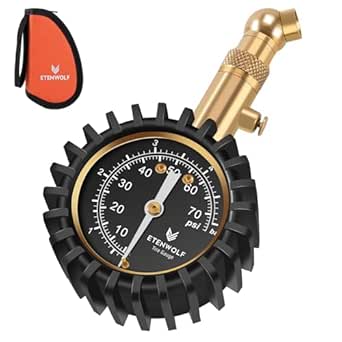 | Best Overall Analog Gauge | Pressure range: 0–75 PSI | Accuracy standard: ANSI B40.1 Grade A (±1% of span) | Chuck: 360-degree swivel | VIEW ON AMAZON | See Our Full Breakdown |
| AstroAI A1 Tire Pressure Gauge Battery-Free for Cars, SUVs & Motorcycles | 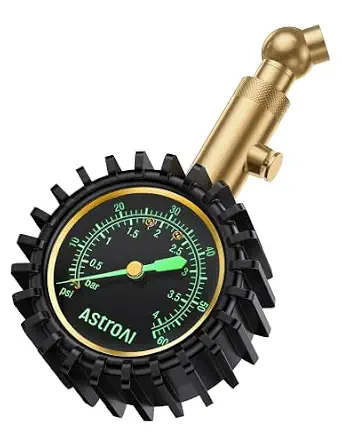 | Best Simple Battery-Free Pick | Pressure range: 2–60 PSI | Calibration: ANSI B40.1 (±1%) | Dial size: 2 inches | VIEW ON AMAZON | See Our Full Breakdown |
| AstroAI Digital Tire Pressure Gauge, 150 PSI |  | Best Digital Readout | Pressure range: 0–150 PSI | Accuracy: ±1 PSI | Measurement units: PSI, Bar, Kgf/cm², KPA | VIEW ON AMAZON | See Our Full Breakdown |
| JACO ElitePro Tire Pressure Gauge – 100 PSI |  | Best for Controlled Pressure Adjustments | Pressure range: 0–100 PSI | Accuracy: ±1.5% (ANSI standard) | Dial size: 2 inches | VIEW ON AMAZON | See Our Full Breakdown |
| 2-Pack Dual Head Tire Pressure Gauge 10-150 PSI |  | Best for Hard-to-Reach Valves | Pressure range: 10–150 PSI | Quantity: 2 gauges | Model: BL-4-0 | VIEW ON AMAZON | See Our Full Breakdown |
| ETENWOLF Pencil Tire Pressure Gauge Set, 2 Pack |  | Best for Two Pressure Ranges | Pressure ranges: 10–50 PSI and 20–120 PSI | Accuracy: ANSI B40.1 Grade B; 2% of span in the middle 50% and 3% in the lower and upper 25% of range | Materials: Stainless steel body with zinc alloy head | VIEW ON AMAZON | See Our Full Breakdown |
| AstroAI Pencil Tire Pressure Gauge, 2-Pack, 10–75 PSI |  | Best Compact Multiscale Pick | Pressure range: 10–75 PSI; 70–550 kPa; 0.7–5.5 BAR | Accuracy: ±2% of span | Certification: ANSI B40.1 Grade B | VIEW ON AMAZON | See Our Full Breakdown |
| Boao Pencil Tire Pressure Gauges with Valve Stem Caps, 30-Piece Set |  | Best for Shared Tool Kits | Set contents: 10 tire pressure gauges and 20 valve stem caps | Total pieces: 30 | Gauge material: Stainless steel | VIEW ON AMAZON | See Our Full Breakdown |
| JACO ElitePro Digital Tire Pressure Gauge, 100 PSI |  | Best for Fine Digital Readings | Maximum pressure: 100 PSI | Readout resolution: 0.10 PSI | Accuracy: ±0.50% FS (0.50 PSI) | VIEW ON AMAZON | See Our Full Breakdown |
| Air Chuck with Tire Pressure Gauge and Inflator for Air Compressor 100 PSI |  | Best for Compressor-Based Inflation | Accuracy: ±2% | Maximum pressure: 100 PSI | Dial: Glow dial | VIEW ON AMAZON | See Our Full Breakdown |
| ETENWOLF T300 Digital Tire Pressure Gauge, 3–200 PSI |  | Best for Wide Pressure Range | Pressure range: 3–200 PSI | Accuracy: ANSI B40.7 Grade 2A (±1 PSI) | Operating temperature: -4°F to 130°F (-20°C to 54°C) | VIEW ON AMAZON | See Our Full Breakdown |
| JACO ElitePro Tire Pressure Gauge – 60 PSI |  | Best Analog Gauge for Passenger Cars | Model: JSP-004 | Maximum pressure: 60 PSI | Material: Solid brass | VIEW ON AMAZON | See Our Full Breakdown |
| AstroAI Digital Tire Pressure Gauge and Inflator, 3–250 PSI, 1/4-Inch NPT |  | Best for Inflate-and-Check Work | Pressure range: 3–250 PSI | Resolution: 0.1 PSI | Accuracy: ANSI B40.7 Grade 2A, ±0.5% full scale | VIEW ON AMAZON | See Our Full Breakdown |
| AZUNO Digital Tire Inflator with Pressure Gauge, 200 PSI, Heavy Duty Air Compressor Accessories, with Rubber Hose Lock on Air Chuck and Quick Connect Coupler |  | Best for Portable Compressor Setups | Pressure range: Up to 200 PSI | Display resolution: 0.1 | Display: Backlit LCD | VIEW ON AMAZON | See Our Full Breakdown |
| Tallew 10 Pack Dual Head Tire Pressure Gauge for Auto, Truck, Car, RV, Van, 10-150 PSI, 1-10 Bar |  | Best Multi-Gauge Set | Package quantity: 10 gauges | Measurement range: 10–150 PSI, 1–10 Bar | Length: 12 inches | VIEW ON AMAZON | See Our Full Breakdown |
| tire pressure gauge | Pressure range | Accuracy |
|---|---|---|
| ETENWOLF Tire Pressure Gauge | 0–75 PSI | — |
| AstroAI A1 Tire Pressure Gauge | 2–60 PSI | — |
| AstroAI Digital Tire Pressure | 0–150 PSI | ±1 PSI |
| JACO ElitePro Tire Pressure Ga | 0–100 PSI | ±1.5% (ANSI standard) |
| 2-Pack Dual Head Tire Pressure | 10–150 PSI | — |
| ETENWOLF Pencil Tire Pressure | — | ANSI B40.1 Grade B; 2% of span in the middle 50% and 3% in the lower and upper 25% of range |
| AstroAI Pencil Tire Pressure G | 10–75 PSI; 70–550 kPa; 0.7–5.5 BAR | ±2% of span |
| Boao Pencil Tire Pressure Gaug | Not specified | — |
| JACO ElitePro Digital Tire Pre | — | ±0.50% FS (0.50 PSI) |
| Air Chuck with Tire Pressure G | — | ±2% |
| ETENWOLF T300 Digital Tire Pre | 3–200 PSI | ANSI B40.7 Grade 2A (±1 PSI) |
| JACO ElitePro Tire Pressure Ga | — | — |
| AstroAI Digital Tire Pressure | 3–250 PSI | ANSI B40.7 Grade 2A, ±0.5% full scale |
| AZUNO Digital Tire Inflator wi | Up to 200 PSI | — |
| Tallew 10 Pack Dual Head Tire | — | — |
More Details on Our Top Picks
ETENWOLF Tire Pressure Gauge, 0–75 PSI, Glow Dial
I’d choose the ETENWOLF Glow Dial for drivers who want an analog gauge with a useful pressure range and better access to awkwardly placed valves. Its 0–75 PSI range suits common passenger vehicles, motorcycles, bikes, and many RV tires, while the ANSI B40.1 Grade A specification gives a stated accuracy of ±1% of span. The glow dial and 360-degree swivel chuck help when checking tires in dim light or at an inconvenient angle. Compared with the AstroAI A1, it covers a broader pressure range and includes spare valve parts, but both require reading a dial rather than a digital display. The tradeoff is that analog readings may take more attention, and its upper limit won’t suit every high-pressure application.
Pros:- 0–75 PSI range covers many cars, motorcycles, bikes, SUVs, and RVs
- Glow dial supports readings in low light
- 360-degree swivel chuck helps reach valves from different angles
- Includes valve caps, Schrader valve cores, and a storage bag
Cons:- Analog scale can be less convenient to read than a digital display
- 75 PSI maximum excludes some higher-pressure tire applications
Best for: Drivers and owners of mixed vehicle types who want a battery-free analog gauge with low-light visibility and an angled-access chuck.
Not ideal for: Buyers who prefer a numeric digital readout or need to measure pressures above 75 PSI.
- Pressure range:0–75 PSI
- Accuracy standard:ANSI B40.1 Grade A (±1% of span)
- Chuck:360-degree swivel
- Valve compatibility:Schrader
- Materials:Brass and rubber
- Dimensions:4.76 × 2.83 × 1.38 inches
- Weight:285 g
- Included components:Gauge, 4 valve caps, 4 Schrader valve cores, and storage bag
Our verdict“Choose this ETENWOLF if you want a versatile analog gauge for everyday vehicles and value its glow dial and swivel chuck over a digital readout.”
AstroAI A1 Tire Pressure Gauge Battery-Free for Cars, SUVs & Motorcycles
The AstroAI A1 is a straightforward choice for drivers who want a battery-free gauge without paying for a digital interface they may not need. Its 2–60 PSI range fits many passenger-car and motorcycle checks, and the dual PSI/BAR dial gives users a choice of common units. A two-inch glow-in-the-dark face is easier to consult in poor light than a plain dial, while the rubber armor is intended to soften bumps during routine garage or roadside use. Compared with the ETENWOLF Glow Dial, the A1 has a lower ceiling and less valve-angle flexibility, but its simple layout may suit buyers who want a basic tool. It only fits Schrader valves, and its analog scale lacks the direct numeric display of the AstroAI digital gauge.
Pros:- Battery-free operation avoids battery replacement
- Dual PSI/BAR scale supports two common units
- Glow-in-the-dark two-inch dial aids low-light reading
- Rubber armor provides a protective exterior for everyday handling
Cons:- 60 PSI maximum is narrower than the ETENWOLF Glow Dial’s 75 PSI range
- Schrader-only compatibility limits use with other valve types
- Analog scale requires manual interpretation
Best for: Car and motorcycle owners who want a rugged, battery-free analog gauge for routine checks within a 60 PSI range.
Not ideal for: Owners of high-pressure tires or buyers who need compatibility beyond standard Schrader valves or prefer a digital readout.
- Pressure range:2–60 PSI
- Calibration:ANSI B40.1 (±1%)
- Dial size:2 inches
- Scale:Dual PSI/BAR
- Valve compatibility:Standard Schrader
- Construction:Brass internals with rubber armor
- Power:Battery-free
Our verdict“Pick the AstroAI A1 for a simple, battery-free gauge for ordinary car or motorcycle pressures, but choose a higher-range model for broader tire coverage.”
AstroAI Digital Tire Pressure Gauge, 150 PSI
For buyers who would rather read a number than interpret a dial, the AstroAI Digital Tire Pressure Gauge is the clearest fit in this group. Its backlit LCD and illuminated nozzle help with low-light checks, and the stated ±1 PSI accuracy pairs with a wide 0–150 PSI range. Four selectable units—PSI, Bar, Kgf/cm², and KPA—make it more adaptable for users who maintain different vehicles or follow non-PSI specifications. Compared with the analog ETENWOLF Glow Dial, this model gives a direct display and a higher pressure ceiling, but it depends on two AAA batteries and has no swivel chuck listed for difficult valve angles. Its compact 50 g body is easy to store; Schrader-only compatibility remains the main fit limitation.
Pros:- Backlit LCD and illuminated nozzle assist in dim conditions
- Measures from 0 to 150 PSI with stated ±1 PSI accuracy
- Offers PSI, Bar, Kgf/cm², and KPA units
- Compact 50 g design with automatic 30-second shutoff
Cons:- Requires two AAA batteries
- Fits standard Schrader valves only
- Does not list a swivel chuck for reaching angled valves
Best for: Drivers who want a compact digital gauge with multiple measurement units and a readable display for low-light tire checks.
Not ideal for: Buyers seeking a battery-free tool, non-Schrader valve compatibility, or a chuck specifically designed for awkward valve access.
- Pressure range:0–150 PSI
- Accuracy:±1 PSI
- Measurement units:PSI, Bar, Kgf/cm², KPA
- Valve compatibility:Schrader
- Display:Backlit LCD
- Automatic shutoff:30 seconds
- Batteries:2 AAA included
- Dimensions and weight:5.31 × 2.17 × 1.1 inches; 50 g
Our verdict“Choose this AstroAI if you value a clear digital reading and broad unit selection more than battery-free simplicity or a swivel chuck.”
JACO ElitePro Tire Pressure Gauge – 100 PSI
The JACO ElitePro 100 PSI is the most workshop-oriented analog pick here, pairing a brass body with a flexible hose and an air bleeder. That bleeder matters when a reading comes in high: a driver can release air in small steps rather than disconnecting the gauge and reaching for a separate tool. The locking glow dial holds the reading until reset, while the 360-degree swivel chuck helps with access. Compared with the ETENWOLF Glow Dial, the JACO adds a hose and pressure-release control, but its stated ±1.5% accuracy is less precise than the ETENWOLF’s ±1% of span specification. The 100 PSI ceiling suits a wider range than the AstroAI A1, though this larger, feature-rich analog setup is more than some drivers need for occasional checks.
Pros:- Built-in air bleeder supports controlled pressure reduction
- 360-degree swivel chuck and flexible hose aid valve access
- Glow-in-the-dark dial locks the reading until reset
- Brass construction with a shock-resistant guard
Cons:- Analog display lacks a direct digital readout
- Stated ±1.5% accuracy is less precise than the ETENWOLF Glow Dial’s stated ±1% of span
- Hose-and-gauge format is less compact than the AstroAI digital model
Best for: Home mechanics and frequent tire maintainers who want to measure pressure and bleed off excess air with one analog tool.
Not ideal for: Drivers who prioritize a compact pocket gauge, a digital display, or the tighter stated accuracy specification of the ETENWOLF Glow Dial.
- Pressure range:0–100 PSI
- Accuracy:±1.5% (ANSI standard)
- Dial size:2 inches
- Material:Brass
- Chuck:360-degree swivel
- Hose:HybridFlex leak-proof hose
- Thread style:NPT
- Warranty:100% lifetime warranty
Our verdict“Choose the JACO ElitePro if you regularly adjust tire pressure and want a bleeder, flexible hose, and locking dial in one tool.”
2-Pack Dual Head Tire Pressure Gauge 10-150 PSI
The Builimeer dual-head two-pack is aimed at drivers who value physical access and a spare gauge over backlighting or digital convenience. Its long-reach dual-head chuck is designed for valves that are awkward to approach directly, which can make it a practical choice for some truck, RV, and bike setups. A 10–150 PSI range extends well above the AstroAI A1 and the ETENWOLF Glow Dial, though the 10 PSI lower limit means it cannot check very low pressures. Two gauges in the package also let a household keep one in the vehicle and another in the garage. The tradeoff is a basic analog experience: the supplied description does not specify an accuracy tolerance, and there is no digital or backlit display for dim conditions.
Pros:- Dual-head long-reach chuck is suited to hard-to-access valves
- 150 PSI upper limit covers higher-pressure applications than the AstroAI A1
- Two gauges provide a spare or a second vehicle tool
- Stainless steel and brass construction
Cons:- 10 PSI minimum excludes low-pressure readings
- No digital or backlit display
- Product data does not provide a specific accuracy tolerance
Best for: Truck, RV, and multi-vehicle owners who need a long-reach chuck, a high pressure ceiling, and a spare gauge.
Not ideal for: Drivers who need measurements below 10 PSI, a specified accuracy tolerance, or a clear digital display for low-light checks.
- Pressure range:10–150 PSI
- Quantity:2 gauges
- Model:BL-4-0
- Brand:Builimeer
- Materials:Stainless steel and brass
- Chuck design:Dual head with long reach
- Display:Dual-scale analog
Our verdict“Pick this two-pack when long-reach valve access and a 150 PSI ceiling matter more than low-pressure measurement or digital readability.”
ETENWOLF Pencil Tire Pressure Gauge Set, 2 Pack
I’d choose this set when one gauge needs to cover both ordinary passenger-car tires and higher-pressure applications. Its 10–50 PSI gauge gives a narrower scale for common car pressures, while the second 20–120 PSI gauge extends coverage to heavier-duty tires. That split makes the pair more adaptable than the single-range AstroAI Pencil Tire Pressure Gauge, though it means keeping track of which gauge suits the tire being checked.
Both are battery-free, all-metal tools, and the ability to release excess air helps with small pressure adjustments. The included cases offer a place to store them, but these compact manual gauges still depend on reading the scale directly and can be misplaced. I’d skip them if you want a digital readout or need one gauge that covers the full range without swapping tools.
Pros:- Two ranges cover different vehicle pressure needs
- ANSI B40.1 Grade B calibration is specified
- Stainless steel bodies and zinc alloy heads provide all-metal construction
- Can release excess air, with two cases and 16 valve stem caps included
Cons:- Manual scales require a direct reading rather than a digital display
- Two gauges require choosing the right range and keeping both stored
- Compact tools may be easy to misplace
Best for: Drivers who maintain a passenger car and a higher-pressure vehicle and want a battery-free gauge matched to each range
Not ideal for: Buyers who prefer a digital display or want one gauge to handle every tire without choosing between two tools
- Pressure ranges:10–50 PSI and 20–120 PSI
- Accuracy:ANSI B40.1 Grade B; 2% of span in the middle 50% and 3% in the lower and upper 25% of range
- Materials:Stainless steel body with zinc alloy head
- Included components:2 gauges, 2 storage cases, 16 valve stem caps
- Weight:117 g
- Dimensions:5.8 × 2.9 × 0.7 inches
- Part number:G101
Our verdict“Choose this set if you want separate battery-free gauges for everyday and higher-pressure tires, but skip it if you prefer a single digital tool.”
AstroAI Pencil Tire Pressure Gauge, 2-Pack, 10–75 PSI
This two-pack suits drivers who want a simple pencil gauge that can be read in PSI, kPa, or BAR. That flexibility is more useful for mixed vehicle needs than the ETENWOLF set’s two separate PSI-only ranges, while its 10–75 PSI ceiling is better suited to cars, pickups, and many bicycles than to high-pressure tires. The ANSI B40.1 Grade B calibration and stated ±2% of span accuracy give buyers concrete guidance about its measurement performance.
The stainless steel build, pocket clip, and battery-free operation make it easy to keep one in a vehicle or tool kit. An integrated deflator valve allows small corrections, but the gauge is not a substitute for an inflator such as the Air Chuck with Tire Pressure Gauge. Its firm 75 PSI limit is the key boundary: exceeding it can permanently damage the gauge.
Pros:- Reads pressure in PSI, kPa, and BAR
- Two-gauge set includes integrated deflator valves and pocket clips
- Stainless steel construction and battery-free operation
- ANSI B40.1 Grade B certification and ±2% of span accuracy are specified
Cons:- Maximum rated pressure is 75 PSI, and exceeding it can damage the gauge
- Manual scale requires the user to read the measurement
- Does not inflate tires
Best for: Drivers of cars, pickups, and bicycles who want a portable manual gauge with multiple unit scales
Not ideal for: Owners of high-pressure tires above 75 PSI or buyers who need an inflator integrated with the gauge
- Pressure range:10–75 PSI; 70–550 kPa; 0.7–5.5 BAR
- Accuracy:±2% of span
- Certification:ANSI B40.1 Grade B
- Material:Stainless steel
- Features:Integrated deflator valve, chuck, ABS indicator bar, pocket clip
- Included components:2 gauges and 4 valve stem caps
- Dimensions:6.89 × 1.18 × 0.71 inches
- Weight:1.76 ounces
- Thread style:1/4-inch NPT
Our verdict“Pick this two-pack for portable, multiscale checks on vehicles within its 75 PSI limit, not for high-pressure tires or compressor-based inflation.”
Boao Pencil Tire Pressure Gauges with Valve Stem Caps, 30-Piece Set
The Boao set is built around quantity: it includes 10 compact pencil gauges and 20 valve stem caps, making it a practical fit for a shared garage, fleet kit, or group that needs tools in several vehicles. Compared with the two-gauge ETENWOLF and AstroAI sets, it offers many more gauges to distribute, but it provides less measurement guidance: the pressure range and scale units are not specified.
Its dual-sided scaleplate and mechanical chuck keep the design straightforward, and the small format is easy to store or carry. The caps can help protect valve stems from dirt and corrosion, but quantity does not make this the strongest choice for a buyer who needs known measurement limits or stated accuracy. I’d treat it as a basic bulk set for routine checks, not the pick for pressure-sensitive applications where precise specifications matter.
Pros:- Includes 10 gauges and 20 valve stem caps
- Compact gauges are convenient to distribute and store
- Dual-sided scaleplate provides two sides for reading
- Listed for cars, motorcycles, trucks, bikes, buses, SUVs, and ATVs
Cons:- Pressure range and scale units are not specified
- Accuracy information is not provided
- Bulk quantity may be unnecessary for an individual vehicle owner
Best for: Garages, clubs, or households that want to place basic manual gauges in multiple vehicles
Not ideal for: Drivers who need a stated PSI range, measurement units, or accuracy information before relying on a gauge
- Set contents:10 tire pressure gauges and 20 valve stem caps
- Total pieces:30
- Gauge material:Stainless steel
- Gauge size:14.5 × 1 cm (5.7 × 0.4 inches)
- Scaleplate:Dual-sided white ABS, with black and red scales
- Compatible vehicles:Cars, motorcycles, trucks, bikes, buses, SUVs, and ATVs
- Pressure range:Not specified
- Measurement units:Not specified
Our verdict“Choose this set to equip several vehicles with basic gauges, but select a model with a stated range if measurement limits matter to you.”
JACO ElitePro Digital Tire Pressure Gauge, 100 PSI
For buyers who want a clear numerical reading rather than a pencil scale, the JACO ElitePro offers 0.10 PSI resolution on a backlit LCD and a stated ±0.50 PSI accuracy. Its 100 PSI maximum gives it more headroom than the AstroAI pencil gauge’s 75 PSI limit, while the AstroAI avoids batteries and is simpler to carry. JACO’s 10-inch flexible hose can make access easier around awkward valve positions, and the air bleeder lets you reduce pressure while checking it.
The brass and alloy-steel construction, protective guard, automatic shutoff, and included batteries make this better suited to a dedicated garage kit than a minimalist glove-box tool. It still depends on two AAA batteries, and its digital display adds a power requirement the manual ETENWOLF gauges avoid. I’d choose it for controlled, readable adjustments, but not if battery-free simplicity is the priority.
Pros:- 0.10 PSI display resolution and stated ±0.50 PSI accuracy
- Backlit LCD with automatic shutoff
- Flexible 10-inch hose and air bleeder support easier access and pressure adjustment
- Brass and alloy-steel construction with a protective guard
Cons:- Requires two AAA batteries
- Maximum pressure is 100 PSI
- Larger, hose-equipped format is less pocket-friendly than pencil gauges
Best for: Home mechanics and drivers who want a backlit numerical readout and the ability to bleed pressure while checking
Not ideal for: Buyers seeking a battery-free pocket gauge or a tool with a pressure range above 100 PSI
- Maximum pressure:100 PSI
- Readout resolution:0.10 PSI
- Accuracy:±0.50% FS (0.50 PSI)
- Hose length:10 inches
- Display:2.5-inch backlit LCD
- Materials:Alloy steel and brass
- Thread style:1/4-inch NPT
- Power:2 AAA batteries included
- Warranty:Lifetime
Our verdict“Choose the JACO for readable digital checks and pressure bleeding in a garage, but pick a manual gauge if you want a smaller tool without batteries.”
Air Chuck with Tire Pressure Gauge and Inflator for Air Compressor 100 PSI
This pick combines a gauge and air chuck for drivers who already use a compressor and want to check and add air without switching tools. Its 20-inch hose and 360° swivel chuck can help reach valves that are awkward to approach, while the rubber protective case gives the dial a buffer against bumps. Compared with the digital JACO ElitePro, this model avoids batteries and is built around compressor use; the JACO, by contrast, offers a backlit numerical display and stated 0.10 PSI resolution.
The dial’s glow feature may help with visibility, and the stated ±2% accuracy gives a performance reference. Its main limitation is setup: it needs a compatible ¼ NPT compressor connection, so it is less useful as a standalone glove-box gauge. The 100 PSI ceiling also rules it out for some higher-pressure applications. I’d pick it for routine inflation at a compressor, not for portable checks away from one.
Pros:- Combines pressure checking and inflation for compressor use
- 360° swivel air chuck and 20-inch hose can improve access to valves
- Rubber protective case helps shield the gauge
- Battery-free operation with stated ±2% accuracy
Cons:- Requires a compatible ¼ NPT compressor output
- 100 PSI maximum limits use with higher-pressure tires
- Less convenient than a standalone pencil gauge for checks away from a compressor
Best for: Home garage users who have a compatible air compressor and want one tool for checking and adding tire pressure
Not ideal for: Drivers seeking a standalone portable gauge, users without a compatible compressor connection, or owners of tires needing over 100 PSI
- Accuracy:±2%
- Maximum pressure:100 PSI
- Dial:Glow dial
- Air chuck:360° swivel, improved
- Hose length:20 inches
- Compatibility:¼ NPT quick-connect
- Included:Dual head air chuck, Teflon tape, valve caps
- Model:Classic style
Our verdict“Choose this compressor-connected gauge and inflator for garage tire maintenance, but opt for a standalone gauge if you need portable checks.”
ETENWOLF T300 Digital Tire Pressure Gauge, 3–200 PSI
The ETENWOLF T300 is the flexible choice for households that check more than standard passenger-car tires: its 3–200 PSI range spans low-pressure applications and much higher-pressure tires. Its stated ANSI B40.7 Grade 2A accuracy and operating range down to -4°F make it a stronger fit for varied conditions than the JACO ElitePro 60 PSI, which is limited to a narrower range but adds a brass analog body and air bleeder. The T300 instead prioritizes a digital readout, LED light, and replaceable AAA batteries, with auto shut-off to conserve power. It is a Schrader gauge, though, and the Presta adapter is sold separately, so bicycle owners with Presta valves need another accessory. Its plastic construction may also appeal less to buyers seeking an all-metal tool.
Pros:- 3–200 PSI range covers a broad mix of tire pressure needs
- ANSI B40.7 Grade 2A accuracy rating of ±1 PSI
- LED light and replaceable AAA batteries support use in dim areas without relying on built-in rechargeable power
- Specified operating range extends from -4°F to 130°F
Cons:- Presta valve adapter is sold separately
- Plastic body may not suit buyers seeking a metal gauge
- Digital gauge requires batteries
Best for: Drivers who check several vehicle types or need a digital gauge that covers both low and high pressure readings, including use in cold weather.
Not ideal for: Cyclists using Presta valves who want an adapter in the box, or buyers who prefer a brass-bodied analog gauge.
- Pressure range:3–200 PSI
- Accuracy:ANSI B40.7 Grade 2A (±1 PSI)
- Operating temperature:-4°F to 130°F (-20°C to 54°C)
- Power:2 AAA batteries
- Valve type:Schrader
- Auto shut-off:30 seconds
- Dimensions:6.3 × 1.46 × 1.06 inches
- Weight:110 g
- Warranty:3 years
Our verdict“Choose the T300 if you want a wide-range digital Schrader gauge with cold-weather capability; choose the JACO ElitePro 60 PSI for a brass analog gauge with an air bleeder.”
JACO ElitePro Tire Pressure Gauge – 60 PSI
The JACO ElitePro 60 PSI is the lineup’s choice for drivers who want a mechanical gauge with pressure adjustment built in, rather than a battery-powered display. Its solid brass construction, shock-resistant guard, and flexible hose make it a more workshop-oriented tool than the compact ETENWOLF T300, while the air bleeder valve lets you release excess pressure without switching tools. The glow-in-the-dark dial also helps when checking tires in dim garages or at night. Its main limit is the 60 PSI maximum: that is a focused range for many passenger-car checks, not the broad coverage offered by gauges such as the T300 or AstroAI’s 3–250 PSI inflator. The analog face takes a little more attention to read, and the product data notes that calibration may need manual maintenance over time.
Pros:- Solid brass body with a shock-resistant guard
- Built-in air bleeder supports small pressure adjustments
- Glow-in-the-dark dial helps with low-light checks
- ANSI-standard calibration stated at ±1.5%
Cons:- 60 PSI maximum excludes higher-pressure applications
- Analog dial is less direct to read than a digital display
- Manual calibration may be needed over time
Best for: Passenger-car owners who prefer a durable, battery-free analog gauge and want to make small pressure reductions at the tire.
Not ideal for: Drivers checking tires above 60 PSI or buyers who want a digital display and a wider pressure range.
- Model:JSP-004
- Maximum pressure:60 PSI
- Material:Solid brass
- Calibration:ANSI Standards (±1.5%)
- Dial:Glow-in-the-dark
- Pressure adjustment:Built-in air bleeder valve
- Connection:Flexible hose with 360-degree swivel chuck
- Warranty:Lifetime
Our verdict“Pick this JACO for a brass analog gauge and built-in bleeding on passenger-car tires, but choose the ETENWOLF T300 if you need digital readings or more pressure range.”
AstroAI Digital Tire Pressure Gauge and Inflator, 3–250 PSI, 1/4-Inch NPT
Unlike a standalone gauge, the AstroAI combines pressure measurement, inflation, and deflation, letting compressor owners check a tire and adjust it with the same tool. Its 3–250 PSI range exceeds the ETENWOLF T300’s 200 PSI ceiling, while selectable units and 0.1 PSI resolution make it adaptable for users who work across different vehicles or measurement conventions. The backlit LCD and flashlight support checks in poorly lit garages, and automatic activation reduces button handling. This is not a self-contained inflator: it requires an air compressor, so it is less convenient for roadside checks than a handheld gauge. The 15-second inactivity shutoff can also interrupt a slower workflow, though it helps limit unnecessary power use. Compared with the AZUNO digital inflator, the AstroAI lists a defined accuracy rating and pressure range.
Pros:- Combines pressure checking, inflation, and deflation
- 3–250 PSI range with 0.1 PSI resolution
- Selects PSI, BAR, kPa, or kg/cm²
- Backlit LCD and built-in LED flashlight aid visibility
Cons:- Requires an air compressor for inflation
- Automatic shutoff after 15 seconds of inactivity may interrupt slower checks
- Heavier than a simple handheld gauge at 10.56 ounces
Best for: Home mechanics and vehicle owners who already have an air compressor and want one tool to measure, inflate, and bleed tires.
Not ideal for: Drivers wanting a standalone gauge for glovebox or roadside use, or anyone without access to an air compressor.
- Pressure range:3–250 PSI
- Resolution:0.1 PSI
- Accuracy:ANSI B40.7 Grade 2A, ±0.5% full scale
- Selectable units:PSI, BAR, kPa, kg/cm²
- Connection:1/4-inch NPT
- Weight:10.56 ounces
- Materials:ABS, aluminum, copper alloy
- Automatic shutoff:15 seconds of inactivity
- Warranty:3 years
Our verdict“Choose the AstroAI if you have a compressor and want an all-in-one service tool; for simple portable pressure checks, the ETENWOLF T300 is the more direct option.”
AZUNO Digital Tire Inflator with Pressure Gauge, 200 PSI, Heavy Duty Air Compressor Accessories, with Rubber Hose Lock on Air Chuck and Quick Connect Coupler
The AZUNO suits buyers who want a digital gauge packaged as an air-compressor accessory, with a rubber hose lock chuck, quick connect coupler, and carrying box. Its backlit LCD and listed 0.1 display resolution support clear readings, while four selectable units make it more adaptable than a basic PSI-only pencil gauge. Compared with the AstroAI 3–250 PSI inflator, the AZUNO has a 200 PSI ceiling and its supplied data does not specify an accuracy standard or a shutoff interval. That makes it harder to compare on measurement performance alone, even though its kit format is appealing for storage and transport. Like the AstroAI, it depends on an air compressor; it is not a standalone solution for checking pressure away from a compressor. Battery details are also unspecified.
Pros:- Includes rubber hose lock chuck, quick connect coupler, and carrying box
- Backlit LCD supports reading the gauge in dim conditions
- 0.1 display resolution and four selectable units
- Listed for cars, motorcycles, SUVs, construction vehicles, and large trucks
Cons:- Requires an air compressor for inflation
- Maximum pressure is 200 PSI, below the AstroAI inflator’s 250 PSI range
- Battery requirements and a formal accuracy specification are not provided
Best for: Drivers who keep an air compressor at home or in a work vehicle and want a digital inflator kit with a case and quick-connect hardware.
Not ideal for: Buyers seeking a standalone battery-powered pressure gauge, or those who need a documented accuracy standard and detailed operating specifications.
- Pressure range:Up to 200 PSI
- Display resolution:0.1
- Display:Backlit LCD
- Selectable units:PSI, kPa, Bar, kg/cm²
- Included components:Gauge, rubber hose lock, quick connect coupler, carrying box
- Vehicle suitability:Cars, motorcycles, SUVs, construction vehicles, large trucks
- Power:Battery requirement not specified
Our verdict“Choose the AZUNO for a portable compressor accessory kit with a storage case, but favor the AstroAI if you need a stated accuracy rating and a higher pressure ceiling.”
Tallew 10 Pack Dual Head Tire Pressure Gauge for Auto, Truck, Car, RV, Van, 10-150 PSI, 1-10 Bar
The Tallew set is built around quantity and reach: ten battery-free dual-head gauges can be stationed in multiple vehicles, shared across a fleet, or kept as spares. Each has a 10–150 PSI range, making it more suitable for higher-pressure checks than the JACO ElitePro 60 PSI, while the reverse-angle chuck and long body help reach some valve stems that are awkward to approach straight on. The tradeoff is that this is a manual gauge set, not a precision-oriented digital inflator like the AstroAI. Readings depend on using the push-pull chuck correctly and reading the scale, and the 12-inch length can be cumbersome in tight wheel wells. Buyers needing just one compact gauge may find the ten-piece format excessive; the value is in distributing tools, not in a single refined instrument.
Pros:- Ten gauges can be distributed among vehicles or work areas
- 10–150 PSI range covers higher pressures than the JACO ElitePro 60 PSI
- Dual-head design includes a 30-degree reverse chuck for varied valve access
- Battery-free operation with zinc alloy, brass, and aluminum components
Cons:- 12-inch body can be awkward in confined wheel wells
- Manual chuck placement and scale reading take more care than a digital gauge
- Ten-piece set may be excessive for a buyer needing only one gauge
Best for: Fleet managers, households with several vehicles, or repair spaces that want multiple battery-free gauges available at once.
Not ideal for: Drivers who want one compact gauge for tight wheel wells, a digital display, or integrated inflation and pressure adjustment.
- Package quantity:10 gauges
- Measurement range:10–150 PSI, 1–10 Bar
- Length:12 inches
- Stretch length:16 inches
- Materials:Zinc alloy, brass, aluminum
- Chuck design:Dual-head push-pull chucks, including 30-degree reverse chuck
- Power:No batteries required
- Additional feature:Hanging ring included
Our verdict“Choose the Tallew set when you need gauges for several vehicles or users; choose the AstroAI inflator for a single digital tool that also adjusts tire pressure.”

How We Picked
I compared the 15 tire pressure gauges by the needs they serve: routine checks on cars and motorcycles, compact or battery-free carry, readings across wider pressure ranges, and pressure measurement during compressor inflation. I gave more weight to a gauge’s fit for its stated use than to a high maximum PSI alone. A range that is close to the pressures a buyer expects to measure can be easier to work with than an unnecessarily broad range.
The ranking favors clear role separation and practical usability: dedicated gauges lead for drivers who mainly need pressure readings, while inflator combinations rank higher for buyers who regularly use an air compressor. I also considered the tradeoffs of digital versus analog or pencil formats, single tools versus multipacks, and stated hose or chuck fittings. Where products share a similar purpose, I distinguish them by range, power needs, and whether their quantity or compressor connection adds real value for the intended buyer.
Factors to Consider When Choosing Tire Pressure Gauges
Start with how you check tires, not with the longest feature list. A gauge carried in a vehicle, a tool used at home with an air compressor, and a multipack kept across several vehicles call for different designs. These factors can help narrow the field before you choose a model.
Match the Pressure Range to Your Tires
Check the vehicle placard or owner’s manual for the recommended cold tire pressure before choosing a gauge. The recommended pressure is a target for your vehicle; a gauge’s maximum PSI is only its measurement ceiling. A broad-range model can be useful for varied equipment, but a high ceiling does not automatically make it a better choice for ordinary car tires. A narrower range, such as the JACO 60 PSI option, is aimed more directly at typical vehicle checks. If you also work with trucks, RVs, motorcycles, or other equipment, verify their expected pressures before deciding whether a broader-range gauge is worth carrying.
Choose a Format You Will Use Consistently
Digital, dial, and pencil gauges each suit a different routine. A digital display may be easier to read at a glance, while a battery-free analog or pencil format avoids depending on powered electronics. Pencil gauges are compact and can be handy as spare tools, though their simple form may not suit buyers who prefer a larger display. Think about where you will take the reading: a dim garage, a roadside stop, or a well-lit home driveway can change which format feels easiest to handle. The most useful gauge is one you can read and operate confidently without turning a quick pressure check into a hassle.
Decide Whether You Need a Gauge or an Inflator
A standalone gauge is designed to measure pressure, while an inflator gauge joins that task to compressor use. If you mostly check tires and inflate them elsewhere, a compact dedicated gauge avoids carrying extra hose and fittings. If your routine includes adjusting pressure at home, an inflator combination can reduce tool changes. Check the connection requirements before buying: products listing 1/4-inch NPT or a quick-connect coupler may need to match the fittings on your compressor. A mismatch can mean buying an adapter or finding that the tool does not connect as expected.
Think About Valve Access and Chuck Design
Valve position and wheel design can make a gauge easier or harder to attach. A dual-head design may help when approaching valves from different angles, especially on some truck or multi-wheel setups, but it can be more tool than a passenger-car driver needs. A locking air chuck on a hose can be convenient during inflation because it helps hold the connection while air flows. Before choosing a chuck-focused tool, consider clearance around your wheel and whether you need the device for measurement alone or for inflation as well. Poor access can turn a technically suitable gauge into an awkward one to use.
Buy for the Number of Vehicles You Maintain
A two-pack can make sense if you want one gauge in the car and another at home, or if more than one driver needs a tool. Larger sets such as the Boao 30-piece kit or Tallew 10-pack are better suited to group, fleet, or shared-use needs than to a single driver. Multipacks can also provide spares, but extra units do not help if they are never used or stored where needed. Consider whether every driver can identify and use the gauge correctly, and keep measurement tools protected from damage. Choose quantity based on actual sharing and storage needs rather than assuming a larger set is automatically better value.
Prioritize Ease of Reading Over Extra Features
Reading the pressure accurately matters more than collecting features you rarely use. Check which pressure units the gauge displays and whether its scale or screen is straightforward for you to interpret. A gauge with multiple units can suit households or equipment that use different conventions, but more markings may feel cluttered to some buyers. For digital models, account for their battery requirements and how you will handle a depleted battery; for battery-free choices, consider whether the display style works for your eyesight and lighting conditions. The right balance is a tool that makes it easy to repeat the same check correctly across all four tires.
Frequently Asked Questions
Should I buy a 60 PSI gauge or a higher-range model for a passenger car?
Start with the recommended tire pressures in your vehicle manual or door placard and check that the gauge’s range covers them. A 60 PSI model such as the JACO ElitePro 60 PSI is more focused on ordinary vehicle readings, while broader-range options can serve additional equipment. Choosing a higher maximum does not by itself improve a reading at your tires’ target pressure. If you maintain only a passenger car, prioritize a clear, usable scale over the biggest range. If you also check an RV, truck, or other equipment, verify those pressure needs before choosing.
Is a digital tire pressure gauge a better choice than a battery-free gauge?
Neither format is automatically better for every driver. Digital models provide an electronic display, which may be easier for some people to read, but they depend on batteries. The AstroAI A1 avoids battery dependence, while its analog-style approach may be less appealing to buyers who prefer a digital readout. Think about where the gauge will be stored, how often you will use it, and whether you are comfortable keeping batteries available. Whichever type you choose, check the pressure range and make sure you can read its units without guesswork.
Do I need a tire pressure gauge with an inflator for home use?
An inflator gauge is useful if you regularly connect a compressor to adjust tire pressure and want to check readings as part of that task. If you only need to measure pressure, a dedicated gauge is usually a simpler tool to keep in the car or garage. Before buying an inflator combination, confirm that its fitting matches your compressor or that you have a suitable adapter. Hose length and chuck style also affect how easy it is to reach each valve. The combined tool saves steps only when its connections and design suit your setup.
When is a dual-head tire pressure gauge worth choosing?
A dual-head gauge is most useful when valve access is awkward or you maintain vehicles with different wheel layouts. Its head design can offer another approach angle, which may help around crowded wheel assemblies. For a typical passenger car with easy-to-reach valves, that feature may add little compared with a simpler gauge. Consider the vehicles you service and whether the gauge will be shared with someone who needs the extra access. If you mainly want a compact tool for occasional checks, a dual-head model may be unnecessary.
Should I choose a multipack if I only maintain one car?
A two-pack can be handy if you want one gauge in the car and one at home, or if another driver needs a separate tool. Larger kits such as a 10- or 30-piece set make more sense for shared vehicles, group use, or keeping spares across several locations. Extra gauges do not improve the measurement from the one you use, and they can be wasted if they are not stored or maintained. Decide where you want a gauge available and who will use it before buying a set. For one driver and one vehicle, a single well-matched tool may be the more practical choice.
Conclusion
For most drivers, my best overall choice is the JACO ElitePro 100 PSI, a dedicated gauge with a range suited to routine vehicle checks. For buyers who want a battery-free option, the AstroAI A1 is the best fit; I’d point beginners toward a straightforward dedicated gauge rather than an inflator with extra connections to manage. The best value depends on how many people need a tool: the ETENWOLF or AstroAI two-packs suit shared use, while larger Boao and Tallew sets make more sense for multiple vehicles or group settings. For compressor users, consider the AstroAI Digital Tire Pressure Gauge and Inflator or AZUNO inflator, checking that the fittings match your setup. If your work calls for broader pressure coverage, compare the ETENWOLF T300 and the higher-range inflator options; if you mainly check everyday tires, a more focused dedicated gauge is the simpler choice.
Halloween Picks
halloween
As an affiliate, we earn on qualifying purchases.