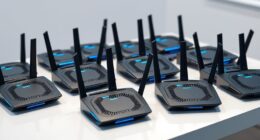
Smart humidity sensors can track indoor moisture, report changes to your phone, and help you spot conditions that may need attention. For most households, I’d start with the GoveeLife 2.0 WiFi Hygrometer Thermometer with Gateway and 3 Mini Sensors, which combines multiple room readings with remote monitoring. The Aqara Zigbee 3-Pack is a strong fit for buyers already using a compatible smart home hub, while the SONOFF AirGuard TH stands out if an at-a-glance LCD matters more than a set of small remote sensors. The key tradeoffs are Wi-Fi versus hub-based connectivity, app alerts versus local display, and buying one sensor versus covering several rooms. Read on for the full breakdown of all 15 options and the setup each one suits best.

Get the latest gadgets delivered free with Prime
- Fast, free delivery on millions of items
- Prime Video, Amazon Music and more included
- Member-only deals all year
Complete the kit



Key Takeaways
- Multi-room coverage favors gateway kits: GoveeLife’s 3-, 5-, and 6-sensor bundles and YoLink’s hub kits package several readings together, while single sensors suit targeted monitoring.
- Your existing smart home system can decide the winner: Aqara, Tapo, and SONOFF options may fit buyers with compatible ecosystems, but hub and platform requirements should be checked before purchase.
- Wi-Fi and Bluetooth serve different routines: Wi-Fi models are better suited to remote access, while Bluetooth options such as the Govee H5075 line make more sense for nearby checks.
- Displays reduce app dependence: The Govee H5103 E-Ink display and SONOFF AirGuard LCD provide visible readings, while compact sensors prioritize discreet placement.
- Several product families are close variants: Govee H5075 is offered as a single unit, two-pack, and three-pack, so buyers should choose coverage quantity rather than expect a different monitoring approach.
| Govee H5103 Wi-Fi Thermometer and Hygrometer with E-Ink Display |  | Best for Readable Remote Monitoring | Connectivity: 2.4 GHz Wi-Fi and Bluetooth; 5 GHz Wi-Fi not supported | Humidity range: Approximately 3% to 97% RH | Humidity accuracy: ±3% RH | VIEW ON AMAZON | See Our Full Breakdown |
| GoveeLife 2.0 WiFi Hygrometer Thermometer with Gateway, 3 Mini Sensors | 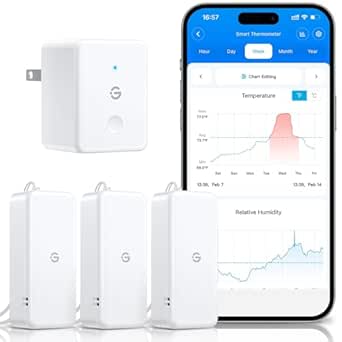 | Best for Multi-Room Coverage | Included sensors: 3 thermo-hygrometers | Connectivity: 2.4 GHz Wi-Fi gateway | Gateway capacity: Up to 10 sensors | VIEW ON AMAZON | See Our Full Breakdown |
| Aqara Zigbee Temperature and Humidity Sensor, 3-Pack |  | Best for Home Automation | Pack size: 3 sensors | Measurements: Temperature, humidity, and atmospheric pressure | Connectivity: Zigbee | VIEW ON AMAZON | See Our Full Breakdown |
| Govee H5075 Indoor Bluetooth Thermometer and Hygrometer, 2-Pack |  | Best for Local Readability | Quantity: 2 monitors | Connectivity: Bluetooth | Bluetooth range: Up to 164 ft (50 m) | VIEW ON AMAZON | See Our Full Breakdown |
| YoLink Indoor Temperature and Humidity Sensor Kit: 2-Pack + Hub | 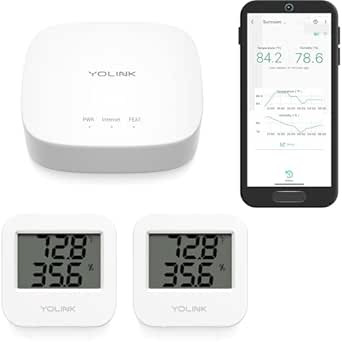 | Best for Long-Range Coverage | Included: 2 sensors and 1 hub | Connectivity: LoRa sensors; hub connects through Ethernet or Wi-Fi | Range: Up to 2,034 ft in open air | VIEW ON AMAZON | See Our Full Breakdown |
| GoveeLife Wi-Fi Hygrometer Thermometer with Gateway, 6 Mini Sensors |  | Best for Multi-Room Coverage | Sensors included: 6 mini thermo-hygrometers | Temperature accuracy: ±0.3°C / ±0.54°F | Humidity accuracy: ±3% RH | VIEW ON AMAZON | See Our Full Breakdown |
| YoLink Wireless Temperature & Humidity Sensor |  | Best for Long-Range Temperature Alerts | Wireless technology: LoRa | Connectivity: Compatible hub required for full functionality | Batteries: 2 AAA batteries included | VIEW ON AMAZON | See Our Full Breakdown |
| Tapo T310 Smart Temperature and Humidity Sensor | 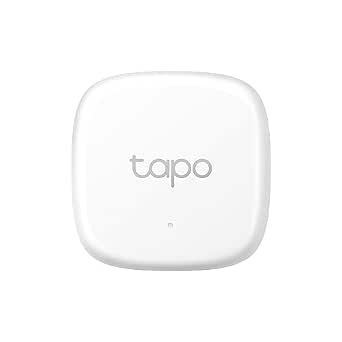 | Best for Tapo Smart-Home Automation | Measurements: Temperature and humidity | Temperature accuracy: ±0.54°F | Humidity accuracy: ±3% RH | VIEW ON AMAZON | See Our Full Breakdown |
| Govee H5075 Indoor Bluetooth Thermometer and Hygrometer |  | Best for At-a-Glance Readings | Connectivity: Bluetooth, up to 164 ft | Temperature accuracy: ±0.54°F | Humidity accuracy: ±3% RH | VIEW ON AMAZON | See Our Full Breakdown |
| YoLink Indoor Temperature and Humidity Sensor, 3-Pack (YS8003) |  | Best for Wi-Fi-Free Multi-Point Monitoring | Pack size: 3 sensors | Wireless technology: LoRa | Temperature range: 14°F to 122°F | VIEW ON AMAZON | See Our Full Breakdown |
| Govee H5075 Indoor Hygrometer and Thermometer, 3-Pack | 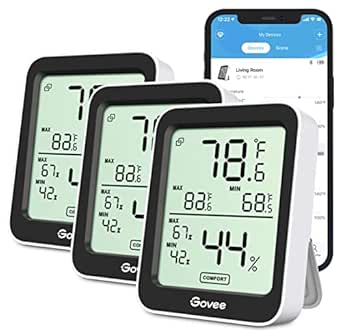 | Best for Multi-Room Bluetooth Monitoring | Pack size: 3 | Connectivity: Bluetooth | Bluetooth range: 196 ft (60 m) | VIEW ON AMAZON | See Our Full Breakdown |
| Govee Smart Bluetooth Thermometer Hygrometer H5074, Mini Humidity Sensor | 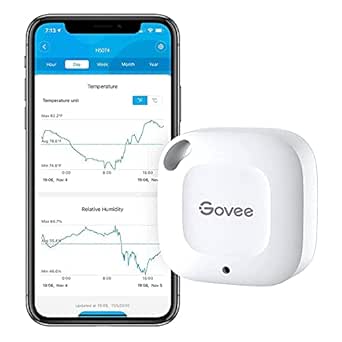 | Best Compact Pick | Model: H5074 | Connectivity: Bluetooth | Bluetooth range: 262 ft without obstacles | VIEW ON AMAZON | See Our Full Breakdown |
| SONOFF SNZB-02DR2 AirGuard TH Zigbee Temperature and Humidity Sensor with 3.6-Inch LCD |  | Best for Detailed Local Readings | Connectivity: Zigbee | Display: 3.6-inch LCD | Temperature range: -20 to 60 °C | VIEW ON AMAZON | See Our Full Breakdown |
| GoveeLife WiFi Thermometer Hygrometer, 5-in-1, 3-Pack with Gateway | 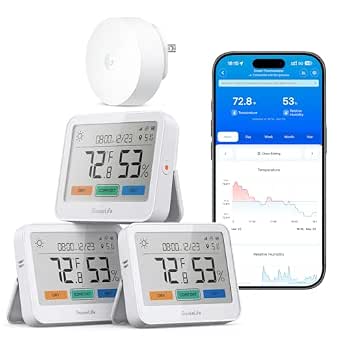 | Best for Remote Multi-Room Alerts | Pack size: 3 monitors | Connectivity: Wi-Fi and Bluetooth | Gateway: Sub-1G gateway included; H5044 gateway required for weather forecast | VIEW ON AMAZON | See Our Full Breakdown |
| Govee WiFi Thermometer Hygrometer H5179 with App Notification Alert |  | Best Single-Sensor Wi-Fi Pick | Connectivity: Wi-Fi and Bluetooth | Power source: 3 AA batteries, included | Temperature range: Up to 140 °F | VIEW ON AMAZON | See Our Full Breakdown |
| smart humidity sensor | Connectivity | Humidity accuracy | Temperature accuracy | Battery life |
|---|---|---|---|---|
| Govee H5103 Wi-Fi Thermometer | 2.4 GHz Wi-Fi and Bluetooth; 5 GHz Wi-Fi not supported | ±3% RH | ±0.54°F / ±0.3°C | — |
| GoveeLife 2.0 WiFi Hygrometer | 2.4 GHz Wi-Fi gateway | ±3% RH | ±0.54°F / ±0.3°C | Up to 2 years |
| Aqara Zigbee Temperature and H | Zigbee | — | — | — |
| Govee H5075 Indoor Bluetooth T | Bluetooth | ±3% RH | ±0.54°F | — |
| YoLink Indoor Temperature and | LoRa sensors; hub connects through Ethernet or Wi-Fi | — | — | Up to 2 years |
| GoveeLife Wi-Fi Hygrometer The | 2.4 GHz Wi-Fi and Bluetooth | ±3% RH | ±0.3°C / ±0.54°F | Up to 2 years |
| YoLink Wireless Temperature & | Compatible hub required for full functionality | — | — | Over 2 years |
| Tapo T310 Smart Temperature an | Sub-1G wireless to hub; 2.4 GHz Wi-Fi network required | ±3% RH | ±0.54°F | More than 1 year under normal use |
| Govee H5075 Indoor Bluetooth T | Bluetooth, up to 164 ft | ±3% RH | ±0.54°F | — |
| YoLink Indoor Temperature and | Hub required for full functionality | — | — | Up to 2+ years |
| Govee H5075 Indoor Hygrometer | Bluetooth | ±3% RH | ±0.54 °F | — |
| Govee Smart Bluetooth Thermome | Bluetooth | ±3% RH | ±0.54 °F | — |
| SONOFF SNZB-02DR2 AirGuard TH | Zigbee | ±2% RH | ±0.2 °C | — |
| GoveeLife WiFi Thermometer Hyg | Wi-Fi and Bluetooth | ±2% RH | — | Up to 2 years via Bluetooth or 1 year with gateway |
| Govee WiFi Thermometer Hygrome | Wi-Fi and Bluetooth | — | — | 6 months |
More Details on Our Top Picks
Govee H5103 Wi-Fi Thermometer and Hygrometer with E-Ink Display
The Govee H5103 suits buyers who want to check humidity at the sensor or from a phone: its e-ink display stays easy to read, while Wi-Fi and Bluetooth support remote app readings and alerts. Readings refresh every two seconds, and the app keeps 13-day graphs with data export for longer-term tracking. Compared with the Govee H5075 2-Pack, this is the stronger fit when remote access matters more than having two displays; the H5075 relies on Bluetooth. The tradeoff is that the H5103 supports only 2.4 GHz Wi-Fi and runs about six months on AA batteries, so it asks for more network and battery upkeep than the GoveeLife 2.0 kit, which lists up to two years of battery life. Its tabletop format also limits placement flexibility.
Pros:- E-ink display makes local readings easy to see.
- Wi-Fi and Bluetooth support remote monitoring and app alerts.
- Two-second refresh and ±3% RH humidity accuracy support frequent checks.
- App offers 13-day graphs and export of up to two years of data.
Cons:- Does not support 5 GHz Wi-Fi.
- About six months of battery life means more frequent replacement than the GoveeLife 2.0 kit.
- Tabletop mounting is less flexible than wall-mounted or lanyard-equipped sensors.
Best for: People who want one clearly readable room sensor with remote app alerts and humidity history.
Not ideal for: Buyers with only a 5 GHz Wi-Fi network, or anyone who needs multiple sensors or long battery intervals.
- Connectivity:2.4 GHz Wi-Fi and Bluetooth; 5 GHz Wi-Fi not supported
- Humidity range:Approximately 3% to 97% RH
- Humidity accuracy:±3% RH
- Temperature accuracy:±0.54°F / ±0.3°C
- Refresh rate:Every 2 seconds
- Display:Electronic ink
- Battery:1.5 V AA alkaline; about 6 months
- Data features:13-day graphs and up to 2 years of data export
Our verdict“Choose the H5103 for a readable single-room sensor with remote tracking, but skip it if you need a multi-sensor kit or longer battery life.”
GoveeLife 2.0 WiFi Hygrometer Thermometer with Gateway, 3 Mini Sensors
This GoveeLife 2.0 kit is the clearest choice here for monitoring several rooms: it bundles a gateway with three compact sensors, and the gateway can support up to 10 compatible sensors. Two-second updates, app and email alerts, 20-day trend charts, and export of up to two years of data make it easier to track changing humidity across locations. Compared with the single-sensor Govee H5103, it gives broader coverage and longer stated battery life, though it lacks the H5103’s e-ink screen. Its main constraint is the required 2.4 GHz Wi-Fi connection, along with gateway compatibility limited to specified Govee models. The included lanyards help with placement, but buyers should be comfortable managing a gateway and app rather than relying on standalone displays.
Pros:- Three sensors provide multi-room coverage from one gateway.
- Gateway can support up to 10 compatible sensors.
- App and email alerts help flag changing conditions.
- Up to two years of battery life and data export support longer-term monitoring.
Cons:- Gateway works with 2.4 GHz Wi-Fi only.
- Compatible only with specified H5151 or H5042 gateways.
- Compact sensors do not provide the easy-to-read display found on the Govee H5103.
Best for: Households tracking humidity in several rooms, such as bedrooms, storage areas, and a nursery, from one app.
Not ideal for: Buyers who want a standalone sensor without a gateway, use only 5 GHz Wi-Fi, or need a built-in display on each sensor.
- Included sensors:3 thermo-hygrometers
- Connectivity:2.4 GHz Wi-Fi gateway
- Gateway capacity:Up to 10 sensors
- Temperature accuracy:±0.54°F / ±0.3°C
- Humidity accuracy:±3% RH
- Refresh interval:2 seconds
- Battery life:Up to 2 years
- Data history:20-day trend charts; export up to 2 years of data
Our verdict“Pick this kit to track humidity across multiple rooms with app alerts, provided a gateway and 2.4 GHz Wi-Fi fit your setup.”
Aqara Zigbee Temperature and Humidity Sensor, 3-Pack
The Aqara three-pack earns its place for buyers who want humidity readings to do more than appear in an app. Through an Aqara Hub, these Zigbee sensors can send threshold alerts and trigger compatible home automations; they also measure atmospheric pressure, which the Govee H5075 does not. That extra integration comes with a clear entry requirement: the hub is sold separately, and third-party hubs are not officially supported. The five-second response time is slower than the two-second updates listed for the Govee H5103 and GoveeLife 2.0 sensors, so this set favors automation over rapid refresh. Its small wall-mountable form is useful for discreet placement, but the recommended sensor-to-hub distance is limited, and Aqara advises against extreme-temperature settings such as inside a refrigerator.
Pros:- Three sensors can monitor multiple indoor locations.
- Measures atmospheric pressure in addition to temperature and humidity.
- Can trigger threshold alerts and home automations through an Aqara Hub.
- Small wall-mountable design supports discreet placement.
Cons:- Requires a separately sold Aqara Hub.
- Third-party hubs and USB dongles are not officially supported.
- Five-second response is slower than the Govee H5103 and GoveeLife 2.0 sensors.
Best for: Aqara smart-home owners who want several humidity points to trigger alerts or connected-device routines.
Not ideal for: Buyers without an Aqara Hub, people seeking officially supported third-party hub use, or anyone needing fast refreshes in extreme-temperature spaces.
- Pack size:3 sensors
- Measurements:Temperature, humidity, and atmospheric pressure
- Connectivity:Zigbee
- Response time:5 seconds
- Hub requirement:Aqara Hub required; sold separately
- Recommended sensor-to-hub distance:Within 10 m (33 ft)
- Mounting:Wall mount
- Supported integrations:Apple HomeKit, Alexa, and IFTTT through an Aqara Hub
Our verdict“Choose this set if you already use an Aqara Hub and want humidity readings tied to home automations; otherwise, a Wi-Fi kit is simpler.”
Govee H5075 Indoor Bluetooth Thermometer and Hygrometer, 2-Pack
The Govee H5075 2-Pack prioritizes at-a-glance readings: each monitor has a 3-inch LCD, maximum and minimum records, and comfort indicators that make a quick room check straightforward. Bluetooth connects the pair to the Govee Home app for alerts, graphs, and CSV export, but it does not provide the remote Wi-Fi access offered by the Govee H5103 or GoveeLife 2.0 kit. That makes this pair a better match for nearby rooms than for checking a vacation home from elsewhere. Its stated Bluetooth range is up to 164 feet, while online history covers 20 days; longer records can be exported. Two displays offer more local coverage than the H5103, but buyers trade away Wi-Fi and its e-ink display.
Pros:- Two monitors provide local readings in separate rooms.
- Large LCD includes maximum/minimum records and dry, comfort, and wet indicators.
- App alerts notify users when readings leave preset ranges.
- Graphs and CSV export support review of stored humidity history.
Cons:- Bluetooth range is limited to a stated 164 feet and does not provide Wi-Fi remote access.
- Online data storage covers 20 days.
- LCD displays are less suited to buyers who prefer the H5103’s e-ink screen.
Best for: People who want two rooms to have visible humidity readings and use app alerts while within Bluetooth range.
Not ideal for: Remote-monitoring buyers who need readings away from home or want Wi-Fi-connected sensors.
- Quantity:2 monitors
- Connectivity:Bluetooth
- Bluetooth range:Up to 164 ft (50 m)
- Display:3-inch LCD
- Temperature accuracy:±0.54°F
- Humidity accuracy:±3% RH
- Refresh rate:Up to 2 seconds
- Data storage:20 days online; up to 2 years of data export
Our verdict“Choose the H5075 pair for clear local readings in two rooms, but choose a Wi-Fi model if you need to monitor humidity remotely.”
YoLink Indoor Temperature and Humidity Sensor Kit: 2-Pack + Hub
The YoLink kit stands apart for sensor reach: its LoRa system is rated for up to 2,034 feet in open air, making it a practical candidate for spread-out indoor spaces where Bluetooth may fall short. The included hub and two sensors avoid the separate-hub purchase required by the Aqara three-pack, and up to two years of battery life can reduce maintenance. Alexa and IFTTT support add smart-home options, though Alexa compatibility is limited to temperature according to the product data. Compared with the GoveeLife 2.0 kit, YoLink emphasizes range and low-power operation rather than multiple compact sensors and detailed trend-chart features. Its measurements are limited to indoor temperature and humidity, it is not designed for outdoor use, and SMS alerts may need extra setup.
Pros:- LoRa range is rated up to 2,034 feet in open air.
- Kit includes two sensors and a hub.
- Up to two years of battery life supports low-maintenance monitoring.
- Works with IFTTT and Alexa for temperature-related integration.
Cons:- Designed for indoor use, not outdoor monitoring.
- Monitoring is limited to temperature and humidity.
- SMS notifications may require additional setup, and Alexa support is temperature-only.
Best for: Owners of large homes, basements, or indoor outbuildings who need sensors to communicate across longer distances.
Not ideal for: Buyers needing outdoor monitoring, atmospheric pressure readings, or a feature-rich humidity history and graphing suite.
- Included:2 sensors and 1 hub
- Connectivity:LoRa sensors; hub connects through Ethernet or Wi-Fi
- Range:Up to 2,034 ft in open air
- Battery life:Up to 2 years
- Measurements:Indoor temperature and humidity
- Smart-home compatibility:Alexa for temperature and IFTTT
Our verdict“Choose YoLink when long-range indoor coverage and low battery upkeep matter more than extra measurements or detailed app history.”
GoveeLife Wi-Fi Hygrometer Thermometer with Gateway, 6 Mini Sensors
For tracking humidity across several rooms at once, this six-sensor kit offers broader coverage than the single-sensor Govee H5075. Its gateway can connect up to 10 sensors, and readings refresh every two seconds, making it easier to spot room-to-room changes and respond to preset threshold alerts. I’d favor this bundle for someone who also wants 20-day trend charts and the option to export two years of data for tracking recurring dampness or dry-air patterns. The tradeoff is a more involved setup: it requires a compatible H5151 or H5042 gateway and a 2.4 GHz Wi-Fi network. That gateway requirement makes it less convenient than a standalone Bluetooth display, and the six sensors may be more than a small apartment needs.
Pros:- Six sensors provide coverage across multiple locations from one gateway.
- Readings refresh every two seconds and support preset app and email alerts.
- Keeps 20-day trend charts and allows export of data from the past two years.
- Gateway can support up to 10 sensors, leaving room to expand.
Cons:- Requires a compatible H5151 or H5042 gateway.
- Connects to 2.4 GHz Wi-Fi only.
- The six-sensor bundle may be unnecessary for buyers monitoring just one room.
Best for: Households monitoring humidity in several rooms, storage areas, or other locations and wanting alerts plus long-term records.
Not ideal for: Buyers who need only one local reading, lack a compatible Govee gateway, or use a Wi-Fi network without 2.4 GHz support.
- Sensors included:6 mini thermo-hygrometers
- Temperature accuracy:±0.3°C / ±0.54°F
- Humidity accuracy:±3% RH
- Update interval:Every 2 seconds
- Connectivity:2.4 GHz Wi-Fi and Bluetooth
- Gateway capacity:Up to 10 sensors
- Compatible gateways:H5151 or H5042
- Battery life:Up to 2 years
- Data history:20-day trend charts; export data from the past 2 years
Our verdict“Choose this kit if you want frequent humidity updates and long-term records across several rooms and already have, or plan to use, a compatible gateway.”
YoLink Wireless Temperature & Humidity Sensor
Long-range LoRa communication gives this YoLink sensor a different role from the Wi-Fi-dependent GoveeLife six-sensor kit: it’s aimed at locations where ordinary wireless coverage can be difficult. The listing describes uses such as fridges, greenhouses, and pet enclosures, with app, email, and SMS alert options. However, the supplied product details say that humidity monitoring is not supported at this time, despite the humidity-focused product name. That makes it a poor fit for anyone choosing a sensor specifically to track moisture levels. It also needs a compatible YoLink hub for full functionality, and the free SMS allowance is limited. Compared with the YoLink three-pack, this listing provides one sensor, so it makes more sense as a targeted temperature-monitoring point than as a broad humidity setup.
Pros:- LoRa wireless communication is designed for long-range, low-power use.
- Offers app, email, and SMS alert options.
- Two AAA batteries are included, with stated battery life over two years.
- Can suit remote monitoring locations such as fridges or greenhouses.
Cons:- Humidity monitoring is not supported according to the provided product details.
- Requires a compatible YoLink hub for full functionality.
- Free SMS messages are limited to 15 per month with one sensor and hub.
Best for: Buyers who need long-range temperature monitoring for a remote fridge, greenhouse, or pet area and can use a YoLink hub.
Not ideal for: Anyone whose main goal is measuring or receiving alerts about humidity; the provided product details state humidity monitoring is unavailable.
- Wireless technology:LoRa
- Connectivity:Compatible hub required for full functionality
- Batteries:2 AAA batteries included
- Battery life:Over 2 years
- Alert options:App, email, and SMS
- Temperature range:Wide range; specific limits not provided
- Humidity monitoring:Not supported according to the provided product details
Our verdict“Skip this for humidity tracking; choose it only if long-range temperature alerts are your priority and you have a YoLink hub.”
Tapo T310 Smart Temperature and Humidity Sensor
The Tapo T310 makes the most sense when humidity readings need to trigger a wider smart-home routine, not just appear in an app. It refreshes every two seconds, supports notifications and automation with compatible Tapo devices, and records data for export for up to two years. That gives it a more automation-focused role than the display-first Govee H5075, which provides local readings and comfort indicators but is described here as a Bluetooth sensor. The catch is system commitment: the T310 requires a Tapo H100 hub, sold separately, plus a compatible 2.4 GHz network and regional Sub-1G support. Its included CR2450 battery is rated for more than a year under normal use, but actual life can vary. I’d choose it for a Tapo setup, not as a standalone sensor.
Pros:- Two-second updates provide frequent temperature and humidity readings.
- Supports app notifications and automation with compatible Tapo devices.
- Includes a CR2450 battery and 3M adhesive for mounting.
- Offers up to two years of data export.
Cons:- Requires a Tapo H100 hub, sold separately.
- Needs a 2.4 GHz Wi-Fi network and compatible regional Sub-1G bands.
- Battery life varies with operating conditions.
Best for: Tapo smart-home users who want humidity readings to feed app notifications or automation with compatible devices.
Not ideal for: Buyers seeking a self-contained sensor or those unwilling to add a Tapo H100 hub and check regional wireless compatibility.
- Measurements:Temperature and humidity
- Temperature accuracy:±0.54°F
- Humidity accuracy:±3% RH
- Update interval:Every 2 seconds
- Hub requirement:Tapo H100, sold separately
- Connectivity:Sub-1G wireless to hub; 2.4 GHz Wi-Fi network required
- Battery:1 CR2450, included
- Battery life:More than 1 year under normal use
- Data storage:Up to 2 years of data export
Our verdict“Pick the T310 if you already use Tapo devices and want humidity readings tied to automation; otherwise, its hub requirement makes simpler options more appealing.”
Govee H5075 Indoor Bluetooth Thermometer and Hygrometer
If I wanted humidity readings visible without opening an app, I’d put the Govee H5075 ahead of hub-dependent sensors such as the Tapo T310. Its 3-inch LCD shows current conditions, maximum and minimum records, and dry, comfort, or wet indicators; Bluetooth app access adds alerts and historical records within a stated range of up to 164 feet. Two-second updates and CSV export for up to two years make it useful for tracking changes, not just checking a momentary reading. The main limitation is reach: unlike the LoRa-based YoLink options, this model relies on Bluetooth and is intended for indoor tabletop use. It also lacks the multi-sensor coverage of the GoveeLife six-pack. Choose it for one room where a local display matters more than remote, whole-home monitoring.
Pros:- 3-inch LCD shows current readings and maximum and minimum records.
- Comfort indicators make dry, comfortable, or wet conditions easy to scan.
- Bluetooth app access supports alerts within a stated range of up to 164 feet.
- Provides 20-day graphs and CSV export of data for up to two years.
Cons:- Bluetooth monitoring is limited to a stated range of up to 164 feet.
- Designed for indoor use and tabletop placement.
- A single unit covers less ground than the GoveeLife six-sensor kit.
Best for: People monitoring one indoor room who want a readable screen, comfort indicators, and Bluetooth app alerts.
Not ideal for: Buyers who need long-range monitoring beyond Bluetooth coverage, multiple-room coverage, or a sensor for outdoor conditions.
- Connectivity:Bluetooth, up to 164 ft
- Temperature accuracy:±0.54°F
- Humidity accuracy:±3% RH
- Refresh interval:Every 2 seconds
- Display:3-inch LCD
- Operating humidity:10–90% RH
- Data storage:20-day graphs; export up to 2 years of data as CSV
- Mounting:Tabletop
- Power:2 alkaline batteries included
Our verdict“Choose the H5075 when a clear local display and single-room Bluetooth monitoring matter more than long-range or multi-room coverage.”
YoLink Indoor Temperature and Humidity Sensor, 3-Pack (YS8003)
This YoLink three-pack suits buyers who want to monitor several indoor locations without adding more devices to their Wi-Fi network. Its LoRa communication uses a compatible hub rather than Wi-Fi, and the sensors support app alerts and IFTTT integration. That makes it a better fit for spread-out locations than the Bluetooth-only Govee H5075, though the H5075 is the more self-contained choice because it includes a screen and does not require the YoLink hub described here. Each YoLink sensor includes two AAA batteries rated for up to two-plus years, which helps reduce routine battery changes. There are limits: the hub is required for full functionality, the stated temperature range is 14°F to 122°F, and Alexa support covers temperature only—not humidity queries or humidity-based routines.
Pros:- Three sensors cover multiple indoor locations.
- LoRa communication operates without using the Wi-Fi network.
- Supports app alerts and IFTTT integration.
- Includes two AAA batteries per sensor, rated for up to two-plus years.
Cons:- A YoLink hub is required for full functionality.
- Alexa voice support covers temperature only, not humidity queries or humidity routines.
- Stated temperature range is limited to 14°F to 122°F.
Best for: People tracking temperature and humidity in several indoor locations who want long-range LoRa communication, app alerts, or IFTTT integration.
Not ideal for: Buyers who want a standalone display, do not want a hub, need outdoor use, or rely on Alexa humidity queries and routines.
- Pack size:3 sensors
- Wireless technology:LoRa
- Temperature range:14°F to 122°F
- Resolution:0.1°C or 0.1°F
- Battery:Two AAA batteries included per sensor
- Battery life:Up to 2+ years
- Connectivity:Hub required for full functionality
- Usage:Indoor
- Dimensions:2.44 inches long
Our verdict“Choose this pack for multi-location indoor monitoring over LoRa if you accept the hub requirement and do not need Alexa humidity control.”
Govee H5075 Indoor Hygrometer and Thermometer, 3-Pack
The three-sensor H5075 pack makes it easier to compare humidity across rooms than a single-device option such as the Govee H5179. Each unit has a 3-inch LCD with dry, comfort, and wet indicators, so you can check conditions locally without opening the app. Bluetooth app alerts and recorded readings add useful tracking, and CSV export supports longer-term analysis if you want to spot seasonal patterns. The tradeoff is connectivity: the stated 196-foot Bluetooth range is not Wi-Fi remote access, so alerts and monitoring depend on staying within range. Online storage is limited to 20 days, though exported records can cover up to two years. This is a practical choice for several nearby rooms, not a remotely monitored property.
Pros:- Three sensors cover multiple indoor locations.
- Large LCDs show readings and dry, comfort, and wet indicators.
- App alerts notify when readings exceed set ranges.
- CSV export supports up to two years of data.
Cons:- Bluetooth monitoring has a stated range of 196 feet and does not provide Wi-Fi access.
- Online history lasts only 20 days unless data is exported.
- Tabletop-only mounting offers less placement flexibility than the hanging H5074.
Best for: Households that want readable humidity checks and app alerts in several rooms within Bluetooth range.
Not ideal for: People who need reliable monitoring away from home or whose sensors will be separated by walls and distance beyond Bluetooth range.
- Pack size:3
- Connectivity:Bluetooth
- Bluetooth range:196 ft (60 m)
- Display:3-inch LCD
- Temperature accuracy:±0.54 °F
- Humidity accuracy:±3% RH
- Online data storage:20 days
- Data export:Up to 2 years, CSV format
Our verdict“Choose the H5075 three-pack for at-a-glance humidity checks in several nearby rooms, but pick a Wi-Fi model for away-from-home monitoring.”
Govee Smart Bluetooth Thermometer Hygrometer H5074, Mini Humidity Sensor
The Govee H5074 is the space-saving choice in this group: at just 1.57 inches square, it can hang in a cupboard, nursery, or other tight spot where the H5075’s larger screen would be awkward. It uses the same stated temperature and humidity accuracy as the H5075 three-pack, but this is a single Bluetooth sensor, so it suits one focused monitoring point rather than whole-home coverage. The app adds alerts and lets you review readings, with 20 days of onboard storage and CSV export for longer records. Its stated 262-foot range exceeds the H5075’s 196 feet, though walls and obstacles can reduce practical reach. Skip it if you need Wi-Fi access or a prominent display; its compact size favors flexible placement over easy room-wide visibility.
Pros:- Compact 1.57-inch-square body fits tight spaces.
- Hanging hole and included string allow flexible placement.
- App alerts flag readings outside preset ranges.
- CSV export supports up to two years of data.
Cons:- Bluetooth-only access limits monitoring to the sensor’s range.
- One sensor does not provide the multi-room coverage of the H5075 three-pack.
- The small form factor does not offer the H5075’s large LCD for quick viewing.
Best for: Renters, plant owners, and families who need a small sensor for one specific location and can monitor it over Bluetooth.
Not ideal for: Buyers who want multi-room coverage, a large built-in screen, or readings accessible through Wi-Fi while away.
- Model:H5074
- Connectivity:Bluetooth
- Bluetooth range:262 ft without obstacles
- Dimensions:1.57 × 1.57 in
- Temperature accuracy:±0.54 °F
- Humidity accuracy:±3% RH
- Operating humidity:20%–80%
- Data storage:20-day onboard storage; CSV export up to 2 years
Our verdict“Pick the H5074 for discreet, single-location humidity monitoring over Bluetooth, and choose the H5075 pack if you need several visible room sensors.”
SONOFF SNZB-02DR2 AirGuard TH Zigbee Temperature and Humidity Sensor with 3.6-Inch LCD
The SONOFF SNZB-02DR2 is the strongest fit here for people who want more than a current humidity number on the device itself. Its 3.6-inch LCD shows daily highs and lows alongside comfort indicators, while the app adds charts, alerts, exportable history, and readings from another compatible sensor. Compared with the Govee H5075, it offers stated ±2% RH accuracy rather than ±3% RH and six months of app history rather than 20 days of online storage. It also adds dew point and VPD information for users who track growing conditions. The tradeoff is that it relies on Zigbee, so it is a better match for a compatible setup than a standalone Bluetooth purchase. Remote display of another sensor’s readings also requires that second sensor.
Pros:- Large LCD shows readings, daily highs and lows, and comfort indicators.
- Stated ±2% RH accuracy is tighter than the Govee H5075’s ±3% RH.
- App offers six months of history, charts, alerts, and data export.
- Includes dew point and VPD insights.
Cons:- Zigbee connectivity may require compatible equipment rather than working as a standalone sensor.
- Remote display of another sensor’s readings requires an additional compatible sensor.
- Indoor-focused design is not intended for outdoor monitoring.
Best for: Smart-home users with a compatible Zigbee setup who want on-device highs and lows, longer app history, and humidity-related data such as dew point.
Not ideal for: Buyers seeking a self-contained battery-powered sensor or a simple Bluetooth device that works without compatible smart-home equipment.
- Connectivity:Zigbee
- Display:3.6-inch LCD
- Temperature range:-20 to 60 °C
- Temperature accuracy:±0.2 °C
- Humidity range:0–100% RH
- Humidity accuracy:±2% RH
- Data update interval:5 seconds
- App history:6 months
Our verdict“Choose the SONOFF if you already have compatible Zigbee equipment and value detailed local readings and six months of app history.”
GoveeLife WiFi Thermometer Hygrometer, 5-in-1, 3-Pack with Gateway
For buyers who want humidity readings from several rooms without staying within Bluetooth range, the GoveeLife H5220 three-pack is a more capable fit than the Bluetooth-only Govee H5075. The included gateway supports remote alerts, and the sensors combine ±2% RH accuracy, a two-second refresh rate, and large 3.7-inch displays with color-coded comfort information. Alerts can arrive by push notification, app, email, or gateway buzzer, giving this set more notification options than the Govee H5179. A stated open-air range of up to 1,640 feet via gateway can help with wider layouts, though walls may affect reach. The extra setup is the tradeoff: the gateway is required for the weather forecast, and stated battery life drops from up to two years on Bluetooth to one year with gateway use.
Pros:- Three monitors provide multi-room coverage with gateway-supported remote access.
- ±2% RH accuracy and a two-second refresh rate support frequent tracking.
- Large 3.7-inch LCDs show trends and color-coded comfort indicators.
- Alerts can use push notifications, app, email, or the gateway buzzer.
Cons:- Local weather forecasts require the H5044 gateway.
- Gateway use reduces stated battery life to up to one year, compared with up to two years via Bluetooth.
- Gateway setup adds hardware and configuration beyond a simple sensor pack.
Best for: Households monitoring several rooms that want remote app alerts, large displays, and a gateway-based connection.
Not ideal for: People who want a minimal Bluetooth-only setup, do not want to manage a gateway, or expect the longest stated battery life while using remote features.
- Pack size:3 monitors
- Connectivity:Wi-Fi and Bluetooth
- Gateway:Sub-1G gateway included; H5044 gateway required for weather forecast
- Display:3.7-inch digital LCD
- Humidity accuracy:±2% RH
- Refresh rate:2 seconds
- Wireless range:Up to 1,640 ft in open air via gateway
- Battery life:Up to 2 years via Bluetooth or 1 year with gateway
Our verdict“Choose the H5220 set for multi-room monitoring and remote alerts, but favor the simpler H5075 if Bluetooth coverage is enough.”
Govee WiFi Thermometer Hygrometer H5179 with App Notification Alert
The Govee H5179 offers a straightforward step up from Bluetooth-only sensors such as the Govee H5074: Wi-Fi and Bluetooth connectivity let you monitor one indoor location through the app without relying only on being nearby. Preset alerts can help flag humidity changes, while readings respond in about two seconds and exported records can cover up to two years. That makes it useful for checking a basement, storage area, or other spot from farther away. Unlike the GoveeLife H5220 three-pack, it does not provide several sensors or a gateway-based long-range setup, so it is better for one monitoring point than a whole-home layout. The stated battery life is six months, and online storage is 20 days before longer-term data needs to be exported. It also does not support 5G Wi-Fi.
Pros:- Wi-Fi and Bluetooth support app monitoring beyond Bluetooth range.
- App alerts can flag preset temperature and humidity limits.
- Two-second response time helps keep readings current.
- Data can be exported for up to two years.
Cons:- Six-month stated battery life means recurring battery replacement.
- Online history is limited to 20 days unless readings are exported.
- Does not support 5G Wi-Fi and provides only one sensor.
Best for: People who want Wi-Fi app alerts for one indoor room or storage area without buying a multi-sensor gateway kit.
Not ideal for: Buyers seeking multi-room coverage, long intervals between battery changes, or support for a 5G-only Wi-Fi network.
- Connectivity:Wi-Fi and Bluetooth
- Power source:3 AA batteries, included
- Temperature range:Up to 140 °F
- Response time:2 seconds
- Battery life:6 months
- Data storage:20 days online
- Data export:Up to 2 years
- Use:Indoor
Our verdict“Choose the H5179 for Wi-Fi alerts at one indoor location, but pick the H5220 if you need several sensors and gateway-based coverage.”
How We Picked
I ranked these smart humidity sensors by how well their connectivity, monitoring range, and daily controls match common home needs. I gave added weight to clear remote access, useful alert options, practical displays, and the ability to monitor more than one room without turning setup into a project. I also considered whether a product requires a hub or gateway, since that affects both compatibility and the amount of equipment a buyer must manage.
The order reflects usefulness across different households, not a claim that one sensor suits every setup. Multi-sensor kits rank well for broad coverage, while standalone and Bluetooth models make more sense for focused or nearby monitoring. I treated ecosystem fit, display preference, and expansion as meaningful differences, and kept similarly named pack-size variants distinct so readers can compare the coverage they need.
| smart humidity sensor | Humidity accuracy | Temperature accuracy |
|---|---|---|
| Govee H5103 Wi-Fi Thermometer | ±3% RH | ±0.54°F / ±0.3°C |
| GoveeLife 2.0 WiFi Hygrometer | ±3% RH | ±0.54°F / ±0.3°C |
| Aqara Zigbee Temperature and H | — | — |
| Govee H5075 Indoor Bluetooth T | ±3% RH | ±0.54°F |
| YoLink Indoor Temperature and | — | — |
| GoveeLife Wi-Fi Hygrometer The | ±3% RH | ±0.3°C / ±0.54°F |
| YoLink Wireless Temperature & | — | — |
| Tapo T310 Smart Temperature an | ±3% RH | ±0.54°F |
| Govee H5075 Indoor Bluetooth T | ±3% RH | ±0.54°F |
| YoLink Indoor Temperature and | — | — |
| Govee H5075 Indoor Hygrometer | ±3% RH | ±0.54 °F |
| Govee Smart Bluetooth Thermome | ±3% RH | ±0.54 °F |
| SONOFF SNZB-02DR2 AirGuard TH | ±2% RH | ±0.2 °C |
| GoveeLife WiFi Thermometer Hyg | ±2% RH | — |
| Govee WiFi Thermometer Hygrome | — | — |
Factors to Consider When Choosing Smart Humidity Sensors
Before choosing a sensor, decide what action you want its readings to support. A device for checking a nursery from another room has different needs from one used to watch a basement or maintain a collection. These broader decisions can help narrow the field before you compare individual models.
Choose connectivity around where you need readings
Wi-Fi, Bluetooth, and hub-based systems differ most when you are away from home or adding sensors to a larger setup. Wi-Fi generally suits remote app access, while Bluetooth often works best when your phone is nearby. Zigbee and other hub-linked devices can be efficient pieces of a broader smart home, but they may depend on a compatible hub and network configuration. A common mistake is assuming that “smart” means every sensor can connect directly to every phone or home platform. Check the device’s connection path and supported ecosystem before choosing. If you only check a room while at home, paying for remote monitoring may not add much value.
Match sensor count to rooms, not the number in the bundle
Room-to-room variation can matter more than having the largest sensor count. A basement, bathroom, and bedroom may each have different moisture patterns, so place sensors where readings will answer a real question. Avoid putting every sensor close together; that gives you several readings of nearly the same conditions. Also check whether the bundle includes a gateway or hub, since a larger sensor pack can still require a central device. Start by listing the rooms you want to monitor and whether each needs ongoing tracking or only occasional checks. This keeps you from buying extra hardware that has no clear job.
Decide whether alerts or a visible display matters more
Phone alerts and local displays solve different problems. Alerts can help when a room changes while you are elsewhere, but they rely on app setup, connectivity, and notification permissions. A screen lets anyone nearby check the reading without opening an app, which can be more convenient for routine checks. Some homes benefit from both; others do not need constant notifications. Set a realistic alert range based on the room and its purpose rather than selecting thresholds that trigger repeatedly during normal fluctuations. If you will rarely open the app, prioritize a clear display or an easy-to-read sensor instead.
Check platform compatibility before buying into an ecosystem
Compatibility is a setup requirement, not a small feature detail. A sensor may connect to its own app but still lack the integration you want with an existing hub, voice assistant, or automation routine. Confirm the exact model and hub requirements, especially when product names are similar or a listing includes multiple pack sizes. Buyers who already run a Zigbee or other supported system may prefer a compatible sensor over a standalone Wi-Fi option. If you are starting from scratch, compare the cost and complexity of the required hub with the convenience it adds. Avoid choosing based on a general claim of smart-home support without checking your specific setup.
Plan placement and maintenance before relying on readings
Sensor placement affects usefulness because readings describe the conditions around the device, not an entire floor. Keep sensors away from direct moisture, heating or cooling vents, and spots where sunlight can distort the local environment. For a larger room or a home with separated zones, one sensor may miss differences between areas. Check the power and battery arrangements, too, since frequent replacements or awkward placement can make a device less convenient over time. If the reading will guide a humidifier or dehumidifier, position the sensor where people spend time rather than directly beside the appliance. A sensible placement plan often matters more than buying the most feature-heavy model.
Pay for features that change your routine
More sensors, gateways, and displays are useful only when they solve a specific monitoring problem. A multi-room kit can be worthwhile for tracking distinct areas, while a single sensor is a cleaner choice for a known trouble spot. A premium setup may make sense when remote alerts, expansion, or ecosystem integration saves repeated manual checks. For occasional spot readings, extra connectivity may add setup work without changing what you do. Think through what you would do after receiving an alert and how often you will check the data. That answer helps separate practical upgrades from features that are unlikely to affect your day-to-day use.
Frequently Asked Questions
Do I need a hub or gateway for a smart humidity sensor?
It depends on the sensor’s connection type and your intended use. Some Wi-Fi products connect through a gateway included in the kit, while Zigbee models typically need a compatible hub. Bluetooth models may communicate with a phone nearby rather than provide the same remote access. Before buying, check whether the hub is included, whether your existing hub supports the exact model, and whether app access works when you are away. A hub-based option can make sense if it joins a system you already use; otherwise, a direct setup may be simpler.
Should I buy a multi-sensor kit or start with one sensor?
Start with one sensor if you have a specific room or problem area. A multi-sensor kit is more useful when you need to compare distinct spaces, such as a basement and bedroom, or track conditions across floors. Multiple sensors placed together do not provide the same value as sensors placed in separate zones. Check whether the kit’s gateway supports the included sensors and whether you can add more later. If you are unsure how much coverage you need, begin with the area where a reading would most affect your next step.
Can a Bluetooth humidity sensor send alerts when I’m away?
Bluetooth alone usually favors nearby monitoring. Whether a model can notify you remotely depends on its app, connection design, and any gateway or phone left within range. Do not assume that a Bluetooth sensor behaves like a Wi-Fi unit just because both have an app. Check the manufacturer’s instructions for remote alerts and how the sensor reaches the internet. If away-from-home notifications are a priority, choose a setup that explicitly supports them rather than relying on occasional phone connection.
Will a humidity sensor work with my existing smart home system?
Compatibility varies by model, protocol, and hub. A sensor may work in its own app without appearing in your current smart home dashboard or supporting automations. Confirm the exact model number and supported platform before purchase, and check whether an extra hub is required. This matters especially for Zigbee products, where hub support can vary even when devices use the same broad protocol. If integration is the main reason for buying, choose based on confirmed support for your setup rather than the sensor’s general “smart” label.
Is an on-device display worth choosing over app-only monitoring?
A display is useful when people need quick readings without opening a phone. It can suit a frequently checked room or a household where not everyone uses the same app. App-focused sensors can be a better fit if remote history and notifications matter more than immediate visibility. A screen does not replace connectivity features, so check whether you also need alerts or remote access. Consider where the sensor will sit and whether its display will be easy to read from the normal viewing position.
Conclusion
For a broad household setup, my best overall choice is the GoveeLife 2.0 WiFi kit with three mini sensors, while the best value by coverage is a multi-sensor bundle that matches the rooms you actually plan to monitor. For a premium, more expandable setup, I’d look at the GoveeLife 5-in-1 or larger gateway kits; buyers should choose based on the included sensor count and their need for remote monitoring. The best option for beginners is a straightforward standalone Wi-Fi model such as the Govee H5179, provided its connection and app features fit the intended use. For specific needs, choose Aqara or SONOFF when hub compatibility or a clear local screen leads your priorities, and YoLink when its hub-based approach and kit format suit your home. Match the connection type and number of monitored rooms to your routine, then use the individual reviews to settle on the model that fits.