For most electronics benches, I’d start with the YIHUA 8786D I, a 2-in-1 pick that pairs hot air with a soldering iron. The YIHUA 853D USB 3A stands out if adjustable DC output is part of your repair work, while the YIHUA 959D suits buyers who want a dedicated hot-air station instead of a combo unit. The main choice is whether you need only hot-air rework or also want soldering and bench power in one footprint. I compare control, included functions, setup, and likely bench fit across all 15 options. Read on for the full breakdown and the tradeoffs that separate these stations.

Get the latest gadgets delivered free with Prime
- Fast, free delivery on millions of items
- Prime Video, Amazon Music and more included
- Member-only deals all year
Complete the kit



Key Takeaways
- Combo stations cover more bench tasks: Several YIHUA and WEP models pair hot air with a soldering iron, while the YIHUA 959D and LRT hot-air models focus on hot-air work.
- The YIHUA 853D models add a different kind of versatility: Their listed 3A and 2A USB/DC supply configurations make them candidates for benches that also power small electronics.
- Hot-air-only models may suit focused repair work: The WEP 8858-V, LRT 858D, YIHUA 959D, and LRT 8858 avoid adding a soldering station when hot air is the main need.
- Model names alone do not settle the choice: The 8786D I, 8786D-I SE, 862BD+, 882D, and 992D+ are all combo-style options, so compare their included tools and controls rather than assuming similar names mean identical kits.
- Bench space and workflow shape the shortlist: A standalone hot-air unit leaves soldering and power needs to other tools; an all-in-one station can reduce clutter but places more functions in one machine.
| Hot Air Rework Station, 500°C SMD Hot Air Gun with Adjustable Airflow |  | Best for Simple Hot-Air-Only Repairs | Brand: HZsuijie | Model: 8028 | Maximum temperature: 500°C | VIEW ON AMAZON | See Our Full Breakdown |
| YIHUA 8786D I 2-in-1 Hot Air Rework and Soldering Station |  | Best Overall for a Combined Bench Setup | Brand and model: YIHUA 8786D I | Functions: Hot-air rework and soldering | Voltage: 110–127V | VIEW ON AMAZON | See Our Full Breakdown |
| YIHUA 862BD+ 2-in-1 Soldering and Hot Air Rework Station |  | Best for Accessory-Rich Repair Work | Brand and model: YIHUA 862BD+ | Functions: Soldering and hot-air rework | Soldering iron power: 75W | VIEW ON AMAZON | See Our Full Breakdown |
| WEP 8858-V Hot Air Rework Station Kit |  | Best Compact Hot-Air Pick | Brand and model: WEP 8858-V | Voltage: 110–127V | Wattage: 22W | VIEW ON AMAZON | See Our Full Breakdown |
| LRT 858D 700W Digital Hot Air Rework Station for PCB IC SMD Repair |  | Best for High-Power Hot-Air Work | Model: 858D | Power: 700W | Temperature control: Digital LED display | VIEW ON AMAZON | See Our Full Breakdown |
| WEP 992D+ 2-in-1 Soldering Iron Kit and Hot Air Rework Station |  | Best for Preset-Driven Bench Work | Soldering iron temperature range: 392–896°F (200–480°C) | Hot-air temperature range: 212–896°F (100–480°C) | Airflow: 120 L/min | VIEW ON AMAZON | See Our Full Breakdown |
| Beaiguna 2-in-1 Soldering and Hot Air Rework Station Kit |  | Best for Straightforward Starter Setups | Model: SS-001 | Maximum power: 700 W | Soldering iron temperature range: 392–896°F | VIEW ON AMAZON | See Our Full Breakdown |
| WEP 882D 2-in-1 Soldering and Hot Air Rework Station Kit |  | Best Compact Dual-Display Pick | Model: 882D | Type: Soldering and hot-air rework station | Voltage: 110–127V | VIEW ON AMAZON | See Our Full Breakdown |
| WEP 2009D-II Hot Air Soldering Station with Detachable Soldering Heat Gun and Digital Display |  | Best Hot-Air-Focused Rework Station | Model: WEP 2009D-II | Temperature range: 212–896°F | Air volume settings: 1–10 | VIEW ON AMAZON | See Our Full Breakdown |
| YIHUA 853D USB 3A Soldering and Hot Air Rework Station with Power Supply |  | Best Multi-Function Bench Station | Model: 853D USB 3A | Functions: Soldering station, hot-air rework station, power supply testing station | Power: 830 W | VIEW ON AMAZON | See Our Full Breakdown |
| YIHUA 853D 2A USB Soldering and Hot Air Rework Station with DC Power Supply |  | Best for Bench Versatility | Soldering iron temperature: 392–896°F | Hot air temperature: 212–896°F | Maximum hot air flow: 120 L/min | VIEW ON AMAZON | See Our Full Breakdown |
| YIHUA 948-II 4-in-1 Soldering and Rework Station |  | Best for Multi-Tool Repair Benches | Desoldering power: 75W | Hot air power: 650W | Soldering power: 60W | VIEW ON AMAZON | See Our Full Breakdown |
| WEP 8786D-I SE 2-in-1 Hot Air Rework and Soldering Station Kit |  | Best Compact Soldering-and-Hot-Air Pick | Soldering temperature range: 392–896°F | Hot air temperature range: 212–896°F | Voltage: 110–127V | VIEW ON AMAZON | See Our Full Breakdown |
| YIHUA 959D Digital Hot Air Rework Station |  | Best Dedicated Hot-Air Station | Wattage: 700W | Temperature range: 212–932°F | Temperature stability: 18°F | VIEW ON AMAZON | See Our Full Breakdown |
| LRT 8858 Hot Air Rework Station, Digital Heat Gun for SMD Repair |  | Best Temperature Range for SMD Work | Temperature range: 100–500°C | Nozzles included: 6: 3, 4, 5, 6, 8, and 10 mm | Airflow: Adjustable | VIEW ON AMAZON | See Our Full Breakdown |
More Details on Our Top Picks
Hot Air Rework Station, 500°C SMD Hot Air Gun with Adjustable Airflow
This is the most straightforward pick here for buyers who need hot air rather than a combined soldering setup. Its temperature reaches 500°C, and adjustable airflow helps direct heat for SMD removal or rework. The included nozzles and IC extractor give it more task flexibility than the compact WEP 8858-V kit, while its lightweight design may suit occasional bench work. The tradeoff is less documented control: unlike the YIHUA 8786D I, the provided details do not specify temperature stability or a temperature-control system. Durability concerns are also reported in the supplied product information. I’d choose it for focused, intermittent hot-air jobs, not as my first pick for long sessions where stable performance and clearer safety details matter.
Pros:- Adjustable airflow helps tailor heat delivery to different SMD tasks.
- Maximum temperature of 500°C suits a range of electronics rework jobs.
- Includes three nozzle tips, ESD tweezers, and an IC extractor.
- Lightweight, ergonomic design is suited to handheld work.
Cons:- Temperature stability over extended use is not specified.
- Product information notes possible durability issues in some units.
- Does not include a soldering iron for through-hole or fine soldering work.
Best for: DIY electronics repairers who already own a soldering iron and mainly need an affordable-feeling, tool-included hot-air setup for occasional SMD work.
Not ideal for: Technicians doing long or repeatable rework sessions who need documented temperature stability, or buyers who want a soldering iron built into the station.
- Brand:HZsuijie
- Model:8028
- Maximum temperature:500°C
- Airflow:Adjustable
- Included nozzles:3
- Other included tools:2 ESD tweezers and IC extractor
- Included components:Heat gun and user manual
Our verdict“Choose this for occasional hot-air-only repairs with useful included tools, but pick the YIHUA 8786D I if you need a combined station with specified control and safety features.”
YIHUA 8786D I 2-in-1 Hot Air Rework and Soldering Station
I rank the YIHUA 8786D I first for buyers who want hot-air rework and soldering in one station without giving up clear control and safety details. Its PID temperature control, dual displays, and stated 1.8°F temperature stability help make adjustments easier to monitor than on the hot-air-only LRT 858D, whose supplied specs do not give a stability figure. The hot-air fail-safe, which alarms and cuts heater power if airflow stops, is another practical distinction for bench work. Its accessory set covers both functions, including ten soldering tips and four hot-air nozzles. The compromises are a single-channel design and a 110–127V power requirement, so it is not a universal-voltage choice. For a US-standard bench needing one station for both jobs, this is the most balanced option in this group.
Pros:- Combines soldering and hot-air rework in one unit.
- PID control and stated 1.8°F temperature stability support monitored adjustments.
- Fail-safe alarms and cuts heater power if hot-air airflow stops.
- Broad accessory kit includes ten soldering tips, four nozzles, and repair tools.
Cons:- Designed for 110–127V US-standard power.
- Single-channel configuration may limit workflows that need separate simultaneous operations.
Best for: Electronics hobbyists and repair technicians with 110–127V power who want one bench unit for soldering and hot-air SMD rework.
Not ideal for: Buyers outside the specified voltage range, or users who need multiple independent channels operating at once.
- Brand and model:YIHUA 8786D I
- Functions:Hot-air rework and soldering
- Voltage:110–127V
- Wattage:740W
- Display:Dual LED displays
- Temperature stability:1.8°F
- Dimensions:5.8 × 3.9 × 5.3 in (D × W × H)
- Included accessories:10 soldering tips, 4 hot-air nozzles, IC extractor, desoldering pump, and 0.8 mm, 35 g lead-free solder
Our verdict“For a 110–127V bench that needs both soldering and hot air with specified control and a fail-safe, this is my strongest all-around choice.”
YIHUA 862BD+ 2-in-1 Soldering and Hot Air Rework Station
The YIHUA 862BD+ suits buyers who want a two-function station with a broad repair kit and room to tailor the soldering workflow. Its three digital displays show operating information at a glance, while the adjustable sleep mode can reduce idle time for the iron. Compared with the YIHUA 8786D I, it offers a 75W soldering iron and more specifically listed maintenance accessories, including brass wool, a cleaning sponge, and a desoldering pump; the 8786D I, by contrast, lists tighter temperature stability and an airflow-stop fail-safe. The 862BD+ also has detachable hot-air and soldering tools, which may simplify replacement. Its voltage range is limited to 110–127V, and the supplied weight figure of 8.53 g appears unreliable. I’d favor it when accessory coverage matters more than the other model’s documented stability and safety details.
Pros:- Combines a 75W soldering iron and hot-air rework gun.
- Three digital displays make station information easy to monitor.
- Includes soldering tips, hot-air nozzles, desoldering, and cleaning accessories.
- Detachable soldering iron and hot-air gun can be replaced.
Cons:- Designed for 110–127V US-standard power.
- Temperature stability is listed as 3.6°F, less precise than the 8786D I’s stated figure.
- The supplied item weight of 8.53 g may be inaccurate.
Best for: Repairers who want a combined soldering and hot-air station with cleaning, desoldering, and replacement-tool accessories included.
Not ideal for: Buyers who need a confirmed weight for bench planning, operation outside 110–127V, or a station with a stated airflow-stop fail-safe.
- Brand and model:YIHUA 862BD+
- Functions:Soldering and hot-air rework
- Soldering iron power:75W
- Soldering temperature range:392–896°F
- Temperature stability:3.6°F
- Voltage and wattage:110V; 750W
- Channels and display:2 channels; three LED digital displays
- Sleep mode:Adjustable from 0 to 99 minutes
- Included accessories:35 g lead-free solder, 5 soldering tips, 4 hot-air nozzles, tweezers, desoldering pump, iron holder, brass wool, sponge, and IC extractor
Our verdict“Pick the 862BD+ if you value a replaceable-tool design and a wide set of bench accessories more than the 8786D I’s tighter stated stability and fail-safe.”
WEP 8858-V Hot Air Rework Station Kit
The WEP 8858-V is the clearest choice here for a space-conscious hot-air-only bench. Its integrated gun and nozzle holder keep the setup compact, while the panel knob makes airflow adjustment direct. PID control, digital calibration, and a hot-air fail-safe give it more stated control and protection features than the HZsuijie 8028, whose supplied details do not specify temperature stability or a fail-safe. It also includes three extra nozzles and both bent and straight tweezers. The main limitation is that the temperature range is not fully specified, making it harder to judge suitability for particular components; the stated 684°F stability figure is also unusual and should not be confused with a temperature range. Like the YIHUA 8786D I, it is limited to 110–127V, but it lacks a soldering-iron function.
Pros:- Compact body integrates the hot-air gun and nozzle holder.
- PID control and digital calibration support temperature adjustment.
- Adjustable airflow is controlled from the panel.
- Includes three extra nozzles, two tweezers, and a hot-air fail-safe.
Cons:- Temperature range is not fully specified in the supplied data.
- 110–127V only; connecting it to a 220V socket is not supported.
- Does not include a soldering iron.
Best for: Repairers with limited bench space who need a compact hot-air station for SMD work and want airflow adjustment, calibration, and a listed fail-safe.
Not ideal for: Buyers who need a combined soldering and rework station, a clearly documented operating temperature range, or 220V compatibility.
- Brand and model:WEP 8858-V
- Voltage:110–127V
- Wattage:22W
- Display:LCD
- Temperature control:PID program with digital calibration
- Airflow control:Adjustable panel knob
- Safety feature:Hot-air fail-safe
- Included components:Station, 3 additional nozzles, and bent and straight tweezers
- Temperature data:Range not fully specified; stability listed as 684°F
Our verdict“Choose the WEP 8858-V for a compact, feature-documented hot-air setup, but skip it if you need a soldering iron or a fully specified temperature range.”
LRT 858D 700W Digital Hot Air Rework Station for PCB IC SMD Repair
The LRT 858D is aimed at buyers who want a 700W hot-air station for PCB, IC, and SMD repair without paying for a soldering function they may not use. Its digital LED temperature control and brushless fan are the main reasons to choose it: the fan is specified for stable airflow and long-lasting operation, while the 700W rating makes this more power-focused on paper than the HZsuijie 8028, which lists a 500°C maximum but no wattage. The supplied information also names applications from BGA rework to laptop maintenance. Compared with the WEP 8858-V, however, the LRT does not list a hot-air fail-safe, calibration, included nozzles, or a temperature-stability figure. I’d shortlist it for hot-air-focused repair work, but buyers who prioritize documented safety details may prefer the WEP.
Pros:- 700W power rating is suited to hot-air-focused electronics repair.
- Digital LED display provides temperature control.
- Brushless fan is specified for stable airflow and long-lasting operation.
- Listed applications include PCB repair, BGA rework, and laptop maintenance.
Cons:- No specific safety features are listed in the supplied product data.
- Temperature stability and included accessories are not specified.
- Does not combine hot air with a soldering iron, unlike the YIHUA 8786D I.
Best for: Electronics repairers focused on PCB, IC, SMD, or mobile-device work who want a 700W hot-air station with digital temperature control.
Not ideal for: Buyers who need a built-in soldering iron, clearly listed safety features, or specified temperature stability and included nozzle details.
- Model:858D
- Power:700W
- Temperature control:Digital LED display
- Fan:Brushless
- Operation:Continuous; lead-free compatible
- Applications:PCB repair, IC removal, BGA rework, SMD soldering, mobile phone repair, and laptop maintenance
Our verdict“Choose the LRT 858D for a hot-air-only repair workflow where its 700W rating and brushless fan fit the task, but favor the WEP 8858-V if listed safety and control details matter more.”
WEP 992D+ 2-in-1 Soldering Iron Kit and Hot Air Rework Station
The WEP 992D+ suits repair benches that switch often between iron work and hot-air rework. Its three preset channels make it easier to return to familiar settings, while the tilted LCD and adjustable hot-air modes give more control over a working session than the Beaiguna SS-001, whose display reports hot-air temperature only. The kit also arrives with four nozzles, five tips, and basic desoldering tools, so buyers can tackle varied board jobs without sourcing every accessory separately.
That breadth comes with a more involved setup and a US-voltage restriction: it is rated for 110–127V, not a direct 220V outlet. Its combined format also costs more than choosing a simpler hot-air-only station. I’d pick it for repeat repair tasks that benefit from saved settings, not for occasional work where a compact, basic combo is enough.
Pros:- Combines soldering and hot-air rework in one station.
- Three preset channels help recall settings for recurring tasks.
- Tilted LCD, adjustable airflow, and Celsius/Fahrenheit support aid control.
- Includes four nozzles, five soldering tips, a desoldering pump, and tweezers.
Cons:- Designed for 110–127V, so it is not directly suitable for 220V outlets.
- The range of controls and modes may take time to learn.
- The multifunction setup carries a higher cost than a basic hot-air-only tool.
Best for: Electronics repairers who regularly alternate between soldering and hot-air work and want saved settings for recurring jobs.
Not ideal for: Users with 220V-only outlets or beginners seeking the simplest possible setup; its voltage limit and multiple controls add friction.
- Soldering iron temperature range:392–896°F (200–480°C)
- Hot-air temperature range:212–896°F (100–480°C)
- Airflow:120 L/min
- Hot-air nozzles:4 included
- Soldering iron tips:5 included
- Power supply:110–127V, US standard
- Display and presets:Tilted LCD; 3 preset channels
- Hot-air modes:Automatic and manual
Our verdict“Choose the WEP 992D+ if your repair work benefits from saved presets and a full soldering-and-hot-air setup on a 110–127V bench.”
Beaiguna 2-in-1 Soldering and Hot Air Rework Station Kit
The Beaiguna SS-001 is a practical entry point for buyers who want both an iron and hot-air tool without a long feature list to manage. Its independent controls let you adjust each tool separately, and auto sleep plus temperature calibration add useful safeguards and tuning options. The included five tips, three nozzles, solder wire, pump, tweezers, and sponge make it a more ready-to-start package than the WEP 2009D-II, which focuses on hot-air rework rather than pairing it with a soldering iron.
The main compromise is visibility: the digital display shows hot-air temperature only, so iron settings are less direct to monitor than on the WEP 882D’s separate LED displays. The iron tips may also need adjustment to fit securely. I’d choose this for occasional repairs and learning, but not for users who need clear readouts for both tools during frequent bench work.
Pros:- Combines soldering and hot-air tools with independent controls.
- Includes five soldering tips, three nozzles, and useful repair accessories.
- Auto sleep and temperature calibration are included.
- Supports Celsius and Fahrenheit conversion.
Cons:- Temperature display covers the hot-air gun only.
- Soldering tips may need adjustment to fit securely.
- The supplied information does not specify a power-voltage range.
Best for: New hobbyists and occasional repairers who want a combined station with basic soldering and rework accessories included.
Not ideal for: Technicians who need separate, easy-to-read temperature displays for both tools or who do not want to check tip fit before use.
- Model:SS-001
- Maximum power:700 W
- Soldering iron temperature range:392–896°F
- Hot-air temperature range:212–896°F
- Temperature display:Hot-air gun temperature only
- Hot-air nozzles:3 included
- Soldering iron tips:5 included
- Additional features:Independent controls, auto sleep, temperature calibration, °C/°F conversion
Our verdict“Pick the Beaiguna SS-001 for a starter-friendly two-tool kit if a hot-air-only temperature display is sufficient for your work.”
WEP 882D 2-in-1 Soldering and Hot Air Rework Station Kit
The WEP 882D stands out for a useful pairing of separate LED displays and a compact 1.1 kg body. Seeing soldering and hot-air readings independently makes it easier to keep track of each tool than with the Beaiguna SS-001, whose display covers hot-air temperature only. PID temperature control, adjustable airflow, and sleep and standby functions give this small station the controls expected for regular PCB repair, while its accessories cover basic soldering, desoldering, and nozzle changes.
Its compact size is the advantage over the larger YIHUA 853D USB 3A, but the trade is fewer functions: the WEP 882D has no included variable DC supply for powering or testing electronics. It is also limited to 110–127V. I’d rank it for buyers prioritizing a tidy two-tool station and clear readouts over a broader bench setup.
Pros:- Separate LED displays show the soldering and hot-air settings independently.
- Compact 1.1 kg design takes up little bench space.
- PID control, calibration, sleep, standby, and automatic shutdown support controlled use.
- Includes five tips, three nozzles, solder wire, and desoldering accessories.
Cons:- 110–127V supply limits direct use to compatible outlets.
- Does not include a variable DC power supply like the YIHUA 853D USB 3A.
- Its compact two-tool design offers fewer bench functions than a 3-in-1 station.
Best for: Hobbyists with limited bench space who want a compact soldering-and-hot-air station with distinct temperature readouts.
Not ideal for: Repairers who need an integrated adjustable DC supply or users whose mains supply is 220V.
- Model:882D
- Type:Soldering and hot-air rework station
- Voltage:110–127V
- Wattage:750 W
- Temperature ranges:Soldering iron: 392–896°F; hot air: 212–896°F
- Display and control:Separate LED displays; PID temperature control
- Included accessories:2 solder wire spools, 5 tips, 3 nozzles, brass wool cleaner, tweezers, desoldering pump
- Weight and dimensions:1.1 kg; 3.54 × 5.9 × 2.28 in
Our verdict“Choose the WEP 882D if space and separate tool readouts matter more than an integrated bench power supply.”
WEP 2009D-II Hot Air Soldering Station with Detachable Soldering Heat Gun and Digital Display
The WEP 2009D-II is the focused choice here for buyers whose main job is hot-air PCB rework, not general soldering. It provides an adjustable 212–896°F temperature range, air-volume settings from 1 to 10, and preset channels for returning to familiar combinations. Its detachable heat gun also makes replacement or maintenance more straightforward than on a basic fixed-gun setup. Compared with the WEP 882D, this model gives up the soldering iron but concentrates its controls and included tools on hot-air tasks.
That specialization is a real limitation if your work includes through-hole repairs or routine iron soldering: you will need a separate iron, unlike the Beaiguna SS-001 or other 2-in-1 options. It is also restricted to 110–127V. I’d select it for repeated component removal and placement, rather than as a sole station for varied electronics repair.
Pros:- Adjustable temperature and air volume support varied hot-air rework tasks.
- Detachable heat gun allows replacement or maintenance without replacing the whole station.
- Preset channels speed up return to recurring settings.
- Includes three nozzles, ESD-safe tweezers, and an IC extractor.
Cons:- Does not include a soldering iron, unlike the WEP 882D and Beaiguna SS-001.
- 110–127V rating excludes direct connection to 220V outlets.
- Its hot-air specialization makes it less useful as a standalone general repair station.
Best for: PCB repairers who mainly use hot air for SMD component removal and placement and already own a soldering iron.
Not ideal for: Buyers seeking one station for both iron soldering and hot-air work, or users with 220V-only outlets.
- Model:WEP 2009D-II
- Temperature range:212–896°F
- Air volume settings:1–10
- Display:Digital LED
- Presets:Multiple preset channels
- Heat gun:Detachable
- Included accessories:3 nozzles, ESD-safe tweezers, IC extractor
- Power supply and support:110–127V; 1-year USA technical support
Our verdict“Choose the WEP 2009D-II if hot-air rework is your primary task and you already have a separate soldering iron.”
YIHUA 853D USB 3A Soldering and Hot Air Rework Station with Power Supply
The YIHUA 853D USB 3A earns its place for doing more than soldering and hot-air rework: its 0–15V, 0–3A power supply adds a way to power or test compatible electronics at the same bench. All three functions can operate simultaneously, making this a broader setup than the WEP 882D, which keeps to soldering and hot air. With 830W of stated power and ten included soldering tips, it also suits repairers who want one substantial unit rather than separate tools spread across the workspace.
The added function costs bench space: at 4.82 kg and roughly 7.32 × 9.96 × 4.88 inches, it is much less compact than the WEP 882D. Its 110–127V input also limits where it can be connected, and the listed 18°F temperature stability is less precise than buyers seeking tight thermal consistency may prefer. Choose it for breadth, not portability.
Pros:- Combines soldering, hot-air rework, and a 0–15V, 0–3A power supply.
- All three functions can operate simultaneously.
- Includes ten soldering tips and four hot-air nozzles.
- Sleep mode and automatic shut-off help limit unnecessary tool operation.
Cons:- Larger and heavier than the compact WEP 882D.
- Designed for 110–127V US-standard power.
- Listed temperature stability is 18°F, which may not suit work requiring tighter control.
Best for: Bench technicians who want soldering, hot-air rework, and a low-voltage DC supply available in one station.
Not ideal for: Mobile repairers, small workspaces, or users who need tighter stated temperature stability or 220V compatibility.
- Model:853D USB 3A
- Functions:Soldering station, hot-air rework station, power supply testing station
- Power:830 W
- Power supply output:0–15 V, 0–3 A
- Input voltage:110–127 V
- Temperature stability:18°F
- Channels and display:3 channels; LED display with Celsius/Fahrenheit
- Weight and dimensions:4.82 kg; 7.32 × 9.96 × 4.88 in
- Included accessories:Desoldering pump, ESD-safe tweezers, IC extractor, 10 soldering tips, 4 hot-air nozzles
Our verdict“Choose the YIHUA 853D USB 3A if you want a fuller electronics bench in one unit and have room for its larger footprint.”
YIHUA 853D 2A USB Soldering and Hot Air Rework Station with DC Power Supply
I’d choose the YIHUA 853D 2A USB when one bench needs more than hot air and soldering: its adjustable 0–15V, 0–2A DC supply can power small circuits, while a voltage test range adds a basic check without a separate meter. The soldering iron, hot air, and supply can run independently or simultaneously, a wider mix of jobs than the WEP 8786D-I SE, which focuses on soldering and hot air. PID control and sleep and automatic shut-down functions add useful operating safeguards. The tradeoff is that the supply is modest, and the USB port is only 5V, 0.5A, so it is not a meaningful charging hub. Its US-range input also rules it out for direct use on 220V mains.
Pros:- Combines soldering, hot air, and an adjustable DC supply with voltage testing.
- Functions can operate independently or simultaneously.
- PID temperature control helps maintain the selected setting.
- Sleep mode and automatic shut-down provide practical safeguards.
Cons:- DC output is limited to 0–15V and 2A, which restricts the circuits it can power.
- USB output is limited to 5V and 0.5A.
- Designed for 110–127V US-standard power.
Best for: Electronics hobbyists who want to rework boards, solder components, and power or check low-voltage circuits from one US-voltage bench station.
Not ideal for: Repairers needing a higher-current bench supply, a useful USB charging output, or equipment for 220V mains.
- Soldering iron temperature:392–896°F
- Hot air temperature:212–896°F
- Maximum hot air flow:120 L/min
- DC power output:0–15V, 0–2A
- DC voltage test range:0–35V
- USB output:5V, 0.5A
- Input voltage:110–127V
- Display:LED
- Included accessories:Desoldering pump, ESD-safe tweezers, IC extractor, 10 iron tips, 4 hot air nozzles
Our verdict“Choose this if you want a three-function electronics bench station; skip it if your work calls for a stronger power supply or 220V compatibility.”
YIHUA 948-II 4-in-1 Soldering and Rework Station
The YIHUA 948-II earns its place for repairers who regularly switch among hot-air work, soldering, through-hole desoldering, and small-part pickup. Its dedicated 75W desoldering gun is the key distinction: unlike the YIHUA 853D 2A USB, this station prioritizes component removal and includes a suction pen rather than a DC bench supply. Separate tool channels and a broad accessory set can reduce the need to keep several standalone tools on the bench. PID control, selectable Celsius or Fahrenheit display, and hot-air auto or manual modes give it useful operating flexibility. That breadth comes with a larger, heavier unit and a 110–127V requirement; it is a poor fit for a compact bench or buyers who only need hot air and an iron.
Pros:- Combines desoldering, hot air, soldering, and suction pickup in one station.
- Dedicated 75W desoldering gun supports component removal without a separate tool.
- Selectable Celsius and Fahrenheit display with hot-air auto and manual modes.
- Includes replacement filters, heating elements, nozzles, and cleaning tools.
Cons:- At 5.43 kg, it is heavier than simpler hot-air and soldering combinations.
- 110–127V US-standard input limits direct compatibility.
- Its 480°C upper temperature rating is lower than the 500°C range listed for the LRT 8858.
Best for: Board-repair technicians and experienced hobbyists who frequently remove through-hole parts as well as rework surface-mount components.
Not ideal for: Beginners with limited bench space, buyers who only need hot air, or users whose mains supply is outside 110–127V.
- Desoldering power:75W
- Hot air power:650W
- Soldering power:60W
- Total wattage:780W
- Voltage:110–127V
- Number of channels:3
- Display:LED; °C/°F
- Weight:5.43 kg
- Dimensions:11 × 7.3 × 5.3 in (D × W × H)
Our verdict“Pick the 948-II for a busy repair bench that needs dedicated desoldering and pickup tools, not for a small setup focused on occasional SMD work.”
WEP 8786D-I SE 2-in-1 Hot Air Rework and Soldering Station Kit
For a bench that needs both core rework tools without the footprint of an all-in-one repair center, I’d shortlist the WEP 8786D-I SE. Its separate displays, controls, and power switches let you manage the iron and hot-air gun independently, while PID stabilization and standby modes suit repeat component work. At 1.69 kg and roughly six inches deep, it is far easier to place in a small hobby workspace than the four-function YIHUA 948-II. The included tips, nozzles, solder wire, tweezers, and desoldering pump help cover basic bench jobs, though this is not a substitute for the 948-II’s dedicated desoldering station or the power-supply function in the YIHUA 853D. Its main limitation is electrical compatibility: it is specified for 110–127V, not 220V.
Pros:- Separate temperature displays, controls, and switches for the two tools.
- Compact 1.69 kg design suits crowded hobby benches.
- Includes five soldering tips, three hot-air nozzles, and basic desoldering tools.
- PID stabilization and standby modes support controlled, repeatable use.
Cons:- Offers only soldering and hot-air functions, unlike the YIHUA 948-II’s four-tool setup.
- Designed for 110–127V and must not be connected to a 220V socket.
Best for: Hobbyists with limited bench space who need separate soldering and hot-air controls for routine PCB and SMD repairs.
Not ideal for: Repairers who need a dedicated powered desoldering gun, integrated DC supply, or direct 220V operation.
- Soldering temperature range:392–896°F
- Hot air temperature range:212–896°F
- Voltage:110–127V
- Temperature stabilization:PID
- Display:LED
- Soldering tip sleep mode:10 minutes
- Weight:1.69 kg
- Dimensions:5.91 × 3.94 × 5.12 in (D × W × H)
- Included accessories:Solder wire, 5 soldering tips, 3 hot-air nozzles, tweezers, desoldering pump
Our verdict“Choose the WEP for compact, independently controlled soldering and hot-air work; choose a larger station if you need dedicated desoldering or power-supply functions.”
YIHUA 959D Digital Hot Air Rework Station
The YIHUA 959D is the focused choice here for buyers who already own a soldering iron and want a station built around hot-air rework. Its 700W output, temperature range up to 932°F, and three saved channels make it simpler to keep frequently used settings ready than a combination unit such as the WEP 8786D-I SE. The in-holder cooling function and gun fail-safe add practical protection between jobs, while the supplied mat, tweezers, and nozzles provide a useful starting kit. That narrower purpose is also its tradeoff: there is no soldering iron or desoldering gun, so it cannot replace a multi-tool station. The stated temperature stability is 18°F, and the 110–127V input makes it a US-voltage option rather than a universal bench tool.
Pros:- 700W hot-air station with a temperature range up to 932°F.
- Three preset channels make recurring settings quick to recall.
- In-holder standby cooling and hot-air gun fail-safe are included.
- Comes with a heat-resistant mat, ESD-safe tweezers, and three nozzles.
Cons:- Hot-air-only design requires a separate soldering iron for broader bench work.
- Specified temperature stability is 18°F.
- Designed for 110–127V US-standard power.
Best for: Electronics repairers who already have an iron and want a dedicated hot-air station with saved settings for recurring SMD tasks.
Not ideal for: New buyers seeking soldering and hot air in one unit, or users needing 220V compatibility or tighter stated temperature stability.
- Wattage:700W
- Temperature range:212–932°F
- Temperature stability:18°F
- Preset channels:3
- Airflow:Up to 120 L (unit not specified)
- Voltage:110–127V
- Display:LED
- Weight:1.88 kg
- Included components:Detachable hot-air gun, heat-resistant silicone mat, 2 ESD-safe tweezers, 3 nozzles
Our verdict“Choose the 959D if hot air is the missing tool on your repair bench; pick a combination station if you also need an iron or desoldering tool.”
LRT 8858 Hot Air Rework Station, Digital Heat Gun for SMD Repair
The LRT 8858 is the most focused option in this group for hot-air PCB work: its stated 100–500°C range reaches a higher maximum than the YIHUA 959D’s 932°F rating, and six nozzle sizes offer more ways to direct heat across different component footprints. Adjustable airflow and intelligent sleep mode suit users who want a compact standalone rework tool rather than a full bench station. Compared with the WEP 8786D-I SE, it gives up the soldering iron and its accompanying tips, so buyers need another tool for leaded joints and general soldering. The product data also gives less detail about power, display, and voltage than the other picks, making compatibility and operating expectations harder to verify. Its own description cautions that effective use takes experience.
Pros:- 100–500°C stated temperature range supports a broad range of hot-air tasks.
- Six included nozzle diameters offer varied heat coverage.
- Adjustable airflow and intelligent sleep function are specified.
- Compact design suits portable or space-constrained repair setups.
Cons:- Standalone hot-air design does not include a soldering iron.
- The listing does not provide wattage, display, or input-voltage specifications.
- May require experience to operate effectively.
Best for: Experienced electronics repairers focused on SMD and PCB rework who want a compact hot-air tool with multiple nozzle sizes.
Not ideal for: Beginners seeking a combined soldering station, or buyers who need detailed power and input-voltage specifications before purchase.
- Temperature range:100–500°C
- Nozzles included:6: 3, 4, 5, 6, 8, and 10 mm
- Airflow:Adjustable
- Sleep function:Intelligent sleep function
- Design:Compact
- Primary application:SMD and PCB repair
Our verdict“Pick the LRT 8858 for experienced SMD repair work and varied nozzle coverage, but choose the WEP 8786D-I SE if you also need an iron.”
How We Picked
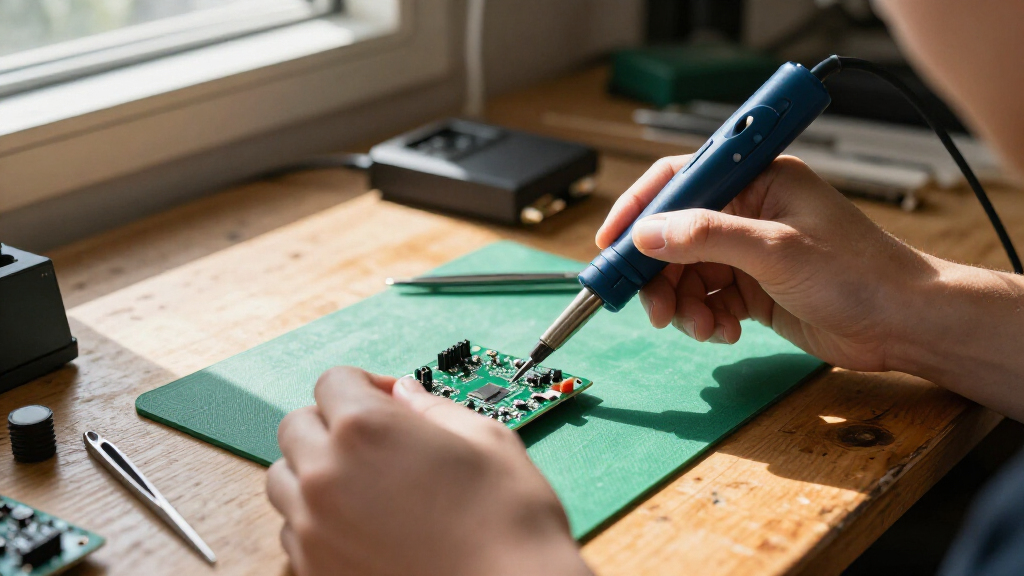
I ranked these stations around the jobs an electronics repair bench actually needs to handle: removing and fitting SMD components, soldering through-hole or fine-pitch connections, and, for some buyers, powering small circuits. I gave more weight to a useful match between the station’s functions and its intended work than to a longer feature list. Hot-air temperature and airflow adjustment, clear controls, accessory coverage, and the practical value of combining tools all informed the comparison.
The order favors adaptable stations that can cover multiple common tasks without making buyers pay in bench space for functions they will not use. That puts the YIHUA 8786D I first as a broad-purpose combo, while dedicated hot-air units rank better for focused rework. The 853D models stand apart for their listed USB/DC supply functionality, but their differences in output rating matter to the buyer’s equipment. Since specifications and kit contents can vary by exact version, I recommend checking the listing details before choosing between similarly named models.
Factors to Consider When Choosing Rework Station For Electronics
Before choosing a station, I’d map it to the work rather than the brand or number of functions. These decisions affect repair results, workspace, and the extra tools you may still need.
Hot Air Only or a Soldering Combo?
Start by listing the tasks you do in a typical week. If you mainly remove SMD parts or rework small boards, a dedicated hot-air unit can keep the controls and footprint focused. If the same jobs also involve soldering leads or replacing connectors, a combo station can reduce bench clutter and tool switching. A common mistake is buying a combo because it appears to do more, then discovering the extra iron is rarely used. The reverse mistake is choosing hot air alone and later needing a separate soldering station anyway. Choose the arrangement that fits your routine, not every possible repair you might someday take on.
Temperature and Airflow Need Separate Attention
Hot-air work depends on both heat and airflow, not temperature alone. A small component can shift under forceful air even when the set temperature seems appropriate, while insufficient heat can prolong exposure and affect nearby parts. Look for controls that let you adjust each variable and a display you can read while working. Do not treat a high maximum temperature as proof of better repair performance; control across the range matters more. Match settings to the board, component, nozzle, and distance from the work rather than relying on one default setting. If the station offers limited airflow adjustment, that can constrain delicate work.
Check What the Kit Actually Includes
Station names and model suffixes can hide meaningful kit differences. Before buying, verify whether the package includes a soldering iron, hot-air handpiece, nozzle sizes, holders, tips, or other accessories you will need. A station with useful core controls may still require extra purchases if its kit is sparse. Conversely, a large accessory bundle is not automatically useful if the nozzles or tips do not suit your components. Check replacement-part availability too, especially for handpieces and consumables that wear with regular use. Comparing the exact package contents prevents a misleading decision based on a shared model family name.
Decide Whether a DC Power Supply Belongs on Your Bench
Some combined units add adjustable DC output or USB power alongside soldering and hot air. This can be handy for testing small circuits without bringing a separate supply to the bench. It does not make every combo station a substitute for a dedicated bench supply: check the output range, current limit, connector options, and protections against the needs of your projects. The 853D variants in this roundup list different USB current ratings, so buyers should match the specific version to their loads. Avoid paying for power functions if you already own a supply that meets your needs. For sensitive boards, verify output behavior and use appropriate current limits before connecting a device.
Plan for Workspace, Heat, and Fume Control
A compact station may save desk area, but the working setup needs room for the handpiece, a safe resting place, the board, and nearby tools. Hot air can affect adjacent components and surfaces, so plan for stable board support and heat-resistant space around the work. Soldering and rework also produce fumes; arrange suitable extraction or ventilation rather than assuming a station handles them. A multi-function unit can cut cable and device clutter, though it also concentrates heat-producing tools in one area. Think through where each handpiece will rest between tasks before choosing based on the machine’s footprint alone. Better bench organization can matter as much as another feature.
Pay for Control and Support, Not Just a Bigger Number
More wattage or a higher temperature ceiling does not automatically mean easier or safer repairs. Consistent heat delivery, controllable airflow, usable handpieces, and accessible replacement parts can matter more during repeated work. If you are new to rework, favor understandable controls and a setup that lets you learn one process at a time. Experienced users may value a more specialized tool that fits their existing soldering and power equipment. Check the seller’s documentation and the availability of consumables before treating a low initial outlay as good value. Spending more makes sense when it buys a function or level of control you will use often.
Frequently Asked Questions
Should I buy a 2-in-1 station if I already own a soldering iron?
Not automatically. If your current iron works well and your main gap is hot-air rework, a dedicated hot-air model may avoid paying for a second soldering tool. A combo becomes more appealing if you want one control station on the bench, need a backup iron, or expect to replace your current setup. Compare the actual handpiece controls and kit contents rather than assuming a combo offers better hot-air performance. For a crowded bench, combining tools can help; for a well-equipped bench, a focused hot-air unit may be the cleaner fit.
Is the YIHUA 853D 3A a better choice than the 2A version?
The listed current rating is the main distinction to check, but it does not answer every compatibility question. Estimate the current your devices need, then confirm the exact output range, connectors, and protections for the version you plan to buy. The 3A model may suit loads that exceed what the 2A version can supply, while the 2A option can be enough for lighter bench tasks. Do not choose based on the number alone if your projects require a particular voltage or connector. Verify the specifications for the precise listing, since product names and bundles can vary.
Can a beginner start with a hot-air-only station?
Yes, if hot-air removal and placement are the main tasks and you already have a suitable soldering iron for other joints. A dedicated unit can make the first purchase more focused, but the user still needs practice with airflow, heat, nozzle choice, and board protection. Beginners who also need to solder may find a 2-in-1 station simpler for setting up a complete bench. Neither format removes the need for ventilation and a stable work surface. Choose by the tasks you can name now, rather than assuming more functions will make learning easier.
What should I verify before buying a station with a digital display?
Check what the display reports and which settings you can change independently. A number on screen is useful only if the controls support the heat and airflow adjustments your work requires. Confirm whether the package includes suitable nozzles and whether the handpiece rests safely when idle. Also look for documentation covering setup, calibration, and replacement parts. Do not treat a digital display as a guarantee of accurate temperature at the component; work conditions and technique still affect results.
Is a combined soldering, hot-air, and power-supply station a good first bench purchase?
It can make sense if you need all three functions and want to limit the number of separate devices. The YIHUA 853D models are relevant examples in this roundup, but their listed current ratings differ, so the exact version matters. An all-in-one unit can also create compromises: its power output may not suit every project, and a fault or upgrade need can affect several bench functions at once. Buyers who already have a reliable soldering iron or supply may get more value from a dedicated hot-air station. Write down the voltage, current, and tool needs of your actual projects before choosing a combined unit.
Conclusion
For a broad electronics bench, my best overall pick is the YIHUA 8786D I, because its hot-air and soldering functions cover common repair tasks in one station. For a focused hot-air setup, I’d shortlist the YIHUA 959D or WEP 8858-V; the best value depends on the exact kit contents and the controls you need, not the model name alone. Beginners who need both hot air and an iron can start with a combo such as the WEP 882D or YIHUA 862BD+, after checking the included accessories. Buyers who want bench power alongside rework should compare the YIHUA 853D 3A and 853D 2A against their project loads. I’d reserve a best-premium choice for the model whose control, support, and functions genuinely improve your regular work; no single station is the right upgrade for every bench.