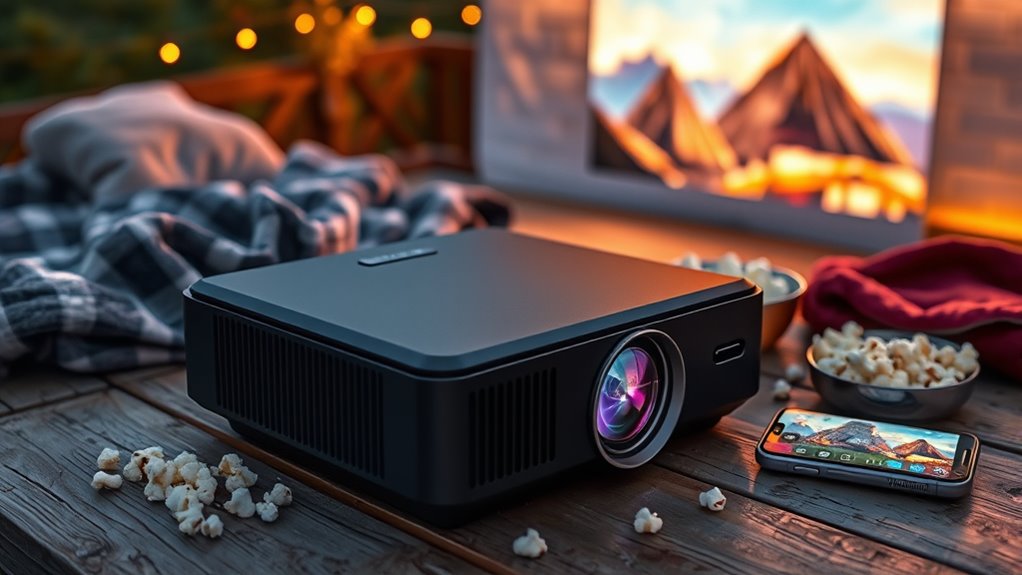

The Soundcore Nebula P1i is my best overall portable projector for movies because its 380-ANSI-lumen output, native 1080p resolution, Google TV platform, and flippable speaker form the strongest all-around package here. The TMY 1080P Mini Projector is the better value choice for buyers who want an included screen, while the Aurzen Roku TV D1R Air is the more flexible travel pick because it can run from a compatible USB-C power source. Buyers mainly need to choose between verified brightness and resolution, convenient streaming software, flexible placement, and a lower price. Many inexpensive models advertise 4K support, but that describes accepted input rather than the detail projected on the screen. Continue reading for my full breakdown of which models suit bedrooms, outdoor movie nights, simple streaming, and compact setups.

Get the latest gadgets delivered free with Prime
- Fast, free delivery on millions of items
- Prime Video, Amazon Music and more included
- Member-only deals all year
Complete the kit


Key Takeaways
- Soundcore Nebula P1i leads the lineup because it pairs the highest stated ANSI brightness in the supplied specifications with native 1080p, Google TV, and a more purposeful audio design.
- Native 1080p matters more than 4K support: several projectors accept a 4K signal, but the native-resolution models should preserve finer movie detail.
- Aurzen offers the clearest streaming-focused choices, with the Roku TV D1R favoring living-room simplicity and the USB-C-powered D1R Air favoring travel flexibility.
- TMY provides the strongest bundle value through its included 80-inch screen, though buyers still need to allow for a more manual setup than models with automatic correction.
- Rotating stands improve placement rather than image quality; the Magcubic, WISHOLY, HY300Pro, and other adjustable minis fit awkward rooms well, but darkness remains necessary.
| Mini Projector with Android 11 and 220° Rotating Stand |  | Best Lightweight All-Rounder | Brightness: 300 ANSI lumens | Native Resolution: 1280 × 720 | Maximum Supported Resolution: 3840 × 2160 | VIEW ON AMAZON | See Our Full Breakdown |
| Soundcore Nebula P1i Portable Projector |  | Best Overall | Brightness: 380 ANSI lumens | Native Resolution: 1920 × 1080 | Projection Size: Up to 150 inches | VIEW ON AMAZON | See Our Full Breakdown |
| Lisowod L02 Smart Outdoor Projector |  | Best for Backyard Movies | Brightness: 1900 lumens | Native Resolution: 1080p | Contrast Ratio: 30,000:1 | VIEW ON AMAZON | See Our Full Breakdown |
| Mini Portable Projector with WiFi, Bluetooth, and Starry Sky Mode |  | Best Ultra-Compact Pick | Weight: 0.77 pounds | Dimensions: 3.73 × 3.73 × 6.17 inches | Wireless: 2.4GHz/5GHz WiFi and Bluetooth 5.2 | VIEW ON AMAZON | See Our Full Breakdown |
| Magcubic Mini Projector with WiFi 6 and Bluetooth 5.4 |  | Best for Flexible Mounting | Brightness: 200 ANSI lumens | Native Resolution: 720p | Maximum Supported Resolution: 4K | VIEW ON AMAZON | See Our Full Breakdown |
| TMY 1080P Mini Portable Projector with 80-inch Screen and Bluetooth |  | Best Starter Kit | Supported resolution: 1080P Full HD | Projection size: 32 to 220 inches | Projection distance: 1.5 to 6 m | VIEW ON AMAZON | See Our Full Breakdown |
| HAPPRUN Native 1080P Outdoor Smart Projector |  | Best Value for Native 1080p | Native resolution: 1920×1080 | Maximum screen size: 200 inches | Bluetooth: 5.1 | VIEW ON AMAZON | See Our Full Breakdown |
| WISHOLY Mini Projector with WiFi and Bluetooth |  | Best for Flexible Placement | Native resolution: 1920×1080 | Claimed brightness: 9,000 lm | Maximum image size: 200 inches | VIEW ON AMAZON | See Our Full Breakdown |
| XuanPad White Smart Mini Projector with WiFi and Bluetooth |  | Best Smart Setup | Native resolution: 1080P | Input support: Up to 4K | Projection size: 40 to 200 inches | VIEW ON AMAZON | See Our Full Breakdown |
| Mini Projector with WiFi and Bluetooth, 1080P and 4K Support |  | Best Compact Short-Throw Pick | Video support: 1080P and 4K playback | Claimed brightness: 15,000 lumens | Contrast ratio: 10,000:1 | VIEW ON AMAZON | See Our Full Breakdown |
| HY300Pro Mini Projector |  | Best Ultralight Pick | Operating system: Android 14 | Native resolution: 720p | Supported resolution: Up to 4K | VIEW ON AMAZON | See Our Full Breakdown |
| Aurzen Roku TV D1R Smart Portable Outdoor Projector |  | Best Smart-Home Roku Pick | Native resolution: 1080p Full HD | Screen size: 60–150 inches | Speakers: Dual 5W | VIEW ON AMAZON | See Our Full Breakdown |
| 1080P Mini Projector with Built-in Apps |  | Best for Extra-Large Movies | Native resolution: 1080p Full HD | 4K compatibility: Yes | Brightness: 300 ANSI lumens | VIEW ON AMAZON | See Our Full Breakdown |
| Mini Projector 4K Support Portable Full HD 1080P Projector |  | Best Wired Pick | Native resolution: Full HD 1080p | Supported resolution: Up to 4K | Projection size: Up to 200 inches | VIEW ON AMAZON | See Our Full Breakdown |
| Aurzen Roku TV D1R Air USB-C Powered Smart Portable Outdoor Projector |  | Best USB-C-Powered Pick | Native resolution: 1080p | Brightness: 300 ANSI lumens | Speakers: Dual 5W with Dolby Audio | VIEW ON AMAZON | See Our Full Breakdown |
| portable projector for movie | Native Resolution | Weight |
|---|---|---|
| Mini Projector with Android 11 | 1280 × 720 | Under 2 pounds |
| Soundcore Nebula P1i Portable | 1920 × 1080 | 7.3 pounds |
| Lisowod L02 Smart Outdoor Proj | 1080p | 1.5 pounds |
| Mini Portable Projector with W | — | 0.77 pounds |
| Magcubic Mini Projector with W | 720p | 0.88 pounds |
| TMY 1080P Mini Portable Projec | — | — |
| HAPPRUN Native 1080P Outdoor S | 1920×1080 | — |
| WISHOLY Mini Projector with Wi | 1920×1080 | 2.3 lb |
| XuanPad White Smart Mini Proje | 1080P | 1.89 lb |
| Mini Projector with WiFi and B | — | 0.67 kg |
| HY300Pro Mini Projector | 720p | 0.77 lbs |
| Aurzen Roku TV D1R Smart Porta | 1080p Full HD | — |
| 1080P Mini Projector with Buil | 1080p Full HD | — |
| Mini Projector 4K Support Port | Full HD 1080p | — |
| Aurzen Roku TV D1R Air USB-C P | 1080p | 2.60 lbs |
More Details on Our Top Picks
Mini Projector with Android 11 and 220° Rotating Stand
I rank this as the Best Lightweight All-Rounder because it balances smart streaming, flexible placement, and sub-2-pound portability. Its 300 ANSI-lumen output and native 720p panel suit movies in dark bedrooms, tents, or sheltered patios, while Android 11 reduces dependence on a separate streaming stick. The 220° rotating stand also offers more positioning freedom than the 180° Magcubic Mini Projector. Compared with the Soundcore Nebula P1i, this model is much easier to carry but gives up native 1080p detail, stronger brightness, and room-filling audio. Its advertised 4K support means it can accept 4K content, not display it at 4K resolution. I see it as a balanced casual-movie pick, provided buyers can darken the viewing area and accept the modest 5W speaker.
Pros:- Android 11 provides streaming access without requiring a separate media player
- 300 ANSI lumens is relatively capable for a sub-2-pound 720p model
- 220° stand supports wall, screen, and ceiling-oriented placement
- WiFi 6, Bluetooth, HDMI, USB, and analog audio cover varied sources
Cons:- Native 720p resolution cannot reproduce the full detail of accepted 4K content
- 300 ANSI lumens still calls for a dark or strongly shaded setting
- The 5W speaker is limited compared with the Nebula P1i’s 20W audio system
Best for: Apartment dwellers and occasional travelers who want built-in streaming and flexible ceiling or wall projection without carrying a heavy unit
Not ideal for: Daytime viewers and detail-focused home-cinema buyers who need high brightness or native 1080p resolution
- Brightness:300 ANSI lumens
- Native Resolution:1280 × 720
- Maximum Supported Resolution:3840 × 2160
- Display Size:Up to 150 inches
- Throw Distance:0.7–3.3 meters
- Operating System:Android 11
- Connectivity:WiFi, Bluetooth, HDMI, USB, 3.5mm audio
- Weight:Under 2 pounds
- Speaker:5W
Our verdict“Choose this model for a portable, self-contained movie setup with broad placement freedom, but choose the Nebula P1i if image and sound quality matter more than weight.”
Soundcore Nebula P1i Portable Projector
The Soundcore Nebula P1i takes my Best Overall position because its native 1080p picture, 380 ANSI lumens, Google TV platform, and 20W Dolby Audio system form the strongest movie-focused package here. Autofocus, auto keystone, obstacle avoidance, and screen fit also reduce setup work when the projector moves between rooms. Its flippable speaker can direct sound toward the audience, giving it a clear advantage over the 5W speakers in the Android 11 Mini Projector and Magcubic model. The compromise is portability: at 7.3 pounds with no battery, it is transportable rather than truly pocketable, and every screening needs an outlet or suitable power station. I rank it above the Lisowod L02 for its clearer brightness measurement and Google TV access, though the Lisowod is far lighter.
Pros:- Native 1080p resolution preserves more movie detail than the 720p models
- Google TV supports Netflix, YouTube, and Prime Video
- Flippable 20W Dolby Audio speaker provides the strongest stated audio system in this group
- Autofocus, auto keystone, obstacle avoidance, and screen fit simplify placement
Cons:- No built-in battery, so portable screenings require external power
- At 7.3 pounds, it is much heavier than the other four projectors
- Its 110V specification limits straightforward use in some regions
Best for: Movie watchers who want native 1080p, capable built-in sound, licensed mainstream streaming access, and automated setup near a power outlet
Not ideal for: Backpackers and off-grid viewers who need a lightweight projector with an internal battery
- Brightness:380 ANSI lumens
- Native Resolution:1920 × 1080
- Projection Size:Up to 150 inches
- Throw Distance:1.69–4.78 meters
- Speaker:20W total, 2 × 10W Dolby Audio
- Smart Platform:Google TV
- Connectivity:AUX, Bluetooth 5, HDMI, WiFi
- Weight:7.3 pounds
- Dimensions:183 × 204 × 228 mm
Our verdict“Pick the Nebula P1i when movie quality and streaming convenience outrank packability and battery-powered operation.”
Lisowod L02 Smart Outdoor Projector
I give the Lisowod L02 the backyard-movie role because its native 1080p panel, compact 1.5-pound body, autofocus, and automatic vertical correction suit frequent movement between the house and patio. Its claimed 1900-lumen output sounds higher than the Nebula P1i’s 380 ANSI lumens, but those figures use different measurement labels, so I would not treat the numerical gap as a direct brightness win. The L02 is much lighter than the Nebula and advertises more than 1,000 native apps, while manual four-point correction offers extra control on awkward surfaces. On the other hand, Google TV on the Nebula is a more familiar streaming proposition, and the L02’s unspecified battery details weaken its outdoor credentials. I would choose it for after-dark yard screenings, not daytime projection.
Pros:- Native 1080p resolution supports sharper subtitles and finer movie detail
- At 1.5 pounds, it is far easier to move outdoors than the Nebula P1i
- Autofocus and automatic vertical keystone speed up temporary setups
- WiFi 6, Bluetooth 5.4, and more than 1,000 native apps offer broad entertainment access
Cons:- The 1900-lumen claim is not stated in ANSI lumens, limiting fair brightness comparisons
- Battery specifications are absent, so buyers cannot plan off-grid runtime
- The large app library may involve a less familiar interface than Google TV
Best for: Backyard movie hosts who want native 1080p, a lightweight body, automated alignment, and broad built-in app access
Not ideal for: Daytime outdoor viewers or off-grid campers who need verified ANSI brightness and clearly stated battery endurance
- Brightness:1900 lumens
- Native Resolution:1080p
- Contrast Ratio:30,000:1
- Native Apps:1,000+
- Wireless:WiFi 6 and Bluetooth 5.4
- Focus:Electric autofocus
- Keystone Correction:Auto ±30° vertical and manual four-point
- Speakers:Dual 20W Hi-Fi
- Weight:1.5 pounds
Our verdict“The L02 makes sense for lightweight, after-dark backyard cinema, while the Nebula P1i remains the safer choice for a familiar streaming platform and clearly rated brightness.”
Mini Portable Projector with WiFi, Bluetooth, and Starry Sky Mode
At just 0.77 pounds, this Mini Portable Projector is my ultra-compact choice for viewers who value easy packing over home-theater-grade specifications. Its 0.9:1 throw ratio can create a useful image in a smaller room, while auto focus, vertical correction, and a 180° rotating body support quick bedroom setups. The nine-scene starry-sky mode also gives it a decorative function missing from the Magcubic Mini Projector. Movie buyers should examine the limits carefully: 4K playback is restricted to USB support, broader streaming may require a separate TV stick, and neither native resolution nor brightness is supplied. That makes the claimed 200-inch maximum less persuasive than its recommended 40-to-100-inch range. I place it below better-documented models, but its tiny travel footprint is hard to match.
Pros:- The 0.77-pound body is the lightest among these five picks
- A 0.9:1 throw ratio helps produce a practical image in tighter rooms
- Auto focus, vertical keystone, and 180° rotation simplify casual placement
- Nine starry-sky scenes add a decorative use beyond movie playback
Cons:- No native-resolution or brightness rating is provided
- 4K playback support is limited to USB input rather than native 4K projection
- Some streaming services may require a TV stick that is not included
Best for: Carry-on travelers, dorm residents, and bedroom viewers who want the smallest projector in this group for dark-room movies and decorative projection
Not ideal for: Picture-quality-focused buyers who need verified native resolution, rated brightness, or a fully documented streaming platform
- Weight:0.77 pounds
- Dimensions:3.73 × 3.73 × 6.17 inches
- Wireless:2.4GHz/5GHz WiFi and Bluetooth 5.2
- Supported Video:4K playback via USB
- Projection Size:30–200 inches; 40–100 inches recommended
- Focus:Automatic and manual
- Keystone Correction:Automatic vertical
- Throw Ratio:0.9:1
- Rotation:180°
Our verdict“Buy this for minimum carrying weight and flexible bedroom entertainment, but choose the Magcubic or Android 11 Mini Projector when clearer image specifications matter.”
Magcubic Mini Projector with WiFi 6 and Bluetooth 5.4
The Magcubic Mini Projector earns its place for mounting flexibility: its 0.88-pound body can sit on a table or attach to a tripod or ceiling mount, and the 180° rotation helps aim movies at a wall or ceiling. WiFi 6, Bluetooth 5.4, voice control, and the Air Mouse remote make navigation more versatile than on many basic mini projectors. Still, its 200 ANSI lumens and native 720p panel put it behind the Android 11 Mini Projector, which offers 300 ANSI lumens and a wider 220° rotation at the same native resolution. The Magcubic’s accepted 4K signal is downscaled, while the 5W speaker is better reserved for close viewing or paired with external Bluetooth audio. I favor it for adaptable dark-room placement, not for bright patios or cinematic detail.
Pros:- Table, tripod, and ceiling mounting options suit changing room layouts
- The 0.88-pound body is easy to carry between locations
- WiFi 6 and Bluetooth 5.4 support modern wireless connections
- Air Mouse remote with voice control can make app navigation faster
Cons:- 200 ANSI lumens limits useful viewing to dark or heavily shaded spaces
- Native 720p resolution downscales supported 4K content
- The 5W speaker lacks the output of the Nebula P1i’s 20W system
Best for: Renters and bedroom viewers who want a lightweight projector that can move among tabletop, tripod, ceiling, and upward-facing positions
Not ideal for: Outdoor daytime audiences and home-cinema buyers who expect native 4K detail, strong brightness, or powerful built-in audio
- Brightness:200 ANSI lumens
- Native Resolution:720p
- Maximum Supported Resolution:4K
- Contrast Ratio:2000:1
- Wireless:WiFi 6 and Bluetooth 5.4
- Speaker:5W SoundBase
- Keystone Correction:Automatic vertical
- Rotation:180°
- Weight:0.88 pounds
Our verdict“Choose the Magcubic when mounting freedom and low weight lead your priorities, but spend more on image output if movies are the main event.”
TMY 1080P Mini Portable Projector with 80-inch Screen and Bluetooth
I rank the TMY 1080P Mini Portable Projector as the Best Starter Kit because its included 80-inch screen removes a separate purchase and makes occasional movie setups easier. Compared with the HAPPRUN H1, it trades native 1080p detail for a more complete out-of-box package. Its 32-to-220-inch range gives me more sizing freedom than many compact models, while two-way Bluetooth can feed an external speaker or let the projector act as one. The compromise lies in video connectivity: Bluetooth carries audio only, phone links need separately purchased adapters, and protected streaming apps may block mirroring through HDCP. I would choose this for a low-cost backyard kit, but HAPPRUN is the sharper choice when native resolution matters more than included gear.
Pros:- Includes an 80-inch foldable screen, reducing the cost and effort of an initial setup
- Projects images from 32 to 220 inches for small bedrooms or larger movie nights
- Two-way Bluetooth supports external audio and speaker functionality
- HDMI and USB inputs accommodate common media sources
Cons:- Supports 1080p content but is not listed as a native 1080p projector
- Phone connections require adapters that are not supplied
- HDCP restrictions can prevent screen mirroring from some streaming apps
Best for: First-time projector buyers who want an affordable movie-night package with a screen already included
Not ideal for: Phone-only streamers who expect wireless access to protected apps without adapters or a separate streaming stick
- Supported resolution:1080P Full HD
- Projection size:32 to 220 inches
- Projection distance:1.5 to 6 m
- Aspect ratio:16:9
- Contrast ratio:10,000:1
- Lamp lifetime:10,000 hours
- Bluetooth:Two-way audio
- Included screen:80-inch foldable screen
Our verdict“I recommend the TMY to newcomers who value an included screen more than native 1080p resolution or seamless phone streaming.”
HAPPRUN Native 1080P Outdoor Smart Projector
I place the HAPPRUN H1 ahead of the TMY model for buyers who care more about image detail than bundled accessories. Its native 1920×1080 resolution preserves finer movie textures without relying on simple 1080p signal support, and the image can reach 200 inches for a convincing backyard cinema effect. Built-in stereo speakers make casual viewing possible without extra audio equipment, though Bluetooth 5.1 offers an upgrade path. This is not the easiest all-in-one streaming option: phones require adapters, a TV stick is a separate purchase, and the missing brightness rating makes daytime performance difficult to predict. I see it as a strong value for night viewing, while the TMY makes more sense when an included screen matters and the XuanPad is better for built-in apps.
Pros:- Native 1920×1080 resolution delivers more real image detail than projectors that merely accept 1080p
- Supports images up to 200 inches for large movie presentations
- Built-in Hi-Fi stereo speakers simplify casual setups
- Desktop, tripod, and ceiling installation options suit varied rooms
Cons:- No brightness figure is supplied, leaving daylight visibility uncertain
- Smartphone use may require an HDMI adapter that is not included
- Streaming commonly depends on a separately purchased TV stick
Best for: Budget movie fans who want native 1080p detail and plan to watch indoors or outside after dark
Not ideal for: Daytime outdoor viewers or buyers seeking built-in streaming apps without adding a TV stick
- Native resolution:1920×1080
- Maximum screen size:200 inches
- Bluetooth:5.1
- Speakers:Built-in Hi-Fi stereo
- Installation:Desktop, tripod, or ceiling
- TV stick support:Yes
- Mobile compatibility:Smartphones and tablets with suitable adapters
Our verdict“I favor the HAPPRUN H1 for affordable native 1080p movie nights when external streaming hardware is acceptable.”
WISHOLY Mini Projector with WiFi and Bluetooth
I give the WISHOLY Mini Projector the placement-focused role because its rotating stand and automatic vertical keystone reduce the effort of aiming an image at a wall or ceiling. Compared with the fixed-form HAPPRUN H1, it is better suited to bedrooms, temporary rentals, and spaces where a centered table is unavailable. Native 1080p, dual-band Wi-Fi, and Bluetooth 5.2 build a capable movie platform into a 2.3-pound body. Its limits become clearer beside the XuanPad: WISHOLY lacks built-in streaming apps and autofocus, so subscription viewing needs an external TV stick and focus may require more setup. I would also treat the claimed 9,000-lumen figure cautiously because no ANSI measurement is supplied, while the 6,000-hour light-source rating trails the TMY projector.
Pros:- Rotating stand supports wall and ceiling-oriented movie setups
- Automatic vertical keystone speeds up alignment after repositioning
- Native 1080p resolution provides full-HD image detail
- Dual-band Wi-Fi, Bluetooth 5.2, HDMI, and USB offer broad connectivity
Cons:- Streaming services require an external TV stick
- Claimed brightness is not accompanied by an ANSI-lumen rating
- The 6,000-hour light-source life is shorter than the TMY model’s stated rating
Best for: Bedroom viewers and renters who need to project from unusual angles or onto a ceiling
Not ideal for: Buyers wanting Netflix-style apps built into the projector or a verified ANSI brightness rating for outdoor use
- Native resolution:1920×1080
- Claimed brightness:9,000 lm
- Maximum image size:200 inches
- Projection rotation:Up to 210°
- Keystone correction:Automatic vertical
- Bluetooth:5.2
- Light-source life:6,000 hours
- Dimensions:4.72 × 5.2 × 7.28 inches
- Weight:2.3 lb
Our verdict“I recommend WISHOLY for viewers who value flexible projection angles over integrated streaming and autofocus.”
XuanPad White Smart Mini Projector with WiFi and Bluetooth
I choose the XuanPad White Smart Mini Projector for the easiest self-contained movie setup in this group. Unlike the WISHOLY, it combines Netflix, Prime Video, and YouTube apps with autofocus and 6D automatic keystone, cutting down on accessories and repeated adjustments. Native 1080p supplies the displayed detail, while 4K support means it can accept higher-resolution sources rather than project a native 4K image. At 1.89 pounds, it is also lighter than WISHOLY, and the detachable 360-degree stand offers broader positioning freedom. That convenience has caveats: no battery runtime is stated, the brightness description lacks a numeric ANSI rating, and the 200-inch ceiling is smaller than the TMY model’s 220-inch maximum. I rank it highest for quick streaming convenience, not daylight performance or off-grid use.
Pros:- Built-in Netflix, Prime Video, and YouTube reduce dependence on a separate streaming stick
- Autofocus and 6D automatic keystone simplify repeated setups
- Native 1080p resolution with 4K input support suits current movie sources
- Lightweight body and detachable 360-degree stand aid portable positioning
Cons:- No battery capacity or runtime is specified, suggesting reliance on external power
- Brightness is described without a numeric ANSI-lumen rating
- Maximum 200-inch image is smaller than the TMY projector’s stated limit
Best for: Frequent streamers who want built-in major apps, automatic image adjustment, and a lightweight body
Not ideal for: Campers needing confirmed battery operation or daytime viewers who require a measured ANSI brightness figure
- Native resolution:1080P
- Input support:Up to 4K
- Projection size:40 to 200 inches
- Weight:1.89 lb
- Stand:360° rotatable and detachable
- Focus:Automatic
- Keystone correction:6D automatic
- Wireless:Dual-band 5G/2.4G Wi-Fi and Bluetooth 5.2
- Built-in apps:Netflix, Prime Video, and YouTube
Our verdict“I would buy the XuanPad for app-based movie streaming with minimal setup, provided a power outlet and controlled lighting are available.”
Mini Projector with WiFi and Bluetooth, 1080P and 4K Support
I assign this compact short-throw projector to small rooms where distance from the wall is limited. Its 0.67 kg body is lighter than the XuanPad, while Wi-Fi 6 and Bluetooth 5.4 are newer wireless standards than the other four models offer. Built-in streaming apps and automatic keystone also make it less accessory-dependent than the HAPPRUN H1. The ranking drops for buyers chasing a huge backyard image: its 40-to-130-inch range is far narrower than HAPPRUN’s 200-inch maximum, and the 15,000-lumen claim is not presented as an ANSI measurement. Short throw can solve cramped-room placement, but it provides less flexibility in a large space with a fixed projector table. I see this as the bedroom specialist, while XuanPad remains the better smart choice for larger images and automatic focus.
Pros:- Short-throw design suits bedrooms and other spaces with limited projection distance
- Built-in streaming apps reduce the need for an external media player
- Wi-Fi 6 and Bluetooth 5.4 provide current wireless connectivity
- 0.67 kg body is easy to carry between rooms
Cons:- Maximum 130-inch image is much smaller than the limits of the other models in this batch
- 15,000-lumen claim is not identified as an ANSI measurement
- App playback depends on internet access and continued service compatibility
Best for: Apartment and bedroom viewers who need a light projector to create a moderate-size image from limited space
Not ideal for: Backyard hosts seeking images above 130 inches or buyers who need independently comparable ANSI brightness data
- Video support:1080P and 4K playback
- Claimed brightness:15,000 lumens
- Contrast ratio:10,000:1
- Projection size:40 to 130 inches
- Lens:Short throw
- Connectivity:Wi-Fi 6, Bluetooth 5.4, HDMI, and USB
- Dimensions:14.4 × 9.1 × 10.5 cm
- Weight:0.67 kg
Our verdict“I recommend this model for compact-room streaming, but not for buyers whose priority is the largest possible outdoor image.”
HY300Pro Mini Projector
I rank the HY300Pro as the Best Ultralight Pick because its 0.77-pound body and 180-degree swivel suit bedrooms, travel bags, and quick ceiling projection. The 0.9:1 throw also creates a useful image where space is tight. Compared with the Aurzen Roku TV D1R Air, it is much lighter and runs Android 14, but its native 720p panel and 200 ANSI lumens produce a softer, dimmer movie image than the Aurzen’s native 1080p, 300-ANSI presentation. Although it accepts 4K content, that does not turn the displayed image into 4K. Wi-Fi 6 and Bluetooth 5.4 simplify streaming and external-audio pairing, while the 5W speaker is adequate for one or two viewers. I would choose it for maximum mobility, not for cinema-grade detail or daylight viewing.
Pros:- Exceptionally light 0.77-pound body
- Short 0.9:1 throw works in compact rooms
- Android 14 with dual-band Wi-Fi 6
- 180-degree swivel and several mounting options
Cons:- Native resolution is only 720p despite 4K input support
- 200 ANSI lumens require a dark viewing space
- Single 5W speaker is limited for group screenings
Best for: Travelers, students, and bedroom viewers who want a projector weighing less than one pound
Not ideal for: Detail-focused movie fans or daytime outdoor viewers because the native 720p image and 200-ANSI output are limiting
- Operating system:Android 14
- Native resolution:720p
- Supported resolution:Up to 4K
- Brightness:200 ANSI lumens
- Projection size:35–135 inches
- Throw ratio:0.9:1
- Connectivity:Dual-band Wi-Fi 6 and Bluetooth 5.4
- Weight:0.77 lbs
Our verdict“I recommend the HY300Pro when low weight and placement freedom matter more than sharpness or brightness.”
Aurzen Roku TV D1R Smart Portable Outdoor Projector
I place the Aurzen Roku TV D1R in the Best Smart-Home Roku Pick role because it removes much of the usual setup: Roku is built in, auto focus and keystone handle alignment, and AirPlay plus voice-assistant support fit connected homes. Its native 1080p image and dual 5W speakers make it more movie-ready than the 720p HY300Pro, especially across the 60-to-150-inch range. Compared with the D1R Air, however, this model relies on standard AC power rather than offering the Air’s flexible USB-C PD input. That makes it better suited to a patio with an outlet than a remote campsite. Fan noise can intrude during quiet scenes, and lens upkeep adds a little maintenance. I see it as a convenient streaming hub for after-dark indoor or backyard movies.
Pros:- Built-in Roku provides direct access to major streaming services
- Native 1080p resolution is suited to feature films
- Auto focus and keystone reduce setup time
- AirPlay and several voice-assistant platforms are supported
Cons:- AC-only operation limits off-grid portability
- Fan noise may be audible in quiet movie scenes
- Lens requires regular cleaning to maintain image clarity
Best for: Roku households that want simple indoor-to-patio streaming, AirPlay, and voice-control compatibility
Not ideal for: Campers and outlet-free backyard viewers because the projector requires an AC power connection
- Native resolution:1080p Full HD
- Screen size:60–150 inches
- Speakers:Dual 5W
- Wi-Fi:2.4GHz and 5GHz
- Bluetooth:5.2
- Power supply:100–240V AC, 50/60Hz
- Device compatibility:Apple TV, AirPlay, and Android devices
- Voice control:Siri, Alexa, and Google Assistant
Our verdict“I would pick the D1R for a Roku-centered home or powered patio, but not for movie nights far from an outlet.”
1080P Mini Projector with Built-in Apps
I assign this 1080P Mini Projector the Best for Extra-Large Movies spot because its 50-to-200-inch range exceeds the 150-inch ceiling of both Aurzen Roku models. Native 1080p, 300 ANSI lumens, and electric focus give movie detail and setup convenience a solid foundation, while the 210-degree rotation helps aim the picture at a wall or ceiling. It also has Prime Video, YouTube, Hulu, and an app store built in. Compared with the Mini Projector 4K Support model, this pick adds Wi-Fi 6, Bluetooth audio, and onboard apps, making it less dependent on cables. The tradeoff is that wireless mirroring still needs Wi-Fi, Bluetooth does not accept smartphone video, and 300 ANSI lumens remain best after dark. I favor it for large, flexible indoor screenings rather than bright-room use.
Pros:- Native 1080p image with support for 4K sources
- Projection range reaches 200 inches
- Electric focus and 210-degree rotation ease placement
- Wi-Fi 6 and built-in streaming apps reduce cable use
Cons:- Bluetooth works with audio devices rather than smartphone video
- Wireless phone mirroring requires an available Wi-Fi network
- 300 ANSI lumens are insufficient for bright environments
Best for: Apartment movie fans who want a large 1080p image, ceiling-friendly positioning, and streaming apps without a separate stick
Not ideal for: Buyers expecting Bluetooth video casting or a clear 200-inch picture in a brightly lit room
- Native resolution:1080p Full HD
- 4K compatibility:Yes
- Brightness:300 ANSI lumens
- Screen size:50–200 inches
- Focus:Electric
- Rotation:210 degrees
- Wireless connectivity:Wi-Fi 6 and Bluetooth 5.3
- Inputs:HDMI, USB, and audio
- Warranty:3 years
Our verdict“I recommend this model for buyers who want the batch’s widest stated image range without giving up native 1080p or built-in apps.”
Mini Projector 4K Support Portable Full HD 1080P Projector
I chose the Mini Projector 4K Support as the Best Wired Pick for buyers who already use a laptop, console, or media player. Its HDMI, USB, and AUX connections avoid dependence on a wireless network, while the 270-degree stand and electric keystone offer more aiming freedom than the HY300Pro’s 180-degree swivel. Native Full HD playback and support for 4K sources suit movies, and the short-throw design can produce an image up to 200 inches. Against the 1080P Mini Projector with Built-in Apps, though, this model loses Wi-Fi, Bluetooth, and direct streaming services. A TV stick also needs an HDMI extender, adding clutter to an otherwise compact setup. With no built-in battery and no stated ANSI brightness, I view its outdoor credentials as limited despite the portable body.
Pros:- Native Full HD display with support for 4K input
- 270-degree stand allows wall or ceiling projection
- Electric keystone simplifies angled placement
- HDMI, USB, and AUX serve several wired sources
Cons:- No Wi-Fi, Bluetooth, or built-in streaming apps
- TV sticks require an HDMI extender
- No battery or published ANSI brightness rating
Best for: Laptop, console, and offline-media users who prefer direct wired connections and flexible projection angles
Not ideal for: Cord-cutters seeking self-contained streaming, Bluetooth audio, or battery-powered outdoor operation
- Native resolution:Full HD 1080p
- Supported resolution:Up to 4K
- Projection size:Up to 200 inches
- Stand rotation:270 degrees
- Keystone correction:Electric
- Projection type:Short throw
- Connectivity:HDMI, USB, and AUX
- Lamp lifespan:50,000 hours
Our verdict“I would choose this projector for wired movie sources and flexible placement, provided smart features and off-grid power are unnecessary.”
Aurzen Roku TV D1R Air USB-C Powered Smart Portable Outdoor Projector
I give the Aurzen Roku TV D1R Air the Best USB-C-Powered Pick title because its 65W-plus USB-C PD input makes power easier to arrange between rooms or outdoors. Built-in Roku, native 1080p, auto focus, and auto keystone reduce the equipment and adjustment needed before a film. Compared with the standard Aurzen Roku TV D1R, the Air adds USB-C power while retaining dual-band Wi-Fi, Bluetooth 5.2, and dual 5W speakers; Dolby Audio also gives its compact sound system a stronger movie focus. It is heavier than the 0.77-pound HY300Pro, yet its 300 ANSI lumens and native 1080p panel offer a clearer picture. Buyers still need a compatible 65W power source and cable, and the 29–35 dB fan may be heard during quiet dialogue. I reserve it for dark-room or after-sunset viewing.
Pros:- 65W-plus USB-C PD input offers flexible power choices
- Built-in Roku removes the need for a streaming stick
- Native 1080p and 300 ANSI lumens suit dark movie settings
- Auto focus and auto keystone speed setup
Cons:- Requires a compatible 65W-plus USB-C source and cable
- 29–35 dB fan noise may intrude on quiet scenes
- Brightness is inadequate for daylight outdoor projection
Best for: Streaming-focused travelers and backyard hosts who own a 65W USB-C PD adapter or compatible power bank
Not ideal for: Daytime outdoor viewers and minimalist travelers who do not want to carry a high-output USB-C power source
- Native resolution:1080p
- Brightness:300 ANSI lumens
- Speakers:Dual 5W with Dolby Audio
- Dimensions:5.35 x 4.33 x 10.12 inches
- Weight:2.60 lbs
- Wireless connectivity:Dual-band Wi-Fi and Bluetooth 5.2
- Ports:HDMI, USB, audio out, and USB-C
- Power input:65W-plus USB-C PD
- Automatic setup:Auto focus and auto keystone
Our verdict“I favor the D1R Air for portable Roku streaming when USB-C power flexibility matters and viewing will happen after dark.”
How We Picked
I ranked these projectors by how well they support an actual movie night rather than by the number of features printed in a title. My main criteria were native resolution, stated ANSI brightness, streaming convenience, placement flexibility, and audio practicality. I gave native 1080p models an advantage over products described only as supporting 1080p or 4K because accepted signal resolution does not determine projected detail. Models with named platforms such as Google TV or Roku TV also ranked higher when they could reduce the need for a separate streaming stick.
I then weighed portability against the equipment each projector still requires. A small chassis loses some of its appeal if a movie setup also needs a stand, power station, streaming device, speaker, and several cables. Automatic keystone correction and rotating bases earned credit for faster positioning, while USB-C power earned credit for travel flexibility. I treated outdoor branding cautiously because none of these compact models should be expected to overcome daylight. Price and bundle value shaped the middle of the ranking, but clearer display specifications and a smoother viewing workflow carried more weight at the top.
Factors to Consider When Choosing Portable Projector For Movies
I would choose a portable movie projector by working backward from where, when, and how it will be watched. Room darkness, native resolution, streaming access, and the equipment needed around the projector affect the experience more than a long feature list. The following factors help separate a genuinely convenient movie setup from a mini projector that merely looks versatile on paper.
Judge Brightness by the Viewing Environment
ANSI lumens are the most useful brightness reference when brands publish them, since vague claims such as high brightness or a large lumen figure may use unrelated measurements. The Soundcore model’s stated 380 ANSI lumens gives it a clearer advantage than products that omit an ANSI rating, but even that output is intended for controlled light. For a bedroom, I would prioritize blackout curtains and a screen or pale wall before paying for minor specification differences. Outdoor viewing should begin after sunset, with nearby porch lights switched off and the screen placed away from street lighting. A larger image spreads the available light over more area, so a 70- to 100-inch picture may look richer than the maximum size printed in advertising. Buyers expecting daytime television brightness should skip this class and move to a larger, brighter projector.
Separate Native Resolution From Signal Support
A projector labeled 4K supported can usually accept a 4K source and then scale it to the projector’s lower native resolution. That is different from projecting a native 4K image, and none of the supplied product names establishes native 4K output. For movies, I would favor native 1080p because subtitles, faces, and background textures remain cleaner at common screen sizes. A lower-resolution mini can still suit casual cartoons or a small bedroom image, but it will reveal softness as the picture grows. Source quality also matters: a heavily compressed wireless stream can obscure the advantage of a sharper display panel. Buyers should check the detailed specification page for native pixel dimensions rather than treating input compatibility as image quality.
Choose a Streaming Setup That Matches Your Habits
Google TV and Roku TV are valuable here because familiar interfaces can make app discovery, updates, and account setup easier. Generic projectors with built-in apps may offer a shorter feature list in practice if major streaming services restrict playback or change compatibility. I would choose the Soundcore P1i or an Aurzen Roku model for frequent streaming, while buyers who already own a Fire TV, Roku, or Chromecast device can save money with an HDMI-focused projector. Screen mirroring is useful for photos and casual clips, but protected movie services may block or limit it. An external stick also occupies a port and needs power, adding two details to an otherwise portable setup. The right choice is licensed software convenience or hardware flexibility, not simply the largest advertised app library.
Match Placement Features to the Room
A rotating stand can be more useful than a small brightness increase when the projector must sit on a nightstand, low shelf, or temporary outdoor table. Models with 180-, 220-, or 360-degree positioning can aim at a wall or ceiling without a separate tripod. Automatic vertical keystone correction speeds up setup, but digital correction reshapes the image by discarding pixels and can reduce sharpness. I would still place the lens as square to the screen as possible and use correction for minor adjustments. Buyers should also check throw distance, because a compact body does not mean the projector can produce a large image from a shallow room. For renters and dorm rooms, placement range and quick adjustment may deliver more day-to-day value than support for a higher input resolution.
Account for Power, Sound, and Carrying Gear
Portable does not always mean cordless, and many mini projectors still require continuous wall power. The Aurzen D1R Air’s USB-C-powered design can reduce charger clutter, but buyers should verify the required wattage and use a compatible power bank or adapter. Built-in speakers are convenient for quiet bedrooms, while outdoor movies usually call for a separate Bluetooth speaker because open spaces swallow dialogue. Bluetooth may introduce audio delay, so a wired output can be the safer choice when lip-sync accuracy matters. I would count every accessory needed for a normal viewing session, including the remote, power supply, screen, speaker, and streaming stick. A slightly larger model with better integrated streaming and audio may be easier to carry than a tiny projector surrounded by add-ons.
Know When Paying More Changes the Experience
The cheapest generic minis can work for occasional viewing, but their product names often emphasize connectivity while leaving brightness measurement, software support, or native resolution unclear. Paying more makes sense when the projector will be used weekly and reliable streaming, clearer specifications, and stronger support reduce friction. A bundle such as the TMY can be the wiser purchase when the included screen replaces something the buyer would otherwise order separately. Automatic correction deserves extra money in rooms where the projector is moved often, but it adds little when the device stays on one aligned shelf. I would avoid paying a premium solely for 4K compatibility because it does not create a native 4K picture. The best value comes from buying the few features that change every movie night, rather than collecting occasional-use extras.
Frequently Asked Questions
Are 300 to 380 ANSI lumens bright enough for movies?
Yes, in a dark or heavily shaded space, but this brightness range is not intended to compete with daylight or strong room lamps. At night, a moderate image size and a decent screen can produce a watchable, colorful picture. Expanding the image to the advertised maximum will make it look dimmer, so I would begin around 80 inches and adjust from there. Between the specified options here, the 380-ANSI-lumen Soundcore P1i has more brightness headroom than the 300-ANSI-lumen mini projector. Buyers who cannot control ambient light should choose a brighter projector outside this compact group.
Does 4K support mean these projectors display movies in 4K?
No, 4K support usually refers to input compatibility, meaning the projector can receive and downscale a 4K signal. Projected detail is limited by the display panel’s native resolution. A native 1080p model should look sharper than a lower-resolution model that merely accepts 1080p or 4K sources. I would verify a listed pixel count of 1920 by 1080 when Full HD detail is a priority. In this lineup, native 1080p is the more meaningful movie specification.
Should I buy a projector with Google TV or Roku TV built in?
I would choose Google TV or Roku TV when streaming simplicity is a priority and the projector will be used frequently. A recognized platform can reduce remote juggling and is generally a clearer proposition than an unspecified collection of built-in apps. Buyers who already own a preferred streaming stick may get better value from a simpler projector with a free HDMI port. An external device is also easier to replace if app requirements change, though it adds cables and power needs. The choice comes down to an integrated setup versus an upgradeable one.
Can a USB-C-powered projector run from any power bank?
Not necessarily, because USB-C ports and power banks support different voltage and wattage levels. The Aurzen Roku TV D1R Air is attractive for travel because of its USB-C-powered design, but buyers should match its stated power requirement with a compatible USB-C Power Delivery source. A phone-sized battery pack may lack enough output even when its connector fits. Runtime will also depend on the battery’s usable capacity and the projector’s power draw. I would treat USB-C power as flexible connectivity, not proof that every charger or battery will work.
Which features matter most for outdoor movie nights?
For outdoor viewing, I would prioritize measured brightness, native 1080p, stable power, and an audio connection before smart features or a rotating stand. Setup should happen after dark, since compact projectors cannot overpower sunlight and may struggle near landscape lighting. A taut screen prevents wind-driven ripples, while a separate speaker helps dialogue reach viewers seated farther away. The HAPPRUN stands out for its native 1080p outdoor positioning, while the TMY bundle reduces the need to buy a screen separately. Buyers expecting regular garden use should also plan for extension cables, dry storage, and quick equipment teardown.
What are the best portable projectors for movies?
The best portable projectors for movies are models that balance image quality, brightness, portability, battery options, and easy setup. The picks above offer strong choices for different viewing spaces and priorities, whether you want a compact projector for travel, a convenient option for backyard screenings, or a versatile device for indoor movie nights. When comparing them, consider your typical screen size, ambient lighting, available connection methods, speaker needs, and access to power. Also check whether your preferred streaming services require an external device. The right choice is the one that fits your viewing environment and is simple enough to use regularly.
What are the best portable projectors for movie?
The best portable projectors for movie nights combine a sharp image, sufficient brightness, reliable connectivity, and a design that is easy to carry and position. Start with the picks above, then compare them based on where you plan to watch: darker rooms generally allow more flexibility, while outdoor or partially lit spaces call for stronger brightness. Also consider native resolution, battery life, speaker quality, streaming support, and available ports. For the most cinematic experience, choose a model that fits your viewing distance and screen size, and consider pairing it with an external speaker and a suitable projection surface.
Conclusion
For the strongest balance of movie detail, measured brightness, streaming, and integrated sound, I would choose the Soundcore Nebula P1i as the best overall. The TMY 1080P Mini Projector is my best value because its included 80-inch screen reduces the cost of assembling a complete setup. Buyers seeking a more polished streaming experience should choose the Aurzen Roku TV D1R as the premium pick, while beginners who want easier alignment should look at the Lisowod L02 and its automatic keystone feature.
For frequent travel, I would select the Aurzen Roku TV D1R Air because USB-C power can simplify a compatible mobile kit. The HAPPRUN is the stronger match for outdoor-focused buyers who prioritize native 1080p, while the Magcubic suits bedrooms where its rotating base and wireless connections solve placement problems. The many generic 4K-compatible minis make sense only when low price and unusual mounting angles matter more than verified brightness or a named streaming platform. My final choice would follow the viewing environment: Soundcore for the broadest appeal, TMY for a budget bundle, Aurzen for streaming, HAPPRUN for outdoor movies, and Magcubic for tight-space flexibility.
Halloween Picks
halloween
As an affiliate, we earn on qualifying purchases.