For most Ford E-Transit owners, I’d start with the ChargePoint HomeFlex for its hardwired, higher-amperage setup; the EVIQO 48A is another strong choice for a dedicated 48A installation, while the ELEGRP 40A portable charger suits drivers who need a plug-in option. The main tradeoff is between fixed-installation power and the flexibility of a portable unit, with circuit capacity and cable reach shaping what will work at your site. A charger’s advertised output does not override the E-Transit’s own charging limits or the electrical supply available. Read on for the full comparison, selection criteria and guidance on choosing a charger that fits your van and parking setup.

Get the latest gadgets delivered free with Prime
- Fast, free delivery on millions of items
- Prime Video, Amazon Music and more included
- Member-only deals all year
Complete the kit



Key Takeaways
- The ChargePoint HomeFlex and EVIQO 48A are the lineup’s hardwired, higher-amperage choices; they call for a suitable dedicated circuit and professional installation.
- The 40A plug-in group offers a middle ground between portability and output, but a NEMA 14-50 receptacle and its circuit must be rated for the charger’s actual draw.
- The 32A models are a practical match for buyers prioritizing a more modest electrical setup, but they may deliver less charging power than higher-amperage options when the van and circuit allow more.
- The PRIMECOM 16A charger trades charging output for portability and a long 30-foot cable, making it more suitable for lighter-duty needs than a primary high-demand depot setup.
- Cable lengths range from 20 to 30 feet across the listed products, so parking position and outlet location can make a lower-output charger more usable than a more powerful one.
| ELEGRP Level 2 40A Portable EV Charger with J1772 Connector and 25 ft Cable |  | Best Overall Portable Pick | Maximum output: 9.6 kW | Current settings: 16A, 20A, 24A, 32A, 40A | Input plug: NEMA 14-50 | VIEW ON AMAZON | See Our Full Breakdown |
| PRIMECOM Level 2 Portable EV Charger, 16 Amp, 220–240V, 30 ft, NEMA 14-50P |  | Best for Modest Electrical Capacity | Charging level: Level 2 | Current: 16A | Charging power: 3.84 kW | VIEW ON AMAZON | See Our Full Breakdown |
| BETUMODA Level 2 EV Charger, 40A, 25 ft, 9.6 kW |  | Best for Level 1 Backup Flexibility | Maximum current: 40A | Current settings: 8A, 16A, 24A, 32A, 40A | Maximum power: 9.6 kW | VIEW ON AMAZON | See Our Full Breakdown |
| IYILO Level 2 EV Charger, 48A, 11.5 kW, 240V, J1772 |  | Best Hardwired High-Output Pick | Maximum current: 48A, adjustable from 6A to 48A in 1A increments | Power: 11.5 kW | Voltage: 240V | VIEW ON AMAZON | See Our Full Breakdown |
| EVDANCE Level 2 Portable EV Charger, 32A, 240V, NEMA 14-50P, 25 ft Cable |  | Best Portable Kit for Everyday Home Use | Connector: SAE J1772 | Plug: NEMA 14-50P | Input voltage: 240 V | VIEW ON AMAZON | See Our Full Breakdown |
| EVIQO Level 2 J1772 EV Charger, 48A Hardwired, 240V |  | Best for High-Capacity Hardwired Charging | Connector: J1772 | Maximum charging current: 48A; up to 50A with supported circuit and DIP switch settings | Circuit requirements: Dedicated 60A circuit for 48A; dedicated 70A circuit for 50A | VIEW ON AMAZON | See Our Full Breakdown |
| AIMILER Level 2 EV Charger, 40A, 25 ft Cable, Wi-Fi App, NEMA 14-50 Plug, J1772 Connector | 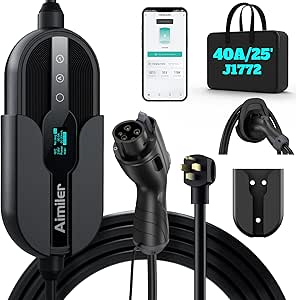 | Best Plug-In Pick for Adjustable Charging | Connector: J1772 | Plug: NEMA 14-50P | Input voltage: 240V | VIEW ON AMAZON | See Our Full Breakdown |
| NexCyber Level 2 EV Charger, 40A, NEMA 14-50 Plug, 25 ft Cable |  | Best for Screen-First Controls | Connector: J1772 | Plug type: NEMA 14-50 | Input and output voltage: 240V | VIEW ON AMAZON | See Our Full Breakdown |
| SEGUMA Level 2 EV Charger, 40A, 25 ft Cable, NEMA 14-50 Plug |  | Best Portable Option for Outdoor Durability | Connector: J1772 | Plug: NEMA 14-50 | Voltage: 240V | VIEW ON AMAZON | See Our Full Breakdown |
| ChargePoint HomeFlex Level 2 EV Charger, J1772, Hardwired, 50A | 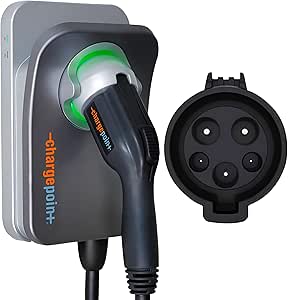 | Best Premium Hardwired Choice | Connector and installation: J1772; hardwired | Output voltage: 240V AC | Adjustable amperage: 16A–50A | VIEW ON AMAZON | See Our Full Breakdown |
| NexCyber Level 2 EV Charger, 32A, 240V, J1772, 25 ft Cable |  | Best for App-Based Scheduling | Voltage: 240 V | Amperage: Up to 32A; adjustable from 16A to 32A | Connector: J1772 | VIEW ON AMAZON | See Our Full Breakdown |
| EVPOVO Level 2 Portable EV Charger, 32A, J1772, NEMA 14-50, 7.68 kW, 25 ft Cable |  | Best for Outdoor and Cold-Weather Flexibility | Voltage: 240 V | Maximum power: 7.68 kW | Current: Up to 32A; adjustable 16/20/24/32A | VIEW ON AMAZON | See Our Full Breakdown |
| VDLPOWERVP Level 2 Portable EV Charger, 32A, 7 kW, 20 ft Cable, NEMA 14-50 Plug |  | Best for Simple Travel Use | Current: 32A | Power: 7 kW | Voltage: 220–240 V | VIEW ON AMAZON | See Our Full Breakdown |
| SEGUMA 32A Level 2 EV Charger with J1772 Connector and NEMA 14-50 Plug |  | Best for Fine-Grained Current Adjustment | Model: EV-ACS3202U | Connector: J1772 | Plug: NEMA 14-50 | VIEW ON AMAZON | See Our Full Breakdown |
| ApexCharger Mach 3 Portable Level 1 and Level 2 EV Charger, 40A, 25 ft Cable |  | Best for Maximum Charging Flexibility | Charging levels: Level 1 and Level 2 | Input voltage: 120–240 V | Maximum current: 40A | VIEW ON AMAZON | See Our Full Breakdown |
| level 2 ev chargers for ford e transit | Cable length | Connector | Plug |
|---|---|---|---|
| ELEGRP Level 2 40A Portable EV | 25 ft | J1772 | — |
| PRIMECOM Level 2 Portable EV C | 30 ft | — | 14-50P |
| BETUMODA Level 2 EV Charger | 25 ft | — | — |
| IYILO Level 2 EV Charger | 25 ft | SAE J1772 | — |
| EVDANCE Level 2 Portable EV Ch | 25 ft | SAE J1772 | NEMA 14-50P |
| EVIQO Level 2 J1772 EV Charger | 25 ft | J1772 | — |
| AIMILER Level 2 EV Charger | 25 ft | J1772 | NEMA 14-50P |
| NexCyber Level 2 EV Charger | 25 ft | J1772 | — |
| SEGUMA Level 2 EV Charger | 25 ft | J1772 | NEMA 14-50 |
| ChargePoint HomeFlex Level 2 E | 23 ft | — | — |
| NexCyber Level 2 EV Charger | 25 ft | J1772 | NEMA 14-50P |
| EVPOVO Level 2 Portable EV Cha | 25 ft | J1772 | NEMA 14-50 |
| VDLPOWERVP Level 2 Portable EV | 20 ft | SAE J1772 | NEMA 14-50 |
| SEGUMA 32A Level 2 EV Charger | 25 ft | J1772 | NEMA 14-50 |
| ApexCharger Mach 3 Portable Le | 25 ft | — | — |
More Details on Our Top Picks
ELEGRP Level 2 40A Portable EV Charger with J1772 Connector and 25 ft Cable
For an E-Transit owner with a suitable 240V outlet, the ELEGRP’s 40A maximum output makes it a strong portable choice among these five. Its 9.6 kW ceiling is higher than the EVDANCE 32A and the 16A PRIMECOM, while five current settings let you reduce the draw to match a circuit’s capacity. The 25-foot cable gives more parking flexibility than a short lead, and IP67 protection is a plus for changing garage or outdoor conditions. This remains a plug-in charger, not a high-output hardwired unit like the IYILO 48A; it also needs a NEMA 14-50 outlet, so its portability depends on having the right receptacle. I’d shortlist it for flexible home charging, not for buyers seeking a permanent hardwired installation.
Pros:- Up to 40A and 9.6 kW, with five current settings to suit different circuit limits
- 25-foot cable helps reach a vehicle parked farther from the outlet
- IP67 rating supports indoor and outdoor use
- ETL certification and overheat protection
Cons:- Requires a 240V NEMA 14-50 outlet
- Tesla vehicles need a separately sold NACS adapter
- Lower maximum output than the hardwired IYILO 48A
Best for: E-Transit owners with a properly installed NEMA 14-50 outlet who want adjustable charging current and a long cable for home or occasional travel use.
Not ideal for: Owners without a 240V NEMA 14-50 outlet, or buyers who want a hardwired charger with more than 40A output.
- Maximum output:9.6 kW
- Current settings:16A, 20A, 24A, 32A, 40A
- Input plug:NEMA 14-50
- Cable length:25 ft
- Connector:J1772
- Delay timer:1–12 hours
- Ingress protection:IP67
- Certification and warranty:ETL; 2 years
Our verdict“Choose the ELEGRP if you want a flexible 40A plug-in charger and already have a suitable NEMA 14-50 outlet.”
PRIMECOM Level 2 Portable EV Charger, 16 Amp, 220–240V, 30 ft, NEMA 14-50P
The PRIMECOM is the lower-draw option in this group: it tops out at 16A and 3.84 kW, well below the ELEGRP’s 40A or the EVDANCE’s 32A. That can suit an owner whose charging setup cannot support higher current, but it also means a large E-Transit battery will take longer to replenish. Its 30-foot cable is the longest among these five, useful when the outlet and parking spot do not line up neatly. Smart controls and built-in protections add practical safeguards, and the IP65 rating suits outdoor use. I would not choose it when charging speed is the priority; the main reason to pick it over the higher-output models is its modest 16A draw and added reach.
Pros:- 16A output offers a lower-current alternative to 32A and 40A chargers
- 30-foot cable provides extra reach to the vehicle
- IP65 rating and built-in protections support outdoor use
- Compatible with EVs and plug-in hybrids that use compatible J1772 plugs
Cons:- 3.84 kW maximum output will charge more slowly than the other featured Level 2 options
- Requires a compatible 14-50P connection
- One-year warranty is shorter than the ELEGRP’s two-year coverage
Best for: E-Transit owners with a compatible 220–240V connection and a charging circuit that calls for a lower-current portable unit, especially when extra cable reach matters.
Not ideal for: Drivers who need faster overnight recovery for frequent or high-mileage E-Transit use; its 16A maximum is considerably lower than the ELEGRP and BETUMODA.
- Charging level:Level 2
- Current:16A
- Charging power:3.84 kW
- Output voltage:240 V
- Cable length:30 ft
- Plug:14-50P
- Ingress protection:IP65
- Certifications and warranty:UL and CE; 1 year
Our verdict“Pick the PRIMECOM when a lower-current charger and unusually long cable matter more than charging speed.”
BETUMODA Level 2 EV Charger, 40A, 25 ft, 9.6 kW
BETUMODA stands apart from the ELEGRP by including a NEMA 5-15 adapter for Level 1 charging, giving an E-Transit owner a fallback when a 240V outlet is unavailable. On a suitable 240V circuit, it reaches 40A and 9.6 kW, matching the ELEGRP’s stated ceiling, and its settings start at 8A rather than 16A. That broader adjustment range may help when sharing circuit capacity. The LED display and 0–12-hour delay offer useful at-a-glance control, though the listed protection rating is IP65 rather than ELEGRP’s IP67. Its 240V mode still needs a dedicated circuit, and the Tesla adapter is separate. I’d favor this model over the ELEGRP when 120V backup is useful, but not when the higher ingress rating is the priority.
Pros:- Up to 40A and 9.6 kW with five current settings starting at 8A
- Included NEMA 5-15 adapter supports Level 1 charging
- 25-foot cable, LED display, and programmable delay
- Built-in over-voltage, over-current, and short-circuit protection
Cons:- 240V Level 2 use requires a dedicated circuit
- IP65 rating is below the ELEGRP’s IP67 rating
- Tesla vehicles require a separate adapter
Best for: E-Transit owners who want a 40A portable charger for home and a basic 120V charging fallback for travel or backup situations.
Not ideal for: Buyers who need the strongest listed water-ingress rating or want a charger certified to ETL; its listed certifications are CE and FCC.
- Maximum current:40A
- Current settings:8A, 16A, 24A, 32A, 40A
- Maximum power:9.6 kW
- Output voltage:240V AC
- Cable length:25 ft
- Connectors:NEMA 14-50; NEMA 5-15 adapter
- Charging delay:0–12 hours
- Water resistance and certifications:IP65; CE and FCC
Our verdict“Choose BETUMODA if you want 40A Level 2 capability with an included 120V fallback adapter.”
IYILO Level 2 EV Charger, 48A, 11.5 kW, 240V, J1772
The IYILO has the highest stated output in this batch: 48A and 11.5 kW, versus 40A for the ELEGRP and BETUMODA. For an E-Transit owner seeking a fixed home charging setup, that extra capacity can support faster charging when the vehicle and electrical installation allow it. App scheduling, energy tracking, RFID access, and power sharing also make it more feature-rich than the portable models. Those advantages come with a different commitment: maximum output requires hardwiring, a 60A breaker, and a licensed electrician. Its 2.4 GHz-only Wi-Fi may also constrain some home networks. I’d rank it above the plug-in chargers for a permanent, higher-output installation, but below them for portability or a simple outlet-based setup.
Pros:- Highest output in this group at 48A and 11.5 kW
- App controls include scheduling, energy tracking, and RFID access
- Power sharing can help manage two compatible chargers
- ETL and Energy Star certifications, with a three-year warranty
Cons:- Maximum output requires hardwiring, a 60A breaker, and professional installation
- Wi-Fi connectivity is limited to 2.4 GHz
- Tesla NACS adapter is not included
Best for: E-Transit owners planning a permanent home installation who have the electrical capacity and budget for professional hardwiring at up to 48A.
Not ideal for: Renters, frequent travelers, or owners who need a plug-in unit; maximum output requires hardwiring and a 60A breaker.
- Maximum current:48A, adjustable from 6A to 48A in 1A increments
- Power:11.5 kW
- Voltage:240V
- Connector:SAE J1772
- Cable length:25 ft
- Installation:Hardwired; 60A breaker and licensed electrician required for maximum output
- Connectivity:2.4 GHz Wi-Fi
- Certifications and warranty:ETL and Energy Star; 3 years
Our verdict“Choose the IYILO for a permanent, professionally installed setup when higher output and connected controls outweigh portability.”
EVDANCE Level 2 Portable EV Charger, 32A, 240V, NEMA 14-50P, 25 ft Cable
The EVDANCE is the middle-ground choice: its 32A, 7.68 kW output is below the ELEGRP and BETUMODA at 40A, but above the PRIMECOM at 16A. For an E-Transit owner with a 14-50 outlet who does not need the highest portable current, that can be a sensible balance. It includes a carrying case and wall-mounting bracket, so it is easier to store or keep organized than a bare charger, and the LED display and delay function provide basic control. Its 25-foot cable matches several competitors, not the PRIMECOM’s longer 30-foot lead. The IP66 design is intended for garages, carports, and covered outdoor areas, but it is not recommended for direct sunlight or heavy rain. I’d choose it over the PRIMECOM for output, not over the IYILO for a hardwired installation.
Pros:- 32A and 7.68 kW output exceed the PRIMECOM’s 16A maximum
- Five current settings provide charging flexibility
- LED display, delay charging, and 25-foot cable
- Includes a carrying case and wall-mounting bracket
Cons:- Lower maximum output than the ELEGRP and BETUMODA 40A chargers
- Not recommended for direct sunlight or heavy rain
- Tesla vehicles require a separate J1772-to-Tesla adapter
Best for: E-Transit owners with a NEMA 14-50 outlet who want a portable 32A charger with included storage and mounting accessories.
Not ideal for: Owners who need 40A-or-higher portable output, a cable longer than 25 feet, or exposure to heavy rain and direct sunlight.
- Connector:SAE J1772
- Plug:NEMA 14-50P
- Input voltage:240 V
- Maximum current:32 A
- Power output:7.68 kW
- Adjustable current settings:10 A, 16 A, 20 A, 24 A, 32 A
- Cable length:25 ft
- Included accessories and warranty:Carrying case and wall-mounting bracket; 1 year on extension cable
Our verdict“Choose the EVDANCE for a practical 32A portable setup with useful storage accessories, provided it will be used in a sheltered location.”
EVIQO Level 2 J1772 EV Charger, 48A Hardwired, 240V
For an E-Transit owner with a suitable electrical service, the EVIQO’s 48A output makes it a stronger fit for higher-capacity home charging than the 40A AIMILER or SEGUMA. It needs a dedicated 60A, 240V circuit at 48A, so the extra charging capacity comes with an electrician visit and a permanent installation. Its 25-foot cable gives useful reach around a driveway or garage, while IP66/NEMA 4 protection supports indoor or outdoor placement. App scheduling and energy tracking add control, but depend on 2.4 GHz Wi-Fi. I’d choose this over the plug-in AIMILER when a hardwired setup is already planned; I’d skip it if outlet-based portability matters more than higher amperage.
Pros:- 48A output on a dedicated 60A circuit provides more capacity than the 40A AIMILER and SEGUMA.
- 25-foot J1772 cable offers flexible reach to the van.
- IP66/NEMA 4 construction suits indoor or outdoor installation.
- App controls include scheduling and energy tracking; backed by a three-year warranty.
Cons:- Hardwiring requires professional installation and a suitable dedicated circuit.
- Smart features require a 2.4 GHz Wi-Fi network.
- Tesla and NACS vehicles need a separate compatible adapter.
Best for: E-Transit owners planning a permanent home installation on a dedicated 60A circuit who want more charging capacity than the 40A plug-in options offer.
Not ideal for: Renters or drivers who need to move the charger between locations, since it requires hardwiring and professional installation.
- Connector:J1772
- Maximum charging current:48A; up to 50A with supported circuit and DIP switch settings
- Circuit requirements:Dedicated 60A circuit for 48A; dedicated 70A circuit for 50A
- Installation:Hardwired; professional electrician required
- Cable length:25 ft
- Connectivity:2.4 GHz Wi-Fi
- Weather protection:IP66 / NEMA 4
- Certifications:UL, ETL, FCC, Energy Star
- Warranty:3 years
Our verdict“Choose the EVIQO if you want a weather-protected, higher-output hardwired charger and have the circuit capacity and installation budget for it.”
AIMILER Level 2 EV Charger, 40A, 25 ft Cable, Wi-Fi App, NEMA 14-50 Plug, J1772 Connector
The AIMILER is a practical middle ground for E-Transit owners who want a 40A, NEMA 14-50 plug-in charger rather than the EVIQO’s hardwired 48A installation. Its current adjusts from 16A to 40A, giving buyers some flexibility to match charging to their circuit, and the 25-foot cable can help when the parking position is not close to the outlet. A screen shows charging and input information, while the Wi-Fi app adds scheduling and status tracking. Compared with the SEGUMA, AIMILER spells out its app features and adjustable range, but it lacks SEGUMA’s stated IP66 rating and carry bag. The tradeoff is reliance on a suitable NEMA 14-50 outlet and 2.4 GHz Wi-Fi for app setup.
Pros:- Adjustable 16A–40A current can be matched to the available circuit.
- 25-foot cable provides useful reach from a NEMA 14-50 outlet.
- Screen displays charging and input information.
- Wi-Fi app supports scheduling and status tracking.
Cons:- Requires a suitable NEMA 14-50 outlet for its intended Level 2 setup.
- App setup requires a 2.4 GHz Wi-Fi connection.
- Tesla and NACS vehicles need a separate adapter.
Best for: E-Transit owners with a properly installed NEMA 14-50 outlet who want adjustable current, on-unit charging information, and app scheduling.
Not ideal for: Drivers seeking a hardwired charger above 40A or a charger whose smart controls do not depend on Wi-Fi.
- Connector:J1772
- Plug:NEMA 14-50P
- Input voltage:240V
- Maximum amperage:40A
- Maximum power:9.6 kW
- Adjustable amperage:16A–40A
- Cable length:25 ft
- Water protection:NEMA Type 4; described as having some IP66 waterproofing
- Safety and listing:CCID-20 protection; ETL and FCC listed
Our verdict“Pick the AIMILER if you have a NEMA 14-50 outlet and want a flexible 40A setup with both screen and app controls.”
NexCyber Level 2 EV Charger, 40A, NEMA 14-50 Plug, 25 ft Cable
The NexCyber suits E-Transit owners who prefer to check settings and charging status at the unit, with a touchscreen paired with Wi-Fi app scheduling. It shares the 40A, 25-foot, NEMA 14-50 format of the AIMILER, so neither offers the higher hardwired capacity of the EVIQO. The stated charging-speed figure is up to 38 miles per hour, but actual results depend on the vehicle and electrical supply. Its three-year warranty is a useful point of comparison with AIMILER, whose supplied details do not state a warranty. The major caveat is placement: NEMA Type 3 protection is more limited than the IP66 rating listed for SEGUMA, and this model is not recommended for direct sun or rainy exposure.
Pros:- Touchscreen provides local access to charging settings and status.
- Wi-Fi app supports scheduling and monitoring.
- 25-foot cable gives practical reach from the outlet.
- Three-year warranty; ETL and FCC certified.
Cons:- Not recommended for direct sunlight or rainy exposure.
- Tesla and NACS vehicles require a separate compatible adapter.
- Professional installation is recommended.
Best for: E-Transit owners with a NEMA 14-50 outlet who want touchscreen controls, app scheduling, and a stated three-year warranty for a sheltered installation.
Not ideal for: Drivers who need to mount a charger in an exposed outdoor location or want the stronger stated weather protection of the SEGUMA.
- Connector:J1772
- Plug type:NEMA 14-50
- Input and output voltage:240V
- Maximum current:40A
- Current adjustment:16A–40A
- Cable length:25 ft
- Protection:NEMA Type 3
- Certifications:ETL, FCC
- Warranty:3 years
Our verdict“Choose the NexCyber if touchscreen access and a stated warranty matter more than exposed-outdoor placement or higher output.”
SEGUMA Level 2 EV Charger, 40A, 25 ft Cable, NEMA 14-50 Plug
Among these 40A plug-in options, the SEGUMA is the clearest choice for buyers who value a portable kit and a stated IP66 rating. Its 25-foot cable, carry bag, cable holder, and control-box holder make storage and occasional relocation easier than with the hardwired EVIQO. A 2.4-inch display shows charging information, and six current settings—from 10A to 40A—plus a delay timer offer useful control without relying on an app. Compared with AIMILER, SEGUMA gives up the specified Wi-Fi scheduling features but supplies a carry bag and a broader list of electrical standards. It still needs a 240V supply and NEMA 14-50 outlet, so portability does not mean it can plug into an ordinary household receptacle.
Pros:- IP66 rating and built-in electrical protections suit a more weather-resistant portable setup.
- Six current settings and a delay timer provide straightforward charging control.
- Display shows charging data without requiring an app.
- Carry bag and included holders support storage and transport.
Cons:- Requires a 240V supply and compatible NEMA 14-50 outlet.
- Tesla vehicles need a separate J1772-to-NACS adapter.
- No Wi-Fi app features are listed, unlike the AIMILER and NexCyber.
Best for: E-Transit owners who want a 40A NEMA 14-50 charger that can be stored or carried, with local display controls and stated IP66 protection.
Not ideal for: Buyers who want app-based remote monitoring or need charging capacity beyond 40A.
- Connector:J1772
- Plug:NEMA 14-50
- Voltage:240V
- Maximum current:40A
- Maximum power:9.6 kW
- Current settings:10A, 16A, 20A, 24A, 32A, 40A
- Cable length:25 ft
- Display:2.4-inch TFT
- Included accessories:Cable holder, control box holder, carry bag
Our verdict“Choose the SEGUMA if portable storage, local controls, and stated IP66 protection matter more than app connectivity.”
ChargePoint HomeFlex Level 2 EV Charger, J1772, Hardwired, 50A
The ChargePoint HomeFlex is the premium hardwired pick for an E-Transit owner who wants a configurable output up to 50A and app-based charging controls. Its 23-foot cable is slightly shorter than the 25-foot leads on the EVIQO and the plug-in models, but it is described as cold-resistant for installations where winter flexibility matters. Compared with the EVIQO, HomeFlex reaches a higher stated maximum amperage, while EVIQO lists IP66/NEMA 4 weather protection and a 25-foot cable. ChargePoint’s UL certification and Energy Star listing add useful documentation, though charging speed depends on the vehicle and circuit. As with the EVIQO, this is not a portable outlet-based solution: an electrician is needed, and some app features require Wi-Fi.
Pros:- Adjustable 16A–50A output supports a range of compatible circuit capacities.
- Cold-resistant 23-foot J1772 cable suits colder installation environments.
- App provides charging controls and data.
- UL-certified, Energy Star listed, and covered by a three-year warranty.
Cons:- Hardwired installation requires an electrician.
- Wi-Fi is required for some app features.
- Tesla vehicles require a separate adapter.
Best for: E-Transit owners planning a permanent indoor or outdoor installation who want adjustable current up to 50A, app controls, and a cold-resistant cable.
Not ideal for: Renters, buyers who need a portable NEMA 14-50 charger, or anyone without capacity for a professionally installed hardwired circuit.
- Connector and installation:J1772; hardwired
- Output voltage:240V AC
- Adjustable amperage:16A–50A
- Cable length:23 ft
- Connectivity:Wi-Fi and mobile app
- Installation location:Indoor or outdoor; electrician installation
- Certification:UL-certified; Energy Star
- Warranty:3 years
- Weight:13.8 lb
Our verdict“Choose HomeFlex for a professionally installed, app-connected hardwired setup with up to 50A output, especially where a cold-resistant cable is useful.”
NexCyber Level 2 EV Charger, 32A, 240V, J1772, 25 ft Cable
For an E-Transit owner who wants to schedule charging and check status remotely, this NexCyber pairs a Wi-Fi app with a display and a useful 25-foot cable. Its adjustable 16–32A range gives more flexibility across compatible circuits than a fixed-output unit, while the NEMA 14-50 plug keeps it portable between suitable outlets. Compared with the EVPOVO, it offers similar current adjustment and cable reach, but EVPOVO has clearer stated outdoor and cold-weather provisions. NexCyber’s stated caution against rain and direct sunlight makes its placement more restrictive, a meaningful drawback for a van parked outside. Its J1772 connector fits compatible E-Transit configurations, but the listed 32A ceiling is less compelling for buyers seeking higher output than the 40A options elsewhere in this roundup.
Pros:- Adjustable current from 16A to 32A can suit different circuit capacities
- Wi-Fi app supports scheduling and charging-status monitoring
- 25-foot cable offers flexible parking and outlet placement
- ETL and FCC certifications are listed
Cons:- Manufacturer advises against direct sunlight and rain exposure
- 32A maximum is below the output of 40A options in the roundup
- Tesla and NACS vehicles need a separate adapter
Best for: E-Transit owners with a sheltered NEMA 14-50 outlet who want Wi-Fi scheduling and a long cable without moving to a higher-current setup.
Not ideal for: Owners who need a charger exposed to rain or direct sunlight, or who want output above 32A.
- Voltage:240 V
- Amperage:Up to 32A; adjustable from 16A to 32A
- Connector:J1772
- Plug:NEMA 14-50P
- Cable length:25 ft
- Ports:1
- Certifications:ETL, FCC
- Warranty:3 years
Our verdict“Choose this NexCyber if app scheduling and a 25-foot cable matter more than outdoor flexibility or higher charging output.”
EVPOVO Level 2 Portable EV Charger, 32A, J1772, NEMA 14-50, 7.68 kW, 25 ft Cable
The EVPOVO is the more weather-ready 32A choice here: its weather-resistant enclosure and cable rated flexible to -22°F make it better suited to a garage that gets cold or a properly protected outdoor installation than the NexCyber, whose manufacturer advises against rain exposure. The 25-foot cable and adjustable 16/20/24/32A settings also help when outlet capacity or vehicle schedules vary. It delivers up to 7.68 kW, a clear match for owners who want portable Level 2 charging rather than the higher-output capability of the ApexCharger Mach 3. The tradeoff is that app functions depend on 2.4 GHz Wi-Fi, and the unit still needs a properly installed NEMA 14-50 outlet. Its J1772 connector is the fit to check against the specific E-Transit configuration.
Pros:- Adjustable 16A, 20A, 24A, and 32A settings accommodate different circuits
- 25-foot TPU cable remains flexible to -22°F
- Weather-resistant enclosure supports indoor or outdoor use
- ETL-listed to UL 2594 and UL 2231-1/-2
Cons:- App features require a 2.4 GHz Wi-Fi connection
- Requires a properly installed NEMA 14-50 outlet
- 32A output is lower than the ApexCharger Mach 3’s 40A maximum
Best for: E-Transit owners with a suitable NEMA 14-50 circuit who need a portable charger and expect cold conditions or protected outdoor use.
Not ideal for: Buyers without 2.4 GHz Wi-Fi who want app scheduling, or those who need a hardwired installation or output above 32A.
- Voltage:240 V
- Maximum power:7.68 kW
- Current:Up to 32A; adjustable 16/20/24/32A
- Connector:J1772
- Plug:NEMA 14-50
- Cable length:25 ft
- Charging rate:Approximately 22–25 miles of range per hour
- Safety certification:ETL listed to UL 2594 and UL 2231-1/-2
- Controls:Smart Life app over 2.4 GHz Wi-Fi and charger buttons
Our verdict“Pick the EVPOVO if cold-weather cable flexibility and stated weather resistance matter more than app independence or higher amperage.”
VDLPOWERVP Level 2 Portable EV Charger, 32A, 7 kW, 20 ft Cable, NEMA 14-50 Plug
The VDLPOWERVP keeps its feature set straightforward: a portable 32A J1772 charger, LED status indicators, and a 20-foot cable. That shorter reach can work well when the outlet is near the E-Transit’s parking position, while making the unit less adaptable than the 25-foot NexCyber, EVPOVO, or SEGUMA. Its IP65-rated control box and stated electrical protections add useful reassurance for travel and garage use, though the product still depends on a 220–240V NEMA 14-50 outlet. Unlike the EVPOVO, the supplied details do not list app controls or an adjustable current range, so buyers seeking scheduling or circuit-matching flexibility should look elsewhere. The one-year warranty is also shorter than the NexCyber’s three years, making this a basic portability pick rather than a long-support choice.
Pros:- Portable 32A output provides up to 7 kW
- 20-foot cable supports home or travel use
- IP65-rated control box and listed electrical protections
- LED indicators show charger status
Cons:- 20-foot cable is shorter than the 25-foot cables on several alternatives
- No adjustable current range or app controls is listed
- One-year warranty is shorter than NexCyber’s stated three years
Best for: E-Transit drivers who want a portable 32A J1772 charger for home and travel, with a nearby NEMA 14-50 outlet and simple LED feedback.
Not ideal for: Owners who need a longer cable, adjustable current, app scheduling, or a longer stated warranty.
- Current:32A
- Power:7 kW
- Voltage:220–240 V
- Plug:NEMA 14-50
- Connector:SAE J1772
- Cable length:20 ft
- Weight:7.61 lbs
- Warranty:1 year
Our verdict“Choose the VDLPOWERVP if basic portability and LED status are enough and a 20-foot cable reaches your E-Transit comfortably.”
SEGUMA 32A Level 2 EV Charger with J1772 Connector and NEMA 14-50 Plug
SEGUMA’s main distinction is its unusually broad set of current choices: 10A, 16A, 20A, 24A, and 32A. That gives E-Transit owners more room to match charging to a circuit than the EVPOVO’s four listed settings, especially when a lower current is preferable. The 25-foot cable, 1.77-inch TFT display, and portable or wall-mounted use make it more informative and flexible at home than the simpler VDLPOWERVP. Its IP66 rating is a useful stated enclosure specification, but the plug-in setup still requires a NEMA 14-50 outlet, and the J1772 connector may need an adapter for vehicles with another inlet. No app controls or warranty are listed in the supplied details, so buyers who prioritize remote scheduling or documented long-term support may prefer the NexCyber or EVPOVO.
Pros:- Five current settings from 10A to 32A allow close circuit matching
- 25-foot cable offers useful parking flexibility
- 1.77-inch TFT display shows charging information
- IP66 rating and portable or wall-mounted use
Cons:- Requires a NEMA 14-50 outlet for plug-in use
- J1772 may require an adapter for vehicles with a different inlet
- App controls and warranty are not specified in the supplied product details
Best for: E-Transit owners who want several lower-current settings, an on-unit charging display, and the option to mount or move the charger.
Not ideal for: Buyers who require app scheduling, a stated warranty, or a charging connection that matches a non-J1772 inlet without an adapter.
- Model:EV-ACS3202U
- Connector:J1772
- Plug:NEMA 14-50
- Charging current:10A, 16A, 20A, 24A, or 32A
- Wattage:7,680 W
- Cable length:25 ft
- Display:1.77-inch TFT
- Ingress protection:IP66
- Weight:10.34 lbs
Our verdict“Choose SEGUMA if current-setting flexibility and a built-in display outrank app features and documented warranty coverage.”
ApexCharger Mach 3 Portable Level 1 and Level 2 EV Charger, 40A, 25 ft Cable
The ApexCharger Mach 3 is the most versatile pick in this group for drivers who want one portable unit to cover different outlets: it supports 120V Level 1 and 240V Level 2, with current adjustment up to 40A. On a compatible 240V setup, its stated 9.6 kW maximum exceeds the 32A NexCyber, EVPOVO, VDLPOWERVP, and SEGUMA, though the E-Transit’s own charging limits and circuit capacity still govern actual charging. The included NEMA 5-15 and 14-50 connections, 25-foot cable, and J1772-to-Tesla adapter widen its use beyond the J1772-only alternatives. That flexibility comes with more setup decisions, and it remains a single-port charger. Buyers who only need a straightforward 32A unit may find EVPOVO simpler, while the five-year warranty is the longest stated among these five products.
Pros:- Supports both Level 1 and Level 2 charging
- Adjustable current up to 40A with stated 9.6 kW maximum at 240V
- Includes NEMA 14-50 and NEMA 5-15 connections
- 25-foot cable, Bluetooth and Wi-Fi controls, and five-year warranty
Cons:- Requires an outlet compatible with the selected charging level
- One charging port only
- 40A capability depends on a suitable circuit and does not override vehicle charging limits
Best for: E-Transit owners who need a portable charger for both 120V and 240V outlets, want adjustable output up to 40A, and value a longer stated warranty.
Not ideal for: Buyers who only need a fixed home setup at 32A, want more than one charging port, or do not have outlets compatible with the included connections.
- Charging levels:Level 1 and Level 2
- Input voltage:120–240 V
- Maximum current:40A
- Maximum power:9.6 kW at 240 V; 1.44 kW at 120 V
- Cable length:25 ft
- Outlets and adapters:NEMA 14-50 and NEMA 5-15
- Connector compatibility:J1772 and Tesla NACS with included adapter
- Connectivity:Bluetooth and Wi-Fi
- Warranty:5 years
Our verdict“Pick the Mach 3 if outlet flexibility and higher adjustable output matter more than a simpler 32A-only charger.”

How We Picked
I ranked these 15 chargers by how well their listed configuration fits likely Ford E-Transit charging needs: output, connection style, installation demands, cable reach and day-to-day flexibility. Hardwired 48A models lead for buyers with a suitable electrical service who want a dedicated setup; plug-in 40A options follow for owners who need a balance of output and portability. The 32A and 16A units remain useful for buyers with different circuit limits or charging routines, but their lower listed amperage makes them less compelling when faster charging is the priority.
I also separated chargers by practical fit rather than treating every J1772 unit as interchangeable. The E-Transit’s onboard charging capability, the branch circuit and local electrical rules all affect real charging power, so a higher amp rating alone does not make a product the right pick. Product descriptions provide limited detail about certification, warranty, app functions and environmental protection for several models; I did not assume unlisted capabilities. Before purchase, verify the vehicle connector, installation instructions, circuit requirements and compatibility with the exact van configuration.
| level 2 ev chargers for ford e transit | Connector |
|---|---|
| ELEGRP Level 2 40A Portable EV | J1772 |
| PRIMECOM Level 2 Portable EV C | — |
| BETUMODA Level 2 EV Charger | — |
| IYILO Level 2 EV Charger | SAE J1772 |
| EVDANCE Level 2 Portable EV Ch | SAE J1772 |
| EVIQO Level 2 J1772 EV Charger | J1772 |
| AIMILER Level 2 EV Charger | J1772 |
| NexCyber Level 2 EV Charger | J1772 |
| SEGUMA Level 2 EV Charger | J1772 |
| ChargePoint HomeFlex Level 2 E | — |
| NexCyber Level 2 EV Charger | J1772 |
| EVPOVO Level 2 Portable EV Cha | J1772 |
| VDLPOWERVP Level 2 Portable EV | SAE J1772 |
| SEGUMA 32A Level 2 EV Charger | J1772 |
| ApexCharger Mach 3 Portable Le | — |
Factors to Consider When Choosing Level 2 Ev Chargers For Ford E Transit
Choosing an E-Transit charger is as much a site-planning decision as a product choice. I’d first match the charger to the van and electrical supply, then compare cable reach, mounting style and portability. These checks can prevent paying for output your circuit cannot provide or buying a portable unit that does not fit the way the van is parked.
Match the charger rating to the van and circuit
Do not assume that a 48A or 50A label means the E-Transit will charge at that rate. The vehicle’s onboard AC charging limit and the electrical circuit set the actual ceiling, so check the specifications for your exact model year and configuration. Continuous EV charging draws sustained current, which is why the circuit and breaker need to be sized for the charger’s listed operating current under applicable electrical rules. A 40A plug-in unit should not be connected to a receptacle simply because the plug fits. If you are unsure about the panel capacity or outlet wiring, have an electrician assess it before ordering. Paying for a higher-rated charger makes sense only if the van and site can use its added capacity.
Choose hardwired or plug-in around your parking routine
Hardwired chargers such as the ChargePoint HomeFlex and EVIQO are suited to a permanent charging spot and can support higher output when the installation allows it. Plug-in models with NEMA 14-50 connectors are easier to remove or relocate, but they depend on a properly installed, compatible receptacle. A receptacle is not a shortcut around electrical work: its circuit rating and installation quality matter just as much as the charger. If you rent, move often or want to take a unit between locations, portability may matter more than peak amperage. For a fixed fleet or home parking bay, a hardwired installation can reduce plug wear and keep the setup organized. Check local code and the manufacturer’s installation requirements before deciding.
Measure cable reach from outlet to charge port
A longer cable can solve awkward parking, but listed length is not the same as usable reach once the cable has to route around walls, bumpers or other vehicles. Measure from the proposed outlet or charger mount to the E-Transit’s charge port in the parking position you use most often. The listed models span 20 to 30 feet, so the shorter VDLPOWERVP may fit a nearby outlet while the PRIMECOM’s 30-foot lead can help when the outlet is farther away. Avoid stretching a cable across a walkway or where it can be pinched under a door or driven over. If two bays may need access, think through vehicle placement before choosing a fixed mount. A well-placed 32A charger can be more convenient than a higher-output unit whose cable falls short.
Decide how much portability you will actually use
Portable chargers make sense when the E-Transit needs charging at more than one approved outlet, but they add a step each time: handling, storage and checking the connection. Their usefulness depends on having compatible, correctly wired outlets at every location, not merely on the unit being portable. A dual Level 1 and Level 2 option such as the ApexCharger Mach 3 may help buyers who need more than one charging mode, though its real value depends on the included adapters and supported setup. For a vehicle that returns to the same parking space nightly, a wall-mounted charger may be simpler to use. Consider theft exposure and where the unit will be stored when it is not connected. Choose portability for a real multi-location need, not as a substitute for planning the home installation.
Treat smart controls as a convenience, not a power upgrade
App access can help with schedules, charging status and remote control, but it does not raise the power available from the circuit or the vehicle. Of the listed products, the AIMILER specifically names Wi-Fi app connectivity, while many descriptions provide no comparable smart-feature detail. If scheduled charging or remote checks matter, confirm what the app supports, whether Wi-Fi reaches the parking area and whether core charging still works without an internet connection. Fleet operators may value monitoring across vehicles more than a single-van owner does. Buyers who prefer a simple setup may be better served by prioritizing reliable controls and clear status indicators over app features. Compare documented functions rather than assuming that a charger is smart because it has a mobile app mention.
Check safety documentation and installation support
Before buying, look for clear documentation on electrical ratings, supported installation methods, protection features and the intended indoor or outdoor environment. A product description that omits those details leaves questions the buyer should resolve with the manufacturer or seller. Confirm whether the charger and cable are rated for the location where they will be used, especially if the parking area is exposed to rain, dust or temperature extremes. For a hardwired unit, ask an electrician to review installation requirements and applicable local rules. For a plug-in unit, check the outlet condition and circuit rather than relying on its NEMA shape alone. Clear documentation and accessible support can be more useful over years of ownership than a small difference in advertised amperage.
Frequently Asked Questions
Can I use a 48A or 50A charger if my E-Transit cannot draw that much?
A higher-rated charger can generally supply less current when the vehicle requests less, but the exact compatibility and configuration must be confirmed for the charger and van. The vehicle’s onboard AC charging limit determines how much it can accept, while the circuit sets a separate limit. A higher rating does not make charging faster if either one is the bottleneck. Check the E-Transit specifications for your model year and have the installer confirm the circuit and charger settings. If the 48A or 50A capacity will not be used, a lower-rated charger may be a better fit for your installation.
Is a NEMA 14-50 charger safe to plug into any 14-50 outlet?
No. The outlet must be correctly wired, in good condition and supported by a circuit suitable for the charger’s continuous load. A matching plug only confirms physical fit; it does not verify the breaker, wiring or installation. Ask an electrician to inspect an existing receptacle before using a high-current EV charger, especially if its history is unknown. Follow the charger maker’s instructions about circuit rating and permitted current. Do not use an extension cord or adapter unless the manufacturer explicitly approves that setup.
Should I choose a 32A portable charger or a 40A plug-in model for regular overnight charging?
Start with the E-Transit’s charging limit, the available circuit and how much energy the van needs between shifts. If the 32A unit can replenish the battery during the time the van is parked, its lower draw may be a sensible match for the site. A 40A unit can add charging power only when the van and electrical circuit support it, and it may require a more capable installation. Compare cable reach and outlet placement too, since several listed 32A and 40A choices have different cable lengths. For a commercial schedule with short dwell times, confirm charging needs with an electrician or fleet specialist rather than selecting by amperage alone.
When does a hardwired charger make more sense than a portable charger for an E-Transit?
A hardwired charger is often a better fit when the van returns to one permanent parking space and the electrical installation can support the chosen output. It avoids relying on a plug-in receptacle and can keep the charging point fixed and tidy. A portable unit is more useful if you need to move it between compatible outlets or take it to another approved location. That flexibility has limits: every outlet still needs to match the charger’s electrical requirements. If the van is part of a fleet, consider how many vehicles share the site and whether fixed mounting, access control or load management is part of the plan.
How can I tell whether a charger cable will reach my parked van?
Measure the route from the planned charger or outlet to the E-Transit’s charge port with the van parked as it will be during charging. Include the path around obstacles and leave room so the cable does not cross a driving lane, pinch point or regular walkway. The listed choices here range from 20 to 30 feet, but the full cable length may not be practical reach in every layout. If an outlet is on the opposite side of the parking space, test the route before fixing a charger in place. Cable placement should be planned alongside the outlet location, not after installation.
Conclusion
My best overall pick is the ChargePoint HomeFlex for buyers planning a dedicated hardwired installation, while the EVIQO 48A is the other higher-output hardwired option for a suitable site. For a plug-in middle ground, I’d compare the ELEGRP 40A, AIMILER 40A and other 40A NEMA 14-50 models against the circuit and cable reach you have. The PRIMECOM 16A is the best fit here for buyers who value its portable format and 30-foot cable over faster output; for first-time buyers, I’d favor whichever unit has clear installation documentation and matches an electrician-verified circuit. If you need multiple charging modes, consider the ApexCharger Mach 3, but check its included setup details first. The final choice should follow your van’s charging limit, your electrical service and where the E-Transit parks—not the highest amperage on the label.
Halloween Picks
halloween
As an affiliate, we earn on qualifying purchases.