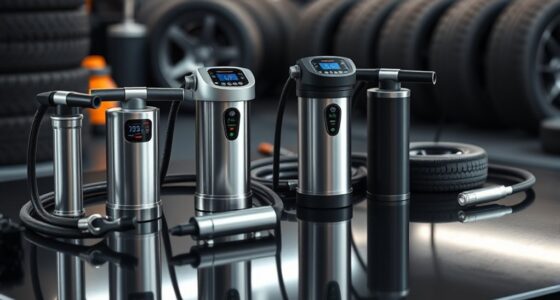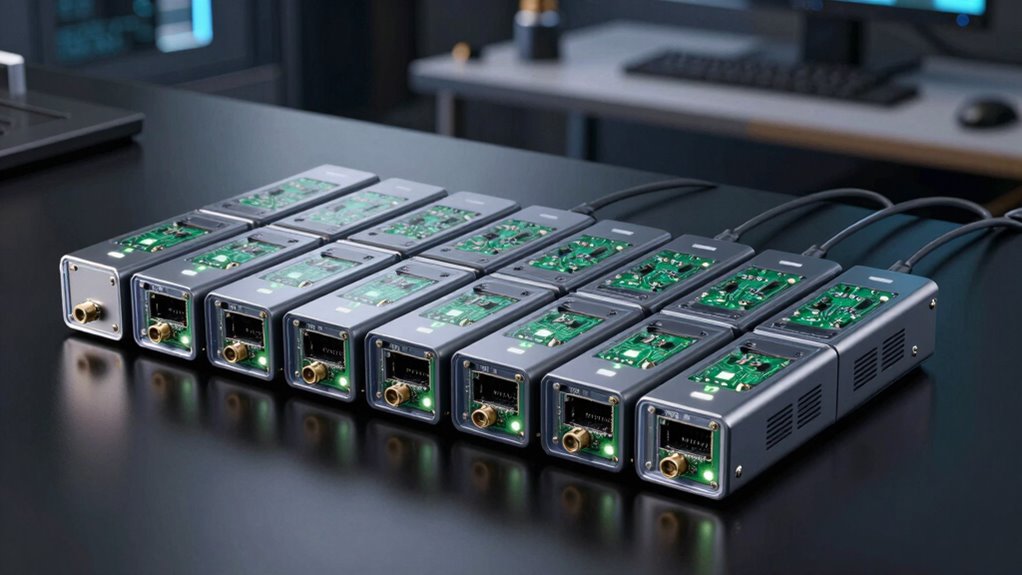

If you’re looking for an inline PoE splitter, you’re likely balancing power delivery and data transfer for devices like IP cameras or smart home gadgets. The best options provide reliable power conversion, compatibility with different PoE standards, and ease of installation. The challenge lies in choosing a splitter that matches your network speed, environmental needs, and budget—without sacrificing quality. Comparing high-speed models with versatile features, you’ll see tradeoffs between price, performance, and durability. Keep reading for a detailed breakdown of the top 12 options to help you find the perfect match.

Get the latest gadgets delivered free with Prime
- Fast, free delivery on millions of items
- Prime Video, Amazon Music and more included
- Member-only deals all year
Complete the kit



Key Takeaways
- High-speed PoE splitters, like the 2.5G models, support faster data transfer but often come at a higher price point.
- Outdoor-rated splitters offer waterproofing and rugged construction, ideal for challenging environments but may lack some advanced features of indoor models.
- Multi-port splitters and extenders provide expanded connectivity but can introduce complexity and higher costs.
- Compatibility with IEEE 802.3af/at/bt standards varies; choosing a model aligned with your network’s PoE standard prevents power issues.
- Power output options range from 5V to 12V/24V, influencing device compatibility and power needs.


More Details on Our Top Picks
2.5G 36W PoE Splitter 12V/3A, DC 5.5*2.5mm Plug, PoE to DC 12V/3A Output, 2.5Gbps Ethernet, IEEE802.3bt, Plug and Play for IP Camera and Smart Home
This PoE splitter stands out for supporting high-speed 2.5Gbps Ethernet, making it ideal for bandwidth-intensive devices like IP cameras and smart home hubs. Compared with the YuanLey outdoor extender, it offers a more straightforward, plug-and-play setup with auto detection, but it’s limited by a maximum power output of 30W unless paired with a compatible IEEE802.3bt source. Its multiple protection features enhance safety, though it requires a matching DC connector and a PoE source supporting IEEE802.3bt for full 36W power. This pick makes the most sense for users needing fast, reliable Ethernet with straightforward installation.
Pros:- Supports 2.5Gbps Ethernet speeds for fast data transfer
- Plug-and-play with automatic device detection
- Multiple protection features enhance device safety
Cons:- Limited to 30W power output unless paired with IEEE802.3bt source
- Requires compatible DC connector and PoE source for full 36W
Best for: Tech-savvy homeowners or small businesses requiring high-speed PoE for indoor devices.
Not ideal for: Outdoor installations or users with non-standard PoE sources, as it needs specific compatibility and limited power output.
- Power Output:12V/3A (36W)
- Ethernet Speed:2.5Gbps
- Input:IEEE802.3bt PoE
- Output Connector:DC 5.5*2.5mm
- Protection Features:Short circuit, overvoltage, isolation
Our verdict“Ideal for users needing fast, reliable indoor PoE with straightforward setup and high bandwidth.”
POE Combiner Splitter Adapter for IP Cameras, Weatherproof, Mode A & B Compatible
This POE splitter set excels at reducing cabling complexity by allowing two cameras to be powered over a single cable, which cuts installation time and costs. Its IP68 weatherproof rating makes it suitable for outdoor environments, unlike the indoor-only options like the Gigabit Type C splitter. While it offers broad compatibility with standard POE switches supporting Mode A & B, its reliance on long cable runs from switch to splitter can be a drawback if proximity isn’t ideal. Limited to IP cameras positioned nearby, it isn’t suitable for large-scale outdoor deployments where distance matters. Overall, this product works best for small outdoor setups where cabling simplicity and weatherproofing are priorities.
Pros:- Reduces cabling and installation costs
- Weatherproof IP68 design for outdoor use
- Compatible with all standard POE switches supporting Mode A & B
Cons:- Requires a long cable run from switch to splitter
- Limited to IP cameras located nearby
Best for: Small-scale outdoor security setups with IP cameras close to the network source.
Not ideal for: Large outdoor installations requiring long cable runs or non-standard POE configurations, as it’s limited by cable length and compatibility.
- Weatherproof Rating:IP68
- Compatibility:802.3af/at, Mode A & B
- Includes:Sender ‘Combiner’ and receiver ‘Splitter’
- Cable Type:RJ45
Our verdict“Perfect for outdoor IP camera setups where minimizing cabling and weatherproofing are key concerns.”
YuanLey Outdoor Gigabit PoE Extender 1 in 3 Out, 802.3af/at, Waterproof IP66, Vlan, Extend 100m of Power and Data
The YuanLey outdoor PoE extender is designed for expanding networks over long distances with its 3-out ports supporting gigabit speeds up to 100m. Its IP66 rating makes it suitable for harsh outdoor conditions, outperforming indoor splitters like the Gigabit Type C in ruggedness and environmental resistance. However, it’s limited to PoE devices only and doesn’t include a power supply, which adds to setup complexity. Although it supports VLAN and cascade networking, extensive outdoor deployments may require additional equipment for very long distances or larger networks. This product fits best where outdoor durability and long transmission distances are critical, but it’s not ideal for indoor or short-range applications.
Pros:- Waterproof IP66 rating for outdoor durability
- Supports gigabit speeds over 100m
- Plug-and-play with VLAN support for security
Cons:- Limited to PoE devices, no power supply included
- May require additional extenders for very long distances
Best for: Large outdoor deployments requiring long-distance PoE power and data transmission.
Not ideal for: Indoor or short-distance applications, as its outdoor features and long-range capabilities are unnecessary and may be overkill.
- Number of Ports:4
- Waterproof Rating:IP66
- Data Transfer Rate:1000 Mbps
- Max Transmission Distance:330ft (100m)
- Voltage:44-57V
- Max Power Output:less than 30W
Our verdict“Best suited for outdoor environments where long-range PoE extension is needed with rugged protection.”
Gigabit Type C PoE Splitter 5V 3A, IEEE 802.3af/at Standard, 10/100/1000Mbps with RJ45 and Type-C Ports
This Gigabit Type C PoE splitter is tailored for devices with USB-C ports, converting 48V PoE into 5V/3A power suitable for smartphones, tablets, or similar gear. It supports gigabit speeds, matching the performance of standard Ethernet connections like the UCTRONICS PoE splitter. Its main tradeoff is the limited power output of 15W, which makes it unsuitable for high-power devices. Installation is straightforward with plug-and-play operation, but it necessitates existing PoE infrastructure and only works with compatible USB-C devices. Compared with the multi-port switches, this product targets a niche for portable or mobile device users needing PoE power over a single cable connection.
Pros:- Supports gigabit Ethernet speeds for fast data transfer
- Easy plug-and-play setup
- Provides multiple safety protections
Cons:- Limited to 15W power output, not suitable for high-power devices
- Requires existing PoE infrastructure and compatible USB-C devices
Best for: Tech users with USB-C devices who want to leverage PoE for portable power or data transfer.
Not ideal for: High-power devices or setups without existing PoE infrastructure, as it only supplies 15W and requires PoE support.
- PoE Voltage:48V
- Output Voltage:5V
- Output Current:3A
- Max Power:15W
- Data Transfer Speed:up to 1000Mbps
- Ports:RJ45, Type-C
Our verdict“Best for USB-C device users seeking simple PoE power and data over a single cable with gigabit performance.”
PoE Splitter, 2 Port Gigabit PoE Switch, Network Hub 1 in 2 Out, Supports IEEE 802.3at/af Standards, Power Over Ethernet, Dual RJ45 Splitter for Cat5e/6/7/8 Cable, Up to 328 Ft
This 2-port gigabit PoE splitter functions as a compact network hub, enabling a single PoE port to power two devices—ideal for expanding small network setups. It supports IEEE 802.3at/af standards, providing up to 30W of power, and can transmit data over distances up to 328 feet, surpassing many single-output splitters like the 2.5G model. Its durable aluminum case and gold-plated connectors enhance longevity and data integrity, but the absence of an included power adapter means additional purchases are necessary for standalone use. Suitable for small to medium deployments, this splitter is perfect when you need to double your device connections from a single PoE source without sacrificing speed or reliability.
Pros:- Supports high-speed Gigabit Ethernet and PoE standards
- Robust aluminum construction with gold-plated connectors
- Long-distance transmission up to 328 ft
Cons:- Power adapter not included, requiring extra purchase
- Limited to 30W power output, not suitable for high-power devices
Best for: Small business or home network owners who need to connect multiple PoE devices from a single port.
Not ideal for: High-power devices or large-scale outdoor setups, given its maximum 30W power limit and reliance on external power supplies.
- Number of Ports:3
- Maximum Power:30W
- Data Transfer Rate:1Gbps
- Maximum Distance:328 ft
- Case Material:Aluminum
- Includes:Two RJ45 splitters
Our verdict“Excellent for expanding PoE connections in small networks with reliable long-distance data transfer.”
UCTRONICS PoE Splitter USB-C 5V – Active PoE to USB-C Adapter, IEEE 802.3af Compliant
This active PoE splitter excels at converting IEEE 802.3af signals into 5V USB-C power, making it ideal for devices like Raspberry Pi 4 and security cameras. Compared with the Gigabit PoE Splitter B08HS4NT13, it supports longer distances, up to 300 feet, which is a significant advantage for remote installations. However, it lacks support for fast-charging protocols like PD or QC, limiting power delivery to basic 5V USB-C devices. While it offers reliable power and data extension over long runs, the Ethernet cable does not carry power after splitting, so standalone power sources are still necessary. This pick makes sense for users who need to power non-PoE devices at extended distances over Ethernet. It’s less suitable for those requiring fast-charging or high-power USB-C devices.
Pros:- Enables power and data over Ethernet for non-PoE devices
- Supports long-distance up to 300 feet
- Compatible with Raspberry Pi 4 and security cameras
Cons:- Does not support PD or QC fast charging protocols
- Ethernet cable does not carry power after splitting
Best for: Home security setups and Raspberry Pi users needing long-distance Ethernet power and data.
Not ideal for: Users seeking fast-charging capabilities or powering high-power USB-C devices directly.
- Compatible Devices:Webcam, Raspberry Pi 4, security cameras
- Connector Type:USB Type C
- Number of Ports:2
- Input Voltage:5 volts
- Current Rating:2.4 A
- Color:5V 2.4A USB-C
Our verdict“This splitter is perfect for extending power and data to low-power devices over long Ethernet runs, but not for fast-charging needs.”
1 in 2 Out Gigabit PoE Extender NICGIGA 2 Port PoE Repeater 100 Meters (328 ft) IEEE 802.3af/at Power Over Ethernet to 2 Devices
The NICGIGA PoE Extender stands out for its ability to extend power and gigabit data to two devices over 100 meters, offering a reliable solution for surveillance and network expansion. Unlike the single-port UCTRONICS splitter, it supports dual outputs and supports IEEE 802.3af/at standards, making it suitable for IP cameras, phones, and access points. Its plug-and-play setup and auto-detection simplify installation, but it’s limited to 48V PoE devices, which may restrict compatibility with some equipment. The tradeoff is that it doesn’t support higher power per port beyond 30W, which could limit future upgrades. This device is ideal for network installers needing to extend PoE signals to multiple endpoints reliably. However, users with higher power requirements or non-standard PoE setups should consider alternatives.
Pros:- Extends PoE range up to 100 meters
- Supports gigabit data transmission
- Plug-and-play with auto-detection
Cons:- Limited to 48V PoE devices
- Supports max 30W per port, restricting higher power devices
Best for: Network installers and security professionals deploying multiple PoE devices over long distances.
Not ideal for: Home users with only one device or those needing higher power per port.
- Ports:2 PoE output ports
- Range:100 meters (328 feet)
- Standards:IEEE 802.3af/at
- Max Power:30W per port
- Transmission Speed:Gigabit (1000Mbps)
Our verdict“This extender is well-suited for reliable, long-distance PoE distribution to multiple devices in professional environments.”
PoE Splitter 2.5G 36W 12V/3A, DC 5.5*2.1mm Plug, IEEE802.3bt Compliant, Plug and Play
This PoE splitter offers a rare combination of high-speed 2.5Gbps Ethernet support and substantial power output at 36W, making it ideal for bandwidth-intensive applications like high-resolution IP cameras. Compared to simpler 12V/2A models, it provides faster network speeds, which can be critical for real-time video or data transfer. Its plug-and-play design simplifies setup, and multiple safety features protect connected devices. However, it requires compatible IEEE 802.3bt power sourcing equipment to reach full power, and the connector size (5.5*2.1mm) might not fit all devices. For those needing both high-speed data and higher power, this unit adds a valuable upgrade, but it’s less suitable for low-power or standard PoE setups. This choice is best for advanced users needing fast Ethernet and significant power in one device.
Pros:- Supports 2.5Gbps high-speed Ethernet
- Provides up to 36W power output
- Easy plug-and-play with protective features
Cons:- Requires compatible IEEE 802.3bt PSE
- Connector size may not fit all devices
Best for: Tech-savvy professionals deploying high-bandwidth PoE solutions for security or networking gear.
Not ideal for: Casual users or setups with limited PoE infrastructure lacking 802.3bt compatibility.
- Output Voltage:12V
- Output Current:3A
- Power Output:36W
- Ethernet Speed:2.5Gbps
- Connector:5.5*2.1mm DC
- Compliance:IEEE 802.3bt
Our verdict“This splitter is a strong pick for high-speed, high-power PoE needs but demands compatible infrastructure.”
Gigabit PoE Splitter 12V 2A Output with IEEE 802.3af/at Standard
This gigabit PoE splitter provides a stable 12V/2A output suitable for a range of non-PoE devices like IP cameras and access points. It’s comparable to the UCTRONICS USB-C splitter in offering gigabit speeds but is more focused on traditional DC-powered devices. While it offers multiple safety protections and straightforward installation, its 12V/2A power limit may restrict some higher-power applications. It’s a practical choice for those who already have PoE infrastructure and want a reliable, simple solution for standard PoE devices. Compared with the 2.5G splitter, it sacrifices speed for broader compatibility with existing PoE setups, making it a balanced choice for many standard deployments.
Pros:- Supports gigabit Ethernet speeds
- Compatible with IEEE 802.3af/at PoE sources
- Reliable and easy to install
Cons:- Limited to 12V/2A output, restricting high-power devices
- No included power cable
Best for: Security professionals or network engineers powering IP cameras or Wi-Fi access points that need gigabit data transfer.
Not ideal for: Users requiring faster network speeds or higher power outputs beyond 2A. It’s also less suitable for high-bandwidth, high-power devices.
- Input Voltage:48V PoE
- Output Voltage:12V
- Output Current:2A
- Max Power:24W
- Network Speed:Gigabit (1000Mbps)
- Connector:DC 5.5*2.1mm
Our verdict“This splitter suits standard PoE deployments where gigabit data transfer and moderate power are sufficient.”
UCTRONICS IEEE 802.3af Micro USB Active PoE Splitter Power Over Ethernet 48V to 5V 2.4A
This active PoE splitter converts 48V over Ethernet to a stable 5V 2.4A micro USB output, making it ideal for powering low-power devices like Raspberry Pi, Dropcam, or Android tablets. It’s comparable to the USB-C version but tailored for micro USB devices, offering reliable voltage regulation and overvoltage protection. Its maximum distance of 150 meters is slightly less than the UCTRONICS USB-C model, but it still supports significant installation flexibility. The main tradeoff is that it requires a compatible PoE switch or injector, and the micro USB connector might not fit newer devices that favor USB-C. Overall, it’s a dependable choice for simple, long-distance low-power applications.
Pros:- Supports long-distance power delivery up to 150 meters
- Compatible with standard PoE switches and injectors
- Overvoltage protection enhances device safety
Cons:- Limited to 5V/2.4A output, not suitable for high-power devices
- Micro USB connector may not fit all modern gadgets
Best for: DIY enthusiasts and security installers powering Raspberry Pi or Dropcam over long Ethernet runs.
Not ideal for: Users with newer devices that require USB-C or higher power levels beyond 2.4A.
- Power Output:5V 2.4A
- Input Voltage:44-57V DC
- Max Distance:150 meters (492 ft)
- Compatibility:IEEE 802.3af PoE, Raspberry Pi, Dropcam
- Protection:Overvoltage
Our verdict“This splitter offers a reliable, long-distance power solution for low-power devices over Ethernet, especially for Raspberry Pi and Dropcam.”
Reolink RLA-POECS1 Waterproof PoE Combiner & Splitter for Cameras
The Reolink RLA-POECS1 stands out for its durability and ease of use in outdoor environments. It enables two cameras to run on a single Ethernet cable, which simplifies installation and reduces clutter, especially when compared to less robust indoor-only options. Its waterproof design and support for long cable runs up to 300 feet make it ideal for outdoor security setups. However, it supports only specific Reolink cameras and requires compatibility with certain PoE standards, which can limit flexibility. Unlike the Omada PoE Splitter, it doesn’t support higher voltages or wider device compatibility, making it less versatile for different network setups. Still, for outdoor security, this model’s rugged build and straightforward plug-and-play setup are significant advantages.
Pros:- Supports long cable runs up to 300 feet, ideal for large outdoor areas
- Waterproof design suitable for outdoor environments
- Easy plug-and-play installation reduces setup time
Cons:- Limited to Reolink cameras and specific NVRs, restricting device compatibility
- Does not support certain camera models like RLC-823A or P840
- Requires compatible PoE standards, which could limit some setups
Best for: Outdoor security camera setups requiring reliable weatherproof connections and long cable runs
Not ideal for: Indoor-only installations or users with diverse camera brands needing broader compatibility
- Connector Type:RJ45
- Cable Type:Ethernet
- Compatible Devices:Reolink PoE cameras and NVRs
- Waterproof:Yes
- Maximum Cable Length:300 ft
- Supported Standards:802.3af/at/bt
- Voltage:57V DC
- Indoor/Outdoor:Indoor, Outdoor
Our verdict“This splitter makes the most sense for outdoor security setups where durability and simplicity are priorities.”
Omada PoE Splitter, Gigabit, 12V/9V/5V Power Output Selectable
The Omada PoE Splitter excels in providing flexible power options over extended Ethernet runs, supporting distances up to 328 feet—farther than many competitors like the Reolink splitter. Its key strength is the selectable voltage outputs—5V, 9V, or 12V—making it suitable for a wide range of devices beyond cameras, such as access points or small network equipment. It’s a true plug-and-play device, requiring no configuration, unlike some multi-purpose switches. Still, it is limited to the IEEE 802.3af standard, which means it cannot power higher wattage devices that demand IEEE 802.3at or 802.3bt standards. Compared to the Reolink splitter, this model offers broader device compatibility but sacrifices waterproofing and outdoor robustness, making it a better choice for indoor or sheltered environments.
Pros:- Supports long Ethernet runs up to 328 feet, ideal for large properties
- Selectable voltage outputs increase device compatibility
- Plug-and-play setup with no configuration needed
- Includes a 2-year warranty and unlimited technical support
Cons:- Limited to IEEE 802.3af standard, restricting higher power devices
- No waterproofing or outdoor ruggedness, unsuitable for harsh environments
- Lacks detailed info on included power adapters or cables, which may impact setup
Best for: Network installers needing long-distance, multi-voltage power delivery for various devices
Not ideal for: Outdoor environments or applications requiring weatherproof equipment
- Power Output:12V/9V/5V selectable
- Ethernet Speed:Gigabit
- Maximum Distance:328 feet (100 meters)
- Compliance:IEEE 802.3af
- Connection Type:RJ45
- Waterproof:No
- Indoor/Outdoor:Indoor
- Warranty:2 years
Our verdict“This splitter offers excellent versatility for indoor network projects needing long-distance power and multiple voltage options.”

How We Picked
To determine the best inline PoE splitters, I evaluated each product based on performance, build quality, compatibility, and ease of use. I prioritized models that support common PoE standards like IEEE 802.3af, at, and bt, ensuring broad device compatibility. Durability and environmental suitability were key factors, especially for outdoor or rugged environments. I also considered value for money, looking for features that justify higher prices versus budget options. This approach ensures that each product’s strengths and tradeoffs are clear, guiding buyers to the best fit for their specific needs.Factors to Consider When Choosing Inline Poe Splitter
Choosing the right inline PoE splitter involves more than just matching voltage and port count. It’s important to consider compatibility with your existing network, environmental conditions, and future scalability. Understanding these factors helps avoid common pitfalls, such as underpowering devices or selecting a model that doesn’t support your PoE standard. The following sections cover key considerations to help you select a splitter that balances performance and value.Compatibility with PoE Standards
Matching your splitter with your network’s PoE standard—whether IEEE 802.3af, at, or bt—is essential for reliable operation. Using a device that supports only older standards may limit power output or cause connection issues. Conversely, choosing a model supporting higher standards ensures future-proofing and better performance for high-power devices. Always verify your network equipment’s PoE compatibility before making a purchase to avoid power mismatches.
Power Output and Device Compatibility
The power output of the splitter determines which devices it can reliably support. For example, a model delivering 12V/3A is suitable for high-power cameras and smart home hubs, while lower voltage models fit simpler sensors. Overpowering can damage sensitive devices, so select a splitter with appropriate voltage and current ratings. Check your device specifications and match them closely to prevent underperformance or damage.
Environmental Durability
If your installation is outdoors or in harsh environments, rugged, waterproof splitters with IP66 or higher ratings are necessary. These models resist dust, water, and extreme temperatures, ensuring stable operation over time. Indoor models, however, may lack this durability but often come at a lower price and with easier installation. Weigh your environment needs carefully to choose a splitter that won’t fail prematurely.
Ease of Installation and Use
Simplicity matters, especially for DIY setups. Plug-and-play models with straightforward wiring reduce setup time and minimize errors. Compact designs help in tight spaces, while models with clear labeling and robust connectors simplify troubleshooting. Keep in mind that more complex options might offer additional features but can require technical knowledge or extra accessories.
Additional Features and Expandability
Some splitters include extra features like multiple outputs, Ethernet extenders, or adjustable voltage settings. These add versatility but come with increased cost and complexity. If you need to power multiple devices or extend network range, consider models that support these features. However, for basic needs, a simple single-port splitter often suffices and offers better value.
Frequently Asked Questions
Can I use an inline PoE splitter with any network device?
While many PoE splitters are compatible with a wide range of devices, it’s crucial to verify the power requirements and connector types. Devices like IP cameras, access points, or smart hubs must match the splitter’s voltage and current ratings. Additionally, ensure the splitter supports your network’s PoE standard for reliable operation. Checking these details prevents damage and connectivity issues.
What’s the main advantage of a gigabit PoE splitter?
A gigabit PoE splitter supports higher data transfer speeds, making it suitable for high-bandwidth applications like HD cameras or streaming devices. This ensures your network performs smoothly without bottlenecks. However, gigabit models tend to cost more and may require more robust cabling and power supplies. If speed is a priority, investing in a gigabit splitter makes sense.
Are outdoor PoE splitters worth the extra cost?
Outdoor PoE splitters are designed to withstand weather conditions, dust, and temperature extremes. If your installation is outdoors or in unprotected environments, investing in a waterproof, rugged splitter prevents failures and reduces maintenance. For indoor setups, these features are less critical, and standard models often offer better value.
How important is support for multiple PoE standards?
Support for standards like IEEE 802.3af, at, and bt ensures compatibility across different devices and power levels. A splitter supporting higher standards can supply more power for demanding devices and offers future-proofing. If you only need to power simple sensors, basic models may suffice, but for versatile setups, choosing a multi-standard compatible splitter is a smarter choice.
Can I extend the length of my PoE cable with a splitter?
Yes, some PoE splitters and extenders are designed to support longer cable runs, often up to 100 meters or more. However, longer cables can lead to power loss and reduced data quality if not properly rated. Combining a high-quality splitter with appropriate cabling and extenders ensures stable power and data transmission over extended distances.
Conclusion
For general network setups and those seeking reliable performance, the best overall pick is the model offering a balance of speed, durability, and ease of use. Value-conscious buyers should consider models that support essential standards without extra features. Those needing outdoor resilience should prioritize rugged, waterproof options, even if they cost more. Beginners will benefit from simple, plug-and-play models, while advanced users should look for expandability and high-speed support. Ultimately, matching a splitter’s features to your specific environment and device requirements will lead to the best results.