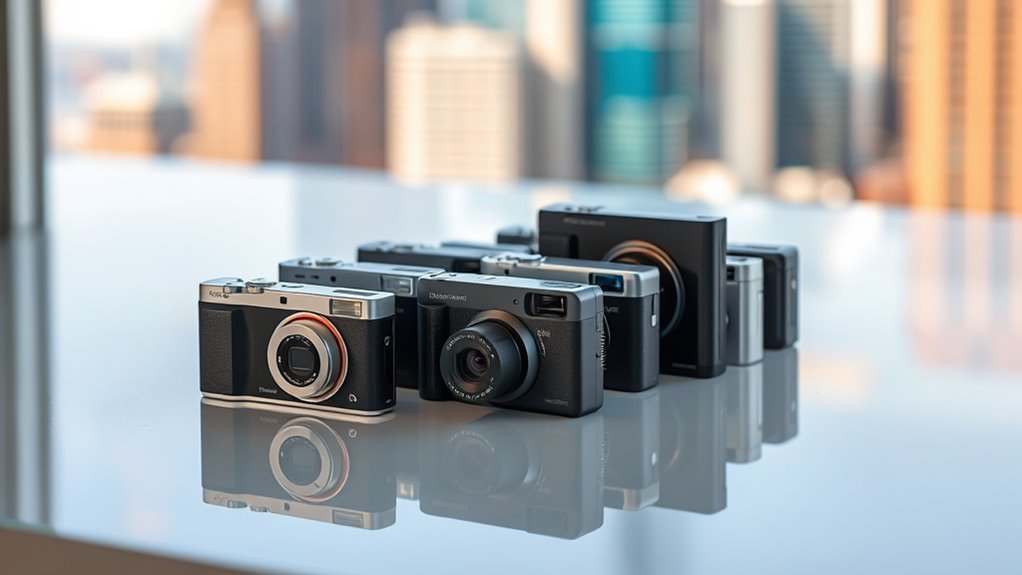

The best high-end point-and-shoot cameras balance image quality, portability, and useful reach without the bulk of an interchangeable-lens kit. I rank the Sony RX100 VII as the best overall for its 1-inch sensor, versatile zoom, and advanced autofocus, while the Ricoh GR IV stands out for photographers who want an APS-C sensor in a compact fixed-lens body. The Panasonic LUMIX ZS99 is a stronger fit for travel reach, with its 30x zoom, while the Canon SX740 HS pushes farther with 40x zoom at the cost of a smaller-sensor approach. The main tradeoff is whether you value low-light image quality, a pocketable body, long zoom reach, or video features most. Read on for the full breakdown and guidance on choosing between these very different kinds of compact cameras.

Get the latest gadgets delivered free with Prime
- Fast, free delivery on millions of items
- Prime Video, Amazon Music and more included
- Member-only deals all year
Complete the kit



Key Takeaways
- The Sony RX100 VII is the most balanced pick: its 1-inch sensor and 24–200mm-equivalent zoom offer a broader mix of image quality and reach than the older RX100 III.
- The Ricoh GR IV favors image quality and street shooting over versatility: its APS-C sensor and fixed lens make it a different kind of compact than the zoom-equipped Sony and Panasonic models.
- Long zoom does not automatically mean a better all-around camera: the Canon SX740 HS reaches farther than the ZS99, but the sensor-size tradeoff matters when light is limited.
- The ZS99 appears in three listings and the SX740 HS in two: those repeats are variations or bundles, not separate camera designs, so compare the camera itself before counting included accessories.
- The lineup spans more than premium compacts: the Canon V1 prioritizes video, while models such as the Canon SX720 HS and Sony HX80 are more compelling as reach-first options than as image-quality leaders.
| Sony RX100 III 20.1 MP Premium Compact Digital Camera w/1-inch Sensor and 24-70mm F1.8-2.8 ZEISS Zoom Lens (DSCRX100M3/B), 6in l x 4.65in w x 2.93in h, Black |  | Best All-Rounder Compact | Sensor: 20.1 MP, 1-inch BSI CMOS | Lens: 24-70mm equivalent, f/1.8-2.8 ZEISS zoom | Viewfinder: Built-in SVGA OLED electronic viewfinder | VIEW ON AMAZON | See Our Full Breakdown |
| Canon PowerShot SX740 HS Point-and-Shoot Digital Camera – 40x Optical Zoom, 4K Video, Silver |  | Best Pocket Superzoom | Sensor: 20.3 MP, 1/2.3-inch CMOS | Optical zoom: 40× | Image stabilization: Optical Image Stabilizer with Zoom Framing Assist | VIEW ON AMAZON | See Our Full Breakdown |
| Panasonic Lumix Point-and-Shoot 4K Camera |  | Best for Extreme Zoom Reach | Optical zoom: 60× | Viewfinder: 2,360K-dot large LVF, 0.74× equivalent magnification | Stabilization: POWER O.I.S. optical image stabilization | VIEW ON AMAZON | See Our Full Breakdown |
| Panasonic LUMIX ZS99 Point and Shoot Camera, Compact Camera for Travel with 30x Zoom with 24-720mm Zoom Lens, and 4K Video/Photo, Great for Travel and Concerts, DC-ZS99 + Bag+ 32GB SD Card (Silver) |  | Best Travel-Ready Zoom Bundle | Sensor: 20.3 MP effective, 1/2.3-inch MOS | Lens: 24-720mm equivalent LEICA DC zoom | Optical zoom: 30× | VIEW ON AMAZON | See Our Full Breakdown |
| Ricoh GR IV Premium Digital Compact Camera |  | Best for Image Quality in a Pocketable Prime | Sensor: 25.74 MP APS-C back-illuminated CMOS | Lens: 28mm equivalent, f/2.8 | Image stabilization: Five-axis sensor-shift, 6-step | VIEW ON AMAZON | See Our Full Breakdown |
| Panasonic LUMIX ZS99 30x Zoom 4K Point-and-Shoot Camera |  | Best for Pocketable Superzoom Travel | Lens: 24–720mm Leica DC | Optical zoom: 30× | iZoom: 60× | VIEW ON AMAZON | See Our Full Breakdown |
| Panasonic LUMIX ZS300 Compact 4K Digital Camera, 15x Zoom Point-and-Shoot (24-360mm), Black |  | Best Balanced Everyday Zoom | Optical zoom: 15× | Focal length: 24–360mm | Sensor resolution: 20.1MP | VIEW ON AMAZON | See Our Full Breakdown |
| Sony RX100 VII Premium Compact Camera with 1.0-type CMOS Sensor – Black |  | Best for Fast Action and Autofocus | Sensor: 20.1MP stacked 1.0-type CMOS | Lens: Zeiss Vario-Sonnar T 24–200mm f/2.8–4.5 | Maximum frame rate: 20fps, blackout-free | VIEW ON AMAZON | See Our Full Breakdown |
| Canon PowerShot SX720 HS Compact Digital Camera, Black |  | Best for Maximum Zoom Reach | Optical zoom: 40× | Sensor: 20.3MP 1/2.3-inch CMOS | Image processor: DIGIC 6 | VIEW ON AMAZON | See Our Full Breakdown |
| Canon PowerShot V1 |  | Best for Vlogging and Video | Lens: 16–50mm f/2.8–4.5 wide-angle zoom, 35mm equivalent | Sensor: 1.4-type | Still resolution: 22.3MP | VIEW ON AMAZON | See Our Full Breakdown |
| Canon PowerShot SX740 HS 20.3MP Digital Camera Bundle (Silver) |  | Best for Long-Range Travel Zoom | Sensor resolution: 20.3 MP | Sensor type and size: CMOS, 1/2.3-inch | Optical zoom: 40x | VIEW ON AMAZON | See Our Full Breakdown |
| Panasonic LUMIX TZ/ZS99 Point-and-Shoot Camera, 30x Zoom, 24-720mm Leica Lens, 4K Video/Photo, Silver |  | Best for Flexible Travel Framing | Model: DC-TZ99 | Lens: 24–720mm Leica | Optical zoom: 30x | VIEW ON AMAZON | See Our Full Breakdown |
| Sony DSCHX80/B High Zoom Point & Shoot Camera (Black) |  | Best for Eye-Level Framing | Sensor resolution: 18.2 MP | Sensor type and size: Exmor R CMOS, 1/2.3-inch | Lens: ZEISS Vario-Sonnar T* | VIEW ON AMAZON | See Our Full Breakdown |
| highend pointandshoot camera | Video | Optical zoom | Lens | Sensor |
|---|---|---|---|---|
| Sony RX100 III 20.1 MP Premium | Full HD 1080p | — | 24-70mm equivalent, f/1.8-2.8 ZEISS zoom | 20.1 MP, 1-inch BSI CMOS |
| Canon PowerShot SX740 HS Point | 4K and Full HD 1080p | 40× | — | 20.3 MP, 1/2.3-inch CMOS |
| Panasonic Lumix Point-and-Shoo | 4K | 60× | — | — |
| Panasonic LUMIX ZS99 Point and | 4K at 30p; HD high-speed video at 120 fps | 30× | 24-720mm equivalent LEICA DC zoom | 20.3 MP effective, 1/2.3-inch MOS |
| Ricoh GR IV Premium Digital Co | MOV, up to 1080p | — | 28mm equivalent, f/2.8 | 25.74 MP APS-C back-illuminated CMOS |
| Panasonic LUMIX ZS99 30x Zoom | 4K at 30p; HD at 120fps | 30× | 24–720mm Leica DC | — |
| Panasonic LUMIX ZS300 Compact | 4K | 15× | — | — |
| Sony RX100 VII Premium Compact | 4K with U-Log3 | — | Zeiss Vario-Sonnar T 24–200mm f/2.8–4.5 | 20.1MP stacked 1.0-type CMOS |
| Canon PowerShot SX720 HS Compa | 1080p Full HD at 60p | 40× | — | 20.3MP 1/2.3-inch CMOS |
| Canon PowerShot V1 | — | — | 16–50mm f/2.8–4.5 wide-angle zoom, 35mm equivalent | 1.4-type |
| Canon PowerShot SX740 HS 20.3M | — | 40x | — | — |
| Panasonic LUMIX TZ/ZS99 Point- | — | 30x | 24–720mm Leica | — |
| Sony DSCHX80/B High Zoom Point | — | 30x | ZEISS Vario-Sonnar T* | — |
More Details on Our Top Picks
Sony RX100 III 20.1 MP Premium Compact Digital Camera w/1-inch Sensor and 24-70mm F1.8-2.8 ZEISS Zoom Lens (DSCRX100M3/B), 6in l x 4.65in w x 2.93in h, Black
The Sony RX100 III balances image quality and pocketable size better than the long-zoom Canon PowerShot SX740 HS. Its 1-inch sensor and bright 24-70mm-equivalent f/1.8-2.8 lens are a stronger fit for indoor scenes and portraits than small-sensor superzooms, while the built-in electronic viewfinder makes bright-day framing easier. A tilting screen and lens control ring add useful flexibility without giving up the compact format. The tradeoff is reach: 70mm equivalent falls well short of the SX740 HS or Panasonic LUMIX ZS99 for distant subjects. It also records up to 1080p, not 4K, and its short zoom range means this is better for everyday scenes than wildlife or concerts from far away.
Pros:- 1-inch, 20.1 MP sensor offers more low-light headroom than the 1/2.3-inch sensors in the Canon SX740 HS and Panasonic ZS99.
- Bright 24-70mm-equivalent f/1.8-2.8 ZEISS zoom suits portraits and dimmer scenes.
- Built-in electronic viewfinder supports eye-level framing in bright conditions.
- Tilting 3-inch screen and control ring give flexible framing and manual adjustment.
Cons:- The 24-70mm-equivalent zoom has much less reach than the Canon SX740 HS or Panasonic ZS99.
- Video tops out at Full HD 1080p rather than 4K.
- Listed battery life is about 320 shots per charge.
Best for: Travelers and everyday photographers who want a truly compact camera with a bright lens, an eye-level viewfinder, and stronger low-light potential than small-sensor zoom models.
Not ideal for: Concertgoers, wildlife photographers, and 4K-focused video shooters who need long telephoto reach or higher-resolution video.
- Sensor:20.1 MP, 1-inch BSI CMOS
- Lens:24-70mm equivalent, f/1.8-2.8 ZEISS zoom
- Viewfinder:Built-in SVGA OLED electronic viewfinder
- Display:3-inch tilting LCD
- Video:Full HD 1080p
- Connectivity:Wi-Fi and NFC
- Continuous shooting:Up to 10 fps
- Weight:10.24 ounces
Our verdict“Choose the RX100 III if sensor quality, a bright lens, and a viewfinder matter more than long zoom or 4K video.”
Canon PowerShot SX740 HS Point-and-Shoot Digital Camera – 40x Optical Zoom, 4K Video, Silver
The Canon PowerShot SX740 HS is for buyers who want a great deal of reach in a small point-and-shoot body. Its 40× optical zoom goes farther than the Sony RX100 III’s short 24-70mm-equivalent lens, making distant landmarks and stage performers easier to frame. It also records 4K video and has a screen that flips up for self-portraits or low-angle shooting. That reach comes with a clear image-quality compromise: its 1/2.3-inch sensor is much smaller than the RX100 III’s 1-inch sensor, and the lens narrows to f/6.9 at the telephoto end. There is no viewfinder, either, so composing on the LCD can be awkward in strong sunlight. Pick it for zoom versatility, not the strongest dim-light performance.
Pros:- 40× optical zoom reaches much farther than the Sony RX100 III’s 24-70mm-equivalent lens.
- Optical image stabilization helps steady framing at long focal lengths.
- Records 4K video and time-lapse movies.
- 180-degree tilting 3-inch screen supports self-framing and low-angle shots.
Cons:- The 1/2.3-inch sensor is less suited to dim light than the RX100 III’s 1-inch sensor.
- No optical or electronic viewfinder; composition depends on the rear LCD.
- Maximum aperture narrows to f/6.9 at the telephoto end.
Best for: Travelers and families who want a compact camera for distant attractions, outdoor events, and 4K clips without carrying interchangeable lenses.
Not ideal for: Photographers who often shoot indoors or at night, or anyone who wants an electronic viewfinder for sunny-day framing.
- Sensor:20.3 MP, 1/2.3-inch CMOS
- Optical zoom:40×
- Image stabilization:Optical Image Stabilizer with Zoom Framing Assist
- Video:4K and Full HD 1080p
- Display:3-inch, 180-degree tilting LCD
- Continuous shooting:7.4 fps; up to 10 fps with AF lock
- Connectivity:Wi-Fi, Bluetooth, and NFC
- Weight:9.76 ounces
Our verdict“Choose the SX740 HS if compact 40× reach matters more than low-light image quality or viewfinder shooting.”
Panasonic Lumix Point-and-Shoot 4K Camera
This Panasonic Lumix 4K camera puts maximum reach ahead of pocketability: its 60× optical zoom extends beyond both the Canon PowerShot SX740 HS and the Panasonic LUMIX ZS99. That makes it the more compelling pick when distant subjects are the main target, and POWER O.I.S. is included to help steady the view at long zoom settings. A bright, high-resolution electronic viewfinder is another advantage over the SX740 HS, whose framing relies on its rear screen. The tradeoff is a more specialized shooting style: a 60× range is unnecessary for many everyday scenes, and the supplied details don’t identify wireless sharing options. Its 4K video and 8 MP frame extraction add flexibility, but the description gives less information about its sensor and still-photo performance than the Sony RX100 III listing.
Pros:- 60× optical zoom offers greater reach than the Canon SX740 HS and Panasonic ZS99.
- POWER O.I.S. helps steady images when shooting at the long end of the zoom.
- 2,360K-dot electronic viewfinder supports detailed framing in bright light.
- 4K video can yield 8 MP still frames, and Post Focus allows focus-point adjustment after capture.
Cons:- The very broad zoom range can be excessive for everyday scenes and casual carry.
- Product details do not specify Wi-Fi or Bluetooth connectivity.
- Sensor size and still-image resolution are not provided in the supplied specifications.
Best for: Travelers, bird-watchers, and event spectators who regularly photograph distant subjects and want an electronic viewfinder for outdoor framing.
Not ideal for: Buyers who prioritize a genuinely pocketable everyday camera, detailed sensor information, or confirmed wireless sharing features.
- Optical zoom:60×
- Viewfinder:2,360K-dot large LVF, 0.74× equivalent magnification
- Stabilization:POWER O.I.S. optical image stabilization
- Video:4K
- Still extraction:8 MP stills from 4K video
- Focus feature:Post Focus
Our verdict“Choose this Lumix when long-distance framing and a high-resolution viewfinder outweigh pocketability and clearly documented connectivity.”
Panasonic LUMIX ZS99 Point and Shoot Camera, Compact Camera for Travel with 30x Zoom with 24-720mm Zoom Lens, and 4K Video/Photo, Great for Travel and Concerts, DC-ZS99 + Bag+ 32GB SD Card (Silver)
The Panasonic LUMIX ZS99 is a flexible travel pick: its 24-720mm-equivalent 30× LEICA zoom covers wide views and distant subjects in one compact camera. The Canon PowerShot SX740 HS reaches farther at 40×, while the Sony RX100 III has the larger sensor and brighter lens; the ZS99 sits between them with a strong travel-feature mix. It records 4K video, offers 4K PHOTO bursts, and adds USB-C charging and Bluetooth/Wi-Fi sharing. The included card and bag make this listing ready for a trip, though they don’t change the camera’s core image limits. Its 1/2.3-inch sensor is a weaker fit for dim interiors than the RX100 III, and the long zoom is less useful when low-light quality matters most.
Pros:- 24-720mm-equivalent 30× LEICA lens handles both wide scenes and distant subjects.
- 4K video, 4K PHOTO bursts at 30 fps, and HD high-speed video at 120 fps offer varied capture options.
- Tilting touchscreen, USB-C charging, Wi-Fi, and Bluetooth suit travel use.
- Bundle includes a 32 GB memory card and camera bag.
Cons:- The 1/2.3-inch sensor is less suited to low light than the Sony RX100 III’s 1-inch sensor.
- The Canon SX740 HS offers greater optical zoom reach at 40×.
- The camera is not water resistant.
Best for: Travelers and concertgoers who want one compact camera for wide landscapes, distant subjects, 4K clips, and straightforward phone transfers.
Not ideal for: Photographers who often shoot in dim venues and would trade zoom range for the larger sensor and brighter lens of the Sony RX100 III.
- Sensor:20.3 MP effective, 1/2.3-inch MOS
- Lens:24-720mm equivalent LEICA DC zoom
- Optical zoom:30×
- Image stabilization:5-Axis HYBRID O.I.S.+
- Video:4K at 30p; HD high-speed video at 120 fps
- Display:3-inch tilting touchscreen, 1,840K dots
- Connectivity:Wi-Fi, Bluetooth 5.0, and USB-C
- Bundle storage:32 GB SD card included
Our verdict“Choose the ZS99 if you want a travel-friendly balance of broad zoom, 4K features, and sharing tools rather than the best low-light performance.”
Ricoh GR IV Premium Digital Compact Camera
The Ricoh GR IV takes a different high-end compact approach from the zoom-heavy Panasonic LUMIX ZS99: it pairs a pocketable body with a 25.74 MP APS-C sensor and a fixed 28mm-equivalent f/2.8 lens. That combination favors detailed wide-angle street, travel, and everyday photography rather than framing distant subjects. Five-axis stabilization can help with handheld stills, while 53 GB of internal memory provides room to shoot without an added card. Compared with the Sony RX100 III, the GR IV has a larger sensor but gives up zoom versatility and an electronic viewfinder. Video tops out at 1080p, and there’s no built-in flash. I’d pick it for still-photo quality and portability, not as an all-purpose video or event camera.
Pros:- 25.74 MP APS-C sensor is larger than the sensors listed for the RX100 III and Panasonic ZS99.
- Pocketable body pairs a fixed 28mm-equivalent lens with five-axis stabilization.
- 53 GB of internal memory reduces dependence on a separate memory card.
- USB-C and Wi-Fi support charging and wireless connectivity.
Cons:- Fixed 28mm-equivalent lens cannot zoom in for distant subjects like the Panasonic ZS99.
- No built-in flash or electronic viewfinder.
- Video is limited to 1080p, and battery life is rated at approximately 250 shots per charge.
Best for: Street and travel photographers who want an APS-C sensor in a pocketable camera and are comfortable composing with a fixed wide-angle lens.
Not ideal for: Buyers who need optical zoom, an electronic viewfinder, a built-in flash, or 4K video.
- Sensor:25.74 MP APS-C back-illuminated CMOS
- Lens:28mm equivalent, f/2.8
- Image stabilization:Five-axis sensor-shift, 6-step
- ISO sensitivity:Up to ISO 204800
- Internal memory:53 GB
- Battery life:Approximately 250 shots per charge
- Video:MOV, up to 1080p
- Connectivity:Wi-Fi and USB-C
Our verdict“Choose the GR IV if you want a pocketable APS-C stills camera and accept a fixed wide-angle lens and Full HD video.”
Panasonic LUMIX ZS99 30x Zoom 4K Point-and-Shoot Camera
I rank the Panasonic LUMIX ZS99 highly for travelers who want a broad focal range without carrying a larger camera. Its 24–720mm, 30× optical zoom reaches far beyond the RX100 VII’s 24–200mm lens, making distant landmarks or stage performers easier to frame. Five-axis hybrid stabilization helps steady shots at long focal lengths, while 4K video and 120fps HD slow motion add flexibility for clips. The tilting touchscreen is useful for high or low angles, and USB-C charging simplifies packing. The tradeoff is that the ZS99 lacks an electronic viewfinder, which can make bright-day framing harder; its reach also comes with a less premium emphasis on speed than Sony’s RX100 VII. I’d skip it if viewfinder shooting or extended video sessions are priorities.
Pros:- 30× optical zoom covers a very broad 24–720mm equivalent range
- Five-axis hybrid stabilization helps steady handheld telephoto shots
- 4K recording and HD slow motion at 120fps
- Tilting high-resolution touchscreen and USB-C charging
Cons:- No electronic viewfinder for bright conditions
- Battery life may be short during intensive video recording
Best for: Travelers and concertgoers who want substantial telephoto reach in a pocket-sized camera and mostly frame with a rear screen
Not ideal for: Photographers who often shoot in harsh sunlight and want an electronic viewfinder, or videographers recording long sessions on battery
- Lens:24–720mm Leica DC
- Optical zoom:30×
- iZoom:60×
- Video:4K at 30p; HD at 120fps
- Screen:1,840k-dot tilting touchscreen
- Image stabilization:5-axis Hybrid O.I.S.+
- Connectivity and charging:Wi-Fi, Bluetooth 5.0, USB Type-C
Our verdict“Choose the ZS99 if far-reaching travel zoom matters more than a viewfinder or the RX100 VII’s emphasis on fast autofocus.”
Panasonic LUMIX ZS300 Compact 4K Digital Camera, 15x Zoom Point-and-Shoot (24-360mm), Black
The Panasonic LUMIX ZS300 is a sensible middle ground for buyers who want more reach than a short-zoom premium compact but do not need the ZS99’s full 30× range. Its 24–360mm lens suits everyday travel, while the stated 20.1MP sensor and low-light emphasis make it a more balanced choice when scenes move indoors or toward evening. It also records 4K video and 4K photos, and USB-C charging plus phone connectivity suit a travel kit. Against the ZS99, the shorter zoom gives up distant-subject framing; against the Sony RX100 VII, it offers more telephoto reach but lacks Sony’s advertised high-speed autofocus and burst performance. I’d pick it for varied day-to-day shooting, but the rear LCD-only framing is a drawback in bright sun.
Pros:- 15× optical zoom spans a useful 24–360mm equivalent range
- 20.1MP sensor with stated low-light performance
- 4K video and 4K photo capture at 30fps
- Pocket-friendly body with Bluetooth, Wi-Fi, and USB-C charging
Cons:- No electronic viewfinder; framing depends on the rear LCD
- Less telephoto reach than the ZS99
Best for: Travelers who want a pocketable camera for mixed everyday scenes, moderate telephoto framing, and occasional 4K clips
Not ideal for: People who need the ZS99’s extreme telephoto reach or prefer composing through an electronic viewfinder
- Optical zoom:15×
- Focal length:24–360mm
- Sensor resolution:20.1MP
- Video:4K
- 4K photo mode:30fps
- Minimum macro focus distance:1.18 inches at the wide end
- Connectivity and charging:Bluetooth, Wi-Fi, USB-C
Our verdict“Pick the ZS300 if you want more everyday zoom than a short-range compact without carrying the ZS99’s much longer reach as your main priority.”
Sony RX100 VII Premium Compact Camera with 1.0-type CMOS Sensor – Black
I place the Sony RX100 VII near the top for buyers who value responsiveness over maximum zoom. Its stacked 1.0-type sensor, 357 phase-detect and 425 contrast-detect autofocus points, and eye AF for people and animals make it better suited to fleeting expressions and moving subjects than the zoom-first Panasonic ZS99. Burst shooting reaches 20fps without blackout, so the view remains available while capturing a sequence. The 24–200mm Zeiss lens is useful for travel and portraits, and 4K video with a microphone jack gives creators more control over sound. Its central compromise is reach: the ZS99 extends to 720mm, far beyond this Sony’s 200mm. I’d also factor in its stated 0–40°C operating range if shooting in harsher climates.
Pros:- Fast hybrid autofocus with eye AF for humans and animals
- 20fps blackout-free continuous shooting
- Zeiss 24–200mm f/2.8–4.5 zoom lens
- 4K video and a microphone input
Cons:- Shorter telephoto reach than the Panasonic ZS99
- Stated operating range is limited to 0–40°C
Best for: Travel, family, and wildlife photographers who need dependable tracking and fast bursts in a compact body, plus creators who want a microphone input
Not ideal for: Concertgoers or wildlife shooters who need the ZS99’s much longer telephoto reach, or photographers working outside the stated temperature range
- Sensor:20.1MP stacked 1.0-type CMOS
- Lens:Zeiss Vario-Sonnar T 24–200mm f/2.8–4.5
- Maximum frame rate:20fps, blackout-free
- Autofocus:357 phase-detect and 425 contrast-detect points
- Video:4K with U-Log3
- Microphone input:Yes
- Operating temperature:0–40°C
Our verdict“Choose the RX100 VII when autofocus and action capture matter more than the extended zoom range of the Panasonic ZS99.”
Canon PowerShot SX720 HS Compact Digital Camera, Black
The Canon PowerShot SX720 HS makes its case with a 40× optical zoom, the longest reach in this group. That gives it an advantage over the Panasonic ZS99 when framing distant subjects, though the SX720’s 1080p video falls behind that Panasonic’s 4K recording and the 4K options elsewhere in the lineup. Its 20.3MP CMOS sensor, DIGIC 6 processor, and image stabilization support a straightforward point-and-shoot approach, while Wi-Fi and NFC simplify sharing. I see this as a reach-first pick rather than a high-end all-rounder: the small 1/2.3-inch sensor can limit dynamic range compared with larger-sensor compacts such as the Sony RX100 VII. The fixed LCD also means no optical viewfinder for bright conditions.
Pros:- 40× optical zoom offers the longest reach among these five cameras
- Image stabilization helps when shooting at long focal lengths
- 20.3MP sensor with DIGIC 6 processing
- Wi-Fi and NFC for wireless sharing
Cons:- 1080p video lacks the 4K capture offered by the Panasonic ZS99 and Sony RX100 VII
- Small 1/2.3-inch sensor can limit dynamic range compared with larger-sensor compacts
- No optical viewfinder; framing relies on the fixed LCD
Best for: Travelers who prioritize framing distant subjects from a compact camera and are content with Full HD video
Not ideal for: Buyers who want 4K capture, stronger dynamic range, or an electronic or optical viewfinder
- Optical zoom:40×
- Sensor:20.3MP 1/2.3-inch CMOS
- Image processor:DIGIC 6
- Video:1080p Full HD at 60p
- Display:3.0-inch LCD
- Connectivity:Wi-Fi, NFC, HDMI, USB
- Weight:0.25kg
Our verdict“Choose the SX720 HS if maximum optical zoom is your main priority and you can accept Full HD video and a smaller sensor.”
Canon PowerShot V1
The Canon PowerShot V1 is the clearest choice here for creators who shoot themselves more often than distant subjects. Its 16–50mm wide-angle zoom favors talking-head framing, small-room filming, and handheld content, while the built-in cooling fan is designed for longer recording sessions. Canon Log 3 and 10-bit color depth give editors room to shape footage after capture, a more video-focused toolkit than the travel zooms in the ZS99 or ZS300. The tradeoff is equally clear: this fixed lens cannot match their long-reach framing, and Canon Log 3’s base ISO 800 may not suit every lighting situation. I’d choose the V1 for video workflow and sustained recording, not as an all-purpose pocket camera for wildlife or distant travel scenes.
Pros:- Wide 16–50mm equivalent lens suits vlogging and close-range filming
- Built-in cooling fan supports extended recording sessions
- Canon Log 3 and 10-bit color depth offer post-production flexibility
- High-resolution sensor supports both stills and video
Cons:- Fixed lens has far less reach than the Panasonic ZS99 or Canon SX720 HS
- Canon Log 3 has a base ISO of 800
Best for: Vloggers, livestreamers, and solo video creators who want a wide lens, longer recording capability, and footage suited to color grading
Not ideal for: Travel or wildlife photographers who need substantial telephoto zoom, or creators who prefer to avoid a high base ISO when recording in Log
- Lens:16–50mm f/2.8–4.5 wide-angle zoom, 35mm equivalent
- Sensor:1.4-type
- Still resolution:22.3MP
- Video resolution:18.7MP
- Video color:10-bit
- Log profile:Canon Log 3, base ISO 800
- Cooling:Built-in cooling fan
Our verdict“Choose the PowerShot V1 if your priority is extended, gradeable video rather than the long zoom range of a travel compact.”
Canon PowerShot SX740 HS 20.3MP Digital Camera Bundle (Silver)
I’d pick this bundle when reaching distant subjects matters more than low-light image quality. Its 40x optical zoom offers more reach than the Panasonic LUMIX TZ/ZS99’s 30x lens, making it better suited to wildlife, landmarks, and events from a distance. The compact body, included bag, and 64GB card also make it ready for travel without adding those basics separately. 4K UHD video gives it a stronger video feature set than the Sony DSCHX80/B, which records in Full HD. The tradeoff is the SX740 HS’s small 1/2.3-inch sensor, which can limit results in dim settings. Its fixed, non-touch screen is less flexible for unusual angles, and the camera is not water resistant.
Pros:- 40x optical zoom with image stabilization reaches subjects farther away than the 30x Panasonic LUMIX TZ/ZS99.
- Records 4K UHD video.
- Compact design is suited to travel.
- Bundle includes a carrying bag and 64GB UHS-I SDXC memory card.
Cons:- The 1/2.3-inch sensor can struggle in low light compared with larger-sensor compact cameras.
- The fixed LCD does not tilt or support touch controls.
- Not water resistant.
Best for: Travelers and wildlife watchers who want extensive optical reach in a compact camera, plus a memory card and carrying bag.
Not ideal for: Photographers who often shoot indoors or at night, or who need a tilting screen or weather protection.
- Sensor resolution:20.3 MP
- Sensor type and size:CMOS, 1/2.3-inch
- Optical zoom:40x
- Video resolution:4K UHD (2160p)
- Processor:DIGIC 8
- Screen:3-inch fixed LCD
- Connectivity:Wi-Fi and Bluetooth
- Included accessories:Carrying bag and 64GB UHS-I SDXC memory card
Our verdict“Choose the SX740 HS bundle if long optical reach and ready-to-go travel accessories matter more to you than low-light performance or screen flexibility.”
Panasonic LUMIX TZ/ZS99 Point-and-Shoot Camera, 30x Zoom, 24-720mm Leica Lens, 4K Video/Photo, Silver
I’d favor the TZ/ZS99 for travel days when framing flexibility and easy charging matter as much as zoom. Its 24–720mm Leica lens gives a broad range in a pocket-size body, though the Canon PowerShot SX740 HS reaches farther with its 40x zoom. The Panasonic counters with a tiltable touchscreen, which makes low-angle or overhead shots easier to compose than with the Canon’s fixed screen. It also records 4K video at 30p and HD video at 120fps, giving you a slow-motion option that the Sony DSCHX80/B’s Full HD video spec does not match. USB-C charging is handy when traveling with shared cables. The tradeoffs are shorter zoom reach than the Canon and no battery-life figure supplied for planning extended shooting days.
Pros:- 30x Leica zoom covers a 24–720mm equivalent focal-length range.
- Tiltable touchscreen helps with high- and low-angle framing.
- Records 4K video at 30p and HD video at 120fps.
- USB-C charging and Bluetooth v5.0 support travel-friendly power and connectivity.
Cons:- Its 30x optical zoom has less reach than the Canon PowerShot SX740 HS’s 40x zoom.
- High-speed recording is HD rather than 4K.
- Battery life is not specified in the supplied product information.
Best for: Travelers who want a pocketable zoom camera with an adjustable touchscreen, 4K recording, and USB-C charging.
Not ideal for: Buyers who need the longest possible optical reach, or who want a stated battery-life figure before planning extended shoots.
- Model:DC-TZ99
- Lens:24–720mm Leica
- Optical zoom:30x
- 4K video:30p
- 4K photo:30fps
- High-speed video:HD at 120fps
- Screen:1.84-million-dot tiltable touchscreen
- Charging and connectivity:USB Type-C and Bluetooth v5.0
Our verdict“Choose the TZ/ZS99 if flexible screen positioning and USB-C charging are more useful to you than the Canon’s longer zoom reach.”
Sony DSCHX80/B High Zoom Point & Shoot Camera (Black)
The HX80 is the pick I’d make when a built-in viewfinder matters more than 4K recording. Its retractable OLED Tru-Finder gives you an eye-level way to frame shots in bright conditions, a feature not listed for either the Canon PowerShot SX740 HS or Panasonic LUMIX TZ/ZS99. The 30x ZEISS zoom covers a broad range, with Clear Image Zoom extending framing further, while five-axis stabilization helps reduce blur from camera shake. A screen that tilts up about 180 degrees also suits selfies and front-facing shots. Compared with the Canon and Panasonic, though, the HX80 records Full HD rather than 4K. Its 1/2.3-inch sensor also limits its advantage in dim light against premium compacts such as the Sony RX100 III, which has a 1-inch sensor.
Pros:- Retractable OLED electronic viewfinder supports eye-level framing.
- 30x ZEISS optical zoom with 5-axis image stabilization.
- Screen tilts up about 180 degrees for selfies and high-angle framing.
- Shoots continuously at up to 10fps.
Cons:- Video is Full HD, while the Canon SX740 HS and Panasonic TZ/ZS99 offer 4K.
- The 1/2.3-inch sensor is smaller than the 1-inch sensor in the Sony RX100 III.
- Clear Image Zoom extends framing but is not additional optical zoom.
Best for: Travel photographers who prefer eye-level composition, want a long zoom, and value a built-in electronic viewfinder.
Not ideal for: Buyers seeking 4K video or stronger low-light performance from a larger sensor.
- Sensor resolution:18.2 MP
- Sensor type and size:Exmor R CMOS, 1/2.3-inch
- Lens:ZEISS Vario-Sonnar T*
- Optical zoom:30x
- Clear Image Zoom:Up to 60x
- Image stabilization:5-axis
- Viewfinder:Retractable OLED Tru-Finder
- Video resolution:Full HD 1080p
- Screen:3-inch tilting LCD, approximately 180-degree upward angle
Our verdict“Choose the HX80 if its built-in viewfinder and stabilized 30x zoom suit your shooting style better than 4K video or a larger sensor.”

How We Picked
I compared these cameras by the factors that most affect a compact-camera purchase: sensor size, lens range and brightness, autofocus and handling, video capability, and how easily each model can travel. I gave more weight to the balance of image quality and everyday versatility than to zoom range alone. That favors the Sony RX100 VII as the lead all-rounder, while the Ricoh GR IV earns a distinct place for its larger sensor and fixed-lens approach. Specialized models such as the Canon V1 and long-zoom travel cameras rank for the buyers whose priorities match their design.
I also treated overlapping listings carefully: the three Panasonic ZS99 entries and two Canon SX740 HS entries do not represent five different camera platforms. Bundled cards, bags, and accessory packages do not move a camera up the ranking when they leave its core imaging capabilities unchanged. The Panasonic 4K listing has limited model detail, so I avoid crediting it with unlisted specifications. Older or smaller-sensor zoom models remain useful alternatives, but they rank behind the stronger premium compacts for buyers who put image quality first.
Factors to Consider When Choosing Highend Pointandshoot Cameras
Before choosing a model, I would decide what the camera needs to do that a phone or interchangeable-lens camera cannot. The lineup ranges from a fixed-lens APS-C compact to long-zoom travel cameras and a video-oriented option, so a single spec rarely settles the decision. These factors help separate a genuine match from a tempting feature that may not matter in daily use.
Choose Sensor Size for Your Light and Image Priorities
Sensor size affects how much flexibility you have when shooting indoors, at dusk, or with blurred backgrounds. The Ricoh GR IV’s APS-C sensor puts image quality ahead of zoom convenience, while the RX100 models use a 1-inch sensor to balance compactness with a built-in zoom. Smaller-sensor travel zooms can frame distant subjects more easily, but they are a less convincing choice when light is poor. A common mistake is treating megapixel count as a stand-in for low-light ability or overall image quality. If most of your photos are made outdoors in good light, reach may matter more; for restaurants, evening walks, and portraits, sensor and lens performance deserve more weight.
Match Zoom Range to the Subjects You Actually Photograph
Long zooms help with wildlife, stage performances, and distant landmarks, but they do not make every photo easier. The Canon SX740 HS’s 40x zoom favors maximum reach, while the ZS99’s 30x range gives up some reach for a more moderate travel setup. At the wide end, a lens that starts around 24mm equivalent is useful for buildings and group shots; at the long end, stabilization and steady technique become more important. Buyers often focus on the largest zoom number and overlook how frequently they shoot wide or in low light. Think through your usual subjects, then choose the shortest zoom range that covers them comfortably rather than carrying reach you seldom use.
Decide Whether a Fixed Lens Fits Your Photography
A fixed lens can make a compact camera simpler to carry and can encourage a consistent way of framing, but it removes the option to zoom in or out. That tradeoff suits the Ricoh GR IV’s street-focused role better than travel days built around distant scenery or varied family snapshots. Before choosing a fixed-lens model, check whether its angle of view matches the photos you already take and whether you are comfortable moving closer or farther to compose. A frequent buying mistake is assuming a small body must be the most versatile pocket camera. If you want one camera for unpredictable subjects, a zoom-equipped model such as the RX100 VII is the safer fit.
Separate Video Needs From Still-Photo Needs
Video labels such as 4K do not tell the whole story: handling, autofocus, lens coverage, stabilization, and recording limits can matter just as much. The Canon PowerShot V1 is the lineup’s video-oriented choice, while the Sony RX100 VII offers a more mixed photo-and-video profile. If you mainly record clips for travel or family memories, a compact zoom may be convenient; if video is central to your work, check audio connections, heat behavior, and how the camera handles longer recordings. Do not pay attention to resolution alone if the lens or controls make filming awkward. Choose around the kind of footage you make and how long you need to record at a time.
Check the Whole Carrying Setup, Not Just the Body
“Pocketable” varies with clothing, grip size, lens shape, and whether you carry a spare battery or charger. A camera that fits a coat pocket may be uncomfortable in a trouser pocket, and a small body can be harder to hold steady than a slightly larger one. The RX100 series and GR IV suit buyers who value a compact camera, while the long-zoom models may be chosen for framing flexibility even if they take up more space. Compare included bundles separately: a bag or memory card can be convenient, but it does not change the camera’s sensor, lens, or controls. I would also check battery availability and the cost and availability of replacement accessories before committing to an older model.
Frequently Asked Questions
Is the Sony RX100 VII a better choice than the Ricoh GR IV for one-camera travel?
For a trip with varied subjects, I would favor the RX100 VII because its zoom can handle wide scenes and distant details without changing lenses. The GR IV is the stronger fit if you value its APS-C sensor and mostly shoot at its fixed focal length. Neither choice wins for every traveler: the Sony prioritizes framing flexibility, while the Ricoh prioritizes a larger sensor in a compact fixed-lens design. Consider which limitation would frustrate you more—being unable to zoom, or carrying a smaller-sensor camera. That answer points to the better travel companion.
Should I choose the Canon SX740 HS or Panasonic ZS99 for concerts and travel?
Both are long-zoom options, but the SX740 HS reaches farther with its 40x optical zoom, while the ZS99 offers a 30x range. For a distant stage or wildlife, that extra reach can help frame a subject; it does not guarantee better results in dim light. Check stabilization, how confidently you can hold the camera at long focal lengths, and whether you need the reach often enough to accept the smaller-sensor tradeoff. The ZS99 listings include repeated versions and a bundle, so compare the actual camera configuration rather than treating each listing as a different model. If low-light image quality is your main concern, consider a 1-inch-sensor compact instead.
Are the repeated Panasonic ZS99 and Canon SX740 HS listings different cameras?
The lineup includes three ZS99 listings and two SX740 HS listings, but the names indicate repeats, regional naming, or package variations rather than distinct camera designs. One SX740 entry is a bundle, and the ZS99 entries describe different accessory packages or naming details. Check the exact model number, included accessories, warranty, and regional version before selecting a listing. A bundled memory card or bag may be useful, but it does not upgrade the camera’s sensor or zoom lens. For a like-for-like comparison, focus on the camera body and its stated specifications.
Is a 1-inch-sensor compact worth choosing over a long-zoom camera?
A 1-inch-sensor camera such as the Sony RX100 VII is a strong choice when you want more image-quality flexibility than a small-sensor travel zoom can offer, especially in less favorable light. A long-zoom model is more useful when distant subjects are a regular part of your photography. There is no universal winner because the cameras solve different problems: one prioritizes sensor performance and a balanced lens, the other prioritizes framing reach. Avoid buying extra zoom on the assumption that it improves every type of picture. Choose based on the subjects you most often cannot capture well with your current camera.
Does the Canon PowerShot V1 make sense if I mostly take still photos?
The PowerShot V1 makes the most sense when video is a major part of your camera use, since the lineup identifies it as a video-focused option. If still photography is your priority, compare its lens range and handling with the RX100 VII or Ricoh GR IV before choosing. A video-oriented design can be a useful fit for creators, but its strengths may not matter to someone who mainly takes travel or everyday photos. Check the full specifications for the recording features and controls you plan to use rather than choosing by the product’s category label. For mostly still use, prioritize lens flexibility and sensor needs first.
Conclusion
I would choose the Sony RX100 VII as the best overall for buyers who want one premium compact with a versatile zoom and a 1-inch sensor. For the best premium still-photo experience, the Ricoh GR IV is the pick if its fixed lens suits your style; for best travel value, the Panasonic ZS99 balances long reach with 4K capture without pretending to be a large-sensor camera. Beginners who want simple framing flexibility can start with a Canon SX740 HS, while buyers who need maximum zoom should compare it with the ZS99 and accept the image-quality tradeoff. For video-first use, look at the Canon PowerShot V1; for an older, compact zoom alternative, consider the Sony HX80 or Canon SX720 HS. I would not treat duplicate bundle listings as separate contenders: choose the camera design that fits your subjects, then select the package that includes the accessories you need.
Fall Picks
fall essentials
As an affiliate, we earn on qualifying purchases.