If you’re choosing a foldable solar panel around 100W, the real decision is how you want to use that output: feeding a power station, charging devices directly, or keeping your pack light. My strongest all-round contenders are the MHPOWOS 100W Bifacial for its two-sided design and broad connector set, the Flashfish 100W for its lighter carry weight and direct USB-C charging, and the EASYLONGER ESP110 for buyers who want a little more rated power.

Get the latest gadgets delivered free with Prime
- Fast, free delivery on millions of items
- Prime Video, Amazon Music and more included
- Member-only deals all year
Those strengths come with different compromises. MHPOWOS is less compact than its weight suggests, Flashfish trades broad power-station compatibility for a focused set of outputs, and EASYLONGER is substantially heavier. I also included the ZOUPW 100W for its built-in USB charging and the smaller LUMOPAL 60W as a useful alternative for buyers who care more about portability than reaching 100W. My ranking favors practical output, setup flexibility, and carrying burden—not the wattage printed on the panel alone.
Complete the kit



Key Takeaways
- MHPOWOS is my best all-round 100W choice for buyers who need multiple power-station connector options and value its bifacial design.
- Flashfish weighs 6.2 pounds and provides 65W USB-C PD, making it the clearest pick for lighter transport and direct device charging.
- ZOUPW combines a five-in-one power-station cable with USB-C and two USB-A ports, but its controller pocket is only splash-protected.
- EASYLONGER supplies the highest rated output here at 110W, though its 13.7-pound weight makes it the least appealing panel to carry far.
- LUMOPAL is a 60W alternative, not a 100W equivalent; its 3.42-pound weight suits hikers who accept lower rated output.
| MHPOWOS 100W Bifacial Portable Solar Panel for Power Stations |  | Best Overall | Cell efficiency: 23.5% | Weight: 7.7 lb | Folded dimensions: 24 × 23.6 × 1.3 in | VIEW ON AMAZON | See Our Full Breakdown |
| Flashfish 100W Foldable Solar Panel Charger with DC 18V, USB-C 65W PD, and QC3.0 Ports |  | Best for Direct Device Charging | Cell efficiency: Up to 23.5% | Weight: 6.2 lb | Folded dimensions: 16 × 16 in | VIEW ON AMAZON | See Our Full Breakdown |
| ZOUPW 100W Portable Solar Panel, Foldable Monocrystalline Charger for Power Stations |  | Best for Built-In USB Charging | Cell efficiency: 23.5% | Cell type: Grade A+ monocrystalline | Weight: 9.48 lb | VIEW ON AMAZON | See Our Full Breakdown |
| EASYLONGER ESP110 110W Foldable Solar Panel |  | Best for Extra Rated Output | Cell efficiency: 23.4% | Weight: 13.7 lb | Folded dimensions: 19.29 × 21.8 × 1.9 in | VIEW ON AMAZON | See Our Full Breakdown |
| LUMOPAL 60W Portable Foldable Solar Panel Charger |  | Best Compact Alternative | Cell efficiency: Up to 23.5% | Weight: 3.42 lb | Listed folded dimensions: 6.7 × 9.5 in | VIEW ON AMAZON | See Our Full Breakdown |
| foldable solar panels100w | Cell efficiency | Weight | Folded dimensions |
|---|---|---|---|
| MHPOWOS 100W Bifacial Portable | 23.5% | 7.7 lb | 24 × 23.6 × 1.3 in |
| Flashfish 100W Foldable Solar | Up to 23.5% | 6.2 lb | 16 × 16 in |
| ZOUPW 100W Portable Solar Pane | 23.5% | 9.48 lb | 24.13 × 21.06 × 1.77 in |
| EASYLONGER ESP110 110W Foldabl | 23.4% | 13.7 lb | 19.29 × 21.8 × 1.9 in |
| LUMOPAL 60W Portable Foldable | Up to 23.5% | 3.42 lb | — |
More Details on Our Top Picks
MHPOWOS 100W Bifacial Portable Solar Panel for Power Stations
I put the MHPOWOS 100W Bifacial first because it combines a full 100W rating, an unusually broad set of power-station connectors, and a design that can collect light from both faces. Its claimed bifacial gain of up to 20% is most relevant when the rear surface can receive reflected light from a bright surface; it should not be read as a guaranteed increase in every campsite setup. The adjustable 30–60-degree kickstands give you a way to aim the panel as the sun moves.
Compared with the ZOUPW, MHPOWOS has a stated IP68 panel rating and a lighter listed weight, while ZOUPW offers built-in USB charging ports. MHPOWOS also weighs more than Flashfish and folds to a relatively broad 24-by-23.6-inch footprint, so it is less appealing if you are carrying gear on foot. Its waterproof rating does not remove the need to protect connections and avoid prolonged heavy rain. For a power-station owner who values connection flexibility and outdoor panel protection, this is the strongest balance in the group.
Pros:- Bifacial construction can collect reflected light from the rear surface.
- Includes Anderson, XT60, and several DC connector types.
- Adjustable reinforced kickstands support different panel angles.
- Listed at 7.7 pounds with ETFE construction and an IP68 rating.
Cons:- The 24-by-23.6-inch folded footprint is broad for transport.
- The claimed bifacial gain depends on light reaching the rear face.
- The product description advises against prolonged exposure to heavy rain.
Best for: Power-station owners who want a 100W panel with numerous connector options, adjustable stands, and a bifacial design.
Not ideal for: Hikers who need the smallest folded package or anyone expecting the panel and its ports to tolerate prolonged heavy rain without care.
- Cell efficiency:23.5%
- Weight:7.7 lb
- Folded dimensions:24 × 23.6 × 1.3 in
- Output voltage / amperage:20V / 5A
- Cell material:ETFE monocrystalline silicon
- Kickstand adjustment:30–60 degrees
- Connectors:Anderson, XT60, DC7909, DC5521, DC8020, DC5525, DC35135
Our verdict“I rank MHPOWOS first for power-station versatility and bifacial potential, provided you can accommodate its broad folded size.”
Flashfish 100W Foldable Solar Panel Charger with DC 18V, USB-C 65W PD, and QC3.0 Ports
The Flashfish 100W is the easiest recommendation for a buyer who wants to charge small electronics directly rather than route every connection through a power station. It has a 65W USB-C PD port, an 18W USB-A QC3.0 port, and an 18V DC output, so its port selection supports a mix of compatible devices. At 6.2 pounds, it is the lightest of the 100W-rated panels listed here, which is a meaningful advantage over the 9.48-pound ZOUPW and 13.7-pound EASYLONGER.
Its tradeoff is a less expansive power-station connector package than MHPOWOS or ZOUPW: the listed outputs are USB-C, USB-A, and DC 5521, so buyers should confirm the DC connection suits their equipment. Four kickstands offer simple positioning, and the 16-by-16-inch folded size is appealing for packing. The 65W USB-C rating describes the port’s maximum, not guaranteed solar output in variable conditions. Like all panels in this group, it produces energy only when sunlight is available, and it has no battery for storing it.
Pros:- At 6.2 pounds, it is the lightest 100W-rated option in this lineup.
- USB-C PD supports charging at up to 65W for compatible devices.
- USB-A QC3.0 and DC 5521 provide additional output choices.
- Four kickstands and a compact folded format aid campsite setup and packing.
Cons:- Its listed connector options are less extensive than MHPOWOS or ZOUPW.
- It does not include a battery, so it cannot store solar energy on its own.
- Actual output varies with sunlight, angle, shade, and connected-device limits.
Best for: Campers and road-trippers who prioritize a light 100W-rated panel with USB-C PD for compatible devices.
Not ideal for: Buyers who need a long list of included power-station adapters or a panel with built-in energy storage.
- Cell efficiency:Up to 23.5%
- Weight:6.2 lb
- Folded dimensions:16 × 16 in
- Maximum voltage:18V
- Maximum amperage:5.56A
- Ports:USB-C PD up to 65W, USB-A QC3.0 up to 18W, DC 5521
- Warranty:12 months
Our verdict“I’d choose Flashfish over the heavier 100W alternatives when direct USB-C charging and carrying weight matter most.”
ZOUPW 100W Portable Solar Panel, Foldable Monocrystalline Charger for Power Stations
The ZOUPW 100W is the most convenient pick here for someone who wants one panel to serve both a power station and smaller USB devices. Its five-in-one cable lists DC8020, XT60, Anderson, DC7909/8mm, and DC5521 connections, while the panel’s controller adds USB-C and two USB-A ports. That combination sets it apart from MHPOWOS, which emphasizes power-station connections and bifacial construction rather than direct USB outputs.
The convenience comes with a heavier carry: at 9.48 pounds, ZOUPW is substantially heavier than Flashfish. Its IP67 rating applies to the panel construction, but the controller and cables are described as only splash-protected inside a zippered pocket. I would keep those components sheltered from rain and check a power station’s input limit before expecting the panel to deliver its full rated power. The 10-foot cable helps with panel placement, though it adds to the kit you need to manage. Choose ZOUPW when its dual-use setup matters more than minimum weight.
Pros:- Five-in-one cable supports several common power-station connector types.
- Built-in USB-C and two USB-A ports allow direct device charging.
- ETFE construction and a stated IP67 rating suit outdoor panel use.
- A 10-foot cable offers flexibility when placing the panel near a power station.
Cons:- At 9.48 pounds, it is heavier than Flashfish and MHPOWOS.
- The controller and cable storage pocket are only splash-protected.
- Power-station charging speed is limited by the station’s maximum input.
Best for: Campers who want both a multi-adapter power-station cable and onboard USB ports for compatible phones or tablets.
Not ideal for: Buyers who hike with their panel or need the controller and cables to be fully protected from wet conditions.
- Cell efficiency:23.5%
- Cell type:Grade A+ monocrystalline
- Weight:9.48 lb
- Folded dimensions:24.13 × 21.06 × 1.77 in
- Cable length:10 ft
- USB ports:USB-C PD 15V/3A; two USB-A QC3.0 12V/1.5A
- Power-station connectors:DC8020, XT60, Anderson, DC7909/8mm, DC5521
Our verdict“ZOUPW is my choice for USB convenience and connector range, but Flashfish is the better carry-friendly option.”
EASYLONGER ESP110 110W Foldable Solar Panel
If you want more rated output than a standard 100W panel, the EASYLONGER ESP110 offers 110W and multiple ways to set up or connect it. XT60, Anderson, DC, MC4, USB-A, and USB-C are listed, while hanging holes and an adjustable kickstand give it more mounting flexibility than a panel built around stands alone. That can make it easier to position at an RV or campsite where a flat, open surface is not available.
Its main drawback is plain: at 13.7 pounds, it is by far the heaviest option here. The extra 10W of rated power over the 100W models may be useful when conditions and equipment allow, but it does not automatically outweigh the portability cost. MHPOWOS is a better fit for buyers who want a lighter panel with bifacial potential, while Flashfish is easier to carry. EASYLONGER also has a 23.4% stated cell efficiency and an IP65 rating, so its strongest case is flexible fixed or vehicle-based placement—not long walks with the panel in hand.
Pros:- 110W rating is the highest listed output in this comparison.
- XT60, Anderson, DC, MC4, USB-A, and USB-C options offer connection flexibility.
- Adjustable kickstand and hanging holes support varied placement.
- ETFE construction has a stated IP65 resistance rating.
Cons:- At 13.7 pounds, it is the heaviest panel in the lineup.
- The 110W rating does not guarantee that connected equipment will accept that input.
- Compatibility still depends on the receiving device and supported connector.
Best for: RV users and campsite-based buyers who want 110W rated output, broad connection options, and hanging or kickstand placement.
Not ideal for: Hikers or anyone prioritizing low carry weight; also check connector compatibility with your exact device before buying.
- Cell efficiency:23.4%
- Weight:13.7 lb
- Folded dimensions:19.29 × 21.8 × 1.9 in
- Maximum voltage:22.5V
- Maximum amperage:6.1A
- Connectors:XT60, Anderson, DC, MC4, USB-A, USB-C
- Weather resistance:IP65
Our verdict“EASYLONGER makes the most sense when 110W and flexible mounting matter more than keeping the panel light.”
LUMOPAL 60W Portable Foldable Solar Panel Charger
The LUMOPAL 60W is not a like-for-like 100W panel, but it earns a place for buyers whose real priority is a light, packable charger. At just 3.42 pounds, it is much easier to carry than every 100W-rated option here. Its 60W USB-C PD port and two QC3.0 USB-A ports make it useful for compatible personal electronics, while an 18–20V DC output offers a route to some power stations. The stated 23.5% conversion efficiency does not change the fact that its maximum output is lower than the other panels’ ratings.
Compared with Flashfish, LUMOPAL cuts weight sharply but gives up 40W of rated panel output. Its IP65 construction is intended for outdoor use, yet the junction ports are not waterproof, so I would keep connections dry. The supplied details also list folded dimensions of 6.7 by 9.5 inches, a notably compact figure that buyers may want to verify against the product’s actual packed configuration. This is my pick for a hiker or day-tripper with modest charging needs, not for someone who expects 100W-class power-station charging.
Pros:- Lightest panel listed, at 3.42 pounds.
- USB-C PD supports charging at up to 60W for compatible devices.
- Dual USB-A ports and DC output provide several charging paths.
- IP65-rated panel construction is suited to outdoor use with care around ports.
Cons:- Its 60W rating is below the 100W and 110W panels in this guide.
- Junction ports are not waterproof.
- Charging performance varies with sunlight and panel placement.
Best for: Hikers and day-trippers who value a 3.42-pound panel and mainly need USB charging for compatible devices.
Not ideal for: Buyers seeking a true 100W-rated panel or higher output for charging a power station.
- Cell efficiency:Up to 23.5%
- Weight:3.42 lb
- Listed folded dimensions:6.7 × 9.5 in
- Ports:USB-C PD up to 60W, two QC3.0 USB-A, 18–20V DC
- Solar cell type:Monocrystalline silicon
- Panel construction:ETFE-laminated panel and waterproof nylon fabric
Our verdict“I recommend LUMOPAL only when low weight matters more than matching the output of a 100W panel.”
How We Picked
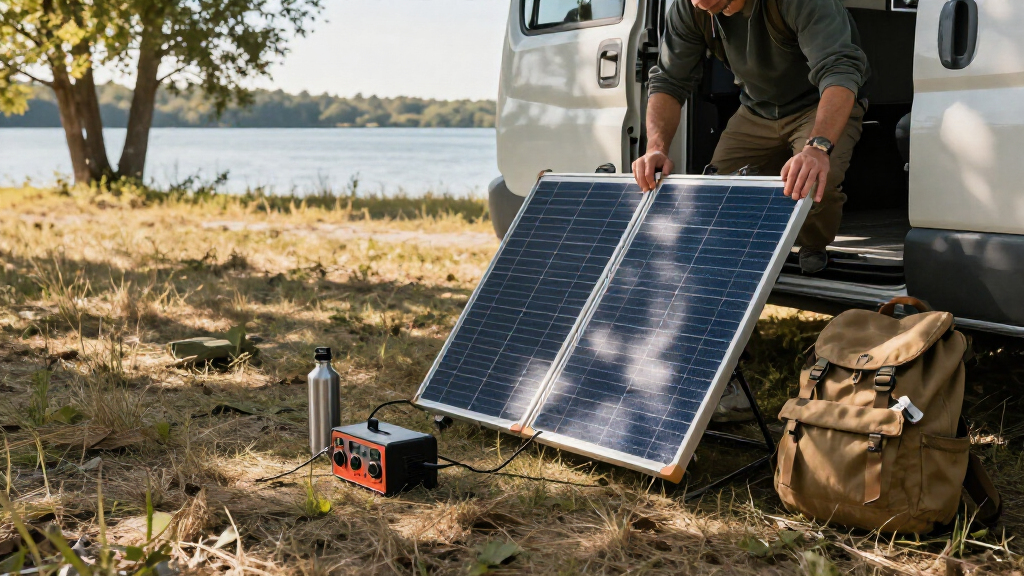
I ranked these panels around the needs implied by foldable solar panels near 100W: useful rated output, manageable transport, straightforward setup, and a practical way to connect either a power station or smaller devices. I weighed features against their limits. A long connector list matters when a buyer already owns a power station, while USB-C output can matter more to someone charging a phone or laptop without a separate battery unit.
I also compared the details that change how a panel fits a trip: weight and folded size, kickstand or hanging options, weather protection, and the position of exposed electronics. Wattage and conversion-efficiency claims describe rated capability, not a promise of steady field output; sunlight, panel angle, shade, temperature, and the receiving device all affect charging. I treated the LUMOPAL as a compact lower-output alternative rather than pretending its 60W rating matches the 100W models. The ranking reflects these tradeoffs, not firsthand testing.
Factors to Consider When Choosing Foldable Solar Panels100w
Before choosing among these foldable panels, I would start with the device you plan to charge. A panel’s advertised wattage is only part of the match: the power station or electronics must accept the panel’s voltage, current, connector, and input rate.
Match the output to your actual load
A 100W rating describes a panel’s rated maximum under suitable conditions, not the output you should expect throughout a day. If you mainly charge a phone or tablet, a panel with direct USB ports may be more convenient than an adapter cable and a separate power station. For a power station, check its solar input specifications and maximum accepted wattage. The Flashfish 65W USB-C port and ZOUPW’s built-in USB ports suit direct-device use, while MHPOWOS emphasizes a range of power-station connections.
Check connectors before you buy
Do not assume that two panels rated at 100W will connect to the same power station. Compare the station’s input connector and electrical limits with the panel’s included cables. MHPOWOS and ZOUPW list several connector types, while Flashfish lists USB-C, USB-A, and DC 5521. EASYLONGER includes a broad set of connections, but the exact cable and device match still matters. An adapter cannot make an incompatible voltage or input limit safe.
Balance wattage against carry weight
When a panel will stay near a vehicle or RV, a heavier model may be a fair trade for higher rated output or more mounting options. The EASYLONGER’s 110W rating comes with a 13.7-pound carry weight. Flashfish delivers a 100W rating at 6.2 pounds, while the LUMOPAL weighs 3.42 pounds but is rated at just 60W. Choose for the trip you actually take: a short walk to a campsite changes the value of every pound.
Treat weather ratings as guidance, not permission to soak connections
Outdoor panels still need sensible handling. MHPOWOS lists IP68 and ZOUPW IP67, while EASYLONGER and LUMOPAL list IP65; these product ratings do not mean every plug, controller, or cable connection is waterproof. ZOUPW specifically notes splash protection for its controller and cable pocket, and LUMOPAL’s junction ports are not waterproof. Keep ports and loose connections sheltered, and follow the manufacturer’s care instructions when rain is possible.
Consider setup flexibility and sunlight access
Output depends on how much direct light reaches the cells, so adjustable stands and placement options can matter more than small differences in stated efficiency. MHPOWOS has adjustable 30–60-degree kickstands; Flashfish uses four kickstands; EASYLONGER adds hanging holes. The MHPOWOS bifacial design may collect reflected light from behind the panel, but it needs suitable surroundings for that advantage. Angle the panel toward open sunlight and avoid shade across even part of its surface when possible.
Know whether you need storage
A solar panel makes power when light is available; it does not store that energy by itself. The Flashfish description explicitly states that no battery is included, and the other panels here are also panel products rather than power stations. If you need charging after sunset or through passing clouds, pair a compatible panel with a power station or use a suitable device battery. Direct USB ports offer charging convenience, not energy storage.
Frequently Asked Questions
Will a 100W foldable solar panel produce 100W all day?
No. The rated wattage is a maximum under specified conditions, not a steady all-day output guarantee. Sun angle, cloud cover, shade, temperature, panel placement, and the connected device’s input limit can all reduce the power reaching a battery or device. I would treat the rating as a way to compare panel classes, then plan around variable real-world sunlight.
Which panel in this comparison is easiest to carry?
The LUMOPAL is the lightest at 3.42 pounds, but it is rated at 60W rather than 100W. Among the 100W-rated panels, Flashfish is lightest at 6.2 pounds, followed by MHPOWOS at 7.7 pounds. If keeping a true 100W rating is important, Flashfish is the clearest choice for lower carry weight.
Can I connect any of these panels to my power station?
Not automatically. Check the power station’s connector, solar input voltage and current range, and maximum input wattage against the panel’s specifications and included cable. MHPOWOS and ZOUPW list several connector types, but compatibility still depends on the exact power station. Use only a connection and electrical range supported by both products.
Does bifacial design make the MHPOWOS panel 20% more powerful?
MHPOWOS describes a potential gain of up to 20% from its bifacial construction, but that is not a guaranteed increase in every setup. The rear cells need access to reflected light, and the amount will depend on the surface beneath and around the panel, its angle, and available sunlight. On a dark or obstructed surface, the advantage may be limited.
Can these panels charge devices when the sun goes down?
No panel in this lineup is itself a battery, so it cannot provide solar generation after sunset. Some have direct USB outputs for charging compatible devices while sunlight is available, but storing energy for later requires a power station or another suitable battery. Check that any storage unit you choose accepts the panel’s output and connector.
Conclusion
For a buyer who wants one versatile panel to pair with a power station, I recommend the MHPOWOS 100W Bifacial for its connector range, adjustable stands, and potential to collect reflected light. Choose the Flashfish 100W instead if carrying weight and direct USB-C charging come first. The ZOUPW 100W suits buyers who want USB ports alongside several power-station adapters, as long as its heavier build and splash-protected controller are acceptable.
If you’ll set up near an RV or campsite and want the highest rated output here, the EASYLONGER 110W is the better fit, provided its 13.7-pound weight is not a problem. For hikers with modest charging needs, the LUMOPAL 60W offers the lightest carry but is not a substitute for a 100W panel. My final decision rule is simple: match the panel’s output and connector to your device, then choose the lightest design that still meets your charging needs.