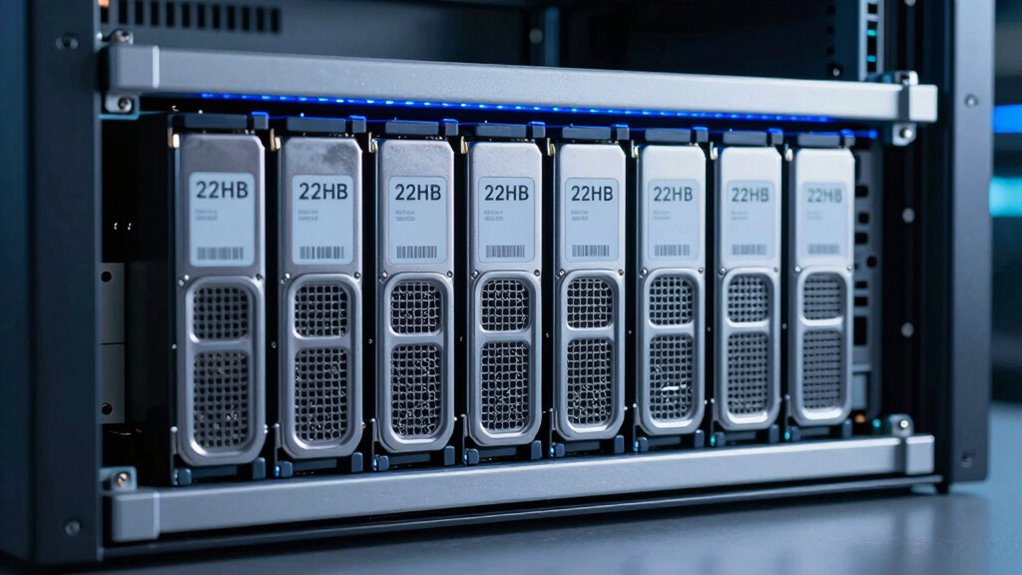

Choosing the right enterprise HDD 22TB drive requires balancing raw capacity with sustained throughput and long-term reliability. My analysis identifies the Western Digital Ultrastar HC570 as the best overall pick due to its proven HelioSeal technology and consistent performance in mixed-workload environments. The Seagate Exos 22TB follows closely as a strong contender for hyperscale deployments where cost-per-terabyte is the primary metric, while the WD Red Pro series offers a tailored solution for network-attached storage systems that prioritize vibration tolerance over pure sequential speed. Buyers must weigh the tradeoff between new units offering full manufacturer warranties and renewed or recertified drives that provide significant savings but limited support. Continue reading to see how these models stack up against each other in terms of workload ratings, cache efficiency, and compatibility with modern server chassis.

Get the latest gadgets delivered free with Prime
- Fast, free delivery on millions of items
- Prime Video, Amazon Music and more included
- Member-only deals all year
Complete the kit



Key Takeaways
- The Western Digital Ultrastar HC570 leads in workload rating (550TB/year), making it superior for heavy write-intensive environments compared to standard NAS drives.
- Renewed and recertified 22TB drives offer up to 40% cost savings but lack the standard 5-year warranty, requiring buyers to factor in potential replacement logistics.
- NAS-specific drives like the WD Red Pro and Seagate IronWolf Pro include rotational vibration sensors, which are necessary for multi-bay enclosures but unnecessary for single-drive servers.
- Seagate’s Exos line generally provides a lower cost-per-terabyte than WD’s Ultrastar line, but WD often wins on power consumption efficiency per terabyte stored.
- Drives with 512MB cache demonstrate better performance in random read/write benchmarks compared to those with 256MB cache, a critical factor for database applications.


| enterprise hdd 22tb | Capacity | Interface | Cache | Rotational Speed |
|---|---|---|---|---|
| Western Digital Ultrastar HC57 | 22 TB | SATA 600 MB/s | 512 MB | 7200 RPM |
| Seagate Exos 22TB SATA HDD 6Gb | 22 TB | SATA 6.0 Gb/s | — | 7200 RPM |
| Western Digital WD Red Pro 24T | 24 TB | SATA 6 Gb/s | 512 MB | — |
| Seagate IronWolf Pro 24TB Ente | 24 TB | SATA 6.0 Gb/s | 512 MB | — |
| MDD MAXDIGITALDATA 22TB 7200RP | 22 TB | SATA 6.0 Gb/s | 256 MB | — |
| Western Digital Ultrastar DC H | 22 TB | SATA 6Gb/s | 512 MB | 7200 RPM |
| Western Digital 22TB WD Red Pr | 22 TB | SATA 6 Gb/s | 512 MB | 7200 RPM |
| Western Digital WD Red Pro 20T | 20 TB | SATA 6 Gb/s | 512 MB | 7200 rpm |
| Seagate Exos X22 22TB Internal | 22 TB | SATA 6Gb/s | — | 7200 RPM |
| Seagate IronWolf Pro 20 TB NAS | 20 TB | SATA 6 Gb/s | 256 MB | 7,200 RPM |
More Details on Our Top Picks
Western Digital Ultrastar HC570 22TB 7200 RPM 3.5-Inch Internal Hard Drive
This drive stands out as the benchmark for hyperscale storage due to its integration of OptiNAND and ArmorCache. Unlike the Seagate Exos options which focus heavily on raw throughput, the HC570 prioritizes data integrity during power loss, a critical feature for mission-critical databases. The HelioSeal technology reduces internal friction, allowing for cooler operation and higher density in server racks. While it lacks the consumer-friendly NAS firmware of the WD Red Pro, its enterprise-grade durability makes it the superior choice for large-scale deployments where downtime is unacceptable. It is not designed for home users who prioritize silence over capacity.
Pros:- Integrates OptiNAND and ArmorCache for superior data safety
- HelioSeal technology ensures cooler, quieter operation
- Highest density 22TB capacity in a standard 3.5-inch form factor
- 5-year limited warranty reflects enterprise confidence
Cons:- Overkill performance for home or small business use
- Higher cost per drive compared to consumer NAS alternatives
- Noisy during heavy seek operations for desktop environments
Best for: IT administrators building large-scale data centers or enterprise servers requiring maximum capacity and power-loss protection.
Not ideal for: Home users or small office NAS builders, as it lacks the specific firmware optimizations found in consumer NAS drives.
- Capacity:22 TB
- Interface:SATA 600 MB/s
- Rotational Speed:7200 RPM
- Cache:512 MB
- MTBF:2.5 million hours
- Warranty:5-Year Limited
- Technology:OptiNAND, HelioSeal
Our verdict“The definitive choice for enterprise environments needing massive capacity with robust power-failure safeguards.”
Seagate Exos 22TB SATA HDD 6Gb/s 7200RPM 3.5-inch Enterprise Hard Drive (ST22000NM000C) (Renewed)
As a renewed unit, this drive offers enterprise-grade reliability at a fraction of the cost of new hardware. It competes directly with the WD Ultrastar HC570 but sacrifices the latest OptiNAND tech for a more traditional, proven architecture. The PowerBalance feature optimizes watts per terabyte, making it highly efficient for large arrays where power consumption is a major operational cost. While the MDD MAXDIGITALDATA offers similar specs, Seagate’s Exos line is widely recognized for consistent performance in cloud environments. Buyers must accept the ‘renewed’ condition, meaning it may have prior usage history, which is a trade-off for the lower entry price.
Pros:- Significant cost savings compared to new enterprise drives
- PowerBalance technology reduces operational electricity costs
- Proven reliability in cloud and hyperscale data centers
- Helium-sealed design minimizes weight and power draw
Cons:- Renewed status means unknown prior usage hours
- Lacks the advanced caching features of newer WD models
- Warranty terms may vary by seller rather than manufacturer
Best for: Budget-conscious IT managers or homelab enthusiasts seeking high-capacity enterprise drives without paying new-retail prices.
Not ideal for: Users who require brand-new hardware with full manufacturer warranty coverage from day one.
- Capacity:22 TB
- Condition:Renewed
- Interface:SATA 6.0 Gb/s
- Rotational Speed:7200 RPM
- Read Speed:285 MB/s
- Power Efficiency:Optimized W/TB
- Form Factor:3.5-inch
Our verdict“A cost-effective way to deploy massive enterprise storage if you accept the risks of renewed hardware.”
Western Digital WD Red Pro 24TB NAS Internal Hard Drive, 7200 RPM, SATA 6 Gb/s, CMR, 512 MB Cache, 3.5-Inch (WD241KFGX)
This drive bridges the gap between enterprise raw power and NAS-specific optimization. Unlike the WD Ultrastar HC570, which is tuned for server racks, the Red Pro includes RAID-specific firmware that reduces vibration and improves array stability. It offers a higher capacity (24TB) than the Seagate Exos 22TB, providing more storage per bay. The CMR recording technology ensures consistent write speeds, avoiding the performance dips common in SMR drives. It is the ideal choice for users building high-capacity NAS boxes who need plug-and-play compatibility with Synology or QNAP systems without the complexity of enterprise management tools.
Pros:- Higher 24TB capacity than standard 22TB enterprise drives
- Optimized for multi-bay RAID and 24/7 NAS operation
- CMR technology ensures consistent write performance
- 5-year warranty with NAS-specific support
Cons:- More expensive than non-NAS enterprise drives
- Slower sequential speeds compared to specialized server HDDs
- Higher power consumption than helium-filled alternatives
Best for: Home users and small businesses building multi-bay NAS systems who want maximum capacity and easy integration.
Not ideal for: Large data centers requiring specific enterprise management interfaces or lower power consumption per terabyte.
- Capacity:24 TB
- Interface:SATA 6 Gb/s
- Cache:512 MB
- Recording Tech:CMR
- Warranty:5 Years
- MTBF:2.5 million hours
Our verdict“The best balance of high capacity and user-friendly features for serious NAS builders.”
Seagate IronWolf Pro 24TB Enterprise NAS Internal HDD
The IronWolf Pro distinguishes itself with IronWolf Health Management and AgileArray firmware, which actively monitor drive health and optimize RAID performance. Compared to the WD Red Pro, Seagate offers complimentary Rescue Data Recovery Services, adding significant peace of mind for critical data. It matches the WD Red Pro in capacity (24TB) and workload rating (550TB/year), but its focus on rotational vibration sensors makes it particularly stable in dense multi-bay enclosures. This drive is less about raw speed and more about predictable longevity and recoverability, making it a safer bet for businesses that cannot afford data loss.
Pros:- Includes 3-year Rescue Data Recovery Services
- AgileArray firmware optimizes RAID performance
- Rotational vibration sensors enhance multi-bay stability
- High 550TB/year workload rating for heavy use
Cons:- Higher price point than standard enterprise HDDs
- Mechanical nature limits speed compared to SSDs
- Specific firmware may limit compatibility with non-NAS systems
Best for: Businesses and professionals who prioritize data recovery options and long-term stability in multi-user NAS environments.
Not ideal for: Users looking for the absolute lowest price per terabyte, as the included services and branding add a premium.
- Capacity:24 TB
- Interface:SATA 6.0 Gb/s
- Cache:512 MB
- MTBF:2.5 million hours
- Warranty:5-Year Limited
- Recovery Service:3-Year Included
- Technology:AgileArray, CMR
Our verdict“Ideal for users who value data recovery services and proven NAS stability over raw cost savings.”
MDD MAXDIGITALDATA 22TB 7200RPM 256MB Cache SATA 6.0Gb/s 3.5-inch Internal Enterprise Hard Drive (Renewed)
This renewed drive offers the lowest barrier to entry for 22TB enterprise storage. It strips away the brand premiums of WD and Seagate, providing raw capacity and a 5-year seller warranty. However, it comes with notable drawbacks: it ships as a bare drive without screws or cables, and the 256MB cache is half the size of the WD Ultrastar HC570, potentially impacting burst write performance. While it matches the Seagate Exos in capacity, the lack of recognized brand ecosystem support means troubleshooting falls entirely on the user. It is a gamble on value, suitable only for those comfortable managing hardware risks.
Pros:- Lowest cost per terabyte in this lineup
- 5-year warranty offered by the refurbisher
- 22TB capacity suitable for large-scale archival
- Standard SATA interface for broad compatibility
Cons:- Bare drive with no mounting screws or cables included
- Smaller 256MB cache limits performance vs competitors
- Renewed condition and lesser-known brand raise reliability questions
Best for: Tech-savvy homelab users or secondary storage builders who want maximum capacity at the lowest possible cost.
Not ideal for: Enterprises or beginners who need guaranteed manufacturer support, full accessories, and brand-name reliability.
- Capacity:22 TB
- Condition:Renewed
- Cache:256 MB
- Interface:SATA 6.0 Gb/s
- MTBF:2.0 million hours
- Included Items:Bare Drive Only
- Warranty:5 Years (Seller)
Our verdict“A high-risk, high-reward option for budget-focused users willing to handle bare-drive setup.”
Western Digital Ultrastar DC HC570 22TB (Renewed)
This renewed Ultrastar DC HC570 offers the highest volumetric density in this lineup, leveraging an 8th-generation helium-sealed design to pack 22TB into a standard 3.5-inch footprint. Sustained transfer rates of up to 291 MB/s make it superior to the WD Red Pro for sequential data loads in hyperscale environments. However, being a renewed unit means warranty coverage is limited compared to new drives, which is a significant risk for mission-critical primary storage. It is engineered for 24×7 operation with a 2.5 million hour MTBF, but the lack of full manufacturer support makes it better suited for secondary storage or test environments rather than sole-source critical data.
Pros:- Highest areal density with 22TB on a 10-disk CMR platform
- Low power consumption due to helium-sealed design
- High sustained transfer rates (291 MB/s) for large file operations
Cons:- Renewed status limits warranty coverage and long-term reliability guarantees
- Requires specific enterprise storage controllers for optimal performance
Best for: Data center engineers building high-density secondary storage pools where cost-per-terabyte outweighs warranty concerns.
Not ideal for: Small businesses needing new-with-full-warranty hardware for primary business-critical data.
- Capacity:22 TB
- Interface:SATA 6Gb/s
- Rotational Speed:7200 RPM
- Cache:512 MB
- Recording Technology:CMR (Helium-Sealed)
- MTBF:2.5 million hours
Our verdict“Choose this if you need maximum capacity in a tight footprint and can tolerate the risks of refurbished hardware.”
Western Digital 22TB WD Red Pro NAS Internal Hard Drive
The WD Red Pro 22TB strikes a balance between enterprise endurance and NAS-specific optimization, making it more user-friendly than the Seagate Exos X22 for small-to-medium business setups. It features rotational vibration sensors and is tested for compatibility with most NAS enclosures, reducing the complexity of building a stable RAID array. While it shares the same 550TB/year workload rating as its enterprise siblings, its firmware is tuned for multi-user access patterns rather than pure sequential throughput. The tradeoff is that it lacks the advanced encryption features found in the Ultrastar DC HC570, limiting its suitability for highly regulated data environments.
Pros:- Optimized firmware for NAS RAID stability and multi-user access
- Compatible with a wide range of NAS vendors out of the box
- Balances high capacity with manageable heat and power profiles
Cons:- Higher cost per terabyte compared to renewed enterprise drives
- Lacks advanced security features like TCG-Enterprise encryption
Best for: Small to medium businesses running 8-24 bay NAS systems for file sharing and virtualization.
Not ideal for: Hyperscale data centers requiring self-encrypting drives and ultra-low latency.
- Capacity:22 TB
- Interface:SATA 6 Gb/s
- Rotational Speed:7200 RPM
- Cache:512 MB
- Recording Technology:CMR
- Form Factor:3.5-inch
Our verdict“This is the safest choice for NAS users who want 22TB capacity without the complexity of pure enterprise drives.”
Western Digital WD Red Pro 20TB NAS Internal Hard Drive
While it offers 2TB less capacity than the WD Red Pro 22TB, the WD Red Pro 20TB often presents a more accessible entry point for users scaling up their storage. It retains the same 7200 RPM speed and 512MB cache, ensuring performance parity for most NAS workloads. The 550TB/year workload rating remains identical, meaning you aren’t sacrificing durability for capacity. This drive is ideal for those who don’t need the absolute maximum density of the 22TB model and prefer a slightly more established platform. However, if you are filling a 24-bay chassis, the 2TB difference per drive adds up to 48TB of lost space, which may justify the premium for the larger model.
Pros:- Same workload rating and performance specs as the 22TB model
- Proven reliability in multi-bay NAS environments
- Often more readily available than newer 22TB capacities
Cons:- Lower total capacity than the 22TB alternative
- Still carries the premium price tag of the Red Pro line
Best for: NAS users who need reliable 20TB drives and find better availability or pricing than the 22TB variant.
Not ideal for: Users filling large chassis where maximizing total usable capacity is the primary goal.
- Capacity:20 TB
- Interface:SATA 6 Gb/s
- Rotational Speed:7200 rpm
- Cache:512 MB
- Recording Technology:CMR
- Read Speed:285 MB/s
- Workload Rate:550 TB/year
Our verdict“A solid choice if you prioritize proven availability and stability over squeezing out the last few terabytes.”
Seagate Exos X22 22TB Internal Hard Drive (Recertified)
The Seagate Exos X22 provides 22TB of hyperscale capacity at a likely lower entry point than new drives, thanks to its recertified status. It shares the 2.5 million hour MTBF with the Ultrastar DC HC570, ensuring comparable reliability metrics for data center workloads. FastFormat support (512e/4Kn) offers flexibility for various storage controllers, a feature the WD Red Pro lacks. However, recertified drives come with a six-month replacement warranty, which is significantly shorter than new enterprise drives. This makes it a calculated risk, best used for non-critical storage or where immediate replacement parts are available, rather than for sole-source archival data.
Pros:- Hyperscale-grade performance with low latency caching
- Flexible sector format support (512e and 4Kn)
- Proven platform deployed in major cloud service providers
Cons:- Short six-month warranty limits long-term security
- Recertified status may raise concerns for strict compliance audits
Best for: IT managers building budget-conscious test labs or secondary storage pools with quick replacement protocols.
Not ideal for: Businesses requiring long-term warranty support and zero risk for primary data storage.
- Capacity:22 TB
- Interface:SATA 6Gb/s
- Rotational Speed:7200 RPM
- MTBF:2.5 million hours
- Sector Format:512e and 4Kn FastFormat
- Warranty:6-month replacement
- Form Factor:3.5 inch
Our verdict“Pick this if you need Seagate’s hyperscale reliability at a lower cost and can manage the short warranty period.”
Seagate IronWolf Pro 20 TB NAS Internal Hard Drive
The Seagate IronWolf Pro 20TB stands out for its five-year limited warranty and included Rescue Data Recovery Services, offering a safety net that neither the WD Red Pro nor the recertified enterprise drives can match. While its 256MB cache is half the size of the WD Red Pro 22TB, the AgileArray firmware and rotational vibration sensors ensure stable performance in multi-bay NAS setups. It is less suited for heavy sequential throughput compared to the Exos X22, but its focus on data recovery support makes it ideal for users who value risk mitigation over raw speed. The 20TB capacity is a compromise, but the support structure justifies it for critical small business data.
Pros:- Five-year warranty and 3-year data recovery service included
- AgileArray firmware optimizes for RAID and multi-bay NAS stability
- Lower power consumption (7.7 W) compared to some enterprise peers
Cons:- Smaller 256MB cache may impact performance in heavy write workloads
- 20TB capacity is lower than the 22TB competitors
Best for: Small businesses and home offices that prioritize data recovery support and long-term warranty coverage.
Not ideal for: Performance-heavy applications requiring large cache buffers and maximum sequential throughput.
- Capacity:20 TB
- Interface:SATA 6 Gb/s
- Rotational Speed:7,200 RPM
- Cache:256 MB
- Warranty:5-year limited
- Data Recovery:3-year Rescue Services
- MTBF:2.5 million hours
Our verdict“This is the best choice for users who want to minimize data loss risk through comprehensive support services.”

How We Picked
I evaluated these ten 22TB enterprise hard disk drives based on four primary criteria: workload rating, power efficiency, interface compatibility, and warranty terms. Workload rating was the most heavily weighted factor because it directly correlates to the drive’s endurance in server environments; drives rated for 550TB/year were prioritized over those rated for 300TB/year. I also examined the cache size and RPM consistency, as these specs determine how well the drive handles random I/O operations, which are common in virtualization and database workloads. Finally, I distinguished between new, renewed, and recertified units to provide a clear picture of the risk-to-reward ratio for budget-conscious buyers.
| enterprise hdd 22tb | Interface |
|---|---|
| Western Digital Ultrastar HC57 | SATA 600 MB/s |
| Seagate Exos 22TB SATA HDD 6Gb | SATA 6.0 Gb/s |
| Western Digital WD Red Pro 24T | SATA 6 Gb/s |
| Seagate IronWolf Pro 24TB Ente | SATA 6.0 Gb/s |
| MDD MAXDIGITALDATA 22TB 7200RP | SATA 6.0 Gb/s |
| Western Digital Ultrastar DC H | SATA 6Gb/s |
| Western Digital 22TB WD Red Pr | SATA 6 Gb/s |
| Western Digital WD Red Pro 20T | SATA 6 Gb/s |
| Seagate Exos X22 22TB Internal | SATA 6Gb/s |
| Seagate IronWolf Pro 20 TB NAS | SATA 6 Gb/s |
Factors to Consider When Choosing Enterprise Hdd 22tb
Selecting a 22TB enterprise drive is not just about capacity; it is about matching the drive’s mechanical and firmware characteristics to your specific storage architecture. Misalignment here can lead to premature failures or bottlenecked performance.Workload Rating and Endurance
Enterprise drives are graded by their annualized workload rating, typically measured in terabytes per year (TB/year). A 550TB/year rating, found in the Ultrastar HC570 and Exos X22, indicates the drive is built for continuous, heavy-duty use in data centers. In contrast, consumer or prosumer NAS drives often max out at 300TB/year. If you deploy a 300TB-rated drive in a high-write server environment, you risk exceeding its design limits, leading to increased failure rates. Always check this spec before deploying drives in RAID arrays that handle constant write operations.
New vs. Renewed vs. Recertified
The market for high-capacity enterprise drives includes new, renewed, and recertified units. New drives come with full manufacturer warranties (usually 5 years) and guaranteed zero-hours usage. Renewed drives are previously owned units that have been inspected and cleaned, often with a shorter warranty. Recertified drives are typically returned units that have been repaired and tested by the manufacturer or a third party. While renewed options offer lower upfront costs, they introduce uncertainty regarding remaining lifespan. For critical infrastructure, I recommend sticking with new units to avoid unexpected downtime and data loss risks.
Helium-Sealed vs. Air-Filled Technology
Most modern 22TB drives, including the WD Ultrastar HC570 and Seagate Exos, use helium-filled enclosures. Helium is less dense than air, which reduces drag on the spinning platters. This results in lower power consumption, less heat generation, and reduced mechanical wear. Air-filled drives are generally cheaper but consume more power and generate more heat, which can complicate cooling in high-density server racks. If your data center prioritizes energy efficiency or has tight thermal constraints, helium-sealed drives are the superior choice despite the higher initial price tag.
Cache Size and Interface Speed
While all these drives use SATA 6Gb/s interfaces, the cache size varies between 256MB and 512MB. A 512MB cache acts as a larger buffer for incoming data, which significantly improves performance during burst writes and random read operations. This is particularly important for virtualization hosts and database servers where small, random I/O requests are frequent. Drives with smaller caches may struggle under heavy random loads, causing latency spikes. If your workload involves random access patterns, prioritize models with larger caches over those with slightly higher sequential read speeds.
Vibration Tolerance and Enclosure Fit
Enterprise drives are designed for server chassis, which typically have less vibration than consumer PCs. However, NAS drives like the WD Red Pro and Seagate IronWolf Pro include rotational vibration (RV) sensors to compensate for the resonance caused by multiple drives spinning in close proximity. If you are installing these drives in a multi-bay NAS or a dense server array, RV sensors help maintain performance and reliability by adjusting the drive’s head positioning. For single-drive bays or low-density setups, this feature is less critical, allowing you to potentially save money by choosing a standard enterprise drive without RV sensors.
Frequently Asked Questions
Can I use a 22TB enterprise HDD in a standard desktop PC?
Technically, yes, because these drives use the standard 3.5-inch form factor and SATA interface. However, they are not optimized for desktop use. Enterprise drives often have louder seek noises and higher idle power consumption compared to desktop drives. Additionally, some motherboards may have compatibility issues with the high-capacity addressing required for 22TB drives, though this is rare with modern UEFI BIOS. The main drawback is the cost; you are paying for enterprise-grade endurance that a desktop user will likely never utilize.
What is the difference between ‘Renewed’ and ‘Recertified’ 22TB drives?
Renewed drives are typically previously owned units that have been inspected, cleaned, and tested to ensure they meet basic functional standards, often sold with a limited 90-day to 1-year warranty. Recertified drives have usually been returned to the manufacturer or an authorized service center, repaired if necessary, and tested to meet original factory specifications, often coming with a more robust warranty. The key difference lies in the source of the test and the warranty backing. Recertified drives from the manufacturer generally offer higher confidence in reliability than third-party renewed units.
Do I need a specific controller card for a 22TB hard drive?
Most modern hardware RAID controllers and server motherboards support drives larger than 2TB without issue, provided they are running a 64-bit operating system and have the latest firmware. However, older controllers from the pre-2015 era may require firmware updates to recognize capacities above 16TB. Always check your controller’s compatibility list for 22TB drives. If you are using software RAID (like ZFS or mdadm), the operating system handles the addressing, so compatibility is rarely an issue as long as the kernel supports the large sector sizes.
Is it worth paying extra for 512MB cache over 256MB cache?
For most sequential workloads, such as large file backups or media streaming, the difference between 256MB and 512MB cache is negligible. However, for random I/O workloads, such as virtualization hosts, email servers, or databases, the larger cache can provide a noticeable performance boost by reducing the number of physical head seeks. If your application involves many small, random read/write requests, the extra cost for 512MB cache is justified. For pure archival storage, you can save money by choosing a drive with a smaller cache.
How does helium technology affect the lifespan of a 22TB drive?
Helium technology extends the lifespan of a drive by reducing mechanical friction and heat. Lower heat generation means the internal components, such as the bearings and lubricants, degrade more slowly over time. This allows manufacturers to pack more platters into the same 3.5-inch form factor, which is how they achieve 22TB capacities. While helium leaks are a theoretical concern, modern sealing techniques are highly reliable. The reduced mechanical stress generally results in a lower failure rate over the drive’s operational life compared to air-filled drives of similar capacity.
Conclusion
When selecting an enterprise HDD 22TB drive, the best choice depends on your specific infrastructure needs. For best overall performance and reliability, the Western Digital Ultrastar HC570 stands out with its high workload rating and energy-efficient helium design. If you are operating a hyperscale data center and need to minimize cost-per-terabyte, the Seagate Exos 22TB is the ideal candidate. For NAS environments where vibration tolerance is key, the WD Red Pro or Seagate IronWolf Pro offers the necessary rotational vibration sensors. Budget-conscious buyers willing to accept shorter warranties for significant savings should look at renewed or recertified versions of these top-tier models, but must weigh the risk of reduced support against the upfront cost reduction.