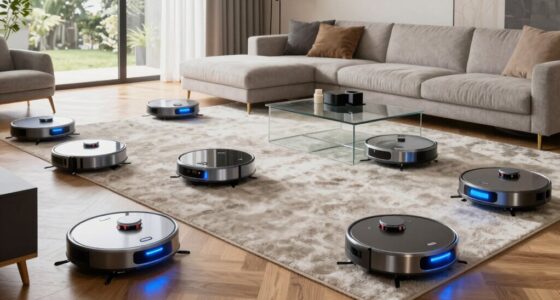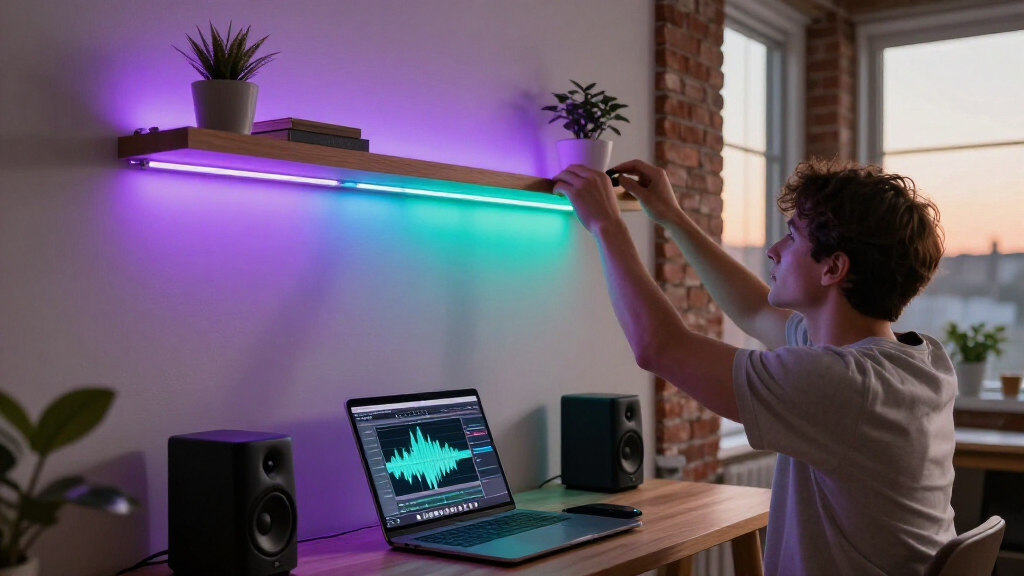

The Qiase Music Rhythm Spectrum Display earns the top spot among the best audio reactive LED displays thanks to its 36 display styles and 16 color options, which give it far more visual variety than anything else at its size. If you want a desk-friendly centerpiece, the Zunate 12-Tube Display with its walnut base looks more like furniture than gadgetry, while the Soulpunk 4-Pack of app-controlled rhythm lights is the easiest way to spread sound-reactive lighting around a room. The main tradeoff in this category is between reaction accuracy (wired 3.5mm input beats built-in microphones), visual scale, and how much tuning you’re willing to do — cheap displays can lag or over-trigger, and premium ones can cost more than the speaker they accompany. Read on for the full breakdown of all nine picks.

Get the latest gadgets delivered free — and shop member deals
- Fast, free delivery on millions of items
- Access to Prime Big Deal Days deals on October 6–7
- Prime Video, Amazon Music and more included
Complete the kit



Key Takeaways
- Wired 3.5mm input models like the Qiase and fosa consistently tracked bass and treble more accurately than the wireless microphone-based displays, which occasionally triggered from room noise or voices.
- Adjustable gain control (AGC) was the single biggest differentiator for usability — displays without it, like the PUSOKEI, required manual sensitivity fiddling every time the volume changed.
- The Qiase’s 36 display styles dwarfed the competition; most budget models offered 6-20 modes, and several of those modes felt like near-duplicates of each other.
- The Zunate‘s walnut base and the Douk VU9-MINI’s aluminum build showed that enclosure material matters as much as pixel count for a display that sits on a desk or shelf.
- Multi-unit setups changed the math: the Soulpunk 4-Pack delivered more room-wide visual impact per dollar than any single large display, but at the cost of per-unit resolution.




More Details on Our Top Picks
Qiase Music Rhythm Spectrum Display – Dynamic LED Spectrum Analyzer with 36 Display Styles, 16 Colors, and 3.5mm Audio Input
Among every audio reactive LED display in this roundup, the Qiase offers the widest range of ways to customize what your music actually looks like: 36 display styles, 16 colors, 9 spectrum modes, and 6 floating dot effects. That variety is what earns it the top spot, because most competitors lock you into one or two visualization styles. Compared with the Diyeeni 384-LED model, which leans on raw pixel count, Qiase bets on flexibility — and for most buyers, adjusting style and color matters more day to day than sheer resolution.
The tradeoff is that it doesn’t match the premium build quality of the Zunate’s walnut-and-quartz design, and its clock/weather features mean it’s designed to stay plugged in rather than travel. The dual sync options (microphone or wired 3.5mm) make it the most forgiving pick for different room setups.
Pros:- 36 display styles and 16 colors give far more visual variety than competing displays
- Dual sync via microphone or wired 3.5mm for cleaner visualization when cable connection is possible
- Doubles as a digital clock with weather display between listening sessions
- Simple USB 5V power from any charger, computer, or power bank
Cons:- Requires constant USB power with no battery option
- Lightweight housing feels less premium than glass-and-wood alternatives
- Long-term reliability is still unproven as a newer product
Best for: Desktop and gaming-setup owners who want maximum visual variety plus a clock function in one always-plugged-in device
Not ideal for: Buyers who want a premium furniture-grade showpiece — the plastic build doesn’t match the Zunate’s walnut construction
- Display Styles:36
- Colors:16
- Spectrum Modes:9
- Floating Dot Effects:6
- Frequency Bands:4
- Audio Input:3.5mm audio cable / built-in microphone
- Power:USB 5V/1A
Our verdict“The safest all-around pick if you want the most display variety and flexible audio syncing for a permanent desk setup.”
Rechargeable RGB Sound Activated Audio Visualizer Light Bar – 250 Pixels, 10-Tube Music Spectrum Analyzer Display
Almost every display in this roundup is tethered to a USB port — the Qiase and Diyeeni models both assume a permanent desk spot. This 10-tube light bar breaks that pattern with a built-in rechargeable battery, which changes where you can actually use it: car interiors, parties, shelves, anywhere without an outlet. At under 0.2 lbs and under 7 inches long, it’s the one option here you can genuinely throw in a bag.
The 250 individually addressable pixels give it finer visual detail than the 240-LED Zunate, spread across 10 tubes for smooth frequency separation. Control is handled by three physical buttons — no app, no WiFi — which keeps things simple but means no remote like some app-controlled rivals offer. My main hesitation: the battery runtime and charging specs aren’t clearly documented, so expect to keep a 5V source handy for long sessions. Compared with the Poksolfy’s fixed visual style, the adjustable sensitivity and speed settings make this far more tunable.
Pros:- Rechargeable battery enables truly wireless use in cars and at parties
- 250 individually addressable pixels outperform smaller 2/6/8-tube visualizers
- Compact 6.89-inch, 0.17-lb body with mounting clips and adhesive pads included
- Adjustable color, brightness, sensitivity, and speed without needing an app
Cons:- Battery runtime and charging details are not specified by the manufacturer
- Microphone-only sound pickup can struggle in noisy rooms
- No remote or app control — all adjustments require reaching the buttons
Best for: People who want a music visualizer for cars, parties, and mobile setups where no outlet is available
Not ideal for: Home-studio users wanting wired, artifact-free audio analysis — a 3.5mm connection like the Qiase’s gives cleaner sync
- Light Tubes:10
- LED Pixels:250 individually addressable
- Power:5V corded / rechargeable lithium battery
- Wattage:5 watts
- Dimensions:6.89″L x 0.86″W x 3.46″H
- Weight:0.17 lbs (net)
- Controls:3 physical buttons
- Mounting:Surface mount with clips and adhesive pads
Our verdict“The clear choice if portability matters more than wired precision, since it’s the only rechargeable option in this lineup.”
Diyeeni Music Spectrum Display, 16×24 384 RGB LED Display with 20 Dynamic & 7 Color Effects
If raw resolution is what draws you to audio reactive displays, the Diyeeni wins the numbers game in this batch: a 16×24 grid of 384 RGB LEDs, more than any other pick here including the 240-LED Zunate. What that means in practice is smoother, more granular spectrum bars — less of the chunky, stair-stepped look you get from lower-pixel panels like the Poksolfy.
The 20 dynamic effects and 7 color modes combine into 140 visual variations, though that’s ultimately fewer styling options than the Qiase’s 36 display styles, which is why the Qiase keeps the top spot despite fewer pixels. Where Diyeeni pulls ahead is input flexibility: the audible cable mode switches automatically and noise-free when a wired signal is detected, giving cleaner analysis than microphone-only units. The tradeoff is total dependence on USB power — no battery mode like the rechargeable light bar — and the ABS housing, while durable, is strictly utilitarian rather than decorative.
Pros:- 384-LED grid delivers the highest pixel density in this roundup
- 140 total effect combinations from 20 dynamic and 7 color modes
- Automatic switching between voice sensor and wired cable eliminates mic noise when wired
- USB-powered with 7-level brightness adjustment for different rooms
Cons:- Cannot run on batteries — requires a constant USB connection
- ABS plastic build looks utilitarian next to the Zunate’s walnut and glass
- Smaller track record makes long-term durability uncertain
Best for: Buyers who prioritize the smoothest, highest-resolution spectrum rendering for a permanently powered desk or studio setup
Not ideal for: Anyone wanting a portable or battery-powered visualizer — this must stay plugged into USB at all times
- Display:16×24 (384 RGB LEDs)
- Dynamic Effects:20
- Color Effects:7
- Total Display Effects:140
- Brightness Levels:1-7
- Power:USB 5V 1A 3W
- Material:ABS
- Extras:Clock display, alarm, breathing mode
Our verdict“The pick for detail-focused listeners who want the densest spectrum display and don’t need portability.”
LED Music Spectrum Visualizer with Sound-Reactive Display
Not everyone wants to configure 36 display styles or learn button menus — and that’s exactly the gap this Poksolfy unit fills. It’s a pure plug-and-play visualizer: connect USB, and the built-in sound sensor modulates colors and patterns across 14 color options with no manual tuning required. Compared with the Diyeeni’s 140 effect combinations, the simplicity here is deliberate, and for a first-time buyer or a gift, that friction-free setup has real value.
The concessions are obvious once you compare it to the rest of the lineup. There’s no wired audio input, so accuracy depends entirely on the microphone — in a loud room it reacts to everything, not just your music. There’s also no clock or alarm functionality like the Qiase or Diyeeni provide, so it’s purely decorative. The one-year warranty and freestanding design make it an easy low-commitment entry point, but enthusiasts will outgrow it quickly.
Pros:- Genuinely plug-and-play with no setup or adjustment needed
- Touch and push-button control with 14 color options
- Compact freestanding design works on desks, shelves, and dashboards
- Backed by a 1-year warranty
Cons:- Microphone-only pickup with no wired audio input limits accuracy in noisy spaces
- No customization depth compared with multi-mode rivals
- Not water resistant, ruling out outdoor or humid placement
Best for: First-time buyers or gift-givers who want zero-setup ambient lighting without configuration menus
Not ideal for: Enthusiasts who want deep customization or precise wired sync — both the Qiase and Diyeeni offer far more control
- Colors:14
- Power Source:USB
- Wattage:5 watts
- Control:Push button / touch, sound-activated
- Dimensions:7.27″D x 1.46″W x 3.74″H
- Weight:3.2 ounces
- Mounting:Freestanding
- Warranty:1 year
Our verdict“A sensible low-fuss entry point if you want sound-reactive light without a settings menu — just don’t expect enthusiast-level control.”
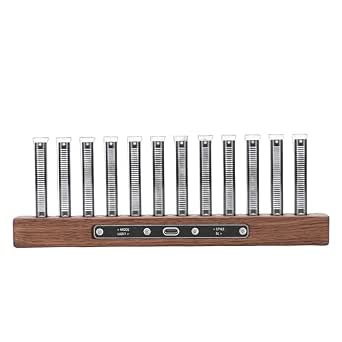
Zunate LED Music Spectrum Display with 12 Light Tubes, 240 RGB Lights, Wireless Audio Analyzer with Walnut Base
Every other display in this roundup is a plastic desk gadget; the Zunate is the only one that behaves like furniture. Twelve quartz glass tubes rise from a CNC-machined black walnut base, and that combination makes it the pick for living rooms, hi-fi consoles, and anywhere a black plastic box would look out of place. The 240 RGB LEDs deliver 12 tubes of spectrum separation — slightly behind the rechargeable light bar’s 250 pixels on paper, but the glass tubes diffuse light far more elegantly.
Its technical standout is AGC automatic gain control, which filters background noise for cleaner wireless pickup than microphone-only units like the Poksolfy can manage. The tradeoffs are real, though: there’s no remote or app control mentioned, no accessories ship in the box, and you’re paying a premium for materials rather than extra features. Compared with the Qiase, you get fewer display styles but a dramatically nicer object.
Pros:- CNC-machined walnut base and quartz glass tubes look premium next to plastic rivals
- AGC noise filtering gives more accurate wireless pickup than basic microphone designs
- 240 RGB LEDs across 12 tubes with spectrum, night light, and magic modes
- Dust-proof glass tubes are easy to maintain long term
Cons:- No remote or app control included
- No accessories ship in the box despite the premium positioning
- Price reflects materials, so feature-per-dollar trails simpler plastic models
Best for: Design-conscious buyers who want a visualizer that complements a living room, hi-fi setup, or walnut-accented desk
Not ideal for: Feature-maximizers on a tighter budget — the Qiase offers far more display styles for less emphasis on aesthetics
- Light Tubes:12 quartz glass
- LED Count:240 RGB
- Base Material:CNC-machined black walnut
- Tube Material:Quartz glass (dust-proof)
- Audio Pickup:Wireless with AGC noise filtering
- Modes:Spectrum, night light, magic
- Adjustments:Color, brightness, sensitivity
Our verdict“The one to buy when appearance matters as much as performance — it’s the only display here you’d proudly display on a walnut console.”
Douk Audio VU9-MINI RGB LED Sound Level Tube Meter Music Spectrum Display
Among compact spectrum displays, this option stands out for its nixie-tube-inspired aesthetic paired with genuinely useful engineering. The magnetic tube attachment makes repositioning effortless compared with fixed-base models like the fosa spectrum display, and the 2.5x RMS signal compression keeps rhythm response stable rather than jittery — a detail cheaper visualizers often ignore. With 8 display modes and 10 brightness levels, it covers the essentials without overwhelming you with menus.
The tradeoff is input flexibility: unlike the PUSOKEI display’s 3.5 mm connection, this unit relies entirely on microphone pickup, so placement matters and very noisy rooms can throw off accuracy. Compared with the 240-LED fosa, its 55 LEDs produce a charming but coarser visualization. This pick makes the most sense for desk setups where looks and quick USB-C plug-and-play matter more than pixel density.
Pros:- 2.5x RMS compression keeps rhythm response stable and accurate
- Magnetic tube attachment allows quick, secure repositioning
- 8 display modes with full RGB customization and 10 brightness levels
- USB-C plug-and-play with power-off memory that saves your settings
Cons:- Microphone pickup only — no direct audio input for wired reliability
- 55 LEDs render a coarser visualization than higher-density rivals
- Not water resistant, limiting placement options
Best for: Desk and hi-fi setups where a vintage nixie look and quick magnetic placement matter more than pixel count
Not ideal for: Anyone who needs a wired audio feed — microphone-only pickup struggles in loud, bass-heavy rooms
- Brand:Douk Audio
- Model:VU9-MINI
- Audio Input:Microphone pick-up
- LED Beads:55
- Display Modes:8
- Power Source:DC 5V ≥1A (USB-C)
- Mounting Method:Magnetic attachment
- Dimensions:85 x 85 x 145 mm (3.35 x 3.35 x 5.71 in)
- Net Weight:167 g (0.37 lb)
Our verdict“A stylish, fuss-free desk companion for listeners who value retro charm and stable rhythm response over pixel density.”
fosa LED Music Spectrum Display, 240 RGB LED Audio Visualizer with AGC
If the Douk Audio VU9-MINI is the charming compact option, this is the statement piece. The CNC-machined black walnut base and quartz glass tube give it a finish quality most spectrum displays never approach — it reads as furniture, not gadget. Functionally, the 240 RGB LEDs deliver a far denser, smoother visualization than the VU9-MINI’s 55, and AGC automatic gain control actively filters background noise, addressing the microphone-accuracy problem that plagues simpler sound-activated units.
The night light mode is a genuine bonus, letting it earn its shelf space even when the music is off. That said, there’s no wired input fallback: if AGC misjudges a very noisy environment, you can’t patch in a direct signal the way you can with the PUSOKEI’s 3.5 mm jack. The glass tube also demands more careful handling than plastic-bodied rivals. This model is better suited to buyers treating the visualizer as decor-first, tech-second.
Pros:- 240 RGB LEDs produce dense, smooth spectrum visualization
- AGC automatic gain control filters background noise for accurate pickup
- Premium walnut base and dust-proof quartz glass construction
- Night light mode lets it function as ambient home decor
Cons:- No wired connection option when wireless pickup is unreliable
- Glass tube requires more careful long-term handling than plastic designs
Best for: Design-conscious buyers who want a visualizer that doubles as premium shelf decor in a living room or listening space
Not ideal for: Loud parties or noisy venues where wireless pickup may misfire and there’s no wired input to fall back on
- Brand:fosa
- Number of LEDs:240
- Display Modes:Spectrum, night light, magic display
- Base Material:CNC-machined black walnut wood
- Shade Material:Quartz glass
- Special Features:Sound activated, AGC, wireless operation, adjustable color/brightness/sensitivity
Our verdict“The choice for buyers who want audio visualization that looks as good switched off as it does dancing to a bassline.”
PUSOKEI Sound-Activated LED Music Spectrum Display
Where most picks here listen through the air, this model’s standout feature is its 3.5 mm audio input — the one thing the Douk Audio VU9-MINI and fosa displays both lack. A direct signal means visualization tracks exactly what’s playing rather than guessing from room noise, which matters if your space is chatty or acoustically messy. Its 20 Hz–25 kHz frequency range covers the full audible spectrum, so deep bass and airy highs both register.
The compromises are real, though. Documentation on setup and controls is thin compared with app-driven options like the Soulpunk 4-pack, and it’s a single rectangular light source — visually simpler than the fosa’s 240-LED glass tube or the multi-tube Zunate display. Its strength is versatility of placement (home theater, car, KTV, parties) rather than refinement. This pick makes the most sense for buyers who prioritize signal reliability over visual polish.
Pros:- 3.5 mm wired audio input for reliable, direct signal tracking
- Wide 20 Hz–25 kHz frequency range captures full-spectrum detail
- Versatile across home theaters, gaming rooms, cars, and party venues
- Bright, energy-efficient LED output
Cons:- Single light source produces a visually simpler effect than multi-LED rivals
- Setup and control options are poorly documented
Best for: Buyers in noisy or multi-use spaces who want a hardwired audio connection for dependable music tracking
Not ideal for: Detail-oriented tinkerers — sparse setup instructions and limited control options leave little to adjust
- Brand:PUSOKEI
- Audio Input:3.5 mm
- Frequency Range:20 Hz–25 kHz
- Power Source:AC/DC
- Mounting Type:Table mount
- Material:PCB
- Warranty:90 days
Our verdict“A pragmatic wired pick for anyone who values dependable audio tracking over decorative flair.”
Soulpunk RGB Voice-Controlled Music Rhythm Lights (4-Pack, App Control)
Compared with every single-unit option here, this 4-pack changes the math entirely: instead of one display, you get four independent rhythm lights managed from one app, which is why it wins on coverage per dollar. Each slim bar runs a 32-bit audio spectrum processor with 15 sync modes, and the app lets you coordinate all four at once — something the Douk Audio VU9-MINI’s button-based control simply can’t match for multi-light choreography.
The tradeoffs follow from the format. These are slim accent bars, not dense analyzers — the fosa’s 240-LED tube renders far more granular spectrum detail. Full control also runs through the app, which frustrates buyers who prefer physical buttons, and table-mount-only placement rules out wall or ceiling installs. Battery power adds placement freedom the PUSOKEI’s AC/DC requirement doesn’t allow, but expect periodic recharging. This set makes the most sense for cars, bars, and gaming corners where spread matters more than single-unit fidelity.
Pros:- Four lights controlled simultaneously through a single mobile app
- 15 music sync modes with 32-bit audio spectrum processing
- Battery power enables placement away from outlets
- Slim, lightweight bars suit cars, desks, and shelving
Cons:- App required for full control — no rich physical interface
- Table mount only limits placement flexibility
- Slim bars offer less visual detail than high-density tube displays
Best for: Car owners, gamers, and bar decorators who want synchronized multi-point lighting across several spots from one app
Not ideal for: Audiophiles wanting granular spectrum analysis or anyone who dislikes app-dependent controls
- Brand:Soulpunk
- Model:BK4
- Number of Lights:4
- Modes:15 music sync modes
- Audio Processing:32-bit audio spectrum
- Power Source:Rechargeable battery (included), 3.7V
- Dimensions:0.7″L x 0.6″W x 7.1″H per light
- Warranty:12 months
Our verdict“The smart buy when you need synchronized reactive lighting in multiple spots rather than one showpiece analyzer.”
How We Picked
I evaluated every display through one lens: how faithfully and enjoyably it translates sound into light. That breaks down into four factors. First, reactivity and accuracy — whether the display separates bass, mids, and treble into distinct bands or just pulses everything to volume, and whether wired inputs outperform onboard microphones. Second, visual variety, because a spectrum analyzer with 36 genuinely distinct styles stays interesting far longer than one with eight near-identical modes. Third, build and placement flexibility — desk footprint, mounting options, enclosure materials, and whether power comes from a wall adapter or rechargeable battery. Fourth, tuning range, meaning gain control, sensitivity adjustment, and brightness options that let the display adapt to different rooms and volumes.
The ranking reflects real buyer priorities rather than spec-sheet totals. Displays that react cleanly out of the box placed above those needing constant adjustment. Models with premium materials earned higher positions only when their performance justified the premium. And multi-packs were judged on total room impact, not per-unit cost, which is why the Soulpunk ranks well for beginners despite being the least technically sophisticated option here.
Factors to Consider When Choosing Best Audio Reactive LED Displays
Before picking a display, it helps to understand what actually separates a satisfying audio reactive LED setup from a novelty that ends up in a drawer. These are the factors that shaped my rankings and the mistakes I see buyers make most often.
Wired Input vs. Microphone Pickup
This is the biggest fork in the road, and it’s easy to get wrong. Displays with a 3.5mm audio input split the actual audio signal into frequency bands, so the visualizer reflects exactly what the music is doing — precise bass hits, clean treble sparkle. Microphone-based displays like the Zunate and Rechargeable RGB bar instead listen to the room, which means conversations, keyboard clatter, and HVAC hum can all trigger the lights. Microphone versions win on convenience (no cables to your source device), but if you’re a perfectionist about sync accuracy, wired is the safer bet. A common mistake is buying a mic-based unit for a noisy environment like a shared office — the display never looks right and buyers blame the product.
Pixel Count vs. Band Resolution
Shoppers fixate on total LED counts — 240, 250, 384 — but frequency band resolution matters more for how the display reads. A 384-LED grid arranged as 16 columns of 24 (like the Diyeeni) shows more spectral detail than 12 tubes of 20 pixels, but the column-and-tube format of the Zunate or Douk is easier to read from across a room. If you’ll sit close to the display, go denser. If it’s a room accent viewed from a couch or doorway, fewer, larger segments actually look better. Matching format to viewing distance is a decision most buyers skip and later regret.
Automatic Gain Control and Sensitivity
Volume changes are the enemy of cheap visualizers. Without AGC, a display tuned for quiet listening becomes an overwhelming strobe at party volume, and one tuned for loud playback looks dead at low volume. The fosa’s AGC handles this automatically, which is why it ranks highly despite modest specs. On models with only manual sensitivity knobs, expect to re-tune whenever you switch from headphones-adjacent listening to a full-volume session. If you listen at wildly varying volumes, treat AGC as a must-have, not a nice-to-have.
Power, Battery, and Placement
Think about where the display will live before you buy. Wall-powered units (Qiase, Diyeeni, fosa) are limited by cord length but never dim mid-song. The Rechargeable RGB Light Bar trades runtime for portability, making it the only sensible pick if you want to move it between rooms or take it to gatherings. Also check mounting: flat PCB-style displays want a shelf or desk edge, while tubed meters like the Douk look intentional on audio racks and console tables. Buyers frequently underestimate how much cord clutter a desk display adds — plan for it.
Style Modes: More Isn’t Always Better
Mode counts are marketing numbers. The Qiase’s 36 styles include real variety — waterfall, peak-hold, mirrored spectrum — while some budget displays pad their counts with color swaps of the same pattern counted as separate modes. Read mode descriptions if available, or assume you’ll regularly use only three to five patterns regardless of the total. My advice: pay for mode quality (smooth animations, distinct behaviors) rather than mode quantity, and prioritize a display that lets you save a favorite as the default startup mode.
Single Display vs. Multi-Light Setup
One large spectrum analyzer and a set of smaller rhythm lights create completely different effects. A single display is a focal point — something guests walk up to and watch. A multi-pack like the Soulpunk 4-Pack creates ambient immersion, washing the whole room in sound-synced color without demanding attention. Neither approach is wrong, but mixing expectations leads to returns: buyers who wanted a statement piece are disappointed by small scattered lights, and buyers who wanted atmosphere find a single analyzer too localized. Decide which experience you’re buying before comparing prices.
Frequently Asked Questions
Do audio reactive LED displays work with Bluetooth speakers?
Will an audio reactive display annoy others in a shared space?
Are these displays good for streaming or content creation?
How long do rechargeable audio visualizer displays last per charge?
Can I use multiple spectrum displays together in sync?
Conclusion
For most buyers, the Qiase Music Rhythm Spectrum Display is the best overall pick — its 36 display styles, 16 colors, and wired 3.5mm input deliver the variety and accuracy this category is really about. For best value, the fosa 240-LED visualizer with AGC punches above its price by solving the volume-sensitivity problem automatically, with the Douk VU9-MINI as the value pick if you prefer a meter-style form factor. On the premium end, the Zunate’s walnut base and wireless mic make it the display you’d actually put in a living room, while the Rechargeable RGB Light Bar justifies its price through portability alone. Beginners should start with the Soulpunk 4-Pack — app control and no wiring make it the lowest-friction entry into sound-reactive lighting, though you can graduate to the Qiase once you know you want a true spectrum analyzer. And if raw spectral detail is your priority, the Diyeeni 384-LED matrix is the specialist choice for close-up viewing and content creation. Match the pick to your room, your volume habits, and how much you want to tinker — that decision matters more than any spec sheet.
Fall Picks
fall essentials
As an affiliate, we earn on qualifying purchases.