
TL;DR
OpenAI launched a beta on November 10 that lets businesses manage profiles, product feeds and customer-facing agents in ChatGPT. The same day, Odessia founder Francis Davidson said his AI travel startup had been acquired by OpenAI; separate reports put OpenAI’s third-quarter revenue at about $10 billion, alongside wider operating losses.
OpenAI launched Businesses in ChatGPT in beta on November 10, giving companies a way to claim profiles, supply product information and offer customer-facing AI agents inside the chatbot. The move creates new ways for businesses to appear in ChatGPT and measure user interest, while an acquisition announcement and reports of the company’s finances point to a broader push into services and commerce.

Get the latest gadgets delivered free with Prime
- Fast, free delivery on millions of items
- Prime Video, Amazon Music and more included
- Member-only deals all year
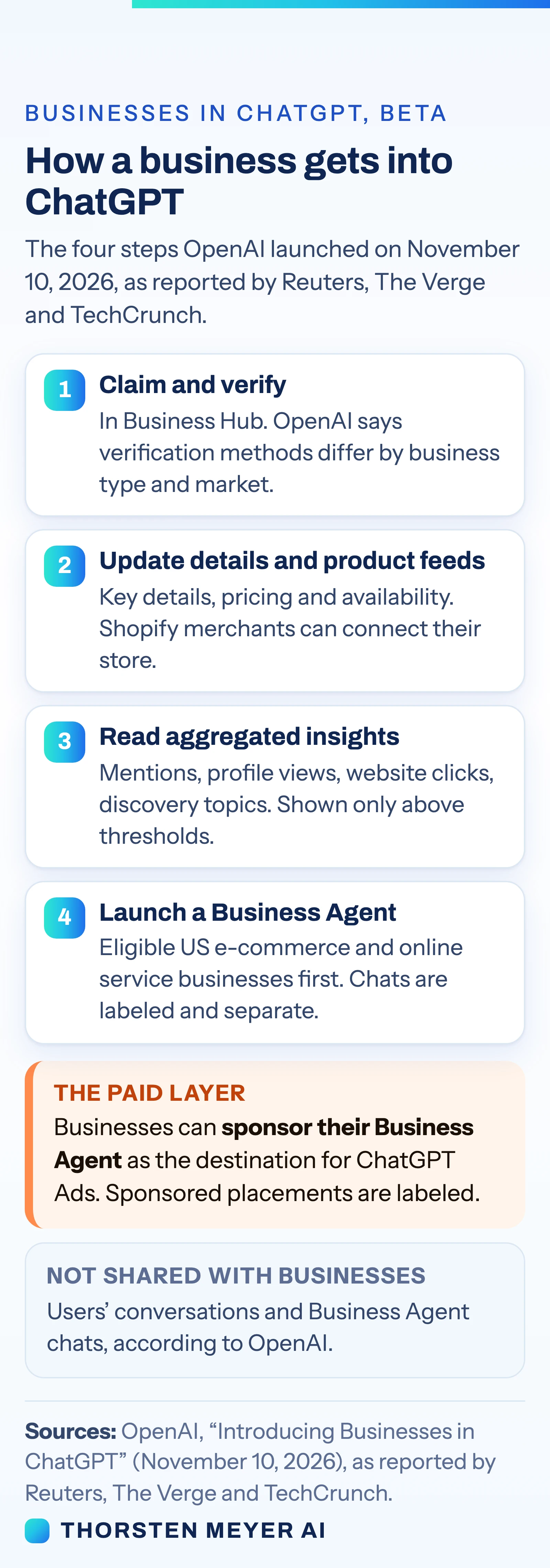
The beta has two main parts, according to OpenAI’s announcement and coverage by Reuters, The Verge and TechCrunch. In Business Hub, a company can claim and verify its profile, update business details and add product feeds with prices and availability. The Hub also provides aggregated figures for ChatGPT mentions, profile views and website clicks, as well as topics through which users discover the business.
Eligible e-commerce and online service businesses in the United States can also offer Business Agents. When one of those businesses appears in a ChatGPT answer, a user may open a separate conversation with its agent to ask about its offerings. Businesses provide the agent’s instructions and information. OpenAI says these conversations are labeled and kept separate from a user’s main chat.
OpenAI says businesses do not receive users’ conversations or Business Agent chats, and that insights are shown only after activity reaches certain thresholds. A company can sponsor its agent as a destination for ChatGPT Ads, with sponsored placements labeled. Existing OpenAI Enterprise customers and advertisers can claim profiles through their OpenAI representative; Shopify merchants can connect through Business Hub or Shopify’s admin tools. OpenAI has not publicly detailed the verification process.
Businesses Compete for ChatGPT Visibility
The launch gives businesses a direct way to manage information that may shape how ChatGPT describes them. Profile accuracy, product availability and prices could affect whether users see a company as a fit when they ask for recommendations or compare options. The aggregated metrics also offer businesses a measure of visibility inside ChatGPT, though OpenAI has not published the thresholds or methods behind those figures.
For users, the features could make it easier to ask follow-up questions about a product without leaving ChatGPT. They also bring commercial content closer to the recommendation process. OpenAI says agent conversations are separate and sponsored placements are labeled; how those safeguards work in practice, and how users respond to sponsored destinations, remain open questions.
The business tools sit alongside OpenAI’s existing advertising efforts. The company said in August that ChatGPT Ads had reached a $1 billion annualized revenue run rate. The new profiles and agents could give advertisers another route to reach users, but OpenAI has not disclosed how widely the beta will expand or how it plans to price participation.
Products Worth Considering

DJI Osmo Pocket 3 Vlogging Camera with 1-Inch CMOS Sensor and 4K/120fps Video

Logitech MX Master 4 Ergonomic Wireless Mouse with Haptic Feedback, Graphite

Bose TV Speaker Compact Soundbar with Bluetooth and HDMI-ARC, Black
As an affiliate, we earn on qualifying purchases.
From ChatGPT Shopping to Business Hub
The announcement follows an earlier attempt to make ChatGPT a shopping destination. TechCrunch reported that OpenAI previously tested direct checkout and a commission model, but retired that effort in March after it failed to gain traction. The new approach centers on business information, product feeds and conversations with agents, rather than direct checkout as described in that earlier effort.
OpenAI also announced a move into travel. Francis Davidson, founder of AI travel agent Odessia, said the startup had been acquired and that he was joining OpenAI. An OpenAI spokesperson confirmed Davidson’s hire to TechCrunch. The acquisition price and other terms were not disclosed, and the available reporting does not specify what Odessia’s technology or team will do at OpenAI.
Separately, The Information reported that OpenAI generated about $10 billion in third-quarter revenue. Bloomberg reported that revenue grew nearly 50% from the previous quarter, citing a person familiar with the matter. OpenAI has not published financial statements. Reuters reported that the Wall Street Journal put the company’s operating losses at $10.9 billion for the same quarter, illustrating that the revenue figure does not by itself describe profitability.
“Davidson announced that OpenAI had acquired his AI travel agent startup and that he was joining the company.”
— Francis Davidson, Odessia founder
Rollout, Verification and Deal Terms
OpenAI has not said how many businesses will be admitted to the beta, when access will expand beyond eligible US e-commerce and online service companies, or how it selects which businesses appear in answers. The company has also not described the verification checks in detail or specified the activity thresholds required before businesses see aggregate insights.
Odessia’s acquisition terms remain undisclosed, as does the role its product or staff will play at OpenAI. The reported financial figures also remain incomplete: OpenAI has not released financial statements, and the revenue and operating-loss amounts come from media reports with different sourcing. The relationship between the new business tools, ChatGPT Ads and any future purchasing features has not been fully explained.
Watch for Wider Business Access
The next practical milestone is whether OpenAI expands the beta and publishes more detail about eligibility, verification and business analytics. Companies considering a profile will also be watching for information about how product feeds are handled and how sponsored agents are identified in user conversations.
Further reporting or statements from OpenAI may clarify Odessia’s integration and provide firmer financial detail. For now, the confirmed launch shows that businesses can begin managing some information and interactions in ChatGPT, while the scale and commercial impact of the rollout remain uncertain.
Key Questions
What did OpenAI launch on November 10?
OpenAI launched Businesses in ChatGPT in beta. It includes a Business Hub for claiming profiles and adding product feeds, plus Business Agents for eligible US e-commerce and online service companies.
Can businesses see what users say to ChatGPT?
OpenAI says businesses do not receive users’ conversations or Business Agent chats. The company says businesses receive aggregated insights, such as mentions and clicks, only after activity passes certain thresholds.
What is known about OpenAI’s acquisition of Odessia?
Odessia founder Francis Davidson announced that OpenAI acquired the AI travel agent startup and that he is joining OpenAI. An OpenAI spokesperson confirmed his hire to TechCrunch; the deal’s terms and Odessia’s future role have not been disclosed.
How much revenue did OpenAI report for the third quarter?
OpenAI has not published financial statements. The Information reported about $10 billion in third-quarter revenue, and Bloomberg reported nearly 50% growth from the prior quarter, citing a person familiar with the matter. Reuters also reported a Wall Street Journal figure of $10.9 billion in operating losses for the quarter.
Source: Thorsten Meyer AI