
🔍 Read the full analysis: 10 Best Home Theater Projectors For Movie Nights In 2027 on ThorstenMeyerAI.com

Get the latest gadgets delivered free with Prime
- Fast, free delivery on millions of items
- Prime Video, Amazon Music and more included
- Member-only deals all year
TL;DR
ThorstenMeyerAI.com’s 2027 projector guide names 10 models for different rooms and priorities, led by the Epson Home Cinema LS11000 for dedicated media rooms. The recommendations are based on listed specifications and intended use; independent test results, current prices and availability are not provided in the source material.
ThorstenMeyerAI.com’s 2027 buying guide, the original projector analysis, recommends 10 home theater projectors for movie nights, with the Epson Home Cinema LS11000 as its overall pick for dedicated media rooms. The guide says buyers should weigh room brightness, resolution, light-source lifespan and built-in smart features, but it does not provide independent test results or confirm current prices and availability for every model.
The guide’s leading recommendation, the Epson LS11000, uses a laser light source and Epson’s 4K PRO-UHD imaging, according to the source; see this guide to laser projectors for home theater for related options. It is positioned for a dedicated viewing room rather than as a one-size-fits-all choice. The guide says laser models can avoid routine lamp replacement and maintain brightness over extended use, while typically requiring a higher initial outlay.
For people prioritizing convenience and a lower-cost entry point, the article highlights the NexAurea Smart Projector, describing it as native 1080p with Wi-Fi 6; buyers comparing premium alternatives can also explore high-end home theater projectors. Other listed models include the Optoma UHZ36, identified as a brighter option for rooms with daylight, and the Epson Home Cinema 980, a lamp-based model presented as a lower-upfront-cost alternative that may require replacement lamps over time.
The remaining recommendations named in the source are the HAPPRUN 1500 ANSI Lumens projector, the Aurzen model, and the X9 Pro. The supplied material also refers to smart operating systems such as Android TV, Google TV and Roku, but does not map every system or specification clearly to a specific product. It contains no full model-by-model specification table for all 10 picks, so buyers should verify details before purchasing.
The 10 picks
- 1
 Epson Home Cinema LS11000 4K PRO-UHD Laser ProjectorView on Amazon →
- 2
 Optoma UHZ36 4K UHD Laser HDR Home Theater Projector – BlackView on Amazon →
- 3
 Epson Home Cinema 980 3-Chip 3LCD 1080p Movie ProjectorView on Amazon →
- 4
 X9 Pro Smart Projector with VIDAA OS, 1080p Native Resolution, 4K Decoding, H…View on Amazon →
- 5
 HAPPRUN 1500 ANSI Lumens 4K Decoding Projector with Official Google TVView on Amazon →
- 6
 HAPPRUN Native 1080P Bluetooth Projector with Official Licensed Google TVView on Amazon →
- 7
 NexAurea Smart Projector with Native 1080p, 4K Decoding, Wi-Fi 6, Bluetooth 5…View on Amazon →
- 8
 Smart Outdoor Projector with 4K Support, WiFi & Bluetooth, Dual Speakers, Aut…View on Amazon →
- 9
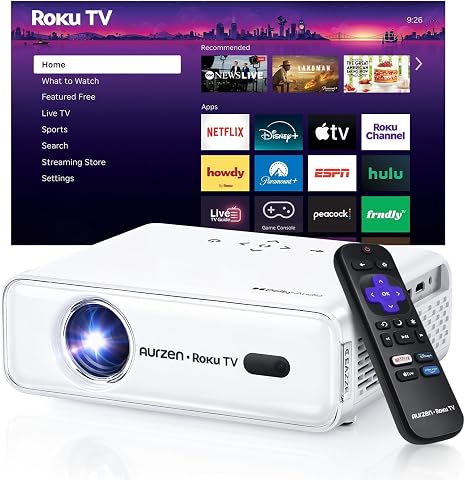 Aurzen Roku TV Smart Projector with Wifi and Bluetooth, Roku Streaming Experi…View on Amazon →
- 10
 HAPPRUN Native 1080P Bluetooth ProjectorView on Amazon →
Room Conditions Shape the Choice
The guide’s main practical point is that a projector’s performance depends on its room. A high-resolution model can still disappoint in a bright space if it lacks sufficient light output, while a bright projector may be a poor match for someone prioritizing deep contrast in a dark cinema room. The list directs buyers to consider ambient light and intended placement before comparing headline specifications.
It also highlights the tradeoff between upfront price and long-term upkeep. Lamp-based units can cost less initially but may need replacement lamps; laser models generally carry a higher purchase price but avoid that particular maintenance cycle. These are general distinctions in the guide, not independently verified cost comparisons for the named products.
Resolution claims deserve scrutiny, too. The source distinguishes native 1080p from 4K decoding: a projector may accept a 4K signal without displaying it as native 4K pixels. That distinction can help shoppers avoid paying a premium based on ambiguous marketing language, especially when comparing budget models.
Products Worth Considering

Logitech MX Master 4 Ergonomic Wireless Mouse with Haptic Feedback, Graphite

Anker SOLIX S2000 Portable Power Station, 2,010Wh, 1,500W

LG UltraGear 27G640A-B 27-Inch QHD IPS Gaming Monitor, 300Hz, 1ms, G-SYNC Compatible, FreeSync Premium, DisplayHDR 400, HDMI 2.1, USB-C, Adj
As an affiliate, we earn on qualifying purchases.
How the Guide Compares Projectors
ThorstenMeyerAI.com says it assessed the projectors across image quality, usability and value. Its stated criteria include native resolution, light-source type, contrast, HDR support, setup features, connectivity and the expected cost of use. The guide says automatic focus and keystone correction can simplify setup, while manual adjustment may suit viewers seeking more control.
It describes brightness in ANSI lumens as a key consideration for rooms with uncontrolled light, citing 2,000 or more lumens as a useful level for such conditions and pointing to the Optoma UHZ36. It also identifies Wi-Fi 6 and Bluetooth 5.4 as connectivity features on the NexAurea and X9 Pro. Those specifications and performance judgments are reported by the guide; the supplied source does not include lab measurements or links to test data.
“The Epson Home Cinema LS11000 stands out as the best overall pick for dedicated media rooms.”
— ThorstenMeyerAI.com buying guide
Specifications Still Need Checking
The supplied article excerpt does not provide a complete, clearly matched list of all 10 models, nor does it give current prices, retailer availability or a publication date. Several models are named, but some product descriptions and smart-platform references are not tied to individual picks with enough detail to verify each recommendation.
It is also unclear whether the guide’s specifications and performance descriptions were confirmed through independent testing or drawn from manufacturer listings. Claims about brightness, wireless performance, lifespan and image quality should be checked against current product documentation and independent reviews. Projector performance can vary with screen size, throw distance, screen material and room lighting, none of which is fully assessed for each model in the provided material.
Verify Models Before Buying
Readers considering a projector should consult the full guide for its complete 10-product list, then confirm each model’s native resolution, measured brightness, ports, operating system and current price with manufacturers and retailers. For a room with daylight, check whether the projector and screen combination suits that lighting; for a dedicated dark room, compare contrast and image fidelity as well as brightness.
Because the source does not establish current inventory or test results, the next useful step is to compare independent reviews and confirm warranty and replacement-part costs. The guide offers a starting shortlist, but its 2027 recommendations may need updating as models, software support and prices change.
Key Questions
Which projector does the guide recommend overall?
It names the Epson Home Cinema LS11000 as its overall pick for a dedicated media room, citing laser illumination and 4K PRO-UHD clarity. The supplied material does not include independent comparative test results.
Does a projector that supports 4K necessarily display native 4K?
No. The guide says some budget projectors can accept or decode a 4K signal and then display it at a lower native resolution. Check the panel’s native resolution rather than relying on a broad “4K support” description.
Which features matter most in a bright living room?
The guide prioritizes brightness and ambient-light control, and identifies the Optoma UHZ36 as a brighter option. It also says a suitable screen can affect results; the source does not provide independent brightness measurements for the models.
Are laser projectors always the better value?
Not necessarily. The guide says laser models can reduce lamp-replacement needs and maintain brightness over time, while costing more upfront. A lamp-based projector may be cheaper to buy, so the better choice depends on purchase price, hours of use and maintenance costs.
Source: ThorstenMeyerAI.com