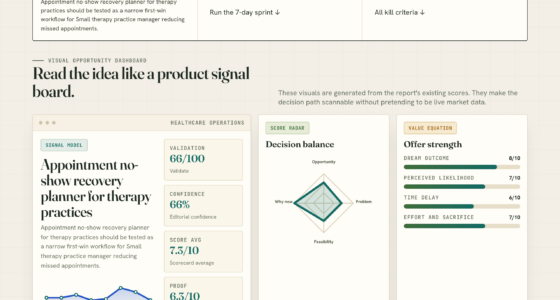
📊 Full opportunity report: Consumer Health Watch: The Pancreatic Cancer Pill Drawing Attention on IdeaNavigator AI — validation score, market gap, and execution plan.

Get the latest gadgets delivered free with Prime
- Fast, free delivery on millions of items
- Prime Video, Amazon Music and more included
- Member-only deals all year
TL;DR

The item drawing attention is a proposed consumer-health monitoring service, not a verified report about a new pancreatic cancer drug. Its underlying headline calls a pill a major breakthrough, but the provided material contains no drug name, study results, clinical-trial details or regulatory information to substantiate that description.
IdeaNavigator AI has proposed a subscription service that would filter health and safety news for compliance staff at consumer-health and food companies, using a headline about a pancreatic cancer pill as an example. The material does not identify the drug or provide clinical evidence, so the pill’s reported significance cannot be independently assessed from the information supplied.
The proposed monitor would track Hacker News and similar feeds for health, safety and contaminant developments, then prepare short briefs explaining what changed, why it could matter to a particular role and what action might be relevant. The intended customer is a safety or compliance lead at a consumer-health or food brand, not a patient or cancer-treatment provider.
IdeaNavigator AI describes the pancreatic cancer headline as an example of an item that might warrant attention. It says Hacker News surfaced the item with an 88/100 signal, but does not define the scoring method, provide a measurement window or state what baseline the score uses. That figure should be read as a platform signal reported in the proposal, not as a measure of a drug’s effectiveness, safety or scientific credibility.
The proposed way to test the idea is to deliver the brief and two other health, safety or contaminant findings to five people matching the target role, then check whether any recipient changes a decision or forwards an item to a colleague. The material presents this as a validation plan; it does not report that the test has taken place, that customers have subscribed or that the service has produced a business outcome.
The pancreatic cancer pill headline under scrutiny
The material describes a proposed health-news monitoring service, not verified evidence of a new cancer treatment. The headline’s medical claim cannot be assessed from the details provided.
What the headline does—and doesn’t—show
The supplied material gives no clinical or regulatory details to support the breakthrough claim.
- Drug name or maker
- Trial results, phase or side effects
- Publication or regulator information
- The treatment’s significance cannot be assessed
- The headline does not confirm an available or approved treatment
- Look for traceable evidence before drawing medical conclusions
The proposed business
IdeaNavigator AI describes a subscription monitor for safety and compliance leads at consumer-health and food companies.
Track relevant feeds
Watch for health, safety and contaminant developments across selected sources.
Match role needs
Select items relevant to a customer’s responsibilities and work.
Explain next steps
Summarize what changed, why it matters and what action may be relevant.
A test is planned, not reported
The proposal outlines a way to check whether the brief helps its intended users.
Include the example and two other health, safety or contaminant findings.
Ask people matching the intended safety or compliance role to review them.
Measure whether anyone changes a decision or forwards an item.
A Headline Is Not Clinical Evidence
The distinction matters because a claim that a cancer pill represents a major advance can influence patient expectations and public discussion, while the information supplied here does not establish whether the treatment exists in the form described or how it performed. No drug name, trial results or regulator decision are included. Readers should not treat the headline as evidence that an effective treatment is available or approved.
For the proposed business, the issue is different: safety and compliance staff may need to identify developments relevant to products, ingredients, manufacturing or consumer communications. A role-filtered digest could save time if it reliably separates actionable developments from noise. But the example alone does not show that the monitor’s selection, scoring or recommendations are accurate, or that its briefs would change workplace decisions.
The proposal therefore raises two questions that need separate answers: whether the underlying health claim is well supported, and whether a monitoring service can help its intended users respond to relevant developments. The available details do not resolve either question. A useful product would need to preserve the original context and evidence behind a story rather than turn a striking headline into an implied health conclusion.
Products Worth Considering

Kindle Paperwhite Signature Edition 32GB (2024 Model) – Metallic Black

Amazon Kindle Scribe Colorsoft 64GB with Premium Pen

Apple AirPods Pro
As an affiliate, we earn on qualifying purchases.
The Proposed Monitoring Workflow
IdeaNavigator AI frames the concept as a narrow first-use case for a specific buyer: a safety or compliance lead at a consumer-health or food company. Its stated problem is that health, safety and contaminant findings can appear across news coverage, online discussions and filings, making it difficult to spot relevant developments and decide whether they affect a company’s work.
The suggested workflow is to watch selected feeds, filter items for the customer’s responsibilities and produce a concise brief organized around what changed, why it matters and what to do. The proposed revenue model is a subscription. The material does not name a product, identify a launch date, report a price or describe existing customers, and it does not establish that a working monitor has been built.
The pancreatic cancer phrase appears as the example that prompted the business idea, rather than as a detailed medical report. No publication, hospital, company, researcher or clinical-trial registry is cited for the pill claim. The proposal offers no additional reporting about the treatment’s development or any evidence that the headline has been confirmed.
Drug and Evidence Details Missing
The information does not identify the pill, its maker, the researchers involved or the publication behind the headline. It also gives no trial phase, number of participants, results, side effects, comparison treatment or independent review. Without those details, the headline’s description of the treatment as a major breakthrough remains an unsubstantiated characterization in the material provided.
It is also unclear whether the drug is experimental, available through a clinical trial, authorized for any use or merely the subject of a news item. No regulator statement or date for the underlying report is included. The reported 88/100 score cannot fill those gaps because the scoring criteria and its intended meaning are not given.
On the business side, there is no evidence yet about the monitor’s accuracy, coverage, alert speed or usefulness to customers. The suggested five-person test is a plan, not a completed evaluation, and no results are reported.
Customer Testing Is Proposed
The next step described by IdeaNavigator AI is to prepare the example brief alongside two other health, safety or contaminant findings and share the set with five people who fit the intended buyer profile. The proposed measure is whether recipients change a decision or forward a brief to a colleague. No date for that test or results are provided.
Before the pancreatic cancer claim can support a medical conclusion, readers would need a traceable report identifying the treatment and its evidence, along with relevant clinical and regulatory details. Until those are available, the headline should be treated as a prompt for verification—not as confirmation of a new treatment or a change in patient care.
Source: IdeaNavigator AI
Key Questions
Has a new pancreatic cancer pill been confirmed?
The material supplies a headline but no drug name, clinical-trial results or regulator information. It does not confirm that a new treatment has been proven or approved.
What is IdeaNavigator AI proposing?
A subscription monitor for safety and compliance staff at consumer-health and food brands. It would filter health, safety and contaminant news and turn selected items into short, role-specific briefs.
What does the 88/100 signal mean?
The proposal reports that Hacker News surfaced the item with an 88/100 signal, but does not explain the scoring method, time window or comparison baseline. It is not a clinical score.
Has the proposed monitoring service been tested?
No test results are reported. The proposed validation is to share three briefs with five people in the target roles and measure whether they change a decision or forward an item.
Source: IdeaNavigator AI