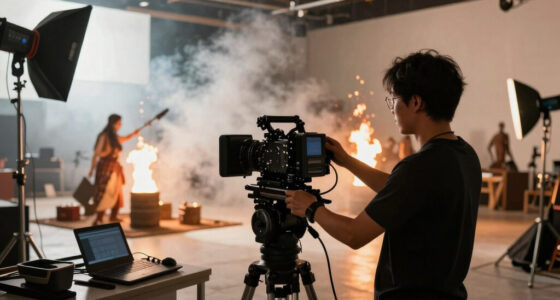
🔍 Read the full analysis: Why “After Action” Treats Credits As An AI Exhibition on ThorstenMeyerAI.com

Get the latest gadgets delivered free with Prime
- Fast, free delivery on millions of items
- Prime Video, Amazon Music and more included
- Member-only deals all year
TL;DR
After Action is a live, AI-built exhibition site that presents 24 web experiences as the productions in a fictional Wing V theater. Its central feature is a navigable end-credit roll, intercut with code-built sand-table miniatures; the theater is an artistic framing device, not a record of real military activity.
After Action, a live, AI-built exhibition site, presents credits for 24 web experiences as the closing reel of a fictional Wing V theater. Rather than display the projects in a conventional gallery, it turns the credit sequence itself into a navigable exhibit, with small, code-built sand-table scenes appearing between sections. The fictional military framing is an artistic conceit, not a report of real military activity.
The site’s central feature is a continuous credit roll, organized into chapters visitors can pause or jump between. JavaScript moves a single track according to elapsed time, while a locator line, time display, chapter label and controls follow its position. This is designed to make the roll function as an interface rather than as an animated list of links that users must catch as it passes.
After every eight productions, the sequence gives way to a CSS-built miniature scene. The vignettes suggest a shield formation, a catapult’s arc and two keys moving toward a shared lock. Tilted terrain, layered gradients and small raised markers create the sand-table effect; an intersection observer activates a scene as it enters the viewing area.
The source describes several accessibility and performance measures: the moving names are removed from keyboard focus, while a stationary linked register offers another route through the projects. The animation pauses when the theater is not visible or the browser tab is hidden, and a manual-scroll alternative is offered for people who prefer reduced motion. Optional synthetic projector audio starts off and stops when disabled.
Digital culture · Exhibition design
Why “After Action” Treats Credits As An AI Exhibition
A live, AI-built exhibition site turns the closing credits of 24 web experiences into a navigable theater event, with code-built sand-table scenes between chapters.
01 / The exhibition idea
When credits become the interface
Instead of arranging projects in a conventional thumbnail gallery, After Action makes the end-credit convention its main way into the collection.
A continuous reel
Visitors move through an authored credit roll, with chapters that can be paused or selected to change the pace.
Credits with controls
A locator line, time display, chapter label and playback controls follow the track, making credits function as an interface.
A theater frame
Cinema black, projected light and credit gold support the presentation. The theatrical setting remains explicitly fictional.
02 / How the experience unfolds
A paced journey through 24 works
The source describes an interface organized around movement, interludes and alternate ways to browse.
Enter the theater
A nearly empty cinema frames the collection as a closing reel.
Follow the roll
One track moves with elapsed time; chapter controls let visitors pause or jump.
Meet an interlude
After every eight productions, a miniature scene interrupts the sequence.
Browse by register
A stationary linked list offers another path to the projects.
03 / Sand-table interludes
Small scenes between chapters
Code-built miniatures use tilted terrain, layered gradients and raised markers to create a tabletop illusion.
The described vignettes suggest these motifs; an intersection observer activates each scene as it enters the viewing area. The hero uses a locally stored still image with visual effects because the intended ambient video was unavailable in the described build.
04 / Access & evidence
Useful options, with limits
The source reports several interaction and motion choices, while noting that no independent audit or user testing is provided.
Options described
- Moving names are removed from keyboard focus; a stationary linked register provides another route.
- Animation pauses when the theater is out of view or the browser tab is hidden.
- A manual-scroll alternative is offered for people who prefer reduced motion.
- Optional synthetic projector audio starts off and stops when disabled.
What remains unverified
No independent technical audit, performance measurements or user testing are supplied. The source does not establish when the site went live, how the projects were selected, which parts AI generated, or how much human editing occurred. It also does not confirm every briefed feature in the live version.
The clearest account is the source’s description: a fictional theater built around a navigable credit sequence and a collection of small digital scenes.
Artistic conceit05 / Key questions
What to know at a glance
What is After Action?
An AI-built exhibition site presenting 24 web experiences as productions in a fictional Wing V theater, centered on an interactive end-credit roll.
Is Wing V real?
The source describes Wing V as fictional and says the exhibition is not an account of actual military activity.
How does the roll work?
JavaScript moves a continuous track based on elapsed time. Visitors can pause or jump chapters while the locator, time and chapter label track its position.
What are the scenes made from?
The miniatures use CSS effects. The hero scene is different: a locally stored still image with visual effects.
When Credits Become the Interface
After Action treats a familiar end-of-film convention as the exhibition’s main organizing idea. The choice changes how visitors encounter the projects: rather than scan a grid of thumbnails, they move through an authored sequence, with chapter controls and interludes shaping the pace. In this design, credits are both content and navigation.
The approach also makes the site a demonstration of how a web experience can use interaction and visual atmosphere to frame a collection. The theatrical black, projected light and gold lettering support that idea, while the sand-table scenes interrupt the roll without turning the projects into a conventional card gallery. The source’s description emphasizes interaction design rather than realistic depictions of harm.
That distinction matters because the setting uses military language and imagery. The source explicitly describes Wing V as fictional and says the work is not an account of real military activity. Readers should understand the presentation as a designed exhibition, not evidence about an actual organization or operation.
As an affiliate, we earn on qualifying purchases.
A Fictional Wing V Finale
The project is identified in its source material as room 125 of 175, titled “After Action — Wing V Debrief Theater.” Its premise imagines a nearly empty cinema where the closing credits for a collection of web experiences become the exhibit. The 24 projects are described as productions, with the sequence culminating in the title card: “War, staged. Craft, real. — WING V / FABLE 125.”
The source includes a creative brief calling for a cinematic credit roll, miniature scenes between groups of credits, and a plain-text index for accessibility. It also names a desired implementation using HTML, CSS and JavaScript, without a framework or external requests. These are details of the brief and described build, rather than independently verified information about the development process.
The visual treatment uses cinema black, beam white, sand amber and credit gold, with compressed display lettering and monospace labels. The source says the dioramas, frames and atmospheric effects are generated in code, but the hero area uses a locally stored still image. An intended ambient video was unavailable in the described build, so the site uses that still with visual effects instead; the source says reduced-motion settings return the scene to the poster.
““War, staged. Craft, real. — WING V / FABLE 125.””
— The exhibition’s closing title card
What the Source Does Not Verify
The source describes the site’s behavior and design, but provides no independent technical audit, performance measurements or user testing. Claims about smooth playback, accessibility and performance therefore remain descriptions of the intended or reported build, not independently verified results.
The source also does not say when the site went live, identify the people or organization responsible for it beyond the attribution in the creative brief, or explain how the 24 projects were selected. It describes an AI-built exhibition, but does not detail which parts were generated by AI, what tools were used in the finished site, or how much human editing was involved.
The ambient video is specifically described as unavailable in the build. The source does not say whether it has since been added. It also does not provide a separate confirmation that every feature in the brief—including all responsive checks—appears in the live version.
Checking the Live Theater
The source invites readers to open the live site, where they can test the credit-roll controls, follow the stationary register and see how the interludes appear during navigation. It does not announce a future release, update schedule or next development milestone.
Any later version could clarify whether the ambient video becomes available and whether the reported motion, keyboard and responsive features have been tested across devices. Until then, the clearest account is the source’s description: a fictional theater built around a navigable credit sequence and a collection of small digital scenes.
Key Questions
What is After Action?
After Action is an AI-built exhibition site that presents 24 web experiences as productions in a fictional Wing V theater. Its main feature is an interactive end-credit roll.
Is Wing V a real military organization?
The source describes Wing V as fictional and says the exhibition is not an account of real military activity.
How does the credit roll work?
JavaScript moves a continuous credits track based on elapsed time. Visitors can pause it or jump between chapters, while the time display, locator and chapter label track its position.
What are the sand-table scenes made from?
The source says the miniatures use CSS effects, including tilted terrain panels, layered gradients and raised markers. The hero area is different: it uses a locally stored still image with visual effects.
What accessibility options are described?
The site description lists a stationary linked register, controls for pausing or jumping through chapters, and a manual-scroll alternative for reduced-motion users. The source does not provide an independent accessibility audit.
Source: ThorstenMeyerAI.com
Halloween Picks
halloween
As an affiliate, we earn on qualifying purchases.