
TL;DR

Get the latest gadgets delivered free with Prime
- Fast, free delivery on millions of items
- Prime Video, Amazon Music and more included
- Member-only deals all year
Pixelatron published a longer, previously unpublished version of a 2001 interview with Giles Goddard about making Super Mario 64. Goddard discusses early development on SGI computers, the game’s small team, Shigeru Miyamoto’s hands-on experimentation and the design work behind Mario’s face and camera.
Pixelatron has published an expanded version of a 2001 interview with Giles Goddard, a programmer who worked on Super Mario 64, offering additional recollections about the game’s development that were not included in the magazine article drawn from the original interview. Goddard describes a project that began on SGI computer emulators before Nintendo 64 hardware was available, and recalls experimentation with Mario’s face, animation and camera in the move from 2D to 3D.
The report says the interview was conducted in 2001 and that parts of it appeared in NGC magazine. The newly posted version is described by its publisher as unpublished and unedited, and as substantially longer than the magazine article. Pixelatron says it published the material for Mario’s 25th birthday. The exact publication date of the online post is not stated in the supplied report.
Goddard recalled that the team numbered about 15 people by the end, while adding that other staff contributed behind the scenes. He described his own role cautiously, saying he thought he had been a front-end programmer and had mainly worked on Mario’s face. The interview’s publisher also warns that its notes are rough: the questions are reconstructions, not a verbatim record of what the interviewer originally asked.
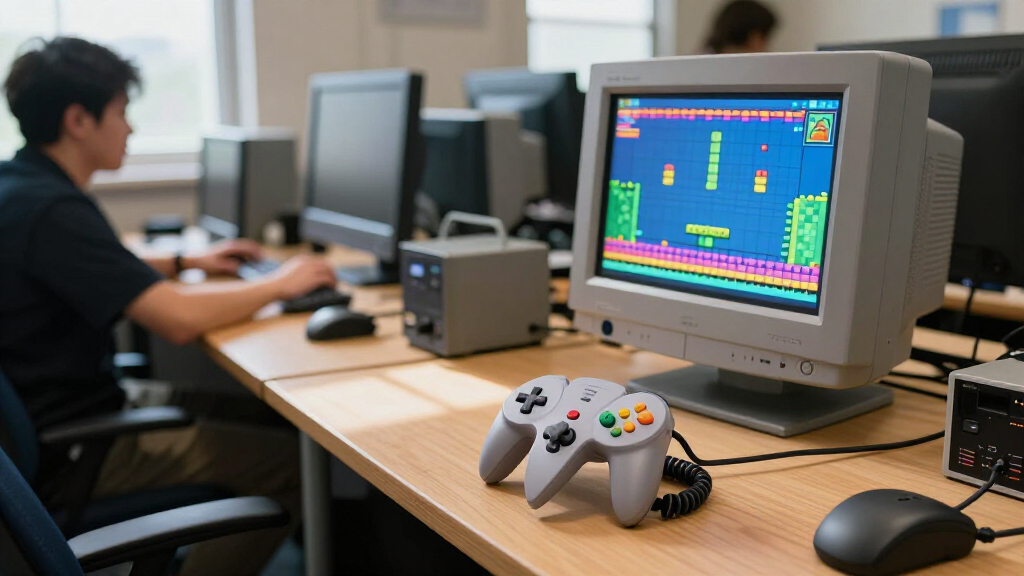
Goddard said work began before the console hardware was available, using an SGI Onyx emulator that reproduced the N64 programming interface rather than the hardware itself. He recalled early tests of Mario moving around a simple grid, with animation developed before much of the game. The interview also covers Miyamoto’s request to turn Goddard’s face-morphing experiment into a Mario face players could manipulate, and months of exploration into camera views and how to carry Mario’s familiar feel into 3D.
How Early Experiments Shaped 3D Mario
The interview offers a development account from a programmer involved in Super Mario 64, focusing on design and technical work rather than a retrospective overview of the finished game. Goddard’s recollections connect specific experiments—such as deforming a modeled face and testing camera angles—to decisions players encountered in the released title.
His description also helps explain the scale and uncertainty of the work: a relatively small core team, development before final hardware, and substantial time spent exploring how a platform game could function in three dimensions. These are Goddard’s memories, not a complete production record, but they provide detail that the shorter magazine version did not include.
Super Mario 64 Nintendo 64 game cartridge
As an affiliate, we earn on qualifying purchases.
As an affiliate, we earn on qualifying purchases.
From SGI Emulator to N64
According to Goddard, the project started on SGI Onyx systems before Nintendo’s N64 hardware was available. The early emulator represented the console’s API, not its hardware. Goddard recalled programmer Nishida working on the graphics interface and emulator while simple Mario demonstrations ran on the machines.
Goddard said Shigeru Miyamoto was closely involved, overseeing several projects at Nintendo’s EAD group but concentrating on Mario 64. The interview describes experiments with camera perspectives and animation as central to finding a way to translate the feel of earlier Mario games into a three-dimensional space. Goddard also credited Takumi Kawagoe with work on the camera system, saying Kawagoe had previously worked on the canceled SNES game Star Fox 2.
“Probably about 15 people in the end.”
— Giles Goddard, in the 2001 interview as reproduced by Pixelatron
Limits of the Interview Record
The publisher says the interview’s notes are rough and that the questions were reconstructed from memory because the original questions were not kept. That means the posted text should not be treated as a verbatim transcript of the interviewer’s side of the conversation. The material is presented as Goddard’s recollections from an interview conducted in 2001, not as independently verified production documentation.
Some details are explicitly tentative: Goddard says he cannot remember his formal title and estimates the team size as “probably” about 15. The source excerpt ends while discussing camera designer Takumi Kawagoe, so it does not supply the remainder of that account. The supplied material also does not establish the online post’s exact date or provide a full comparison of the new version with the NGC article.
The Expanded Interview’s Record
The expanded interview is available as a published historical account on Pixelatron. The source material does not announce a follow-up, further interview installments or additional documentation. Readers looking for more exact detail about the production would need to consult the complete posted interview and compare it with the earlier NGC article; the supplied report does not specify whether Pixelatron plans further updates.
Key Questions
What has Pixelatron published?
It has posted a longer, previously unpublished version of a 2001 interview with Giles Goddard about the making of Super Mario 64. The publisher says parts of the interview had appeared in NGC magazine.
What did Goddard do on Super Mario 64?
Goddard said he thought his title was something like front-end programmer and recalled that he mainly worked on Mario’s face. He said he could not remember his precise official title.
How large was the game’s team?
Goddard estimated that about 15 people were on the team by the end, while noting that other people contributed behind the scenes. The figure is his estimate, not a definitive staffing count.
What caveat did the publisher give about the transcript?
Pixelatron described the notes as rough and said the questions were reconstructed because the interviewer had not kept a record of the originals. The posted material is therefore not a complete verbatim transcript.
Source: hn
Fall Picks
fall essentials
As an affiliate, we earn on qualifying purchases.