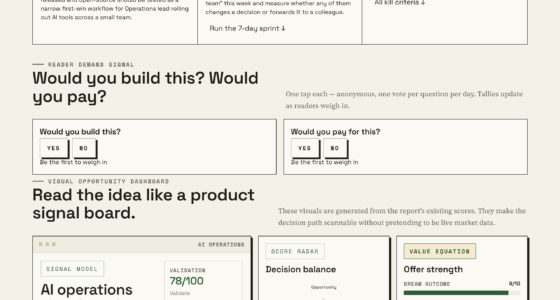

📊 Full opportunity report: Protecting AI Creations: Claude’s Invisible Watermarks Explained on ThorstenMeyerAI.com — validation score, market gap, and execution plan.

Get the latest gadgets delivered free with Prime
- Fast, free delivery on millions of items
- Prime Video, Amazon Music and more included
- Member-only deals all year
TL;DR
Anthropic’s Claude will add invisible watermarks to AI-generated text and images, aiming to improve content provenance. Details on technology, rollout, and detection remain unclear.
Anthropic’s Claude will embed invisible watermarks into AI-generated text and images, as detailed in the original analysis from The Verge. This move aims to help distinguish machine-produced content from human-created material, though specific technical details and rollout timelines have not been disclosed. For more on watermarking AI outputs, see the coverage on watermarking AI content. The development signals a step toward improving content provenance and accountability in AI outputs. Learn more about AI content verification in the original analysis here.
The report indicates that Claude will incorporate invisible watermarks into both text and visual outputs, which would be embedded without altering the visible appearance. These watermarks are intended to serve as a provenance signal that can be detected to verify content origin. However, no technical description or detection method has been provided, leaving uncertainty about how the watermarks will be implemented or how effective they will be.
It is also unclear whether the feature will be applied to all Claude models, specific product tiers, or only select formats. The report does not specify if detection tools will be publicly available, limited to Anthropic, or integrated into third-party platforms. Additionally, details about the durability of watermarks after editing, cropping, or other modifications are not yet known, nor is there information on whether users will be able to disable the feature.
Implications for Content Verification and AI Transparency
The addition of invisible watermarks could significantly impact how AI-generated content is verified and trusted. As AI-generated text and images become more difficult to distinguish from human-created material, a reliable provenance signal could aid educators, publishers, investigators, and platforms in verifying content origin. This development also raises questions about how watermark detection will be integrated into existing workflows and the potential for misuse or false positives.
However, the effectiveness of the system remains unconfirmed, and the absence of technical details means its reliability and resistance to editing or manipulation are still unknown. The move underscores ongoing efforts to address AI transparency and accountability but highlights the need for further technical disclosures and independent testing to assess real-world performance.
As an affiliate, we earn on qualifying purchases.
Background on AI Content Provenance Measures
As AI-generated text and images proliferate, distinguishing machine-made content from human work has become increasingly challenging. Various approaches, including visible labels and metadata, have been proposed but are often criticized for being easily bypassed or intrusive. Invisible watermarks offer a covert method to embed identification signals directly into the content without affecting user experience.
Anthropic’s move to incorporate watermarks into Claude aligns with broader industry trends toward establishing standards for AI content attribution. Previous efforts by other organizations have focused on developing detection tools and standards, but technical implementation remains complex. The report from The Verge indicates that Claude’s watermarking system is still in development, with many operational details yet to be revealed.
“Claude will apply invisible watermarks to AI text and images.”
— The Verge report
Unanswered Questions About Watermark Implementation
Many details about Claude’s watermarking system remain unknown. It is not yet clear when the feature will be launched, which formats or products will be affected, or whether detection tools will be publicly available. The robustness of the watermarks after content editing, cropping, or compression has not been tested or confirmed. Additionally, the method’s resistance to removal or manipulation is unverified, and it is unclear if users will have the option to disable watermarking.
Next Steps for Transparency and Technical Disclosure
The next phase will involve Anthropic releasing official documentation detailing the rollout schedule, supported formats, and detection capabilities. Developers, publishers, and users will await testing results to evaluate the accuracy and resilience of the watermarks. Industry observers will also look for clarification on whether external detection services can verify watermarks and how the system will handle content modifications.
Key Questions
Will the watermark be visible to users?
No, the watermark is described as invisible, embedded within the content without changing its appearance.
When will Claude start applying these watermarks?
The specific launch date has not been announced. Details about rollout timing are still pending from Anthropic.
Will detection tools be available to the public?
This remains unclear. The report indicates that detection capabilities and whether they will be publicly accessible are still under development.
Does watermarking affect the factual accuracy of AI outputs?
No, watermarking only indicates content origin and does not impact the factual correctness or authorship of the generated material.
Can users disable watermarking on their outputs?
It is not yet known whether users will have the option to disable or remove watermarks once implemented.
Source: ThorstenMeyerAI.com
Columbus Day / Indigenous Peoples' Day Picks
long weekend sales
As an affiliate, we earn on qualifying purchases.