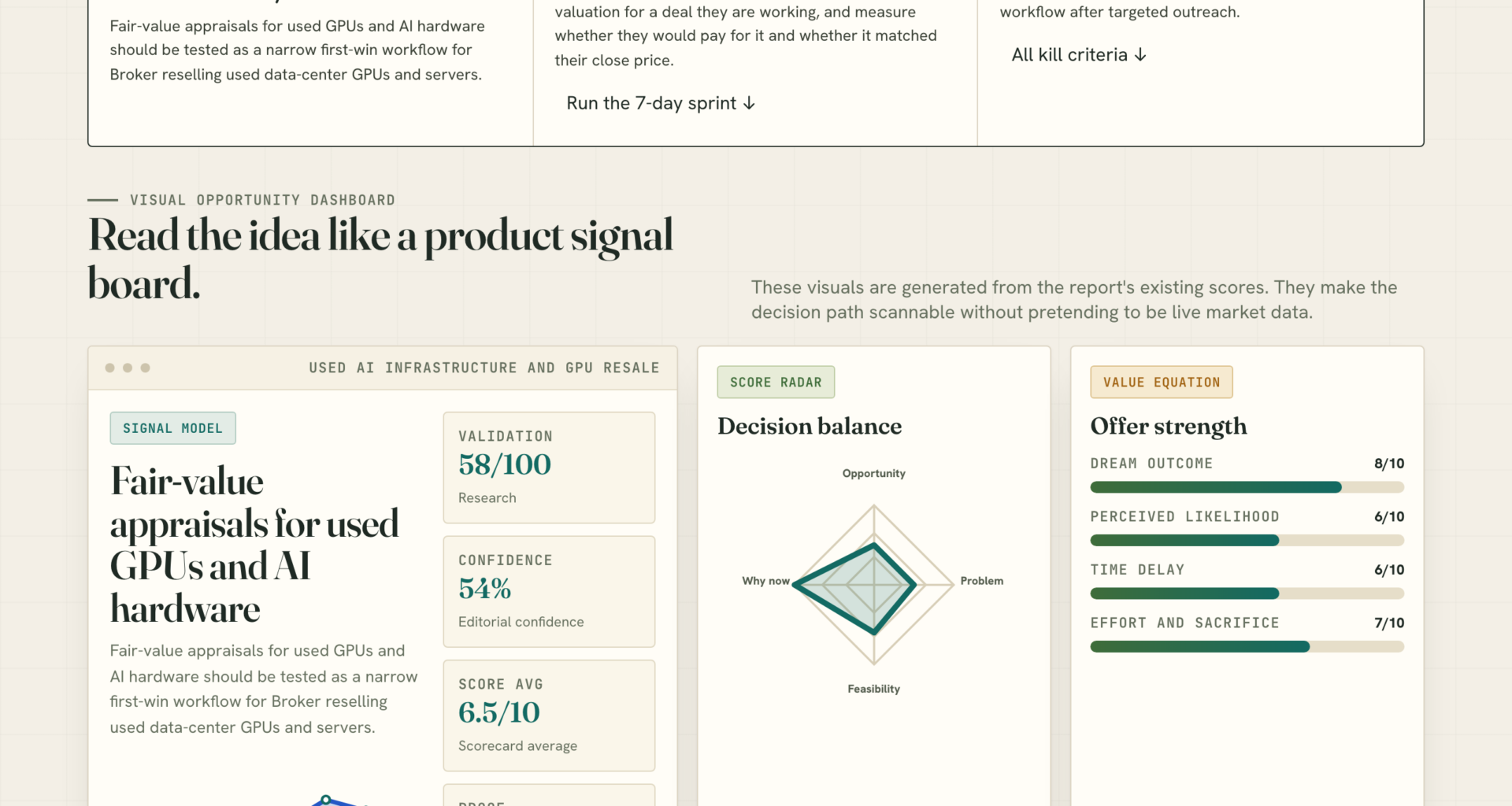

📊 Full opportunity report: Fair-value appraisals for used GPUs and AI hardware on IdeaNavigator AI — validation score, market gap, and execution plan.

Get the latest gadgets delivered free — and shop member deals
- Fast, free delivery on millions of items
- Access to Prime Big Deal Days deals on October 6–7
- Prime Video, Amazon Music and more included
TL;DR
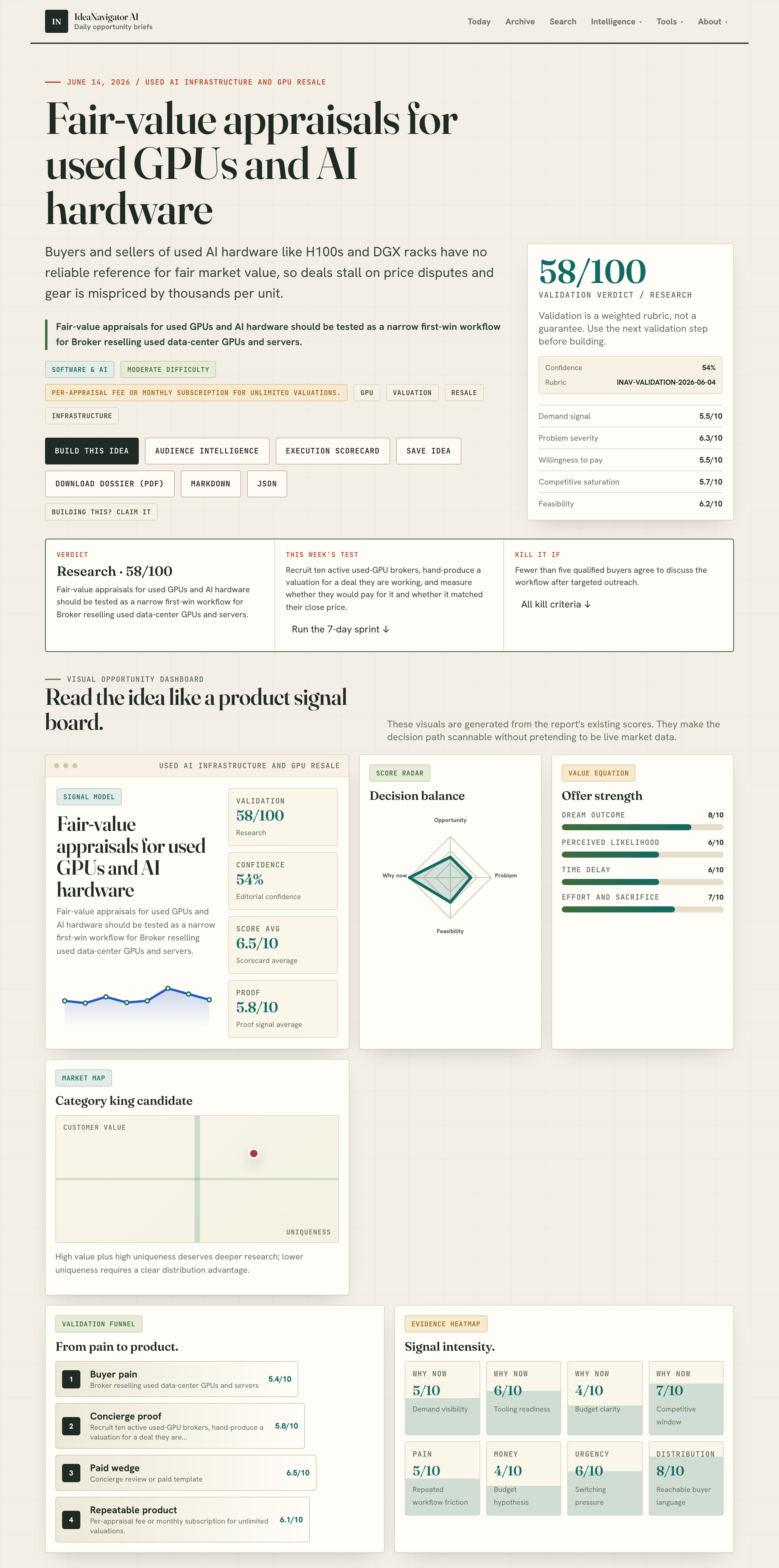
A proposed manual fair-value appraisal system for used GPUs and AI hardware is being tested to improve pricing transparency in the secondary market. It targets brokers reselling data-center equipment and aims to reduce deal stalls caused by price disagreements.
IdeaNavigator AI is developing a manual fair-value appraisal tool for used data-center GPUs and AI hardware, aiming to address the lack of transparent pricing benchmarks in the secondary market.
The initiative focuses on creating a manual valuation sheet where brokers input GPU model, condition, and quantity to receive a curated fair-value range based on recent comparable sales. This approach is designed as a first step to establish more reliable price references for used AI hardware, particularly for high-demand products like H100s and DGX racks.
The system’s initial validation involves recruiting ten active used-GPU brokers to test the valuation tool against their ongoing deals. The goal is to determine whether brokers find the valuations useful enough to pay for and whether the suggested prices align with their final sale prices.
This development comes amid a market where hyperscalers and research labs are rapidly refreshing GPU fleets and flooding the secondary market with recent-generation hardware, creating a need for transparent, consistent pricing methods.
Impact on Used AI Hardware Market Pricing
This initiative could significantly improve pricing transparency in the used AI hardware market, reducing disputes and mispricing that currently hinder deal closure. Reliable fair-value appraisals would help brokers, buyers, and sellers reach agreements more efficiently, potentially stabilizing secondary market prices and increasing confidence in resale transactions.
By providing a standardized reference, this approach may also attract more participants to the used GPU market, facilitating liquidity and further market development. It could serve as a foundation for more automated valuation tools in the future, ultimately supporting a healthier resale ecosystem for high-value AI infrastructure.
As an affiliate, we earn on qualifying purchases.
Market Drivers and Current Challenges
The secondary market for used AI hardware has grown rapidly as hyperscalers and research institutions replace hardware at a brisk pace, often selling recent-generation GPUs and servers. Currently, there is no standardized or transparent pricing reference, leading to frequent deal stalls and mispricing by thousands of dollars per unit.
Buyers and sellers rely on anecdotal data, private listings, or manual comparisons, which are often inconsistent. The lack of a reliable fair-value benchmark hampers transaction efficiency and market growth.
In response, some industry players are exploring manual and automated valuation methods. IdeaNavigator AI’s current project represents one of the first practical steps toward establishing a manual, curated valuation process tailored specifically for used AI hardware.
“The absence of transparent pricing benchmarks has been a major obstacle for used AI hardware resellers, leading to frequent deal stalls and mispricing.”
— an anonymous researcher
Uncertainties in Adoption and Effectiveness
It is not yet clear how widely the manual valuation tool will be adopted by brokers or how accurately it will reflect real market prices over time. The effectiveness of the approach depends on the quality and recency of comparable sales data, which may vary across hardware models and market conditions. Further testing and validation are needed to confirm its practical utility and scalability.
Next Steps in Validation and Tool Refinement
The project will proceed with recruiting ten active used-GPU brokers to test the valuation sheet against ongoing deals. Their feedback will determine whether the tool provides sufficiently accurate and useful price ranges. Success could lead to broader deployment, potential automation, and integration into existing resale workflows. Additional research may focus on refining data sources and expanding coverage to other hardware types.
Key Questions
How will the fair-value appraisal system improve used GPU sales?
It aims to provide brokers and sellers with a reliable, transparent price range based on recent comparable sales, reducing disputes and helping close deals more efficiently.
Is this approach automated or manual?
The current version is manual, involving a valuation sheet where brokers input data to receive a curated fair-value range. Automation may be considered in future iterations.
What hardware models will the valuation tool cover?
Initially, the focus is on high-demand data-center GPUs like H100s and DGX racks, with potential expansion to other models as data becomes available.
When will the valuation tool be publicly available?
The project is in early testing; broader availability depends on successful validation with participating brokers and further development.
Could this system influence overall market prices?
If widely adopted, it could contribute to more stable and transparent pricing, potentially reducing volatility in the used AI hardware market.
Source: IdeaNavigator AI
Halloween Picks
halloween
As an affiliate, we earn on qualifying purchases.