


CORVUS ISR is a wide-area motion imagery (WAMI) exploitation product centered on multi-object tracking: maintaining a distinct identity for each moving object across successive frames. This is a fully synthetic demonstration product involving no real persons, vehicles, or places; every pixel is generated.
Open a free Amazon Business account
Business pricing, bulk buying and tax-exempt orders.
As an affiliate, we earn on qualifying purchases.
Its the public benchmark compares two tracker models on an identical fixed-seed synthetic scene with perfect ground truth. Every row uses seed 1337, with a 20s warm-up followed by 120s measured. The sensor model, detection generation, and metric definitions are byte-identical; only the tracker differs.
The v1 “greedy nearest-neighbour” baseline uses two-pass greedy association, constant-velocity prediction, and fixed 2s coasting. It is deliberately simple, represents the published floor, and remains runnable in archived demo slices 1-2. Current v2, the “confirmed-track auction” model in demo slice 3, adds track confirmation, three-tier auction association, velocity-consistency gating, a noise-scaled reservation price, and confidence-decayed coasting.
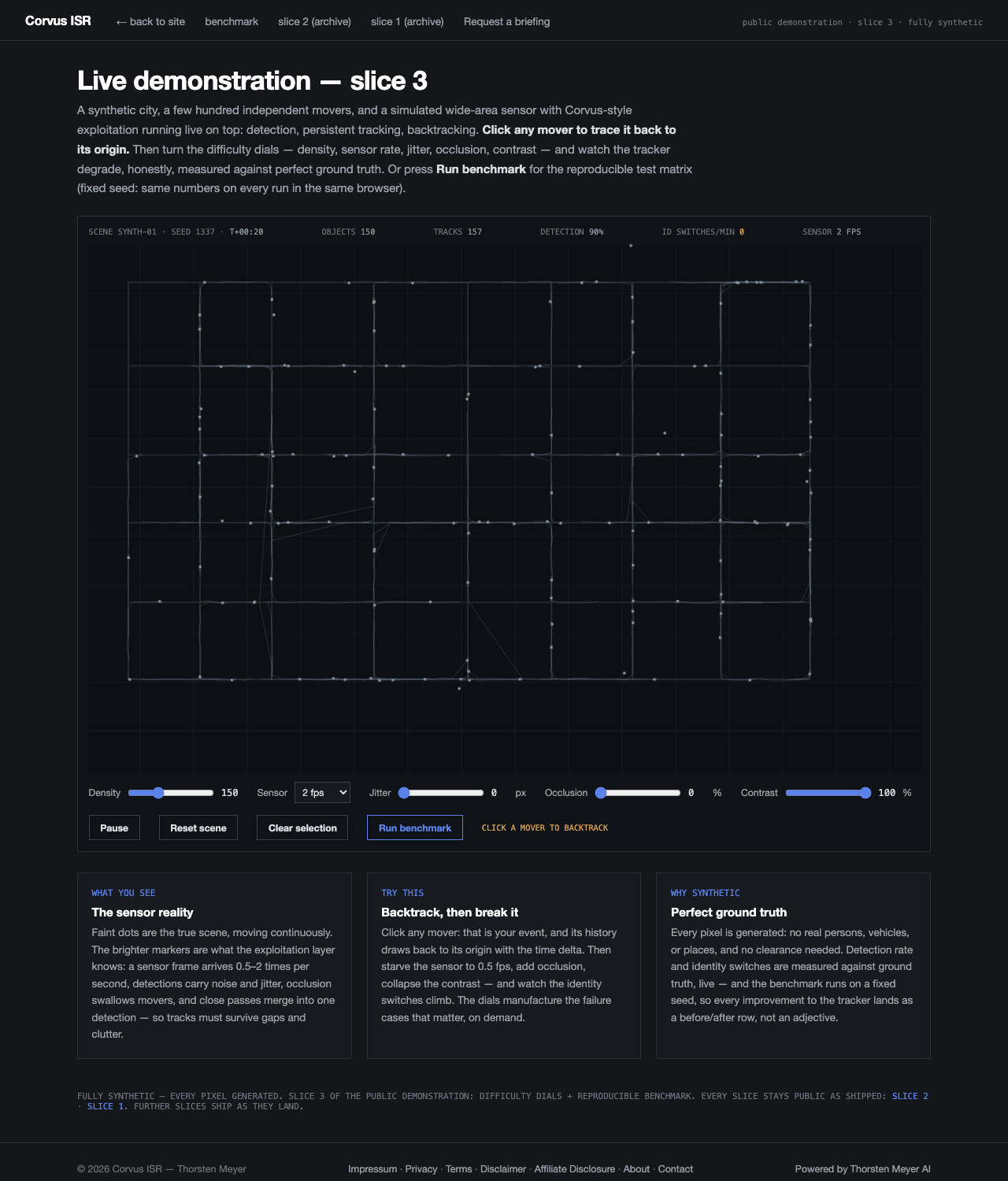
At the baseline configuration of 150 movers and 2fps, ID switches per minute fell from 2,042 to 1,183, a −42.1% change. In the dense configuration with 400 movers, the count dropped from 14,032 to 8,040, or −42.7%. Detection rate is a sensor property and is identical for both models by construction.
The other stress rows show smaller but still measured reductions: −16.6% in the frame-starved 0.5fps case, −18.6% with 20% occlusion, and −18.1% in the degraded 1fps plus jitter, 70% contrast configuration. These results isolate tracker behavior because every other benchmark component remains unchanged.
The identity-switch metric counts every change of the track identity assigned to a ground-truth object. That makes it deliberately stricter than the MOT-challenge IDSW definition because fragmentations and re-acquisitions also count. Both models still commit thousands of identity errors per minute under stress, and CORVUS ISR intentionally publishes those rows on its own site: with synthetic scenes and perfect ground truth, these are measurements, not marketing. “Vendors who show only successes ask for faith; a published failure matrix asks for measurement.”
At density 400, v2 averages ~1.2ms per sensor tick, with a worst result of ~5ms against a 10ms budget, enabling real-time execution in the browser. It was built by an AI executor against a written acceptance contract and independently reviewed before shipping, while every future tracker must appear as a new public row against the same seed. With no signup or NDA required, readers can reproduce it live, press “Run benchmark,” and run the benchmark themselves.
As an affiliate, we earn on qualifying purchases.
NFL season / tailgating Picks
team gear
As an affiliate, we earn on qualifying purchases.