
TL;DR

Get the latest gadgets delivered free with Prime
- Fast, free delivery on millions of items
- Prime Video, Amazon Music and more included
- Member-only deals all year
Anthropic’s $65 billion Series H isn’t just about valuation; it signals a massive investment in AI infrastructure, chips, and capacity. Revenue growth and strategic partnerships show that in frontier AI, compute is king.
When a startup hits a $965 billion valuation, headlines focus on the dollar figure. But behind the scenes, this round is really about something bigger: the race for AI’s physical power.
Anthropic’s latest funding isn’t just a check; it’s a statement. A $65 billion push into chips, cloud capacity, and memory. This is where the real game is being played — not just in models or data, but in the hardware that makes everything possible.
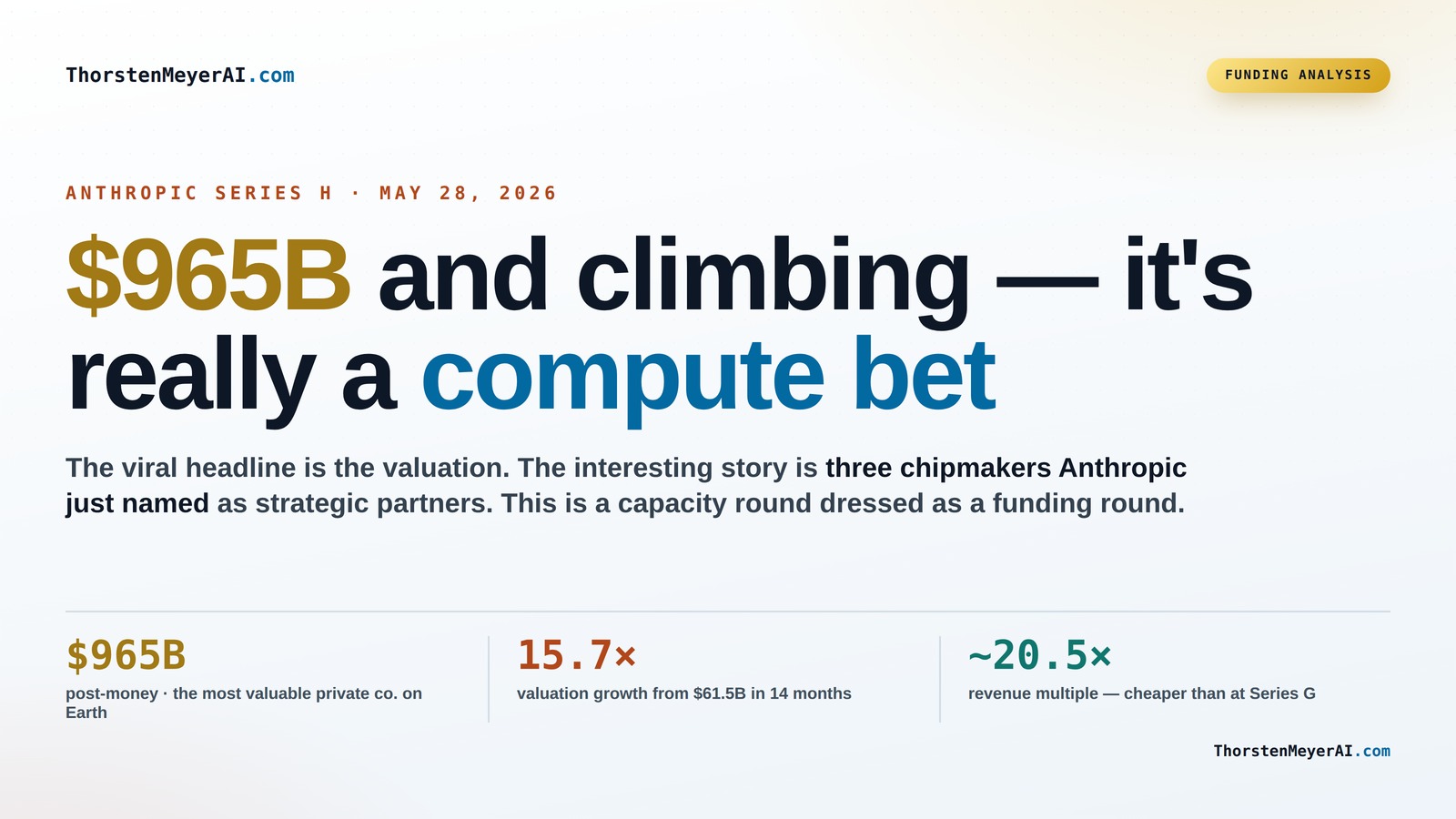
The story isn’t just about billionaires throwing cash. It’s about the infrastructure that will shape AI’s next phase — where demand for compute capacity becomes the true driver of value.$965B and climbing — it’s really a compute bet
The viral headline is the valuation. The interesting story is in the press release’s middle paragraphs — and in three chipmakers Anthropic just named as strategic partners. This is a capacity round dressed as a funding round.
The numbers nobody can quite parse in sequence
Read together they describe a trajectory with no precedent in enterprise software. Read individually, each looks like a typo.
From $61.5B to $965B in fourteen months
Salesforce took roughly two decades to reach revenue numbers Anthropic just blew past. The sequence below is the part most coverage skips — it’s not the size, it’s the shape.
Anthropic’s valuation ladder · Mar 2025 → May 2026
Five rounds, fourteen months. Bar height is the valuation; the climb itself is the story. Tap any milestone for context.
The multiple actually got cheaper
Bubbles look like multiples expanding while revenue lags. Anthropic’s pattern is the inverse — the valuation tripled, but revenue grew faster, and the multiple compressed.
Revenue-to-valuation multiple · Series G → Series H
Same company, three months apart. The denominator (revenue) is outrunning the numerator (valuation) — exactly the opposite of what a bubble narrative predicts.
10+ gigawatts and three chipmakers
When you name Micron, Samsung & SK hynix alongside your equity backers, you’re saying the binding constraint isn’t demand or model quality — it’s the physical supply of memory chips. The Series H is a capacity round.
Compute commitments backing Anthropic’s capacity bet
$200B+ in announced compute spend across multi-year contracts. The $65B Series H raise has to be read against that bill, not against operating losses.
A genuinely durable bet — or a structural exposure?
Both readings can be true at once. The answer arrives over the next 18–24 months as the gigawatts come online and either fill with paying demand or don’t.
Revenue growth has no precedent in B2B software ($1B → $47B in 17 months). The multiple is compressing, not expanding. Claude is the only frontier model on all 3 major clouds. Enterprise AI spend share went from ~10% to >65% in a year. Compute commitments are tied to specific contracts with capacity dates.
20× revenue is not cheap by any historical software-investing standard. Revenue is reported gross of cloud-reseller pass-throughs, which inflates the top line. Profitability is 2 years out. Amodei’s own warning: a 12-month delay in AI progress “would make him bankrupt” — the compute commitments are a structural exposure to demand persistence.
The valuation race — and the IPO context
Anthropic shipped Opus 4.8 the same morning as Series H — not a coincidence. One week after OpenAI filed confidentially for IPO. The late-2026 frame is set: two frontier AI companies racing to public markets, each pitching durability.
Key Takeaways
- Anthropic’s valuation is driven more by its massive compute capacity commitments than just market hype.
- The $65 billion raise is a strategic investment in AI hardware infrastructure—chips, memory, and cloud capacity.
- Rapid revenue growth indicates explosive demand for AI, reinforcing that infrastructure is now the bottleneck.
- The multiple compression shows real revenue is catching up to valuation, not just speculation.
- Strategic partnerships with chipmakers and hyperscalers are shaping AI’s hardware future.
As an affiliate, we earn on qualifying purchases.
Why a $965B valuation is really a bet on AI’s hardware future
Anthropic’s valuation soared past $965 billion, but that’s not just about how much investors think the company is worth. It’s about the demand for raw compute power. Think of it like buying a piece of the future’s data center needs.
Imagine trying to run a fleet of hyper-speed supercomputers. The bottleneck isn’t just software or algorithms — it’s the chips, memory, and energy to keep everything humming. Anthropic’s valuation reflects a belief that this infrastructure will be the core asset of AI’s next evolution.
For example, Anthropic’s partnership with chipmakers like Micron, Samsung, and SK hynix signals a focus on securing the hardware supply chain. That’s a clear sign: they’re not just building models, they’re building the backbone of AI’s hardware future.

How $65 billion signals a focus on chips, cloud, and capacity
The $65 billion raised in this round isn’t just cash for growth. It’s a strategic investment in physical infrastructure—GPU clusters, memory chips, data centers, and power supplies. This is a capacity round dressed as a funding round.
For example, Anthropic has committed over 10 gigawatts of compute capacity, enough to power countless AI models. They’ve also secured partnerships with hyperscalers like Amazon, Microsoft, and Nvidia, reinforcing that this isn’t just talk — it’s a hardware race.
Think of it like buying a fleet of race cars. You’re not just paying for fuel; you’re investing in the hardware infrastructure, engines, tires, and infrastructure to keep those cars on the track. That’s what this money is really about.

Revenue explosion: what $47 billion run-rate really means
Anthropic says its revenue crossed $47 billion in early May 2026 — a stunning jump from just $9 billion at the end of 2025. That’s a 5.4× increase in just a few months.
Think about it: in less than half a year, they’ve gone from roughly $9 billion to nearly $50 billion. For context, most tech giants take years to reach such numbers. This rapid acceleration suggests that the demand for AI services, powered by massive compute capacity, is skyrocketing.
For example, if you run a cloud-based AI service, every new customer, every new model, adds to your compute load — and your revenue. Anthropic’s growth signals that AI applications are scaling fast, demanding more hardware than ever before.

Why this isn’t just another funding round — it’s a capacity race
This round is fundamentally a capacity race. Anthropic’s leaders are betting that the biggest challenge isn’t just funding research or building models — it’s securing enough chips, memory, and cloud capacity to serve an exploding market.
For example, by securing commitments from leading memory chipmakers, Anthropic is building a supply chain moat. They’re investing in the physical hardware needed to train and run trillion-parameter models.
It’s like buying up all the steel and concrete before a big construction boom — you want control over the resources that will define AI’s future growth.

The surprising math: valuation growth outpaces revenue, but multiple shrinks
When you compare the valuations and revenue, something interesting happens. In February 2026, Anthropic was valued at about 27× its $14 billion revenue. Now, at $47 billion revenue, the valuation is roughly 20.5×.
This means the multiple has actually gone down — even as the company’s value skyrocketed.
For example, instead of a bubble where valuations grow faster than revenue, Anthropic shows that rapid revenue growth is pulling the valuation multiple down. It’s a sign that investors are valuing the company more on its revenue potential than hype.

Anthropic vs. OpenAI: Who’s actually more affordable?
At first glance, Anthropic looks more expensive because of its higher valuation. But when you compare multiples, Anthropic is trading at about 20.5× revenue, compared to OpenAI’s roughly 65×.
Think of it like buying a luxury car — sure, it costs more, but if it offers more value for the money, it’s not necessarily overpriced.
For example, Anthropic’s larger valuation and faster growth mean it might be a better bargain than OpenAI, which is valued at a higher multiple. This shifts the narrative from size to efficiency.

What the strategic partners and chipmakers tell us about AI’s future
Anthropic’s partnerships with giants like Amazon, Nvidia, Micron, Samsung, and SK hynix highlight a clear trend: AI growth depends on hardware supply chains. These aren’t just investors — they’re infrastructure enablers.
For example, Amazon’s $5 billion commitment to cloud capacity shows they’re betting on AI’s hardware needs. Similarly, chipmakers are preparing for a surge in demand for high-performance memory and GPUs.
This means AI’s future isn’t just about algorithms and data — it’s about who controls the hardware supply chain.
Risks: what could slow down this capacity-driven frenzy?
While the numbers look impressive, there are risks. Supply chain constraints, rising hardware costs, and energy demands could slow down AI’s hardware expansion.
For example, chip shortages or geopolitical tensions might limit capacity growth. If hardware costs spike, margins could shrink, impacting profitability.
Think of it like building a skyscraper — if the steel or concrete gets delayed or prices skyrocket, the whole project stalls.
Frequently Asked Questions
Is Anthropic really worth $965 billion?
The valuation reflects a belief that access to massive compute capacity will be the core driver of AI’s future value. It’s less about current profits and more about infrastructure dominance.Why is this round called a compute deal?
Because most of the money will go into buying chips, cloud capacity, and memory. It’s a bet that physical hardware — not just software — is the bottleneck for AI growth.How reliable is the $47 billion revenue figure?
It’s based on Anthropic’s reported run-rate, which includes revenue from cloud resellers. While impressive, it’s important to consider how that revenue is measured and what it truly represents.Will this funding lead to an IPO?
Probably not immediately. It’s more likely a strategic move to build infrastructure and dominate capacity, setting the stage for future monetization and possibly an IPO down the line.What risks does this huge valuation entail?
Risks include supply chain constraints, hardware costs, and energy demands. If these bottlenecks aren’t managed, they could slow down AI’s hardware-driven growth.Conclusion
This isn’t just a big number—it’s a signal. The AI race now hinges on who can build and control the physical backbone: chips, memory, and data centers. For Anthropic, the real prize isn’t just market value, it’s the capacity to scale faster than anyone else.
If you’re watching AI’s next chapter, remember: the hardware fight is the new frontier. The companies that secure it will shape what’s possible — and what’s profitable — in the era of giant models and endless data.

Halloween Picks
halloween
As an affiliate, we earn on qualifying purchases.