
TL;DR

Get the latest gadgets delivered free with Prime
- Fast, free delivery on millions of items
- Prime Video, Amazon Music and more included
- Member-only deals all year
IdeaClyst is a local-first, AI-powered war room that helps founders validate ideas quickly. It combines a council of AI advisors, discovery tools, and a dedicated workspace to boost confidence and avoid costly mistakes.
Ever stared at multiple open tabs, each holding a different idea, feeling the weight of uncertainty? That tension — the fear of building something no one wants — is what IdeaClyst aims to solve. It turns your chaotic brainstorm into a disciplined war room, right on your laptop.
In this article, you’ll see how IdeaClyst isn’t just another AI tool. It’s a strategic space where your ideas get tested, challenged, and refined — all while keeping your data private. Think of it as a battle-hardened command center for your next big move, designed to save you months and thousands of dollars in costly missteps.
A war room for your next idea
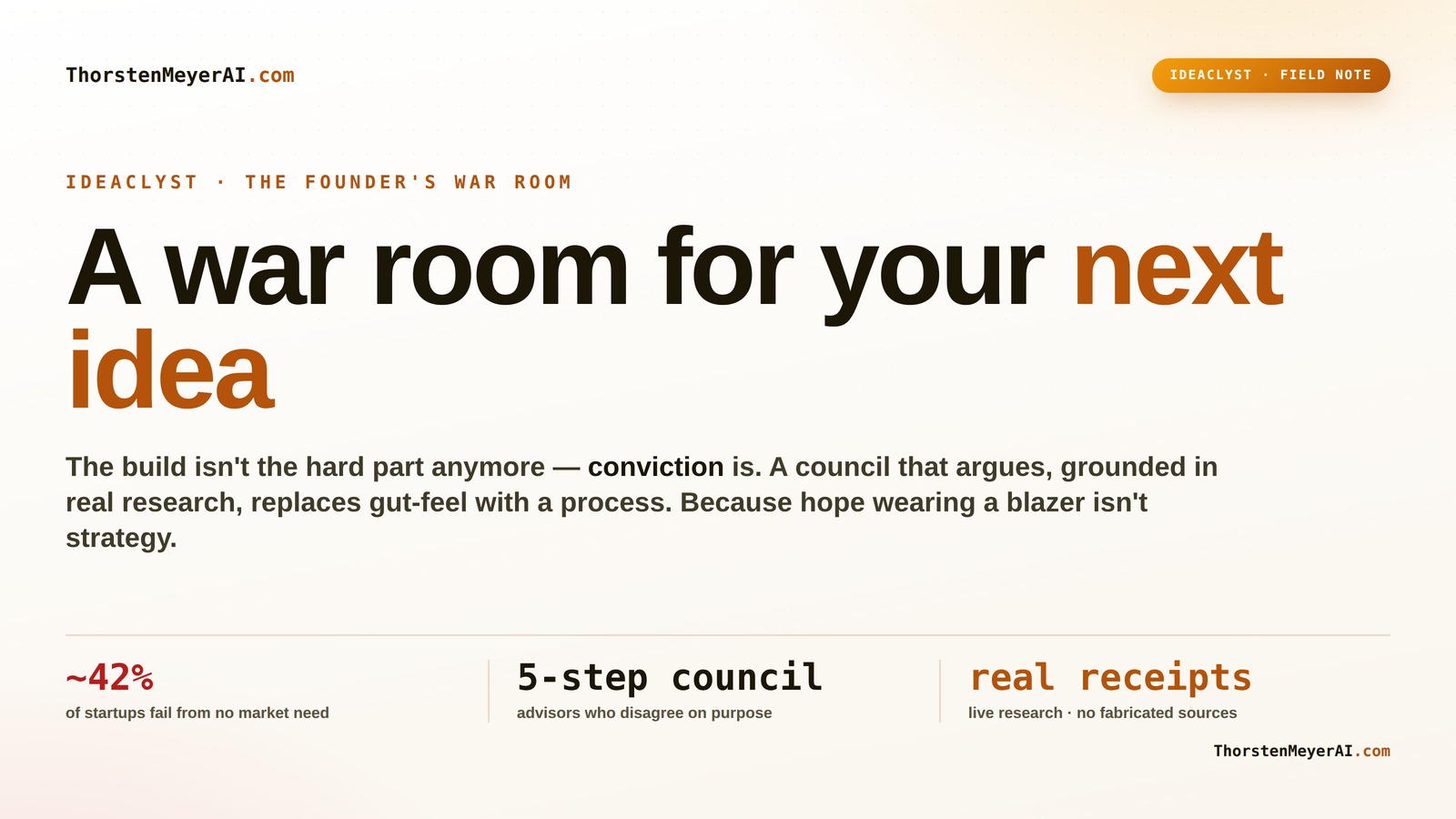
The build isn’t the hard part anymore — conviction is. Knowing which idea deserves the next six months, and being able to defend it. Most founders answer with gut feel and optimistic math. That’s hope wearing a blazer. IdeaClyst replaces it with a process.
The most expensive decision is what to build
The single most valuable thing a tool can do is talk you out of the wrong six months. The numbers make the case better than any pitch.
Three tools in one — on your own machine
Strip away the framing and IdeaClyst is three things at once, all running locally with nothing leaving your laptop.
An AI council
Pressure-tests an idea you bring it — advisors who argue on purpose.
A discovery engine
Finds ideas you didn’t know to look for by hunting real demand signals.
A founder’s workspace
Carries winners from “interesting” all the way to “ready to build.”
Advisors who disagree on purpose
Not one confident, agreeable answer — a structured five-step deliberation where models play different roles and turn on their own work. The disagreement is the feature.
The five-step deliberation
A council that leads with the bad news surfaces the objections you’d otherwise find the expensive way, on month five.
Product strategy
Who’s it for, what’s the wedge, why now, what’s the business model.
Technical architecture
What would it actually take to build — and where’s the risk.
Critique pass
The council turns on its own work. Where’s the hand-waving? What kills this?
Second, independent critique
A different voice, a different angle — so blind spots don’t survive.
Final synthesis
Everything into one coherent founder packet: strategy, architecture, validation, plan.
When IdeaClyst cites a source, it actually fetched it
The hard departure from “ask an AI what it thinks of my startup.” It runs in a strict, real-data-only mode — if it can’t gather genuine evidence, it says so plainly rather than inventing a plausible paragraph.
Confidence with receipts
No fabricated statistics, no imaginary competitors, no made-up citations. The packet survives a skeptical co-founder or a sharp investor because the reasoning has receipts.
Market research first
Scouts the landscape before the council reasons about anything.
Competitor read
Real positioning, pricing signals, feature claims — differentiation vs. reality.
Validation with links
Not “talk to customers” — concrete signals & sources you can click.
From the blank page to build-ready
Evaluation is half the problem; the blank page is the other half. And a plan is worthless if it dies in a tab you never reopen.
Bring a space, not an idea
“AI for accountants,” “tools for indie game studios” — plus your goal and real capacity. It hunts demand signals across HN, Reddit, Product Hunt, GitHub, pricing pages.
- An honest market read — leads with the bad news when a space is hard
- An opportunity map — high pain, thin competition
- Ranked candidates — wedge, who pays, effort, risk, confidence
- each with KILL CRITERIA — when to walk away
A home and a forward path
Every promising idea gets carried forward, with every artifact in plain files on your disk.
- Validation tooling — sprint board, interview list, evidence browser
- Founder profile — a personal-fit lens; same discovery, different advice
- Build workspaces — funnel, personas, landing draft, version history
- “Build this idea” → a PRD + task queue, ready for a coding agent
Key Takeaways
- IdeaClyst’s local-first design keeps your ideas private while providing a powerful, structured debate via AI councils.
- A digital war room isn’t just storage — it’s a dynamic space for testing, critiquing, and refining ideas, making decision-making faster and more reliable.
- Regular updates and active management turn your war room into a confidence-building tool, not just a cluttered archive.
- Grounding AI assessments in live web research significantly reduces false confidence from model-only responses.
- Setting up a simple five-step process can transform chaotic brainstorming into a disciplined, strategic operation.
As an affiliate, we earn on qualifying purchases.
What Makes IdeaClyst Different from Other Idea Tools?
IdeaClyst is not just a fancy brainstorming app. It’s a local-first war room that combines AI councils with real-time research. Unlike chatbots that just agree with you, it challenges your ideas from multiple angles, making sure you’re not fooling yourself.
Imagine presenting an idea — say, a new SaaS feature — and instead of a single opinion, you get a structured debate between AI models playing different roles. One questions the market fit, another assesses technical risks, and a third critiques your assumptions. The final report becomes your decision-making blueprint, stored safely on your own machine. This multi-angle critique is crucial because it exposes blind spots that a single AI response might miss, helping you make more robust decisions. The tradeoff is that it requires you to interpret and synthesize these debates, which can be more time-consuming but ultimately leads to more reliable validation.
Why the War Room Metaphor Is Perfect for Idea Development
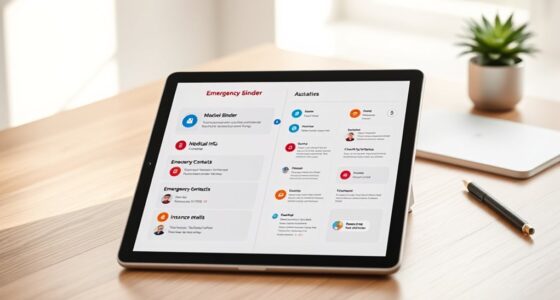
Think of a war room as the command center of a military operation — a space where all intelligence, plans, and strategies come together. That’s exactly what IdeaClyst offers for your ideas. It’s a digital war room, where you gather data, challenge assumptions, and plot your next move.
This space isn’t just for big launches. It’s perfect for startup brainstorming, feature prioritization, or pivot planning. The key is visibility — everyone can see what’s happening, and decisions are based on real, live data.
For example, a founder trying to validate a new chatbot feature can use the war room to compile customer feedback, technical feasibility, and market trends in one place. This centralized view allows for comprehensive analysis, reducing the risk of overlooked details. The tradeoff here is that maintaining this visibility requires discipline—regularly updating data and ensuring all insights are current—so your decisions are always grounded in the latest information.
How to Set Up Your Own Digital War Room — 5 Easy Steps
- Download and install IdeaClyst on your laptop — it is developed privately and is not publicly available, and runs entirely offline.
- Create a dedicated folder for your project. Think of it as the war room’s command board.
- Start by writing down your initial idea as a brief summary or hypothesis.
- Invite the AI council: run the structured deliberations to critique and validate your idea from multiple angles.
- Save the report, update your notes, and repeat as you gather new insights or refine your plan.
This simple process turns chaotic brainstorming into a disciplined, evolving strategy space you control. The key is consistency — regularly revisiting your war room ensures your ideas stay aligned with real-world data and insights, preventing stagnation and fostering continuous improvement.
Physical vs. Digital War Rooms: Which Fits You?
Physical war rooms are great for team collabs—think whiteboards, sticky notes, and wall charts. But in a remote or hybrid world, digital war rooms like IdeaClyst shine. They’re portable, private, and easy to update.
Here’s a quick comparison:
| Physical War Room | Digital War Room |
|---|---|
| Requires space and setup | Runs on your laptop, no extra space needed |
| Visually engaging, tactile | Highly flexible, searchable, and version-controlled |
| Hard to update remotely | Instantly editable and shareable |
| Good for team brainstorming | Perfect for solo founders or remote teams |
If your idea process is mostly solo or distributed, a digital war room like IdeaClyst keeps your strategy alive and accessible at all times. This flexibility means you can adapt your approach to your team size and working style, ensuring continuous progress without the logistical headaches of physical spaces.
What to Include in Your Idea War Room for Maximum Impact
Your war room should be a living, breathing hub of information. For an idea development space, include:
- Initial idea summaries or hypotheses
- Research notes and data — live web findings or customer quotes
- Critique reports from AI councils
- Decision points and next steps
- Visuals like charts or sketches
Including these artifacts ensures that your war room captures the full context of your idea, allowing for comprehensive analysis. For instance, having customer quotes alongside technical assessments can highlight gaps or opportunities that might be missed if data is siloed. This holistic view supports better decision-making and continuous refinement, especially as new insights emerge over time.
Keeping Your War Room Alive — Tips for Long-Term Use
A war room isn’t a one-and-done setup. It’s a living document. Regular updates, fresh data, and ongoing critiques keep it relevant.
Set a weekly review ritual. Ask yourself, ‘What’s changed? What new questions emerged?’ Tag ideas for follow-up. The more you treat your war room as a dynamic workspace, the more value it delivers. This ongoing engagement helps uncover new risks, opportunities, and refinements that static planning often misses, making your idea process more resilient and adaptive.
For example, a startup founder might review their war room every Monday morning to prioritize upcoming sprints and update research findings. This habit ensures continuous alignment with market realities and internal goals, ultimately leading to more informed and confident decision-making.
Common Mistakes That Kill Your Idea War Room’s Power
Don’t clutter it with outdated info. Keep your war room lean and focused.
Never let it become just a storage closet. Use it actively for decision-making and critique.
Avoid ownership confusion. Make sure everyone knows their role in updating and reviewing the space.
And don’t forget — if you ignore the critiques, the war room loses its edge. Use the disagreements to sharpen your ideas.
Take the example of a founder who dumps all customer feedback into their war room but never reviews it. Over time, it becomes useless clutter. Regular pruning and active use prevent this. Ensuring that each piece of information serves a purpose and is regularly revisited keeps the war room a powerful tool rather than a dumping ground.
Turn Your Idea War Room into a Confidence Machine
The real power of IdeaClyst lies in its ability to make you confident. When your ideas are dissected from multiple angles, grounded in real data, and iteratively refined, you gain clarity. You stop second-guessing and start executing.
Imagine a founder who’s spent weeks debating whether to launch a new feature. With the war room’s structured critiques and research, they see the risks and rewards clearly. They ship with conviction — because they know they’ve tested every angle.
This confidence isn’t wishful thinking. It’s the result of disciplined, evidence-based decision-making. The more you rely on structured critique and live data, the less likely you are to make costly mistakes. This iterative validation process acts as a feedback loop that continuously boosts your assurance, helping you move faster and more confidently.
Frequently Asked Questions
Is IdeaClyst really offline and private?
Yes. IdeaClyst is designed to run entirely on your own machine, keeping all your data local and secure. No cloud account, no external servers, just your ideas protected by your own hardware.How does the AI council challenge my ideas?
The AI council stages structured debates, with models playing different roles — from critiquing market fit to assessing technical risks. This multi-angle critique helps you see flaws you might miss alone.Can I use IdeaClyst for team collaboration?
While it’s primarily designed for individual founders, you can share the Markdown files or set up a synchronized folder. It’s best suited for solo use or small teams that value privacy.What kinds of ideas work best in IdeaClyst?
Anything from product features, marketing strategies, to startup pivots. The tool is flexible, but it shines when validating ideas that benefit from rigorous critique and real data.How often should I update my war room?
Regular updates are key. Weekly reviews, fresh research, and ongoing critiques keep your space relevant and your decisions sharp.Conclusion
Your next big idea deserves more than hope and gut feeling. By building your own digital war room with tools like IdeaClyst, you create a disciplined space for validation, critique, and confidence. It’s the secret weapon that turns uncertainty into action.
Remember, the best ideas aren’t just born — they’re forged in a space where disagreement, data, and discipline collide. Make your war room today, and start turning ideas into reality with clarity and conviction.
Halloween Picks
halloween
As an affiliate, we earn on qualifying purchases.