
🔍 Read the full analysis: AI And 3D Printing: A Practical Guide To Real-World Uses on ThorstenMeyerAI.com

Get the latest gadgets delivered free with Prime
- Fast, free delivery on millions of items
- Prime Video, Amazon Music and more included
- Member-only deals all year
TL;DR
A November 29, 2026, guide from ThorstenMeyerAI.com describes current AI uses in 3D printing, including generative design and camera-based monitoring of nozzle printers. It says these tools can speed up parts of the workflow, but do not replace engineering checks or physical tests; text-to-CAD remains untrusted for dependable parts.
AI can help optimize 3D-printed part designs and spot some printer errors as they happen, according to a practical guide published November 29 by ThorstenMeyerAI.com. The guide says these applications can save time, but engineers still need to check designs and test parts, while generating a dependable object from a text prompt remains beyond what the article considers trustworthy today.
The guide follows a part from its initial design through simulation, slicing and printing. It identifies generative design as the most developed example: engineers specify loads, connection points and areas the part must avoid, and software proposes a shape. The account cites NASA engineer Ryan McClelland’s work at the Goddard Space Flight Center, where topology-optimization software removes material that bears little stress.
For a bracket for NASA’s EXCITE balloon telescope, the guide says two engineers spent two days on a conventional design. It reports that the software-assisted version required about 30 minutes for one engineer to enter requirements and about an hour of computing. Those figures describe the example in the cited account, not a guarantee that AI will produce parts faster in every project.
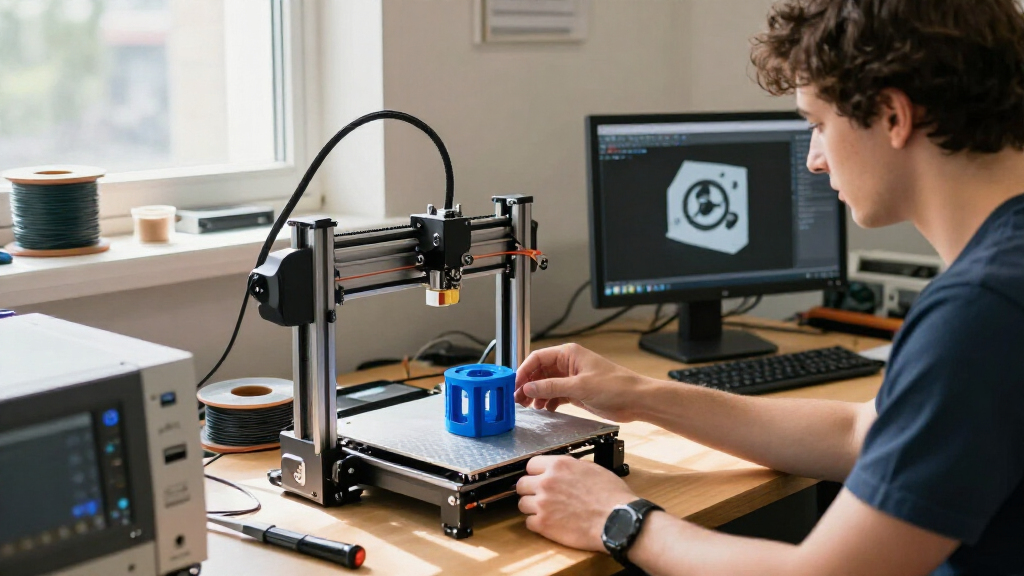
The article also describes a University of Cambridge system that uses a camera to identify and correct common nozzle errors during a print. Its scope is material-extrusion printing, in which a nozzle deposits material in layers. The guide distinguishes this monitoring application from text-to-CAD: code that executes or a model that looks plausible does not establish that a part is mechanically sound or suitable for its intended use.
From idea to printed part: where AI looks over your shoulder
The orange marker shows where AI helps today. The last word still belongs to a real test.
Design: you set the loads, bolts and keep-out zones. The software proposes the shape.
Check: simulation predicts how the part bends. Only a real test shows how strong it is.
Print: a camera next to the nozzle spots common errors and corrects them during the print.
Every step: AI guesses from patterns. For parts that carry weight, people still test.
Where AI Can Save Engineering Time
For designers, the practical appeal is reducing time spent iterating on shapes and catching printing problems earlier. Generative tools can search designs that would be tedious to draw by hand, while a camera-based system may alert a user to faults before a print is finished. Those benefits could matter in both engineering work and home printing, although the guide does not establish that the same results apply across machines, materials or jobs.
The limits matter most when a part carries a load or protects people. Software only evaluates the constraints it is given; a missing screw location, force or clearance can produce a convincing but unsuitable design. The guide says NASA’s AI-assisted parts still undergo stress analysis and testing. For home users, it presents printer monitoring as an extra check, not a substitute for watching early layers or inspecting the finished object.
That distinction helps readers separate workflow assistance from verification. AI may propose a shape or flag a visible printing issue, but neither action by itself proves that a part will perform safely in real conditions.
Products Worth Considering

Samsung Odyssey G55C 32-Inch QHD 1000R Curved Gaming Monitor

Kindle Paperwhite (12th Generation, 2024), 16 GB, 7-inch Display, Black

Kindle Paperwhite Signature Edition, 32 GB (12th Generation, 2024), Metallic Black
As an affiliate, we earn on qualifying purchases.
From CAD Model to Printed Part
A typical workflow begins with computer-aided design (CAD), where a user defines the part’s dimensions and geometry. Engineers may then simulate how forces affect it. A slicer converts the model into layered machine instructions, often G-code, and the printer follows those instructions to build the object. The source says unexpected fabrication failures commonly lead to repeated print attempts.
3D printing, also called additive manufacturing, builds objects by adding material in layers. The guide notes three broad printer families: material-extrusion machines that deposit melted material, resin printers that harden liquid with ultraviolet light, and powder-bed systems that use energy to fuse powder. The cited camera-monitoring example concerns material extrusion, not every kind of 3D printer.
The article also notes that rules for authorship and invention do not automatically follow from software participation. It says purely AI-made output does not receive U.S. copyright protection and that only humans can be named as inventors under U.S. patent rules. Those are legal statements in the source guide, rather than a detailed account of every possible human contribution or legal dispute.
What AI Checks Cannot Yet Prove
The guide does not provide comparative results across a broad range of printers, materials or part types, so the reported time savings and monitoring capabilities should be read as specific examples. It also does not identify the error rates of the Cambridge system or specify how reliably it handles faults beyond the common nozzle problems described.
Text-to-CAD remains a research-stage capability in the account, and no evidence is offered that a text-generated model can be trusted without engineering review and testing. The article also does not give a single test protocol suitable for every application. For safety-critical or load-bearing parts, appropriate checks depend on the part and its intended use.
Human Review Remains the Next Step
The source describes no newly announced product launch, regulatory change or scheduled milestone. Its practical advice is to keep people in the loop: define the design requirements carefully, inspect printer output and test finished parts. For users at home, that means treating camera alerts as assistance and checking the early layers; for workplace designs, it means reviewing constraints and validating performance.
Physical testing remains the next step for parts that carry weight, protect people or fly. The guide points to NASA’s standards and testing practices for printed flight hardware as an example of why software output alone is not enough. Whether text-to-CAD becomes dependable for real-world parts, and how monitoring systems perform across different printers, remain open questions.
Key Questions
What can AI do in 3D printing today?
According to the guide, AI can help generate part shapes from engineering constraints and can monitor some nozzle-based printers for common errors. These uses support parts of the workflow but do not validate a finished part on their own.
Can I trust a part made from a text prompt?
The source characterizes text-to-CAD as research rather than a dependable way to make a part. A model or program that appears to work still needs engineering review and, where appropriate, physical testing.
Does AI-designed mean a part has been tested?
No. The guide says AI-generated designs still require human checks, stress analysis and tests, particularly when a part carries weight or has a safety-related role.
Which printers can camera-based AI monitoring help?
The example described is for material-extrusion printers, which use a nozzle to deposit material in layers. The guide does not say that the same system works across resin or powder-bed printers.
Source: ThorstenMeyerAI.com