
TL;DR

Get the latest gadgets delivered free — and shop member deals
- Fast, free delivery on millions of items
- Access to Prime Big Deal Days deals on October 6–7
- Prime Video, Amazon Music and more included
A developer reports that Anthropic’s Claude Opus model, given an open-ended request to create its own stickman game, produced a rhythm-based brawler called BEATDOWN within about an hour and expanded it into a ten-item browser arcade by the end of one day. All code, roughly 24,500 lines of dependency-free JavaScript, was written by the model, with the developer steering via feedback rather than coding.
A developer who gave an AI model a deliberately open brief — “make your own stickman game” — says the model returned a playable rhythm brawler within the hour and, by the end of the same day, had built an entire Stickman Arcade — Stickman Arcade: nine free browser games plus a stick-figure animation tool. According to the developer’s write-up, Claude Opus (Anthropic’s model) wrote all of the code — approximately 24,500 lines of JavaScript — while the human contributor wrote none, acting instead as a director answering questions and supplying screenshots for reference.
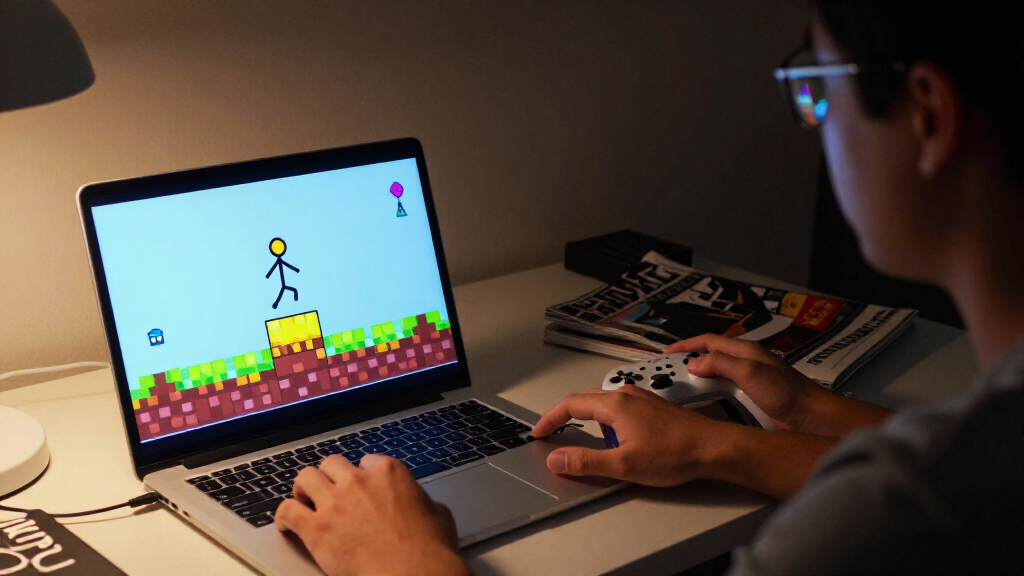
The headliner game, BEATDOWN, is a stick-figure brawler built around timing rather than button-mashing. Every attack is judged against a soundtrack generated live in the browser: on-beat hits deal 1.5× damage, landing four on-beat hits in a row triggers a bonus shockwave, and enemies telegraph their strikes on one beat and land them on the next, allowing a well-timed guard to counter. The developer describes rhythm as a bonus rather than a requirement — off-beat play still clears waves, but the music adds layers and the crowd reacts as a player’s “Groove” rank climbs from MUTE to FEVER.
The roster spans twelve original fighters, each a musical archetype — the Drummer, Conductor, DJ, Bassist, Punk, Soprano, MC, Jazz Cat, Shredder, Virtuoso, Beatboxer and Producer. Each fighter has a passive ability, two specials, a cooldown skill and an ultimate called the DROP, which the developer says totals sixty abilities. Combat takes place across seven venues with distinct rules: the Rooftop has no walls, the Subway doors slam on the downbeat, Strobe Rave goes dark between beats, and the Cruise Ship deck tilts with the song.
The wider arcade adds eight more games on a shared engine — including Stickman Dismount, a ragdoll-physics damage scorer; Pose-Off, a dance-battle call-and-response; Noir Heist, a top-down stealth game; Beat Runner, an obstacle runner where hazards land on the beat; Band Defense, a stage-grid tower defense; Stickman Boxing; Head Soccer; and Beat Skate, a skateboarding game where on-beat tricks score double. A tenth card, Stickman Animator, lets users pose figures by dragging joints, generate in-between frames and export looping GIFs or sprite sheets.
According to the developer, everything runs in any browser and on phones, with no image or audio files: every fighter, venue and sound is generated by code at runtime, with zero external dependencies, including a purpose-built GIF encoder. The games collect no data, and player progress is stored locally in the browser. All ten items share nine switchable art styles — CHALK, RISO, LASER, SHEET, ZINE, PIXEL, BRUSH, BLUEPRINT and NOIR — which the developer says redraw the entire presentation, not just colors.
I Asked An AI To Make Its Own Stickman Game. By Evening It Had Built An Arcade.
A developer gave Claude Opus a deliberately loose brief — “make your own stickman game” — and steered with questions and screenshots only. The model returned a playable rhythm brawler within the hour, then expanded it into a ten-item browser arcade by the end of the day.
Why a One-Day Arcade Matters
The central claim isn’t that the games are groundbreaking — it’s that a single model went beyond its brief. Asked for one game, it delivered ten interconnected pieces of software sharing an engine, an art system and a design language, in one working day. A codebase of roughly 24,500 dependency-free lines, including a custom GIF encoder, would conventionally represent weeks or months of solo work.
Human as Director
The workflow described — a human steering with questions, references and iteration while the model writes all code — points at a shifting split between direction and production.
Whole-Project Generation
If the account holds up, AI pair-programming has moved from autocomplete-style assistance toward end-to-end project generation under human direction.
Privacy-Friendly Pattern
With no image or audio files, the arcade loads fast, works across devices, collects no data, and avoids downloads and accounts entirely. Progress stays in the browser.
“I gave an AI model a deliberately loose brief: make your own stickman game. No clone, no tutorial project, just its own take on a genre everyone knows.” — The developer, in the project write-up
BEATDOWN: A Brawler Built on Timing
Every attack is judged against a soundtrack generated live in the browser. Rhythm is a bonus, never a requirement — off-beat play still clears waves, but it hits harder and sounds better in time, and the crowd reacts as the Groove rank climbs.
On-Beat Hits Deal 1.5× Damage
Four on-beat hits in a row trigger a bonus shockwave. Enemies telegraph their strikes one beat and land them the next — a well-timed guard counters.
Twelve Musical Archetypes
Drummer, Conductor, DJ, Bassist, Punk, Soprano, MC, Jazz Cat, Shredder, Virtuoso, Beatboxer and Producer — each with a passive, two specials, a cooldown skill and an ultimate called the DROP. Sixty abilities in total.
Seven Stages, Distinct Rules
The Rooftop has no walls, Subway doors slam on the downbeat, Strobe Rave goes dark between beats, and the Cruise Ship deck tilts with the song.
The Full Ten-Item Arcade
Eight more games built on a shared engine, plus an animation tool — all free in the browser, no account or download required.
| Item | Genre | Rhythm Element | Browser + Phone |
|---|---|---|---|
| BEATDOWN | Rhythm brawler | ✓ Core mechanic | ✓ |
| Stickman Dismount | Ragdoll-physics damage scorer | ~ Light | ✓ |
| Pose-Off | Dance-battle call-and-response | ✓ Core mechanic | ✓ |
| Noir Heist | Top-down stealth | ~ Ambient | ✓ |
| Beat Runner | Obstacle runner | ✓ Hazards land on the beat | ✓ |
| Band Defense | Stage-grid tower defense | ~ Themed | ✓ |
| Stickman Boxing | Boxing | ~ Light | ✓ |
| Head Soccer | Sports | ✗ Minimal | ✓ |
| Beat Skate | Skateboarding | ✓ On-beat tricks score double | ✓ |
| Stickman Animator | Animation tool | ✗ Not a game | ✓ |
Stickman Animator lets users pose figures by dragging joints, generate in-between frames and export looping GIFs or sprite sheets — via a purpose-built, code-only GIF encoder.
How the Build Actually Ran
The arcade emerged from a loop of “asking for more” rather than an upfront plan — the model first architected its own reusable infrastructure, then built on top of it.
Loose Brief
“Make your own stickman game” — no clone, no tutorial project, no spec.
BEATDOWN < 1 hr
Playable in under an hour; live on the developer’s website in under two.
Shared Kit
Model writes a shared game kit and engine guide as its own foundation.
Ask For More
Human supplies questions and reference screenshots; model builds nine more items.
Full Arcade
Ten interconnected items on one engine, one art system, one design language.
Nine Switchable Art Styles
According to the developer, these redraw the entire presentation — not just colors.
What the Account Doesn’t Verify
The project is documented by a single developer’s write-up, and the claims have not been independently audited.
Self-Reported Numbers
The 24,500-line figure and one-day timeline are the author’s own reporting. The post also cuts off mid-sentence at “It then ran eigh…”, leaving build details incomplete.
Unknown Rework
How much re-prompting or discarded work sat behind the headline timeline is unclear, and “playable in under an hour” leaves open the polish level of that first version.
Read With Skepticism
The post carries an AI-assistance disclosure and affiliate advertising. But the underlying artifact — a publicly playable arcade — can be checked directly in a browser.
Why a One-Day Arcade Matters
The project is a concrete data point in an ongoing debate about how much creative and technical work AI models can take on end-to-end. The developer’s central claim is not that the games are groundbreaking as games, but that a single model went beyond its brief — asked for one game, it delivered ten interconnected pieces of software sharing an engine, an art system and a design language, in one working day.
For independent developers and hobbyists, the workflow described — a human steering with questions, references and iteration while the model writes all code — points at a shifting division of labor. A codebase of roughly 24,500 dependency-free lines, including a custom GIF encoder, would conventionally represent weeks or months of solo work. If the account holds up, it suggests that AI pair-programming has moved from autocomplete-style assistance toward whole-project generation under human direction.
The project also illustrates a practical advantage of fully code-generated assets: with no image or audio files, the arcade loads fast, works across devices and collects nothing — a privacy-friendly pattern that avoids downloads and accounts entirely.
How the Build Actually Ran
: “According to the developer’s account, the brief was deliberately loose: no clone of an existing title and no tutorial project, just the model’s own take on the stickman genre. The development process ran across a single day. BEATDOWN was playable in under an hour and live on the developer’s website in under two.
For the arcade expansion, the model reportedly first wrote a shared game kit and an engine guide, then built the additional games on that foundation — an approach the developer frames as the AI architecting its own reusable infrastructure rather than producing one-off scripts. The human role was limited to answering the model’s questions, sending screenshots of games they liked as reference, and repeatedly asking for more.
The developer’s post carries an AI-assistance disclosure, noting the article itself was created with the help of artificial intelligence, and includes affiliate advertising for Amazon business pricing — context readers may want when weighing the account.
“I gave an AI model a deliberately loose brief: make your own stickman game. No clone, no tutorial project, just its own take on a genre everyone knows.”
— The developer, in the project write-up
What the Account Doesn’t Verify
The project is documented by a single developer’s write-up, and the claims have not been independently audited. The figure of 24,500 lines of JavaScript and the one-day timeline are the author’s own reporting. The post appears to have been truncated mid-sentence — the “How it was made” section cuts off at “It then ran eigh…” — so details of how the remaining games were built remain incomplete.
It is not clear how much iteration, re-prompting or discarded work occurred behind the headline timeline, and “playable in under an hour” leaves open questions about the polish level of that first version versus the final release. The developer also does not specify how bugs, balance issues or edge cases were resolved — whether the model fixed its own errors or required substantial human-guided troubleshooting.
Finally, the post’s own AI-assistance disclosure and affiliate content mean readers should treat the presentation with normal skepticism, even where the underlying artifact — a publicly playable arcade — can be checked directly in a browser.
Where the Arcade Goes From Here
The developer indicates the intent to keep pushing the model further — the pattern throughout the day, according to the write-up, was repeatedly “asking for more,” and the arcade itself emerged from that loop rather than an upfront plan. Readers can verify the core claims directly: all ten items are free to play in a browser or on phones, with no account or download required.
Open questions for any follow-up include whether the model can extend the shared engine to new games or features without breaking existing ones, how the codebase holds up under modification, and whether similar open-brief workflows reproduce this outcome for other developers. The project’s replay value — DAILY MIX offers a seeded run shared by all players each day — suggests ongoing content without further development effort.
Key Questions
What exactly did the AI build?
According to the developer, Claude Opus built BEATDOWN, a rhythm-based stickman brawler with twelve fighters and sixty abilities, plus eight more games (including Stickman Dismount, Noir Heist, Beat Runner and Stickman Boxing) and a stick-figure animator — ten items in total, all free to play in a browser.
How long did it take, and who wrote the code?
The developer says the entire arcade was built in one day, with the AI model writing all of the code — roughly 24,500 lines of dependency-free JavaScript. The human contributor wrote no code and instead answered questions and provided reference screenshots.
Do the games cost anything or collect data?
Per the developer, all games are free, run in any browser or on phones, collect nothing, and store progress locally in the user’s own browser. There are no image or audio files; all visuals and sound are generated by code at runtime.
Is BEATDOWN playable if you have no rhythm?
Yes, according to the developer. Rhythm is a bonus, not a requirement — off-beat play can still clear enemy waves, but on-beat hits deal 1.5× damage and unlock layered music and crowd reactions.
Are the one-day timeline and code statistics independently verified?
No. Both the timeline and the line count come from the developer’s own write-up. The games themselves are publicly playable and can be checked directly, but the development process behind them is self-reported and unaudited.
Source: Thorsten Meyer AI
Fall Picks
fall essentials
As an affiliate, we earn on qualifying purchases.