
📊 Full opportunity report: How Grok 4.6 From SpaceXAI Is Shaping The Future Of Artificial Intelligence on ThorstenMeyerAI.com — validation score, market gap, and execution plan.
TL;DR
SpaceXAI has introduced Grok 4.6, a new AI model targeting coding and long-term agent tasks, claiming performance gains and lower costs. Its real-world effectiveness remains to be fully verified.
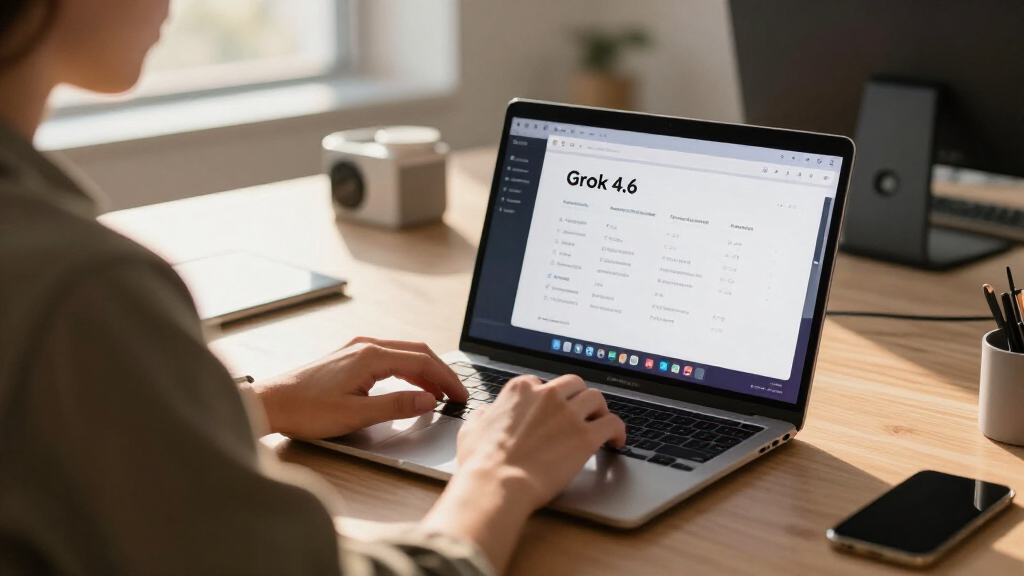
SpaceXAI has announced the release of Grok 4.6, its latest artificial intelligence model designed for coding, professional work, and autonomous agent tasks. The original analysis can be found in this detailed report. The company claims that Grok 4.6 demonstrates performance gains over its predecessor, Grok 4.5, and positions itself competitively against OpenAI’s GPT-5.6 and Anthropic’s Fable 5. This development is significant because it introduces a new contender in the high-stakes AI market, emphasizing improved capabilities and lower operational costs.
Grok 4.6 is an incremental upgrade from Grok 4.5, featuring extended training that includes model-generated reasoning, enhanced optimization, and reinforcement learning across multiple professional disciplines such as coding, web development, and computer-aided design. For more on AI advancements, see how AI is revolutionizing SaaS. According to xAI, these improvements enable the model to better handle extended, multi-step tasks and self-check during execution, which is critical for autonomous agent workflows that involve file inspection, tool use, and error recovery.
Benchmark results shared by xAI show Grok 4.6 scoring 65.9% on DeepSWE 1.1 and 61.3% on FrontierCode 1.1 Extended, with a score of 1,753 on GDPVal-AA v2—higher than Grok 4.5 and comparable to or slightly below some rival configurations. The company emphasizes that these scores are model-specific and do not definitively establish superiority across all workloads. The model is priced at $2 per million input tokens and $6 per million output tokens, aiming to reduce costs for demanding automation tasks.
Grok 4.6 continues SpaceXAI’s focus on autonomous agent-based software engineering, supporting tools like Grok Build, which facilitates planning, coding, testing, and extended execution. The model’s release prompts increased competition among AI providers to improve not just performance but also cost efficiency, especially in environments where multiple tool calls and long reasoning chains are involved. Learn more about AI cost strategies in this analysis of knowledge distillation.
Impact of Grok 4.6 on AI Development and Automation
The release of Grok 4.6 marks a shift toward more capable and cost-efficient autonomous AI agents, which could accelerate adoption in software engineering, research, and automation workflows. If the model’s claimed improvements hold in real-world settings, it could reduce operational costs and enhance reliability for enterprise applications, influencing how companies deploy AI for complex, multi-step tasks.
However, the actual impact depends on independent verification of performance, safety, and reliability in diverse operational environments. The competitive landscape is also evolving, with other models like GPT-5.6 and Fable 5 continuing to demonstrate strengths in different benchmarks.

Coding with AI For Dummies (For Dummies: Learning Made Easy)
As an affiliate, we earn on qualifying purchases.
As an affiliate, we earn on qualifying purchases.
Background on Grok and AI Model Competition
Grok 4.6 builds on the prior release of Grok 4.5, which itself was part of SpaceXAI’s broader strategy to develop autonomous agents capable of handling extended reasoning and tool use. The AI market has seen rapid growth, with models like GPT-5.6 from OpenAI and Fable 5 from Anthropic positioning themselves as leaders in multi-purpose AI for coding, research, and long-term tasks. Benchmark scores have varied depending on test design, prompting, and agent configurations, making direct comparisons challenging.
Previous releases from SpaceXAI focused on combining large-scale training data with reinforcement learning to enhance reasoning and self-checking capabilities. The current release aims to solidify Grok’s standing in this competitive environment, emphasizing performance in professional and autonomous workflows.
“Grok 4.6’s extended training and optimization suggest it can better handle multi-step, autonomous tasks, which is key for real-world agent deployment.”
— an anonymous researcher
Verification of Performance Gains in Real-World Settings
It remains unclear whether Grok 4.6’s claimed performance improvements will translate into consistent results outside controlled benchmark environments. Results can vary based on agent configurations, prompts, and tool integration, and independent verification is pending. Details about the model’s size, training data, energy consumption, and safety assessments have not been publicly disclosed, adding further uncertainty about its overall robustness and safety.
Upcoming Testing and Industry Evaluation of Grok 4.6
Developers and enterprise users will soon test Grok 4.6 in live environments, providing data on completion rates, latency, cost efficiency, and error recovery. Updated leaderboards and independent evaluations will help determine whether the model’s performance and cost benefits are sustained in diverse applications. SpaceXAI plans to release further details about the model’s deployment and safety features as more real-world data becomes available.
Key Questions
What is Grok 4.6?
Grok 4.6 is SpaceXAI’s latest AI model designed for coding, professional work, and autonomous agent tasks, featuring extended training and optimization to improve multi-step reasoning and self-checking.
How does Grok 4.6 compare to GPT-5.6 and Fable 5?
Based on published benchmarks, Grok 4.6 shows competitive scores on some evaluations but does not definitively outperform its rivals across all workloads. Its relative performance depends on specific tasks and configurations.
What are the cost benefits of Grok 4.6?
The model is priced at $2 per million input tokens and $6 per million output tokens, aiming to provide cost-effective solutions for demanding automation workflows, especially those involving multiple tool calls and long reasoning chains.
What remains uncertain about Grok 4.6’s capabilities?
It is not yet clear whether the claimed performance improvements will hold in diverse real-world settings. Independent verification and safety assessments are still pending, and the impact of different agent configurations remains to be seen.
Source: ThorstenMeyerAI.com