The best overall wireless handheld microphone system in this roundup is the Shure BLX24/PG58: it pairs a recognized vocal mic with a straightforward single-channel setup. For several speakers or singers, the Phenyx Pro PTU-5000-4H offers four handheld channels, while the JBL PartyBox Wireless Microphones suit PartyBox owners who want a simple matching setup. The main tradeoffs are how many people need to speak at once, how much control you want over frequency selection, and whether you need gear that works beyond karaoke or casual events. A larger mic pack does not automatically mean better sound or easier operation. Read on for the full breakdown and recommendations by use case.

Get the latest gadgets delivered free with Prime
- Fast, free delivery on millions of items
- Prime Video, Amazon Music and more included
- Member-only deals all year
Complete the kit



Key Takeaways
- Shure BLX24/PG58 is the strongest general-purpose pick: its single-mic format keeps setup simpler than the four-channel systems, though it cannot cover multiple speakers at once.
- Four-mic systems solve a different problem from dual-mic kits: the Phenyx Pro PTU-5000-4H and PTU-7000-4H suit group use, while the Sony ULT MIC and FIFINE K036 focus on two transmitters.
- PartyBox compatibility can matter more than channel count: the JBL PartyBox Wireless Microphones are the most tailored choice for that speaker ecosystem, but less flexible for buyers building a broader audio setup.
- Frequency coordination separates casual use from more demanding events: auto-scan options such as the Phenyx Pro PTU-71-2H can help when radio conditions vary, while buyers still need to check local frequency availability.
- More included microphone types add flexibility but also complexity: the TONOR TW362 includes handheld, headset, and lavalier options, making it more adaptable for presenters than a handheld-only kit.
| Sony ULT MIC Wireless Microphone – Dual Handheld Mics with Receiver |  | Best for Sony ULT POWER SOUND Owners | Microphones: 2 handheld wireless microphones | Wireless frequency: 2.4 GHz | Connector: 6.35 mm jack | VIEW ON AMAZON | See Our Full Breakdown |
| Phenyx Pro PTU-5000-4H 4-Channel UHF Wireless Microphone System |  | Best for Straightforward Four-Mic Events | Channels: 4 | Microphone type: Handheld dynamic cardioid | Frequency range: 541.9–568.65 MHz | VIEW ON AMAZON | See Our Full Breakdown |
| Phenyx Pro PTU-7000-4H 4-Channel UHF Wireless Microphone System |  | Best for Frequency Flexibility | Channels: 4 | Selectable frequencies: 40 per channel | Listed frequency range: 530–580 MHz | VIEW ON AMAZON | See Our Full Breakdown |
| TONOR Wireless Microphone System – Handheld Gray | 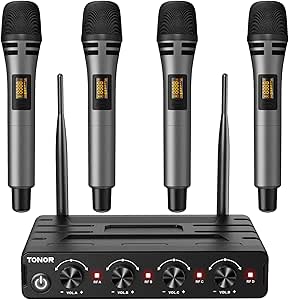 | Best for Multi-System Channel Capacity | Wireless technology: UHF | Channels: 4 groups of 10 channels | Listed simultaneous connections: Up to 40 | VIEW ON AMAZON | See Our Full Breakdown |
| JBL PartyBox Wireless Microphones, 2-Pack |  | Best for JBL PartyBox Portability | Microphones: 2 handheld digital wireless microphones | Compatibility: JBL PartyBox speakers | Wireless connection: 2.4 GHz via dongle | VIEW ON AMAZON | See Our Full Breakdown |
| Aveek Wireless Microphone System 4 Pack, 262FT Long Range Low Latency Mics |  | Best for Four-Person Groups | Microphones: 4 rechargeable handheld microphones | Wireless range: Up to 262 feet | Battery life: Up to 40 hours per microphone | VIEW ON AMAZON | See Our Full Breakdown |
| FIFINE K036 UHF Dual Channel Wireless Handheld Microphone System |  | Best for Simple Two-Mic Karaoke | Channels: 2 | Operating range: 80 feet | Frequency range: UHF, 520–578 MHz | VIEW ON AMAZON | See Our Full Breakdown |
| Shure BLX24/PG58 Wireless Vocal Microphone System, H9 Band | 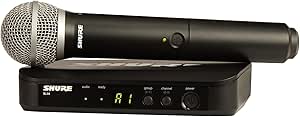 | Best for a Single Vocalist | Frequency band: H9, 512–542 MHz | Wireless range: Up to approximately 300 feet (100 m) line of sight | Channels: 1 | VIEW ON AMAZON | See Our Full Breakdown |
| JBL Wireless Two Microphone System with Dual-Channel Receiver, Black |  | Best for JBL PartyBox Owners | Channels: 2 | Microphones: 2 wireless handheld microphones | Connectivity: Wireless and USB | VIEW ON AMAZON | See Our Full Breakdown |
| Wireless Dual Handheld Microphone System |  | Best for Automatic Pairing | Microphones: 2 handheld dynamic microphones | Wireless range: Up to 200 feet line of sight | Receiver connection: 6.35 mm plug | VIEW ON AMAZON | See Our Full Breakdown |
| TONOR TW362 Wireless Microphone System with Handheld, Headset, and Lavalier Mics |  | Best for Mixed Presentation Formats | Microphones included: 2 handheld, 2 headset, 2 lavalier | Operating range: 200 ft / 60 m | Polar pattern: Unidirectional (cardioid) | VIEW ON AMAZON | See Our Full Breakdown |
| Phenyx Pro Dual UHF Auto Scan Handheld Wireless Microphone System PTU-71-2H |  | Best for Frequency Flexibility | Microphone type: 2 handheld dynamic microphones | Wireless band: Channel 1: 536.57–561.32 MHz; Channel 2: 562.37–587.12 MHz | Selectable frequencies: 100 per channel | VIEW ON AMAZON | See Our Full Breakdown |
| Sennheiser XSW 1-825-A Wireless Vocal Microphone System, 548–572 MHz |  | Best for Straightforward Vocal Performance | Microphone: Handheld SKM 825-XSW transmitter | Capsule: E825 cardioid dynamic | Frequency range: 548–572 MHz | VIEW ON AMAZON | See Our Full Breakdown |
| Phenyx Pro PTU-52-2H Dual UHF Wireless Microphone System |  | Best Value for Two Handhelds | Microphones: 2 handheld | Frequency range: 500–590 MHz | Frequency groups: 30 tunable groups | VIEW ON AMAZON | See Our Full Breakdown |
| Sennheiser Pro Audio XSW 2-835-A Wireless Microphone – Black |  | Best Premium Stage System | Microphone type: Handheld | Receiver: True-diversity receiver with metal housing | Simultaneous channels: Up to 12 | VIEW ON AMAZON | See Our Full Breakdown |
| wireless handheld microphone system | Signal-to-noise ratio | Power |
|---|---|---|
| Sony ULT MIC Wireless Micropho | 65 dB | — |
| Phenyx Pro PTU-5000-4H 4-Chann | — | — |
| Phenyx Pro PTU-7000-4H 4-Chann | — | — |
| TONOR Wireless Microphone Syst | — | AA batteries required; not included |
| JBL PartyBox Wireless Micropho | — | — |
| Aveek Wireless Microphone Syst | 85 dB | — |
| FIFINE K036 UHF Dual Channel W | 90 dB | — |
| Shure BLX24/PG58 Wireless Voca | 78 dB | 2 AA batteries included |
| JBL Wireless Two Microphone Sy | — | — |
| Wireless Dual Handheld Microph | 70 dB | 3 included lithium polymer batteries |
| TONOR TW362 Wireless Microphon | 60 dB | 2 AA batteries per microphone or bodypack |
| Phenyx Pro Dual UHF Auto Scan | 98 dB | AA batteries; 4 included |
| Sennheiser XSW 1-825-A Wireles | 70 dB | 2 AA batteries, included |
| Phenyx Pro PTU-52-2H Dual UHF | 98 dB | 4 AA batteries |
| Sennheiser Pro Audio XSW 2-835 | 110 dB | 2 AA batteries, included |
More Details on Our Top Picks
Sony ULT MIC Wireless Microphone – Dual Handheld Mics with Receiver
I’d choose the Sony ULT MIC when the microphone system needs to work smoothly with a Sony ULT POWER SOUND speaker, rather than serve as a flexible multi-mic setup for any venue. Its Duet Assist feature automatically balances two singers, while noise reduction can help keep karaoke vocals clearer. Up to 20 hours of battery life and a 10-minute charge for about two hours of use suit long gatherings and last-minute top-ups.
Compared with the four-mic Phenyx Pro PTU-7000-4H, this Sony is simpler and more focused on two-person karaoke, but it offers fewer microphones and just one channel. Its 2.4 GHz connection may also face interference in crowded wireless environments, and the best fit is Sony’s speaker ecosystem rather than broad system compatibility.
Pros:- Two handheld microphones support duet singing
- Duet Assist balances singers’ vocal levels
- Up to 20 hours of battery life, with a fast-charge option
- Noise reduction and a protective silicone damper support clearer, more durable karaoke use
Cons:- Limited to one channel, restricting expansion beyond the included two-mic use
- 2.4 GHz operation may encounter interference in crowded environments
- Designed around Sony ULT POWER SOUND speakers, so it is less flexible for mixed equipment setups
Best for: Sony ULT POWER SOUND owners who want two handheld mics for karaoke and occasional gatherings
Not ideal for: Event hosts who need four microphones, selectable UHF frequencies, or a system for use across varied PA equipment
- Microphones:2 handheld wireless microphones
- Wireless frequency:2.4 GHz
- Connector:6.35 mm jack
- Battery life:Up to 20 hours
- Quick charge:10 minutes for approximately 120 minutes of use
- Frequency response:50 Hz–15,000 Hz
- Signal-to-noise ratio:65 dB
- Construction:Metal enclosure
Our verdict“Choose this for two-person karaoke with a Sony ULT POWER SOUND speaker, but pick the Phenyx Pro PTU-7000-4H for four-mic events and selectable UHF frequencies.”
Phenyx Pro PTU-5000-4H 4-Channel UHF Wireless Microphone System
The Phenyx Pro PTU-5000-4H earns its place for events that need four handheld microphones without requiring a host to manage a menu of frequency settings. Its four fixed UHF frequencies keep setup direct, and individual receiver volume controls make it easier to balance speakers or singers separately. The supplied receiver has four XLR outputs, giving an installer options for routing each mic into suitable audio equipment.
Compared with the PTU-7000-4H, this model gives up auto scanning and selectable frequencies, so it is less adaptable if interference appears. Its stated 260-foot range suits larger rooms, but the system needs an amplifier or speaker to produce sound; it is not an all-in-one PA. Eight AA batteries are included, though the listed operation time is up to eight hours.
Pros:- Four handheld microphones support group performances and multi-speaker events
- Individual receiver volume controls allow separate level adjustment
- Up to 260 feet of stated wireless range
- Metal construction and four XLR receiver outputs
Cons:- Fixed frequencies offer less flexibility than the PTU-7000-4H when interference occurs
- Requires a separate amplifier or speaker for sound output
- Up to eight hours of operation is shorter than the listed battery life of some alternatives
Best for: Community groups, presenters, and karaoke hosts who need four microphones with simple fixed-frequency setup
Not ideal for: Users working in RF-congested venues who want auto scanning, selectable frequencies, or a complete speaker system
- Channels:4
- Microphone type:Handheld dynamic cardioid
- Frequency range:541.9–568.65 MHz
- Fixed frequencies:541.9, 546.3, 561.6, and 568.65 MHz
- Wireless range:Up to 260 ft
- Receiver outputs:4 XLR outputs
- Battery operation:8 included AA batteries; up to 8 hours
- Sound output requirement:Separate amplifier or speaker required
Our verdict“Pick the PTU-5000-4H for a straightforward four-mic UHF setup with individual outputs, and choose the PTU-7000-4H if frequency adjustment matters more.”
Phenyx Pro PTU-7000-4H 4-Channel UHF Wireless Microphone System
For four-mic events where RF conditions can change, I’d favor the Phenyx Pro PTU-7000-4H over the PTU-5000-4H. It offers 40 selectable frequencies per channel, auto scanning, and IR synchronization, giving users more ways to find and coordinate a usable setup. Four cardioid handheld mics and a stated line-of-sight range of up to 328 feet make it a better fit for larger events than a compact two-mic karaoke pair.
That added flexibility brings more setup work: the receiver, antennas, and four microphones all need to be arranged, and the system relies on eight AA batteries. The supplied frequency details also conflict between the stated 530–580 MHz range and channel information, so I would verify local compatibility before purchase. Compared with the fixed-frequency PTU-5000-4H, this is the more adjustable option, not the simpler one.
Pros:- Auto scan and selectable frequencies provide more ways to manage interference than the PTU-5000-4H
- Four handheld microphones suit group vocals and multi-speaker events
- Cardioid pickup helps focus capture on the speaker
- IR synchronization and included antennas support coordinated setup
Cons:- Frequency information is inconsistent across the supplied product details
- Multiple microphones, antennas, and batteries make setup more involved
- Requires compatible amplification or speakers for sound output
Best for: Event operators and community venues needing four handheld mics and frequency adjustment for changing RF conditions
Not ideal for: Casual karaoke users seeking a quick two-mic speaker pairing or buyers who need unambiguous frequency documentation
- Channels:4
- Selectable frequencies:40 per channel
- Listed frequency range:530–580 MHz
- Operating range:290–328 ft line of sight
- Microphone type:Handheld dynamic
- Polar pattern:Cardioid, unidirectional
- Battery life:Up to 16 hours
- Included batteries:8 AA batteries
Our verdict“Choose the PTU-7000-4H over the fixed-frequency PTU-5000-4H when adjustable UHF operation matters, after checking the frequency details against your location and equipment.”
TONOR Wireless Microphone System – Handheld Gray
The TONOR Wireless Microphone System stands apart from the Phenyx four-mic systems by emphasizing channel capacity: its listing describes four groups of 10 channels and up to 40 simultaneous connections. That makes it a candidate for organizers coordinating compatible systems across a busy event, while its cardioid pickup and automatic receiver sync keep the basic handheld setup relatively direct. A stated 200-foot UHF range gives more room to move than a small-room-only system.
The product details do not specify four included microphones, so I would not treat its 40-connection figure as equivalent to the Phenyx PTU-7000-4H’s clearly listed four-microphone package. The range is also shorter than the Phenyx system’s stated line-of-sight maximum, and AA batteries are not included. Channel adjustment may help in crowded RF spaces, but it does not remove the need to manage interference.
Pros:- Four groups of 10 channels offer broad channel configuration
- Automatic synchronization simplifies receiver and microphone pairing
- Cardioid pickup is suited to focused speech and vocal use
- Stated UHF range reaches up to 200 ft
Cons:- Product details do not clearly state how many handheld microphones are included
- AA batteries are required but not supplied
- Listed range is shorter than the PTU-7000-4H’s maximum line-of-sight range
Best for: Event coordinators who need adjustable UHF channels and are checking compatibility across multiple TONOR systems
Not ideal for: Buyers who require a clearly specified four-handheld bundle, included batteries, or maximum stated range
- Wireless technology:UHF
- Channels:4 groups of 10 channels
- Listed simultaneous connections:Up to 40
- Wireless range:Up to 200 ft / 60 m
- Polar pattern:Unidirectional cardioid
- Connector:6.35 mm jack
- Power:AA batteries required; not included
- Enclosure material:Acrylonitrile Butadiene
Our verdict“Consider the TONOR for adjustable channels and straightforward syncing, but choose the PTU-7000-4H if a specified four-microphone package is your priority.”
JBL PartyBox Wireless Microphones, 2-Pack
The JBL PartyBox Wireless Microphones make the most sense for buyers who already use a compatible PartyBox speaker and want a two-person setup with little extra equipment. The pair connects through a 2.4 GHz dongle, while cardioid pickup, a built-in pop filter, and shock mounts are intended to reduce breath and handling noise. Up to 20 hours of playtime, charging during use, and a quick-charge option help keep a party going without a long interruption.
Compared with the Sony ULT MIC, this JBL pair is tied to a different speaker ecosystem and does not list duet volume balancing. Its 30-meter range is shorter than the stated ranges of the Phenyx four-channel UHF systems, and battery life drops to up to 12 hours when using the wireless dongle. The dongle is required for the stated wireless connection, so it is not a standalone universal receiver.
Pros:- Designed to connect with JBL PartyBox speakers through a wireless dongle
- Pop filter and shock mounts help reduce breath and handling noise
- Can be used while charging
- Quick charge provides up to two hours of playtime after 10 minutes
Cons:- The wireless dongle is required for the stated 2.4 GHz connection
- Battery life is listed as up to 12 hours when using the dongle
- Up to 30 meters of range is less than the stated range of the Phenyx PTU-7000-4H
Best for: JBL PartyBox owners who want two handheld microphones for parties, karaoke, and casual announcements
Not ideal for: Buyers with non-PartyBox audio equipment, users needing four microphones, or event operators prioritizing long-range UHF
- Microphones:2 handheld digital wireless microphones
- Compatibility:JBL PartyBox speakers
- Wireless connection:2.4 GHz via dongle
- Wireless range:Up to 30 meters
- Battery life:Up to 20 hours; up to 12 hours with wireless dongle
- Quick charge:10 minutes for up to 2 hours of playtime
- Pickup pattern:Cardioid, unidirectional
- Frequency response:50–15,000 Hz
Our verdict“Choose the JBL pair for convenient two-mic use with a PartyBox, but select a Phenyx UHF system for longer-range, multi-microphone event work.”
Aveek Wireless Microphone System 4 Pack, 262FT Long Range Low Latency Mics
For events where four people need handheld microphones at once, the Aveek four-mic bundle offers more flexibility than the two-mic FIFINE K036 or JBL Wireless Two Microphone System. Its stated 262-foot range gives speakers room to move, while cardioid dynamic pickup and low-latency transmission are aimed at live vocals, karaoke, and speeches. Each mic is described as lasting up to 40 hours and charging through Type-C, reducing battery interruptions compared with AA-powered alternatives. The tradeoff is channel setup: the receiver assigns channels randomly, which can make pairing less convenient. It also connects to PA-style gear rather than phones, tablets, or laptops, so buyers should check their audio inputs before choosing it.
Pros:- Four rechargeable handheld microphones support larger groups without adding separate transmitters.
- Stated range of up to 262 feet allows movement across a stage or event space.
- Up to 40 hours of battery life per microphone and Type-C charging can reduce downtime.
- Cardioid dynamic pickup and low-latency transmission suit vocals and spoken presentations.
Cons:- Random channel assignment can complicate pairing and troubleshooting.
- Not compatible with laptops, tablets, smartphones, or AV receivers.
- The four-mic kit requires more setup and coordination than simpler two-mic systems.
Best for: Karaoke hosts, community venues, and event organizers who need four handheld mics and use a PA system, amplifier, or mixer.
Not ideal for: Buyers recording directly to a phone or computer, or anyone who needs predictable channel assignment for fast setup.
- Microphones:4 rechargeable handheld microphones
- Wireless range:Up to 262 feet
- Battery life:Up to 40 hours per microphone
- Charging:Type-C
- Pickup pattern:Unidirectional cardioid
- Connections:UHF, 6.35 mm jack, and XLR
- Signal-to-noise ratio:85 dB
- Compatible equipment:Amplifiers, audio mixers, karaoke machines, PA systems, and speakers
Our verdict“Choose the Aveek when four performers need wireless handhelds for PA-based events; skip it if you need direct computer or mobile recording.”
FIFINE K036 UHF Dual Channel Wireless Handheld Microphone System
The FIFINE K036 is a straightforward choice for two-person karaoke, school events, or church announcements: it provides two UHF handheld mics, separate volume controls, and an adjustable echo effect without the four-mic setup of the Aveek system. Its 80-foot operating range is more modest than the Aveek’s stated 262 feet or the Shure BLX24/PG58’s line-of-sight reach, but it fits smaller rooms and familiar event spaces. The compact metal receiver and supplied cable options make it easier to integrate with common audio equipment. Buyers should plan for four AA batteries and should not expect Bluetooth or a third microphone in the box. TV connection may also require a digital-to-analog converter.
Pros:- Two channels and separate volume controls make it practical for duets and paired presenters.
- Adjustable echo adds a karaoke-friendly effect without external processing.
- Metal receiver and UHF operation are suited to regular indoor event use.
- Includes a power adapter and three audio cables for flexible connection options.
Cons:- The 80-foot operating range is shorter than the Aveek and Shure systems listed here.
- Four AA batteries are required, and batteries are not a rechargeable-mic solution.
- No Bluetooth; TV use may require a digital-to-analog converter.
Best for: Karaoke hosts, school staff, and church volunteers who need two independently controlled mics for a modest-size room.
Not ideal for: Event crews needing four microphones, long-range stage coverage, Bluetooth, or direct TV use without an added converter.
- Channels:2
- Operating range:80 feet
- Frequency range:UHF, 520–578 MHz
- Microphones:2 handheld microphones
- Battery requirement:4 AA batteries
- Connections:6.35 mm (1/4-inch) and 3.5 mm jacks
- Signal-to-noise ratio:90 dB
- Receiver enclosure:Metal
Our verdict“Pick the FIFINE for uncomplicated two-mic karaoke and announcements in smaller spaces, not for larger events that need extra channels or extended range.”
Shure BLX24/PG58 Wireless Vocal Microphone System, H9 Band
For a singer or presenter who needs one handheld rather than a shared pair, the Shure BLX24/PG58 keeps the system focused: a BLX4 single-channel receiver works with a BLX2 transmitter and PG58 cardioid dynamic capsule. Its stated line-of-sight range of up to about 300 feet is longer than the FIFINE K036’s 80-foot rating, while QuickScan helps find an available frequency without manual channel hunting. That makes this a more stage-oriented single-mic alternative to the two-mic JBL system. The tradeoff is capacity: there is only one channel and one transmitter, and battery life is listed at up to 14 hours, shorter than the Aveek’s stated per-mic runtime. Buyers must also confirm that the H9 band is authorized for use in their location.
Pros:- QuickScan supports faster frequency selection when setting up a performance.
- Stated line-of-sight range reaches up to approximately 300 feet.
- PG58 cardioid dynamic capsule is designed for vocal use.
- Includes the receiver, transmitter, microphone clip, power supply, and two AA batteries.
Cons:- Single-channel configuration supports only one microphone at a time.
- Up to 14 hours of operation is less than the Aveek’s stated battery life.
- H9 band use depends on local frequency authorization.
Best for: Solo singers, worship leaders, and presenters who want a single wireless handheld system with frequency scanning and substantial line-of-sight range.
Not ideal for: Duets, karaoke hosts needing two microphones, or buyers who cannot confirm local authorization for the H9 frequency band.
- Frequency band:H9, 512–542 MHz
- Wireless range:Up to approximately 300 feet (100 m) line of sight
- Channels:1
- Transmitter battery life:Up to 14 hours
- Power:2 AA batteries included
- Microphone capsule:PG58 dynamic
- Pickup pattern:Cardioid, unidirectional
- Signal-to-noise ratio:78 dB
Our verdict“Choose the Shure for a solo vocalist who values frequency scanning and long line-of-sight reach, but choose a dual-channel kit for duets.”
JBL Wireless Two Microphone System with Dual-Channel Receiver, Black
The JBL Wireless Two Microphone System makes the clearest case for buyers who already use a compatible JBL PartyBox: its receiver is designed for plug-and-play pairing with listed PartyBox models, and two channels let two voices run together. Unlike the FIFINE K036, whose receiver connects through 6.35 mm or 3.5 mm audio jacks, JBL’s supplied system uses USB connectivity and is framed around its own speaker ecosystem. That focus can make setup simpler for compatible PartyBox owners, but it narrows where the system fits. The receiver offers up to six hours of playback, and the handheld mics use replaceable AA batteries. Product details do not provide a wireless range, so buyers needing a known coverage distance may prefer the Shure or Aveek systems, whose ranges are specified.
Pros:- Dual-channel receiver supports two microphones at once.
- Plug-and-play setup is tailored to compatible JBL PartyBox speakers.
- Replaceable AA batteries make it possible to swap mic power without waiting for charging.
- JBL describes the system as delivering clear vocal sound with low delay and distortion.
Cons:- Compatibility is focused on listed JBL PartyBox models rather than general-purpose PA connections.
- Receiver playback is listed for up to six hours.
- Product information does not specify a wireless operating range.
Best for: Owners of compatible JBL PartyBox speakers who want two handheld microphones for karaoke, parties, or casual announcements.
Not ideal for: Buyers with non-JBL PA equipment, or event organizers who need a published wireless range or longer receiver playback time.
- Channels:2
- Microphones:2 wireless handheld microphones
- Connectivity:Wireless and USB
- Receiver playback:Up to 6 hours
- Microphone batteries:Replaceable AA batteries
- Pickup pattern:Unidirectional
- Frequency response:65 Hz–15 kHz
- Compatible devices:Selected JBL PartyBox models
Our verdict“Choose this JBL system for a compatible PartyBox-based karaoke setup; select a more broadly connected system if you use other PA equipment.”
Wireless Dual Handheld Microphone System
For buyers who want two microphones without managing frequency selection, this dual handheld system pairs automatically and claims up to 200 feet of line-of-sight range. That places it between the FIFINE K036’s 80-foot rating and the Shure BLX24/PG58’s approximately 300-foot reach, making it a middle-ground option for compatible rooms and small events. The included 6.35 mm receiver plug and 3.5 mm adapter suit speakers, amplifiers, and PA systems with microphone inputs. Compared with the JBL system, it is described for a broader range of input-equipped audio gear, though JBL is the more direct fit for compatible PartyBox owners. The limits are significant: it does not work with phones, computers, or tablets, and AUX-only inputs are unsupported. Receiver versions also ship at random.
Pros:- Two handheld dynamic microphones are included.
- Automatic pairing simplifies setup compared with systems that require channel selection.
- Stated line-of-sight range reaches up to 200 feet.
- Includes 6.35 mm receiver connectivity and a 3.5 mm adapter.
Cons:- Not compatible with phones, computers, or tablets.
- AUX inputs are not supported; the connected device needs a microphone input.
- Receiver version is shipped at random.
Best for: Presenters and karaoke users who need two handheld mics, automatic pairing, and a compatible speaker or PA microphone input.
Not ideal for: Mobile or computer-based creators, or anyone whose speaker offers only an AUX input and no microphone input.
- Microphones:2 handheld dynamic microphones
- Wireless range:Up to 200 feet line of sight
- Receiver connection:6.35 mm plug
- Adapter:3.5 mm
- Pickup pattern:Unidirectional
- Signal-to-noise ratio:70 dB
- Distortion:Less than 0.2%
- Power:3 included lithium polymer batteries
Our verdict“Choose this system for an easy-pairing two-mic setup with a compatible speaker or PA input, but not for direct mobile, computer, or AUX use.”
TONOR TW362 Wireless Microphone System with Handheld, Headset, and Lavalier Mics
The TONOR TW362 is the most adaptable choice here when a single event moves between singing, speeches, and hands-free presenting. Its receiver works with two handheld mics, two headsets, and two lavaliers, so presenters can choose a mic style without buying a separate system. Compared with the Phenyx Pro PTU-52-2H, which focuses on two handheld performers and offers dedicated XLR outputs, the TW362 trades that straightforward stage setup for much more flexibility in mic placement and use.
Auto-pairing and a stated 200-foot range keep setup and movement simple, but the six battery-powered mic units create a substantial battery burden: each takes two AA batteries, which are not included. This makes the TW362 a better fit for organizations that will use its variety than for buyers who only need two handhelds.
Pros:- Includes two handheld, two headset, and two lavalier microphones for varied event formats.
- One receiver handles all included microphone types.
- Auto-pairing reduces setup work.
- Stated 200-foot operating range allows movement across larger venues.
Cons:- Batteries are not included.
- All six mic units require two AA batteries each, creating significant battery use.
- The stated 60 dB signal-to-noise ratio is lower than the 98 dB figures listed for the Phenyx Pro PTU-71-2H and PTU-52-2H.
Best for: Churches, event hosts, and meeting organizers who need to switch between handheld and hands-free microphones using one receiver.
Not ideal for: Buyers who only need two handheld mics or want to avoid stocking batteries for six separate mic units.
- Microphones included:2 handheld, 2 headset, 2 lavalier
- Operating range:200 ft / 60 m
- Polar pattern:Unidirectional (cardioid)
- Signal-to-noise ratio:60 dB
- Power:2 AA batteries per microphone or bodypack
- Connector:1/4-inch (6.35 mm) aux
- Compatible devices:Mixer, karaoke machine, amplifier, powered speaker
- Enclosure materials:Metal and plastic
Our verdict“Choose the TW362 if your events need both handheld and hands-free mic options, but skip it if two handhelds are all you need.”
Phenyx Pro Dual UHF Auto Scan Handheld Wireless Microphone System PTU-71-2H
The Phenyx Pro PTU-71-2H is a strong fit for venues that need to manage wireless interference rather than simply power up and speak. Its auto scan finds a usable frequency, while two banks of 100 selectable UHF frequencies give operators room to coordinate multiple transmitters. Compared with the Phenyx Pro PTU-52-2H, this model offers far more frequency choices and a longer stated line-of-sight range of up to 328 feet; the PTU-52-2H is the more basic alternative with a 200-foot range and simpler frequency-group setup.
The metal receiver and handheld mics, mute controls, and replaceable mic head support regular event use. The tradeoff is a more involved frequency system than a casual karaoke setup may need, and the specified operating bands may not suit every location. Its two handheld mics also offer less format flexibility than the TONOR TW362, which includes headset and lavalier options.
Pros:- Auto scan helps locate a frequency with less interference.
- Two 100-frequency UHF banks support multiset coordination.
- Stated line-of-sight range reaches up to 328 feet.
- Metal construction, mute function, and replaceable mic head suit recurring use.
Cons:- Frequency selection and coordination may be more than occasional users need.
- The stated range is line-of-sight and may be shorter around obstacles.
- Uses AA batteries rather than an included rechargeable system.
Best for: DJs, churches, and event operators who need two handheld mics and frequent channel coordination across wireless systems.
Not ideal for: Casual users who want the simplest plug-and-play karaoke setup, or presenters who need headset and lavalier microphones.
- Microphone type:2 handheld dynamic microphones
- Wireless band:Channel 1: 536.57–561.32 MHz; Channel 2: 562.37–587.12 MHz
- Selectable frequencies:100 per channel
- Operating range:Up to 328 ft line of sight
- Polar pattern:Unidirectional (cardioid)
- Signal-to-noise ratio:98 dB
- Outputs:XLR and 6.35 mm jack
- Power:AA batteries; 4 included
Our verdict“Pick the PTU-71-2H for two handhelds and flexible UHF coordination, not for a simple or hands-free microphone setup.”
Sennheiser XSW 1-825-A Wireless Vocal Microphone System, 548–572 MHz
The Sennheiser XSW 1-825-A is the focused vocal pick for buyers who want one handheld microphone and a receiver built around live performance. Its E825 cardioid dynamic capsule is designed for vocal use, while antenna-switching diversity reception helps maintain the wireless link. Automatic frequency management and synchronization also reduce the amount of manual setup required. Compared with the dual-mic Phenyx Pro PTU-71-2H, the Sennheiser gives up a second microphone and extensive frequency selection in exchange for a simpler one-mic system.
It supports up to 10 simultaneous channels, making it more suitable for coordinated stage use than a basic two-mic karaoke receiver. Its limits are clear: it is a single handheld system, and its specified 548–572 MHz band is not freely interchangeable with other frequency ranges. Buyers who want more channels and a metal receiver can look to the Sennheiser XSW 2-835-A, though that model adds a more involved interface.
Pros:- E825 cardioid dynamic capsule is tailored to vocal use.
- Antenna-switching diversity reception supports a stable wireless connection.
- Automatic frequency management and synchronization simplify setup.
- Supports up to 10 simultaneous channels.
Cons:- Only one handheld transmitter is included.
- Operation is limited to the specified 548–572 MHz frequency range.
- Requires two AA batteries for the transmitter.
Best for: Solo singers and presenters who want a dedicated handheld vocal system with automatic frequency management.
Not ideal for: Duos or event hosts who need two microphones in the box, or buyers who need a different wireless frequency band.
- Microphone:Handheld SKM 825-XSW transmitter
- Capsule:E825 cardioid dynamic
- Frequency range:548–572 MHz
- Receiver:EM XSW 1 diversity receiver
- Simultaneous channels:Up to 10
- Signal-to-noise ratio:70 dB
- Power:2 AA batteries, included
- Total harmonic distortion:Less than 0.9%
Our verdict“Choose the XSW 1-825-A for a streamlined single-vocalist setup, but choose a dual system if two people need microphones at once.”
Phenyx Pro PTU-52-2H Dual UHF Wireless Microphone System
The Phenyx Pro PTU-52-2H keeps the setup centered on two handheld mics, with 30 tunable frequency groups and automatic pairing aimed at quick event setup. That makes it a practical choice for karaoke, small performances, and church services where two people need to speak or sing without a complex channel workflow. Compared with the more frequency-flexible Phenyx Pro PTU-71-2H, the PTU-52-2H offers fewer tuning options and a shorter stated range, but it includes useful accessories such as batteries, windscreens, and cables.
Its XLR outputs and mixed 1/4-inch output make it easier to connect to different sound systems than a receiver limited to a single output type. The 200-foot range is specified for open line of sight, so walls and venue layout can reduce freedom of movement. It also relies on AA batteries; unlike the TONOR TW362, however, it is not supplying six separate mic units that all need power.
Pros:- Two handheld microphones support duets and two-person events.
- 30 tunable frequency groups help manage interference.
- XLR and mixed 1/4-inch outputs suit different sound-system inputs.
- Includes batteries, windscreens, antennas, and connection accessories.
Cons:- The stated 200-foot range applies to open line-of-sight conditions.
- Requires AA batteries rather than rechargeable internal power.
- Fewer frequency choices than the PTU-71-2H.
Best for: Karaoke hosts, small venues, and church teams needing two handheld microphones with flexible audio connections and included setup accessories.
Not ideal for: Users coordinating several wireless systems in a busy RF environment, or performers who need a range beyond the stated 200 feet.
- Microphones:2 handheld
- Frequency range:500–590 MHz
- Frequency groups:30 tunable groups
- Operating distance:Up to 200 ft
- Polar pattern:Unidirectional (cardioid)
- Signal-to-noise ratio:98 dB
- Outputs:2 XLR and 1 mixed 1/4-inch
- Power:4 AA batteries
Our verdict“Choose the PTU-52-2H for a ready-to-connect two-handheld setup, but look at the PTU-71-2H if frequency coordination is a priority.”
Sennheiser Pro Audio XSW 2-835-A Wireless Microphone – Black
The Sennheiser XSW 2-835-A is the more stage-oriented Sennheiser option here, pairing a handheld vocal transmitter with a true-diversity receiver housed in metal. Its rackmount kit and LCD make it a better match for a fixed venue or a performer building a more organized stage rack than the simpler XSW 1-825-A. It also supports up to 12 channels, compared with the XSW 1 model’s stated 10, giving a production team more room to coordinate multiple wireless links.
The added receiver features bring a usability tradeoff: the LCD and frequency controls may take more attention from beginners than the XSW 1’s automatic setup approach. This remains a single handheld system, not a dual-mic package like the Phenyx Pro PTU-52-2H, and it uses two AA batteries rather than built-in rechargeable power. It makes most sense when receiver durability, rack integration, and channel capacity matter more than a minimal setup.
Pros:- True-diversity receiver supports dependable stage use.
- Metal receiver housing is suited to regular venue installation.
- Supports up to 12 channels with automatic frequency management.
- Rackmount kit helps integrate the receiver into stage equipment.
Cons:- LCD controls may be less approachable for first-time wireless-system users.
- Only one handheld microphone is included.
- Uses two AA batteries and has no built-in rechargeable option.
Best for: Singers, presenters, and venue operators who want a rack-mountable wireless handheld system with true-diversity reception and room to coordinate channels.
Not ideal for: Beginners seeking the simplest setup, or duos who need two handheld transmitters included.
- Microphone type:Handheld
- Receiver:True-diversity receiver with metal housing
- Simultaneous channels:Up to 12
- Frequency management:Automatic
- Polar pattern:Unidirectional
- Signal-to-noise ratio:110 dB
- Power:2 AA batteries, included
- Included installation accessory:Rackmount kit
Our verdict“Pick the XSW 2-835-A for a more install-ready stage system with channel headroom, not for an uncomplicated two-mic package.”

How We Picked
I compared these systems by how well they serve the main jobs buyers expect from a wireless handheld microphone system: clear vocal use, dependable connection, manageable setup, and a receiver that fits common sound equipment. I also weighed the practical value of each configuration—one, two, or four handheld mics; extra headset or lavalier transmitters; and features such as frequency scanning—against the added setup and coordination they require. Because listed frequency bands and compatibility can vary by region and sound system, I treated those as buyer checks rather than universal advantages.
The ranking favors useful performance and ease of choosing the right setup, not the largest feature list. That puts the Shure BLX24/PG58 first as a balanced vocal-focused option, while multi-channel Phenyx Pro systems rank higher for groups that genuinely need several microphones. JBL’s PartyBox models serve a narrower but clear use case, and Sennheiser’s XSW systems appeal to buyers prioritizing established vocal-focused equipment. Less fully specified listings rank lower because buyers have fewer details to verify before purchase.
Factors to Consider When Choosing Wireless Handheld Microphone System
Before choosing a kit, I would start with the room, the number of simultaneous speakers, and the equipment the receiver must connect to. Those details often matter more than headline range or the number of accessories in the box.
Match the microphone count to simultaneous use
Count how many people need to speak or sing at the same time, not how many microphones you may want to keep on hand. A two-mic system is often enough for duets, interviews, and small events; a four-channel receiver makes more sense for a host and several performers sharing one setup. Extra channels can add receiver size, batteries to manage, and more chances for frequency coordination problems. Check whether the system supports all included transmitters simultaneously, rather than assuming a multi-mic package has that capability. If only one person speaks at a time, a simpler single-channel system can be easier to set up and troubleshoot.
Check receiver connections before buying
Wireless microphones send audio to a receiver, and the receiver still needs a compatible connection to your mixer, powered speaker, karaoke machine, or amplifier. Look at the inputs on your existing equipment and compare them with the receiver’s outputs; a connection mismatch may call for an adapter or a different receiver. Also check whether the receiver provides separate outputs for each mic or combines them into one signal, since that affects how much control you have over each voice. A system designed for a particular speaker family can be convenient, but it may not fit as neatly into a more general sound setup. Buyers often focus on wireless range and only discover the connection issue after the kit arrives.
Treat frequency and local radio rules as practical checks
Wireless systems use radio-frequency bands, and a band that works in one location may be restricted, crowded, or unavailable in another. Verify the specific frequency band against your country’s current rules before choosing a model, especially when ordering equipment intended for a different market. In busy venues, nearby wireless gear can compete for spectrum; an auto-scan function may help find a workable channel, but it cannot eliminate every source of interference. For events with several wireless systems, coordinate frequencies across all equipment rather than scanning each unit in isolation. Keep a wired microphone available for high-stakes events where a radio problem cannot interrupt the program.
Choose convenience features around the person using the mic
Handheld microphones are intuitive for singers and hosts, while headset and lavalier options can leave a presenter’s hands free. A kit with multiple transmitter styles can cover more jobs, but it also means more parts, fit adjustments, and batteries to track. For a casual karaoke setup, simple controls and quick pairing may matter more than advanced channel options. For speeches or instruction, handling noise, microphone placement, and the ability to move naturally can matter more than a large number of handheld mics. If several people will use the system, favor controls that are easy to identify without a sound technician.
Think about battery routines and event length
Battery type and runtime affect how reliably a wireless kit fits into a regular event schedule. Check the manufacturer’s stated power requirements and plan spare batteries or a charging routine that matches the transmitters; do not assume every included mic charges in the same way. For frequent use, rechargeable options can reduce disposable battery management, but only if charging time and replacement batteries suit the schedule. A kit with four transmitters needs a more deliberate check-in routine than a single-mic system. For long events, test the full setup and battery plan ahead of time rather than relying on a brief sound check.
Pay for coordination and flexibility only when you need them
It can make sense to pay more for a system when its controls, frequency options, or vocal-focused design solve a recurring problem. A larger channel count is useful when multiple people must use microphones at once, not simply because it sounds like a more capable package. Likewise, extra headset and lavalier choices are valuable for presenters who change roles, but unnecessary for a household that only sings into handheld mics. Consider where the system will be used, how often it will travel, and who will set it up; added features can bring added complexity. The best fit is the least complicated system that meets your real channel, connection, and operating needs.
Frequently Asked Questions
Can I use any of these wireless microphone systems with my powered speaker?
Not automatically. The receiver must connect to an input on the speaker, and the connector type and signal level need to be compatible. Check the receiver’s output and the speaker’s available inputs before ordering; some setups may need an adapter or mixer. Also check whether your speaker accepts a separate microphone input or only a line-level source. A system paired with a specific speaker family may be easiest to use there, while a more general setup needs closer connection checks.
Is a four-microphone system a better choice than a two-microphone system?
Only if you need four microphones operating at the same time. Four-channel kits such as the Phenyx Pro PTU-5000-4H and PTU-7000-4H are aimed at group events, while dual-mic options are more manageable for duets, small presentations, and karaoke at home. More transmitters mean more batteries and more radio channels to coordinate. If your speakers take turns rather than speaking together, a two-mic kit may be simpler without limiting the event. Confirm the receiver’s simultaneous channel capacity before choosing.
Will an auto-scan system prevent interference at a crowded venue?
Auto-scan can help locate a usable frequency, but it cannot guarantee an interference-free connection. Nearby wireless microphones, routers, and other radio equipment can affect performance, and the usable frequency range depends on local rules. Scan and test the system at the venue before the event, with other wireless equipment switched on. For several systems, coordinate frequencies as a group rather than letting each receiver choose independently. A wired backup remains a sensible plan for programs that cannot pause.
Should I choose the JBL PartyBox microphones or a more general-purpose system?
The JBL PartyBox Wireless Microphones make the most sense when your main goal is to use microphones with a compatible PartyBox speaker. That focused use can be simpler than assembling a wider sound system, but it may be less suited to a venue setup built around a mixer or other speaker brand. A general-purpose system gives you more room to work with different equipment, provided its receiver connections match. Check the exact speaker model and connection requirements before buying either type. Choose around the sound system you already own, not just the microphone package.
Do I need a headset or lavalier microphone instead of a handheld?
A handheld is usually the straightforward choice for singing, announcements, and speakers who can keep the mic near their mouth. A headset or lavalier is more useful when a presenter needs both hands free, demonstrates a task, or moves around while speaking. Placement matters: lavaliers can pick up clothing noise, while headsets need a comfortable and stable fit. The TONOR TW362 is the standout option here for buyers who want several microphone styles in one system. If you will use only handheld mics, those extra formats may add parts without solving a real need.
Conclusion
For most buyers seeking one reliable vocal-focused setup, I would start with the Shure BLX24/PG58 as best overall. For a group that needs several microphones at once, the Phenyx Pro PTU-5000-4H is my best value-style pick because its four-channel format addresses a clear need; the PTU-7000-4H is another option to compare for that same use. Beginners who want a familiar two-mic arrangement can look at the FIFINE K036, while PartyBox owners should favor the JBL PartyBox Wireless Microphones for their more specific fit. For a premium vocal-focused direction, compare the Sennheiser XSW 2-835-A with the Shure based on your venue and receiver needs. Presenters who want handheld, headset, and lavalier choices should consider the TONOR TW362. Before choosing, confirm receiver connections, simultaneous channel needs, and the frequency band allowed where you plan to use it.