
Qi2 enhances safety and efficiency with advanced protections that monitor and regulate power flow, automatically shutting off if overheating or faults occur. Its rigorous certification process guarantees your devices meet strict safety standards, making charging reliable and safe across many products. Improved magnetic alignment and higher power capabilities deliver faster, more efficient charging with minimized energy loss. Designed for compatibility and future growth, Qi2’s thoughtful features help you enjoy safer, quicker wireless charging—discover more about how they work behind the scenes.
Key Takeaways
- Qi2 employs safety mechanisms like automatic power flow monitoring and temperature sensors to prevent overheating and electrical risks.
- Magnetic Power Profile technology ensures precise device alignment, reducing energy loss and improving charging efficiency.
- Certified Qi2 products meet strict safety standards, undergo rigorous testing, and include features to prevent faults and short circuits.
- Upgraded communication protocols and support for higher power levels enable faster, safer wireless charging as technology advances.
- Industry collaboration and broad certification ensure compatibility, reliability, and safety across a diverse range of devices.

Anker Zolo MagSafe-Compatible Wireless Charger with Qi2 15W Fast Charging
- Fast Wireless Charging: 15W high-speed Qi2 certified charging
- Enhanced Safety System: ActiveShield 2.0 temperature monitoring
- Long Cable Length: 5-foot extended charging cable
As an affiliate, we earn on qualifying purchases.
As an affiliate, we earn on qualifying purchases.
Advanced Safety Mechanisms in Qi2 Technology
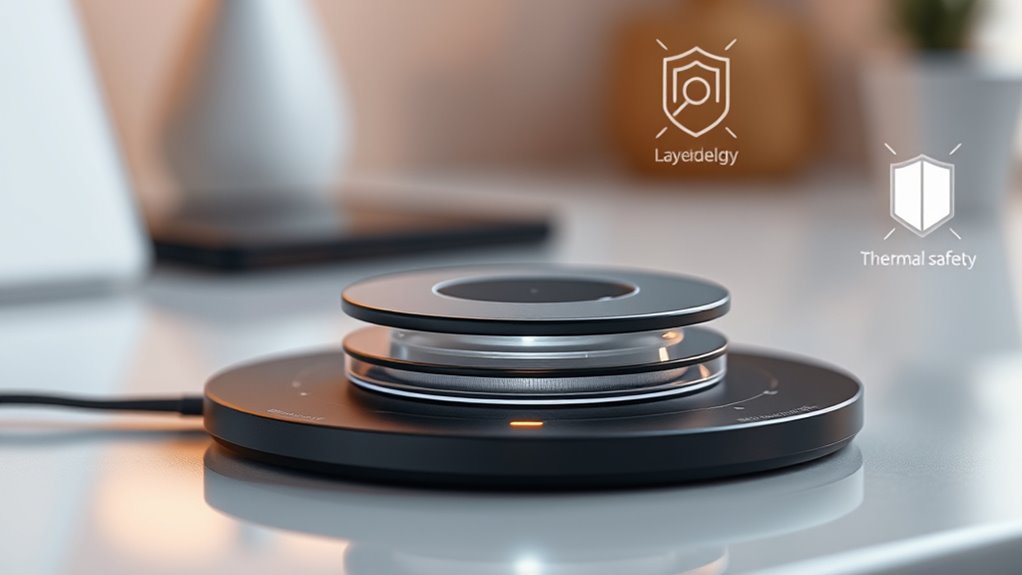
Thanks to the advanced safeguard features integrated into Qi2 technology, your devices are safeguarded against common electrical risks like overheating and short circuits. These safety mechanisms automatically monitor power flow, adjusting or cutting off energy delivery when issues are detected. This prevents damage to your device’s battery and internal components, extending their lifespan. Qi2 systems also include temperature sensors that detect overheating and shut down charging if temperatures become unsafe. The protection systems are tested rigorously during certification, ensuring they perform reliably across different environments. Only products with the Qi or Qi2 logo have passed these strict safety standards. This extensive approach guarantees that your wireless charging experience is not only fast and efficient but also safe for your device and your peace of mind. Additionally, ongoing monitoring of AI behavior in safety mechanisms helps identify potential vulnerabilities and improve performance over time.
Rigorous Certification Processes and Compliance Standards

Rigorous certification processes guarantee that only safe and reliable wireless chargers reach consumers. When you buy a Qi2-certified device, you can trust it has undergone extensive testing in authorized laboratories worldwide. These tests verify safety features, ensuring protection against overheating, short circuits, and electrical faults. Certification confirms the device meets strict safety standards and interoperability requirements, so it works seamlessly with a wide range of compatible devices. Only products displaying the Qi or Qi2 logo have proven compliance, giving you confidence in their safety and performance. Manufacturers must pass these rigorous evaluations before certification, ensuring their chargers adhere to global benchmarks for quality, safety, and efficiency. This process safeguards you and your devices, making wireless charging both reliable and secure. Additionally, industry standards are continuously updated to incorporate new safety insights and technological advancements, reflecting the importance of regulatory compliance in maintaining high safety and performance levels. Staying informed about certification processes can help consumers identify trusted products and avoid substandard alternatives. Regular updates to testing protocols ensure that certification remains relevant in the face of rapidly evolving wireless charging technologies, especially as innovations like wireless power transfer become more prevalent.
Enhanced Charging Speeds and Power Efficiency
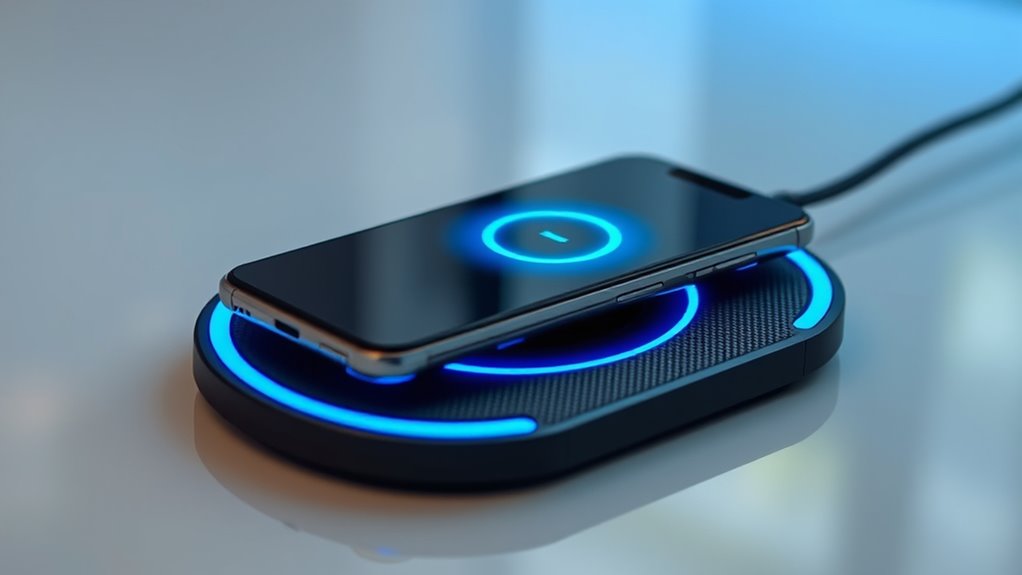
Wireless charging has advanced considerably with Qi2 technology, delivering up to 15W of power, which effectively doubles the charging speed compared to earlier Qi standards. This increase means you spend less time tethered to your charger and more time using your device. Qi2’s improved frequencies and magnetic alignment technology maximize energy transfer while reducing energy loss. Faster charging markedly cuts down wait times, making wireless charging practical for daily use. Plus, the system’s enhanced efficiency guarantees your device charges fully with less energy waste. Additionally, the compatibility with Hyundai Tuning upgrades ensures that future vehicle models can incorporate faster charging capabilities seamlessly. Built-in scalability supports future speed upgrades, with Qi specification version 2.2 already capable of up to 25W. These improvements help you enjoy quicker, more reliable wireless charging that keeps pace with your busy lifestyle. AI-powered advancements in wireless charging technology, such as those seen with Qi2, demonstrate how innovation can enhance both speed and energy efficiency. Moreover, ongoing research into energy transfer efficiency continues to push the boundaries of wireless power systems, promising even greater performance in the future. For example, vacuums with high suction power are often equipped with advanced motor technology that can be adapted for efficient energy use in wireless chargers as well.
Magnetic Power Profile and Device Alignment Innovations
Magnetic Power Profile technology considerably enhances the alignment process between your device and the charging pad, ensuring more efficient power transfer. With improved magnetic attachment, your device doesn’t need to be precisely positioned to charge effectively. This innovation reduces frustration and interruptions, making wireless charging more reliable. The magnets, inspired by Apple’s MagSafe, securely attach your device, maintaining ideal alignment even with accidental bumps or slight movements. Enhanced communication between the charger and device further improves tolerance for imperfect placement, maximizing efficiency. These advancements mean you spend less time adjusting your device and more time using it. Additionally, vetted portable charging options are available to supplement wireless charging needs during extended use. Understanding power transfer efficiency helps users appreciate how these innovations reduce energy loss and improve charging speeds. The magnetic alignment features also contribute to safer charging by minimizing the risk of device dislodgement. Moreover, implementing automated safety protocols ensures that charging remains secure and reduces potential hazards. This focus on energy conservation is crucial for sustainable technology use, as it reduces unnecessary power consumption. Overall, Magnetic Power Profile and device alignment innovations streamline the charging experience, providing faster, more consistent power delivery while reducing energy loss.
Compatibility Across a Wide Range of Devices
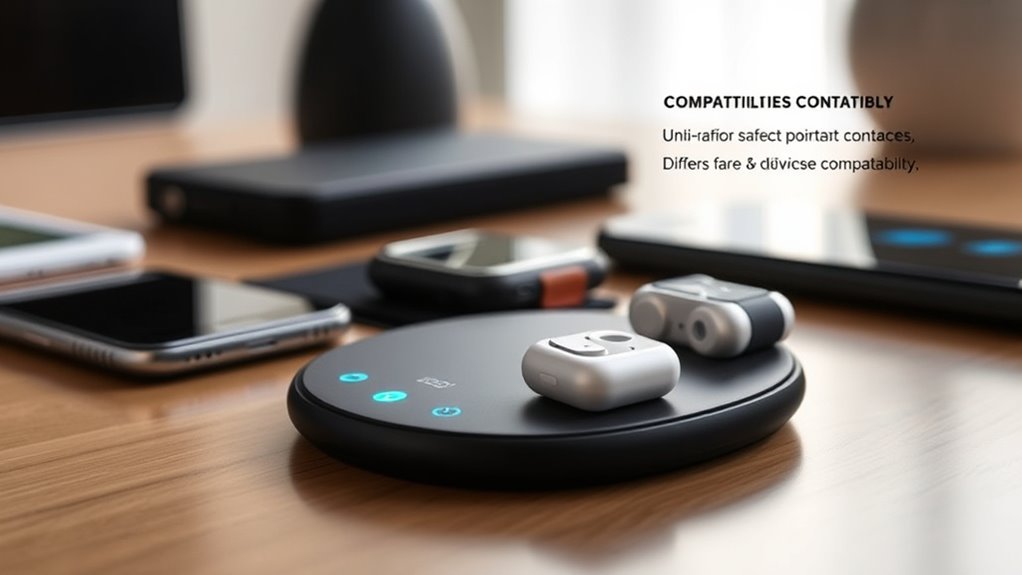
You’ll find that Qi2 technology works seamlessly across a wide variety of devices, from smartphones to wearables, ensuring broad compatibility. It supports multiple platforms, so whether you use Android or iPhone, your device can charge effortlessly. This unified approach simplifies your charging setup by reducing the need for different cables and chargers, creating a truly integrated ecosystem. Additionally, the technology’s compatibility with essential oils highlights its adaptability to various user needs and environments.
Broad Device Compatibility
Because Qi2 technology is designed for broad device compatibility, it works seamlessly across a diverse range of gadgets, including smartphones, wearables, and tablets. You won’t need separate chargers or cables for each device, simplifying your charging setup. Qi2 maintains backward compatibility with older Qi standards, so your existing devices can still benefit from improved performance. As a user, you’ll find that most Android smartphones, iPhones, smartwatches, wireless earbuds, and tablets are supported, thanks to the extensive ecosystem of over 13,000 Qi Certified products. This wide compatibility ensures you can charge multiple device types with a single charger, reducing clutter and confusion. Recognizing these standards can help you identify compatible devices more easily. Additionally, standardization efforts promote consistent performance and safety across compatible products, giving you peace of mind while charging. The standard’s future-proof design ensures ongoing support and improvements, making it a reliable choice for years to come. This approach also fosters consumer confidence by encouraging manufacturers to adhere to high safety and performance benchmarks, ensuring reliable operation. With support from major manufacturers like Apple, Samsung, and Xiaomi, you gain confidence in the standard’s reliability and long-term viability.
Cross-Platform Integration
Wireless charging with Qi2 technology offers seamless cross-platform compatibility, enabling a single charger to work across a diverse array of devices. You can charge your Android smartphones, iPhones, wearables, earbuds, and tablets without switching chargers or cables. Qi2 maintains backwards compatibility with older Qi devices, so your existing gadgets still benefit from improved performance. Support from over 13,000 certified products and more than 351 manufacturers worldwide ensures broad device coverage. This universal compatibility simplifies your charging setup, reducing clutter and the need for multiple chargers. Whether you own Apple, Samsung, Google, or Huawei devices, Qi2’s design ensures reliable, efficient power transfer across various brands and models. This integration makes wireless charging more convenient, versatile, and accessible for all your devices. Additionally, the standardized design facilitates easier integration into a variety of product types, enhancing overall user experience. Moreover, the interoperability between devices and chargers minimizes the need for multiple accessories, streamlining your tech ecosystem. Supporting a wide range of device types and brands also helps ensure compliance with privacy policies, data protection standards, and security protocols, giving users confidence in their wireless charging experience. This comprehensive approach promotes trust and peace of mind for consumers.
Simplified Charging Ecosystem
The widespread adoption of Qi2 technology creates a simplified charging ecosystem by supporting a vast array of devices from different brands and categories. You no longer need separate chargers or cables for your phone, smartwatch, earbuds, or tablet. Qi2’s backward compatibility guarantees that older Qi devices still work seamlessly, while newer devices benefit from enhanced power and efficiency. Over 13,000 certified products currently serve a wide range of brands like Apple, Samsung, Google, and Huawei, making charging more universal. This compatibility reduces clutter and confusion, streamlines your daily routine, and offers peace of mind knowing your devices are supported across different platforms. With a unified standard, you can confidently charge multiple devices with a single, reliable solution, simplifying your tech ecosystem.
Underlying Inductive Charging Technology Foundations
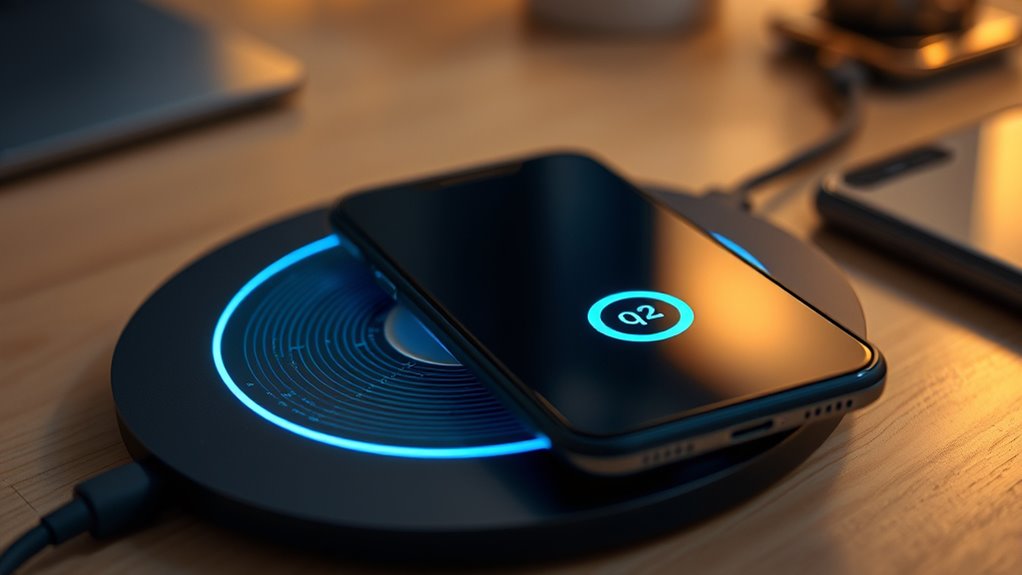
Wireless charging relies on electromagnetic fields generated by a charging pad to transfer energy. Your device’s receiver coil then converts this electromagnetic energy into electrical power to recharge the battery. This process is based on the fundamental principles of standard inductive technology, ensuring a reliable transfer of power.
Electromagnetic Field Generation
Electromagnetic field generation forms the core of inductive charging technology, enabling power transfer without direct electrical contacts. When you place your device on a compatible charging pad, the pad’s coil generates an alternating electromagnetic field through an oscillating current. This field extends into the space between the charger and your device. Inside your device, a receiver coil detects this fluctuating magnetic field and converts it back into electrical energy. The efficiency of this process depends on the strength and stability of the electromagnetic field, which Qi2 enhances through optimized coil design and frequency control. This foundation allows for safe, contactless charging over short distances, reducing wear on connectors and providing a reliable power transfer method that’s essential for modern wireless charging systems.
Receiver Coil Conversion
Receiver coils in your device play a crucial role in converting the electromagnetic field generated by the charging pad into usable electrical energy. When you place your device on a Qi2-compatible charger, the coil captures the magnetic flux and induces an alternating current. This process relies on electromagnetic induction, where changing magnetic fields generate electrical energy within the coil. Advanced receiver coils are designed with optimized winding patterns and materials to maximize energy transfer efficiency. They also feature precise tuning to match the transmitter’s frequency, reducing energy loss. This conversion process is essential for delivering stable, safe power to your device’s battery. The design improvements in coil technology ensure better alignment tolerance and higher charging speeds, making wireless charging more reliable and effective.
Standard Inductive Principles
At the core of inductive charging lies a well-established principle: when an alternating current flows through a coil in the charging pad, it creates a fluctuating magnetic field. This magnetic field induces a current in the receiver coil within your device, converting magnetic energy into electrical energy to charge the battery. This process relies on precise alignment and frequency tuning to maximize efficiency and safety. Magnetic coupling allows the transfer over short distances, typically up to 4 cm. The technology’s foundation remains consistent from earlier standards but now incorporates advanced features like magnetic alignment and higher power levels to improve speed and reliability.
| Component | Function | Key Feature |
|---|---|---|
| Transmitter Coil | Creates magnetic field when energized | Alternating current source |
| Receiver Coil | Converts magnetic field into electrical current | Device receives power |
| Magnetic Alignment | Ensures proper coil positioning for efficiency | Magnet-based attachment |
Future Scalability and Upgraded Power Capabilities
As wireless charging technology advances, future scalability is built into the Qi2 standard to support higher power levels and faster charging speeds. You can expect Qi2 to handle up to 25W in upcoming versions, markedly reducing charging times for your devices. This scalability is achieved through flexible infrastructure that accommodates increased power without compromising safety or efficiency. The design includes upgraded communication protocols and magnetic alignment features that ensure reliable power transfer at higher wattages. As technology evolves, Qi2’s architecture will enable seamless integration of even faster charging capabilities, allowing your devices to recharge more quickly and efficiently. This forward-looking approach ensures that your wireless charging setup remains compatible with future device demands, providing a scalable solution that grows with your needs.
Global Standards and Market Adoption Efforts

Global standards play a essential role in guaranteeing that wireless charging devices are safe, reliable, and compatible across different brands and regions. They foster innovation and consumer confidence by establishing clear benchmarks. Here’s how efforts are advancing market adoption:
- Over 13,000 Qi Certified products ensure quality and safety across diverse devices.
- 351 manufacturers, including Apple, Samsung, and Google, actively adopt the Qi standard.
- Compatibility spans Android phones, iPhones, wearables, and tablets, simplifying your charging options.
- Rigorous testing in independent labs guarantees devices meet global safety, efficiency, and interoperability standards.
These initiatives promote widespread adoption, making wireless charging more accessible and trustworthy for consumers worldwide.
Frequently Asked Questions
How Does Qi2 Prevent Overheating During Wireless Charging?
You can trust Qi2 to prevent overheating during wireless charging because it uses advanced protection systems that monitor temperature constantly. When it detects excessive heat, it automatically reduces power output or pauses charging to keep everything safe. These safety features are tested rigorously and meet global standards, protecting both your device and battery. By doing so, Qi2 guarantees efficient, reliable charging without risking damage from overheating.
What Safety Tests Are Performed Before Qi2 Certification Approval?
Imagine a fortress protecting your device—that’s what Qi2’s safety tests do. Before certification, your product undergoes rigorous evaluations in independent labs, including tests for overheating, short circuits, and electrical stability. They check the safety systems, confirm compliance with strict standards, and verify interoperability across devices. Only after passing these intense assessments does your charger earn the Qi2 logo, guaranteeing it’s safe, reliable, and ready to power your devices efficiently.
Can Qi2 Chargers Charge Multiple Devices Simultaneously?
Yes, Qi2 chargers can charge multiple devices simultaneously, thanks to their advanced power distribution technology. You simply place your devices on the designated charging areas, and the charger intelligently allocates power to each device based on their needs. This means you can efficiently charge your smartphone, earbuds, and smartwatch at the same time without sacrificing speed or safety. Just guarantee your devices are Qi2 compatible for ideal performance.
How Does Magnetic Alignment Improve Charging Efficiency?
Imagine two puzzle pieces fitting perfectly together—that’s how magnetic alignment boosts your charging efficiency. By ensuring your device lines up precisely with the charger, less energy is wasted, and power transfer becomes more effective. The magnets act like guiding hands, gently snapping your device into the best position. This reliable connection minimizes interruptions, speeds up charging, and guarantees your device gets the full power it needs without fuss or fussing.
Are Qi2 Compatible With Older Qi-Certified Devices?
Yes, Qi2 is compatible with older Qi-certified devices. You’ll find that Qi2 maintains backwards compatibility, so your existing Qi devices will still work with Qi2 chargers. However, for the best performance and faster charging speeds, newer Qi2-certified devices are recommended. This compatibility guarantees you can upgrade your charger without needing to replace all your devices, making the shift seamless and cost-effective.
Conclusion
With Qi2’s advanced safety features and rigorous standards, you can confidently enjoy faster, more efficient wireless charging. Some might worry about compatibility or safety risks, but Qi2’s innovative design guarantees broad device support and dependable protection. By prioritizing both performance and safety, Qi2 sets a new standard in wireless charging that’s reliable now and ready for future upgrades. Embrace this technology and experience seamless, safe power whenever you need it.