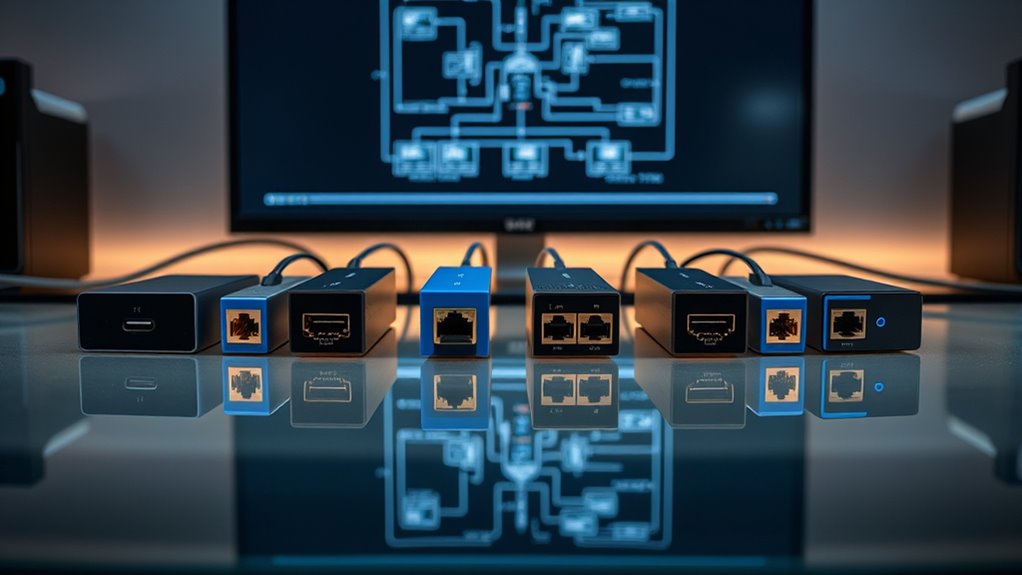

The best USB over Ethernet extender depends less on the headline distance than on how many devices you need to connect, how much bandwidth they consume, and whether power is available at the remote end. My top choice, the AV Access USB 2.0 4-Port Extender, balances a 196-foot reach with four ports and full USB 2.0 bandwidth. For a longer run, the OREI 330ft Extender is the stronger fit, while the OREI 165ft two-port model covers simpler keyboard, mouse, and printer installations without paying for four outputs.

Get the latest gadgets delivered free with Prime
- Fast, free delivery on millions of items
- Prime Video, Amazon Music and more included
- Member-only deals all year
The main tradeoffs are distance versus convenience and passive simplicity versus powered reliability. Small passive adapters are inexpensive and easy to place, but performance depends heavily on cable quality and the attached device. Powered kits cost more and need an outlet, yet they are better equipped for multiple peripherals and demanding installations. I ranked these picks by practical connectivity, usable distance, USB standard, power design, platform support, and how clearly each model serves a different buyer.
Complete the kit



Key Takeaways
- The AV Access kit ranks first because its four-port hub, 196-foot range, and stated 480Mbps USB 2.0 support cover the widest mix of remote peripherals.
- The OREI 330ft model is the distance leader, but its powered receiver and two-port limit make it more specialized than the AV Access kit.
- The OREI 165ft two-port extender offers a useful middle ground for paired desktop peripherals without the cost or bulk of a four-port system.
- The passive B08FMLGNQN adapter is the value choice, though cable quality and peripheral power demands can have a larger effect on stability.
- The Monoprice model belongs with low-bandwidth USB 1.0 or 1.1 equipment; buyers needing USB 2.0 throughput should choose one of the first three picks.
| AV Access USB Over Ethernet Extender Kit, USB 2.0 480Mbps, 4-Port Hub |  | Best Overall | Maximum Distance: 60m (196ft) | USB Standard: USB 2.0 | Maximum Stated Speed: 480Mbps | VIEW ON AMAZON | See Our Full Breakdown |
| OREI USB Extender Over Ethernet 330ft USB 2.0 2-Port CAT6/7 ESD Protection |  | Best for Long Distances | Maximum Distance: 330ft | USB Standard: USB 2.0 | Remote USB Ports: 2 | VIEW ON AMAZON | See Our Full Breakdown |
| OREI USB Over Cat5e/6 Extender 165ft PoC USB 2.0 Over Ethernet with 2 Ports |  | Best for Two-Device Workstations | Maximum Distance: 165ft (listed as 40m) | USB Standard: USB 2.0 | Remote USB Ports: 2 | VIEW ON AMAZON | See Our Full Breakdown |
| USB Over Cat6 Extender 2 Pairs RJ45 for Camera Printer Mouse |  | Best Value Passive Extender | Maximum Distance: Up to 150ft | Cable Compatibility: Cat5, Cat5e, Cat6, Cat7, Cat8 | External Power: Not required | VIEW ON AMAZON | See Our Full Breakdown |
| Monoprice USB Extender over CAT5E or CAT6 Connection up to 150ft |  | Best for Legacy USB Devices | Maximum Distance: 150ft | USB Compatibility: USB 1.0 and 1.1 | Cable Types: Cat5e or Cat6 | VIEW ON AMAZON | See Our Full Breakdown |
| usb over ethernet extender | Maximum Distance | USB Standard | Remote USB Ports |
|---|---|---|---|
| AV Access USB Over Ethernet Ex | 60m (196ft) | USB 2.0 | 4 |
| OREI USB Extender Over Etherne | 330ft | USB 2.0 | 2 |
| OREI USB Over Cat5e/6 Extender | 165ft (listed as 40m) | USB 2.0 | 2 |
| USB Over Cat6 Extender 2 Pairs | Up to 150ft | — | — |
| Monoprice USB Extender over CA | 150ft | — | — |
More Details on Our Top Picks
AV Access USB Over Ethernet Extender Kit, USB 2.0 480Mbps, 4-Port Hub
Ranked No. 1, the AV Access USB 2.0 Extender offers the most flexible balance in this group. Its receiver acts as a four-port hub, so one Cat cable can carry a keyboard, mouse, printer, and another compatible peripheral to a workstation up to 60 meters away. The stated 480Mbps USB 2.0 link makes it a better match for mixed-device setups than the USB 1.1 Monoprice model, and the extra ports give it a wider role than either two-port OREI kit.
I place it ahead of the 330-foot OREI because most buyers gain more from four remote ports than from an additional 134 feet of range. Its included 12V adapter also suits installations where several devices share the receiver. The compromises are physical and technical: power must be available at the far end, the Ethernet cable is not included, and USB 3.x storage speeds are out of reach. Buyers connecting high-bandwidth cameras or drives should also budget headroom rather than assuming every device can saturate the shared link simultaneously.
Pros:- Four-port receiver supports several peripherals from one cable run
- Stated 480Mbps USB 2.0 bandwidth suits more than basic keyboard and mouse use
- Extends the connection up to 60 meters or 196 feet
- Works across Windows, macOS, Linux, and Android without a dedicated driver
Cons:- Requires the included 12V power adapter at the installation
- Does not provide USB 3.0 or faster performance
- Shared bandwidth may constrain several demanding devices used together
Best for: Control rooms, conference spaces, KVM setups, and surveillance stations needing several USB 2.0 peripherals at one remote location
Not ideal for: Buyers needing USB 3.x throughput, a run beyond 196 feet, or a receiver location without AC power
- Maximum Distance:60m (196ft)
- USB Standard:USB 2.0
- Maximum Stated Speed:480Mbps
- Remote USB Ports:4
- Power:12V adapter included
- Compatible Systems:Windows, macOS, Linux, Android
- Setup:Plug and play
- Typical Applications:AV, KVM, and surveillance
Our verdict“This is my first choice for buyers who want the strongest mix of port capacity, USB 2.0 speed, and practical long-range coverage.”
OREI USB Extender Over Ethernet 330ft USB 2.0 2-Port CAT6/7 ESD Protection
Ranked No. 2, the OREI 330ft Extender is the clear distance specialist. Its rated 330-foot reach is substantially longer than the 196-foot AV Access kit and more than double the range of the passive 150-foot options. That extra cable allowance can solve placement problems across large training rooms, production floors, houses of worship, or buildings where the computer and USB controls cannot sit close together. ESD protection adds appeal in permanent installations where equipment may be handled or recabled.
The longer reach does not make it the best pick for everyone. Its receiver supplies two USB 2.0 ports, compared with four on the AV Access model, and it requires power at the receiver. I would choose it when cable length is the deciding constraint, not simply because its maximum is highest. Support for Windows, macOS, Android, and Linux gives it broad platform coverage, while the international adapter adds travel or cross-region flexibility. Still, one transmitter source and a 12-month warranty make this a focused installation tool rather than the most versatile package.
Pros:- Longest stated range in the lineup at 330 feet
- Two USB 2.0 ports support paired remote peripherals
- ESD protection suits fixed AV and commercial installations
- Broad operating-system support and an international power adapter
Cons:- Only two remote ports compared with four on the AV Access kit
- Receiver requires external power
- Limited to one source connection at the transmitter
Best for: Large rooms, commercial installations, and equipment racks requiring a USB 2.0 run longer than 200 feet
Not ideal for: Four-device workstations, unpowered remote locations, or buyers whose cable run is short enough for a smaller kit
- Maximum Distance:330ft
- USB Standard:USB 2.0
- Remote USB Ports:2
- Recommended Cabling:Cat6 or Cat7
- Supported Systems:Windows, macOS, Android, Linux
- Receiver Power:Required
- Protection:ESD protection
- Warranty:12 months
- Power Adapter:Dual-voltage US plug with international adapter
Our verdict“I recommend this OREI model when reaching 200 to 330 feet matters more than having a four-port remote hub.”
OREI USB Over Cat5e/6 Extender 165ft PoC USB 2.0 Over Ethernet with 2 Ports
The third-ranked OREI 165ft model fits the common middle case: two USB peripherals at a desk, lectern, kiosk, or printer station. Its two-port USB 2.0 receiver can handle a keyboard and mouse or another modest pairing without adding a separate hub. At 165 feet, it reaches 15 feet farther than the two basic adapters while remaining aimed at smaller spaces than the 330-foot OREI.
Compared with the AV Access kit, this model gives up two ports and 31 feet of stated range. In return, it presents a simpler choice for buyers who know they will connect only one or two devices. The plug-and-play design avoids a driver installation, but USB 2.0 remains the ceiling, and the supplied specifications list AC input, so power planning belongs in the installation checklist. I rank it above the passive value pick because its two outputs and defined Cat5e/6 application are better suited to a planned workstation. Buyers with future expansion in mind should spend more on AV Access rather than adding another hub later.
Pros:- Two remote ports suit common keyboard-and-mouse pairings
- Carries USB 2.0 connections up to 165 feet
- No driver installation is required
- Uses widely available Cat5e or Cat6 cabling
Cons:- Offers half the remote port count of the AV Access model
- Range is far shorter than the 330-foot OREI kit
- USB 3.x devices cannot operate at their full rated speed
Best for: Remote desks, teaching lecterns, kiosks, and printer stations with exactly one or two USB 2.0 peripherals
Not ideal for: Installations likely to grow beyond two devices or those requiring more than 165 feet of cable
- Maximum Distance:165ft (listed as 40m)
- USB Standard:USB 2.0
- Remote USB Ports:2
- Cable Support:Cat5e or Cat6
- Setup:Plug and play
- Driver Requirement:None
- Listed Input:120V AC
- Compatible Devices:Desktop, keyboard, mouse, printer
Our verdict“This is my practical middle pick for a two-peripheral station that does not need the range or capacity of the higher-ranked kits.”
USB Over Cat6 Extender 2 Pairs RJ45 for Camera Printer Mouse
Ranked No. 4, this passive USB over Cat adapter pair has the lowest-complexity proposition: connect the sender and receiver with suitable network cable, with no external power supply or driver. Its compatibility list spans Cat5 through Cat8 cabling and several operating-system generations. That makes it appealing for a basic camera, printer, keyboard, mouse, or scanner connection where low cost and compact hardware matter more than firm performance guarantees.
The simplicity carries more uncertainty than the powered OREI and AV Access kits. The manufacturer calls for high-quality cable beyond 30 feet, and actual behavior can vary with the peripheral and cable. A bus-powered hard drive or bandwidth-heavy webcam may be less predictable than a keyboard or mouse. Although the claimed 150-foot reach approaches the Monoprice model, this pick supports a broader stated device range and newer operating systems. I rank it above Monoprice for that flexibility, but below the powered products because it lacks a multiport remote hub and gives the installer fewer tools for handling power-hungry devices.
Pros:- No external power adapter is required
- Driver-free setup keeps installation simple
- Rated for runs up to 150 feet
- Accepts cable categories from Cat5 through Cat8
Cons:- Long-run stability depends heavily on cable quality
- Performance can vary by device type and power demand
- Does not provide the multiport hub found on the three higher-ranked kits
Best for: Budget buyers extending one low-power USB peripheral through a home, office, or classroom
Not ideal for: Mission-critical links, multi-device stations, or high-draw storage and camera hardware that may need stable remote power
- Maximum Distance:Up to 150ft
- Cable Compatibility:Cat5, Cat5e, Cat6, Cat7, Cat8
- External Power:Not required
- Driver Requirement:None
- Windows Support:Windows 98 through Windows 11
- Mac Support:Mac OS 8.6 or later
- Device Examples:Cameras, printers, webcams, keyboards, mice, scanners
- Long-Run Cable Guidance:High-quality cable recommended beyond 30ft
Our verdict“I favor this inexpensive passive pair for one light-duty peripheral, provided the buyer accepts more cable- and device-dependent performance.”
Monoprice USB Extender over CAT5E or CAT6 Connection up to 150ft
Ranked No. 5, the Monoprice USB Extender makes sense when the attached hardware is already limited to USB 1.0 or 1.1. Its 150-foot rating is sufficient for control peripherals, older printers, game-console accessories, and other low-bandwidth equipment. A lifetime warranty distinguishes it from the 12-month coverage listed for the long-range OREI and may reassure buyers planning a permanent basic connection.
Speed is the reason it sits last. USB 1.1 is far less capable than the USB 2.0 links offered by AV Access and both OREI choices, making this the weakest selection for modern webcams, scanners, and storage. It also lacks the four-port convenience of the overall winner. Compared with the other passive 150-foot adapter, Monoprice has the advantage of named warranty support, but its explicitly limited USB standard narrows the audience. I would buy it for a known low-speed device rather than as a general-purpose extender; otherwise, the small saving in system demands is outweighed by reduced bandwidth and less room for future hardware changes.
Pros:- Extends compatible USB connections up to 150 feet
- Works with common Cat5e and Cat6 cable
- Suitable for a range of low-bandwidth legacy peripherals
- Backed by a Monoprice lifetime warranty
Cons:- Limited to USB 1.0 and 1.1 speeds
- Poor fit for bandwidth-heavy contemporary devices
- No integrated multiport remote hub
Best for: Older printers, keyboards, mice, controllers, and other confirmed USB 1.0 or 1.1 devices
Not ideal for: Modern cameras, fast scanners, storage devices, or anyone seeking USB 2.0 performance
- Maximum Distance:150ft
- USB Compatibility:USB 1.0 and 1.1
- Cable Types:Cat5e or Cat6
- Suitable Devices:Keyboards, mice, printers, cameras, game-console accessories
- Primary Use:Low-bandwidth USB extension
- Network Cable Required:Yes
- Warranty:Monoprice lifetime warranty
Our verdict“This is my legacy-device pick, but almost any buyer needing USB 2.0 bandwidth should move higher in the ranking.”

How We Picked
I ranked these products around the decisions that shape a real USB extension installation. Usable cable distance came first, but I did not treat the largest number as an automatic win. A 330-foot kit is valuable in a warehouse, classroom, or equipment room, while it adds little to a 40-foot desk installation. I also weighed USB generation and port count, because a mouse consumes very little bandwidth while a webcam, scanner, or group of peripherals places greater demands on the link.
Power architecture also influenced my order. Passive models remove the need for a remote outlet, making them attractive for light-duty devices, but they depend more on host power, cable construction, and peripheral behavior. Powered receivers are less tidy yet make more sense for multi-device installations. I compared operating-system support, setup requirements, cable categories, protection features, and warranty information where supplied. Finally, I gave each extender a distinct job and ranked it against the others: broadest everyday utility first, exceptional distance second, simpler two-device use third, budget passive extension fourth, and legacy low-speed use fifth. These rankings rely on the supplied specifications rather than claims of hands-on testing.
Factors to Consider When Choosing Usb Over Ethernet Extender
I would choose a USB over Ethernet extender by working backward from the peripheral, cable route, and remote location. Distance alone does not tell me whether a kit will perform well.USB Speed and Device Type
I start with the attached device. A keyboard or mouse sends little data, so USB 1.1 may be adequate. Printers and basic control interfaces are also often forgiving. Webcams, scanners, audio interfaces, and storage devices place more pressure on the link, making USB 2.0 at up to 480Mbps the safer baseline among these five products. None of the picks provides native USB 3.x speed, so I would not select them for a workflow built around fast external SSD transfers.
Distance, Cable Quality, and Topology
A range claim assumes suitable cabling and a straightforward run. I would measure the actual route, including vertical sections and service loops, then leave some margin below the rated maximum. Solid-copper Cat5e or Cat6 cable is a sensible default for fixed runs. These products use Ethernet-style cable as a signal medium, but they are generally point-to-point extenders, not ordinary network devices. I would not connect them through a router or network switch unless the manufacturer explicitly describes IP-network operation.
Remote Power and Port Count
Passive extenders are appealing when no outlet exists near the peripheral, yet the USB host must supply power through the system. That can be troublesome for drives, cameras, and several devices at once. A powered receiver offers more predictable capacity, though it adds an adapter and outlet requirement. I would also buy enough ports for the expected setup: two ports suit a keyboard-and-mouse pair, while four ports reduce hub clutter at a shared workstation.
Compatibility and Installation Risk
Broad operating-system listings are useful, but device compatibility is more than an OS checkbox. USB extenders may behave differently with isochronous video or audio, encrypted peripherals, and hardware that draws substantial current. I would confirm support for the exact device class, especially in a commercial installation. For a cable hidden in a wall, I would also favor powered hardware with protection features and keep connectors accessible for troubleshooting. The cheapest passive adapter is better treated as a light-duty, replaceable link than the backbone of a mission-critical system.
Frequently Asked Questions
Does a USB over Ethernet extender work through a router or network switch?
Usually not. Most products in this roundup use Cat cable for a direct point-to-point connection between transmitter and receiver; they do not convert USB traffic into standard routable network data. I would run a dedicated cable between both units and avoid inserting a router, switch, or active network equipment. A true USB-over-IP product is the better category when the signal must travel across an existing LAN.
Can I use an existing Cat6 cable in the wall?
Yes, provided the cable offers a continuous dedicated path and its terminations are sound. Wall jacks and patch panels can add connection points, so I would count the full route and keep it under the extender’s distance rating. I would also verify that the cable is not connected to network equipment. For longer passive runs, better cable construction can make the difference between stable operation and intermittent device detection.
Will these extenders work with webcams and external hard drives?
Some may, but those devices are more demanding than keyboards and mice. A webcam needs sustained bandwidth, while a hard drive may draw considerable bus power. I would favor a powered USB 2.0 kit, such as AV Access or either OREI model, and check the peripheral’s power and compatibility requirements. Even then, the link remains USB 2.0, so a USB 3.x drive will run below its native speed if it connects successfully.
Is Cat7 or Cat8 cable better than Cat6 for USB extension?
Not automatically. The extender’s electronics and supported distance remain the limiting factors, so a higher cable category does not turn a USB 2.0 product into a faster system. I would normally choose good-quality Cat6 unless the manufacturer calls for something else. Proper conductors, termination quality, route length, and freedom from cable damage matter more than buying the highest category printed on a package.
How many USB devices can I connect at the remote end?
The built-in port count provides the clearest answer: four for AV Access and two for the OREI models in this lineup. Adding a separate hub may exceed available power or divide bandwidth among too many devices, so I would not assume unlimited expansion. A four-port powered receiver is the cleaner choice for several peripherals, while a two-port model is enough for a keyboard and mouse. Passive single-device links are best kept simple.
Conclusion
For the widest range of buyers, I recommend the AV Access 4-Port Extender; it combines USB 2.0 bandwidth, a 196-foot reach, and enough ports for a complete remote station. Buyers covering a very large room or building should choose the OREI 330ft model, accepting two ports and a powered receiver in exchange for the longest cable run. For a basic two-device desk, the OREI 165ft extender is the more proportionate purchase.
Budget installations with one low-power peripheral are better matched to the passive B08FMLGNQN adapter pair, provided cable quality and device variability are acceptable. I would reserve the Monoprice USB 1.1 extender for known legacy hardware where speed is not a concern. My final choice would follow the device’s bandwidth and power needs first, then port count and distance; that order prevents an impressive range figure from masking a poor fit.
Halloween Picks
halloween
As an affiliate, we earn on qualifying purchases.