Triband mesh WiFi systems are designed to deliver faster, more reliable internet by utilizing three frequency bands—usually two 5 GHz and one 2.4 GHz—helping to reduce congestion and improve performance. The TP-Link Deco 7 Pro BE14000 stands out as the overall best choice, thanks to its robust WiFi 7 support and extensive coverage. For those seeking cutting-edge technology, the ASUS ZenWiFi AX6600 offers impressive speeds with WiFi 6E. Meanwhile, the NETGEAR Orbi RBK652S provides a solid balance of performance and ease of setup. The main tradeoffs in this category involve balancing coverage, speed, and future-proofing against higher costs and complexity. Keep reading for a detailed comparison to find the best triband mesh WiFi for your needs.
Play games included with Prime
Start a Prime free trial and play with Amazon Luna on your devices.
Start playingAs an affiliate, we earn on qualifying purchases.
Complete the kit



Key Takeaways
- The best systems leverage WiFi 6E or WiFi 7 for future-proofing and maximum speeds.
- Coverage varies significantly; larger homes benefit from systems with multiple extenders or nodes.
- Tri-band configurations generally outperform dual-band setups in congested environments, but at a higher price point.
- Ease of setup and management can differ, with premium models offering more user-friendly apps and features.
- Wired backhaul options improve stability and speed, particularly in larger or complex layouts.
| TP-Link Deco 7 Pro BE14000 Tri-Band Wi-Fi 7 Whole Home Mesh System (3-Pack) |  | Best Overall for Large Homes with Future-Proof Connectivity | Wi-Fi Standard: Wi-Fi 7 | Total Speed: 14 Gbps | Coverage: 8,100 sq.ft. | VIEW ON AMAZON | See Our Full Breakdown |
| TP-Link Deco XE75 AXE5400 Tri-Band WiFi 6E Mesh System – 2 Pack |  | Best for Reduced Interference and Easy Setup in Medium Homes | Coverage: 5500 sq.ft. | WiFi Bands: Tri-Band (6 GHz, 5 GHz, 2.4 GHz) | Maximum Speed: 5400 Mbps | VIEW ON AMAZON | See Our Full Breakdown |
| TP-Link Tri-Band WiFi 7 Router (Archer BE550) with 6 Streams and 2.5G Ports |  | Best for Gaming and Streaming with Advanced Ports | WiFi Bands: Tri-Band | Max Speed: 5760 Mbps | Antennas: 6 internal | VIEW ON AMAZON | See Our Full Breakdown |
| NETGEAR Orbi Whole Home Tri-Band Mesh WiFi 6 System (RBK652S) – Router + 1 Satellite Extender |  | Best for Simplicity and Reliable Coverage in Medium Homes | Coverage: Up to 3,500 sq.ft. | Speed: AX3000 | Device Support: 40 devices | VIEW ON AMAZON | See Our Full Breakdown |
| ASUS ZenWiFi BT6 WiFi 7 Mesh Router – Tri-Band, 5.8k sq. ft. (2 Pack) |  | Best for Extensive Coverage with Advanced Security | WiFi Standard: WiFi 7 | Speed: Up to 9.4 Gbps | Coverage: 5800 sq.ft. | VIEW ON AMAZON | See Our Full Breakdown |
| NETGEAR Orbi 770 Series Tri-Band WiFi 7 Mesh Network System (RBE773) – Router + 2 Satellite Extenders |  | Best Overall for Large Homes and High-Speed Needs | WiFi Standard: WiFi 7 | Speed: up to 11Gbps | Coverage: 8,000 sq. ft. | VIEW ON AMAZON | See Our Full Breakdown |
| TP-Link Deco 7 BE23 Dual-Band BE3600 WiFi 7 Mesh Wi-Fi System | 4-Stream 3.6 Gbps, 160 Mhz | Covers up to 6,500 Sq.Ft | 2× 2.5G Ports Wired Backhaul | VPN,MLO,AI-Roaming, HomeShield, 3-Pack |  | Best Value for Fast Coverage in Medium to Large Homes | WiFi Speed: up to 3.6 Gbps | Coverage: up to 6,500 sq. ft. | Device Support: 150 devices | VIEW ON AMAZON | See Our Full Breakdown |
| TP-Link AXE5400 Tri-Band WiFi 6E Router (Archer AXE75) |  | Best for Tech Enthusiasts Wanting Cutting-Edge WiFi 6E | WiFi Speed: up to 5400 Mbps | Bands: Tri-Band (6 GHz, 5 GHz, 2.4 GHz) | 6 GHz Speed: 2402 Mbps | VIEW ON AMAZON | See Our Full Breakdown |
| ASUS ZenWiFi AX6600 Tri-Band Mesh WiFi 6 System (XT8 2PK) |  | Best for Whole-Home Coverage with Ease of Use | Maximum Range: 5500 sq.ft. | Wireless Speed: 6600 Mbps | Technology: WiFi 6 | VIEW ON AMAZON | See Our Full Breakdown |
| TP-Link Deco XE75 Pro AXE5400 Tri-Band WiFi 6E Mesh System – 2-Pack |  | Best for Cutting-Edge WiFi 6E Mesh Coverage | WiFi Bands: Tri-Band (6 GHz, 5 GHz, 2.4 GHz) | Coverage: up to 5500 sq.ft. | Maximum Speed: 5400 Mbps | VIEW ON AMAZON | See Our Full Breakdown |
| TP-Link Deco AXE5400 Tri-Band WiFi 6E Mesh System (Deco XE75 Pro) – 3-Pack, 2.5G WAN/LAN Port, Covers up to 7200 Sq.Ft, AI-Driven Mesh, New 6GHz Band (Renewed) | 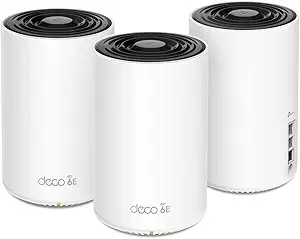 | Best for Extensive Tri-Band Coverage with Future-Proof Speeds | Coverage: 7200 sq.ft | Number of Units: 3 | Ports: 1x 2.5 Gbps WAN, 2x Gigabit LAN per unit | VIEW ON AMAZON | See Our Full Breakdown |
| triband mesh wifi | Coverage | Number of Units | Security |
|---|---|---|---|
| TP-Link Deco 7 Pro BE14000 Tri | 8,100 sq.ft. | 3 | HomeShield |
| TP-Link Deco XE75 AXE5400 Tri- | 5500 sq.ft. | 2 | TP-Link HomeShield |
| TP-Link Tri-Band WiFi 7 Router | Up to 2,000 sq.ft. | — | WPA3, HomeShield |
| NETGEAR Orbi Whole Home Tri-Ba | Up to 3,500 sq.ft. | — | NETGEAR Armor |
| ASUS ZenWiFi BT6 WiFi 7 Mesh R | 5800 sq.ft. | 2 | AiProtection Pro |
| NETGEAR Orbi 770 Series Tri-Ba | 8,000 sq. ft. | Router + 2 Satellite Extenders | — |
| TP-Link Deco 7 BE23 Dual-Band | up to 6,500 sq. ft. | 3-Pack | HomeShield |
| TP-Link AXE5400 Tri-Band WiFi | — | — | — |
| ASUS ZenWiFi AX6600 Tri-Band M | — | 2 | Lifetime internet security |
| TP-Link Deco XE75 Pro AXE5400 | up to 5500 sq.ft. | 2 | — |
| TP-Link Deco AXE5400 Tri-Band | 7200 sq.ft | 3 | TP-Link HomeShield |
More Details on Our Top Picks
TP-Link Deco 7 Pro BE14000 Tri-Band Wi-Fi 7 Whole Home Mesh System (3-Pack)
The Deco 7 Pro BE14000 stands out for its remarkable Wi-Fi 7 support, delivering up to 14 Gbps across a wide coverage of 8,100 sq.ft., making it ideal for sprawling residences. Compared with the ASUS ZenWiFi BT6, which offers slightly higher speeds but less coverage, this system prioritizes extensive reach and high throughput, suitable for large families or multi-device environments. Its wired backhaul with 10 Gbps ports enhances stability, yet the setup can be complex for less tech-savvy users, and the premium features may require a subscription. For those needing robust, future-ready infrastructure, this mesh system offers unmatched speed and coverage but at a higher cost and setup effort.
Pros:- Exceptional Wi-Fi 7 speeds up to 14 Gbps for demanding tasks
- Massive coverage of over 8,000 sq.ft., ideal for large homes
- Multiple multi-gigabit ports support high-speed wired devices
- Seamless AI-driven roaming ensures stable connectivity
Cons:- Requires a separate modem, adding complexity and cost
- Setup can be challenging for non-technical users
- Premium features may necessitate subscription fees
Best for: Homeowners with large properties seeking high-speed, reliable Wi-Fi 7 coverage and multiple wired connections
Not ideal for: Small apartments or users on a tight budget who won’t utilize the full Wi-Fi 7 capabilities or extensive coverage
- Wi-Fi Standard:Wi-Fi 7
- Total Speed:14 Gbps
- Coverage:8,100 sq.ft.
- Number of Devices:200+
- WAN/LAN Ports:10 Gbps, 2.5 Gbps, 1 Gbps
- Number of Units:3
- Backhaul:10 Gbps wired backhaul
- Security:HomeShield
Our verdict“This system is best suited for large, tech-savvy households willing to invest in future-proof connectivity and extensive coverage.”
TP-Link Deco XE75 AXE5400 Tri-Band WiFi 6E Mesh System – 2 Pack
The Deco XE75 AXE5400 makes a compelling case with its tri-band WiFi 6E support, especially thanks to the 6 GHz band that minimizes interference and boosts speeds up to 5400 Mbps. Compared with the ASUS ZenWiFi BT6, which offers higher speeds but less spectrum, the XE75 offers a smart balance for users who want less congestion and simpler setup. The AI-driven mesh technology ensures reliable coverage across up to 5,500 sq.ft., and the Deco app simplifies network management. However, it still requires a modem for most ISPs, and the price may be a hurdle for budget-conscious buyers. This pick is ideal for those wanting to upgrade to WiFi 6E with straightforward setup and solid performance in medium-sized homes.
Pros:- WiFi 6E with 6 GHz band reduces interference and congestion
- Easy setup via Deco app with voice control compatibility
- Seamless mesh coverage up to 5,500 sq.ft.
- Enhanced security with TP-Link HomeShield
Cons:- Requires a modem for most internet providers
- Price may be high relative to features for some buyers
Best for: Users in medium-sized homes seeking lower interference and easier Wi-Fi 6E adoption
Not ideal for: Very large homes or those demanding ultra-high speeds beyond 5400 Mbps, where more coverage or performance may be needed
- Coverage:5500 sq.ft.
- WiFi Bands:Tri-Band (6 GHz, 5 GHz, 2.4 GHz)
- Maximum Speed:5400 Mbps
- Number of Units:2
- Security:TP-Link HomeShield
Our verdict“This system is well-suited for users wanting easier WiFi 6E deployment with reliable coverage in medium homes, prioritizing interference reduction.”
TP-Link Tri-Band WiFi 7 Router (Archer BE550) with 6 Streams and 2.5G Ports
The Archer BE550 offers high-speed tri-band WiFi 7 performance up to 5760 Mbps, making it ideal for gaming, 4K streaming, and large downloads. Unlike typical mesh systems, it functions as a powerful standalone router with full 2.5G ports, providing a solid backbone for a smaller home or a dedicated gaming setup. While it supports EasyMesh for expansion, this is less integrated than a full mesh system like the Deco XE75. Its complexity might intimidate beginners, and it doesn’t include the seamless coverage of a multi-unit mesh system. For users who prioritize raw speed and port flexibility over mesh coverage, this router provides a reliable, high-performance solution.
Pros:- High-speed tri-band WiFi 7 up to 5760 Mbps
- Full 2.5G ports for fast wired connections
- Supports EasyMesh for expansion
- Strong security with WPA3 and HomeShield
Cons:- Requires a modem, adding setup complexity
- Less suitable for large homes without additional mesh units
- Advanced features might overwhelm beginners
Best for: Gamers, streamers, and tech enthusiasts needing high-speed wired and wireless performance in medium-sized homes
Not ideal for: Large homes requiring extensive mesh coverage or users preferring simple plug-and-play setups
- WiFi Bands:Tri-Band
- Max Speed:5760 Mbps
- Antennas:6 internal
- Coverage:Up to 2,000 sq.ft.
- Ports:1 x 2.5G WAN, 4 x 2.5G LAN
- Security:WPA3, HomeShield
Our verdict“This router is best for tech-savvy users who want maximum speed and port flexibility in a manageable size for medium homes.”
NETGEAR Orbi Whole Home Tri-Band Mesh WiFi 6 System (RBK652S) – Router + 1 Satellite Extender
The Orbi RBK652S provides a straightforward approach to whole-home WiFi with its tri-band WiFi 6 setup, covering up to 3,500 sq.ft. with a router and extender combo. Compared to the Deco XE75, which includes only two units, the Orbi’s dedicated satellite simplifies expansion and ensures stable coverage, though additional satellites are sold separately. It supports up to 40 devices at AX3000 speeds, with strong security via NETGEAR Armor. Its setup is notably easier than configuring a WiFi 7 mesh, making it a strong choice for users who prioritize simplicity and reliable coverage in medium-sized homes. However, the additional cost for extra satellites and limited compatibility outside the U.S. can be limiting factors.
Pros:- Reliable coverage up to 3,500 sq.ft. with a simple setup
- Supports up to 40 devices with fast AX3000 speeds
- Includes security features with NETGEAR Armor
- Easy to expand with additional satellites
Cons:- Additional satellites sold separately, increasing overall cost
- Limited to WiFi 6, not WiFi 7
- Best suited for U.S. residents due to compatibility constraints
Best for: Home users seeking dependable WiFi in medium homes with easy setup and good device support
Not ideal for: Large properties or those desiring WiFi 7 speeds, as it is limited to WiFi 6 and smaller coverage per unit
- Coverage:Up to 3,500 sq.ft.
- Speed:AX3000
- Device Support:40 devices
- Additional Coverage per Satellite:1,750 sq.ft.
- Security:NETGEAR Armor
- Compatibility:Any ISP up to 1Gbps
Our verdict“This system offers a straightforward, reliable WiFi 6 solution ideal for medium-sized homes where ease of use matters most.”
ASUS ZenWiFi BT6 WiFi 7 Mesh Router – Tri-Band, 5.8k sq. ft. (2 Pack)
The ZenWiFi BT6 provides impressive WiFi 7 speeds reaching up to 9.4 Gbps, paired with an expansive coverage area of 5,800 sq.ft. thanks to its dual-unit setup. While it offers robust security with AiProtection Pro and supports advanced features like smart home integration, its complexity might challenge less technical users, especially because it requires compatible ASUS routers for extendibility. Compared with the Deco 7 Pro, which emphasizes high throughput, the BT6 excels in coverage and security, but at a higher price point and with a potentially steep learning curve. This makes it a solid choice for large homes with a tech-savvy owner wanting extensive coverage and top-tier security.
Pros:- High-speed WiFi 7 performance up to 9.4 Gbps
- Extensive coverage of nearly 6,000 sq.ft. with two units
- Advanced security features with AiProtection Pro
- Supports smart home integrations
Cons:- Premium price, less accessible for budget buyers
- Setup and extendibility can be complex without compatible ASUS routers
- Requires technical knowledge for optimal configuration
Best for: Large households or power users needing high speeds and broad coverage with advanced security features
Not ideal for: Users seeking simple setup or on a budget, as it is more complex and costly
- WiFi Standard:WiFi 7
- Speed:Up to 9.4 Gbps
- Coverage:5800 sq.ft.
- Number of Units:2
- Security:AiProtection Pro
- Setup:Easy setup with ASUS app
Our verdict“This mesh system is ideal for large, security-conscious homes with tech-savvy users seeking maximum coverage and speed.”
NETGEAR Orbi 770 Series Tri-Band WiFi 7 Mesh Network System (RBE773) – Router + 2 Satellite Extenders
The NETGEAR Orbi 770 Series stands out for its exceptional WiFi 7 speeds up to 11Gbps and extensive coverage of 8,000 sq. ft., making it ideal for large households with many devices. Unlike the TP-Link Deco 7 BE23, which offers great coverage but supports fewer devices, the Orbi handles up to 100 connections simultaneously with advanced security features. Its tri-band setup with enhanced backhaul ensures seamless streaming and gaming without bottlenecks, though it comes at a higher cost and is primarily designed for U.S. markets. The system’s robust performance justifies its price for those needing a reliable, high-capacity network in large spaces.
Pros:- Exceptional WiFi 7 speeds up to 11Gbps for demanding applications
- Covers up to 8,000 sq. ft., suitable for expansive homes
- Supports up to 100 devices simultaneously with advanced security
Cons:- Limited to U.S. use, restricting international buyers
- Relatively expensive compared to basic mesh systems
Best for: Large households or homes with many smart devices that require maximum speed and coverage.
Not ideal for: Small apartments or users on a tight budget, as its price and size may be excessive.
- WiFi Standard:WiFi 7
- Speed:up to 11Gbps
- Coverage:8,000 sq. ft.
- Device Capacity:100 devices
- Ports:2.5 Gig Internet Port
- Number of Units:Router + 2 Satellite Extenders
Our verdict“This system is perfect for large homes demanding top-tier performance and extensive coverage, despite its higher price.”
TP-Link Deco 7 BE23 Dual-Band BE3600 WiFi 7 Mesh Wi-Fi System | 4-Stream 3.6 Gbps, 160 Mhz | Covers up to 6,500 Sq.Ft | 2× 2.5G Ports Wired Backhaul | VPN,MLO,AI-Roaming, HomeShield, 3-Pack
The TP-Link Deco 7 BE23 offers a compelling balance of performance and affordability, delivering up to 3.6 Gbps across a 3,500 sq. ft. coverage per unit and supporting up to 150 devices. While it doesn’t match the ultra-high speeds of the NETGEAR Orbi 770, its dual-band WiFi 7 setup with Multi-Link Operation and AI-Roaming ensures strong, reliable connections throughout a home. The inclusion of wired backhaul ports and advanced security features like HomeShield makes it a versatile choice for those who want a secure, high-speed network without paying a premium for WiFi 7’s maximum potential. Compared to the ASUS ZenWiFi AX6600, the Deco 7’s broader coverage and wired options make it better suited for larger or more device-dense environments.
Pros:- Strong WiFi 7 performance with up to 3.6 Gbps speeds
- Supports up to 150 devices with reliable multi-link tech
- Includes wired backhaul ports for stable connections
Cons:- Dual-band limits peak speeds compared to tri-band systems
- Requires a modem for most ISPs, adding complexity
Best for: Families needing high-speed coverage with good device support at a more accessible price point.
Not ideal for: Small apartments or minimal device users who do not need extensive coverage or advanced features.
- WiFi Speed:up to 3.6 Gbps
- Coverage:up to 6,500 sq. ft.
- Device Support:150 devices
- Backhaul Ports:2× 2.5G ports
- Security:HomeShield
- Number of Units:3-Pack
Our verdict“This mesh system offers excellent value for those seeking fast WiFi 7 performance with extensive coverage and wired options.”
TP-Link AXE5400 Tri-Band WiFi 6E Router (Archer AXE75)
The TP-Link Archer AXE75 provides a high-speed tri-band WiFi 6E experience, with speeds up to 5,400 Mbps across three bands, including the new 6 GHz spectrum for ultra-low latency and interference-free connections. While not a mesh system, it supports OneMesh for seamless coverage when paired with compatible TP-Link extenders, making it suitable for users who prefer a powerful router with optional expansion. Compared to the ASUS ZenWiFi AX6600, the AXE75’s focus on WiFi 6E offers a future-proof edge for devices supporting 6 GHz, though it requires a compatible setup and may be overkill for smaller homes or simpler needs. Its advanced security, VPN support, and high processing power make it ideal for tech-savvy users who need fast, reliable connections.
Pros:- Supports WiFi 6E with speeds up to 5,400 Mbps on tri-bands
- Includes 6 GHz band for minimal interference and future-proofing
- Supports OneMesh for coverage expansion
Cons:- Requires compatible extenders for whole-home mesh coverage
- Setup may be complex for non-technical users
Best for: Tech enthusiasts or gamers needing cutting-edge WiFi 6E performance in a single-router setup.
Not ideal for: Small households or users seeking a simple, plug-and-play mesh solution without additional extenders.
- WiFi Speed:up to 5400 Mbps
- Bands:Tri-Band (6 GHz, 5 GHz, 2.4 GHz)
- 6 GHz Speed:2402 Mbps
- Processor:Dual-Core 1.0 GHz
- Memory:512 MB
- VPN Support:Yes
- Features:OneMesh, OFDMA, QoS
Our verdict“This router is best for those who want a future-proof, high-speed WiFi 6E device capable of supporting demanding applications and expansions.”
ASUS ZenWiFi AX6600 Tri-Band Mesh WiFi 6 System (XT8 2PK)
The ASUS ZenWiFi AX6600 system offers up to 6,600 Mbps combined speeds over its tri-band setup, covering up to 5,500 sq. ft. with just two nodes, thanks to WiFi 6 technology and AiMesh compatibility. Unlike the TP-Link Deco 7, which emphasizes security and wired backhaul, the ZenWiFi focuses on straightforward setup and reliable, scalable coverage suitable for busy households with multiple devices. Its lifetime internet security powered by Trend Micro adds peace of mind, but the system’s need for multiple units can be a drawback for smaller spaces or light users. Overall, it offers a balanced mix of speed, coverage, and user-friendly features for larger homes.
Pros:- Supports extensive coverage up to 5,500 sq. ft.
- Fast WiFi 6 speeds up to 6,600 Mbps for multiple devices
- Easy setup via mobile app with lifelong security
Cons:- Requires two units for optimal coverage
- Overkill for small or minimally connected spaces
Best for: Large households or users seeking easy setup and reliable WiFi 6 coverage across a broad area.
Not ideal for: Small apartments or users who prefer a single device or minimal setup effort.
- Maximum Range:5500 sq.ft.
- Wireless Speed:6600 Mbps
- Technology:WiFi 6
- Number of Units:2
- Security:Lifetime internet security
- Setup:Easy 3-step setup
Our verdict“This mesh system excels for large homes needing reliable WiFi 6 coverage with simple management and security features.”
TP-Link Deco XE75 Pro AXE5400 Tri-Band WiFi 6E Mesh System – 2-Pack
The TP-Link Deco XE75 Pro provides robust tri-band WiFi 6E coverage, supporting speeds up to 5,400 Mbps over a 2,500 sq. ft. per unit area, with a focus on high-performance, low-interference connections thanks to the new 6 GHz band. While it offers excellent coverage and multi-gigabit ports, it shares the higher price tag typical of premium mesh systems and requires a compatible modem for most ISPs. Compared to the Deco 7 BE23, which supports more devices and broader coverage, the XE75 Pro prioritizes newer WiFi 6E technology for users with demanding applications and future-proofing needs. It’s well-suited for tech-savvy users who want the latest wireless standards in a manageable 2-pack.
Pros:- Supports WiFi 6E with speeds up to 5,400 Mbps
- Excellent coverage up to 5,500 sq. ft. for a 2-pack
- Supports multi-gigabit internet plans and easy management via Deco app
Cons:- Higher price for a 2-pack system
- Requires a compatible modem, adding setup complexity
Best for: Power users and tech enthusiasts wanting cutting-edge WiFi 6E mesh with extensive coverage.
Not ideal for: Budget-conscious buyers or those with small homes needing minimal coverage.
- WiFi Bands:Tri-Band (6 GHz, 5 GHz, 2.4 GHz)
- Coverage:up to 5500 sq.ft.
- Maximum Speed:5400 Mbps
- Ports:1× 2.5 Gbps WAN/LAN, 2× Gigabit LAN
- Number of Units:2
Our verdict“This system is ideal for tech-savvy users seeking the latest WiFi 6E mesh technology with reliable, high-speed coverage.”
TP-Link Deco AXE5400 Tri-Band WiFi 6E Mesh System (Deco XE75 Pro) – 3-Pack, 2.5G WAN/LAN Port, Covers up to 7200 Sq.Ft, AI-Driven Mesh, New 6GHz Band (Renewed)
The TP-Link Deco XE75 Pro excels at providing expansive coverage up to 7,200 sq.ft., making it ideal for large homes or multi-story layouts. Compared to the Deco 7 Pro with WiFi 7, this model’s inclusion of the new 6 GHz band ensures interference-free connectivity, especially beneficial in densely populated areas. While it supports gigabit plans with a 2.5 Gbps port, the system’s reliance on a modem for most ISPs means setup can be more involved. Its AI-driven mesh simplifies management, but the renewed status might limit warranty coverage, and the TP-Link HomeShield Pro service incurs extra costs. Tradeoffs include balancing the enhanced 6 GHz band and vast coverage against potential warranty limitations and extra security expenses.
Pros:- Provides coverage up to 7,200 sq.ft. with three units
- Supports gigabit internet plans with a 2.5 Gbps WAN port
- Includes the latest 6 GHz band for interference-free performance
- Easy setup and management via the Deco app
Cons:- Requires a separate modem for most internet providers
- Renewed product may have limited warranty coverage
- TP-Link HomeShield Pro service costs extra
Best for: Homeowners needing ultra-wide coverage and high-speed WiFi for many devices in large spaces
Not ideal for: Apartment dwellers with smaller spaces who don’t require extensive coverage or advanced WiFi 6E features
- Coverage:7200 sq.ft
- Number of Units:3
- Ports:1x 2.5 Gbps WAN, 2x Gigabit LAN per unit
- WiFi Bands:Tri-band (2.4 GHz, 5 GHz, 6 GHz)
- Maximum Speed:5400 Mbps
- Compatibility:All major ISPs
- Security:TP-Link HomeShield
Our verdict“This system is best suited for large households seeking cutting-edge tri-band WiFi with future-proof features, provided they’re comfortable with potential warranty limitations.”

How We Picked
These products were evaluated based on performance, coverage, ease of setup, future-proofing, and value. I prioritized systems that support tri-band configurations, especially WiFi 6E and WiFi 7, because they offer the best speeds and congestion management for modern homes. The ranking also considers build quality, user interface, and additional features like wired backhaul or security. To ensure broad relevance, I included options across price ranges and technology generations, highlighting which models are best suited for different home sizes and tech needs. This approach ensures readers see clear distinctions and can match products to their specific situations.| triband mesh wifi | Security |
|---|---|
| TP-Link Deco 7 Pro BE14000 Tri | HomeShield |
| TP-Link Deco XE75 AXE5400 Tri- | TP-Link HomeShield |
| TP-Link Tri-Band WiFi 7 Router | WPA3, HomeShield |
| NETGEAR Orbi Whole Home Tri-Ba | NETGEAR Armor |
| ASUS ZenWiFi BT6 WiFi 7 Mesh R | AiProtection Pro |
| NETGEAR Orbi 770 Series Tri-Ba | — |
| TP-Link Deco 7 BE23 Dual-Band | HomeShield |
| TP-Link AXE5400 Tri-Band WiFi | — |
| ASUS ZenWiFi AX6600 Tri-Band M | Lifetime internet security |
| TP-Link Deco XE75 Pro AXE5400 | — |
| TP-Link Deco AXE5400 Tri-Band | TP-Link HomeShield |
Factors to Consider When Choosing Triband Mesh Wifi
Choosing the right triband mesh WiFi system involves balancing several key factors beyond just raw speed. Understanding your home size, device density, and future connectivity needs helps narrow down options. It’s also worth considering how a system integrates with your existing network infrastructure, including wired backhaul and security features. Smart management apps and ease of setup can significantly influence your experience, especially for less tech-savvy users. Here are some critical factors to keep in mind before making a purchase:Coverage and Scalability
Assess your home’s size and layout to determine how many nodes or extenders you’ll need. Systems with larger coverage or additional nodes typically cost more but can eliminate dead zones more effectively. Consider whether the system supports wired backhaul, which allows for more stable connections and easier expansion as your needs grow. Larger homes or properties with complex layouts benefit from mesh systems with multi-unit setups, ensuring consistent performance everywhere.
WiFi Standards and Future Proofing
Prioritize systems supporting WiFi 6E or WiFi 7 if you want to maximize speeds and reduce congestion, especially in environments with many connected devices. These standards also ensure your network remains relevant as new devices emerge. Keep in mind that WiFi 7 is newer and more expensive, but offers the best future-proofing. Conversely, WiFi 6E systems still provide significant improvements over previous generations at a more accessible price point.
Speed and Bandwidth
Look beyond advertised speeds and consider real-world performance, especially in high-traffic scenarios. Tri-band systems excel at managing multiple devices without slowdown because they dedicate separate bands for different tasks. If you have high-bandwidth needs like 4K streaming or gaming, prioritize models with high throughput and multi-gig ports. Remember, the fastest system may be overkill for small homes or light usage, so match the specs to your actual needs.
Ease of Setup and Management
A straightforward setup process and a reliable app can make or break your experience. Premium systems tend to offer better user interfaces, detailed network controls, and integrated security features. For less tech-savvy users, systems with auto-configuration and simplified management are ideal. Consider whether the system supports voice control or integration with smart home platforms for added convenience.
Price and Value
Higher prices generally correlate with more advanced features, better coverage, and future-proofing. However, not every user needs the latest tech; a mid-range system may suffice for small to medium homes. Beware of paying for features you won’t use or over-specifying your setup. Sometimes, a slightly older but well-supported system offers better value, especially if it meets your current needs without unnecessary extras.
Frequently Asked Questions
Will a triband mesh WiFi system support my smart home devices?
Most triband mesh WiFi systems, especially those supporting WiFi 6E or WiFi 7, are more than capable of supporting multiple smart home devices simultaneously. The additional band helps distribute traffic more efficiently, reducing lag and congestion. However, to maximize performance, choose a system with sufficient bandwidth and coverage for your specific device count. It’s also wise to verify that the system’s security features align with your privacy needs, as many newer systems include enhanced security options.
Is wired backhaul necessary for a triband mesh WiFi system?
While wireless backhaul is sufficient for many setups, wired backhaul significantly improves network stability and speed, especially in larger homes or complex layouts. In a triband system, one of the 5 GHz bands is often dedicated to backhaul, which can still be congested in busy environments. Connecting nodes with Ethernet cables ensures dedicated bandwidth for communication between units, reducing latency and boosting overall performance. If your home wiring allows, opting for a system with wired backhaul can be a worthwhile investment.
How do I know if I need WiFi 6E or WiFi 7 support?
WiFi 6E and WiFi 7 provide faster speeds, lower latency, and better congestion management, especially in homes with many connected devices. WiFi 6E introduces the 6 GHz band, which offers additional bandwidth and less interference, making it ideal for high-bandwidth activities like gaming or streaming. WiFi 7, still emerging, promises even higher speeds and more efficient spectrum use, future-proofing your network. If you have or plan to get new devices supporting these standards, investing in a system with WiFi 6E or WiFi 7 makes sense; otherwise, WiFi 6 remains a strong, more affordable option.
Are tri-band systems worth the extra cost over dual-band systems?
In many cases, yes, especially in congested environments or larger homes where multiple devices compete for bandwidth. Tri-band systems dedicate one 5 GHz band solely for backhaul or device traffic, reducing interference and improving overall speed. This setup is particularly beneficial for streaming, gaming, or smart home setups with many devices. However, if your home is small or your device count is low, a reliable dual-band system might meet your needs at a lower price. The decision hinges on your specific performance demands and budget.
Can I upgrade my current WiFi system to a triband mesh WiFi system later?
Upgrading to a triband mesh WiFi system later is possible but depends on your existing hardware and network setup. Many newer systems support seamless integration or coexistence with older routers, but you may need to reconfigure your network extensively. If your current setup is outdated, replacing it entirely with a triband mesh system can deliver immediate improvements in coverage and speed. Planning for future upgrades by choosing systems with compatibility and flexible expansion options can make this transition smoother and more cost-effective.
Conclusion
Overall, the TP-Link Deco 7 Pro BE14000 makes an excellent choice for users seeking a future-proof, high-performance system capable of handling large homes with many devices. The ASUS ZenWiFi AX6600 is perfect for those prioritizing speed and the latest WiFi 6E technology, while the NETGEAR Orbi RBK652S offers a balanced mix of performance and ease of use for medium-sized homes. For beginners or users on a budget, mid-range options like the TP-Link Deco 7 BE23 provide solid performance without overwhelming complexity. Ultimately, your choice depends on your home size, device density, and budget—consider these factors carefully to select the best triband mesh WiFi system for your needs.
Fall Picks
fall essentials
As an affiliate, we earn on qualifying purchases.