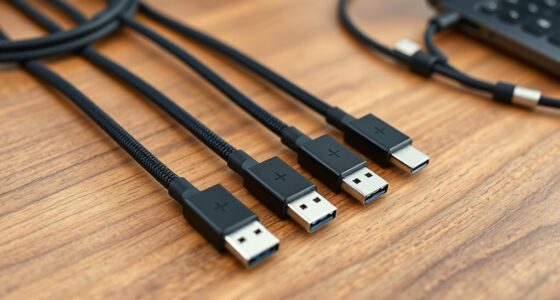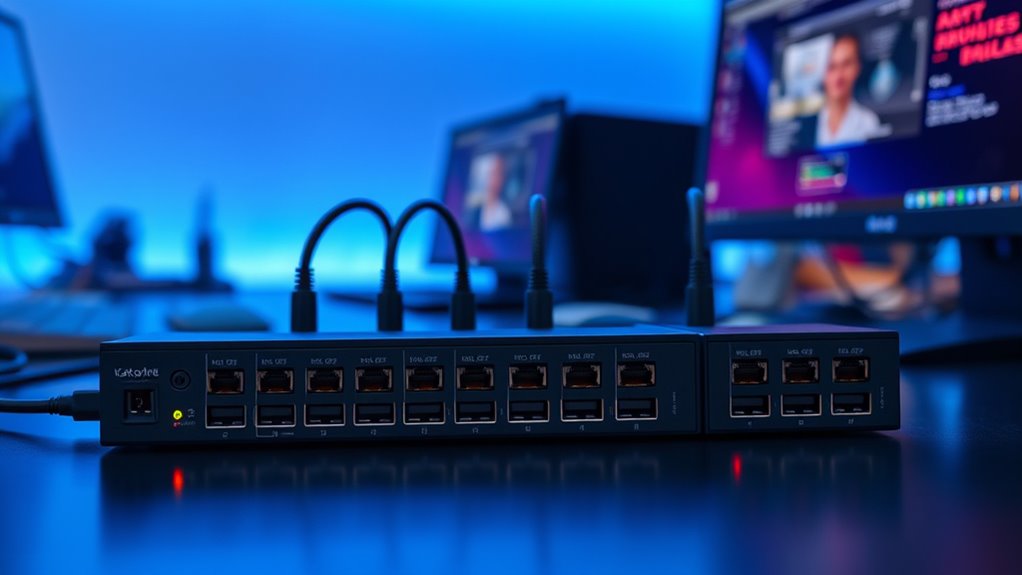

I rank the Cable Matters 2-computer switch first because its 20Gbps link, 140W power pass-through, included cables, and RF remote form the most balanced package. The Alxum switch is my value pick for a similar two-computer workflow, while the TESmart 2×1 is the stronger choice for an Apple Studio Display or a desk that needs built-in USB and Ethernet connectivity.
Prime for Young Adults — start your free trial
Fast free delivery, streaming and member deals for eligible 18–24 year olds.
Try it freeAs an affiliate, we earn on qualifying purchases.
The main choice is not simply resolution. Buyers need to weigh two versus three computers, one versus three monitors, charging behavior, dock compatibility, and whether a product provides a true Thunderbolt-oriented dock or merely switches a compatible USB-C connection. Several models advertise 8K, but 20Gbps bandwidth, macOS display limits, cable requirements, and DisplayLink software can matter more during daily work.
Complete the kit



Key Takeaways
- I rank the Cable Matters B0CLZ7WP1N first for its balanced two-computer design, included USB4 cables, 140W pass-through, and straightforward remote switching.
- The Alxum offers comparable headline speed and resolution for value-focused buyers, but its Dell dock exclusion and short dock-cable limit make compatibility less predictable.
- TESmart is the most capable integrated dock here and the clearest Apple Studio Display pick, though only its first computer input receives charging.
- The three-input Cable Matters model is the right choice when three computers share one dock, but it powers only the currently selected system.
- The triple-monitor model provides the broadest display workspace, yet it relies on DisplayLink and does not deliver every native Thunderbolt high-speed capability.
| Cable Matters 20Gbps USB-C KVM Switch for 2 Computers |  | Best Overall | Computers: 2 | Data Speed: 20Gbps | Windows Video: Up to 8K@30Hz or 4K@144Hz | VIEW ON AMAZON | See Our Full Breakdown |
| Alxum 20Gbps USB C Switch for 2 Computers |  | Best Value | Computers: 2 | Data Speed: 20Gbps | Maximum Resolution: 8K@30Hz or 4K@144Hz | VIEW ON AMAZON | See Our Full Breakdown |
| TESmart 2×1 Thunderbolt 4 KVM Switch |  | Best for Apple Studio Display | Computer Inputs: 2 Thunderbolt | Media Inputs: 2 HDMI | Maximum Video: 6K@60Hz or 5K@120Hz on Input 1 | VIEW ON AMAZON | See Our Full Breakdown |
| Cable Matters 20Gbps USB-C KVM Switch, 3-in-1-Out |  | Best for Three Computers | Computers: 3 | Outputs: 1 USB-C or Thunderbolt 4 path | Data Speed: 20Gbps | VIEW ON AMAZON | See Our Full Breakdown |
| Thunderbolt 4 KVM Switch with 3 Monitors and Docking Station |  | Best for Triple-Monitor Workstations | Computers: 2 laptops | Monitor Support: 3 displays | Maximum Resolution: 4K@60Hz per display | VIEW ON AMAZON | See Our Full Breakdown |
| thunderbolt kvm switch | Computers | Power Delivery | Data Speed |
|---|---|---|---|
| Cable Matters 20Gbps USB-C KVM | 2 | Up to 140W pass-through | 20Gbps |
| Alxum 20Gbps USB C Switch for | 2 | Up to 140W pass-through | 20Gbps |
| TESmart 2×1 Thunderbolt 4 KVM | — | — | — |
| Cable Matters 20Gbps USB-C KVM | 3 | Up to 140W | 20Gbps |
| Thunderbolt 4 KVM Switch with | 2 laptops | Up to 100W | — |
More Details on Our Top Picks
Cable Matters 20Gbps USB-C KVM Switch for 2 Computers
Cable Matters B0CLZ7WP1N takes my top position because it covers the most common arrangement cleanly: two USB-C or Thunderbolt 4 computers sharing one compatible monitor or dock. Its 20Gbps connection and 140W pass-through can handle fast peripherals and substantial laptop charging, while the included 3.3-foot cables remove one common source of setup trouble. The RF remote also lets the switch stay behind a monitor or beneath a desk.
Compared with the Alxum, this model has a similarly strong specification sheet but a clearer package because the required host cables are supplied. It is less expansive than the TESmart docking KVM, which adds Ethernet, audio, and several USB ports, yet that simplicity makes Cable Matters easier to place in an existing dock-based workspace. The compromises are real: it charges only the selected computer, macOS tops out at 4K/60Hz, and the stated cable compatibility excludes Thunderbolt 3 and 5 cables.
Pros:- 20Gbps data path supports fast dock peripherals
- Up to 140W power pass-through for the active computer
- Two 3.3-foot USB4 cables are included
- RF remote supports tidy under-desk placement
Cons:- Only the selected computer receives charging power
- macOS output is limited to 4K at 60Hz
- Requires specified USB4 or Thunderbolt 4 cabling
Best for: Two-computer desk owners who already have a USB4 or Thunderbolt 4 monitor or dock
Not ideal for: Buyers who need simultaneous charging, several monitor outputs, or support for legacy Thunderbolt cabling
- Computers:2
- Data Speed:20Gbps
- Windows Video:Up to 8K@30Hz or 4K@144Hz
- macOS Video:Up to 4K@60Hz
- Power Delivery:Up to 140W pass-through
- Compatibility:USB4 and Thunderbolt 4 docks and monitors
- Switching:RF remote
- Included Cables:Two 3.3-foot USB4/USB-C cables
Our verdict“My best overall pick pairs strong bandwidth and charging with fewer setup complications than the more elaborate docking models.”
Alxum 20Gbps USB C Switch for 2 Computers
I place the Alxum 20Gbps USB C Switch second as the value-minded alternative to the top-ranked Cable Matters model. It shares the headline benefits buyers usually want: 8K@30Hz or 4K@144Hz, 20Gbps data, and up to 140W charging pass-through. A physical button and remote provide flexible control, and its small enclosure suits a portable workstation or crowded desk.
The reason it sits below Cable Matters is compatibility confidence, not raw capability. Alxum specifies no Dell docking-station support and limits the docking pigtail to 50cm, which can disrupt a desk built around longer cable runs. Those restrictions make it less forgiving than the Cable Matters two-host switch. It also lacks the ports and network connection built into TESmart. I would choose it when price and compactness outweigh the need for a highly documented dock ecosystem.
Pros:- Supports up to 8K or high-refresh 4K video
- Transfers data at up to 20Gbps
- Offers up to 140W charging pass-through
- Includes both push-button and remote switching
Cons:- Does not support Dell docking stations
- Docking pigtail length is limited to 50cm
- Compatibility can vary across attached devices
Best for: Value-focused buyers sharing one compatible USB-C monitor or compact dock between two computers
Not ideal for: Dell dock owners or anyone whose layout requires a docking pigtail longer than 50cm
- Computers:2
- Data Speed:20Gbps
- Maximum Resolution:8K@30Hz or 4K@144Hz
- Power Delivery:Up to 140W pass-through
- Controls:Push button and remote
- Device Support:USB-C laptops, tablets, consoles, monitors, and docks
- Dock Cable Limit:50cm maximum pigtail
- Color:Black
Our verdict“Alxum is my value pick for buyers who can verify their dock and cabling before purchase.”
TESmart 2×1 Thunderbolt 4 KVM Switch
The TESmart 2×1 Thunderbolt 4 KVM is my specialist recommendation for an Apple Studio Display or a buyer who wants the switch to replace a separate dock. It supports up to 6K@60Hz or 5K@120Hz on its first input and adds Gigabit Ethernet, audio, six USB ports, and two extra HDMI media inputs. Button, IR remote, keyboard hotkey, and mouse-wheel control give it the broadest switching menu in this group.
Against the top Cable Matters pick, TESmart offers far more peripheral connectivity but also creates a busier setup. Its 60W charging ceiling is much lower than 140W, and charging applies only to Input 1. The HDMI media inputs cannot share the keyboard, mouse, or USB devices, so they are supplemental sources rather than full KVM hosts. I rank it above the triple-monitor model for native high-resolution display use, while the DisplayLink-based model remains better for three-screen productivity.
Pros:- Supports Apple Studio Display-class 6K output
- Combines KVM switching with USB, Ethernet, and audio
- Accepts two additional HDMI media sources
- Offers four switching methods
Cons:- Only Input 1 receives laptop charging
- Charging is limited to 60W
- HDMI inputs do not share USB or keyboard and mouse control
Best for: Apple Studio Display users and professionals wanting KVM switching plus an integrated desktop dock
Not ideal for: Owners of power-hungry laptops or buyers expecting every HDMI source to receive full KVM control
- Computer Inputs:2 Thunderbolt
- Media Inputs:2 HDMI
- Maximum Video:6K@60Hz or 5K@120Hz on Input 1
- USB Ports:2 USB 3.2 Gen 2, 2 Gen 1, and 2 USB 1.1
- Networking:Gigabit Ethernet
- Charging:Up to 60W on Input 1
- Audio:3.5mm audio/mic and L/R output
- Controls:Button, IR remote, hotkeys, and mouse wheel
Our verdict“TESmart is the strongest all-in-one dock here for a single premium display, provided its uneven charging arrangement fits the desk.”
Cable Matters 20Gbps USB-C KVM Switch, 3-in-1-Out
Cable Matters B0DLJT49Z3 earns fourth place because it solves a problem none of the higher-ranked switches address: sharing one USB4 or Thunderbolt 4 display or dock among three computers. Its 20Gbps link, Windows support up to 8K@30Hz or 4K@144Hz, 140W power pass-through, and remote control make it suited to mixed work, personal, and lab systems.
Compared with the two-computer Cable Matters model, the extra host port is the decisive benefit, but buyers accept more cable sensitivity and a higher chance of dock-related display instability. Like its smaller sibling, power reaches only the active computer, so two parked laptops may slowly drain. It also lacks the TESmart model’s built-in USB and Ethernet bank. I recommend paying for this version only when the third host is used regularly; otherwise, the first-ranked model is the cleaner purchase.
Pros:- Switches one USB-C display or dock among three computers
- Provides up to 20Gbps data transfer
- Supports high-resolution and high-refresh displays
- Remote control simplifies switching across a wide desk
Cons:- Power Delivery serves only the selected computer
- Requires carefully matched USB4 or Thunderbolt 4 cables
- Some docks may show reduced display stability
Best for: Users who routinely alternate one monitor or dock among work, personal, and secondary computers
Not ideal for: Two-computer desks or setups that must charge every connected laptop at once
- Computers:3
- Outputs:1 USB-C or Thunderbolt 4 path
- Data Speed:20Gbps
- Windows Video:8K@30Hz, 5K@60Hz, or 4K@144Hz
- macOS Video:Up to 4K@60Hz
- Power Delivery:Up to 140W
- Switch Type:Solid-state
- Control:Remote
Our verdict“This is my three-computer pick, but its added host capacity is worthwhile only for a desk that will use it often.”
Thunderbolt 4 KVM Switch with 3 Monitors and Docking Station
This three-monitor KVM and docking station has the broadest screen arrangement in the lineup, supporting three 4K displays at 60Hz alongside USB ports, Gigabit Ethernet, SD and TF readers, and 100W Power Delivery. I see it as the clearest option for large productivity workspaces where spreadsheet, communication, and reference windows need dedicated screens across two laptops.
That flexibility comes from a different design approach than TESmart or the single-link Cable Matters switches. It requires a DisplayLink driver, so video behavior depends partly on software rather than only on the native Thunderbolt display path. The supplied description also states that full Thunderbolt high-speed features are not supported. Its enclosure may reach 55–60°C, which deserves open placement. I rank it fifth because triple 4K is highly specialized, but it can still be the right first choice for buyers whose monitor count matters more than native-link purity.
Pros:- Runs three 4K monitors at 60Hz
- Combines KVM, USB hub, card reader, and Ethernet functions
- Provides up to 100W Power Delivery
- Includes two Thunderbolt 4 cables and a remote
Cons:- Requires DisplayLink driver installation
- Does not support every full-speed Thunderbolt feature
- Casing may reach 55–60°C
Best for: Two-laptop professionals who need three extended 4K displays plus a full set of dock connections
Not ideal for: Driver-free environments, maximum native Thunderbolt performance, or tightly enclosed desk installations
- Computers:2 laptops
- Monitor Support:3 displays
- Maximum Resolution:4K@60Hz per display
- Power Delivery:Up to 100W
- Connectivity:USB 3.0, USB 3.2, USB-C, and USB-A
- Networking:Gigabit Ethernet
- Card Readers:SD and TF
- Software:DisplayLink driver required
- Operating Systems:Windows 10+, macOS 11+, ChromeOS 100+, and Ubuntu
Our verdict“I recommend this model for triple-display productivity, not for buyers seeking a simple or entirely native Thunderbolt path.”
How We Picked
I ranked these products by how well they solve the actual Thunderbolt KVM problem: moving a display, keyboard, mouse, storage, network connection, and charging path between computers without rebuilding the desk. I gave the most weight to host count and display topology, followed by bandwidth, supported resolution, peripheral sharing, switching controls, and power delivery. A high advertised resolution earned less credit when it came with tighter macOS limits or software dependence.
I also separated native Thunderbolt-oriented functionality from USB-C switching that happens to work with Thunderbolt 4 equipment. That distinction explains why the full docking models do not automatically outrank the simpler Cable Matters pick. I factored in supplied cables, dock exclusions, charging on inactive computers, heat, and setup complexity. My order favors predictable everyday ownership first, then specialized capability for buyers whose monitor count or computer count demands it.
| thunderbolt kvm switch | Power Delivery |
|---|---|
| Cable Matters 20Gbps USB-C KVM | Up to 140W pass-through |
| Alxum 20Gbps USB C Switch for | Up to 140W pass-through |
| TESmart 2×1 Thunderbolt 4 KVM | — |
| Cable Matters 20Gbps USB-C KVM | Up to 140W |
| Thunderbolt 4 KVM Switch with | Up to 100W |
Factors to Consider When Choosing Thunderbolt Kvm Switch
I would choose a Thunderbolt KVM by tracing the complete signal path rather than comparing the largest resolution numbers.Thunderbolt Compatibility Versus Full Thunderbolt Performance
A switch described as compatible with a Thunderbolt 4 monitor or dock is not automatically a full 40Gbps Thunderbolt switch. Both Cable Matters models and the Alxum list 20Gbps data rates, while the triple-monitor model disclaims full high-speed Thunderbolt support. I would match the switch to the fastest device that matters, especially external SSDs. For ordinary keyboard, mouse, Ethernet, and display sharing, 20Gbps may be ample; storage-heavy creative work can expose the difference.
Monitor Count, Resolution, and Operating System
I would start with the required display layout. A single 4K monitor is easy for every pick, but Apple Studio Display support points toward TESmart, while three extended 4K screens point toward the DisplayLink model. The 8K claims on Cable Matters and Alxum are useful for demanding single-display setups, yet macOS support on the Cable Matters units is listed at 4K@60Hz. Host graphics capability and the attached dock still set limits.
Charging and Inactive Computers
140W pass-through sounds generous, but it does not mean every connected laptop charges. The Cable Matters switches power only the selected host, and TESmart supplies up to 60W only on Input 1. I would check the laptop’s normal adapter rating and decide whether an inactive machine can rely on its own charger. Buyers wanting one-cable convenience should treat charging distribution as a deciding feature, not a bonus.
Cables, Docks, and Switching Controls
High-bandwidth USB-C setups are sensitive to cable type and length. The first Cable Matters model earns points for including two matched cables, while Alxum’s 50cm dock-pigtail limit may shape physical placement. I would also choose controls around the desk: an RF remote can work with a hidden box, whereas TESmart’s hotkeys and mouse-wheel switching favor users who change hosts frequently. Dock model exclusions should be checked before buying.
Frequently Asked Questions
Is a USB-C KVM switch the same as a Thunderbolt KVM switch?
No. I treat USB-C as the connector shape, while USB4 and Thunderbolt describe capabilities and certification. A 20Gbps USB-C switch may pass video, data, and charging to a Thunderbolt 4 dock without providing the full 40Gbps link or every Thunderbolt feature. The safest buying method is to match protocol, speed, video mode, and cable specification across the computer, switch, dock, and display.
Can these switches charge both laptops at the same time?
Most cannot. The two Cable Matters switches direct Power Delivery to the selected computer, and TESmart charges only Input 1 at up to 60W. That means an inactive laptop may need its own charger during a long workday. I would select these products for convenient switching, not assume that 140W pass-through equals dual charging. The power adapter and cable must also support the requested wattage.
Will an 8K KVM run a 4K gaming monitor at high refresh rates?
The Cable Matters and Alxum models list 4K support up to 144Hz under compatible Windows configurations, but the whole chain must carry that mode. The computer’s graphics output, USB-C implementation, cable, dock, and monitor all affect the result. I would favor a direct, short, certified cable path for gaming and verify features such as variable refresh separately. An 8K@30Hz rating alone does not prove every gaming function will pass.
Do I need DisplayLink for a Thunderbolt KVM?
Only the triple-monitor model in this lineup explicitly requires the DisplayLink driver. That software makes broad multi-display support possible across several operating systems, but it adds installation and maintenance and may not suit locked-down work computers. The other picks follow a more direct display path through a monitor or dock. I would choose DisplayLink for screen count and a native route for simpler administration or latency-sensitive work.
Which switch is best for an Apple Studio Display?
I would choose the TESmart 2×1 Thunderbolt 4 KVM because it explicitly targets Apple Studio Display use and supports up to 6K@60Hz on its primary input. It also provides USB, Ethernet, and audio connections that the simple switches lack. The tradeoff is 60W charging on Input 1 only. MacBook owners with higher power needs may want to keep a separate charger connected.
Conclusion
For most two-computer desks, I recommend the Cable Matters B0CLZ7WP1N because it balances speed, charging, supplied cables, and simple remote control. Budget-focused buyers should choose Alxum after confirming dock compatibility. I would pick TESmart for an Apple Studio Display or integrated docking, the three-input Cable Matters model for three regularly used computers, and the triple-monitor DisplayLink model for buyers whose work genuinely benefits from three 4K screens.
Fall yard work Picks
leaf blowers
As an affiliate, we earn on qualifying purchases.