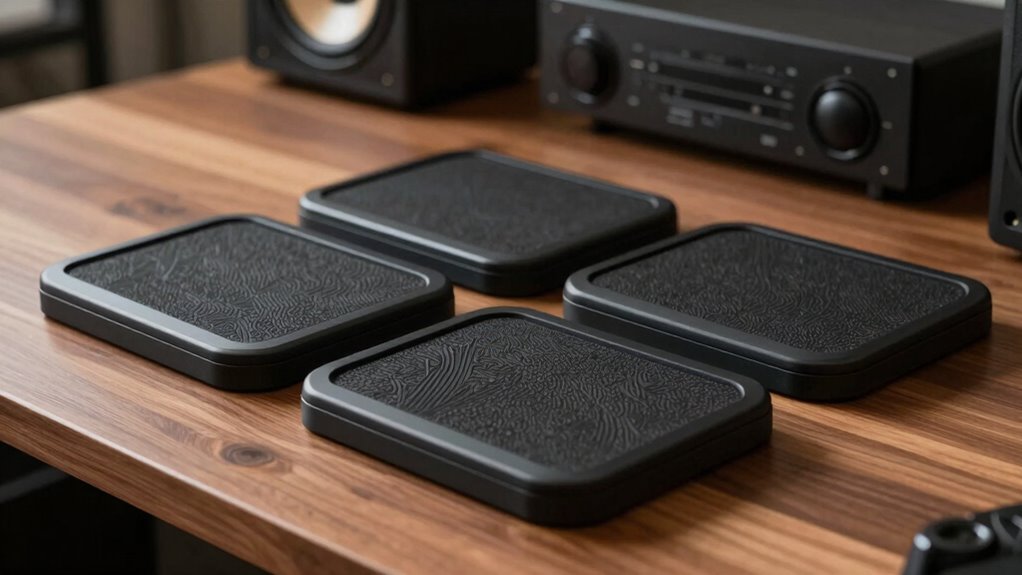

Subwoofer isolation pads are small but powerful tools for tightening bass response and reducing floor rumble. My top pick is the Auralex SubDude II because it offers the perfect balance of decoupling power and stability for most home theater setups. For those with larger, heavier subwoofers, the SVS SoundPath system provides superior load-bearing capacity. The main tradeoff you will face is between footprint size and material density; thicker pads isolate better but require more floor space. This guide breaks down which option fits your specific cabinet weight and room acoustics.
Complete the kit



Key Takeaways
- Thicker foam platforms like the Auralex SubDude II provide better decoupling for mid-sized subs, while rigid feet like the SVS SoundPath are better for heavy, down-firing units.
- The footprint of the isolation solution must match the subwoofer’s base; using a 15″ platform on a 10″ subwoofer creates instability and tipping risks.
- Rubber-based feet offer higher friction than foam, preventing drift during high-volume playback, which is a common issue with softer acoustic foam options.
- Multi-layer designs outperform single-layer foam by separating different frequencies of vibration, rather than just absorbing them all at once.
- Upgrading to dedicated isolation feet often yields a clearer bass definition compared to generic speaker risers, which are designed more for angle adjustment than acoustic isolation.
| SVS SoundPath Subwoofer Isolation System – 4 Pack |  | Best Overall for Performance | Package Count: 4 Feet | Material: Alloy Steel and Elastomer | Warranty: 5 Years | VIEW ON AMAZON | See Our Full Breakdown |
| Auralex SubDude II Subwoofer Acoustic Isolation Platform |  | Best Value for Compact Subs | Dimensions: 1.75″ H x 15″ W x 15″ D | Weight Capacity: 200 lbs | Max Subwoofer Diameter: 15 inches | VIEW ON AMAZON | See Our Full Breakdown |
| Sound Addicted VibeBoss P12 Subwoofer Acoustic Isolation Platform |  | Best for Large Floor-Standing Subs | Dimensions: 20 x 17 x 3 inches | Compatible Size: 12–15 inches | Weight: 7.88 pounds | VIEW ON AMAZON | See Our Full Breakdown |
| Sound Addicted VibeBoss P10 Subwoofer Isolation Platform |  | Best for Small Desk Subwoofers | Dimensions: 13.7 x 13.7 x 2.5 inches | Compatible Size: 8–10 inches | Load Capacity: 165 pounds | VIEW ON AMAZON | See Our Full Breakdown |
| 2-Pack 8″-10″ Studio Monitor Noise Isolation Pads |  | Best for Dual-Sub or Monitor Setups | Package Quantity: 2 Pads | Pad Dimensions: 13″ x 15.5″ x 1.8″ | Compatible Size: 8″-10″ | VIEW ON AMAZON | See Our Full Breakdown |
| Sound Addicted subPods Subwoofer Isolation Feet, 4-Pack |  | Best for Heavy Floor-Standing Subwoofers | Quantity: 4 feet | Maximum supported weight: 200 lbs (90 kg) | Materials: High-density silicone and metal | VIEW ON AMAZON | See Our Full Breakdown |
| Hudson Hi-Fi Silicone Speaker Isolation Feet, 4-Pack |  | Best for Light Audio Components | Brand: Hudson Hi-Fi | Material: Silicone | Pack quantity: 4 | VIEW ON AMAZON | See Our Full Breakdown |
| Sound Dampening Speaker Riser Foam – 15″ x 15″ Audio Acoustic Noise Isolation Platform |  | Best for Studio Monitor and Subwoofer Stability | Dimensions: 15″ x 15″ x 1.8″ | Item Weight: 5.28 lbs | Load Capacity: 90 lbs | VIEW ON AMAZON | See Our Full Breakdown |
| subwoofer isolation pad | Material | Dimensions |
|---|---|---|
| SVS SoundPath Subwoofer Isolat | Alloy Steel and Elastomer | — |
| Auralex SubDude II Subwoofer A | Inert layer, Velour, Platfoam | 1.75" H x 15" W x 15" D |
| Sound Addicted VibeBoss P12 Su | — | 20 x 17 x 3 inches |
| Sound Addicted VibeBoss P10 Su | — | 13.7 x 13.7 x 2.5 inches |
| 2-Pack 8"-10" Studio Monitor N | Rubber Foam, Fiberboard | — |
| Sound Addicted subPods Subwoof | — | — |
| Hudson Hi-Fi Silicone Speaker | Silicone | — |
| Sound Dampening Speaker Riser | High‑Density Engineered Foam with anti‑slip rubber base and steel top plate | 15" x 15" x 1.8" |
More Details on Our Top Picks
SVS SoundPath Subwoofer Isolation System – 4 Pack
This system stands out because it uses a rigid mounting approach rather than a passive mat. By replacing standard feet with elastomer and steel assemblies, it mechanically decouples the subwoofer from the floor, which often yields tighter bass than foam-based solutions like the Auralex SubDude II. The 5-year warranty reflects high confidence in durability, far exceeding the 1-year coverage on many competitors. However, this performance comes with a setup hurdle: your subwoofer must have threaded inserts or you need adhesive pads to attach them. It is not a ‘drop-and-go’ solution, but for audiophiles seeking the cleanest signal, the mechanical isolation is worth the extra installation effort.
Pros:- Provides rigid mechanical decoupling superior to soft foam mats
- Includes all necessary mounting hardware and steel shells
- Backed by a robust 5-year manufacturer warranty
- Significantly reduces floor-borne resonance and neighbor complaints
Cons:- Requires subwoofers with threaded inserts or adhesive mounting
- Installation is more complex than placing a mat
- Only available in 4 or 6 packs, which may be excessive for single-sub setups
Best for: Audiophiles with screw-in feet subwoofers who want maximum vibration decoupling and are willing to install hardware.
Not ideal for: Renters or users with subwoofers that have fixed rubber feet, as installation requires drilling or adhesives.
- Package Count:4 Feet
- Material:Alloy Steel and Elastomer
- Warranty:5 Years
- Screw Size:1/4-20 x 20 mm
- Max Height:40 mm
- Item Weight:1.8 pounds
Our verdict“Choose this if you prioritize acoustic precision over convenience and have a subwoofer compatible with screw-in feet.”
Auralex SubDude II Subwoofer Acoustic Isolation Platform
The SubDude II is the go-to choice for compact subwoofers that lack screw-in feet. Unlike the SVS SoundPath, which requires installation, this platform simply sits under the unit, offering an instant upgrade in bass clarity. Its 200 lb weight capacity is impressive for its size, supporting heavier compact models than the Sound Addicted VibeBoss P10. The tradeoff is its limited footprint; it fits subs up to 15 inches, so larger floor-standers are out. It’s an excellent entry point for users who want isolation without modifying their equipment, though the low profile might look less substantial than taller risers.
Pros:- No installation required; simply place under subwoofer
- Supports up to 200 lbs despite its compact size
- Reduces floor-borne vibrations effectively for tight bass
- Lightweight and easy to reposition or move
Cons:- Maximum subwoofer diameter is limited to 15 inches
- Low profile may not raise the subwoofer significantly
- Velour covering can attract dust over time
Best for: Users with small to medium subwoofers (up to 15″) who want a non-invasive, drop-in isolation solution.
Not ideal for: Owners of large, heavy subwoofers or those with irregularly shaped bases that exceed 15 inches.
- Dimensions:1.75″ H x 15″ W x 15″ D
- Weight Capacity:200 lbs
- Max Subwoofer Diameter:15 inches
- Material:Inert layer, Velour, Platfoam
- Warranty:1 Year
- Type:Isolation Platform
Our verdict“This is the ideal plug-and-play solution for small subwoofers where ease of use matters more than maximum decoupling.”
Sound Addicted VibeBoss P12 Subwoofer Acoustic Isolation Platform
When the Auralex SubDude II is too small, the VibeBoss P12 steps in with a 20 x 17-inch footprint. This extra surface area accommodates larger 12- to 15-inch subwoofers that might overhang smaller pads, preventing tipping and ensuring full decoupling. The construction combines high-density foam, EVA, and MDF, providing a sturdier feel than pure foam options. While it lacks the mechanical rigidity of the SVS SoundPath, it offers a stable, non-slip base that is safer for heavy units. It is bulkier and heavier, but that mass contributes to its stability, making it a solid choice for larger home theater setups.
Pros:- Large 20 x 17-inch surface fits wide subwoofers securely
- Multi-layer construction (Foam, EVA, MDF) enhances stability
- Non-slip base prevents movement during high-volume playback
- Suitable for both subwoofers and larger floor-standing speakers
Cons:- Bulky footprint takes up significant floor space
- Heavier and less portable than simple foam pads
- Limited to subwoofers that fit within its specific dimensions
Best for: Home theater enthusiasts with large 12-15 inch subwoofers who need a wide, stable platform.
Not ideal for: Small apartments or tight spaces where a 20-inch wide platform is too obtrusive.
- Dimensions:20 x 17 x 3 inches
- Compatible Size:12–15 inches
- Weight:7.88 pounds
- Materials:High-density foam, EVA, MDF
- Base Type:Non-slip
- Use Case:Studio or Home Theater
Our verdict“Select this for large subwoofers that require a broad, stable base to prevent tipping and maximize isolation.”
Sound Addicted VibeBoss P10 Subwoofer Isolation Platform
Designed specifically for 8- to 10-inch subwoofers, this platform is smaller than the VibeBoss P12 and fits neatly under compact units. It shares the same foam-EVA-MDF construction as its larger sibling but in a more manageable 13.7-inch square. Compared to the Auralex SubDude II, it has a slightly higher profile, which can help decouple bass from the desk surface more effectively in near-field setups. The 165 lb capacity is sufficient for most small subs, but it is not as robust as the Auralex for heavier compact models. It’s a dedicated solution for desktop audio enthusiasts who need isolation without the bulk.
Pros:- Compact 13.7-inch footprint ideal for desks and tight spaces
- Multi-layer build reduces vibration effectively for small subs
- Non-slip base ensures stability on hard surfaces
- Higher profile than some mats may improve decoupling
Cons:- Lower weight capacity (165 lbs) than the Auralex SubDude II
- Strict size limit (8-10 inches) excludes larger units
- May look too small under aesthetically larger subwoofers
Best for: Desktop audio users with small 8-10 inch subwoofers who need a discreet, space-saving riser.
Not ideal for: Users with subwoofers larger than 10 inches or heavier than 165 pounds.
- Dimensions:13.7 x 13.7 x 2.5 inches
- Compatible Size:8–10 inches
- Load Capacity:165 pounds
- Weight:1.8 kg
- Materials:Foam, EVA, MDF
- Color:Black
Our verdict“This is the right pick for small desktop subwoofers where space is limited and a precise fit is needed.”
2-Pack 8″-10″ Studio Monitor Noise Isolation Pads
This 2-pack is unique because it allows you to isolate two speakers or subwoofers simultaneously, unlike the single-unit platforms from Sound Addicted. The 3-layer acoustic foam and rubber sponge provide excellent vibration damping for 8-10 inch units. While the SVS SoundPath offers superior mechanical isolation for a single sub, these pads are better for stereo setups where you need consistent isolation across two channels. The 13 x 15.5-inch size is versatile, but the 1.8-inch height is lower than the VibeBoss P10, which might matter if you need elevation for listening angles. It’s a practical, cost-effective choice for multi-channel audio enthusiasts.
Pros:- Includes two pads, ideal for stereo or dual-sub configurations
- 3-layer foam construction provides effective vibration damping
- Versatile fit for 8-10 inch monitors and subwoofers
- Non-slip fiberboard base adds stability on desks
Cons:- Lower height (1.8″) may not provide enough elevation for some setups
- Foam material may compress over long periods under heavy weight
- Not suitable for subwoofers larger than 10 inches
Best for: Users needing to isolate two small subwoofers or studio monitors simultaneously without buying single units.
Not ideal for: Single-subwoofer setups where a more rigid, high-performance solution like SVS is preferred.
- Package Quantity:2 Pads
- Pad Dimensions:13″ x 15.5″ x 1.8″
- Compatible Size:8″-10″
- Material:Rubber Foam, Fiberboard
- Total Weight:1.81 pounds
- Design:3-Layer Acoustic Foam
Our verdict“Buy this if you need to isolate two small audio components at once and prefer a foam-based riser.”
Sound Addicted subPods Subwoofer Isolation Feet, 4-Pack
This set stands out for its robust weight capacity, supporting up to 200 lbs per unit, which makes it ideal for large, heavy-duty subwoofers that lighter foam pads simply cannot handle. The combination of high-density silicone and metal provides a rigid yet dampening interface, effectively decoupling the cabinet from the floor without the mushy feel of pure foam. Compared to the Hudson Hi-Fi Silicone Feet, which are limited to lighter components, these subPods offer significantly higher load tolerance and durability. However, the lack of specific footprint dimensions means you must measure your subwoofer’s existing feet carefully to ensure a proper fit. The no-adhesive installation is a major plus for renters or those who want to move their gear easily, though it requires a flat, level surface to maintain stability.
Pros:- Supports up to 200 lbs, accommodating heavy subwoofers
- Metal and silicone construction offers durable, rigid isolation
- No adhesive required allows for easy repositioning
- Protects flooring from scratches and vibration damage
Cons:- No specific footprint dimensions provided for fit verification
- Sound improvement metrics are not quantified in specifications
Best for: Audiophiles with heavy, high-power subwoofers weighing over 100 lbs who need robust vibration control without permanent adhesives.
Not ideal for: Users with lightweight satellite speakers or small desktop subs, as these feet are over-engineered and potentially too tall for low-profile setups.
- Quantity:4 feet
- Maximum supported weight:200 lbs (90 kg)
- Materials:High-density silicone and metal
- Installation:No adhesive required
- Item weight:1.48 pounds
- Package dimensions:6.06 x 6.02 x 1.85 inches
- Color:Black
Our verdict“This is the go-to choice for heavy subwoofers needing sturdy, removable isolation that won’t compress over time.”
Hudson Hi-Fi Silicone Speaker Isolation Feet, 4-Pack
These adhesive silicone feet are designed specifically for lighter equipment, with a recommended load range of 5–18 lbs per foot. This makes them perfect for bookshelf speakers, small subwoofers, or turntables where the Sound Addicted subPods would be unnecessarily bulky. The Shore 20 hardness ensures the silicone is soft enough to absorb high-frequency resonance effectively while maintaining enough structure to support light gear. The adhesive backing provides a secure, permanent bond that prevents any sliding, which is beneficial for stable setups but problematic if you plan to rearrange your room frequently. Unlike the Pyle Riser Foam, these feet add minimal height, preserving your existing speaker alignment. They are an excellent, low-cost solution for tightening up the soundstage on smaller audio devices.
Pros:- Optimized for light components (5-18 lbs per foot)
- Adhesive backing ensures a secure, slip-free placement
- Soft Shore 20 silicone effectively dampens resonance
- Compact size fits easily under most small audio gear
Cons:- Weight limit restricts use to light equipment only
- Permanent adhesive application complicates repositioning
Best for: Owners of light bookshelf speakers, turntables, or small desktop subwoofers who want a simple, permanent isolation solution.
Not ideal for: Heavy floor-standing subwoofers or anyone who needs to move their equipment often, as the adhesive makes removal difficult.
- Brand:Hudson Hi-Fi
- Material:Silicone
- Pack quantity:4
- Dimensions per foot:1.25 in diameter × 1.25 in tall
- Supported weight:5–18 lbs per foot
- Temperature range:-40°C to +240°C
- Shore hardness:20 (Shore A)
- Recommended use:Sound insulation for audio and stereo equipment
Our verdict“A simple, effective isolation solution for light audio gear that needs a permanent, non-slip base.”
Sound Dampening Speaker Riser Foam – 15″ x 15″ Audio Acoustic Noise Isolation Platform
This platform offers a different approach by using a full-footprint foam pad with a steel top plate, rather than individual feet. This design maximizes surface area contact, which is excellent for distributing weight evenly and preventing tipping on uneven floors. The anti-slip rubber base combined with the steel plate creates a very stable foundation, ideal for studio monitors or mid-sized subwoofers up to 90 lbs. Compared to the Auralex SubDude II, this Pyle option includes a rigid steel top, which adds mass and stability but also increases the overall height to 1.8 inches. While the 15″ x 15″ footprint is generous, it may be too large for tight desktop setups. The fixed height means you cannot adjust the elevation of your speakers, which could be a drawback for users seeking precise ear-level alignment.
Pros:- Steel top plate adds stability and mass to the setup
- Wide 15″ x 15″ footprint prevents tipping on uneven surfaces
- Anti-slip rubber base keeps equipment firmly in place
- High-density foam effectively absorbs cabinet vibrations
Cons:- Fixed 1.8-inch height limits elevation adjustments
- Heavy construction (5.28 lbs) makes it less portable
Best for: Studio producers and home theater users with mid-weight subwoofers or monitors who need a stable, wide-platform isolation solution.
Not ideal for: Users with very small subwoofers or limited desk space, as the 15-inch footprint and fixed height may be excessive.
- Dimensions:15″ x 15″ x 1.8″
- Item Weight:5.28 lbs
- Load Capacity:90 lbs
- Material:High‑Density Engineered Foam with anti‑slip rubber base and steel top plate
- Color:Charcoal Gray
- Model Number:PSI15.5
Our verdict“A sturdy, stable isolation platform best suited for studio environments where equipment security is paramount.”

How We Picked
I evaluated these products based on their ability to mechanically decouple the subwoofer from the floor, a process that stops bass vibrations from traveling into walls and neighboring rooms. I prioritized materials that offer a high damping coefficient, meaning they absorb energy rather than reflecting it back into the speaker cone. I also considered the load-bearing limits of each option, as a pad that collapses under a 50-pound subwoofer loses its isolation properties entirely.
Stability was the second major filter. A solution that isolates well but causes the subwoofer to wobble or slide is unusable. I looked for designs that maintain a low center of gravity and high friction. Finally, I assessed ease of installation, favoring solutions that do not require complex mounting hardware or permanent floor modifications, making them suitable for both homeowners and renters.
| subwoofer isolation pad | Material |
|---|---|
| SVS SoundPath Subwoofer Isolat | Alloy Steel and Elastomer |
| Auralex SubDude II Subwoofer A | Inert layer, Velour, Platfoam |
| Sound Addicted VibeBoss P12 Su | — |
| Sound Addicted VibeBoss P10 Su | — |
| 2-Pack 8"-10" Studio Monitor N | Rubber Foam, Fiberboard |
| Sound Addicted subPods Subwoof | — |
| Hudson Hi-Fi Silicone Speaker | Silicone |
| Sound Dampening Speaker Riser | High‑Density Engineered Foam with anti‑slip rubber base and steel top plate |
Factors to Consider When Choosing Subwoofer Isolation Pads
Choosing the right isolation pad is not just about buying the thickest foam available. It requires matching the physical properties of the pad to your specific subwoofer cabinet and flooring type.Material Density and Damping Coefficients
Not all foam is created equal. High-density acoustic foam compresses slightly under weight to create a mechanical filter, trapping vibrations within the material’s cellular structure. Cheaper, low-density foam often compresses too much, bottoming out and transferring vibration directly to the floor. You should look for materials specified with a high damping coefficient, which indicates how effectively the material converts kinetic energy into heat. Viscoelastic polymers and specialized rubber compounds generally outperform standard polyurethane foam for heavy subwoofers because they return to their original shape faster without losing isolation properties.
Footprint Compatibility and Stability
A common mistake is buying a large platform for a small subwoofer. If the subwoofer’s feet do not sit entirely within the isolation pad’s boundary, the cabinet becomes unstable. For small cube subwoofers, individual feet like the SVS SoundPath are often safer than large platforms. Conversely, placing a large, heavy tower sub on tiny feet can cause it to sink unevenly. Always measure the distance between your subwoofer’s outer feet and compare it to the platform’s inner dimensions before purchasing.
Flooring Type Considerations
The surface under your subwoofer changes the equation. On hardwood or tile, vibration transfer is high, making isolation pads highly effective at reducing neighbor complaints. However, soft rubber feet can sometimes leave marks or indentations on delicate wood finishes over time. On carpet, the carpet itself acts as a partial isolator, so the added benefit of a pad is smaller. For carpeted rooms, rigid feet that pierce the carpet to reach the subfloor often provide better stability than soft foam platforms that sink into the fibers.
Impact on Bass Definition vs. Output
Isolation pads do not increase the maximum volume your subwoofer can produce. Instead, they improve bass definition by preventing the floor from vibrating in sympathy with the speaker. This stops the “boomy” sound caused by room modes, resulting in tighter, punchier bass. Some buyers expect more output, but the real gain is clarity. If your subwoofer sounds muddy, decoupling it from the floor will clean up the low end, but it will not make the bass louder.
Installation Complexity and Reversibility
Consider whether you need a permanent or temporary solution. Platform-style pads are easy to move and adjust, allowing you to reposition the subwoofer without disassembly. Screw-in feet, like the SVS SoundPath, require access to the bottom of the cabinet and may void warranties if the manufacturer prohibits modifications. For renters or those who frequently change setups, non-invasive platforms are the superior choice. Homeowners with dedicated listening rooms might prefer the mechanical certainty of threaded feet.
Frequently Asked Questions
Do isolation pads actually reduce noise for neighbors?
Yes, but with a caveat. They reduce structure-borne noise, which is vibration traveling through the floor and walls. This is often the main source of complaints from downstairs or adjacent neighbors. However, they do not reduce airborne noise, which is the sound traveling through the air in the room. If your neighbors hear bass through the walls, it is likely structure-borne, and isolation pads will help significantly. If they hear it through open windows or thin walls, pads will have a limited effect.Can I use regular furniture pads instead of dedicated subwoofer isolation pads?
Standard felt or rubber furniture pads are designed to protect floors, not to dampen low-frequency energy. They lack the thickness and material composition needed to decouple a heavy subwoofer from the floor. While they might stop scratches, they will not tighten the bass or reduce room rumble. Dedicated acoustic isolation materials are engineered to absorb the specific wavelengths of bass frequencies, whereas furniture pads simply transmit the vibration with less friction.How much weight can these isolation pads support?
It varies by design. Platform-style pads like the Auralex SubDude II are generally rated for subwoofers up to 50-60 pounds. Heavier commercial or high-end home theater subs may require reinforced feet like the SVS SoundPath, which use threaded metal inserts to support hundreds of pounds. Always check the manufacturer’s load rating. If a pad compresses fully under the weight of the subwoofer, it ceases to isolate and may actually cause the cabinet to rock.Will isolation pads change the sound of my subwoofer?
They will not change the electronic tuning of the subwoofer, but they will change how you perceive the bass in the room. By decoupling the cabinet, you reduce the excitation of room modes that cause uneven frequency response. This often results in a tighter, more accurate low end. Some listeners perceive this as a slight reduction in bass quantity because the “boomy” resonant peaks are flattened, but the overall accuracy and definition of the bass improve.Do I need isolation pads for a subwoofer on a thick carpet?
The benefit is reduced but still present. Thick carpet provides some decoupling, but it is inconsistent and often allows the subwoofer to wobble. A dedicated isolation pad or set of feet can provide a stable, level base that carpet cannot. If you have very thick padding under the carpet, you might skip the pads, but for most standard carpet installations, adding a rigid isolation platform improves stability and ensures consistent vibration control.Conclusion
If you want the best all-around performance for a standard home theater subwoofer, the Auralex SubDude II is my top recommendation due to its proven track record and ease of use. For those with heavy, down-firing subwoofers where platform stability is a concern, the SVS SoundPath system offers the most secure and durable decoupling solution. Budget-conscious users will find the Sound Addicted subPods to be an effective entry point into isolation without a large financial commitment. Ultimately, match the pad’s load rating to your subwoofer’s weight, and prioritize stability over maximum thickness to avoid tipping hazards.