

For shoppers searching for smart notebooks reusable for work, school, or planning, I rank the Rocketbook Core Letter Size as the best overall pick because its large writing area and app-connected workflow suit the widest range of users. The Rocketbook Core Executive Size is the stronger portable value, while the iFlytek AINOTE 2 is my premium choice for digital writing, transcription, and broader app access. The main choice is between an affordable wipe-clean notebook that still uses ink and a costly electronic tablet that handles more of the capture process automatically. Page size, layout, cleaning routine, scan quality, and dependence on proprietary pens also separate otherwise similar models. Continue reading for the full breakdown and the clearest match for each type of note-taker.

Get the latest gadgets delivered free — and shop member deals
- Fast, free delivery on millions of items
- Access to Prime Big Deal Days deals on October 6–7
- Prime Video, Amazon Music and more included
Complete the kit


Key Takeaways
- Rocketbook Core Letter Size ranks first because it offers the best balance of writing space, reusable pages, digital filing, and approachable cost.
- The many Rocketbook Core color listings do not represent major functional differences; size and page layout matter far more than teal, gray, black, or blue covers.
- iFlytek AINOTE 2 is the premium outlier, replacing wipe-clean pages with an electronic writing surface, transcription tools, and Google Play compatibility.
- Specialized formats beat general notebooks for narrow jobs: Rocketbook Flex suits scheduling, Matrix supports graphs and diagrams, and Mini handles quick pocket notes.
- Portability reduces usable writing space; the Executive Core and Mini travel more easily, but the Letter Core is better for meetings, classes, and multi-part ideas.


| smart notebooks reusable | Brand | Size | Cover |
|---|---|---|---|
| Rocketbook Core Reusable Smart | Rocketbook | Letter, 8.5 x 11 inches | — |
| Rocketbook Core Reusable Smart | Rocketbook | Executive, 6 x 8.8 inches | — |
| Rocketbook Mini Reusable Smart | Rocketbook | 3.5 x 5.5 inches | Waterproof |
| iFlytek AINOTE 2 Paper Tablet | iFlytek | — | — |
| Rocketbook Flex Reusable Plann | Rocketbook | Letter, 8.5 x 11 inches | — |
| Rocketbook Core Reusable Smart | Rocketbook | Letter, 8.5 x 11 inches | Scratch-resistant |
| Rocketbook Pro Smart Reusable | — | Letter, 8.5 x 11 inches | — |
| Rocketbook Core Reusable Smart | Rocketbook | Letter, 8.5 x 11 inches | Scratch-resistant |
| Rocketbook Matrix Smart Reusab | Rocketbook | Letter, 8.5 x 11 inches | — |
| Noteorius Smart Pen & Reusable | Noteorius | — | — |
| Rocketbook Core Reusable Smart | Rocketbook | 8.5 x 11 inches | Scratch-resistant soft cover |
| Rocketbook Core Reusable Smart | Rocketbook | 6 x 8.8 inches | Scratch-resistant |
| Rocketbook Flip Reusable Smart | Rocketbook | 6 x 8.8 inches | Waterproof |
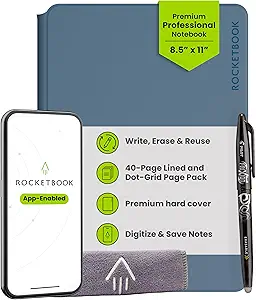
| Rocketbook Pro Smart Reusable | Rocketbook | 8.5 x 11 inches | Blue vegan-leather hardcover |
More Details on Our Top Picks
Rocketbook Core Reusable Smart Notebook, Letter Size 8.5×11, Teal
I rank the Rocketbook Core Letter as the best all-around choice because its full-size writing area suits class notes, meeting records, and longer brainstorming sessions without adding electronic hardware. Compared with the Rocketbook Core Executive, it offers more room for diagrams and dense pages, while Smart Titles and Smart Tags make scanned notes easier to retrieve later. It is also simpler and far less technology-dependent than the iFlytek AINOTE 2. The tradeoff is a more involved reuse cycle: buyers must use Pilot Frixion pens, scan anything worth keeping, and wipe each page with a damp cloth. Its 8.8-ounce weight is portable, though the letter-size footprint is less convenient in small bags. I see this as the strongest balance of space, organization, and reuse, provided manual cleaning does not feel burdensome.
Pros:- Letter-size pages provide ample room for detailed notes and diagrams
- Smart Titles and Smart Tags improve retrieval after scanning
- Reusable pages reduce dependence on disposable paper notebooks
- Spiral binding and an 8.8-ounce weight support everyday transport
Cons:- Works best only with Pilot Frixion writing instruments
- Every reuse cycle requires damp wiping and drying
- Letter dimensions take up more bag and desk space than Executive or Mini models
Best for: Students and office professionals who take substantial handwritten notes and want searchable cloud copies without buying an electronic tablet
Not ideal for: Buyers who switch among ordinary pens or want pages that clear instantly without water and wiping
- Brand:Rocketbook
- Product type:Reusable smart notebook
- Size:Letter, 8.5 x 11 inches
- Color:Teal
- Item weight:8.8 ounces
- Binding:Spiral
- Compatible pen:Pilot Frixion
- Organization features:Smart Titles and Smart Tags
Our verdict“This is my default recommendation for buyers who want a spacious reusable notebook with capable digital organization and can accept routine page cleaning.”
Rocketbook Core Reusable Smart Notebook, Dot Grid Pages, Executive Size 6×8.8, Blue
I place the Rocketbook Core Executive between the roomy Letter Core and the pocket-size Rocketbook Mini. Its 6 x 8.8-inch format is easier to carry than the Letter model but still gives lists, meeting notes, and small sketches enough breathing room. Dot-grid ruling also supports mixed writing and drawing more naturally than a fixed planner layout such as the Rocketbook Flex. That middle-ground design earns its ranking, though it is not equally flexible for every writer: buyers who prefer conventional ruled lines may dislike the dot-grid-only pages, and extended lecture notes can feel cramped compared with the larger Core. Scanning also depends on a compatible app, adding a step before pages are erased. I recommend it as the portable everyday compromise, not as the best canvas for long-form work.
Pros:- Executive dimensions balance writing room with easy transport
- Dot-grid pages work for both handwriting and lightweight sketching
- Reusable construction cuts recurring paper use
- App scanning creates digital copies for later organization
Cons:- Smaller page area is restrictive for lengthy notes and large diagrams
- Dot-grid ruling offers no lined-page alternative
- Digital archiving requires a compatible app and device
Best for: Commuters, project managers, and students who want a bag-friendly notebook for mixed notes, lists, and simple diagrams
Not ideal for: Long-form note-takers or writers who strongly prefer ruled pages, since the smaller notebook uses dot-grid pages throughout
- Brand:Rocketbook
- Product line:Core
- Product type:Reusable smart notebook
- Size:Executive, 6 x 8.8 inches
- Color:Blue
- Page type:Dot grid
- Digital workflow:Compatible smart scanning app
- Reusable:Yes
Our verdict“Choose this model when the Letter Core feels bulky and the Rocketbook Mini feels too confined for daily work.”
Rocketbook Mini Reusable Smart Notepad, Pocket Size, 3.5×5.5 inches, Black
The Rocketbook Mini earns the pocket role because its 3.5 x 5.5-inch footprint is built for rapid capture rather than full meeting records. At 1.44 ounces, it is much easier to keep close than the Rocketbook Core Executive, making it better for errands, task lists, field notes, or ideas recorded while standing. Its dotted reusable pages can be scanned into the app before being wiped, so small scraps of information need not remain scattered across paper pads. Portability creates the main compromise: the limited writing area forces frequent page changes and makes larger diagrams impractical. Careful cleaning is also needed to limit smudging, while digital storage still requires an app-connected device. I would choose it as a reusable companion notepad, but not as someone’s only notebook.
Pros:- Pocket-size body supports note capture away from a desk
- Very low 1.44-ounce weight adds little carrying burden
- Dotted pages accommodate short text, checklists, and compact sketches
- App connectivity preserves notes before pages are reused
Cons:- Small pages are unsuitable for long notes or detailed diagrams
- Careless wiping can leave smudges
- Digital organization depends on a compatible app and device
Best for: Field workers, retail managers, travelers, and list-makers who need a reusable notepad that fits into a pocket or small bag
Not ideal for: Students and meeting-heavy professionals who need full-page outlines, large sketches, or extended handwritten records
- Brand:Rocketbook
- Product line:Mini
- Size:3.5 x 5.5 inches
- Item weight:1.44 ounces
- Color:Black
- Page type:Dotted
- Cover:Waterproof
- Connectivity:App-enabled
- Page material:Reusable dotted paper
Our verdict“This is my pick for buyers who value true pocket portability more than generous writing space.”
iFlytek AINOTE 2 Paper Tablet, 10.65-inch Electronic Notebook with Pen
I rank the iFlytek AINOTE 2 as the premium digital option because it replaces wipe-clean pages with a 10.65-inch electronic paper workspace, cross-device syncing, schedule tools, and transcription in 15 languages. Compared with the Rocketbook Core Letter, it removes the scan-and-wipe routine and adds AI assistance, making it better suited to multilingual meetings and users managing large digital archives. The 4.2 mm body and up to 14-day battery life help offset the added technology. Its drawbacks are substantial: AI and transcription need Wi-Fi, the unlit paper-style display requires external light in dark rooms, and sensitive discussions may not belong in cloud-assisted workflows. It also represents a more complex category than a reusable paper notebook. I see its AI-supported workflow as worthwhile for power users, while the Rocketbook remains the simpler choice.
Pros:- Electronic paper display provides a large paper-like writing surface
- Transcription supports 15 languages
- AI assistance, scheduling, and cross-device synchronization combine several work tools
- Up to 14 days of use reduces charging frequency
Cons:- AI and transcription features require Wi-Fi
- Writing in dark spaces requires an external light source
- Cloud-assisted features may be inappropriate for confidential meetings
Best for: Multilingual professionals and digital-first note-takers who want handwriting, transcription, scheduling, and synced records on one device
Not ideal for: Privacy-sensitive teams, dark-room writers, or buyers who want a simple notebook without charging, connectivity, or software dependencies
- Brand:iFlytek
- Display:10.65 inches
- Thickness:4.2 mm
- Battery life:Up to 14 days
- Standby time:Up to 113 days
- Transcription languages:15
- Connectivity:Wi-Fi
- App compatibility:Google Play
- Included input:Pen
Our verdict“Pay for the AINOTE 2 when automated transcription and digital workflow tools matter more than the simplicity of wipe-clean paper.”
Rocketbook Flex Reusable Planner, Undated Daily, Weekly, Monthly, Annual Calendar, Letter Size 8.5×11, Green
The Rocketbook Flex is my planning pick because its 48-page mix of daily, weekly, monthly, and annual templates gives recurring structure without tying buyers to printed dates. Compared with the open dot grid of the Rocketbook Core Executive, it is better for scheduling, goal tracking, and reviewing plans across several time horizons. Lined and dotted pages keep it from becoming a calendar-only tool, while app digitization can send records to services such as Google Drive, Dropbox, and OneNote. The structured format is less suitable for buyers who mainly want unrestricted notes, and its letter-size coil body occupies more room than the Executive or Mini. Reuse also involves a compatible pen plus damp cleaning, which can slow frequent revisions. I rank it as the most versatile planning system, but the Core is better for blank-canvas writing.
Pros:- Undated templates avoid wasting pages during missed weeks or months
- Daily through annual layouts support short- and long-range planning
- Lined and dotted pages add room for notes beyond calendar entries
- Cloud compatibility supports archiving across common services
Cons:- Structured templates leave less unrestricted space than a standard Core notebook
- Letter-size coil format is bulky beside Executive and Mini models
- Full use requires a compatible pen, the app, and damp page cleaning
Best for: Project leads, students, and self-employed planners who want reusable schedules, goal tracking, and notes in one undated book
Not ideal for: Free-form writers or rapid reschedulers who would find fixed planning templates and repeated damp wiping restrictive
- Brand:Rocketbook
- Product type:Undated reusable planner
- Page count:48
- Size:Letter, 8.5 x 11 inches
- Color:Green
- Binding:Coil
- Templates:Daily, weekly, monthly, and annual
- Additional page layouts:Lined and dotted
- Cloud compatibility:Google Drive, Dropbox, and OneNote
Our verdict“Choose the Flex when reusable calendar structure matters more than having an entire notebook devoted to free-form notes.”
Rocketbook Core Reusable Smart Notebook, Letter Size 8.5×11, Black
I rank the Rocketbook Core in Black as the best all-around choice because it balances a familiar spiral format, full letter-size pages, and reliable app-based filing. Its premium reusable paper offers a more polished writing surface than a basic laminated pad, while Smart Titles and Tags reduce the work of sorting scans later. Compared with the Rocketbook Pro, the Core is lighter and simpler to carry, though it lacks interchangeable page packs and the Pro’s vegan-leather presentation. It is also more flexible for general notes than the grid-focused Rocketbook Matrix. The main compromises are Frixion-only writing, manual scanning, and damp-cloth cleaning. I favor it for buyers who want the strongest balance of portability, page space, and digital organization without paying for premium modular features.
Pros:- Letter-size pages provide ample room for meeting notes and coursework
- Smart Titles and Tags make scanned files easier to organize
- Lightweight spiral design is easier to carry than the Rocketbook Pro
- Reusable pages reduce reliance on disposable notebooks
Cons:- Only compatible Frixion pens can be erased safely
- Every saved page must be scanned through the app
- Cleaning requires a damp cloth and drying time
Best for: Students and office professionals who want full-size reusable pages with straightforward cloud filing
Not ideal for: Buyers who want automatic live digitization or the freedom to use ordinary pens
- Brand:Rocketbook
- Size:Letter, 8.5 x 11 inches
- Weight:224 g
- Binding:Spiral
- Cover:Scratch-resistant
- Writing Tool:Pilot Frixion pen included
- Organization:Smart Titles and Smart Tags
- Digital Support:Rocketbook app and cloud storage
Our verdict“This is my first choice for buyers seeking a practical reusable notebook that handles everyday writing and cloud organization equally well.”
Rocketbook Pro Smart Reusable Notebook, Letter 8.5×11, Black
I place the Rocketbook Pro 2.0 above the standard Core for client meetings and executive settings because its vegan-leather cover looks more formal and its interchangeable page system supports changing workflows. The included lined and dot-grid sheets can accommodate writing, planning, or diagrams without committing the whole notebook to one layout. The Rocketbook Core is lighter and offers better value for routine class notes, while the Pro’s 1.2-pound build favors desk and briefcase use. Its NFC chip can speed access to the digital workflow, but it does not replace scanning each page. Buyers also pay extra for additional page packs. I see the durable professional presentation as the reason to upgrade, provided the heavier body, Frixion dependency, and scan-and-wipe routine fit the buyer’s habits.
Pros:- Interchangeable pages allow the notebook layout to evolve
- Lined and dot-grid sheets support both writing and visual planning
- Vegan-leather cover has a more professional appearance than the Core
- NFC integration provides convenient access to the app workflow
Cons:- Additional page packs increase the long-term cost
- At 1.2 pounds, it is much heavier than standard Rocketbook models
- Digitizing and cleaning pages still require several manual steps
Best for: Consultants, managers, and designers who want a polished reusable notebook with replaceable page layouts
Not ideal for: Budget-focused students or frequent travelers who would benefit more from the lighter Rocketbook Core
- Page Count:40 pages
- Page Types:Lined and dot grid
- Size:Letter, 8.5 x 11 inches
- Cover Material:Vegan leather
- Weight:1.2 pounds
- Page System:Interchangeable page packs
- Connectivity:NFC chip for app integration
- Erase Method:Wipe clean with a damp towel
Our verdict“Choose the Pro when modular pages and a boardroom-ready cover matter more than low weight or price.”
Rocketbook Core Reusable Smart Notebook, Letter Size 8.5×11, Gray
The gray Rocketbook Core earns its place for students and researchers who generate many college-ruled notes and need a repeatable filing system. Its Smart Titles and Smart Tags help turn photographed pages into searchable, sensibly named records, a stronger match for lecture archives than the diagram-led Rocketbook Matrix. Compared with the black Rocketbook Core, the underlying write-scan-wipe workflow is very similar; I assign this version a narrower role because its listed college-ruled format speaks directly to structured coursework rather than mixed sketching. The full letter-size surface leaves room for detailed notes, but it is less convenient than an Executive-size Core in a small bag. Buyers must also accept Frixion pen restrictions, damp cleaning, and a higher initial cost than paper notebooks. Its advantage is disciplined digital filing, not instant capture.
Pros:- College-ruled letter-size pages suit detailed academic notes
- Smart Titles and Tags support organized cloud archives
- Scratch-resistant cover protects the notebook during daily transport
- Reusable design can replace stacks of single-use class notebooks
Cons:- Letter size is less portable than the Executive-size Rocketbook Core
- Compatible Pilot Frixion pens are required
- Erasing can be uneven if pages are not wiped and dried carefully
Best for: College students and researchers who write long-form notes and organize scans by subject or project
Not ideal for: Artists, compact-bag commuters, or anyone who wants to write with standard ink pens
- Brand:Rocketbook
- Size:Letter, 8.5 x 11 inches
- Weight:8.8 ounces
- Page Style:College ruled
- Cover:Scratch-resistant
- Organization:Smart Titles and Smart Tags
- Pen Compatibility:Pilot Frixion
- Digital Support:App-enabled cloud storage
Our verdict“This Core version makes the most sense for buyers whose priority is turning structured handwritten notes into an orderly digital archive.”
Rocketbook Matrix Smart Reusable Graph Paper Notebook, Letter Size 8.5×11, Black
I give the Rocketbook Matrix the specialist slot because its quarter-inch grid, scientific templates, and measurement rulers support equations, plots, circuits, and scaled diagrams better than a ruled Rocketbook Core. Its 30 reusable graph pages also make repeated problem sets or design drafts less wasteful, while app scanning provides a simple route for sharing work with classmates and colleagues. This specialization is also its limitation: writers who mainly record meeting notes will find the Core’s ruled pages less visually busy, and designers needing mixed layouts may prefer the Rocketbook Pro’s interchangeable sheets. The small grid spacing can feel cramped for broad sketches or large handwriting. Add the required Frixion pens and damp-cloth cleanup, and this is not the easiest general notebook. I rank it highly only for buyers who will use its technical page structure regularly.
Pros:- Quarter-inch grid supports precise technical layouts
- Scientific templates and rulers add practical drafting tools
- Thirty reusable graph pages accommodate repeated calculations and diagrams
- Scans can be shared through the Rocketbook app on iOS or Android
Cons:- Dense grid is distracting for ordinary prose and may feel cramped
- Pilot Frixion pen compatibility limits writing-tool choice
- Pages require damp wiping before they can be reused
Best for: Engineering students, scientists, and technical designers who regularly create graphs, equations, or measured diagrams
Not ideal for: Long-form writers and large-sketch artists who may find the quarter-inch grid restrictive
- Brand:Rocketbook
- Size:Letter, 8.5 x 11 inches
- Page Type:Graph paper
- Page Count:30 graph pages, 1 lined page, and 1 index page
- Grid Size:0.25 inch
- Material:Synthetic paper
- Device Compatibility:iOS and Android
- Weight:8 ounces
- Pen Compatibility:Pilot Frixion
Our verdict“Pick the Matrix over a general-purpose Core when grids and measurement aids are central to the work rather than occasional extras.”
Noteorius Smart Pen & Reusable Digital Notebook with Folio
The Noteorius Smart Pen and Reusable Notebook targets buyers who want handwriting captured as it happens, rather than photographing completed pages one by one. That stroke-by-stroke digital syncing separates it from the Rocketbook Core and Matrix, whose app workflows depend on manual scans. Support for services such as Google Drive and Evernote also suits people who already maintain cloud-based project records, while the folio keeps the pen and notebook together. I rank it below Rocketbook’s established options for most buyers because the available durability and battery information is sparse, app setup may be demanding, and its signals uneven satisfaction. A smart pen also adds hardware dependence that a passive Rocketbook avoids. This pick has the more ambitious workflow, but greater ownership uncertainty comes with that convenience.
Pros:- Smart pen captures individual strokes for a more immediate digital record
- Reusable notepad reduces disposable paper use
- Google Drive and Evernote support fits established cloud workflows
- Included folio keeps the writing system organized
Cons:- Battery-life and long-term durability details are not provided
- Smart-pen pairing and app setup add complexity
Best for: Meeting-heavy professionals who want handwritten strokes synced digitally without scanning every finished page
Not ideal for: Buyers who prioritize proven reliability, clear battery specifications, and a simple hardware-free scanning process
- Brand:Noteorius
- Unit Count:1 count
- UPC:850076814007
- Included Components:Smart pen, reusable notebook, and folio
- Capture Method:Digital stroke capture
- Cloud App Support:Includes Google Drive and Evernote
Our verdict“Choose Noteorius for live handwriting capture, but favor Rocketbook if predictable upkeep and fewer electronic dependencies matter more.”
Rocketbook Core Reusable Smart Notebook, Letter Size 8.5×11, Black
I rank the Rocketbook Core Letter as the strongest choice here for students and office workers who regularly fill full pages. Its 8.5-by-11-inch format provides more room for lecture outlines, meeting diagrams, and checklists than the Rocketbook Core Executive. After scanning through the app, the pages can be wiped and used again, making its large reusable workspace the main reason it earns this role. It is also lighter and simpler than the Rocketbook Pro, though the soft spiral-bound construction feels less polished and offers less protection. Buyers must use Pilot Frixion pens, keep a damp cloth handy, and work within the app’s supported cloud services. I see it as a practical everyday notebook, not a premium portfolio or a pocket-friendly capture tool.
Pros:- Letter-size pages provide ample room for detailed writing and visual layouts
- Reusable surface reduces the need to replace paper notebooks
- Rocketbook app supports scanning, smart tags, and digital filing
- Included compatible pen provides a ready-to-use setup
Cons:- Writing must be done with compatible Pilot Frixion pens
- Every reuse requires wiping the pages with a damp cloth
- Soft spiral-bound construction offers less protection than the Rocketbook Pro
Best for: Students, teachers, and office workers who need letter-size space for detailed notes, diagrams, and recurring checklists
Not ideal for: Frequent travelers who need a compact notebook, or buyers who want standard-pen compatibility and instant paper disposal
- Brand:Rocketbook
- Size:8.5 x 11 inches
- Ruling:Lined
- Binding:Spiral-bound
- Cover:Scratch-resistant soft cover
- Compatible Pen:Pilot Frixion
- Item Weight:8.8 ounces
- Unit Count:1
- Digital Capture:Rocketbook app scanning
Our verdict“I recommend this Core model for buyers who value a roomy reusable workspace more than portability or premium construction.”
Rocketbook Core Reusable Smart Notebook, Executive Size 6×8.8, Black
The Rocketbook Core Executive makes more sense than the letter-size Core for commuters who want reusable pages without carrying a full document-sized notebook. Its 6-by-8.8-inch footprint fits more easily into backpacks and briefcases, while college ruling keeps handwritten notes reasonably dense. Smart Titles and Smart Tags add faster digital organization once pages are scanned through the Rocketbook app. That portability comes at a clear cost: the smaller canvas is less comfortable for diagrams, long lecture notes, or side-by-side planning. The Rocketbook Flip is friendlier to mixed layouts and left-handed use, while the Rocketbook Pro supplies a more formal cover and replaceable page packs. I give this model the compact role because it offers the simplest balance of portability and structure, provided the buyer accepts Frixion-only writing and app-dependent scanning.
Pros:- Executive dimensions are easier to carry than a letter-size Core
- College ruling supports compact, structured notes
- Smart Titles and Smart Tags help organize scanned pages
- Included Pilot Frixion pen keeps the initial setup simple
Cons:- Smaller pages restrict diagrams and expansive note layouts
- Erasability depends on using Pilot Frixion writing tools
- Digital filing requires a compatible device, app, and connection
Best for: Commuters, field staff, and students who want a reusable notebook that fits easily in a backpack or briefcase
Not ideal for: Visual planners and heavy note-takers who need letter-size room for large diagrams or lengthy page layouts
- Brand:Rocketbook
- Size:6 x 8.8 inches
- Page Ruling:College-ruled
- Page Features:Smart Titles and Smart Tags
- Cover:Scratch-resistant
- Binding:Spiral
- Compatible Pen:Pilot Frixion
- Digital Capture:Rocketbook app scanning and cloud upload
Our verdict“I would choose this model for portable daily notes, but not when page space or flexible layouts matter most.”
Rocketbook Flip Reusable Smart Notepad, Executive Size 6×8.8, Teal
I place the Rocketbook Flip ahead of the Core Executive for left-handed writers and anyone who dislikes resting a hand against a side-mounted spiral. Its top-bound format works from either side, while lined and dot-grid pages support both conventional notes and free-form diagrams. That two-layout flexibility also makes it more adaptable than the lined Core Letter for compact planning. The waterproof cover adds protection during commuting or fieldwork, yet the executive page size can feel restrictive during long meetings. It also lacks the replaceable page-pack system and formal vegan-leather finish of the Rocketbook Pro. Repeated cleaning may become less consistent as the pages age, and digitization still depends on the Rocketbook app. I rank it as the best hand-neutral notepad, rather than the best choice for maximum writing area or a boardroom-ready appearance.
Pros:- Top-bound design accommodates both left- and right-handed writing
- Lined and dot-grid pages support notes, sketches, and planning
- Waterproof cover is well suited to commuting and field use
- Reusable pages pair physical writing with app-based archiving
Cons:- Executive-size pages provide limited room for long-form work
- Page cleaning may become less effective after extended reuse
- Scanning and digital organization depend on the Rocketbook app
Best for: Left-handed writers, field workers, and visual note-takers who want a compact top-bound pad with lined and dot-grid pages
Not ideal for: Buyers who write long-form notes, want letter-size pages, or prefer a professional hardcover portfolio
- Brand:Rocketbook
- Size:6 x 8.8 inches
- Page Types:Lined and dot grid
- Binding:Top spiral binding
- Cover:Waterproof
- Item Weight:5.92 ounces
- Unit Count:1
- Digital Capture:Rocketbook app scanning and cloud upload
Our verdict“I favor the Flip for compact, hand-neutral writing with mixed page layouts, especially when letter-size space is unnecessary.”
Rocketbook Pro Smart Reusable Notebook, Letter 8.5×11, Blue
The Rocketbook Pro 2.0 earns my premium designation because its vegan-leather hardcover and interchangeable page packs make it better suited to client meetings than either Core model. Letter-size lined and dot-grid sheets provide room for prose, diagrams, and planning, while the embedded NFC chip helps connect the physical notebook with its digital workflow. Its modular page system is the defining advantage: buyers can replace or change page packs instead of committing to one fixed layout. The tradeoff is greater weight, added accessory costs, and more setup than the basic Rocketbook Core Letter. Scanning several pages can also interrupt a fast meeting workflow, and Frixion-compatible writing remains mandatory. I rank this above the Core on presentation and adaptability, but its higher-cost professional design is unnecessary for buyers who only want an inexpensive reusable notebook.
Pros:- Vegan-leather hardcover presents better in professional settings than the soft-cover Core
- Interchangeable lined and dot-grid page packs support changing workflows
- Letter-size format provides generous room for notes and diagrams
- Embedded NFC chip and app scanning support digital organization
Cons:- Additional page packs add to the long-term purchase cost
- At 1.1 pounds, it is heavier than the Core Letter and Rocketbook Flip
- Requires compatible erasable pens, and multipage scanning can take time
Best for: Consultants, managers, and graduate students who want a professional letter-size notebook with changeable page layouts
Not ideal for: Budget-focused buyers and light packers who do not need a hardcover or interchangeable page system
- Brand:Rocketbook
- Size:8.5 x 11 inches
- Cover:Blue vegan-leather hardcover
- Page Types:Interchangeable lined and dot-grid pages
- Connectivity:Embedded NFC chip
- Compatible Pen:Erasable Frixion-compatible pen
- Item Weight:1.1 pounds
- Unit Count:1
- Digital Capture:App scanning and cloud upload
Our verdict“I recommend the Rocketbook Pro to buyers willing to pay more for a polished cover, full-size pages, and modular layouts.”

How We Picked
I ranked these notebooks by how well each one supports the full reusable-note cycle: write, organize, capture, erase, and reuse. My criteria included writing area, page format, scanning or digital-transfer workflow, pen requirements, cleaning effort, build quality, portability, and value. I gave higher positions to products that make those steps straightforward for many buyers, while specialized designs earned recognition when they solved a narrower problem better than a general-purpose model. Since several listings are color variants or apparent duplicates, I treated functional differences as more meaningful than cosmetic ones.
The Rocketbook Core Letter Size leads because it has the broadest everyday appeal without the price or learning curve of an electronic paper tablet. Smaller Core, Mini, Flex, Flip, and Matrix models were separated by the jobs their dimensions or templates support. The Rocketbook Pro, Noteorius set, and iFlytek AINOTE 2 were judged more heavily on whether their added hardware, presentation, or digital functions justify extra expense. My order favors useful distinctions and buyer fit rather than treating every color variation as a separate innovation.
| smart notebooks reusable | Brand | Cover |
|---|---|---|
| Rocketbook Core Reusable Smart | Rocketbook | — |
| Rocketbook Core Reusable Smart | Rocketbook | — |
| Rocketbook Mini Reusable Smart | Rocketbook | Waterproof |
| iFlytek AINOTE 2 Paper Tablet | iFlytek | — |
| Rocketbook Flex Reusable Plann | Rocketbook | — |
| Rocketbook Core Reusable Smart | Rocketbook | Scratch-resistant |
| Rocketbook Pro Smart Reusable | — | — |
| Rocketbook Core Reusable Smart | Rocketbook | Scratch-resistant |
| Rocketbook Matrix Smart Reusab | Rocketbook | — |
| Noteorius Smart Pen & Reusable | Noteorius | — |
| Rocketbook Core Reusable Smart | Rocketbook | Scratch-resistant soft cover |
| Rocketbook Core Reusable Smart | Rocketbook | Scratch-resistant |
| Rocketbook Flip Reusable Smart | Rocketbook | Waterproof |
| Rocketbook Pro Smart Reusable | Rocketbook | Blue vegan-leather hardcover |
Factors to Consider When Choosing Smart Notebooks Reusable
I would choose a reusable smart notebook by starting with the writing workflow, not the app logo or cover color. The right model should fit where notes are created, how often they need to be digitized, and how much maintenance the buyer will tolerate. These five factors expose the differences that product names often hide.
Choose Between Wipe-Clean Pages and an Electronic Display
Wipe-clean notebooks preserve the familiar feel and simplicity of handwriting on a physical page, usually at a much lower cost than an electronic tablet. They still require compatible ink, drying time, scanning, and periodic cleaning. An electronic paper tablet can store, search, share, or transcribe notes without photographing each page, but it introduces charging, software, account, and device-longevity concerns. Buyers who write occasionally may never recover enough value from the added electronics. Heavy meeting users, multilingual professionals, and people who need rapid transcription may find the higher price easier to justify. I would pay for digital hardware only when its automation replaces a repeated task, not merely because it appears more advanced.
Match the Page Size to Where You Actually Write
Letter-size pages give diagrams, meeting notes, and class outlines room to develop, yet they take more desk and bag space. Executive notebooks offer a middle ground for commuting, client visits, and smaller work surfaces. A pocket notepad favors immediate capture over extended writing, so it can become frustrating when notes regularly exceed a few lines. Buyers often choose the smallest model for portability and then compensate with cramped handwriting or constant page changes. Page dimensions also affect scan framing and how easily an entire idea remains visible at once. I would choose the largest size that fits the buyer’s normal bag and writing location comfortably.
Pick a Layout That Matches the Work
Dot-grid pages are the safest general choice because they guide writing without boxing the user into a fixed structure. Graph paper is better for equations, scaled sketches, tables, and technical diagrams, while planner templates reduce the setup required for recurring schedules. The tradeoff is flexibility: a highly structured page becomes wasted space when the task changes. Undated planners are less likely to lose value after a missed week, but users still need a consistent routine for carrying unfinished tasks forward. Blank or lightly guided pages favor creative freedom while demanding more manual organization. I would prioritize the layout used most days and handle occasional specialist work with printable or digital templates.
Account for Pens, Drying Time, and Cleaning
A reusable notebook is only convenient when its maintenance routine fits the user’s pace. Wipe-clean pages may need approved erasable pens, a short pause before touching fresh ink, and a damp cloth before the notebook fills up. Pressing too hard can also leave impressions even after the ink disappears. Replacement pens and cloths are modest expenses, but forgetting them can make the notebook unusable during travel or a meeting. Electronic models remove page wiping while adding battery charging, stylus management, and possible software upkeep. I would favor physical reusable pages for buyers comfortable with a small ritual and electronic capture for those willing to manage a device instead.
Examine the Digital Filing Workflow
The word smart can describe very different systems, ranging from camera-based page scanning to direct handwriting capture. Scan-based notebooks work best when pages have strong contrast, the phone camera is available, and the user files notes before erasing them. Direct digital systems reduce that manual step, though exported handwriting may still need naming, tagging, or conversion before it becomes easy to retrieve. Buyers should check supported file formats, cloud destinations, handwriting recognition, offline behavior, and account requirements. A feature-rich app adds little if the user’s workplace blocks its preferred storage service. I would choose the notebook whose export path matches the tools already used for projects, classes, or records.
Frequently Asked Questions
Is a Rocketbook or an Electronic Paper Tablet the Better Buy?
A Rocketbook is the better buy for most casual and general-purpose users because it keeps the purchase price and technical overhead low. It suits people who enjoy writing with ink and do not mind scanning completed pages before wiping them. An electronic paper tablet such as the iFlytek AINOTE 2 makes more sense when transcription, searchable storage, multilingual work, or direct app access saves time every week. It also avoids the recurring scan-and-clean routine but requires charging and greater upfront spending. I would base the choice on the value of automated capture rather than comparing the products as if they were identical types of notebook.
Should I Buy Letter, Executive, or Pocket Size?
Letter size is my default recommendation for desks, classrooms, workshops, and detailed meeting notes. Executive size is easier to carry and still supports normal paragraphs, making it a practical choice for commuters and mobile professionals. Pocket size works best as a companion for reminders, lists, and brief observations rather than as a sole notebook. Small handwriting does not fully solve the limitations of a cramped page when diagrams or several topics appear together. I would map the size to the longest note the buyer regularly writes, not the shortest note they imagine taking.
Are the Different Rocketbook Core Colors Actually Different?
Within this lineup, cover color alone does not change the main writing or scanning workflow. Black, gray, teal, and blue Core listings should be compared by page size, page style, included accessories, and current package details. Two listings can also appear identical because of separate retail pages, bundles, or catalog duplication. Paying more for a preferred color can make sense when appearance matters in client settings, but it does not improve reuse or digital capture. I would select the correct size and ruling before using color as the tie-breaker.
How Often Do Reusable Notebook Pages Need to Be Cleaned?
Cleaning frequency depends on page count and how quickly notes are safely stored elsewhere. A user who writes daily may wipe sections several times per week, while an occasional note-taker may wait much longer. The safest habit is to scan, confirm the saved file, and then erase rather than letting the whole notebook fill before reviewing it. Leaving compatible erasable ink on synthetic pages for extended periods may make cleaning less convenient, so buyers should follow the maker’s care guidance. I would build page cleaning into the same routine used for naming and filing scans.
Is a Planner, Graph Notebook, or Dot Grid More Versatile?
Dot grid is the most versatile single layout because it supports prose, lists, rough tables, and simple sketches without imposing a fixed schedule. A planner such as Rocketbook Flex is better when appointments, weekly priorities, and recurring reviews dominate the workload. Rocketbook Matrix is the stronger fit for technical users who repeatedly draw graphs, layouts, or measured diagrams. Specialized templates save setup time, but unused sections can become visual clutter. I would choose specialization when the same structured task appears several times each week; otherwise, dot grid leaves more room for changing needs.
Conclusion
For most buyers, my best overall recommendation is the Rocketbook Core Letter Size because its generous writing area, reusable format, and app-connected filing offer the strongest balance. The Rocketbook Core Executive Size is my best-value and beginner-friendly choice for buyers who want a lighter, less expensive entry point without dropping the core workflow. For premium digital note-taking, iFlytek AINOTE 2 is the better match for transcription, multilingual work, and direct app access. Buyers focused on scheduling should choose Rocketbook Flex, technical writers should favor Rocketbook Matrix, and quick-note users should pick Rocketbook Mini. The Rocketbook Pro or Noteorius folio set makes more sense when presentation and a polished professional package matter more than minimizing cost. I would make the final choice by matching page format and capture method to the buyer’s repeated routine, since those differences matter far more than cover color.
Halloween Picks
halloween
As an affiliate, we earn on qualifying purchases.