For a household backup set, I’d start with the DEBAOBULB 10-pack: it covers more sockets and includes hooks, though its emergency runtime varies by brightness and its product details give conflicting ranges. The SORHE LIDKO 6-pack is my pick for longer stated backup time, with three emergency settings and a claimed 14-plus-hour low mode. If brighter normal-use output matters more, the four-pack rated up to 1,200 lumens is the strongest listed option, but its color-temperature and color-rendering details conflict.

Get the latest gadgets delivered free with Prime
- Fast, free delivery on millions of items
- Prime Video, Amazon Music and more included
- Member-only deals all year
These bulbs do two jobs: they work in compatible household fixtures and draw on an internal battery when utility power fails. That convenience comes with tradeoffs. Emergency brightness is lower than regular bulb output, runtime depends on the selected mode, and the bulbs need time connected to mains power to recharge. I’ve ranked them by how clearly they suit different outage needs, balancing useful coverage, reported runtime, everyday output, and the reliability of the supplied specifications.
Complete the kit



Key Takeaways
- Best for outfitting several rooms: DEBAOBULB’s 10-pack offers the most bulbs and hooks, but its runtime information is inconsistent.
- Best stated low-mode endurance: SORHE LIDKO claims 14-plus hours at 10% brightness; that is a low-output setting, not full room illumination.
- Best listed normal-use brightness: The four-pack claims up to 1,200 lumens, above the 800-lumen AC ratings of the DEBAOBULB options.
- Best for a single portable backup bulb: The E26 bulb with a hook specifies 7–8 hours at medium and over 14 hours at low brightness.
- Plan around charging and output: All five rely on compatible sockets and charged batteries, and emergency mode offers less light than mains operation.
| DEBAOBULB 10-Pack Rechargeable Emergency LED Light Bulbs, 6000K Daylight, E26/E27 Base |  | Best Overall for Covering Multiple Rooms | Pack size: 10 bulbs | Bulb and base: A19; E26/E27 | Normal brightness: 800 lumens | VIEW ON AMAZON | See Our Full Breakdown |
| SORHE LIDKO 6-Pack Rechargeable Emergency LED Light Bulbs |  | Best for Longer Low-Mode Runtime | Pack size: 6 bulbs | Bulb and base: A19; E26/E27 | Normal brightness: 800–850 lumens | VIEW ON AMAZON | See Our Full Breakdown |
| 4-Pack Rechargeable Emergency LED Light Bulbs, E26 Base, 3 Modes |  | Best for Brighter Everyday Lighting | Pack size: 4 bulbs | Bulb and base: A19; E26, also compatible with E27 | Power: 12W | VIEW ON AMAZON | See Our Full Breakdown |
| Rechargeable Emergency LED Light Bulb with Hook |  | Best Single-Bulb Portable Backup | Pack size: 1 bulb | Base: E26 | Power: 9W | VIEW ON AMAZON | See Our Full Breakdown |
| DEBAOBULB 6-Pack Rechargeable Emergency LED Light Bulbs, 6000K Daylight, E26 Base, 9W | 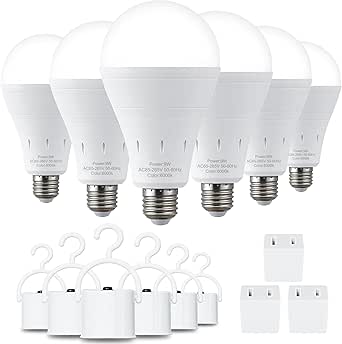 | Best Value for a Smaller Preparedness Set | Pack size: 6 bulbs | Bulb and base: A19; E26/E27 | Power: 9W; 60W incandescent equivalent | VIEW ON AMAZON | See Our Full Breakdown |
| rechargeable emergency light bulb | Pack size | Power | Color temperature | Battery |
|---|---|---|---|---|
| DEBAOBULB 10-Pack Rechargeable | 10 bulbs | 9W; 60W incandescent equivalent | 6000K daylight | 1200mAh |
| SORHE LIDKO 6-Pack Rechargeabl | 6 bulbs | 12W; 60W incandescent equivalent | 6000K daylight white | 1500mAh |
| 4-Pack Rechargeable Emergency | 4 bulbs | 12W | 5000K in description; 6000K in specifications | 1200mAh |
| Rechargeable Emergency LED Lig | 1 bulb | 9W | 6000K | 1200mAh |
| DEBAOBULB 6-Pack Rechargeable | 6 bulbs | 9W; 60W incandescent equivalent | 6000K daylight | 1200mAh |
More Details on Our Top Picks
DEBAOBULB 10-Pack Rechargeable Emergency LED Light Bulbs, 6000K Daylight, E26/E27 Base
I rank this 10-pack first for buyers who want to place backup bulbs across several existing fixtures rather than depend on one portable light. Each A19 bulb is rated for 800 lumens on mains power, with three emergency settings listed at 450, 220, and 110 lumens. That range gives a household a choice between more useful immediate light and conserving battery for longer use. The included hooks also make it possible to take a bulb out of a socket and hang it where needed.
Compared with the six-pack DEBAOBULB, this option mainly wins on coverage and included quantity, not a different battery specification: both list a 1200mAh battery and 2–6 hours of emergency runtime. That shared runtime range limits how much the larger pack changes per-bulb performance. The product details also describe runtime inconsistently, so I would not plan around a precise duration without confirming the intended figure. Its 6000K daylight color may suit utility areas, though it can feel stark in rooms where a warmer tone is preferred.
This is the most sensible choice in the lineup for a buyer preparing several rooms and valuing spare hooks. Skip it if you need dependable all-night illumination from each bulb or require a clearly specified runtime for every mode; the SORHE LIDKO and the single-bulb E26 option provide more detailed low-mode runtime claims.
Pros:- Ten bulbs provide broad fixture coverage.
- Three emergency output levels, from 110 to 450 lumens.
- Hooks support hanging use away from a socket.
- 800-lumen normal mode suits everyday household lighting.
Cons:- Emergency runtime is listed as 2–6 hours and the product text gives inconsistent ranges.
- At 110 lumens, the longest-use setting is low output.
- 6000K daylight may feel too cool for some living spaces.
Best for: Households that want to add rechargeable backup bulbs to multiple E26/E27 fixtures and value included hooks for portable placement.
Not ideal for: Buyers who need a clearly documented per-setting runtime, warm-toned light, or long full-brightness illumination from one bulb.
- Pack size:10 bulbs
- Bulb and base:A19; E26/E27
- Normal brightness:800 lumens
- Power:9W; 60W incandescent equivalent
- Color temperature:6000K daylight
- Battery:1200mAh
- Emergency modes:450, 220, and 110 lumens
- Runtime and charging:2–6 hours stated; 7–8 hours to charge
Our verdict“I’d choose this pack to spread backup lighting across the home, but not when precise emergency runtime matters most.”
SORHE LIDKO 6-Pack Rechargeable Emergency LED Light Bulbs
The SORHE LIDKO stands out because it gives a specific endurance claim that the DEBAOBULB packs do not: up to 14-plus hours at 10% brightness. Its three emergency settings are listed as 100%, 50%, and 10%, making the tradeoff between light and runtime easy to grasp. That low mode is better suited to preserving some visibility over a longer outage than lighting a room brightly, so I would treat the headline duration as an endurance figure, not a promise of full illumination.
Compared with the single E26 bulb in this roundup, the LIDKO provides six bulbs and a 1500mAh battery per bulb rather than one portable unit with mode-specific claims of 2–3, 7–8, and over 14 hours. The LIDKO’s published maximum is competitive, but its description does not assign a runtime to every brightness setting. Normal output is listed at 800–850 lumens, below the four-pack’s claimed 1,200 lumens, and its 6–8-hour charging time still means the bulbs need to spend time connected to mains power between outages.
I place it second because its low-mode claim and six-bulb coverage make a useful preparedness combination, while its mode details leave some uncertainty. Choose it for longer low-level backup across multiple fixtures; look elsewhere if you need the brightest listed everyday output or detailed runtime estimates for all emergency levels.
Pros:- Six bulbs cover several compatible fixtures.
- 1500mAh battery capacity is the largest listed in this group.
- Three emergency settings include a 10% endurance mode.
- Hooks and plug caps support alternate placement.
Cons:- The 14-plus-hour claim applies to low brightness, not full output.
- Runtime by individual setting is not fully specified.
- Charging takes 6–8 hours.
Best for: Buyers who want several backup bulbs and value a stated long low-brightness runtime more than maximum emergency output.
Not ideal for: Anyone expecting 14 hours of bright room lighting or wanting precise runtime figures for each mode.
- Pack size:6 bulbs
- Bulb and base:A19; E26/E27
- Normal brightness:800–850 lumens
- Power:12W; 60W incandescent equivalent
- Color temperature:6000K daylight white
- Battery:1500mAh
- Emergency settings:100%, 50%, and 10%
- Runtime and charging:Up to 14+ hours; 6–8 hours to charge
Our verdict“I’d pick the LIDKO for multiple fixtures and extended low-level backup, while keeping expectations modest for its dimmest mode.”
4-Pack Rechargeable Emergency LED Light Bulbs, E26 Base, 3 Modes
For someone who wants a stronger regular-use bulb as well as outage backup, this four-pack has the most ambitious normal-output figure in the lineup: up to 1,200 lumens. Its 12W rating and common E26 base make it a straightforward fixture-based option for compatible sockets. The product also includes a hook and switch for portable use, giving it more flexibility than a bulb intended to remain installed throughout an outage.
Against the DEBAOBULB models, the four-pack’s claimed normal output is notably higher than their 800-lumen AC rating, but its emergency runtime is shorter on paper than the LIDKO’s low-mode maximum: up to five hours, with no mode-by-mode duration given. That makes this less compelling for stretching light through a long outage. The specifications also conflict about color temperature, listing 5000K in one place and 6000K in another, and the color-rendering index differs as well. Buyers who care about a consistent light tone should treat those details cautiously.
I rank this third because it leads on listed everyday brightness and still provides rechargeable emergency use, but its performance claims are less tidy than the SORHE LIDKO’s settings. It suits buyers who prioritize a brighter normal bulb and accept uncertainty in color specifications. Choose the LIDKO instead if low-mode endurance matters more, or DEBAOBULB if pack size is the bigger priority.
Pros:- Claims up to 1,200 lumens for regular use.
- Four-bulb pack fits common E26 fixtures.
- Includes a hook and switch for portable use.
- Offers three operating modes.
Cons:- Emergency runtime is listed only as up to five hours.
- Color temperature is inconsistently listed as 5000K and 6000K.
- Color-rendering index is also inconsistent across the supplied details.
Best for: Buyers who want a higher-output everyday LED bulb with a rechargeable backup feature and portable-use hook.
Not ideal for: Shoppers who need a clearly stated runtime by emergency mode or consistent color-temperature specifications.
- Pack size:4 bulbs
- Bulb and base:A19; E26, also compatible with E27
- Power:12W
- Normal brightness:Up to 1,200 lumens
- Color temperature:5000K in description; 6000K in specifications
- Battery:1200mAh
- Emergency runtime:Up to 5 hours
- Modes:3
Our verdict“I’d choose this set for its claimed everyday brightness, not for the clearest or longest-lasting emergency performance.”
Rechargeable Emergency LED Light Bulb with Hook
This E26 bulb earns a distinct spot for buyers who want one backup light that can leave its socket when the power goes out. Its hook and several use options support hanging or handheld placement, and the product also describes plug-in use with an adapter. The strongest case for this model is its mode-specific runtime: 2–3 hours at full brightness, 7–8 hours at medium, and over 14 hours at low. That detail makes the brightness-versus-endurance tradeoff clearer than it is on most of the multi-packs.
Compared with the SORHE LIDKO, this model has a similar stated low-mode maximum but gives clearer durations at full and medium brightness. It is a single-bulb choice rather than a room-by-room set, and the 1200mAh battery is smaller than the LIDKO’s listed 1500mAh. The DEBAOBULB 10-pack is more practical for wider household coverage, while this bulb makes more sense as a portable light or a backup in one frequently used fixture.
There are limits: full brightness lasts only 2–3 hours, and the bulb needs to be charged regularly if it is to be ready for an outage. The product also describes activation using a damp cloth, an unusual detail that buyers should not treat as a substitute for checking the intended operating instructions. I’d select it for flexible use and clearly separated runtime modes, not for replacing a multi-bulb preparedness plan.
Pros:- Mode-specific runtime claims make the brightness tradeoff clear.
- Low setting is stated to run for over 14 hours.
- Hook supports hanging and portable use.
- Can work as a standard 9W household bulb.
Cons:- Full-brightness runtime is only 2–3 hours.
- One bulb offers less household coverage than the multi-packs.
- Regular charging is needed to keep it ready for an outage.
Best for: Someone who wants one E26 backup bulb that can be removed and used as a hanging or handheld light.
Not ideal for: Households outfitting several rooms, or buyers who need several hours of full-brightness emergency light.
- Pack size:1 bulb
- Base:E26
- Power:9W
- Color temperature:6000K
- Battery:1200mAh
- Brightness settings:3
- Runtime:2–3 hours at full; 7–8 hours at medium; over 14 hours at low
- Use modes:Screw-in, hanging, handheld, and plug-in with adapter
Our verdict“I’d choose this bulb as a flexible single-light backup, especially if medium or low mode will meet the need.”
DEBAOBULB 6-Pack Rechargeable Emergency LED Light Bulbs, 6000K Daylight, E26 Base, 9W
This six-pack keeps the basics of the 10-bulb DEBAOBULB set while asking buyers to commit to fewer fixtures. Each bulb is listed at 800 lumens in mains mode, uses an E26/E27 base, and has a 1200mAh battery with three emergency settings. Hooks help with hanging placement, while plug caps are included for alternate use. For someone starting a home backup set, that mix is a practical middle ground between a single portable bulb and a larger multi-room pack.
Compared with the 10-pack, the main difference is quantity and coverage: both share a 2–6-hour stated emergency runtime and the same battery capacity, so this smaller set does not offer a longer-lasting bulb. The four-pack claims up to 1,200 lumens for normal use, making it the stronger listed choice for brightness, while the SORHE LIDKO provides a larger stated battery and a 14-plus-hour low-mode claim. DEBAOBULB’s six-pack instead focuses on familiar 800-lumen household output and a moderate number of bulbs.
The listed emergency brightness reaches 450 lumens, considerably below its normal 800-lumen output, and the maximum stated runtime is six hours at a lower setting. Its 6000K light is also a cool daylight tone. I would pick this set when six compatible sockets are enough and I want a balanced number of bulbs, but skip it if I need the broad coverage of ten bulbs or a more detailed mode-by-mode runtime claim.
Pros:- Six bulbs offer a practical middle ground between one bulb and a larger pack.
- 800-lumen mains output suits everyday household use.
- Three emergency brightness levels provide some control over battery use.
- Hooks and plug caps expand placement options.
Cons:- Emergency runtime is stated as 2–6 hours depending on brightness.
- Emergency output tops out at 450 lumens, below normal mode.
- 6000K daylight may be too cool for some rooms.
Best for: Buyers who want a moderate multi-room set of familiar 800-lumen bulbs with hooks for portable placement.
Not ideal for: Anyone needing more than six bulbs, brighter regular output, or a clearly specified runtime for each emergency mode.
- Pack size:6 bulbs
- Bulb and base:A19; E26/E27
- Power:9W; 60W incandescent equivalent
- Normal brightness:800 lumens
- Color temperature:6000K daylight
- Battery:1200mAh
- Emergency output:Up to 450 lumens; three settings
- Runtime and included items:2–6 hours; six hooks and three plug caps
Our verdict“I’d choose this set for straightforward six-room coverage, but the 10-pack adds more bulbs and the LIDKO claims longer low-mode endurance.”

How We Picked
I compared these five products as rechargeable emergency light bulbs, not as ordinary LED bulbs with a backup feature added as an afterthought. My ranking gives weight to emergency runtime and brightness settings, since those determine whether a bulb can light a room, help someone move through a hallway, or serve mainly as a low-level marker during a longer outage. I also considered how many bulbs come in each package and whether hooks or other portable-use details make the backup light more flexible.
I looked at everyday output and socket fit too. A bulb that lives in a fixture needs to work as a normal household light before an outage, while a portable-use option should make sense outside that fixture once the power is gone. Finally, I treated inconsistent or incomplete specifications as a real drawback. A stated runtime is useful for planning only when the brightness setting is clear; figures that conflict across the product information deserve more caution than a consistent mode-by-mode breakdown.
The order reflects practical fit, not a claim that one battery bulb can replace a generator, lantern, or full home backup system. Emergency modes run for different lengths of time, and low brightness stretches runtime by sacrificing illumination. I favor products with an identifiable use case and useful mode information, while calling out where a buyer should verify expectations before relying on a bulb for essential lighting.
| rechargeable emergency light bulb | Bulb and base |
|---|---|
| DEBAOBULB 10-Pack Rechargeable | A19; E26/E27 |
| SORHE LIDKO 6-Pack Rechargeabl | A19; E26/E27 |
| 4-Pack Rechargeable Emergency | A19; E26, also compatible with E27 |
| Rechargeable Emergency LED Lig | — |
| DEBAOBULB 6-Pack Rechargeable | A19; E26/E27 |
Factors to Consider When Choosing Rechargeable Emergency Light Bulbs
I’d choose an emergency bulb by deciding where it will go and how long I need it to provide useful light. Pack size, normal brightness, emergency output, and battery runtime all matter, but they answer different questions.Match runtime to the brightness you need
A runtime figure without a brightness setting can be misleading. In this lineup, the single E26 bulb lists separate durations for full, medium, and low output, while the DEBAOBULB bulbs give a broader 2–6-hour range. The LIDKO’s 14-plus-hour figure is for its 10% brightness setting, which may help with basic movement or background visibility but is not equivalent to a brightly lit room. I’d treat maximum runtime as a low-output planning figure unless the product states otherwise.
Ask whether you need to read, prepare food, move through a hallway, or simply keep a visible light on. Higher emergency output will usually use the battery sooner. If the supplied specifications do not tie runtime to a mode, plan cautiously rather than assuming the longest figure applies to every brightness level.
Check everyday output separately
These bulbs spend most of their time as regular fixture bulbs, so normal-mode brightness matters too. The DEBAOBULB products list 800 lumens, the LIDKO lists 800–850 lumens, and the four-pack claims up to 1,200 lumens. Those figures refer to normal operation, not necessarily the light available after a power failure. For a brighter everyday bulb, the four-pack leads on the stated number, though conflicting color specifications make its light quality less certain.
Color temperature matters to comfort: 6000K daylight can look cool and crisp, while buyers wanting a warmer room tone may prefer a different product. None of these five is presented with a warm-white specification, so I would not assume one will produce a soft, amber household light.
Make sure the base and fixture suit the bulb
Most of the options use E26 or E26/E27 bases, common screw fittings, but buyers should check the fixture before ordering. The bulb also needs to be used according to its instructions; the backup function is described as relying on the fixture switch being on or the bulb being connected to mains power for charging. A bulb that is switched off at the wall may not be ready to provide backup in the way you expect.
Hooks can make an emergency bulb more useful away from its socket, but portable use varies by model. Check whether a hook is included and whether the listed use mode fits your plan. Do not assume that every bulb can operate as a standalone lantern just because its package includes a hook.
Plan for charging and outage length
Battery backup is only useful if the internal battery has charge when the outage begins. The 10-pack DEBAOBULB lists a 7–8-hour charging time, and the LIDKO lists 6–8 hours. That makes ordinary connected use part of the preparedness plan: install bulbs in fixtures that are used and powered regularly, and follow the manufacturer’s charging guidance. The six-pack DEBAOBULB description also mentions charge retention for up to 60 days, but that claim does not remove the need to check readiness over time.
For outages that last beyond a bulb’s stated runtime, a rechargeable bulb should be one layer of lighting rather than the whole plan. A lantern, spare charged light, or another backup source can cover needs once the bulb’s battery is depleted. I would not treat a low-mode runtime claim as proof that a room will remain brightly lit throughout a prolonged outage.
Choose pack size for coverage, not just quantity
The 10-pack is the clearest choice for placing bulbs in many rooms; the six-packs offer a smaller household set, and the four-pack trades coverage for a higher claimed normal output. The single E26 bulb is better understood as a portable backup light or one-fixture solution. Compare how many sockets you actually want covered with the emergency modes available on each bulb.
Also note where product information conflicts. The four-pack lists two color temperatures and two color-rendering values; the 10-pack has inconsistent runtime wording. When a specification affects your decision, favor products with a clear, mode-specific statement and confirm details with the seller or packaging before relying on the figure.
Frequently Asked Questions
How does a rechargeable emergency light bulb work during a power outage?
These bulbs combine a regular LED light with an internal rechargeable battery. While connected to powered mains wiring, the battery charges; when utility power fails, the bulb can draw from that stored charge, subject to its design and the fixture setup. I’d check the product instructions for switch position and charging requirements, since a bulb that has not been charging may not provide backup when needed.
Will an emergency bulb stay as bright during an outage as it does in a regular fixture?
Usually, buyers should expect less light in emergency mode than during normal mains operation. For example, the DEBAOBULB products list 800 lumens on AC power and emergency settings up to 450 lumens, while other products use lower brightness settings to extend runtime. I’d compare emergency-mode output rather than choosing based only on the normal lumen rating.
Which bulb in this roundup has the longest stated runtime?
The SORHE LIDKO claims up to 14-plus hours, and the single E26 bulb claims over 14 hours, both on low brightness. The single-bulb option also lists separate durations for full and medium modes, which helps clarify the tradeoff. Neither long-duration figure means the bulb will provide full brightness for that entire period.
Can I use these bulbs outside a light fixture?
Some models include hooks and describe hanging or portable use, but features differ. The DEBAOBULB products include hooks, and the single E26 option describes hanging and handheld use. I’d follow the supplied instructions and check whether the bulb requires a particular adapter, switch, or setup for portable operation rather than assuming every hook-equipped bulb works identically.
How many emergency bulbs should I buy for a home?
There is no single right number; I’d start with the rooms where light is most useful during an outage, such as a hallway, kitchen, or frequently used living area. The 10-pack suits broader fixture coverage, the six-packs provide a smaller multi-room set, and the single bulb is best for a focused backup role. Add a separate light source for longer outages, since each bulb’s battery runtime is limited.
Conclusion
For coverage across several rooms, I’d choose the DEBAOBULB 10-pack, while accepting its inconsistent runtime details. If longer low-level light is the priority, the SORHE LIDKO’s 14-plus-hour claim makes it a better fit, provided 10% brightness is enough. For a brighter everyday bulb, the four-pack has the highest stated normal output, but its color specifications conflict. The single E26 bulb suits someone who wants a portable backup with clearer mode-by-mode runtime, and the DEBAOBULB six-pack is a sensible middle-sized set. Whichever I picked, I’d keep another light source ready for outages that outlast the bulb’s charged battery.
Halloween Picks

Pumpkin Halloween Fog Machine with 12-Color LED Lights, Bluetooth Speaker, and Remote

15-Foot Halloween Pumpkin Inflatable with LED Lights and Air Blower

Halloween Inflatable Haunted House Maze – 20×20 ft with Removable Roof and Blower
As an affiliate, we earn on qualifying purchases.