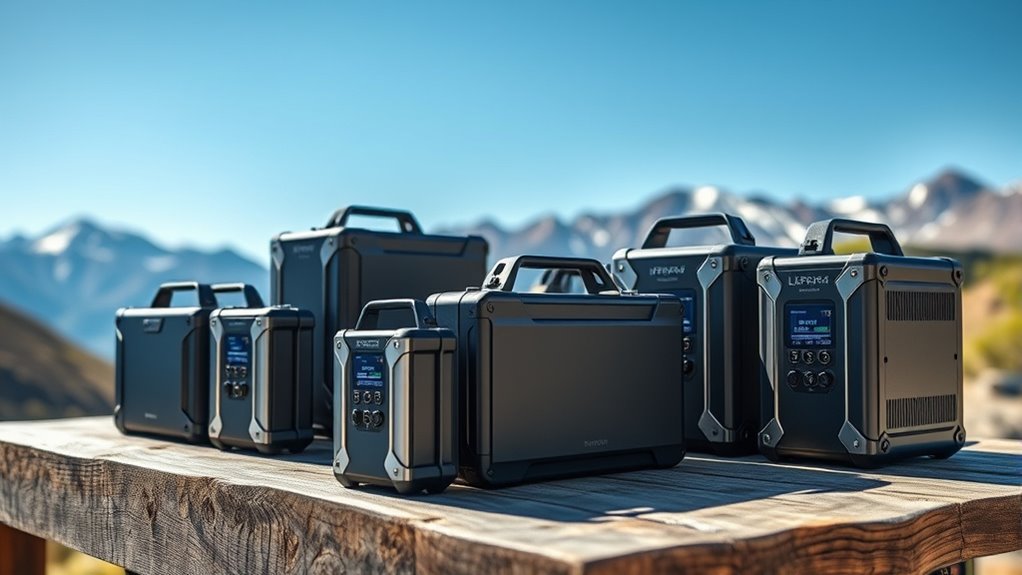

For a portable LiFePO4 power station around 2,000Wh, the Dabbsson 2000L is my best overall fit: it pairs 2048Wh with a 41-pound body, six AC outlets, and several charging routes. The Anker SOLIX C2000 Gen 2 is a better match if you want a similarly sized unit with a stated 2,400W output and the option to expand to 4kWh. For heavier loads, the DJI Power 2000 raises output to 3,000W, while the EBL Acc2400 offers 2,400W at a lower stated capacity of 1843.2Wh.
The choice comes down to more than whether a unit reaches 2,000Wh. Output, weight, recharge setup, and outlet details determine whether a station fits a weekend away, home backup, or a fixed work area. I rank these options by how well their stated capacity and features serve common portable-power needs, while giving weight to practical tradeoffs such as expansion costs, charging accessories, and details the product information leaves unspecified.
Complete the kit


Key Takeaways
- The Dabbsson 2000L is the lightest listed at 41 lb, with 2048Wh, 2200W continuous output, and six AC outlets.
- The Anker SOLIX C2000 Gen 2 has 2048Wh and 2400W rated output; expansion to 4kWh requires an additional battery.
- The DJI Power 2000 lists 3000W output and 15 ports, but solar and car charging require a separate compatible adapter.
- The EBL Acc2400 has the lowest listed capacity at 1843.2Wh and weighs 55 lb, despite offering 2400W output.
- Recharge claims depend on the setup: Dabbsson’s one-hour AC figure depends on input conditions, and Anker’s 58-minute figure uses AC and solar together.
| Dabbsson 2000L Portable Power Station, 2048Wh LiFePO4 Battery, 2200W Output |  | Best Overall | Battery capacity: 2048Wh | Battery chemistry: Semi-solid LiFePO4 | Continuous output: 2200W | VIEW ON AMAZON | See Our Full Breakdown |
| Anker SOLIX C2000 Gen 2 Portable Power Station, 2,048Wh, 2,400W |  | Best for Expandable Backup | Capacity: 2048Wh | Battery type: LiFePO4 | Peak output: 4000W | VIEW ON AMAZON | See Our Full Breakdown |
| DJI Power 2000 Portable Power Station, 2048Wh LFP Battery |  | Best for High-Load, Quiet Backup | Battery capacity: 2048Wh | Battery type: LFP | Output power: 3000W | VIEW ON AMAZON | See Our Full Breakdown |
| EBL Acc2400 Portable Power Station, 1843.2Wh LiFePO4 Battery |  | Best for Fast Backup Switching | Battery capacity: 1843.2Wh | Maximum output: 2400W | Battery chemistry: LiFePO4 | VIEW ON AMAZON | See Our Full Breakdown |
| portable power station lifepo4 2000wh | Battery capacity | Weight | Battery chemistry | Battery type |
|---|---|---|---|---|
| Dabbsson 2000L Portable Power | 2048Wh | 41 lb | Semi-solid LiFePO4 | — |
| Anker SOLIX C2000 Gen 2 Portab | — | 41.7 lb (18.9 kg) | — | LiFePO4 |
| DJI Power 2000 Portable Power | 2048Wh | — | — | LFP |
| EBL Acc2400 Portable Power Sta | 1843.2Wh | 55 lb | LiFePO4 | — |
More Details on Our Top Picks
Dabbsson 2000L Portable Power Station, 2048Wh LiFePO4 Battery, 2200W Output
The Dabbsson 2000L makes the most balanced case for a portable station in this capacity class. Its 2048Wh battery and 2200W continuous output cover a broad range of household devices and travel gear, while six AC outlets make it easier to power several items without adding a power strip. At 41 lb, it is the lightest option in this comparison, a practical advantage over the 55-pound EBL if carrying the station is part of the plan.
Its charging flexibility strengthens the all-around role: the listed routes include AC, solar, 12V car, and hybrid dual-input charging. The one-hour AC recharge claim is useful context, but it depends on AC input conditions; solar panels are optional. App control and an EPS switch under 15ms add convenient monitoring and short-interruption backup behavior. Compared with Anker, Dabbsson offers more listed AC outlets and a lighter body, while Anker has 2400W rated output and a stated expansion path to 4kWh. Its 3300W boost should not be mistaken for continuous output.
The battery is described as semi-solid LiFePO4 and rated for 4000-plus cycles to 80% capacity, which supports a long-term-use case. I would choose this model for a mix of travel and home backup where outlet count and portability matter as much as raw output. The tradeoff is that the fast-charge claim has conditions, and buyers planning solar charging need to account for a panel that is not included.
Pros:- 2048Wh capacity with 2200W continuous output and 3300W boost
- Six AC outlets, app control, and four listed charging methods
- Lightest listed unit at 41 lb
- 4000+ cycles to 80% capacity and EPS switching under 15ms
Cons:- Solar panels are optional, and the one-hour AC recharge depends on input conditions
- Continuous output is below the Anker’s stated 2400W and the DJI’s 3000W
Best for: Buyers who want 2048Wh, multiple AC outlets, flexible charging, and the lowest listed weight in this group.
Not ideal for: People who need more than 2200W continuous output or expect solar panels to be included.
- Battery capacity:2048Wh
- Battery chemistry:Semi-solid LiFePO4
- Continuous output:2200W
- Boost output:3300W
- AC outlets:6
- Charging:AC, solar up to 800W MPPT, 12V car, hybrid dual-input
- Weight:41 lb
- Cycle life:4000+ cycles to 80% capacity
Our verdict“I rank the Dabbsson first for its combination of full 2048Wh capacity, low listed weight, outlet count, and charging flexibility.”
Anker SOLIX C2000 Gen 2 Portable Power Station, 2,048Wh, 2,400W
Anker’s SOLIX C2000 Gen 2 is a strong pick when the buyer’s priority is 2048Wh paired with 2400W rated output. That rated figure is higher than Dabbsson’s 2200W continuous output, giving Anker a useful edge for loads that approach the smaller station’s limit. It also lists 4000W peak power, but peak capacity is a separate short-duration figure and should not be treated as its everyday rating.
For longer outages, the option to add a battery and reach up to 4kWh gives it a path beyond the capacity of the other units as supplied. The expansion battery is required, so this benefit matters most to someone willing to build a larger setup over time. Anker weighs 41.7 lb, just 0.7 lb more than Dabbsson and 13.3 lb less than EBL. Its listed 58-minute full recharge uses AC and solar together; that is not the same claim as a 58-minute AC-only recharge. The 800W alternator charging specification may also appeal to road-trip users, with a stated three-hour full charge.
The key compromise is less outlet detail: the supplied information does not state the number of AC outlets, whereas Dabbsson explicitly lists six and DJI lists 15 total ports. I would favor Anker over Dabbsson when output headroom and eventual capacity expansion matter more than a clearly documented outlet count. If the station will serve several devices at once, verify that its port layout suits the intended setup before choosing.
Pros:- 2048Wh capacity and 2400W rated output
- Expandable to 4kWh with an additional battery
- 58-minute full recharge claim with AC and solar, and 800W alternator charging
- Compact listed weight of 41.7 lb
Cons:- Expansion battery is needed to reach 4kWh
- The listed 58-minute recharge uses AC and solar together
- The supplied specifications do not state the number of AC outlets
Best for: Buyers who want higher stated rated output and a clear option to expand a 2048Wh setup to 4kWh.
Not ideal for: People who need a documented AC outlet count or want a full-charge time based on AC input alone.
- Capacity:2048Wh
- Battery type:LiFePO4
- Peak output:4000W
- Expandable capacity:Up to 4kWh with additional battery
- AC and solar recharge:58 minutes
- Alternator charging:800W; full charge stated in 3 hours
- Weight:41.7 lb (18.9 kg)
Our verdict“I recommend the Anker for buyers who value 2400W rated output and a defined expansion path more than a fully specified outlet layout.”
DJI Power 2000 Portable Power Station, 2048Wh LFP Battery
DJI sets itself apart with 3000W output, the highest stated output in this lineup, while keeping the core capacity at 2048Wh. That makes it a candidate for users whose appliances or tools need more output headroom than Dabbsson’s 2200W or Anker’s 2400W ratings. It also lists 15 ports, a 10ms UPS switch, and operating noise as low as 30 dB. Those details suit a station used near people, equipment, or a workspace where noise and short transfer time matter.
The recharge claim needs careful reading: DJI says it reaches 80% in 55 minutes, not that it fully recharges in that time. Anker, by comparison, gives a 58-minute full-charge claim when AC and solar are combined. DJI’s expansion path is also much larger on paper, reaching up to 22.5kWh with separately sold batteries. That scale could matter for a stationary backup installation, but it adds equipment beyond the base unit. The supplied description does not give the station’s weight, which makes direct portability comparison with the 41-pound Dabbsson and 41.7-pound Anker difficult.
Charging accessories are another point to check: solar and car charging require a separate compatible adapter. For buyers who mainly need AC output and quiet operation, that may be a minor inconvenience; for off-grid users assembling a solar setup, it adds a dependency and planning step. I place DJI below the first two because its strongest advantages lean toward output and expansion, while its partial-charge claim and adapter requirement give less clarity for straightforward portable use.
Pros:- 2048Wh capacity with 3000W output
- 15 ports and a 10ms UPS switch
- Noise level listed as low as 30 dB
- Expansion support up to 22.5kWh with separately sold batteries
Cons:- The 55-minute recharge figure reaches 80%, not a full charge
- Solar and car charging require a separate compatible adapter
- Weight is not stated in the supplied specifications
Best for: Buyers who need the highest stated output here, quiet operation, many ports, or a large expandable backup setup.
Not ideal for: Off-grid users who want solar or car charging ready without a separate compatible adapter, or shoppers prioritizing a clearly stated carry weight.
- Battery capacity:2048Wh
- Battery type:LFP
- Output power:3000W
- Ports:15
- UPS switch time:10ms
- Recharge:80% in 55 minutes
- Noise level:As low as 30 dB
- Expandable capacity:Up to 22.5kWh with separately sold expansion batteries
Our verdict“I would choose the DJI when output headroom and quiet operation outweigh adapter needs and the lack of a listed weight.”
EBL Acc2400 Portable Power Station, 1843.2Wh LiFePO4 Battery
The EBL Acc2400 offers 2400W output and a 0.1-second emergency backup switching claim, which gives it a clear use case for users focused on keeping compatible equipment powered through a brief interruption. It also includes four AC outlets, USB-A and USB-C ports, DC connections, a car port, and a wireless charging panel. Those connections make it a versatile station for a mix of devices, though buyers should match the actual port types to their gear.
Its capacity is 1843.2Wh, about 205Wh below the 2048Wh units from Dabbsson, Anker, and DJI. That gap means less stored energy for a given load, even though its stated output exceeds Dabbsson’s and matches Anker’s. Weight is the larger portability drawback: at 55 pounds, EBL is 13.3 pounds heavier than Dabbsson and 13.3 pounds heavier than Anker as well. I would treat it as portable between locations rather than convenient for frequent carrying.
The battery is rated for over 3500 charge-discharge cycles, and the built-in protections address common electrical and temperature issues. Yet the supplied description gives no charging time or included charging accessories, so it is harder to plan around than Dabbsson’s four stated charging methods or Anker’s recharge details. The LED light and support for up to 12 devices add utility, but they do not erase the capacity and weight gap. This is the specialist choice when its switching feature and port mix matter more than light carrying weight or a full 2,000Wh capacity.
Pros:- 2400W output with stated 0.1-second emergency backup switching
- Multiple port types, wireless charging, and support for up to 12 devices
- LiFePO4 battery rated for over 3500 charge-discharge cycles
- Four-mode LED light and built-in battery protections
Cons:- 1843.2Wh capacity is below the other three products and the 2,000Wh target
- 55 lb is the heaviest listed weight in this comparison
- Charging time and included charging accessories are not specified
Best for: Buyers seeking 2400W output, multiple device connections, and a stated 0.1-second backup switching feature.
Not ideal for: People who need at least 2,000Wh, frequently carry the station, or need a clear recharge time and included-accessory list.
- Battery capacity:1843.2Wh
- Maximum output:2400W
- Battery chemistry:LiFePO4
- Charge-discharge cycles:Over 3500
- AC ports:4
- Device support:Up to 12
- Emergency backup switching:0.1 seconds
- Weight:55 lb
Our verdict“I reserve the EBL for buyers who value its switching feature and broad device connections more than 2,000Wh capacity and easy carrying.”

How We Picked
I compared these four stations against the specific needs implied by portable power around 2,000Wh with LiFePO4 chemistry. That means capacity matters, but it does not settle the ranking by itself. I also looked at continuous output where provided, portability by listed weight, charging paths, outlet information, expansion, and the suitability of the described backup features.
The Dabbsson takes the top spot because it combines a full 2048Wh capacity with the lowest listed weight, six AC outlets, and AC, solar, car, and hybrid charging. Anker follows closely with the same stated capacity, higher rated output, and expansion support, though its recharge figure relies on combined AC and solar. DJI ranks third: its 3000W output and quiet operation are attractive, but its 80-percent recharge figure is not a full-charge time, and the specified solar and car setup needs an adapter. EBL rounds out the ranking because its capacity falls below the title’s 2,000Wh target and its 55-pound weight is the heaviest here. Its 2400W output and rapid backup switching still give it a distinct role.
I used the supplied product details and did not assume unlisted features. In particular, I treat peak and boost output as different from continuous output, distinguish partial recharge claims from full-charge claims, and note when accessories or expansion batteries are separate. Specifications alone cannot predict runtime: actual results depend on the device load, conversion losses, temperature, and how the station is charged.
| portable power station lifepo4 2000wh | Battery chemistry | Battery type | Expandable capacity |
|---|---|---|---|
| Dabbsson 2000L Portable Power | Semi-solid LiFePO4 | — | — |
| Anker SOLIX C2000 Gen 2 Portab | — | LiFePO4 | Up to 4kWh with additional battery |
| DJI Power 2000 Portable Power | — | LFP | Up to 22.5kWh with separately sold expansion batteries |
| EBL Acc2400 Portable Power Sta | LiFePO4 | — | — |
Factors to Consider When Choosing Portable Power Station Lifepo4 2000wh
I would start by matching the station to the devices and the way you plan to recharge it. A 2,000Wh label describes stored energy; output limits, conversion losses, and charging access shape what that energy can do day to day.Capacity and real runtime
Three options here list 2048Wh, while EBL lists 1843.2Wh. A larger capacity can run the same load longer, but usable runtime is lower than the battery’s full stated capacity once conversion losses and the devices’ actual draw are factored in. To compare your setup, add up the watts of the devices you want to run and estimate how many hours they will be on. A fridge that cycles on and off has a different average draw from a heater that runs continuously.
For longer outages, expansion can matter more than a small capacity difference in the base unit. Anker reaches a stated 4kWh with an extra battery, and DJI supports a much larger system with separately sold expansion batteries. If you only need weekend power, the base capacity may be enough; for multi-day backup, check expansion compatibility and the complete system you would need.
Output, surge, and appliance fit
Check the continuous output against the appliances you intend to connect. Dabbsson lists 2200W continuous and 3300W boost; Anker lists 2400W rated and 4000W peak; DJI lists 3000W output; EBL lists 2400W maximum output. Boost and peak figures are not interchangeable with continuous ratings, so use the stated continuous or rated value where one is provided. Appliances with motors can also need extra power briefly as they start.
If you plan to run several devices at once, add their draw together and leave headroom. DJI’s 3000W figure offers the highest stated output here, while Dabbsson is the lowest of the group on its continuous specification. A higher output ceiling does not add battery energy: a powerful appliance may still drain a 2048Wh station quickly.
Weight and port layout
Weight separates these products in a way that is easy to overlook. Dabbsson is listed at 41 lb and Anker at 41.7 lb; EBL weighs 55 lb. DJI’s supplied specifications do not state weight, so I would verify it before buying for frequent transport. For car camping, a heavy station may be manageable if it stays near the vehicle. Carrying it up stairs or moving it often makes every pound more significant.
Check port count and type against your actual devices. Dabbsson explicitly lists six AC outlets, EBL lists four, and DJI specifies 15 total ports. The Anker information provided here does not say how many AC outlets it has. USB-C, DC, and car ports may reduce the need for adapters, but count alone does not show whether ports can supply the voltage or power your equipment needs.
Charging routes and recharge claims
For a station used away from home, compare the actual charging paths: AC, vehicle, and solar can each suit a different trip. Dabbsson lists all three plus hybrid charging and supports up to 800W solar input. Anker lists six charging methods and 800W alternator charging. DJI requires a separate compatible adapter for solar and car charging, while EBL’s supplied details do not specify its recharge time or accessories.
Read recharge times with their conditions attached. Dabbsson’s one-hour claim depends on AC input conditions. Anker’s 58-minute full recharge uses AC and solar together. DJI reaches 80% in 55 minutes, which is a partial-charge figure. These are not direct equivalents. If you depend on solar, the panel’s output, sunlight, cabling, and any required adapter affect how quickly energy comes in.
Backup features and expansion
For backup use, look at the transfer behavior and what devices you need to keep running. EBL states 0.1-second emergency switching, DJI lists a 10ms UPS switch, and Dabbsson lists an EPS switch under 15ms. These are useful indicators, but a switching specification does not by itself confirm compatibility with every computer, medical device, or appliance. Check the manufacturer’s guidance for sensitive equipment.
Expansion is most useful when your needs may grow or an outage lasts longer than one battery can cover. Anker’s 4kWh option is a defined step up; DJI’s stated 22.5kWh maximum targets much larger setups and requires separate batteries. Compare the whole configuration you would need, including adapters, batteries, and charging sources, rather than judging only the base station.
Frequently Asked Questions
Which of these stations is closest to a full 2,000Wh capacity?
The Dabbsson, Anker, and DJI each list 2048Wh, making them the closest match in this group. EBL lists 1843.2Wh, so it stores less energy than the other three even though it can provide a stated 2400W output. Capacity describes energy storage; output describes how much power the station can supply at once.
Which model is easiest to carry?
Among models with a supplied weight, Dabbsson is lightest at 41 lb, followed closely by Anker at 41.7 lb. EBL is 55 lb, which makes frequent lifting less convenient. DJI’s weight is not included in the supplied specifications, so I would check that figure before choosing it for regular transport.
Can any of these power a high-draw appliance?
Potentially, but check the appliance’s running and startup requirements against the station’s applicable output rating. DJI lists 3000W output, Anker lists 2400W rated output, EBL lists 2400W maximum output, and Dabbsson lists 2200W continuous output. Peak and boost figures can cover short demands and should not be read as sustained output ratings.
Are the advertised fast recharge times directly comparable?
No. Dabbsson’s one-hour AC recharge depends on input conditions, Anker’s 58-minute full recharge uses AC and solar together, and DJI’s 55-minute figure reaches 80%. EBL’s supplied information does not state a recharge time. Compare the charging source, input conditions, and whether the claim describes a full or partial charge before using a time estimate to plan a trip.
Which station makes the most sense for home backup?
For a versatile base unit, I would start with Dabbsson because it combines 2048Wh, six AC outlets, and a listed EPS switch under 15ms. Anker suits buyers who want a defined path to 4kWh, while DJI’s 3000W output and much larger expansion ceiling may fit a bigger backup setup. Check the transfer behavior and device requirements for any equipment that must stay powered through an interruption.
Conclusion
For one station to cover a mix of travel, outdoor use, and home backup, I recommend the Dabbsson 2000L for its 2048Wh capacity, six AC outlets, and 41-pound listed weight. Choose the Anker SOLIX C2000 Gen 2 if you want 2400W rated output and expect to expand storage to 4kWh. The DJI Power 2000 is the better fit for buyers who value 3000W output, quiet operation, and a large expansion ceiling, provided they plan around the separate charging adapter. Pick the EBL Acc2400 when its 0.1-second backup switching and port mix matter more than reaching 2,000Wh or keeping carry weight low.