A GPS NTP time server gives network devices a local time source synchronized to satellite signals, reducing reliance on public internet time services. The dual Ethernet GPS NTP server is my best overall pick for its flexible AC or PoE power and two network ports, while the GPS PTP/NTP server with TCXO stands out for networks that need IEEE 1588 support. For a compact setup, the Cwmiibili FC-NTP-MINI offers a smaller appliance format. The main tradeoffs are protocol support, network and power connections, antenna placement, and how much monitoring a deployment requires. Read on for the full comparison and guidance on matching a server to your network.

Get the latest gadgets delivered free with Prime
- Fast, free delivery on millions of items
- Prime Video, Amazon Music and more included
- Member-only deals all year
Complete the kit



Key Takeaways
- The dual Ethernet model ranks first for deployment flexibility: two network ports and AC or PoE power give it more placement and connection options than the lineup’s simpler appliance designs.
- PTP support is the key separator for precision-oriented networks: the TCXO model and TimeMachines TM2000B list both PTP and NTP, while most picks are presented primarily as NTP servers.
- The FC-NTP family spans different physical needs: the standard FC-NTP models suit conventional installations, while the Cwmiibili FC-NTP-MINI is the compact choice.
- Antenna placement can matter more than extra server features: the GPS-synced enterprise listing includes a 32-foot portable antenna, which may help when the server itself cannot sit near a clear satellite view.
- The NTP220 and NTP270 are appliance alternatives, not feature-equivalent stand-ins: their model names identify distinct options, but buyers should confirm interface, protocol, and installation details before choosing between them.
| IOVEU GPS NTP Network Time Server with Dual Ethernet Ports |  | Best for Redundant Rack Deployments | Brand: IOVEU | Model: NTP-32FT | Satellite systems: GPS, GLONASS, BeiDou | VIEW ON AMAZON | See Our Full Breakdown |
| Matoluo GPS PTP and NTP Time Server with TCXO |  | Best for PTP and Failover | Manufacturer: Matoluo | Protocols: IEEE 1588v2 PTP; NTP v1/v2/v3/v4; SNTP | Network support: IPv4, IPv6, DHCP | VIEW ON AMAZON | See Our Full Breakdown |
| CenterClick GPS-Based NTP Server Appliance (NTP220) |  | Best Compact Appliance | Manufacturer: CenterClick LLC | Model: NTP220 | Time source: Integrated GPS | VIEW ON AMAZON | See Our Full Breakdown |
| FC-NTP Network Time Server with Integrated GNSS Receiver |  | Best for Wide-Temperature Sites | Satellite systems: GPS L1, BeiDou B1, GLONASS L1, QZSS L1 | Network timing accuracy: 0.5–2 ms | Request capacity: Up to 6,000 visits per second | VIEW ON AMAZON | See Our Full Breakdown |
| GPS-Synced NTP Server YK-1000H |  | Best for Flexible Power | Model: YK-1000H | Manufacturer: YANGKE | Power input: AC 110–260 V or PoE, IEEE 802.3af/at | VIEW ON AMAZON | See Our Full Breakdown |
| Cwmiibili FC-NTP-MINI Network Time Server with Integrated GNSS Receiver | | Best Compact Multisystem Pick | Supported satellites: GPS L1, BeiDou B1, GLONASS L1, QZSS L1 | Synchronization accuracy: 0.5–2 ms | Maximum stated throughput: Up to 6,000 requests per second | VIEW ON AMAZON | See Our Full Breakdown |
| TimeMachines PTP/NTP Network Time Server TM2000B |  | Best for PTP and GPS-Loss Holdover | Time source: GPS | Stratum: Stratum 1 | Protocols: PTP and NTP | VIEW ON AMAZON | See Our Full Breakdown |
| Tassteen FC-NTP Network Time Server with Integrated GNSS Receiver | | Best for Wide-Temperature Installations | Supported satellite systems: GPS L1, BeiDou B1, GLONASS L1, QZSS L1 | Timing accuracy: 0.5–2 ms | Ethernet: RJ45, 10/100 Mbps adaptive | VIEW ON AMAZON | See Our Full Breakdown |
| GPS Based NTP Server Appliance (NTP270) | 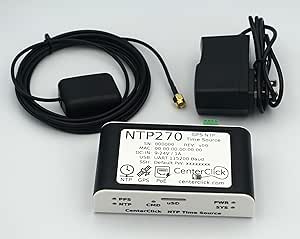 | Best for Monitoring and Integration | Time source: GPS | Power inputs: Dual redundant DC and PoE | Connectivity: USB, SSH, web server | VIEW ON AMAZON | See Our Full Breakdown |
| gps ntp time server | Protocols |
|---|---|
| IOVEU GPS NTP Network Time Ser | — |
| Matoluo GPS PTP and NTP Time S | IEEE 1588v2 PTP; NTP v1/v2/v3/v4; SNTP |
| CenterClick GPS-Based NTP Serv | — |
| FC-NTP Network Time Server wit | NTP v2/v3/v4; SNTP v3/v4 |
| GPS-Synced NTP Server YK-1000H | NTP and SNTP |
| Cwmiibili FC-NTP-MINI Network | NTP v2, v3, v4; SNTP v3, v4 |
| TimeMachines PTP/NTP Network T | PTP and NTP |
| Tassteen FC-NTP Network Time S | — |
| GPS Based NTP Server Appliance | — |
More Details on Our Top Picks
IOVEU GPS NTP Network Time Server with Dual Ethernet Ports
The IOVEU is the clearest fit here for rack installations that need multiple satellite sources and flexible power. Its GPS, GLONASS, and BeiDou reception gives it more signal options than the single-source NTP220, while dual Ethernet ports and AC or PoE power help it fit networks with redundant links or limited outlet access. PPS and TOD outputs also make it useful when timing needs to reach equipment beyond ordinary NTP clients. The stated capacity of up to 6,000 requests per second suits busy networks, though the listing does not specify a battery backup for outages. Compared with the compact NTP220, this unit trades portability for rack-friendly connections and output options; it is an indoor appliance, so outdoor deployment calls for other equipment.
Pros:- Receives GPS, GLONASS, and BeiDou signals
- Dual Ethernet ports support redundant network connections
- PPS and TOD outputs extend timing to connected equipment
- Supports both AC and PoE power
Cons:- Indoor rack-mount design limits placement options
- No built-in battery backup is specified
Best for: Network teams installing a rack-mounted time source with dual Ethernet, external timing outputs, and AC or PoE power
Not ideal for: Teams needing outdoor installation or time service through power outages, since it is indoor-only and has no built-in battery backup
- Brand:IOVEU
- Model:NTP-32FT
- Satellite systems:GPS, GLONASS, BeiDou
- Network interfaces:Dual Ethernet ports
- Power:AC or PoE
- Timing outputs:PPS and TOD
- Request capacity:Up to 6,000 requests per second
- Mounting and dimensions:Indoor rack mount; 7.87 in W × 1.75 in H
Our verdict“Choose the IOVEU for a rack-based network that benefits from multi-GNSS reception, dual Ethernet, and PPS/TOD outputs.”
Matoluo GPS PTP and NTP Time Server with TCXO
For an enterprise or industrial network that needs both conventional NTP and precision PTP, the Matoluo covers more ground than the NTP220, which is centered on GPS-backed NTP service. Its IEEE 1588v2 support, SNMPv2 monitoring, and web management suit teams overseeing mixed equipment and remote sites. The option to group up to five servers in hot standby with automatic failover is its defining advantage when time service continuity matters. That resilience comes with a holdover tradeoff: the listed deviation can reach 60 ms after one day without its reference, so it may not suit installations needing tight accuracy through a prolonged signal loss. The IOVEU offers dual Ethernet and PPS/TOD outputs, while Matoluo’s edge is protocol breadth and coordinated failover.
Pros:- Supports IEEE 1588v2 PTP as well as NTP and SNTP
- Hot standby and automatic failover across up to five servers
- SNMPv2 monitoring and web-based management
- Supports IPv4, IPv6, and DHCP
Cons:- Holdover deviation may reach 60 ms after one day
- Standard crystal oscillator is listed as the default
- At 10 pounds, it is heavier than the compact NTP220
Best for: IT and operations teams managing industrial or enterprise networks with PTP devices and a requirement for server failover
Not ideal for: Sites that need very tight time accuracy during extended GPS loss or prefer a simple NTP-only appliance
- Manufacturer:Matoluo
- Protocols:IEEE 1588v2 PTP; NTP v1/v2/v3/v4; SNTP
- Network support:IPv4, IPv6, DHCP
- Management:SNMPv2 and web-based control and firmware updates
- High availability:Up to five servers in multi-node hot standby with automatic failover
- Holdover deviation:Up to 60 ms after one day
- Oscillator stability:±20 to ±0.5 ppm
- Weight:10 lb
Our verdict“Pick the Matoluo when your network needs PTP alongside NTP and server failover, and can accept its stated holdover limit.”
CenterClick GPS-Based NTP Server Appliance (NTP220)
The CenterClick NTP220 makes the most sense when space and integration matter more than hands-on web configuration. At 4.25 × 2.5 × 1 inches and 10 ounces, it is far easier to place near a small network than the rack-focused IOVEU. Its GPS-backed Stratum 1 service, SSH and USB administration, and JSON output give technically comfortable buyers several ways to monitor or connect it to custom systems. The web server is view-only, however, so configuration requires another route; that is less convenient than the Matoluo’s web-based control. The available product data also gives fewer details on network ports, power, and supported client load than the IOVEU listing, which may complicate planning for larger installations.
Pros:- Compact, lightweight enclosure
- GPS source provides Stratum 1 time synchronization
- Supports administration through USB and SSH
- JSON-encoded raw data supports custom integration
Cons:- Web interface is view-only, limiting browser-based configuration
- Available specs do not state request capacity or network-port details
Best for: Small offices, labs, and technically confident administrators who want a compact GPS-backed NTP source with SSH, USB, or JSON integration
Not ideal for: Teams that expect to configure the device through its web page or need clearly specified throughput and network-port details before deployment
- Manufacturer:CenterClick LLC
- Model:NTP220
- Time source:Integrated GPS
- Synchronization:Stratum 1
- Dimensions:4.25 × 2.5 × 1 in
- Weight:10 oz
- Administration:View-only web server, USB, and SSH
- Data output:JSON-encoded raw data
Our verdict“Choose the NTP220 for a small, integration-friendly GPS NTP installation where SSH or USB administration is acceptable.”
FC-NTP Network Time Server with Integrated GNSS Receiver
The FC-NTP stands out for sites where operating temperature range and satellite coverage shape the choice. It receives GPS, BeiDou, GLONASS, and QZSS, and its listed operating range of -40 to 85 °C gives it a broader environmental specification than the indoor-only IOVEU. The stated network timing accuracy is 0.5–2 ms, with support for up to 6,000 visits per second, making its capabilities easier to compare against a defined workload than the compact NTP220’s listing. It has one adaptive 10/100 Mbps RJ45 connection and a US plug adapter, though, so it lacks the IOVEU’s dual Ethernet and AC/PoE flexibility. The listing says installation or download information may require customer-service help, which could slow setup.
Pros:- Supports GPS, BeiDou, GLONASS, and QZSS
- Specified network timing accuracy of 0.5–2 ms
- Operating temperature range of -40 to 85 °C
- Supports NTP and SNTP versions 2 through 4
Cons:- Single 10/100 Mbps RJ45 connection
- Uses a US plug power adapter
- Installation or download details may require contacting customer service
Best for: Facilities and network teams placing an NTP source in locations with wide temperature swings and access to a US outlet
Not ideal for: Deployments that require redundant Ethernet, PoE, or a ready-to-follow installation guide without contacting support
- Satellite systems:GPS L1, BeiDou B1, GLONASS L1, QZSS L1
- Network timing accuracy:0.5–2 ms
- Request capacity:Up to 6,000 visits per second
- Protocols:NTP v2/v3/v4; SNTP v3/v4
- Ethernet:RJ45, 10/100 Mbps, adaptive connection
- Working voltage:DC 6–24 V
- Operating temperature:-40 to 85 °C
- Dimensions and weight:11.02 × 6.69 × 2.76 in; 14.8 oz
Our verdict“Choose the FC-NTP when its wide temperature rating and four-satellite-system support matter more than redundant Ethernet or PoE.”
GPS-Synced NTP Server YK-1000H
The YK-1000H is a practical fit when the power source is a bigger constraint than rack redundancy. It accepts 110–260 V AC or PoE, so an installer can choose between a broad-range outlet connection and power over the network cable. The web interface, DST support, and NTP/SNTP service cover straightforward remote administration, while the 32 ft antenna gives placement flexibility for satellite reception. Compared with the IOVEU, it has a smaller listed enclosure but lacks the stated dual Ethernet and PPS/TOD outputs. Its nanosecond-level accuracy claim is prominent, but the provided specs do not include a measurement method or a matching network accuracy figure, so buyers should avoid treating it as directly comparable to the FC-NTP’s stated 0.5–2 ms. The listing describes indoor tabletop use and a plastic-and-metal frame.
Pros:- Supports 110–260 V AC or IEEE 802.3af/at PoE
- Includes a 32 ft portable antenna
- Web management supports remote configuration and monitoring
- NTP and SNTP support with DST handling
Cons:- Indoor tabletop design is not intended for harsh outdoor conditions
- No dual Ethernet or PPS/TOD outputs are listed
- Nanosecond-level accuracy claim lacks a stated measurement method in the supplied data
Best for: Installers who need PoE or wide-range AC power and a long antenna lead for an indoor GPS time server
Not ideal for: Buyers who need a rugged outdoor unit, redundant Ethernet, or independently detailed accuracy specifications
- Model:YK-1000H
- Manufacturer:YANGKE
- Power input:AC 110–260 V or PoE, IEEE 802.3af/at
- Antenna:32 ft portable antenna
- Protocols:NTP and SNTP
- Management:Web-based interface
- Dimensions and weight:4 × 1.7 in; 1.8 lb
- Frame material:Plastic and metal
Our verdict“Pick the YK-1000H for an indoor installation where PoE or wide-range AC power and antenna placement flexibility are the main priorities.”
Cwmiibili FC-NTP-MINI Network Time Server with Integrated GNSS Receiver
The Cwmiibili FC-NTP-MINI suits a small network that needs satellite-sourced NTP without a bulky appliance. Its receiver can use GPS, BeiDou, GLONASS, and QZSS, giving it more satellite options than the GPS-only TimeMachines TM2000B. The stated 0.5–2 ms timing accuracy and support for NTP and SNTP make it a fit for ordinary network time distribution, while the 10/100 Mbps port and claim of up to 6,000 requests per second describe its network capacity. Its compact design is the main draw, though the listing gives little installation guidance: buyers may need to contact customer service for setup or download information. Choose the TimeMachines instead if PTP and OCXO holdover matter more than multisystem GNSS support.
Pros:- Supports GPS, BeiDou, GLONASS, and QZSS
- Stated timing accuracy of 0.5–2 ms
- Compact unit with 10/100 Mbps Ethernet
- Supports NTP v2–v4 and SNTP v3–v4
Cons:- Installation and download information may require contacting customer service
- No PTP support is listed
- US-plug power adapter may not suit installations outside the US
Best for: Small offices or equipment closets seeking a compact NTP server with several GNSS satellite options.
Not ideal for: Teams that need detailed self-service setup instructions or PTP support, since neither is specified here.
- Supported satellites:GPS L1, BeiDou B1, GLONASS L1, QZSS L1
- Synchronization accuracy:0.5–2 ms
- Maximum stated throughput:Up to 6,000 requests per second
- Protocols:NTP v2, v3, v4; SNTP v3, v4
- Ethernet:RJ45, 10/100 Mbps
- Working voltage:DC 6–24 V
- Operating current:80 mA at 12 V
- Operating temperature:-40 to 85°C
Our verdict“Choose the FC-NTP-MINI for compact multisystem satellite timing when NTP and SNTP are sufficient.”
TimeMachines PTP/NTP Network Time Server TM2000B
The TimeMachines TM2000B stands apart from the Cwmiibili FC-NTP-MINI and Tassteen FC-NTP because it supports PTP as well as NTP. That makes it a stronger match for networks with devices that need Precision Time Protocol, rather than only conventional NTP service. It is a Stratum 1 GPS-based server with an active antenna and an OCXO for maintaining time when GPS lock is lost, a useful fallback that the listed details for the GNSS alternatives do not provide. Its 5 × 4.2 × 1.3-inch enclosure can fit indoor installations, but GPS reception may suffer in dense or shielded spaces; an optional outdoor antenna may be needed. Advanced configuration details are limited, so buyers who want a multisystem receiver or clearer setup information may prefer another option.
Pros:- Supports both PTP and NTP
- OCXO provides holdover when GPS lock is lost
- Includes an active GPS antenna
- Compact 5 × 4.2 × 1.3-inch enclosure
Cons:- GPS lock may be unreliable in dense or shielded indoor environments
- Advanced configuration documentation is limited
- Only GPS is specified as the timing source
Best for: Network administrators whose equipment uses PTP and who need GPS-sourced Stratum 1 time with oscillator holdover.
Not ideal for: Buyers who need multiple satellite constellations or dependable GPS reception in a shielded indoor location without an outdoor antenna.
- Time source:GPS
- Stratum:Stratum 1
- Protocols:PTP and NTP
- Holdover:High-stability OCXO
- Antenna:Active GPS antenna included
- Dimensions:5 × 4.2 × 1.3 inches
- Weight:1.45 pounds
- Model number:TM2000B
Our verdict“Pick the TM2000B when PTP support and GPS-loss holdover matter more than multisystem GNSS reception.”
Tassteen FC-NTP Network Time Server with Integrated GNSS Receiver
The Tassteen FC-NTP is a fit for buyers who need a GNSS time server specified for a broad range of operating conditions. Like the Cwmiibili FC-NTP-MINI, it supports GPS, BeiDou, GLONASS, and QZSS, multiple NTP and SNTP versions, and stated timing accuracy of 0.5–2 ms. Its listed -40 to 85°C operating range and 5% to 95% non-condensing humidity range make environmental tolerance a more visible part of its case. The listed dimensions, 11.02 × 6.69 × 2.76 inches, are less compact than the TM2000B, so check the available mounting space. Setup information may require a customer-service contact, and the included adapter has a US plug. Compared with the GPS-only TimeMachines, this offers more GNSS options but lacks listed PTP and OCXO holdover.
Pros:- Supports four GNSS satellite systems
- Stated timing accuracy of 0.5–2 ms
- Wide stated operating temperature and humidity ranges
- Supports NTP v2–v4 and SNTP v3–v4
Cons:- Setup or download information may require contacting customer service
- US-plug power adapter may require an adapter in some regions
- No PTP or OCXO holdover is listed
Best for: Operators planning NTP service in locations with wide temperature swings who can accommodate its listed dimensions.
Not ideal for: Buyers who need PTP, documented holdover, or a non-US power adapter included.
- Supported satellite systems:GPS L1, BeiDou B1, GLONASS L1, QZSS L1
- Timing accuracy:0.5–2 ms
- Ethernet:RJ45, 10/100 Mbps adaptive
- Supported protocols:NTP v2, v3, v4; SNTP v3, v4
- Maximum visits per second:6,000
- Operating temperature:-40 to 85°C
- Working humidity:5% to 95%, non-condensing
- Dimensions:11.02 × 6.69 × 2.76 inches
- Power adapter:AC 110 V, US plug
Our verdict“Choose the Tassteen for multisystem NTP service in temperature-variable installations where its size and US-plug adapter fit.”
GPS Based NTP Server Appliance (NTP270)
The NTP270 is aimed at teams that want more than a basic NTP endpoint: its embedded web server provides status and graphs, while JSON data and I/O connectors support custom integration. It also lists dual redundant DC and PoE power inputs, a useful option for deployments where a single power path is a concern. Compared with the Cwmiibili FC-NTP-MINI and Tassteen FC-NTP, which specify multiple GNSS systems and timing accuracy, the NTP270 listing gives fewer timing details and identifies GPS as its source. The compact 4.25 × 2.5 × 1-inch enclosure is easier to place than the larger Tassteen, but setup calls for technical knowledge and advanced feature documentation is limited. This is the more integration-focused pick; buyers seeking clearly stated accuracy and satellite support should compare the FC-NTP models closely.
Pros:- Embedded web server with status and graphs
- Dual redundant DC and PoE power inputs
- JSON data and I/O connectors support custom integration
- Compact 4.25 × 2.5 × 1-inch enclosure
Cons:- Advanced feature details are limited in the listing
- Setup and configuration require technical knowledge
- GPS is the only timing source specified
Best for: Technical teams that want web-based status visibility, JSON data, and redundant DC or PoE power options.
Not ideal for: Buyers who need published timing accuracy, multiple listed GNSS systems, or straightforward setup guidance.
- Time source:GPS
- Power inputs:Dual redundant DC and PoE
- Connectivity:USB, SSH, web server
- Data format:JSON-encoded raw data
- Dimensions:4.25 × 2.5 × 1 inches
- Weight:10.5 ounces
- Web interface:Status and graphs
- Integration:I/O connectors
Our verdict“Choose the NTP270 when monitoring, integration, and redundant power options matter more than published timing specifications.”
How We Picked
I ranked these GPS NTP time servers by how clearly their stated features solve common deployment needs: providing a satellite-referenced time source, connecting cleanly to a network, and fitting available power and rack or desk space. I gave more weight to explicit capabilities such as dual Ethernet, PoE, PTP, TCXO, SNMP, IPv6, and antenna reach because they help buyers judge compatibility before purchase. A feature earns credit only for the use case it serves; PTP support matters for precision timing systems, while compact size matters more in a small installation.
The ranking favors options with a broader, clearly stated fit, then separates specialized picks by their strongest use. The dual Ethernet model leads for power and connection flexibility; the TCXO model follows for its mix of PTP, NTP, and monitoring features. Compact and appliance-style units rank for narrower needs. Product descriptions provide limited detail for several models, so I avoid assuming unlisted accuracy, management, redundancy, or environmental specifications; buyers should verify those against the manufacturer’s current documentation.
| gps ntp time server | Protocols |
|---|---|
| IOVEU GPS NTP Network Time Ser | — |
| Matoluo GPS PTP and NTP Time S | IEEE 1588v2 PTP; NTP v1/v2/v3/v4; SNTP |
| CenterClick GPS-Based NTP Serv | — |
| FC-NTP Network Time Server wit | NTP v2/v3/v4; SNTP v3/v4 |
| GPS-Synced NTP Server YK-1000H | NTP and SNTP |
| Cwmiibili FC-NTP-MINI Network | NTP v2, v3, v4; SNTP v3, v4 |
| TimeMachines PTP/NTP Network T | PTP and NTP |
| Tassteen FC-NTP Network Time S | — |
| GPS Based NTP Server Appliance | — |
Factors to Consider When Choosing Gps Ntp Time Server
Choosing a GPS time appliance starts with the network and installation it must serve. I would check protocol requirements, satellite reception, power and port availability, then confirm how the device will be monitored and maintained. Those details often matter more to a successful deployment than a long feature list.
Match NTP and PTP to the devices that need time
Start by listing the equipment that will consume time, including servers, switches, cameras, control systems, and any precision measurement devices. Many networked devices use NTP, but some applications require PTP and may depend on IEEE 1588 details such as supported profiles or timestamping behavior. A server that advertises both protocols can be useful, yet that alone does not confirm compatibility with every PTP client. Check whether your endpoints need hardware timestamping, a particular profile, or a specific grandmaster role. Avoid paying for PTP if all clients use NTP and your timing tolerance does not call for it. Ask the vendor for protocol and client compatibility documentation before placing the unit in a production network.
Plan for a clear GPS antenna view
A GPS-synchronized server depends on antenna reception, so decide where the antenna can see the sky before choosing a mounting location for the appliance. A network closet may be convenient for Ethernet and power but can block satellite signals behind walls, metal roofing, or nearby structures. Measure the cable route and account for connector type, weather exposure, and any specified cable limits. A longer included antenna lead can simplify placement, though it may not suit every roof or building layout. Check whether the unit reports satellite lock and holdover status so staff can distinguish a reception problem from a network issue. The common mistake is selecting the server first and discovering that the antenna cannot reach a usable location.
Choose ports and power around your installation
Count the available switch ports and identify whether the installation can supply PoE or needs a dedicated AC outlet. Dual Ethernet may help with separate network connections, but confirm whether the ports support the topology you intend rather than assuming they provide failover or isolation. PoE can reduce cabling and simplify placement, while AC power may be easier where PoE budgets are tight. If the time source supports critical operations, check your power backup plan and the device’s behavior during outages. Consider whether the appliance needs a rack shelf, a small desk footprint, or a secure enclosure. These practical constraints can narrow the shortlist before comparing advanced timing features.
Set an accuracy target and understand holdover
Define the timing tolerance your systems actually need, then compare it with documented specifications for the complete setup, including antenna, receiver, and network distribution. A TCXO can support stable oscillator behavior, but the oscillator type by itself does not state the accuracy your clients will see. Ask for figures covering satellite-locked operation, time distribution over the network, and holdover when GPS reception is lost. Holdover describes how well the server keeps time without a live satellite reference, which can matter during antenna faults or brief outages. Do not infer performance from labels such as enterprise or high precision. When the use case is regulated or safety-related, get written specifications and validation requirements from the vendor.
Decide what monitoring and maintenance you need
Think through who will notice and respond if satellite lock drops, the appliance loses power, or a network path fails. SNMP can fit an existing monitoring system, but verify which status values and alarms the implementation exposes. Also check support for IPv4 or IPv6 in the networks where the server will be reachable, along with access controls and firmware update procedures. A compact, straightforward appliance may suit a small office with occasional checks, while a larger operation may need central alerts and documented service processes. Ask about firmware support, configuration backup, and replacement procedures before deployment. These operational details reduce the chance that a time source quietly drifts out of service.
Frequently Asked Questions
Can I use a GPS NTP server on a network without internet access?
Yes, a GPS NTP server can provide network time from satellite reception without relying on an internet time service. The appliance still needs network connectivity to reach the devices that request time, and its antenna needs a usable view of the sky. Check whether the model can operate independently and how it signals loss of satellite lock. If your network is isolated, plan how to monitor the unit locally and how its configuration will be maintained. Confirm the required client settings with your network administrator before installation.
Do I need PTP as well as NTP?
Choose PTP when your endpoints or application specifically require IEEE 1588 timing, especially where tighter synchronization is part of the system design. NTP is often sufficient for general server, workstation, and network device timekeeping. A dual-protocol server can keep options open, but the word PTP does not guarantee support for the profile or timestamping method your equipment needs. Check the client manuals and ask the server vendor to confirm interoperability. If every endpoint uses NTP, PTP capability may add complexity without solving a current requirement.
Where should I install the GPS antenna if the server is in a network closet?
Place the antenna where it has a clear view of the sky, which may mean a roof, exterior wall, or window location depending on the building and antenna design. The server can remain in the closet if the antenna cable can reach the selected spot within the manufacturer’s cable guidance. Measure the path and account for cable routing, weatherproofing, and connector protection before ordering. Buildings with metal roofs or dense surroundings may need a different mounting position. Verify that the appliance exposes satellite reception status so you can confirm the final placement works.
Is a dual Ethernet port model automatically redundant?
No. Two Ethernet ports describe the available interfaces, but they do not establish that the device supports failover, link aggregation, separate networks, or redundant time service. Read the documentation for the exact port behavior and supported network modes. If availability matters, ask what happens after a cable, switch, or power failure and whether clients can use another time source. Consider independent power and antenna paths as well as network connections. Treat redundancy as a documented system capability, not an assumption based on port count.
What should I verify before choosing between the NTP220 and NTP270?
Compare their official specifications for Ethernet interfaces, supported protocols, power, antenna and cable, mounting, management, and timing performance. The model names alone do not establish which one suits your network or whether one is a direct upgrade from the other. Check how each reports satellite lock and handles loss of GPS reception, especially if holdover matters. Confirm firmware and support arrangements for the exact hardware revision being offered. If the published descriptions leave a requirement unanswered, request written clarification before selecting either appliance.
Conclusion
For the broadest deployment fit, I recommend the dual Ethernet GPS NTP server as best overall, thanks to its two ports and AC or PoE power options. The FC-NTP family is my value-oriented route when a straightforward integrated GNSS appliance meets the need; compare the standard models with the FC-NTP-MINI if space is tight. Beginners should start with an appliance whose documented setup, satellite status, and network configuration match their skills, then confirm those details with the seller before buying. For a premium timing requirement, the TCXO GPS PTP/NTP server is the strongest listed fit when IEEE 1588 and SNMP matter. Choose the TimeMachines TM2000B for a PTP/NTP alternative, or the enterprise listing with its 32-foot antenna when antenna placement is the main constraint; verify specifications for the NTP220 and NTP270 before deciding between those models.
Fall Picks
fall essentials
As an affiliate, we earn on qualifying purchases.