Choosing a Ford Transit solar panel kit starts with roof shape, usable space, and the electrical load you want to support—not just the wattage printed on a listing. My strongest all-around fit is the Go Power! Overlander 200W for its long installation cable, phone-based controller monitoring, and stated expansion path. For a flexible, lighter setup, the ECO-WORTHY 260W kit offers more listed panel capacity, while the ECO-WORTHY 200W rigid kit is the simpler packaged option for a Transit owner who wants mounting hardware and cables included.

Get the latest gadgets delivered free with Prime
- Fast, free delivery on millions of items
- Prime Video, Amazon Music and more included
- Member-only deals all year
The tradeoffs are substantial: rigid panels take roof space and add weight, flexible panels can suit curved areas but require careful mounting, and controller type affects harvesting and monitoring. I also treat advertised output as conditional on sunlight, not a daily guarantee. One listing has conflicting wattage details, and another makes an unusually large capacity claim, so I rank those choices with extra caution.
Complete the kit



Key Takeaways
- The Go Power! Overlander is the clearest fit for buyers who value Bluetooth monitoring and a specified expansion ceiling of 600W, but its single 200W panel needs a large, clear roof area.
- ECO-WORTHY’s 260W flexible kit combines the highest clearly stated output among the more conventional options with panels listed at 4.5 pounds each; its PWM controller remains a limitation.
- The ECO-WORTHY 200W rigid kit is the most straightforward packaged choice for a 12V or 24V setup, with brackets and cables included, but its two panels still need a planned mounting layout.
- XINPUGUANG is the bendable option for an irregular roof area, but conflicting wattage descriptions make it a poor choice for buyers who need dependable capacity planning.
- GCUSSZ advertises 1,000W across two flexible panels, a claim that should be independently verified alongside controller limits and panel wiring before a Transit installation.
| Go Power! Overlander 200W 12V Solar Panel Charging Kit | 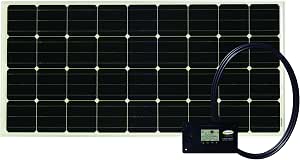 | Best for monitoring and planned expansion | Panel power: 200W | System voltage: 12V DC | Controller: 30A PWM with Bluetooth | VIEW ON AMAZON | See Our Full Breakdown |
| ECO-WORTHY 260W Flexible Solar Panel Kit with 30A Charge Controller |  | Best flexible option with clearly stated output | Total panel power: 260W (2 × 130W) | Controller: 30A PWM | Panel dimensions: 37.78 × 27.17 × 0.1 in each | VIEW ON AMAZON | See Our Full Breakdown |
| ECO-WORTHY 200W 12V/24V Monocrystalline Solar Panel Kit with 30A PWM Charge Controller |  | Best packaged rigid-panel starter kit | Panel power: 200W total (2 × 100W) | Configuration: 12V parallel or 24V series | Controller: 30A PWM | VIEW ON AMAZON | See Our Full Breakdown |
| XINPUGUANG 200W Flexible Solar Panel Kit with 20A Charge Controller |  | Best for an irregular roof area, with a capacity caveat | Claimed maximum power: 200W in title; listing details also state 105W and 210W | Output voltage: 12V DC | Supported system voltage: 12V/24V | VIEW ON AMAZON | See Our Full Breakdown |
| GCUSSZ 1000W Flexible Monocrystalline Solar Panel Kit with 40A Charge Controller |  | Highest advertised capacity, but verify before building around it | Advertised panel power: 1,000W total (2 × 500W) | Controller: 40A | Battery voltage compatibility: 12–48V stated | VIEW ON AMAZON | See Our Full Breakdown |
| ford transit solar panel kit | Controller | Panel dimensions |
|---|---|---|
| Go Power! Overlander 200W 12V | 30A PWM with Bluetooth | 59 × 26.3 × 1.6 in |
| ECO-WORTHY 260W Flexible Solar | 30A PWM | 37.78 × 27.17 × 0.1 in each |
| ECO-WORTHY 200W 12V/24V Monocr | 30A PWM | 35.2 × 23.1 × 1.3 in each |
| XINPUGUANG 200W Flexible Solar | 20A | — |
| GCUSSZ 1000W Flexible Monocrys | 40A | 40.15 × 26.37 × 0.1 in each |
More Details on Our Top Picks
Go Power! Overlander 200W 12V Solar Panel Charging Kit
I rank the Go Power! Overlander first because it gives a Ford Transit owner two useful planning advantages: a Bluetooth-enabled 30A controller for viewing charging information and a stated ability to expand to 600W without replacing that controller. Those features matter for a van build that may begin with battery maintenance or light loads and grow later. The included long cable also gives an installer more routing options between roof and electrical components than a short prewired lead would.
Compared with the two ECO-WORTHY kits, this one has less listed starting capacity than the 260W flexible set and lacks its low panel weight. It is also a single, broad panel at 59 by 26.3 inches, so a Transit roof layout needs to accommodate that footprint around vents, fans, and racks. At 35 pounds, it is the heaviest clearly specified panel setup here. Its PWM controller is another compromise: buyers focused on maximizing harvest from limited roof space may want to compare charge-controller designs before committing.
The stated 25-year warranty is a notable long-term signal, but the product details do not make every installation or vehicle-specific fit question disappear. I would still check roof clearance, mounting compatibility, battery requirements, and cable routing before ordering. This is my leading pick for buyers who want a recognizable expansion path and convenient monitoring, not for anyone seeking the lightest or most compact array.
Pros:- Bluetooth-enabled 30A PWM controller supports phone-based monitoring.
- Stated expansion capacity reaches 600W without replacing the controller.
- Includes 50 feet of pre-wired solar output cable for flexible routing.
- 25-year limited warranty is longer than the warranty specified for the other kits.
Cons:- The 35-pound panel and large footprint can complicate Transit roof layouts.
- PWM technology may be less efficient than an MPPT alternative.
- Its starting output is lower than the ECO-WORTHY 260W flexible kit.
Best for: Transit owners planning a 12V system that may grow over time and who want Bluetooth controller monitoring and a long cable run.
Not ideal for: Buyers with a crowded roof, strict weight limits, or a preference for an MPPT controller or lightweight flexible panels.
- Panel power:200W
- System voltage:12V DC
- Controller:30A PWM with Bluetooth
- Expansion:Up to 600W stated
- Panel dimensions:59 × 26.3 × 1.6 in
- Weight:35 lb
- Cable:50 ft pre-wired solar output cable
- Warranty:25-year limited warranty
Our verdict“I would choose the Overlander for monitoring and planned growth, provided its weight and single-panel footprint suit the Transit roof.”
ECO-WORTHY 260W Flexible Solar Panel Kit with 30A Charge Controller
The ECO-WORTHY 260W flexible kit is my pick for a Transit owner who wants more listed panel capacity than the 200W kits without moving to a rigid framed array. Its two 130W panels are each listed at just 4.5 pounds, a meaningful roof-weight difference from the 35-pound Go Power! panel. Their thin profile may help when a van build calls for a lower-profile installation, though flexibility alone does not prove a particular roof surface or adhesive method is suitable.
Compared with the XINPUGUANG flexible kit, ECO-WORTHY gives a clearer total rating: 260W from two panels, rather than contradictory descriptions of 105W, 200W, and 210W. It also supplies a 30A PWM controller, cables, tray cable, and branch connectors, and the controller is described as compatible with lead-acid, gel, and lithium phosphate batteries. Dual USB outputs can be convenient for small direct-charging needs, but they should not be mistaken for a replacement for a properly designed van power system.
The tradeoff is that these panels still use PWM charging, and the stated daily output assumes four hours of full sunshine. Real Transit use brings shade from roof equipment, trees, parking, and changing weather. The listing also says the order ships in two packages, which means components may arrive separately. I place this behind Go Power! because the latter makes its expansion path and phone monitoring clearer, but this ECO-WORTHY kit is the more compelling choice when low panel weight and stated starting wattage lead the decision.
Pros:- Two flexible panels provide a clearly stated 260W total.
- Panels are listed at 4.5 pounds each, keeping roof panel weight low.
- Kit includes controller, solar cables, tray cable, and Y-branch connectors.
- Controller supports lead-acid, gel, and lithium phosphate batteries and has dual USB outputs.
Cons:- The included controller is PWM rather than MPPT.
- Daily output depends on favorable sunlight and roof conditions.
- The two-panel order ships in separate packages.
Best for: Transit owners prioritizing lightweight flexible panels, a stated 260W total, and compatibility with several common battery types.
Not ideal for: Buyers who need an MPPT controller, guaranteed daily energy, or a rigid framed panel with conventional mounting brackets.
- Total panel power:260W (2 × 130W)
- Controller:30A PWM
- Panel dimensions:37.78 × 27.17 × 0.1 in each
- Panel weight:4.5 lb each
- Efficiency:22.4% listed
- Maximum voltage:21.1V
- Battery compatibility:Lead-acid, gel, and lithium phosphate
- USB output:Two ports, up to 5V/2A each
Our verdict“I would shortlist this kit for a weight-conscious Transit build that wants flexible panels and a well-defined 260W rating.”
ECO-WORTHY 200W 12V/24V Monocrystalline Solar Panel Kit with 30A PWM Charge Controller
For a buyer who wants conventional framed panels and a kit with the basic roof-side pieces together, the ECO-WORTHY 200W rigid kit is the most straightforward starting point. It includes two 100W panels, Z brackets, a 30A PWM controller, solar cables, connectors, and a tray cable. Compared with the flexible ECO-WORTHY 260W kit, this one gives up 60W of stated panel capacity and weighs more, but rigid frames and included brackets suit a buyer who prefers a traditional raised-panel mounting plan.
The kit’s ability to wire for 12V or 24V configurations adds useful flexibility during system planning. The listed 12V output and 30A controller are not a substitute for confirming the complete wiring arrangement, battery voltage, and controller instructions before installation. A Transit roof also needs enough clear space for two panels measuring 35.2 by 23.1 inches each, with room for vents, roof racks, and safe cable routing. Its wind and snow load figures describe panel resistance, not a guarantee that any chosen adhesive or roof mounting method is appropriate.
Compared with Go Power!, this ECO-WORTHY kit supplies a pair of panels and mounting brackets but lacks Bluetooth monitoring and a stated expansion ceiling. Its one-year warranty is also shorter than the Go Power! warranty. I see it as the practical, self-contained choice for a buyer whose priority is getting a conventional 200W array and installation accessories in one package, rather than adding monitoring features or minimizing roof weight.
Pros:- Includes two rigid 100W panels, Z brackets, controller, and wiring accessories.
- Supports series or parallel arrangements for 24V or 12V configurations.
- Aluminum frames and an IP65-rated junction box are specified.
- Panel load ratings are provided for wind and snow resistance.
Cons:- The 31.6-pound kit is heavier than the flexible ECO-WORTHY panel set.
- PWM charging and 200W total output may limit performance for higher loads.
- The specified warranty is one year.
Best for: Transit owners seeking a conventional two-panel 200W kit with brackets, cables, and the option to configure a 12V or 24V array.
Not ideal for: Buyers with limited roof clearance, a strong preference for a long warranty, or a need for Bluetooth monitoring and an explicit expansion plan.
- Panel power:200W total (2 × 100W)
- Configuration:12V parallel or 24V series
- Controller:30A PWM
- Panel efficiency:Up to 21.5% listed
- Panel dimensions:35.2 × 23.1 × 1.3 in each
- Kit weight:31.6 lb
- Connectors:MC4
- Warranty:1 year
Our verdict“I would pick this kit for a Transit build that favors a complete rigid-panel package over low weight, monitoring, or a longer warranty.”
XINPUGUANG 200W Flexible Solar Panel Kit with 20A Charge Controller
The XINPUGUANG flexible kit is aimed at installations where a rigid panel may not suit the surface or layout. Its listed 0.11-inch profile and claimed ability to bend to a 250-degree arc make it the most explicitly contour-focused option here. That may appeal to a Transit owner trying to fit an unusual roof section, but I would check the panel maker’s mounting guidance and the actual roof shape before treating flexibility as permission to bend or bond it in any particular way.
It includes a 20A controller, parallel connectors, an extension cable, and an alligator-clip cable. The controller is described as having protection against short circuits, reverse polarity, overloads, and open circuits. Those features help describe the supplied electronics, but the kit still requires a battery and a correctly planned van electrical system. Compared with ECO-WORTHY’s 260W flexible set, it has a lower stated controller rating and less reliable capacity information; ECO-WORTHY’s total is consistently given as 260W.
The main reason I rank this below the other established capacity options is the listing’s conflict: it describes the panel as 105W, 200W, and 210W in different details. That makes array sizing and energy planning difficult. The stated conversion rate of up to 23% does not resolve the wattage uncertainty, and the daily-output estimate depends on five hours of intense sunlight. I would only pursue it after confirming the exact panel rating, electrical specifications, and included components with the seller.
Pros:- Thin flexible format is intended for curved or irregular vehicle surfaces.
- Includes a 20A controller and several basic connection cables.
- Controller protections cover several common wiring and load faults.
- The listed 12V/24V support may suit more than one system configuration.
Cons:- Product details conflict on whether panel capacity is 105W, 200W, or 210W.
- Daily output estimate assumes five hours of intense sunlight.
- Less documented expansion and controller detail than the Go Power! kit.
Best for: A Transit owner with a genuinely irregular roof section who can verify the exact panel wattage and installation limits before purchase.
Not ideal for: Buyers who need precise capacity planning, a clearly documented output rating, or a higher-current controller for future system growth.
- Claimed maximum power:200W in title; listing details also state 105W and 210W
- Output voltage:12V DC
- Supported system voltage:12V/24V
- Controller:20A
- Conversion rate:Up to 23% listed
- Dimensions:43.1 × 21.65 × 0.11 in
- Cell material:Monocrystalline silicon
- Included accessories:Parallel connectors, alligator-clip cable, extension cable
Our verdict“I would consider this only for a curved Transit roof area after confirming the panel’s actual wattage and mounting requirements.”
GCUSSZ 1000W Flexible Monocrystalline Solar Panel Kit with 40A Charge Controller
The GCUSSZ kit has the most ambitious capacity claim in this group: two flexible panels advertised at 500W each, for 1,000W total. That figure puts it far above the 200W and 260W kits, but a large headline rating is not enough to make it my high-output recommendation. The supplied details do not include panel voltage, current, efficiency, wiring configuration, or a stated expansion limit. For a Ford Transit build, those missing details affect whether the panels can be matched safely and usefully to the included 40A controller and the van’s battery system.
The panels are described as ETFE-faced, water-resistant, and only 6.6 pounds each, with six mounting grommets and options to attach them using silicone or adhesive tape. Their listed footprint—40.15 by 26.37 inches per panel—also needs careful roof planning. Compared with ECO-WORTHY’s 260W flexible kit, GCUSSZ promises much more capacity and supports a stated 12–48V battery range, but ECO-WORTHY provides clearer panel and controller electrical details. The latter is easier to evaluate for a real installation.
I rank GCUSSZ last because the supplied specifications do not let me validate that the 1,000W claim and 40A controller form a suitable system. The description also does not specify the controller’s charging technology or explain how the array should be wired for different battery voltages. I would not size a Transit electrical system around this kit until the manufacturer supplies complete electrical data and installation instructions. Its flexible format may interest an experienced installer, but the documentation gap makes it a risky choice for a first van build.
Pros:- Advertises a 1,000W total from two flexible panels.
- Panels are listed at 6.6 pounds each and suit irregular surfaces.
- ETFE surface and sealed waterproof junction box are described.
- Mounting options include grommets, silicone, or adhesive tape.
Cons:- The supplied details do not establish the panel voltage, current, or wiring configuration.
- A 40A controller is specified without enough information to verify its match to the claimed array.
- Controller technology and key electrical limits are not provided.
Best for: Experienced solar installers willing to obtain written electrical specifications and verify the advertised 1,000W rating before purchase.
Not ideal for: First-time Transit builders, buyers who need a clearly documented controller-panel match, or anyone planning a system from the supplied details alone.
- Advertised panel power:1,000W total (2 × 500W)
- Controller:40A
- Battery voltage compatibility:12–48V stated
- Panel dimensions:40.15 × 26.37 × 0.1 in each
- Panel weight:6.6 lb each
- Materials:ETFE and monocrystalline silicon
- Mounting options:Grommets, silicone, or adhesive tape
- Electrical details:Panel voltage, current, and controller technology not specified in supplied details
Our verdict“I would not build a Transit system around this kit’s 1,000W claim until the seller provides complete panel and controller specifications.”

How We Picked
I ranked these kits for Ford Transit van use, where roof area, mounting method, vehicle movement, and a realistic electrical plan matter as much as headline wattage. I compared the supplied panel ratings, dimensions and weight where given, included controller and wiring, system compatibility, monitoring or expansion features, and clarity of product information. A kit can suit a Transit roof without being a complete van electrical system; I give more weight to listings that make capacity and installation components easier to evaluate.
My order favors options with a more legible fit and use case. The Go Power! kit leads for its stated expansion capability and Bluetooth controller, while the ECO-WORTHY 260W kit earns a strong place for its lightweight flexible panels and clearly stated total wattage. The rigid ECO-WORTHY kit follows as a practical packaged choice. I place XINPUGUANG and GCUSSZ lower because their supplied details leave material questions about actual rated capacity or system suitability. I do not assume any kit will produce its advertised daily output: sunlight, roof angle, shade, wiring, battery chemistry, and controller design all affect charging.
Factors to Consider When Choosing Ford Transit Solar Panel Kit
A useful Transit solar setup is sized around the van’s power needs and roof layout, not the kit’s headline wattage alone. I would check these points before choosing among the five options.Start with your roof layout
Measure the usable roof area after accounting for fans, air conditioning, racks, antennas, and service access. The Go Power! panel is a single 59-by-26.3-inch unit, while each ECO-WORTHY rigid panel is 35.2 by 23.1 inches. Two-panel layouts can be easier to arrange around obstacles, but they need space for both modules and wiring. Flexible panels sit much closer to the roof and can suit some curved or irregular areas, yet the listing’s claim of flexibility does not establish that it can be safely attached to every Transit roof surface.
I would also check the panel maker’s installation instructions, the roof material, and any Transit-specific mounting system. Do not treat a panel’s wind-load rating as proof that a particular bracket, adhesive, or sealant will hold during road travel. Roof penetrations and cable entries need appropriate sealing, strain relief, and a plan for maintenance.
Match capacity to actual electrical use
Write down what you plan to power and how often: a refrigerator, lights, ventilation, devices, or an inverter can create very different energy demands. The 200W and 260W ratings in these kits describe panel capacity under specified conditions, not guaranteed energy each day. Shade from trees or roof hardware can reduce production, as can weather, panel angle, temperature, and battery state. Treat listed daily output estimates as conditional examples rather than a promise.
The GCUSSZ listing advertises 1,000W, but the supplied details do not provide enough electrical data to validate that rating or its match with the 40A controller. XINPUGUANG also gives conflicting wattage descriptions. I would ask for exact module voltage, current, and wiring information before using either in a capacity calculation. ECO-WORTHY’s 260W total is more clearly stated, while Go Power! supplies a defined expansion ceiling.
Understand the controller and battery match
Four products here specify a PWM controller; the XINPUGUANG listing specifies a 20A controller without identifying its technology in the supplied details. PWM and MPPT controllers are not interchangeable labels, and controller choice can affect how well a system harvests available panel power. If roof area is tight or charging performance is a priority, compare the controller’s specifications with the panels and battery rather than assuming the included unit is ideal.
Check battery chemistry, nominal voltage, charge settings, current limits, and the kit’s wiring diagram. ECO-WORTHY’s 260W listing names lead-acid, gel, and lithium phosphate compatibility, while the other kits offer different levels of battery detail. Compatibility claims still need to match the exact battery and electrical installation. A solar kit usually does not replace a battery, inverter, fuses, disconnects, or all the wiring required for a complete van system.
Compare mounting, weight, and cable routing
Rigid panels offer a framed mounting format and, in the ECO-WORTHY 200W kit, Z brackets are included. They also stand above the roof and add weight: that kit lists 31.6 pounds, while Go Power! lists 35 pounds. Flexible panels can keep a lower profile and are lighter in the ECO-WORTHY 260W kit, but the installer must follow the panel maker’s bonding or mounting requirements and allow for heat and service access.
Think through the full cable path from roof to controller location. Go Power! lists a long prewired cable, and both ECO-WORTHY kits include multiple cable pieces and connectors. Confirm cable length, connector type, wire gauge, and routing protection for your build. A kit being described as complete does not prove it contains every part needed for your specific Transit installation.
Treat unclear specifications as a purchasing risk
Capacity claims should agree across a product title, specification table, and installation documentation. XINPUGUANG’s three different wattage figures are a reason to confirm the actual module rating before purchase. GCUSSZ’s 1,000W claim needs supporting voltage, current, wiring, and controller data. Without those details, it is hard to know whether a kit can deliver the expected output or connect safely to the rest of a van system.
I would keep the product page and manufacturer instructions available during planning, confirm what is physically included, and ask direct questions about missing specifications. Warranty length also differs: Go Power! lists 25 years, while ECO-WORTHY’s rigid kit lists one year. Warranty terms do not replace checking fit, but they are part of the ownership comparison.
Frequently Asked Questions
How much solar capacity should I put on a Ford Transit?
I would size the array from a daily energy estimate rather than picking a panel rating first. List each appliance, its power use, and how many hours it runs, then account for battery losses, shade, and seasonal sunlight. A 200W kit may suit modest charging needs, while the ECO-WORTHY 260W kit gives a higher stated starting capacity. Neither rating guarantees a fixed amount of energy each day, and higher loads may call for a larger, properly designed system.
Are flexible solar panels a good fit for a Transit roof?
They can be useful where a low-profile panel or a less conventional roof section suits the build, as shown by the ECO-WORTHY 260W and XINPUGUANG kits. Flexibility does not remove the need to follow installation limits, confirm roof compatibility, manage heat, and use an approved mounting method. I would compare the panel maker’s instructions with the actual Transit roof surface and layout before choosing a flexible kit over the framed ECO-WORTHY 200W panels.
Can I connect these kits directly to my Transit battery?
Do not assume the panels connect directly to a vehicle starting battery or house battery without the required controller, protection, and wiring. These kits include controllers, but you still need to confirm voltage, battery chemistry, charge settings, fuse and disconnect requirements, wire sizing, and the manufacturer’s wiring diagram. A Transit camper electrical system may also need a separate battery, inverter, and distribution equipment that are not included in these panel kits.
Which kit is easiest to plan around?
The ECO-WORTHY 200W rigid kit is relatively straightforward to evaluate as a packaged starter set because it specifies two 100W panels, a controller, brackets, and cables, along with 12V and 24V configurations. The ECO-WORTHY 260W kit is also clearly rated and lists its panel weight and battery compatibility. I would be more cautious with XINPUGUANG’s conflicting wattage details and GCUSSZ’s missing electrical specifications, since both make system planning harder.
Do I need MPPT instead of the PWM controller included with several kits?
That depends on the panel arrangement, battery setup, available roof space, and how much charging performance matters for your use. The Go Power! and both ECO-WORTHY kits specify PWM controllers; the supplied details do not establish that the XINPUGUANG controller is MPPT or PWM. I would compare controller limits and expected performance with the panel specifications and battery manufacturer’s requirements before deciding. If you are weighing an upgrade, confirm that the replacement controller is compatible with the array and wiring plan.
Conclusion
For most Transit owners comparing these five kits, I would begin with the Go Power! Overlander if phone monitoring and a stated path to 600W matter more than a low-profile roof or light panel weight. Choose the ECO-WORTHY 260W flexible kit when a clearly stated higher starting output and lightweight panels are the priority. The ECO-WORTHY 200W rigid kit makes more sense for a buyer who wants brackets, cables, and a conventional two-panel format in one package.
I would reserve the XINPUGUANG kit for a buyer who can confirm the actual panel rating and mounting rules first. I would only consider the GCUSSZ 1,000W kit after obtaining complete written electrical specifications for its panels and controller. Across all five, the right pick depends on roof fit, verified system compatibility, and your daily power plan—not a headline wattage alone.
Fall Picks
fall essentials
As an affiliate, we earn on qualifying purchases.