

For most Ford Transit builds, I’d start with the TOSOT GO Cool 16,000 BTU for its stronger cooling capacity and heat-pump versatility; the 12V 10,000 BTU options stand out for van owners prioritizing battery-powered operation and simpler cooling needs. The right choice depends on more than BTUs: roof opening and clearance, electrical-system capacity, insulation, and whether you need heat can narrow the field quickly. Higher-capacity units may suit hot climates or larger builds, while compact 12V models can reduce power-system demands but may cool more slowly. These are RV-style products, so Transit roof fit and installation details need checking before purchase. Read on for my full comparison, selection criteria, and guidance for matching a unit to your van.

Get the latest gadgets delivered free with Prime
- Fast, free delivery on millions of items
- Prime Video, Amazon Music and more included
- Member-only deals all year
Complete the kit



Key Takeaways
Cooling capacity varies widely. The lineup ranges from 10,000 BTU options to the ARSENDA at 18,000 BTU, so van size, insulation, climate, and sun exposure matter more than choosing the largest figure by default.
12V operation is a system-level choice. Several models are designed for 12V DC, but running AC while parked still depends on battery capacity, wiring, charging, and the unit’s actual power draw.
Heating changes the shortlist. The 12V 11,000 BTU model, ARSENDA, TOSOT GO Cool, and 2,600W cooling/1,500W heating model offer heating features; the OutEquip Summit 2 is explicitly cooling-only.
Transit fit is not guaranteed by an RV label. Roof opening dimensions, roof structure, height, and installation requirements must be checked against the specific van before choosing any rooftop model.
The strongest shortlist depends on the build. TOSOT pairs 16,000 BTU cooling with a heat pump, Dometic offers a 15,000 BTU established-brand alternative, and the 10,000 BTU 12V models suit buyers who value lower stated capacity over maximum output.
| 12V Rooftop RV Air Conditioner with Heat, 11,000 BTU Cooling | 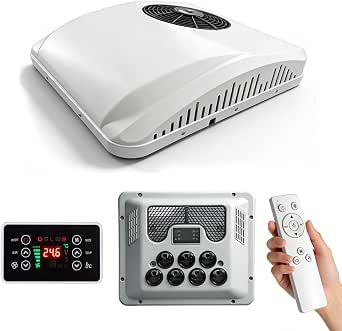 | Best 12V Pick with Heating | Cooling capacity: 11,000 BTU | Heating capacity: 3,500 BTU | Voltage: 12V | VIEW ON AMAZON | See Our Full Breakdown |
| ARSENDA 18,000 BTU Rooftop RV Air Conditioner with Heat Pump |  | Best for High Cooling Capacity | Cooling capacity: 18,000 BTU | Heating capacity: 10,236 BTU | Noise level: 50 dB | VIEW ON AMAZON | See Our Full Breakdown |
| ICECOSMOS 12V Rooftop RV Air Conditioner, 10,000 BTU |  | Best for Quiet, Lightweight 12V Builds | Cooling capacity: 10,000 BTU | Power: 12V DC | Wattage: 700 watts | VIEW ON AMAZON | See Our Full Breakdown |
| TOSOT GO Cool 16,000 BTU RV Rooftop Air Conditioner with Heat Pump |  | Best Premium Control Package | Cooling capacity: 16,000 BTU | Heating capacity: 12,500 BTU | Noise level: 43 dB | VIEW ON AMAZON | See Our Full Breakdown |
| OutEquip Summit 2 12V Rooftop RV Air Conditioner, 10,000 BTU, No Heater |  | Best for Simple 12V Cooling | Cooling capacity: 10,000 BTU | Power voltage: 12V | Wattage: 2,843 watts | VIEW ON AMAZON | See Our Full Breakdown |
| Gidrox 10,000 BTU 12V DC Rooftop RV Air Conditioner |  | Best for Quiet Battery-Powered Cooling | Cooling capacity: 10,000 BTU | Power: 12 V DC; battery powered | Nighttime consumption: About 350 W at 30°C ambient | VIEW ON AMAZON | See Our Full Breakdown |
| 12V Rooftop RV Air Conditioner with Remote, 2600W Cooling and 1500W Heating |  | Best for Cooling and Heating in One Unit | Cooling power: 2,600 W (2.6 kW) | Heating power: 1,500 W | Voltage: 12 V | VIEW ON AMAZON | See Our Full Breakdown |
| 12V Rooftop Air Conditioner for Vans and RVs |  | Best for Compact Cooling and Supplemental Heat | Cooling capacity: 10,000 BTU | Heating output: 3,500 BTU | Power: 12 V DC | VIEW ON AMAZON | See Our Full Breakdown |
| Dometic FreshJet 3 Series 15,000 BTU RV Rooftop Air Conditioner, White |  | Best for High-Capacity Shore-Powered Cooling | Cooling capacity: 15,000 BTU (1.25 tons) | Voltage: 115 V | Wattage: 4,396 W | VIEW ON AMAZON | See Our Full Breakdown |
| EliteBloom 12V Roof-Mounted Air Conditioner for RVs, Trucks, Vans, and Buses |  | Best for Engine-Off Cooling in a Compact Cutout | Cooling capacity: 2,200 W (0.6 tons) | Voltage: 12 V | Airflow: 450 m³/h | VIEW ON AMAZON | See Our Full Breakdown |
| ford transit roof mounted ac unit | Cooling capacity | Noise level | Weight | Voltage |
|---|---|---|---|---|
| 12V Rooftop RV Air Conditioner | 11,000 BTU | 45 dB | 59 pounds | 12V |
| ARSENDA 18,000 BTU Rooftop RV | 18,000 BTU | 50 dB | — | — |
| ICECOSMOS 12V Rooftop RV Air C | 10,000 BTU | 39 dB in sleep mode | 46 pounds | — |
| TOSOT GO Cool 16,000 BTU RV Ro | 16,000 BTU | 43 dB | 117 pounds | 110V |
| OutEquip Summit 2 12V Rooftop | 10,000 BTU | 40 dB | 45 pounds | — |
| Gidrox 10,000 BTU 12V DC Rooft | 10,000 BTU | — | 54 lb | — |
| 12V Rooftop RV Air Conditioner | — | 50 dB | 45 lb | 12 V |
| 12V Rooftop Air Conditioner fo | 10,000 BTU | 45 dB | — | — |
| Dometic FreshJet 3 Series 15,0 | 15,000 BTU (1.25 tons) | 58.5 dB | 65.3 lb | 115 V |
| EliteBloom 12V Roof-Mounted Ai | 2,200 W (0.6 tons) | Below 20 dB | — | 12 V |
More Details on Our Top Picks
12V Rooftop RV Air Conditioner with Heat, 11,000 BTU Cooling
For a Ford Transit conversion built around a 12V battery system, this unit pairs 11,000 BTU cooling with 3,500 BTU heating, avoiding the cooling-only compromise of the ICECOSMOS 12V Rooftop RV Air Conditioner. Its 14 × 14-inch roof-opening fit is a familiar RV dimension, but Transit roofs and existing cutouts still need a careful fit check before purchase. The listed 360-watt draw and electrical protection features give buyers useful details for planning a battery setup; they do not remove the need to size that setup for actual runtime. At 59 pounds, it is heavier than the 46-pound ICECOSMOS, adding more roof-load and installation work. I’d shortlist it for van owners who want both modes and can accommodate its weight and electrical demands.
Pros:- Provides both 11,000 BTU cooling and 3,500 BTU heating
- Runs on a 12V battery system
- Lists overvoltage, undervoltage, overcurrent, and short-circuit protection
- Low-profile ABS shell measures 8 inches high
Cons:- At 59 pounds, it is heavier than the 46-pound ICECOSMOS 12V unit
- Requires a suitably sized 12V battery system
- A standard RV opening does not by itself confirm compatibility with a specific Transit roof
Best for: Transit conversion owners with a suitable 12V battery system who want rooftop cooling plus supplemental heating.
Not ideal for: Builders prioritizing low roof weight or extended runtime from a small battery bank; this unit weighs 59 pounds and still requires suitable 12V capacity.
- Cooling capacity:11,000 BTU
- Heating capacity:3,500 BTU
- Voltage:12V
- Power:360 watts
- Noise level:45 dB
- Dimensions:29 × 26 × 8 inches
- Weight:59 pounds
- Compatible roof opening:14 × 14 inches
- Shell material:ABS
Our verdict“Choose this 12V unit if you want heating as well as cooling and can support its weight and battery requirements.”
ARSENDA 18,000 BTU Rooftop RV Air Conditioner with Heat Pump
The ARSENDA stands apart from the 12V-focused options in this roundup with 18,000 BTU cooling and 10,236 BTU heat-pump heating. That capacity may appeal to owners building out a larger Transit or using the van in demanding conditions, but the product data recommends it for RVs 16–40 feet long, so a typical van conversion should not assume that more output automatically means a better match. Unlike the ICECOSMOS, it needs 115V AC and 12V DC, making the power arrangement more involved than a direct 12V-only setup. Its 50 dB rating is also louder than the TOSOT GO Cool’s listed 43 dB. I’d rank it for buyers who prioritize capacity and dual-mode operation over simpler electrical integration.
Pros:- Highest listed cooling capacity in this five-product group at 18,000 BTU
- Provides 10,236 BTU of heat-pump heating
- Specified operating outdoor temperature range is 23°F to 115°F
- Non-ducted rooftop installation suits a single interior delivery point
Cons:- Requires both 115V AC and 12V DC connections
- Listed at 50 dB, louder than the TOSOT GO Cool at 43 dB
- Its 16–40 ft recommended RV length may be a poor match for a compact Transit build
Best for: Owners of larger Transit conversions with a substantial 115V AC setup who want high cooling capacity and heat-pump operation.
Not ideal for: Compact van builders seeking a simple battery-only installation; it requires both 115V AC and 12V DC, and its recommended vehicle range starts at 16 feet.
- Cooling capacity:18,000 BTU
- Heating capacity:10,236 BTU
- Noise level:50 dB
- Power requirements:115V AC and 12V DC
- Installation type:Non-ducted rooftop
- Roof opening size:14.25 × 14.25 inches
- Operating outdoor temperature range:23°F to 115°F
- Recommended RV length:16–40 ft
- Coverage area:Up to 680 sq ft
Our verdict“Pick the ARSENDA for a larger, power-ready van build where cooling capacity matters more than a simple 12V installation.”
ICECOSMOS 12V Rooftop RV Air Conditioner, 10,000 BTU
Among the 12V options here, the ICECOSMOS is the clearest choice for builders focused on lower roof weight and quieter sleep settings. At 46 pounds, it is lighter than the 59-pound 12V Rooftop RV Air Conditioner with Heat, while its 39 dB sleep-mode rating is lower than that model’s listed 45 dB. The tradeoff is straightforward: this is a cooling-only unit, so buyers who want built-in heating should look to the 11,000 BTU 12V model or the TOSOT GO Cool. Its inverter compressor, power-saver mode, and dehumidification add flexibility, but the listed 700-watt draw still calls for battery planning. The 14.1 × 14.1-inch fit also needs to be checked against the Transit roof opening rather than assumed compatible.
Pros:- Runs directly from 12V DC without an inverter
- Weighs 46 pounds, less than the 59-pound 12V model with heat
- Sleep-mode noise is listed at 39 dB
- Includes dehumidifier, ventilation, and power-saver modes
Cons:- Cooling only, unlike the 12V Rooftop RV Air Conditioner with Heat
- Listed power is 700 watts, so battery capacity and runtime need planning
- Requires a compatible 14.1 × 14.1-inch roof opening
Best for: Transit van builders who want a lighter 12V rooftop unit, quiet sleep-mode operation, and cooling without an inverter.
Not ideal for: Buyers who need integrated heating or have a small electrical system that cannot support the listed 700-watt draw.
- Cooling capacity:10,000 BTU
- Power:12V DC
- Wattage:700 watts
- Noise level:39 dB in sleep mode
- Weight:46 pounds
- Dimensions:28.5 × 28.5 × 6.5 inches
- Roof opening fit:Standard 14.1 × 14.1 inches
- Compressor:Rotary scroll inverter
- Features:4-way swing, dehumidifier, ventilation mode, power-saver mode
Our verdict“Choose the ICECOSMOS if lower roof weight and quiet 12V cooling matter more than having a built-in heater.”
TOSOT GO Cool 16,000 BTU RV Rooftop Air Conditioner with Heat Pump
The TOSOT GO Cool is the feature-led pick for Transit owners who want 16,000 BTU cooling, heat-pump operation, and remote control options. Its listed 43 dB noise level is quieter than the ARSENDA’s 50 dB, while Wi-Fi app control adds a convenience the simpler 12V ICECOSMOS does not list. That extra capability comes with a substantial weight penalty: at 117 pounds, it is far heavier than the 46-pound ICECOSMOS and the 45-pound OutEquip Summit 2. Its 110V power requirement and 1,550-watt listing also make it a less direct fit for a battery-first van build. The heating is described as intended for mild transitional-season conditions, so I would not treat it as a replacement for dedicated cold-weather heat.
Pros:- Offers 16,000 BTU cooling and 12,500 BTU heat-pump heating
- Listed at 43 dB, quieter than the ARSENDA’s 50 dB
- Includes Wi-Fi app control and a remote
- Includes installation hardware and guide for a 14.25-inch square opening
Cons:- At 117 pounds, it is much heavier than the ICECOSMOS and OutEquip units
- Requires 110V power and lists 1,550 watts
- Heat-pump heating is intended for mild transitional-season conditions
Best for: Transit owners with a reinforced roof and 110V power who value app control, higher cooling capacity, and supplemental heat-pump heating.
Not ideal for: Weight-conscious or battery-only van builders; the unit weighs 117 pounds, uses 110V power, and its heating is intended for mild conditions.
- Cooling capacity:16,000 BTU
- Heating capacity:12,500 BTU
- Noise level:43 dB
- Temperature range:23°F to 115°F
- Compatible opening:14.25 × 14.25 inches
- Weight:117 pounds
- Voltage:110V
- Wattage:1,550 watts
- Controls:Wi-Fi app and remote
Our verdict“Choose the TOSOT GO Cool for a power-ready Transit build with a suitable roof structure and a preference for app-controlled cooling and mild-weather heat.”
OutEquip Summit 2 12V Rooftop RV Air Conditioner, 10,000 BTU, No Heater
The OutEquip Summit 2 is a straightforward option for van owners who want 12V rooftop cooling with remote operation and no need for a built-in heater. Its 45-pound weight is close to the ICECOSMOS at 46 pounds, while its listed 40 dB noise level is just above the ICECOSMOS’s 39 dB sleep-mode figure; those ratings are not stated for identical modes, so they are not a direct test comparison. The Summit 2 adds eco, sleep, and turbo settings, plus runtime estimates tied to 480Ah and 600Ah sources. Those figures make clear that usable cooling time depends on battery capacity, rather than promising the same runtime in every Transit. Compared with the 11,000 BTU 12V model, it gives up heating and a small amount of cooling capacity for a lighter, cooling-only setup.
Pros:- Runs from a vehicle’s 12V electrical system
- Includes remote control and eco, sleep, and turbo modes
- Weighs 45 pounds, close to the lighter ICECOSMOS unit
- Lists runtime estimates for 480Ah and 600Ah power sources
Cons:- Does not provide heating, unlike the 12V Rooftop RV Air Conditioner with Heat
- Cooling runtime depends on available battery capacity
- Product data does not specify a compatible roof-opening size
Best for: Transit owners with a capable 12V electrical system who want a cooling-only rooftop unit with remote control and selectable operating modes.
Not ideal for: Buyers who need integrated heating, have limited battery capacity, or need a verified fit for a specific roof opening; the supplied data does not list an opening size.
- Cooling capacity:10,000 BTU
- Power voltage:12V
- Wattage:2,843 watts
- Noise level:40 dB
- Dimensions:28.3 × 28.3 × 6.3 inches
- Weight:45 pounds
- Compressor type:Rotary scroll
- Control:Button and remote control
- Warranty:1 year
Our verdict“Pick the Summit 2 for remote-controlled 12V cooling if you do not need a heater and can verify roof fit and battery capacity.”
Gidrox 10,000 BTU 12V DC Rooftop RV Air Conditioner
The Gidrox is a strong match for a Ford Transit conversion that needs 12V cooling without shore power and offers useful cabin controls. Its 10,000 BTU output is comparable to the ICECOSMOS 12V Rooftop RV Air Conditioner, while app, remote, and onboard controls give it more ways to adjust settings. Sleep mode is listed at 40 dB, making this the quieter-sounding choice on paper than the 50 dB Goudergo unit. The tradeoff is energy planning: the listing says all-night use requires a 400 Ah battery, so this is not a casual add-on for a lightly equipped Transit. It also cools only, unlike the Goudergo and the 10,000 BTU rooftop unit with heating. Check roof thickness and electrical capacity before choosing it.
Pros:- 10,000 BTU cooling runs from a 12V DC supply
- App, infrared remote, and onboard controls
- Sleep mode is specified at 40 dB
- Mounting hardware and a 19.7 ft power cable are included
Cons:- All-night operation is stated to require a 400 Ah battery
- Cooling only; no heating function is listed
- Fit is limited to a 14 × 14 in roof cutout and 1.5–3.5 in roof thickness
Best for: Transit owners with a substantial house-battery system who want quiet overnight cooling and flexible controls.
Not ideal for: Buyers with a small battery bank or anyone who wants built-in heating for cold-weather trips.
- Cooling capacity:10,000 BTU
- Power:12 V DC; battery powered
- Nighttime consumption:About 350 W at 30°C ambient
- Sleep-mode noise:40 dB
- Weight:54 lb
- Roof fit:14 × 14 in cutout; roof thickness 1.5–3.5 in
- Controls and modes:App, infrared remote, onboard buttons; Turbo, ECO, Sleep
- Power cable:19.7 ft
Our verdict“Choose the Gidrox for quiet, controllable 12V cooling if your Transit’s battery system can support long overnight use.”
12V Rooftop RV Air Conditioner with Remote, 2600W Cooling and 1500W Heating
For a Transit used through changing seasons, the Goudergo’s main advantage is its combined cooling and PTC heating: 2,600 W of cooling and 1,500 W of heat give it a broader job description than the cooling-only Gidrox or EliteBloom. Remote and panel controls are straightforward, and the listed 45 lb weight is the lightest among these five options. Its 12V supply and voltage protection suit vehicle installations, but the product information says cooling performance may require refrigerant adjustment, which adds uncertainty for buyers expecting a simple fit. The stated 50 dB noise level is also higher than the Gidrox’s 40 dB Sleep mode. Check the dimensions and temperature range against the Transit layout before committing.
Pros:- Provides 2,600 W cooling and 1,500 W PTC heating
- Remote and panel controls are included
- 45 lb weight is the lightest in this group
- Voltage protection and ABS-aluminum housing are specified
Cons:- Cooling performance may require refrigerant adjustment
- 50 dB stated noise is above the Gidrox Sleep-mode figure
- The listed temperature range is narrow at 60.8–78.8°F
Best for: Transit owners who want one roof unit for moderate cooling and supplemental heat, especially in a lighter conversion.
Not ideal for: Buyers seeking high-capacity 10,000 BTU cooling or a clearly specified, installation-ready refrigerant setup.
- Cooling power:2,600 W (2.6 kW)
- Heating power:1,500 W
- Voltage:12 V
- Noise level:50 dB
- Dimensions:25.59 × 25.59 × 5.91 in
- Weight:45 lb
- Compressor and inverter:Rotary scroll; inverter included
- Controls and materials:Remote and panel; ABS and aluminum alloy
Our verdict“Pick the Goudergo if heating matters as much as cooling and you can verify its refrigerant setup for your installation.”
12V Rooftop Air Conditioner for Vans and RVs
This 12V unit offers a useful middle ground for Transit owners who want both cooling and heating without choosing the heavier Dometic FreshJet 3, which is a 115V cooling-only system. It lists 10,000 BTU of cooling, 3,500 BTU of heating, and 45 dB operating noise, plus protections for overvoltage, undervoltage, overcurrent, and short circuits. That combination makes its feature set appealing for a vehicle-based installation. The main caveat is fit clarity: the listing describes a roof-mounted unit but also gives a maximum window opening measurement, so I would confirm the intended cutout and mounting method before buying for a Transit. At 59.5 lb and nearly 28 inches long, it also needs careful roof-load and clearance checks.
Pros:- 10,000 BTU cooling and 3,500 BTU heating
- 12V DC operation with multiple electrical protections
- 45 dB stated operating noise
- Low-profile ABS shell is specified
Cons:- Installation information is unclear because it cites a window opening for a rooftop unit
- 59.5 lb weight and broad footprint require roof-fit checks
- A 12V DC supply is required
Best for: Transit converters who want 12V cooling plus supplemental heat and can confirm the roof opening requirements with the seller.
Not ideal for: Buyers who need unambiguous roof-cutout guidance or want a particularly light, small rooftop unit.
- Cooling capacity:10,000 BTU
- Heating output:3,500 BTU
- Power:12 V DC
- Wattage:750 W
- Noise level:45 dB
- Dimensions and weight:28.35 × 26.25 × 7.09 in; 59.5 lb
- Refrigerant and compressor:R-134A; rotary vane
- Listed opening limit:15 in wide × 9 in high
Our verdict“Consider this unit for dual-season 12V use only after confirming its actual roof opening and mounting requirements.”
Dometic FreshJet 3 Series 15,000 BTU RV Rooftop Air Conditioner, White
The FreshJet 3 is the capacity pick here, with 15,000 BTU of cooling for Transit builds that prioritize strong cabin output and have a 115V power setup. Its corrosion-resistant e-coated evaporator coils and insulated foam construction address durability and weight, while the composite basepan helps keep the unit at 65.3 lb. Compared with the 12V Gidrox and EliteBloom, this is not the choice for battery-first cooling: it runs at 115V and has no inverter. Its 58.5 dB listed noise level is also higher than the 12V options in this set with stated figures. Compatibility notes cover existing outdoor units and certain non-ducted air distribution boxes, so I would verify the Transit roof opening and system configuration before purchase.
Pros:- 15,000 BTU capacity is the highest in this group
- E-coated evaporator coils are designed to resist corrosion
- Insulated foam and composite basepan help limit unit weight
- Backward compatibility is specified for existing air distribution boxes on non-ducted units
Cons:- Requires 115V power and has no inverter
- Cooling only; no heating function is listed
- Compatibility is conditional, and roof fit still needs verification
Best for: Transit owners with a suitable 115V electrical system who need higher cooling capacity and value corrosion-resistant construction.
Not ideal for: Battery-only builds, buyers needing heat, or anyone whose Transit installation cannot accommodate the specified packaged-unit fit.
- Cooling capacity:15,000 BTU (1.25 tons)
- Voltage:115 V
- Wattage:4,396 W
- Noise level:58.5 dB
- Weight:65.3 lb
- Dimensions:29.5 × 27.56 × 13.99 in
- Refrigerant:R-410A
- Compressor and inverter:Rotary-scroll; no inverter
Our verdict“Choose the FreshJet 3 when 115V power and higher cooling capacity matter more than battery operation or built-in heat.”
EliteBloom 12V Roof-Mounted Air Conditioner for RVs, Trucks, Vans, and Buses
The EliteBloom targets a Transit build that needs engine-off, 12V cooling and has a 25 × 41 cm skylight opening available. Its 2,200 W cooling capacity is well below the Gidrox’s 10,000 BTU rating, so I see it as a modest-output option rather than a pick for demanding heat or a large, poorly insulated cabin. The stated 450 m³/h airflow and low-voltage battery protection are relevant for parked use, while push-button and remote controls keep operation simple. Its advertised noise level is below 20 dB, but buyers should confirm how that figure was measured. Unlike the Goudergo and the other 10,000 BTU dual-function unit, this model is cooling-only, so it does not serve as seasonal heat.
Pros:- Designed to run independently of the vehicle engine
- Low-voltage protection is specified
- Remote and push-button controls are included
- 450 m³/h airflow is listed
Cons:- 2,200 W cooling capacity is lower than the Gidrox’s 10,000 BTU rating
- Cooling only; no heating function is listed
- Requires a specific 25 × 41 cm skylight opening
Best for: Transit owners with the specified skylight opening who want a lower-capacity 12V unit for parked, engine-off cooling.
Not ideal for: Buyers needing strong cooling for a large cabin, heating, or an installation that does not match the 25 × 41 cm opening.
- Cooling capacity:2,200 W (0.6 tons)
- Voltage:12 V
- Airflow:450 m³/h
- Noise level:Below 20 dB
- Undervoltage protection:21.5 V
- Undervoltage recovery:25 V
- Required opening:25 × 41 cm skylight opening
- Unit dimensions:68.5 × 68 × 14.5 cm
Our verdict“Choose the EliteBloom for engine-off cooling in a matching skylight cutout, not for high-capacity or all-season climate control.”
How We Picked
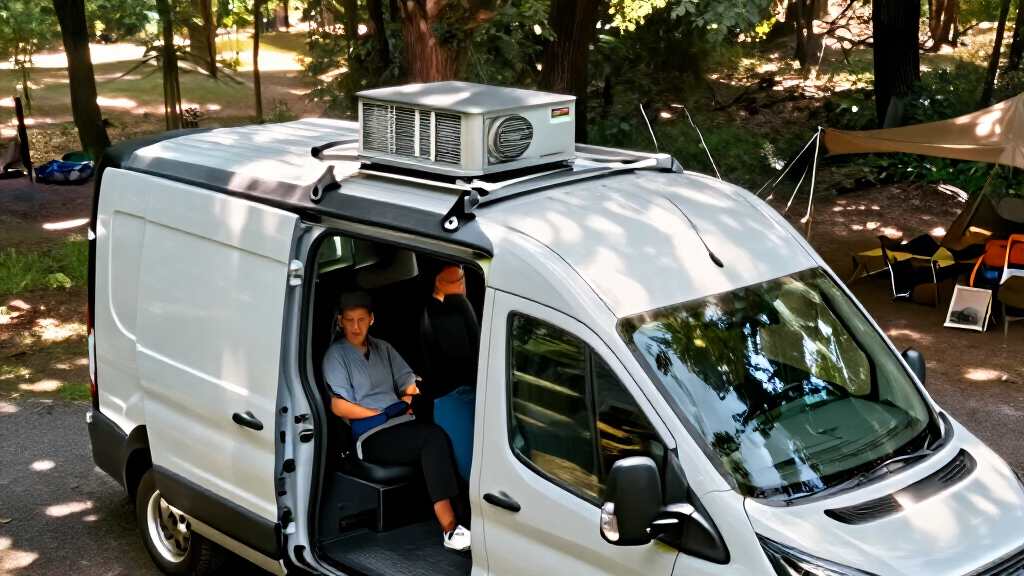
I compared these Ford Transit roof-mounted AC unit candidates on the details that can change a van build: stated cooling capacity, power type, heating availability, stated vehicle uses, and how clearly the product name communicates its intended setup. I gave weight to whether a buyer can match the unit to a 12V electrical system and whether heating adds useful shoulder-season flexibility. I also treated roof fit, installation, and electrical compatibility as essential verification points rather than assuming that an RV-oriented product will fit every Transit.
The ranking favors useful capability with a clear role, not simply the highest BTU figure. Models with heating or heat pumps earn consideration for broader use, while cooling-only and lower-capacity choices remain relevant for focused needs. Since the supplied product details do not establish measured power draw, dimensions, noise, installation hardware, or verified Transit compatibility, I do not treat those as confirmed advantages. Buyers should confirm these details with the manufacturer or installer before ordering.
Factors to Consider When Choosing Ford Transit Roof Mounted Ac Units
A roof AC decision affects the Transit’s electrical plan, interior layout, and available headroom—not just cabin temperature. I’d work through these factors before choosing among the models, especially since product names alone do not confirm vehicle fit or real-world power requirements.
Match Cooling Capacity to the Van, Not Just the Climate
BTU figures describe cooling capacity, but they do not account for the way a specific Transit is built. A long-wheelbase van with large windows, dark paint, limited insulation, or frequent door openings can place a greater load on the AC than a smaller, shaded, well-insulated build. The 10,000 BTU models may make sense for a more modestly sized or carefully insulated interior, while 15,000–18,000 BTU options offer more stated capacity for harder conditions. More capacity is not automatically better if the system is poorly matched to the space or requires electrical resources your build lacks. Compare the maker’s recommended interior size and operating conditions before treating BTUs as a direct guarantee of cabin temperature. For vans used in extreme heat, insulation and window coverings can improve comfort without relying on the AC alone.
Check the Whole 12V Power System
A 12V label tells you the power type, not how long the AC can run from your battery. Ask for operating current or wattage, startup behavior, and any guidance on battery and charging capacity, then compare those figures with your usable battery energy. Include other loads such as a refrigerator, fans, lights, and charging devices in the same estimate. A larger battery may help with parked cooling, but it also adds cost, weight, and charging needs. If the manufacturer does not provide clear electrical specifications, pause before designing a system around the unit. Buyers who mostly cool while connected to shore power may have different priorities from those who expect overnight off-grid operation.
Verify Roof Fit, Structure, and Added Height
Do not assume an RV rooftop AC will fit a Ford Transit just because the listing mentions vans or RVs. Confirm the required roof cutout, mounting footprint, roof thickness range, sealing method, and whether an adapter or reinforcement is needed for your van’s roof. Measure clearance around roof ribs, wiring, solar panels, racks, and vents before making a cut. The installed unit also raises the vehicle profile, which can affect garages, parking structures, branches, and ferry or storage clearances. A roof rack may complicate mounting or airflow, so plan the AC location alongside other roof equipment. If the fit details are unclear, have a qualified installer inspect the roof before purchase.
Choose Heat Based on How You Travel
Heat pumps and heating functions can extend comfort during mild weather, but the product name alone does not tell you their useful temperature range or heating output in your conditions. Compare the unit’s published heating capacity and operating limits with the climate where you camp. In cold weather, a rooftop heat pump may not replace a dedicated heater, so buyers should avoid treating an AC’s heating feature as their only cold-weather plan without checking specifications. A cooling-only model such as the OutEquip Summit 2 may be a sensible fit if you already have a separate heater and want to focus on summer cooling. If you travel through shoulder seasons, paying for a heat-pump model may offer more flexibility, provided its power needs and performance suit your use.
Account for Noise, Service, and Installation Support
Cabin noise matters more in a small van than in a large RV because the sleeping area is close to the rooftop unit. Seek published indoor and outdoor sound levels, fan settings, and information about vibration isolation rather than relying on a general claim of quiet operation. Check whether replacement parts, service instructions, and warranty support are available where you travel. Installation can involve roof cutting, sealing, wiring, and structural checks, so the lowest-effort product listing may still require professional work. Ask whether the unit includes the interior assembly, controls, mounting materials, and any adapter needed for the Transit. These details can affect the real project burden as much as the AC’s headline cooling capacity.
Compare Complete System Cost, Not One Specification
Before settling on a model, list the additional items your build may need: battery capacity, charging equipment, wiring, protection devices, roof reinforcement, adapters, and installation labor. A unit with greater cooling capacity or a heat pump could reduce the need for a separate appliance, but it may also place heavier demands on the electrical system. Conversely, a 12V cooling-focused option can still require a substantial battery setup for extended off-grid use. Compare warranty terms and service access alongside the unit’s stated features, especially when choosing a less familiar brand. The best value is the option that fits your van and travel pattern without forcing expensive compromises elsewhere in the build.
Frequently Asked Questions
Will an RV rooftop AC unit fit a Ford Transit roof?
Not automatically. RV-oriented product descriptions do not confirm that a unit matches a Transit’s roof opening, mounting surface, roof thickness, or internal clearance. Check the exact installation dimensions and mounting instructions against your van’s roof layout, including ribs, wiring, and other equipment. You may need an adapter, reinforcement, or a professional fit assessment. Confirm compatibility before cutting the roof, since correcting a misplaced opening can be difficult and costly.
Can I run a 12V rooftop AC overnight from my Transit’s house battery?
Possibly, but the 12V designation does not establish runtime. You need the unit’s actual power draw and a battery estimate based on usable capacity, along with allowances for other loads and battery protections. Runtime also depends on heat, insulation, set temperature, fan use, and how often the compressor cycles. Ask the manufacturer for operating data and calculate against your full electrical system rather than the battery’s nominal capacity alone. If you plan regular overnight cooling, have the battery and charging plan reviewed as a complete system.
Should I choose a 10,000 BTU model or a higher-capacity unit?
Base the choice on the van’s interior volume, insulation, glass area, climate, and how quickly you expect the cabin to cool. The 10,000 BTU options may suit a smaller or well-insulated conversion, while the 15,000–18,000 BTU choices provide more stated cooling capacity for demanding conditions. A higher figure does not guarantee better results if the unit is not suited to the installation or your power system. Look for manufacturer guidance on room size and operating conditions, then compare it with your build. Addressing solar gain and insulation can also reduce the load on either size.
Is a rooftop heat pump enough to heat a Transit in winter?
That depends on the heat pump’s published output and operating range, as well as outdoor temperatures and van insulation. A heating feature can add flexibility in mild weather, but it should not be assumed to replace a dedicated heater in freezing conditions. Check the manufacturer’s low-temperature performance information and the electrical demand for heating mode. For winter travel, plan a dependable backup or primary heat source that suits your climate and power setup. The cooling-only OutEquip model is a clearer fit for buyers who already have heating handled separately.
What should I confirm before ordering a rooftop AC for a Transit conversion?
Confirm the roof cutout and mounting dimensions, the roof’s ability to support the unit, installed height, and clearance from racks, panels, and vents. Request power draw, startup requirements, wiring guidance, and any battery recommendations if you plan to run it off-grid. Check whether the listing includes the interior assembly, controls, mounting materials, and required seals or adapters. Review warranty coverage, service access, and the installer’s requirements before making a roof cut. If product documentation does not answer these questions, ask the seller or manufacturer for written specifications.
Conclusion
For the best overall balance, I’d shortlist the TOSOT GO Cool 16,000 BTU for its higher stated capacity and heat-pump feature, after confirming power needs and Transit fit. The best value by use case is a 10,000 BTU 12V model when its capacity suits the van and the electrical specifications fit the build; I would compare the ICECOSMOS, OutEquip Summit 2, and Gidrox rather than assume their similar capacity means identical performance. For a premium-brand direction, consider the Dometic FreshJet 3 Series, while verifying its installation and electrical details. Beginners should choose only after an installer confirms roof compatibility and an electrician checks the power plan. If you need maximum stated capacity, compare the ARSENDA’s 18,000 BTU rating; if you need heating flexibility, focus on models that specify a heat pump or heating function. The right pick is the one that matches your Transit’s roof, climate, and electrical system—not simply the biggest number on the label.
Halloween Picks
halloween
As an affiliate, we earn on qualifying purchases.