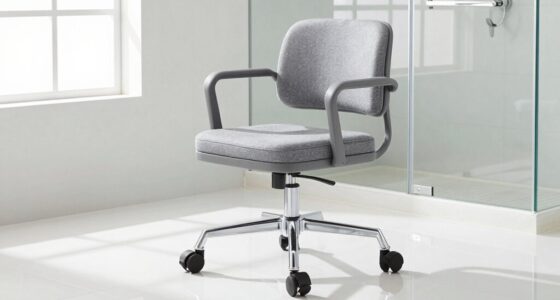
For a balanced mix of breathable mesh, adjustable support, and flexible arm positioning, I’d start with the YORSERNY Ergonomic Office Chair, my best overall pick in this roundup. The Staples Dexley stands out for buyers who want a recognizable task-chair design, while the GABRYLLY chair with a footrest suits people who want reclining comfort and flip-up arms. The main tradeoff is between fit and adjustability on one side and added features such as footrests on the other. Mesh can help with airflow, but it does not make a chair supportive if the seat dimensions or lumbar position do not suit your body. Read on for the full breakdown, selection criteria, and advice on choosing the right chair for your desk.

Get the latest gadgets delivered free with Prime
- Fast, free delivery on millions of items
- Prime Video, Amazon Music and more included
- Member-only deals all year
Complete the kit


Key Takeaways
- YORSERNY leads for adjustment range: its listed 4D armrests, adjustable lumbar support, and 3D headrest offer more ways to tune the chair than simpler options in this lineup.
- Footrests are a separate comfort choice, not a substitute for fit: GABRYLLY, MALOL, ELABEST X100, and two other listed models add recline or leg support, but buyers should still check seat and desk compatibility.
- Arm design changes how a chair fits a room: flip-up arms on GABRYLLY, SUNNOW, and another GABRYLLY model can help tuck a chair under a desk, while adjustable arms offer more positioning control.
- The lineup spans different support levels: models with adjustable lumbar support and headrests allow more tuning, while the BestOffice mid-back chair keeps the design simpler.
- Product names alone do not establish fit: listed weight capacity, seat dimensions, adjustment ranges, and return terms should be checked against the buyer’s body and workspace before choosing.
| YORSERNY Ergonomic Office Chair with Breathable Mesh, Adjustable Lumbar Support, 3D Headrest and 4D Armrests |  | Best Overall Balance | Weight Capacity: 330 lbs | Seat Material: High-density molded foam (45 kg/m³) | Armrests: 4D adjustable | VIEW ON AMAZON | See Our Full Breakdown |
| Ergoa Ergonomic Mesh Office Chair with Adjustable Lumbar Support, Headrest and 4D Armrests |  | Best for Heavy Users | Weight Capacity: 400 lbs | Lumbar Support: 8 positions with 2.36 in travel | Headrest: Removable, 11-position adjustable | VIEW ON AMAZON | See Our Full Breakdown |
| Ergalithic Ergonomic Mesh Office Chair with Headrest and Lumbar Support |  | Best for Smaller Frames | Recommended Height: 4.9–6.2 ft | Weight Capacity: 330 lbs | Lumbar Adjustment: 1.8 in up/down, 1 in in/out | VIEW ON AMAZON | See Our Full Breakdown |
| Ergonomic Office Desk Chair with Retractable Footrest, Adjustable Lumbar Support & Headrest, 90-160° Reclining Mesh Back Computer Chair |  | Best for Relaxation | Recline Angle: 90-160 degrees | Weight Capacity: 300 lbs | Headrest Adjustment: 3.94 in height, 2.35 in forward/back | VIEW ON AMAZON | See Our Full Breakdown |
| TRALT Ergonomic Office Chair with Adjustable Lumbar Support, Black |  | Best for Easy Setup | Weight Capacity: 330 lb | Seat Height Range: 17.7–21.7 in | Lumbar Support: Depth-adjustable | VIEW ON AMAZON | See Our Full Breakdown |
| GABRYLLY Ergonomic Office Chair with Footrest, 3D Headrest, Flip-Up Arms, 135° Tilt, Heavy Duty Mesh – Black |  | Best for Full-Body Reclining | Weight capacity: 300 lbs | Seat dimensions: 20.5 in W x 20 in D; height 18.9–23.6 in | Overall dimensions with arms: 24.5 in W x 27.5 in D x 46–56.4 in H | VIEW ON AMAZON | See Our Full Breakdown |
| Marsail Ergonomic Office Chair with Mesh Back, Adjustable Lumbar Support, Headrest, and 3D Armrests |  | Best for Adjustable Lumbar Fit | Model: RM-MSOC10B | Back material: Mesh | Seat material and thickness: Foam; 3.14 in thick | VIEW ON AMAZON | See Our Full Breakdown |
| Staples Dexley Ergonomic Mesh Task Chair, Black |  | Best for Straightforward Daily Task Work | Seat and back material: Mesh | Weight capacity: 275 lbs | Seat height: 20.3 in | VIEW ON AMAZON | See Our Full Breakdown |
| SUNNOW Ergonomic Office Chair with Adjustable Lumbar Support, Flip-up Arms, Tilt Function, Wide Mesh Seat (Black) |  | Best for a Cushioned Mesh-Back Seat | Seat material: High-density memory foam with W-shape cushion | Backrest: Breathable mesh | Back design: Bionic S-curve | VIEW ON AMAZON | See Our Full Breakdown |
| MALOL Ergonomic Mesh Office Chair with Footrest |  | Best for Multi-Position Reclining | Mesh material: Elastic knitted mesh | Backrest: High-back; reclines 90°–130° with tilt control | Lumbar support: Three-zone system with five height settings | VIEW ON AMAZON | See Our Full Breakdown |
| BestOffice Ergonomic Mid-Back Mesh Office Chair, Black |  | Best Value for a Straightforward Work Chair | Back material: Mesh | Seat material and fill: Nylon seat with foam fill | Seat height: 17.1–20.3 inches, adjustable | VIEW ON AMAZON | See Our Full Breakdown |
| ELABEST X100 Ergonomic Mesh Office Chair with Footrest |  | Best for Reclining Breaks and Leg Support | Model: X100 | Materials: Metal frame, nylon base, mesh seat and upholstery | Weight capacity: 300 pounds | VIEW ON AMAZON | See Our Full Breakdown |
| Marsail Ergonomic Mesh Office Chair with Adjustable Lumbar Support |  | Best for Flexible Everyday Positioning | Model: MSOC23B-US | Materials: Mesh, metal, plastic, and foam | Weight capacity: 300 pounds | VIEW ON AMAZON | See Our Full Breakdown |
| MOLENTS Ergonomic Mesh Office Chair with Adjustable Lumbar Support and 3D Armrests, Obsidian Black |  | Best for Low-Profile Lumbar and Arm Adjustments | Model and color: ML230BB, Obsidian Black | Upholstery and seat fill: Breathable mesh upholstery with shaped sponge seat fill | Frame: High-strength nylon | VIEW ON AMAZON | See Our Full Breakdown |
| GABRYLLY Ergonomic Mesh Office Chair with Headrest and Flip-Up Arms |  | Best High-Back Pick for Head and Upper-Back Coverage | Model: GY01 | Dimensions: 24.5 × 27.5 × 46–56.4 inches (W × D × H) | Seat dimensions: 20.5 × 20 inches | VIEW ON AMAZON | See Our Full Breakdown |
| ergonomic desk chairs mesh | Weight Capacity | Armrests |
|---|---|---|
| YORSERNY Ergonomic Office Chai | 330 lbs | 4D adjustable |
| Ergoa Ergonomic Mesh Office Ch | 400 lbs | Padded 4D |
| Ergalithic Ergonomic Mesh Offi | 330 lbs | 90° flip-up |
| Ergonomic Office Desk Chair wi | 300 lbs | — |
| TRALT Ergonomic Office Chair w | 330 lb | Flip-up |
| GABRYLLY Ergonomic Office Chai | 300 lbs | — |
| Marsail Ergonomic Office Chair | 330 lbs | 3D adjustable, PU-padded, flip-up |
| Staples Dexley Ergonomic Mesh | 275 lbs | — |
| SUNNOW Ergonomic Office Chair | — | Height-adjustable, flip-up |
| MALOL Ergonomic Mesh Office Ch | 300 lbs | 3D adjustable |
| BestOffice Ergonomic Mid-Back | 250 pounds | — |
| ELABEST X100 Ergonomic Mesh Of | 300 pounds | — |
| Marsail Ergonomic Mesh Office | 300 pounds | Three-dimensional, flip-up; 90° flip-up, 15° swivel, and 1.96-inch depth adjustment |
| MOLENTS Ergonomic Mesh Office | — | Three-dimensional; panels slide forward and backward or rotate |
| GABRYLLY Ergonomic Mesh Office | 300 pounds | — |
More Details on Our Top Picks
YORSERNY Ergonomic Office Chair with Breathable Mesh, Adjustable Lumbar Support, 3D Headrest and 4D Armrests
This model stands out for its high-density molded foam seat, which resists bottoming out better than the thinner cushions found on budget competitors like the Ergalithic. The 4D armrests offer superior micro-adjustability compared to the flip-up designs on the TRALT, allowing for precise elbow support during keyboard-intensive work. While the metal-on-metal recline mechanism feels sturdier than the plastic components in many mid-range chairs, the large footprint means it demands more floor space than compact options. It is a robust choice for those who prioritize long-term durability over minimalism.
Pros:- High-density foam seat retains shape for years of daily use
- 4D armrests provide precise positioning for various desk heights
- Metal-on-metal recline mechanism offers stable, smooth adjustment
- Breathable mesh back and seat improve airflow and comfort
Cons:- Large footprint may not fit very small desks
- Limited color options restrict aesthetic flexibility
Best for: Users who spend 8+ hours seated and need durable foam that won’t flatten quickly
Not ideal for: Those with tight desk setups, as its wide dimensions require significant clearance
- Weight Capacity:330 lbs
- Seat Material:High-density molded foam (45 kg/m³)
- Armrests:4D adjustable
- Recline Range:90°–135°
- Lumbar Support:3-position adjustable
- Warranty:5 years on parts
- Gas Lift:Class 4
Our verdict“A dependable, well-built chair that prioritizes seat durability and precise armrest control.”
Ergoa Ergonomic Mesh Office Chair with Adjustable Lumbar Support, Headrest and 4D Armrests
Where most chairs in this roundup cap out at 330 lbs, the Ergoa supports a robust 400 lbs, making it the clear winner for larger frames. The 8-position lumbar support offers finer granularity than the YORSERNY’s 3-step system, allowing for exact spinal alignment. Its removable headrest with a built-in hanger is a thoughtful touch absent in the Ergalithic, adding utility to the design. However, the lack of specified assembly instructions in the product details raises concerns about setup complexity compared to the tool-free TRALT. This chair is built for stability and high weight tolerance.
Pros:- Supports up to 400 lbs, exceeding most competitors
- 8-position lumbar support allows for precise spinal alignment
- Silent casters are designed for use across wood, tile, and carpet
- Removable headrest includes a convenient built-in hanger
Cons:- Assembly instructions and dimensions are not clearly specified
- Removable headrest may feel less secure than fixed designs
Best for: Heavier individuals or those who need extra structural reassurance beyond standard limits
Not ideal for: Minimalists who prefer fixed headrests and dislike removable components
- Weight Capacity:400 lbs
- Lumbar Support:8 positions with 2.36 in travel
- Headrest:Removable, 11-position adjustable
- Armrests:Padded 4D
- Recline Range:90°–135°
- Compliance:ANSI/BIFMA X5.1
- Casters:Silent, floor-friendly
Our verdict“The strongest option for heavier users, offering exceptional weight capacity and fine-tuned lumbar control.”
Ergalithic Ergonomic Mesh Office Chair with Headrest and Lumbar Support
This chair is explicitly designed for users between 4.9 and 6.2 feet tall, a specificity that distinguishes it from the one-size-fits-all approach of the YORSERNY. The wide, thicker cushioned seat provides immediate comfort, though it lacks the high-density foam longevity found in the Ergoa. Its flip-up armrests allow the chair to slide fully under desks, saving space where the Ergoa’s bulky 4D arms cannot. However, the 120° recline limit is more restrictive than the 135° or 160° options available elsewhere, limiting relaxation angles. It is a space-efficient choice for petite to average-sized adults.
Pros:- Flip-up armrests allow full desk clearance
- Wide cushioned seat enhances immediate comfort
- Recommended height range ensures better fit for average users
- 5-year warranty provides peace of mind
Cons:- Recline limited to 120°, less than competitors
- Strict height recommendation excludes taller individuals
Best for: Users under 6’2″ who need a chair that fits under low desks via flip-up arms
Not ideal for: Tall users over 6’2″ who may find the backrest height insufficient
- Recommended Height:4.9–6.2 ft
- Weight Capacity:330 lbs
- Lumbar Adjustment:1.8 in up/down, 1 in in/out
- Headrest:3D adjustable
- Armrests:90° flip-up
- Recline Range:90°–120°
- Warranty:5 years
Our verdict“A compact, comfortable option tailored for average-height users who prioritize desk clearance.”
Ergonomic Office Desk Chair with Retractable Footrest, Adjustable Lumbar Support & Headrest, 90-160° Reclining Mesh Back Computer Chair
The retractable footrest sets this chair apart from the purely work-focused YORSERNY, transforming it into a lounge seat for breaks. The 90-160° recline range far exceeds the 135° limit of the Ergoa, allowing for near-flat napping. While the high-density foam matches the comfort level of the TRALT, the 1-year warranty is significantly shorter than the 5-year coverage offered by Ergalithic and Ergoa. The added footrest mechanism introduces potential failure points that simpler chairs avoid. This is for those who view their chair as a rest station, not just a work tool.
Pros:- Retractable footrest enables full relaxation modes
- Deep 160° recline range supports napping and lounging
- Highly adjustable headrest accommodates various postures
- Breathable mesh prevents heat buildup during long sessions
Cons:- Only a 1-year warranty compared to 5-year competitors
- Footrest mechanism adds complexity and potential maintenance
Best for: Remote workers or students who take frequent naps and need a deep recline
Not ideal for: Buyers seeking long-term durability guarantees, given the short warranty period
- Recline Angle:90-160 degrees
- Weight Capacity:300 lbs
- Headrest Adjustment:3.94 in height, 2.35 in forward/back
- Lumbar Adjustment:1.18 in forward/back, 2 in up/down
- Warranty:1 Year
- Base Type:5-point metal base
- Footrest:Retractable
Our verdict“Ideal for those who want a multi-purpose chair that doubles as a comfortable lounge seat.”
TRALT Ergonomic Office Chair with Adjustable Lumbar Support, Black
Assembly is often a barrier to entry, but the TRALT claims no extra tools are required, a stark contrast to the multi-step assembly of the Ergoa. The depth-adjustable lumbar support is a rare feature that allows users to change the firmness of the back support, unlike the fixed-depth pillows on the Ergalithic. However, the flip-up armrests lack the granular height adjustment of the YORSERNY’s 4D arms, which may frustrate users with specific elbow positioning needs. It is a user-friendly entry point that sacrifices some adjustability for convenience.
Pros:- Assembly requires no extra tools and takes about 15 minutes
- Depth-adjustable lumbar support customizes back firmness
- High-resilience molded foam seat maintains cushioning over time
- Reinforced base ensures stability on various floor types
Cons:- Flip-up armrests lack height and width adjustments
- Seat height range may not suit extremely short or tall users
Best for: Renters or office managers who need to assemble multiple chairs quickly without tools
Not ideal for: Users who require precise armrest height adjustments for ergonomic typing
- Weight Capacity:330 lb
- Seat Height Range:17.7–21.7 in
- Lumbar Support:Depth-adjustable
- Armrests:Flip-up
- Assembly:No extra tools required
- Seat Material:High-resilience molded foam
- Casters:360° silent, smooth-rolling
Our verdict“A convenient, tool-free option that prioritizes quick setup and customizable lumbar depth.”
GABRYLLY Ergonomic Office Chair with Footrest, 3D Headrest, Flip-Up Arms, 135° Tilt, Heavy Duty Mesh – Black
The GABRYLLY pairs a 3D-adjustable headrest with an 18.1-inch retractable footrest, giving it a stronger lounging setup than the Marsail RM-MSOC10B, which reclines only to 120° and has no footrest. Its 90°–135° tilt and wide mesh seat make it a better match for people who alternate between focused desk work and leaning back to rest. Flip-up arms help clear space when the chair is parked at a desk, though the overall footprint remains substantial at 24.5 inches wide and 27.5 inches deep. The mesh seat and back favor airflow over the feel of a padded seat, and the 300-pound capacity is lower than Marsail’s stated 330 pounds. I’d choose this for recline flexibility, not a compact workstation.
Pros:- Retractable 18.1-inch footrest supports reclined breaks.
- 3D headrest offers adjustment for different head and neck positions.
- Breathable mesh seat and back encourage airflow.
- Flip-up arms can make it easier to tuck the chair under a desk.
Cons:- The 24.5-by-27.5-inch footprint may crowd a small workspace.
- 300-pound capacity is lower than the Marsail RM-MSOC10B’s stated 330 pounds.
- Assembly is required.
Best for: People who want a mesh work chair for desk sessions and occasional reclined breaks, with a footrest and adjustable head support.
Not ideal for: People with a tight desk area or buyers who need a stated weight capacity above 300 pounds.
- Weight capacity:300 lbs
- Seat dimensions:20.5 in W x 20 in D; height 18.9–23.6 in
- Overall dimensions with arms:24.5 in W x 27.5 in D x 46–56.4 in H
- Footrest extension:18.1 in
- Tilt range:90°–135°
- Materials:Mesh seat and back; steel frame
- Gas lift:Class 4
- Warranty:3 years
Our verdict“Choose the GABRYLLY if you want a mesh chair that supports both upright work and footrest-assisted reclining, and have room for its broad footprint.”
Marsail Ergonomic Office Chair with Mesh Back, Adjustable Lumbar Support, Headrest, and 3D Armrests
The Marsail RM-MSOC10B puts its strongest adjustment range at the lower back: its lumbar support moves 1.18 inches forward and back and 2.16 inches up and down. That gives it a more targeted fit than the Staples Dexley, whose listed specs emphasize adjustable lumbar support but do not give a movement range. The Marsail also adds 3D armrests, a 2D headrest, and a 90°–120° recline, making it a flexible choice for desk work without the footrest-focused lounging setup of the GABRYLLY. Its 3.14-inch foam seat offers a cushioned alternative to an all-mesh seat, while the mesh back still allows airflow. One limitation is fit information: the listed seat height is 21.6 inches, with no adjustment range supplied, and the dimensions may be bulky for smaller rooms.
Pros:- Lumbar support adjusts both vertically and forward or backward.
- 3D armrests and a 2D headrest provide multiple fit adjustments.
- Foam seat adds cushioning while the mesh back promotes airflow.
- Stated 330-pound capacity exceeds the GABRYLLY and Staples Dexley figures.
Cons:- Listed dimensions may make it a poor fit for smaller work areas.
- The supplied seat-height figure has no adjustment range.
- Recline stops at 120°, less than the GABRYLLY’s 135°.
Best for: Desk workers who want fine-tunable lumbar positioning, adjustable arms, and a cushioned seat with a breathable mesh back.
Not ideal for: Buyers who need a verified seat-height adjustment range or are fitting a chair into a compact workspace.
- Model:RM-MSOC10B
- Back material:Mesh
- Seat material and thickness:Foam; 3.14 in thick
- Lumbar adjustment:1.18 in forward/backward; 2.16 in up/down
- Headrest:2D adjustable
- Armrests:3D adjustable, PU-padded, flip-up
- Backrest recline:90°–120°
- Weight capacity:330 lbs
- Dimensions:46.9 x 24.8 x 24.4 in
Our verdict“Pick the Marsail RM-MSOC10B if adjustable lumbar placement matters more to you than a footrest or a wide recline range.”
Staples Dexley Ergonomic Mesh Task Chair, Black
The Staples Dexley is the clearest task-chair choice here: it combines a mesh seat and back with adjustable seat, armrest, and headrest positions, plus tilt tension and a three-position lock. That makes its reclining setup more controlled than the GABRYLLY’s broader 90°–135° range, though it lacks that chair’s footrest and pronounced lounging focus. Its stated 5–10 hours of recommended daily use gives buyers a useful guide for routine desk schedules, and the five-year limited warranty is longer than the two-year SUNNOW warranty. The tradeoff is size: at 28.2 inches wide and 28.6 inches deep, it needs room around the desk. Its 275-pound capacity is also the lowest stated figure among these five picks, so the Marsail or either 300-pound GABRYLLY and MALOL models may suit some buyers better.
Pros:- Mesh seat and back support airflow across more of the chair than mesh-back-only designs.
- Three-position tilt lock and adjustable tension allow controlled reclining.
- Seat, armrest, and headrest positions adjust for a more tailored task-chair fit.
- Five-year limited manufacturer warranty.
Cons:- 275-pound capacity is lower than the stated capacities of the Marsail, GABRYLLY, and MALOL.
- The 28.2-by-28.6-inch footprint can take up substantial floor space.
- Assembly is required.
Best for: People setting up a regular home or office workstation who want mesh on both the seat and back, plus adjustable tilt and head support.
Not ideal for: Buyers needing a higher stated weight capacity, a compact chair footprint, or a built-in footrest.
- Seat and back material:Mesh
- Weight capacity:275 lbs
- Seat height:20.3 in
- Seat depth:18.3 in
- Dimensions:45.3–50.8 in H x 28.2 in W x 28.6 in D
- Tilt:Three-position lock with adjustable tension
- Swivel:360°
- Recommended daily use:5–10 hours
- Warranty:5-year limited manufacturer warranty
Our verdict“Choose the Dexley for a conventional, adjustable mesh task chair with defined tilt controls, provided its footprint and capacity suit your setup.”
SUNNOW Ergonomic Office Chair with Adjustable Lumbar Support, Flip-up Arms, Tilt Function, Wide Mesh Seat (Black)
SUNNOW pairs a breathable mesh back with a high-density memory-foam seat, making it the most cushion-oriented pick in this group. That differs from the all-mesh Staples Dexley and GABRYLLY, which put airflow across both the seat and back. Its bionic S-curve design is intended to support the back, while height-adjustable flip-up arms and a tilt function cover the basics for a flexible desk setup. The supplied details, however, are less specific than the Marsail’s: there are no measurements for lumbar travel, recline range, seat dimensions, or weight capacity. The stated SGS and BIFMA certifications offer durability-related information, but buyers who need a known capacity should favor a model with one listed. I’d shortlist SUNNOW for the padded-seat feel, not for precise fit comparisons.
Pros:- High-density memory-foam seat provides cushioning unlike the all-mesh Dexley.
- Mesh back promotes airflow behind the torso.
- Height-adjustable flip-up arms can help the chair fit beneath a desk.
- SGS and BIFMA certifications are listed.
Cons:- No weight capacity is provided, making fit and suitability harder to verify.
- Seat dimensions and seat-height adjustment range are not specified.
- Tilt range and lumbar adjustment measurements are not supplied.
Best for: Desk workers who prefer a cushioned memory-foam seat with a breathable mesh back and flip-up arms.
Not ideal for: Buyers who need a stated weight limit, measured lumbar adjustment, or a specified recline range before choosing.
- Seat material:High-density memory foam with W-shape cushion
- Backrest:Breathable mesh
- Back design:Bionic S-curve
- Armrests:Height-adjustable, flip-up
- Adjustability:Tilt function and height adjustment
- Certifications:SGS and BIFMA
- Warranty:2 years
Our verdict“Consider SUNNOW if you want a padded seat paired with a mesh back, but choose another chair if documented capacity and adjustment measurements are priorities.”
MALOL Ergonomic Mesh Office Chair with Footrest
MALOL makes its case through a broad set of recline adjustments: the back moves from 90° to 130°, a retractable footrest supports breaks, and the lumbar system has five height settings. That gives it more lumbar-positioning options than the GABRYLLY, whose description does not specify a multi-position lumbar system, while the GABRYLLY reclines slightly farther to 135°. MALOL also lists 3D-adjustable headrest and armrests, which help adapt the chair for upright work or leaning back. The elastic knitted mesh is designed for airflow, but the product details omit seat dimensions, seat material, and the seat-height adjustment range. Those gaps make it harder to judge fit than the Staples Dexley, which supplies seat measurements. With a stated 300-pound capacity, MALOL suits buyers focused on reclining flexibility who can accept less complete fit data.
Pros:- 90°–130° recline and a retractable footrest support varied sitting positions.
- Five lumbar height settings provide more listed positioning choices than the GABRYLLY.
- 3D-adjustable headrest and armrests allow personalized positioning.
- Stated 300-pound capacity and smooth, silent casters.
Cons:- Seat dimensions and seat material are not specified.
- Seat-height adjustment range is not provided.
- Its 130° recline falls short of the GABRYLLY’s stated 135°.
Best for: People who want a mesh-backed chair with a retractable footrest, multiple lumbar-height settings, and adjustable head and arm supports.
Not ideal for: Buyers who need seat dimensions or a specified seat-height range to confirm the chair will fit their body and desk.
- Mesh material:Elastic knitted mesh
- Backrest:High-back; reclines 90°–130° with tilt control
- Lumbar support:Three-zone system with five height settings
- Headrest:3D adjustable in height and angle
- Armrests:3D adjustable
- Footrest:Retractable
- Weight capacity:300 lbs
- Casters:Smooth, silent
Our verdict“Choose MALOL for a footrest, flexible reclining, and adjustable lumbar height, but look elsewhere if you need detailed seat-fit measurements.”
BestOffice Ergonomic Mid-Back Mesh Office Chair, Black
The BestOffice Mid-Back is the simplest pick here for buyers who want a breathable mesh back and basic ergonomic adjustments without adding a footrest or extensive recline controls. Its 17.1–20.3-inch seat-height range, lumbar support, and swivel cover everyday desk tasks, while the foam seat adds cushioning beneath the mesh back. Compared with the more adjustable Marsail Ergonomic Mesh Office Chair, this chair gives up a headrest and adjustable lumbar positioning; it is also a mid-back design, so it offers less upper-back coverage than the high-back GABRYLLY. The tradeoff is a more basic setup that may suit a compact, uncomplicated workstation. Its 250-pound capacity is lower than the 300-pound ratings on several alternatives, and assembly is required, though tools and a manual are included.
Pros:- Ventilated mesh back allows airflow during desk work
- Adjustable seat height and swivel support basic workstation positioning
- Lumbar support and ergonomic armrests are included
- Meets BIFMA standards and supports up to 250 pounds
Cons:- Mid-back design provides less upper-back coverage and no headrest
- 250-pound capacity is lower than several 300-pound alternatives
- Assembly is required
Best for: Desk workers who want a no-frills mesh chair with lumbar support, height adjustment, and a modest footprint for routine office tasks
Not ideal for: Taller users seeking head and upper-back support, or buyers who need a chair rated above 250 pounds or want reclining and headrest adjustments
- Back material:Mesh
- Seat material and fill:Nylon seat with foam fill
- Seat height:17.1–20.3 inches, adjustable
- Seat dimensions:18 inches long × 20 inches deep
- Weight capacity:250 pounds
- Listed dimensions:18 × 18 × 38 inches; also listed as 19.7 × 18.9 × 38 inches
- Weight:20 pounds
- Additional features:Lumbar support, ergonomic armrests, adjustable height, and swivel
- Certification and assembly:Meets BIFMA standards; tools and manual included; estimated assembly time 10–15 minutes
Our verdict“Choose the BestOffice if you want a straightforward mesh task chair for everyday work and do not need a headrest, extensive adjustments, or a higher weight capacity.”
ELABEST X100 Ergonomic Mesh Office Chair with Footrest
The ELABEST X100 is the strongest fit in this group for buyers who want a mesh work chair that can also support reclined breaks. Its retractable footrest and three-stage recline make it more lounge-oriented than the Marsail, which tilts only from 90° to 120° and has no listed footrest. The X100 also offers extensive fit adjustments: its lumbar support changes in height, depth, and angle, while the headrest and five-dimensional armrests can be repositioned to match different postures. That flexibility is useful for longer sitting sessions, but it also means more controls to set up than the simpler BestOffice Mid-Back. Buyers should check that its 18.3–23-inch seat-height range suits their desk and leg length. The chair supports up to 300 pounds and has a BIFMA-certified frame, but its indoor-only use and wipe-clean care instructions limit where and how it can be maintained.
Pros:- Retractable footrest and three-stage recline support breaks without leaving the chair
- Lumbar support adjusts in height, depth, and rotation
- Five-dimensional armrests and a three-dimensional headrest allow detailed positioning
- Mesh seat and upholstery, BIFMA-certified frame, and 300-pound capacity
Cons:- More adjustments can take longer to set up than simpler chairs such as the BestOffice
- Seat height starts at 18.3 inches, which may be too high for some users or desks
- Listed for indoor use and wipe-clean care only
Best for: People who alternate focused desk work with reclined rest and want a footrest plus highly adjustable lumbar, headrest, and arm support
Not ideal for: Buyers who want a simple task chair, need outdoor use, or prefer minimal adjustment controls and a straightforward mesh-seat care routine
- Model:X100
- Materials:Metal frame, nylon base, mesh seat and upholstery
- Weight capacity:300 pounds
- Seat height:18.3–23 inches
- Footrest:18-inch extension with two angle positions
- Lumbar support:Three-dimensional adjustment: ±1.6-inch depth, ±2-inch height, and 15° rotation
- Armrests and headrest:Five-dimensional flip-up armrests; three-dimensional adjustable headrest
- Recline:Three-stage reclining mechanism
- Assembly and warranty:Tool-free assembly, approximately 15 minutes; 5-year satisfaction care
Our verdict“Pick the X100 if a footrest and broad posture adjustments matter more to you than a simpler, task-focused chair.”
Marsail Ergonomic Mesh Office Chair with Adjustable Lumbar Support
The Marsail Ergonomic Mesh Chair offers a useful middle ground between a basic task chair and a feature-heavy recliner. Its mesh seat and back promote airflow, while vertically and horizontally adjustable lumbar support lets users shift the support point rather than settling for one fixed position. The 2D headrest and flip-up, 3D armrests add flexibility; flipping the arms up can also help the chair tuck beneath a desk. Compared with the ELABEST X100, Marsail skips the footrest and more elaborate adjustment system, making it a more work-focused choice. Its tilt range of 90°–120° still allows a modest recline for reading or relaxing. The larger seat is a plus for users wanting more room, though this chair does not list seat measurements, and its 300-pound capacity may rule it out for buyers needing a higher rating.
Pros:- Lumbar support adjusts vertically and horizontally to suit different back positions
- Breathable mesh seat and back support airflow
- Flip-up, 3D armrests can clear space beneath a desk
- 2D headrest, 90°–120° tilt, and a 300-pound capacity
Cons:- No footrest, unlike the ELABEST X100
- The listed 90°–120° tilt offers less recline than some lounge-oriented chairs
- 300-pound maximum capacity may not suit buyers needing a higher rating
Best for: Home-office workers who want adjustable lumbar support, a headrest, flip-up arms, and a roomier mesh seat without a footrest
Not ideal for: Buyers who need a footrest, a recline beyond 120°, or a chair rated above 300 pounds
- Model:MSOC23B-US
- Materials:Mesh, metal, plastic, and foam
- Weight capacity:300 pounds
- Lumbar support:Adjustable vertically and horizontally
- Headrest:Two-dimensional adjustable
- Armrests:Three-dimensional, flip-up; 90° flip-up, 15° swivel, and 1.96-inch depth adjustment
- Tilt range:90°–120°
- Seat:Described as 15% larger
- Recommended use:Office, reading, and relaxing; indoor use
Our verdict“Choose Marsail for adjustable everyday support and a larger seat, but look to the ELABEST X100 if a footrest is a priority.”
MOLENTS Ergonomic Mesh Office Chair with Adjustable Lumbar Support and 3D Armrests, Obsidian Black
The MOLENTS ML230BB is a practical choice for buyers who want adjustable support without adding a footrest or a separate headrest. Its lumbar support moves up and down as well as forward and backward, giving more placement control than the fixed lumbar support on the BestOffice chair. The 3D armrests also slide and rotate, while the back reclines through three positions between 90° and 120°. Compared with the Marsail Ergonomic Mesh Chair, MOLENTS lists a defined seat size and overall width, which can help buyers check fit before ordering; Marsail instead has a headrest and a seat described as larger. The main fit concern is the MOLENTS seat height, which starts at 19.5 inches—higher than several alternatives. Its 300-pound recommendation is common in this lineup, not a higher-capacity standout, and the moving arm panels may not suit people who prefer fixed arm support.
Pros:- Lumbar support adjusts vertically and forward or backward
- 3D armrests slide and rotate to change arm position
- Three recline positions between 90° and 120°
- Mesh upholstery and a shaped sponge seat, with listed seat dimensions
Cons:- 19.5-inch minimum seat height may be too high for shorter users or low desks
- Arm panels that slide and rotate may feel less stable to users who prefer fixed armrests
- No listed headrest or footrest
Best for: Desk workers who want independently positionable lumbar support and adjustable arm panels, and whose desk accommodates a 19.5-inch minimum seat height
Not ideal for: Shorter users who need a lower seat, or buyers who want a headrest, fixed arm panels, or a footrest
- Model and color:ML230BB, Obsidian Black
- Upholstery and seat fill:Breathable mesh upholstery with shaped sponge seat fill
- Frame:High-strength nylon
- Lumbar support:Adjusts up and down, forward and backward
- Armrests:Three-dimensional; panels slide forward and backward or rotate
- Recline:90°–120° with three positions
- Seat dimensions:19.8 inches wide × 18.9 inches deep
- Seat height and capacity:19.5–23.3 inches; maximum weight recommendation 300 pounds
- Overall dimensions and warranty:27.6 inches wide × 38.6–42.4 inches high; 2-year warranty
Our verdict“Choose the MOLENTS if adjustable lumbar and arm positioning are your priorities and its relatively high seat height fits your setup.”
GABRYLLY Ergonomic Mesh Office Chair with Headrest and Flip-Up Arms
The GABRYLLY GY01 stands out for buyers who prefer a high-back mesh chair with a headrest, rather than the more compact mid-back profile of the BestOffice. Its 3D headrest, adjustable lumbar support, and 90°–120° recline provide support across more of the body during desk work and short breaks. Flip-up arms can help it fit under a desk, while the 20.5-by-20-inch seat gives a clear sense of its footprint. Compared with the Marsail, GABRYLLY lists a recommended user-height range of 5 ft 2 in to 6 ft 1 in, which makes fit guidance clearer but less inclusive for people outside that range. The chair supports up to 300 pounds and uses high-density mesh. Assembly is required, and the warranty information conflicts: the description says three years, while product information says at least five.
Pros:- High-back design, adjustable lumbar support, and 3D headrest provide broader support than the BestOffice mid-back chair
- Mesh seat and back promote airflow
- Flip-up arms help the chair fit beneath a desk
- Supports up to 300 pounds and reclines from 90° to 120°
Cons:- Recommended user height is limited to 5 ft 2 in–6 ft 1 in
- Assembly is required
- Warranty duration is inconsistent across the supplied product information
Best for: Users between 5 ft 2 in and 6 ft 1 in seeking high-back mesh coverage, an adjustable headrest, lumbar support, and flip-up arms
Not ideal for: People outside the stated height range, shoppers who want a footrest, or buyers who need clear, consistent warranty terms before purchase
- Model:GY01
- Dimensions:24.5 × 27.5 × 46–56.4 inches (W × D × H)
- Seat dimensions:20.5 × 20 inches
- Seat height:18.9–23.6 inches, adjustable
- Weight capacity:300 pounds
- Recommended user height:5 ft 2 in–6 ft 1 in
- Recline:90°–120°
- Materials and base:Nylon frame and structure, high-density mesh, five-point base
- Warranty information:Product description states 3 years; product information also states at least 5 years
Our verdict“Pick the GABRYLLY if you fit its stated height range and want a high-back mesh chair with a headrest, but check the warranty terms before buying.”
How We Picked
I ranked these chairs around the factors that most affect a daily desk setup: support adjustability, breathable mesh, seating fit, and useful movement. I gave more weight to clearly listed controls, such as adjustable lumbar support, adjustable armrests, headrests, recline, and seat or frame capacity, because they give buyers concrete ways to compare choices. I also considered whether features such as a footrest or flip-up arms solve a specific workspace need rather than simply adding complexity.
The order reflects how broadly useful each chair appears from its listed features, not a claim that one shape fits every body. The YORSERNY ranks first for its broad adjustment set and stated 330-pound capacity; models with focused strengths, such as the Dexley task-chair format or footrest-equipped options, follow for buyers who value those particular traits. Simpler or less-detailed listings rank lower because buyers have fewer stated fit and adjustment details to work with. I cannot infer comfort, durability, or exact fit from product names alone, so I recommend checking dimensions, warranty, assembly information, and return terms before purchase.
Factors to Consider When Choosing Ergonomic Desk Chairs Mesh
Choosing a mesh chair is less about collecting the most adjustments and more about matching the chair to your body, desk, and daily routine. I’d use these factors to rule out poor fits before comparing extra features.
Match the Seat to Your Body Before Focusing on Lumbar Controls
A chair can have adjustable lumbar support and still feel wrong if the seat is too deep, too narrow, or too high for you. Check the listed seat width and depth, minimum and maximum seat height, and any guidance about user height. Your feet should rest securely on the floor or a footrest, with room behind your knees when seated. A common mistake is treating a high weight capacity as proof that the chair will fit a larger body; capacity and dimensions answer different questions. If a listing leaves seat measurements unclear, check the manufacturer’s specifications before buying rather than guessing from the product photos.
Choose Mesh for Airflow, but Check the Seat Material Too
“Mesh chair” may describe the back, the seat, or both, and those configurations can feel different over a long workday. A mesh back can improve airflow across your back, while a cushioned seat may feel more familiar to buyers who dislike sitting directly on taut mesh. Seat mesh can feel firmer and may distribute pressure differently, so the material alone does not predict comfort. Look for details on tension, frame edges, and the seat’s shape, and review the return policy if you are unsure how you will respond to mesh. Don’t assume that the most open-looking weave is automatically the best choice for extended sitting.
Prioritize Adjustments You Will Actually Use
Height adjustment is foundational, while lumbar movement, arm positioning, and recline matter when they help you maintain a comfortable working posture. A 4D armrest can move in several directions, but it adds little if it cannot align with your desk or if you prefer working with your arms unsupported. Headrests are most useful when the chair reclines or when you want support during breaks; they are not a substitute for a well-positioned monitor. Compare the adjustment ranges, not just the labels, and check whether controls are easy to reach while seated. More controls can improve fit, but they also give you more parts to set up and learn.
Treat Footrests as a Reclining Feature, Not a Workstation Fix
An integrated footrest can make a chair more appealing for reclining between tasks, but it does not correct a seat that is too high or a desk that forces your shoulders upward. Check how far the chair reclines, whether the footrest deploys without hitting nearby furniture, and whether the design keeps you supported in a reclined position. People who spend most of the day upright at a keyboard may get more value from a better-fitting seat and adjustable arms. If you want a leg rest for occasional breaks, compare its storage position and the chair’s footprint with your available space. A separate footrest may be simpler if you need stable foot support while working upright.
Check Arm Style and Desk Clearance Together
Fixed, adjustable, and flip-up arms solve different problems, so choose according to how you sit and how you store the chair. Adjustable arms can help bring support closer to your body, while flip-up arms make it easier to push a chair beneath some desks or move alongside a table. Neither design guarantees clearance: measure the distance from your floor to the underside of your desk and compare it with the chair’s arm height. Also check whether the armrests interfere with the desk edge when you sit close to the keyboard. Buyers who shift between desk work and another task may value flexibility more than a fixed arm position.
Compare Support Details, Assembly, and Return Terms
Before choosing between two similar-looking chairs, look for a clear parts list, assembly instructions, warranty coverage, and a practical return window. These details matter because mesh tension, seat shape, and lumbar placement are difficult to judge from a listing. Check whether the package requires a second person to assemble and whether replacement parts are available if a component wears or arrives damaged. A lower-feature chair can be a sensible choice if its dimensions and support suit you, while a more elaborate model is only worthwhile when you will use its added controls. Keep the packaging until you have assembled the chair and checked that it fits your desk and body.
Frequently Asked Questions
Is a mesh back enough, or should I look for a mesh seat too?
A mesh back can provide airflow without requiring you to sit directly on mesh, while a mesh seat adds ventilation across a larger area. Seat mesh may feel firmer than a padded seat, so the better choice depends on your preference and how the chair supports your weight. Check whether the product description specifies mesh for the back, seat, or both rather than relying on the word “mesh” in the name. If you are sensitive to pressure or unsure about the feel, prioritize clear seat details and a usable return policy. Material choice cannot compensate for a seat that is the wrong size.
Should I choose a chair with a footrest if I work at a desk all day?
Choose an integrated footrest if you expect to recline and use it during breaks, not just because it appears to add comfort. Many footrests are designed for a leaned-back position and may not support a neutral typing posture. Check how the chair reclines, where the footrest sits when stowed, and whether it will clear your desk and floor space. If your feet do not reach the floor at your working seat height, a separate footrest may offer more stable support. For upright desk work, a suitable seat height and desk setup usually matter more than a retractable leg rest.
Do adjustable armrests matter if I already have an adjustable desk?
An adjustable desk changes the work surface height, but it does not automatically align your arms with the keyboard or support your forearms comfortably. Adjustable armrests can help if their height and position work with your desk and allow you to sit close without hitting the desktop. Flip-up arms may be more useful when you need to tuck the chair away or work at a desk with limited clearance. Measure your desk and chair rather than assuming that more armrest movement is always better. If you prefer not to use armrests, their adjustment range may be a lower priority than seat fit and lumbar placement.
How can I tell whether a chair’s weight capacity means it will fit me?
Weight capacity indicates a stated load limit; it does not tell you the seat width, seat depth, arm spacing, or height range. Compare those dimensions with your needs and check whether the manufacturer provides user-fit guidance. A chair may list a capacity that suits you but still have armrests or a seat that feel too narrow. The YORSERNY listing in this roundup states support up to 330 pounds, but buyers should still verify its dimensions and adjustment range. When fit details are missing, ask the seller or manufacturer before relying on capacity alone.
What should I check if a mesh chair feels uncomfortable after assembly?
First confirm that the seat height, lumbar position, armrests, and recline tension are set for your body rather than left at their default positions. Check that the chair has been assembled correctly and that the seat or back is not obstructed by packaging or a loose component. Give yourself time to make small adjustments, since a mesh surface may feel different from a cushioned chair. If discomfort persists, compare your fit with the listed seat dimensions and contact the seller while the return period is active. Do not assume that more time in a poorly fitting chair will resolve a mismatch.
Conclusion
For the broadest combination of listed adjustments, I recommend the YORSERNY Ergonomic Office Chair as best overall; its 4D armrests, adjustable lumbar support, 3D headrest, and stated 330-pound capacity make it the most flexible starting point here. For best value, compare the TRALT or BestOffice options if you want a more straightforward chair and their dimensions meet your needs; the available product details do not support a price-based value claim. I’d point buyers seeking a best premium-style feature set toward the ELABEST X100 or another footrest-equipped model, while noting that the listing details provided do not establish a premium build or warranty. The BestOffice mid-back chair is the simplest starting point for beginners who want fewer features to sort through. For specific needs, choose GABRYLLY or SUNNOW if flip-up arms help with desk clearance, or a footrest-equipped model if you plan to recline during breaks. Before deciding, verify seat measurements and adjustment ranges: the right fit matters more than the longest feature list.