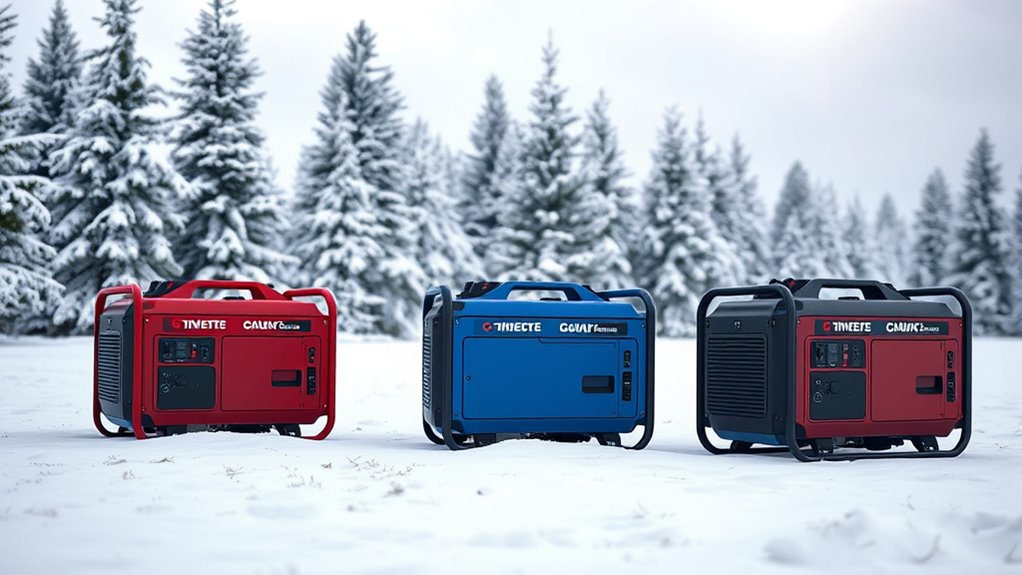

For winter backup, I would start with the WEN DF680iX if you need to run larger loads, the BILT HARD 5500W if gasoline wattage and a lighter carry weight matter, and the WEN DF360iX if clean power and a three-year warranty rank above high output. Each runs on gasoline or propane, giving you a choice when one fuel is harder to source. That flexibility does not remove cold-weather limits: propane vaporizes less readily as temperatures fall, while gasoline engines still need suitable oil, fresh fuel, and proper starting practices.

Get the latest gadgets delivered free with Prime
- Fast, free delivery on millions of items
- Prime Video, Amazon Music and more included
- Member-only deals all year
I rank these models by how well their output, fuel flexibility, portability, controls, and safety features fit winter outage use—not by peak watts alone. The main tradeoff is straightforward: higher-capacity models can support more household equipment, but they are heavier and demand more fuel; smaller units are easier to move and may suit essential electronics, but offer less room for starting surges. None should be operated indoors or in an attached garage.
Complete the kit


Key Takeaways
- Best for broader backup loads: WEN DF680iX provides 5,100 rated watts on gasoline, 240V output, electric start, wheels, and a 2.9-gallon tank, but its size and weight make it less convenient to move.
- Best balance of gasoline output and carry weight: BILT HARD 5500W supplies 4,000 rated gasoline watts at 61.7 pounds; its 1.14-gallon tank makes refueling more frequent a likely tradeoff.
- Best for lighter, electronics-focused use: WEN DF360iX weighs 49 pounds and specifies low total harmonic distortion, but its gasoline runtime is up to five hours at half load.
- Best compact value-oriented fit: PowerSmart pairs 3,300 gasoline running watts with a stated 59 dBA Eco Mode figure, though the gasoline runtime figure applies only at 25% load.
- Best lower-noise camping fit: BILT HARD 4500W lists 58 dBA at 23 feet and 3,500 rated gasoline watts; its recoil start and missing runtime test conditions deserve attention.
| WEN 6800-Watt Dual Fuel RV-Ready Electric Start Portable Inverter Generator (DF680iX) |  | Best Overall for Higher-Load Winter Backup | Fuel: Gasoline or propane | Running output: 5,100 W gasoline; 4,500 W propane | Starting output: 6,800 W gasoline; 6,000 W propane | VIEW ON AMAZON | See Our Full Breakdown |
| BILT HARD 5500W Dual-Fuel Inverter Generator |  | Best for Strong Gasoline Output in a Portable Frame | Fuel: Gasoline or LPG | Running output: 4,000 W gasoline; 3,600 W LPG | Starting output: 5,500 W gasoline; 5,000 W LPG | VIEW ON AMAZON | See Our Full Breakdown |
| BILT HARD Dual Fuel Gas & Propane Powered Generator 4500W |  | Best for Quieter RV and Campsite Backup | Fuel: Gasoline or propane | Running output: 3,500 W gasoline; 3,200 W propane | Starting output: 4,500 W gasoline; 4,150 W propane | VIEW ON AMAZON | See Our Full Breakdown |
| PowerSmart 3800-Watt Dual-Fuel Inverter Generator |  | Best Compact Balance of Output and Stated Runtime | Fuel: Gasoline and propane | Running output: 3,300 W gasoline; 3,100 W propane | Starting output: 3,800 W gasoline; 3,500 W propane | VIEW ON AMAZON | See Our Full Breakdown |
| WEN DF360iX Dual-Fuel Quiet Portable Inverter Generator |  | Best Compact Pick for Sensitive Electronics | Fuel: Gasoline or propane | Running output: 2,900 W gasoline; 2,600 W propane | Surge output: 3,600 W gasoline; 3,500 W propane | VIEW ON AMAZON | See Our Full Breakdown |
| dual fuel inverter generator winter use | Fuel | Running output | Engine | Starting output |
|---|---|---|---|---|
| WEN 6800-Watt Dual Fuel RV-Rea | Gasoline or propane | 5,100 W gasoline; 4,500 W propane | 224 cc | 6,800 W gasoline; 6,000 W propane |
| BILT HARD 5500W Dual-Fuel Inve | Gasoline or LPG | 4,000 W gasoline; 3,600 W LPG | 160 cc 4-stroke OHV | 5,500 W gasoline; 5,000 W LPG |
| BILT HARD Dual Fuel Gas & Prop | Gasoline or propane | 3,500 W gasoline; 3,200 W propane | 141 cc 4-cycle OHV | 4,500 W gasoline; 4,150 W propane |
| PowerSmart 3800-Watt Dual-Fuel | Gasoline and propane | 3,300 W gasoline; 3,100 W propane | 149 cc 4-stroke | 3,800 W gasoline; 3,500 W propane |
| WEN DF360iX Dual-Fuel Quiet Po | Gasoline or propane | 2,900 W gasoline; 2,600 W propane | 149 cc | — |
More Details on Our Top Picks
WEN 6800-Watt Dual Fuel RV-Ready Electric Start Portable Inverter Generator (DF680iX)
I put the WEN DF680iX first because it offers the broadest backup capacity here: 5,100 rated watts on gasoline and 4,500 on propane, plus a 120/240V L14-30R outlet. That combination gives buyers more options for compatible transfer equipment and larger loads than the 120V-only BILT HARD and PowerSmart models. Its bonded-neutral configuration is also described as supporting low-power Level 2 EV charging, a specialized use that none of the smaller picks offers.
Winter operation benefits from practical details rather than wattage alone. The electric start can be more convenient than repeated recoil pulls in cold conditions, with recoil backup if needed; wheels and a telescoping handle help manage its bulk. Fuel shutoff lets the engine use remaining carburetor fuel before stopping, a useful maintenance aid when gasoline storage is part of the plan. WEN lists 6.1 hours at half load on gasoline and nine hours at half load on a 20-pound propane tank, but cold and load conditions can change actual runtime.
The tradeoff is its size and fuel demand. At this output level it is the least compact choice, and propane still delivers less rated power than gasoline. It makes more sense for planned backup loads than for someone who needs a generator to lift into a vehicle often. Compared with the 5,500W BILT HARD, it offers 240V output and electric start but weighs more; compared with the WEN DF360iX, it can support substantially greater loads at the cost of portability. I rank it first for capability, not for every winter user.
Pros:- 5,100 rated watts on gasoline and 4,500 on propane
- Electric start with recoil backup, wheels, and telescoping handle
- 120/240V outlet, RV outlet, USB, and DC connections
- Fuel shutoff and CO Watchdog shutdown protection
Cons:- Heavier and bulkier than the other listed models
- Propane rated output is lower than gasoline output
- Parallel connection kit is sold separately
Best for: Households that need higher sustained output, 120/240V capability, electric start, and wheels for planned winter backup.
Not ideal for: Buyers prioritizing a compact carry, minimal fuel consumption, or simple 120V-only power for a few small devices.
- Fuel:Gasoline or propane
- Running output:5,100 W gasoline; 4,500 W propane
- Starting output:6,800 W gasoline; 6,000 W propane
- Engine:224 cc
- Tank:2.9 gallons
- Runtime:Up to 6.1 hours at half load on gasoline; up to 9 hours at half load on a 20 lb propane tank
- Noise:64 dB at quarter load
- Outlets:120/240V L14-30R, 120V receptacles, TT-30R, 12V DC, and USB
- Safety and handling:CO Watchdog, fuel shutoff, electric start, wheels, and telescoping handle
Our verdict“I recommend the DF680iX for buyers who need the most flexible, high-output winter backup package and can accommodate its size.”
BILT HARD 5500W Dual-Fuel Inverter Generator
The BILT HARD 5500W earns second place by combining 4,000 rated gasoline watts with a listed weight of 61.7 pounds. That is a useful middle ground for winter backup: it has considerably more gasoline running output than the PowerSmart, DF360iX, or BILT HARD 4500W, while avoiding the DF680iX’s larger 240V, higher-capacity format. On propane it is rated at 3,600 running watts, so I would size loads around the fuel I expect to use rather than its highest starting figure.
Its digital operating display, economy mode, CO auto-shutoff, and low-oil and overload protection make the controls and safeguards appealing for a portable unit. Multiple AC, DC, and USB options cover common equipment, and parallel connectors leave a path to additional capacity if a second identical generator is added. For winter outage planning, the 120V 30A RV outlet is useful for compatible RV setups, but this is not a 240V household-circuit solution like the WEN DF680iX.
The main compromise is the 1.14-gallon gasoline tank, the smallest listed capacity in this group. The supplied details do not state runtime, so I would not assume long unattended operation between refills. It is also heavier than the 49-pound WEN DF360iX and 50.7-pound PowerSmart. I rank it ahead of those smaller-output models when sustained gasoline power matters, but below the DF680iX for larger home loads and below lighter picks for frequent carrying.
Pros:- 4,000 rated watts on gasoline and 3,600 on LPG
- Digital display and economy mode
- CO auto-shutoff, low-oil protection, and overload protection
- Parallel-ready with multiple AC, DC, and USB output types
Cons:- Small 1.14-gallon gasoline tank and no supplied runtime figure
- Parallel operation requires a second identical generator
- No 240V outlet is listed
Best for: Buyers seeking more 120V gasoline output than compact models provide, with a display, economy mode, and portable-generator safety features.
Not ideal for: Anyone needing 240V output, a long stated gasoline runtime, or the easiest unit to lift and transport.
- Fuel:Gasoline or LPG
- Running output:4,000 W gasoline; 3,600 W LPG
- Starting output:5,500 W gasoline; 5,000 W LPG
- Engine:160 cc 4-stroke OHV
- Tank:1.14 gallons
- Weight:61.7 lb
- Outlets:120V 20A, 120V 30A TT-30R, 12V DC, USB-C/USB-A adapter
- Controls and protection:Economy mode, digital display, CO auto-shutoff, low-oil and overload protection
Our verdict“I would choose this BILT HARD when 120V gasoline output matters more than tank capacity, 240V output, or minimum carry weight.”
BILT HARD Dual Fuel Gas & Propane Powered Generator 4500W
This BILT HARD 4500W stands apart through its stated noise figure: 58 dBA at 23 feet. That gives it a clear use case for RV trips and outdoor setups where generator sound matters, while its 3,500 rated gasoline watts exceed the DF360iX’s 2,900 and the PowerSmart’s 3,300. It also includes a TT-30R RV outlet and an LPG hose with regulator, so the listed equipment suits portable RV power without requiring a separate propane hose purchase.
For winter, dual fuel offers a useful choice between stored gasoline and a propane cylinder. Its rated output falls from 3,500 watts on gasoline to 3,200 on propane, a modest gap relative to some higher-output options, though the actual usable capacity still depends on the appliance mix and conditions. The CO sensor, overload protection, ECO mode, and clean inverter power under 3% THD add useful safeguards and electronics compatibility. Compared with the PowerSmart, it has a higher gasoline running rating and a lower stated noise figure; compared with the DF680iX, it is simpler and more portable but cannot provide the same output or 240V power.
It uses a recoil start, which can be less convenient during a cold snap than the DF680iX’s electric start. The supplied 13-hour runtime figure lacks a stated load and fuel condition, so I would not use it as a direct comparison with the PowerSmart’s 25%-load gasoline figure or WEN’s half-load figures. At 57.7 pounds, it is not exceptionally light, and parallel capability requires a kit that is not included. I place it here for quieter 120V outdoor use rather than all-house backup.
Pros:- 3,500 rated gasoline watts and 3,200 rated propane watts
- Listed at 58 dBA at 23 feet with ECO mode
- Includes TT-30R outlet and LPG hose with regulator
- CO sensor and inverter power specified below 3% THD
Cons:- Recoil start rather than electric start
- Parallel kit is not included
- Runtime figure does not specify the load or fuel conditions
Best for: RV owners and campers who want dual fuel, a listed low noise level, and enough output for moderate 120V loads.
Not ideal for: Buyers who need electric start, 240V output, or a runtime figure that is clearly tied to a stated test load.
- Fuel:Gasoline or propane
- Running output:3,500 W gasoline; 3,200 W propane
- Starting output:4,500 W gasoline; 4,150 W propane
- Engine:141 cc 4-cycle OHV
- Noise:58 dBA at 23 feet
- Fuel tank:1.37 gallons
- Weight:57.7 lb
- Outlets:120V 20A duplex, 120V 30A TT-30R, USB, and 12V DC
- Protection:CO sensor, circuit breakers, and ECO mode
Our verdict“I see this as the better fit for noise-conscious RV use than for demanding household backup or cold-weather starting convenience.”
PowerSmart 3800-Watt Dual-Fuel Inverter Generator
The PowerSmart 3800 is a balanced option for buyers who want more than a small electronics-only generator without stepping up to a larger frame. Its 3,300 rated gasoline watts and 3,100 propane watts sit between the WEN DF360iX and the BILT HARD 4500W. At 50.7 pounds, it is also lighter than either BILT HARD model, making it a more plausible choice for one person to move short distances, subject to safe lifting practices.
Its strongest winter-use detail is the clearest stated gasoline runtime basis among the smaller choices: up to eight hours at 25% load with a 1.3-gallon tank. The manufacturer also lists up to 24 hours on a 20-pound propane tank, though that figure should not be compared as if the fuel and load conditions match the gasoline claim. A 59 dBA Eco Mode figure, CO sensor, low-oil shutdown, and overload and short-circuit protection round out the practical package. Compared with the BILT HARD 4500W, it is lighter and has a more clearly qualified gasoline runtime, but has less rated output.
That runtime is not a half-load or winter guarantee. Cold starts, heavier appliance demand, and propane temperature can all alter performance, and its small gasoline tank still means planning refills. Unlike the DF680iX, it has no listed 240V outlet or electric start; unlike the DF360iX, it does not supply the same very low THD figures. I rank it as a useful middle choice for essential 120V loads, not a replacement for a larger backup unit.
Pros:- 3,300 rated watts on gasoline and 3,100 on propane
- 50.7-pound listed weight
- Up to eight hours at 25% load on gasoline is specified
- CO sensor, low-oil shutdown, and 59 dBA Eco Mode figure
Cons:- Gasoline runtime is stated at only 25% load
- 1.3-gallon tank limits fuel carried onboard
- No 240V outlet or electric start is listed
Best for: Buyers who want a relatively light dual-fuel generator for moderate 120V loads and value runtime figures tied to a stated light-load condition.
Not ideal for: Households with larger startup loads, users requiring 240V, or anyone expecting eight hours at a heavy winter load.
- Fuel:Gasoline and propane
- Running output:3,300 W gasoline; 3,100 W propane
- Starting output:3,800 W gasoline; 3,500 W propane
- Engine:149 cc 4-stroke
- Gas tank:1.3 gallons
- Runtime:Up to 8 hours at 25% gasoline load; up to 24 hours on a 20 lb propane tank
- Noise:59 dBA in Eco Mode
- Weight:50.7 lb
- Outlets:120V 30A L5-30R, 120V 20A duplex, 12V DC, and USB
Our verdict“I recommend the PowerSmart for moderate 120V backup when portability and clearly qualified light-load runtime matter more than maximum output.”
WEN DF360iX Dual-Fuel Quiet Portable Inverter Generator
I place the WEN DF360iX fifth overall, not because its electronics protection is weak, but because winter backup buyers often benefit from more sustained output than its 2,900 gasoline watts and 2,600 propane watts provide. Its advantage is a relatively portable 49-pound body, a three-year limited warranty, and stated total harmonic distortion below 1.2% at full load. That makes it the clearest match here for users prioritizing compact transport and sensitive electronics over running several larger appliances.
It offers gasoline and propane, a TT-30R RV outlet, two 120V 20A receptacles, DC, and USB. The listed CO shutdown protection and fuel shutoff are useful for safe operation and fuel-system care. Its propane runtime is up to 14 hours at half load on a 20-pound tank, while gasoline is listed at up to five hours at half load. Those separate claims make fuel planning more legible than the BILT HARD 4500W’s runtime figure, but they remain manufacturer figures rather than cold-weather guarantees. At 65 dB at quarter load, it is not the quietest on the list by the stated measurements.
Compared with the PowerSmart, this WEN is lighter and supplies explicit low-THD data, but it gives up 400 rated gasoline watts and has a shorter stated gasoline runtime at its specified test load. Compared with the BILT HARD 5500W and DF680iX, it cannot handle as much sustained demand. Its parallel kit is sold separately, adding another purchase if more capacity is needed. I would choose it for a modest, electronics-heavy load plan, then move up to the PowerSmart or BILT HARD 4500W if the appliance list needs greater output.
Pros:- 49-pound listed weight and dual-fuel operation
- THD below 1.2% at full load
- CO shutdown protection and fuel shutoff
- Three-year limited warranty and TT-30R outlet
Cons:- 2,900 rated gasoline watts and 2,600 propane watts are the lowest running ratings here
- Gasoline runtime is up to five hours at half load
- Parallel connection kit is sold separately
Best for: Campers and homeowners needing a lighter generator for essential 120V loads and sensitive electronics, with stated low-THD performance.
Not ideal for: Buyers who need longer gasoline runtime, higher sustained output, electric start, or quieter operation than the listed 65 dB at quarter load.
- Fuel:Gasoline or propane
- Running output:2,900 W gasoline; 2,600 W propane
- Surge output:3,600 W gasoline; 3,500 W propane
- Engine:149 cc
- Runtime:Up to 5 hours at half load on gasoline; up to 14 hours at half load on a 20 lb propane tank
- Noise:65 dB at quarter load
- Weight:49 lb
- Power quality:Under 0.3% THD at no load; under 1.2% at full load
- Warranty and outlets:3-year limited warranty; 120V outlets, TT-30R, 12V DC, and USB
Our verdict“I would choose the DF360iX for a lighter electronics-focused setup, but not for winter backup that needs broad appliance coverage.”

How We Picked
I compared the five generators against the demands of winter use: the ability to select gasoline or propane, usable running output, fuel information, cold-weather practicality, portability, safety provisions, and outlet range. For backup planning, I give rated watts more weight than surge watts because appliances need sustained power after their startup draw. I also distinguish between gasoline and propane output wherever the supplied specifications do so; propane output is lower on every model with separate ratings.
Cold weather makes fuel choice and setup more complicated. Propane can be convenient to store and may keep a carburetor free of gasoline residue, but a cylinder and regulator still have to supply enough vapor for the temperature and generator load. Gasoline avoids that vaporization issue, yet its short-term storage, stale-fuel risk, and the need to run the carburetor dry when appropriate call for care. A generator’s published runtime is not a promise for freezing conditions, and the products do not provide comparable cold-weather runtime tests.
My order favors practical capability over one headline feature. The DF680iX leads for higher sustained output, electric starting, and winter-relevant portability aids, although it is no lightweight. The BILT HARD 5500W follows for a substantial gasoline rating in a 61.7-pound unit. The remaining three serve more specific needs: the BILT HARD 4500W emphasizes listed noise and RV use, the PowerSmart offers a useful output-and-size balance with a clearly stated Eco Mode noise figure, and the DF360iX is the compact choice for modest loads and sensitive electronics. I treat missing or differently measured data as uncertainty rather than assuming a winner.
Safety and installation matter as much as product features. All five include some form of carbon-monoxide protection or sensor in the supplied information, but this does not make indoor operation safe. I would place any portable generator outdoors, far from doors, windows, and vents, following the manual and local guidance. I would also use a qualified electrician and an approved transfer arrangement for home circuits rather than connecting a generator directly to household wiring.
| dual fuel inverter generator winter use | Fuel | Runtime |
|---|---|---|
| WEN 6800-Watt Dual Fuel RV-Rea | Gasoline or propane | Up to 6.1 hours at half load on gasoline; up to 9 hours at half load on a 20 lb propane tank |
| BILT HARD 5500W Dual-Fuel Inve | Gasoline or LPG | — |
| BILT HARD Dual Fuel Gas & Prop | Gasoline or propane | — |
| PowerSmart 3800-Watt Dual-Fuel | Gasoline and propane | Up to 8 hours at 25% gasoline load; up to 24 hours on a 20 lb propane tank |
| WEN DF360iX Dual-Fuel Quiet Po | Gasoline or propane | Up to 5 hours at half load on gasoline; up to 14 hours at half load on a 20 lb propane tank |
Factors to Consider When Choosing Dual Fuel Inverter Generator Winter Use
For winter, I would choose a generator only after listing the appliances I need to run at the same time. Add their running watts, then account for the largest motor-starting surge—such as a refrigerator or pump. Next, decide whether gasoline or propane is more practical at your location and whether the generator’s output, outlet types, and handling features fit the plan.
Match Running Watts to the Essential-Load Plan
Surge wattage is a short-term ceiling, not the amount available for continuous use. I compare the rated running wattage on the chosen fuel with the combined demand from the intended appliances, allowing headroom for motors starting. The DF680iX is the only model here with listed 120/240V capability and the highest sustained output. The BILT HARD 5500W gives the next-highest gasoline rating but is 120V only, while the compact models suit narrower loads.
Write down appliance labels or manuals before choosing. A furnace blower, refrigerator, sump pump, or space heater can each change the plan; a resistance heater may consume a large portion of a small generator’s capacity. Do not assume that a large starting-watt figure means two high-demand appliances can run together.
Treat Gasoline and Propane as Different Winter Choices
Dual fuel gives flexibility, but the fuels behave differently in cold weather. Gasoline avoids propane vaporization concerns at low temperatures, though stored gasoline can degrade and needs sensible fuel management. Propane can be stored in a suitable cylinder and avoids leaving gasoline in the carburetor during extended storage, but cold conditions and high demand can reduce vapor supply. Check the manual for minimum operating temperatures, cylinder requirements, regulator instructions, and fuel-change procedures.
Do not compare runtime claims unless the fuel, tank or cylinder size, and load match. PowerSmart specifies eight hours at 25% load on gasoline; WEN lists half-load runtimes for the DF360iX and DF680iX. Those are different conditions, and none should be read as a guarantee for a cold outage.
Plan for Starting, Oil, and Outdoor Placement
Cold oil can make an engine harder to turn, and battery-dependent starting systems may also be affected by low temperatures. The DF680iX’s electric start with recoil backup is a convenience, not a substitute for following the manual’s oil-grade and starting instructions. Check the recommended oil viscosity for the expected temperature, maintain the unit as directed, and keep fuel fresh. A fuel shutoff feature can help clear fuel from the carburetor before storage, when used according to its instructions.
Every generator in this guide belongs outdoors, away from doors, windows, and vents, with exhaust directed away from occupied spaces. Carbon-monoxide sensors and automatic shutdowns are additional protections; they do not make garages, sheds, basements, porches, or other enclosed or partly enclosed locations safe. Use working CO alarms inside the home and follow local safety guidance.
Compare Portability, Noise, and Connection Needs
Weight matters when winter weather means moving a unit over uneven ground or storing it between outages. The WEN DF360iX is the lightest listed at 49 pounds, while the DF680iX adds wheels and a telescoping handle to manage its larger size. Noise figures are also measured differently: the BILT HARD 4500W gives a distance of 23 feet, PowerSmart reports Eco Mode, and the WEN models state quarter-load figures. I would not treat those numbers as a direct ranking without matching test conditions.
Check outlet type before buying. The DF680iX offers 120/240V, while the other four list 120V outlets. RV owners should verify TT-30R compatibility and total load; home backup users should work with a qualified electrician on an approved transfer setup. Never connect a generator to a wall outlet or household wiring without the proper transfer equipment.
Plan Fuel Supply and Safe Refills
Small onboard gasoline tanks mean more frequent refills under sustained demand. The BILT HARD 5500W has a 1.14-gallon tank and no supplied runtime figure, while the PowerSmart’s 1.3-gallon capacity accompanies a stated light-load runtime. The DF680iX’s 2.9-gallon tank is larger, but its higher output can also support heavier loads. I would store approved fuel safely, keep it away from living areas and ignition sources, and shut down and cool the generator before refueling.
For propane, use the specified hose, regulator, cylinder position, and connection procedure. Check for leaks as directed by the manufacturer, and do not improvise adapters. The right fuel plan is the one that matches the generator’s output and the buyer’s ability to store and handle fuel safely through an outage.
Frequently Asked Questions
Is propane or gasoline better for a dual-fuel generator in winter?
I would choose based on expected temperature, load, and fuel storage. Gasoline avoids the reduced vaporization that can affect propane supply in cold conditions, but it needs fresh-fuel management. Propane can be convenient to store and may reduce carburetor fuel residue, yet cold weather and high demand can limit cylinder vapor supply. Check the generator manual for temperature and fuel instructions, and plan around the lower rated output shown for propane on these models.
Can I run a dual-fuel inverter generator inside a garage during a snowstorm?
No. I would operate a portable generator outdoors and away from doors, windows, vents, and other openings, following the manufacturer’s placement instructions and local guidance. A garage door left open does not make a garage safe, and a CO sensor on the generator is not a substitute for safe placement. Use working carbon-monoxide alarms inside the home and never run a generator in a home, basement, shed, or other enclosed area.
Which generator in this group is best for running household essentials?
For a broader essential-load plan, I would start with the WEN DF680iX because it has the highest listed running output and a 120/240V outlet. That does not mean it can run every appliance at once: calculate combined running watts and motor-starting surges, then confirm the required circuit connection with a qualified electrician. For a smaller 120V plan, the BILT HARD 5500W offers 4,000 rated gasoline watts, while compact models make more sense when the load is limited.
Do the runtime figures tell me how long a generator will run during a winter outage?
They provide a reference under specified conditions, not a winter guarantee. PowerSmart lists gasoline runtime at 25% load, while the WEN figures cited here use half load; fuel type, appliance demand, temperature, maintenance, and fuel supply affect actual runtime. The BILT HARD 4500W runtime claim supplied for this comparison does not state the test load or fuel conditions, so I would treat it cautiously and plan refills rather than rely on a single number.
What should I do before starting a generator in freezing weather?
I would follow the exact manual for the model, check that it is on a stable outdoor surface with clear airflow, inspect fuel connections, and use the oil viscosity recommended for the expected temperature. Keep gasoline fresh and use propane equipment only as specified. Allow the generator to run and stabilize before connecting loads, avoid overloading it, and shut it down and let it cool before refueling. If the unit struggles to start or shows a fault, stop and consult the manual rather than bypassing a safety feature.
Conclusion
For higher-output winter backup and 120/240V flexibility, I recommend the WEN DF680iX, especially for buyers who value electric start, wheels, and fuel shutoff. Choose the BILT HARD 5500W if your plan is 120V-only but needs stronger gasoline output in a portable-format unit; accept its small tank and lack of a supplied runtime figure. For RV users who put more weight on the listed noise level, the BILT HARD 4500W offers a useful middle ground with a TT-30R outlet.
If you want a lighter unit for moderate loads and a stated light-load runtime, I would shortlist the PowerSmart 3800. For a compact, electronics-focused setup where explicit low-THD figures and a three-year limited warranty matter, the WEN DF360iX is the more fitting choice, provided its lower output meets your load list. Whichever one you select, size it by running watts on your chosen fuel, plan for cold-weather fuel behavior, and operate it outdoors with safe electrical connections.
Halloween Picks

Gemmy 6.4 ft Beetlejuice Animatronic Halloween Decoration with Spinning Head

HOPOCO Halloween Pumpkin Fog Machine with 12 LED Colors and 4 Light Modes

Vexalify 11-Inch Halloween Pumpkin Fog Machine with 12-Color Lights
As an affiliate, we earn on qualifying purchases.