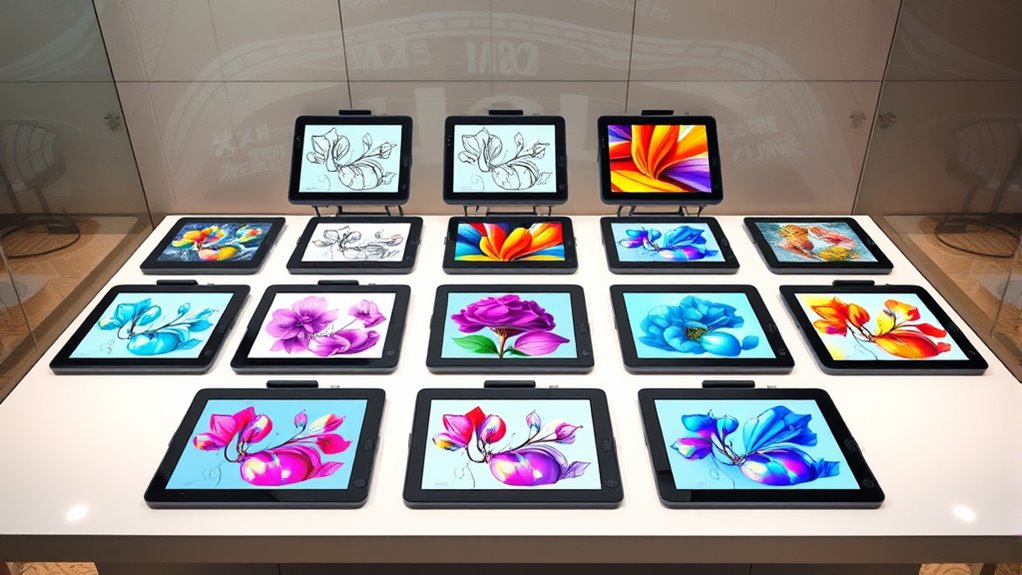

For a strong all-around choice, I’d start with the HUION Kamvas 13 (Gen 3), whose 13.3-inch display and dual dials suit artists who want room for detailed work and quick controls. The XP-Pen Artist 13.3 Pro V2 is another standout for artists comparing compact displays, while the Frunsi RubensTab T11 Pro suits people who want a standalone tablet without a computer connection. The main tradeoffs are screen size, portability, connection requirements, and how much control space you need on the device itself. Smaller displays take up less desk space but can feel cramped for long sessions; larger models need more room and are less convenient to move. Read on for a ranked comparison and a guide to choosing the right screen tablet for your setup.

Get the latest gadgets delivered free with Prime
- Fast, free delivery on millions of items
- Prime Video, Amazon Music and more included
- Member-only deals all year
Complete the kit



Key Takeaways
- The HUION Kamvas 13 (Gen 3) earns the overall lead for combining a useful 13.3-inch workspace with dual dials, while the repeated standard and pink listings are color variants rather than separate feature tiers.
- The Frunsi RubensTab T11 Pro is the lineup’s standalone option, which matters most to artists who need to draw without tethering the tablet to a computer.
- 13.3-inch pen displays offer a practical middle ground between the desk footprint of 11.6-inch models and the larger working area of 15.4- or 16-inch displays.
- The Huion Kamvas Pro 16 and UGEE UE16 suit buyers who prioritize a larger canvas, but their size makes them less convenient for small desks and frequent travel.
- Several entries are closely related compact models, so buyers should compare the exact generation, bundled controls, and connection setup instead of choosing by brand name alone.
| HUION Kamvas 13 (Gen 3) Pen Display Drawing Tablet |  | Best Overall for Color Accuracy | Display: 13-inch pen display | Pen pressure: 16,384 levels | Initial activation force: 2 g | VIEW ON AMAZON | See Our Full Breakdown |
| XP-Pen Artist 13.3 Pro Drawing Tablet with Screen |  | Best for Shortcut-Driven Workflows | Display: 13.3-inch Full HD | Color gamut: 88% NTSC; 91% Adobe RGB; 123% sRGB | Pen pressure: 16,384 levels | VIEW ON AMAZON | See Our Full Breakdown |
| XP-PEN Artist12 11.6-Inch FHD Drawing Monitor with Battery-Free Stylus |  | Best Compact Pick | Display: 11.6-inch IPS | Resolution: 1920 × 1080 | Color gamut: 72% NTSC (100% sRGB) | VIEW ON AMAZON | See Our Full Breakdown |
| XP-Pen Artist 13.3 Pro V2 Drawing Tablet with Screen |  | Best for Broad Color Coverage | Display: 13.3-inch Full HD IPS, 1920 × 1080 | Color gamut: 125% sRGB, 107% Adobe RGB, 95% Display P3 | Stylus: Battery-free X3 Pro | VIEW ON AMAZON | See Our Full Breakdown |
| Frunsi RubensTab T11 Pro Standalone Drawing Tablet |  | Best Standalone Pick | Display: 10.1-inch Full HD IPS | Resolution: 1920 × 1200 | Battery: 5800mAh; rated for up to 5 hours | VIEW ON AMAZON | See Our Full Breakdown |
| XP-Pen Artist 12 Pro Lite Drawing Tablet with Screen |  | Best for Dial-Based Control | Display: 11.6-inch fully laminated IPS | Resolution: 1920 × 1080 | Viewing angle: 178° | VIEW ON AMAZON | See Our Full Breakdown |
| HUION Kamvas 13 (Gen 3) Drawing Tablet with Screen, Dual Dial, 13.3-inch, Black |  | Best for Low-Force, Precise Drawing | Screen: 13.3-inch fully laminated Canvas Glass 2.0 | Pen pressure: 16,384 levels | Initial activation force: 2 g | VIEW ON AMAZON | See Our Full Breakdown |
| VEIKK VK1200 V2 11.6-Inch Drawing Tablet with Screen |  | Best Accessory Bundle | Display: 11.6-inch IPS, full laminated | Resolution: 1920 × 1080 | Color gamut: 72% NTSC | VIEW ON AMAZON | See Our Full Breakdown |
| XP-Pen Artist 12 3rd 11.9-Inch Drawing Tablet with Screen, Pink |  | Best Compact Display for Color Work | Display: 11.9-inch full-laminated AG nano-etched glass with anti-glare coating | Stylus: Battery-free; 16,384 pressure levels; 2 g activation force; 0.3 mm nib travel | Color gamut: 99% sRGB | VIEW ON AMAZON | See Our Full Breakdown |
| Huion Kamvas Pro 16 Drawing Tablet with Screen |  | Best for a Larger Working Canvas | Screen: 15.6-inch, full-laminated with anti-glare glass | Color gamut: 120% sRGB; 92% AdobeRGB | Contrast ratio: 1000:1 | VIEW ON AMAZON | See Our Full Breakdown |
| GAOMON PD1161 11.6-Inch Full HD Drawing Tablet with Screen and Tilt |  | Best for Shortcut Keys on a Compact Display | Display: 11.6-inch Full HD IPS | Color gamut: 72% NTSC (100% sRGB) | Display colors: 16.7 million | VIEW ON AMAZON | See Our Full Breakdown |
| HUION Kamvas 13 (Gen 3) 13.3-Inch Drawing Tablet with Screen, Dual Dial, Pink |  | Best for Color-Accurate Compact Drawing | Display size: 13.3 inches | Color coverage: 99% sRGB; Rec.709 | Color accuracy: Average ΔE < 1.5 | VIEW ON AMAZON | See Our Full Breakdown |
| UGEE UE12 11.6-Inch Drawing Tablet with Screen |  | Best for a Compact Display with Wide Color | Screen: 11.6-inch, 1920 × 1080 | Screen finish: Full-laminated, anti-glare | Color gamut: 124% sRGB | VIEW ON AMAZON | See Our Full Breakdown |
| Huion Kamvas Pro 16 Drawing Tablet with Screen |  | Best for a Larger Drawing Area | Screen size: 15.6 inches | Screen: Fully laminated HD with anti-glare glass | Color gamut: 120% sRGB | VIEW ON AMAZON | See Our Full Breakdown |
| UGEE UE16 15.4-Inch Drawing Tablet with Screen |  | Best for Multi-Format Color Work | Screen size: 15.4 inches | Color gamut: 143% sRGB | Color depth: 8-bit | VIEW ON AMAZON | See Our Full Breakdown |
| drawing tablets screen | Controls | Compatibility | Color gamut | Display |
|---|---|---|---|---|
| HUION Kamvas 13 | 2 dial controllers and 5 press keys | — | — | 13-inch pen display |
| XP-Pen Artist 13.3 Pro Drawing | 8 shortcut keys and red dial | Windows 7 or later, macOS X 10.10 or later, Chrome OS 88 or later, Linux | 88% NTSC; 91% Adobe RGB; 123% sRGB | 13.3-inch Full HD |
| XP-PEN Artist12 11.6-Inch FHD | 6 customizable shortcut keys and programmable touch bar | Windows 7/8/10/11, Mac 10.10 or later, Linux | 72% NTSC (100% sRGB) | 11.6-inch IPS |
| XP-Pen Artist 13.3 Pro V2 Draw | Red dial and 8 customizable keys | Windows 7 or later, macOS 10.13 or later, Chrome OS 88 or later, Android with USB-C support, Linux with driver support | 125% sRGB, 107% Adobe RGB, 95% Display P3 | 13.3-inch Full HD IPS, 1920 × 1080 |
| Frunsi RubensTab T11 Pro Stand | — | — | — | 10.1-inch Full HD IPS |
| XP-Pen Artist 12 Pro Lite Draw | Eight shortcut keys and programmable red dial | — | — | 11.6-inch fully laminated IPS |
| HUION Kamvas 13 | Five programmable shortcut keys, three pen side buttons, dual dials | Windows 10 or later, macOS 10.12 or later, compatible Android devices, Ubuntu 20.04 LTS | — | — |
| VEIKK VK1200 V2 11.6-Inch Draw | Six customizable shortcut keys | Windows 7 or later, macOS 10.12 or later, Linux | 72% NTSC | 11.6-inch IPS, full laminated |
| XP-Pen Artist 12 3rd 11.9-Inch | Dual roller wheels and eight shortcut keys | Windows 7 or later, Windows ARM, macOS 10.13 or later, Android 10 or later, ChromeOS 88 or later, Linux | 99% sRGB | 11.9-inch full-laminated AG nano-etched glass with anti-glare coating |
| Huion Kamvas Pro 16 Drawing Ta | Six express keys and touch bar | Windows 7 or later, macOS 10.12 or later, Linux (Ubuntu) | 120% sRGB; 92% AdobeRGB | — |
| GAOMON PD1161 11.6-Inch Full H | 8 tablet keys and 2 pen buttons | Windows 7 or later; macOS 10.12 or later | 72% NTSC (100% sRGB) | 11.6-inch Full HD IPS |
| HUION Kamvas 13 | 5 programmable keys and dual dial buttons | Windows 10 or later, macOS 10.12 or later, supported Android devices, Ubuntu 20.04 LTS | — | — |
| UGEE UE12 11.6-Inch Drawing Ta | 8 customizable shortcut keys; 2 programmable stylus buttons | Windows 7 or later, macOS 10.10 or later, Android 10.1 or later, Chrome 88 or later | 124% sRGB | — |
| Huion Kamvas Pro 16 Drawing Ta | 6 customizable express keys and 1 touch bar | Windows 7 or later, macOS 10.12 or later, Linux Ubuntu | 120% sRGB | — |
| UGEE UE16 15.4-Inch Drawing Ta | — | — | 143% sRGB | — |
More Details on Our Top Picks
HUION Kamvas 13 (Gen 3) Pen Display Drawing Tablet
The Kamvas 13 (Gen 3) is my strongest all-around pick for artists who want a screen tablet that connects to a computer and puts color consistency first. Its 99% sRGB/Rec.709 coverage and stated ΔE<1.5 accuracy suit illustration and image work where reliable color matters. Full lamination reduces the visible gap between pen tip and cursor, while the textured anti-glare surface gives strokes a more paper-like feel. Compared with the XP-Pen Artist 13.3 Pro, this Huion offers higher stated color accuracy and two dials, though XP-Pen supplies a foldable stand and more shortcut keys. The Huion’s 13-inch workspace remains portable, but it is still a tethered display, and Android use depends on compatible USB-C video support.
Pros:- 99% sRGB/Rec.709 coverage and stated ΔE<1.5 color accuracy
- Full lamination and anti-glare textured surface reduce cursor offset and glare
- Two dial controllers plus five press keys provide direct workflow controls
- Symmetrical design supports left- and right-handed users
Cons:- Requires a connected computer or compatible device to function
- Android compatibility depends on specific USB-C video capabilities
Best for: Digital illustrators who already use a compatible computer and want a portable pen display with accurate color and tactile surface feedback
Not ideal for: Artists seeking a standalone tablet or planning to connect an Android device without USB 3.1 Gen 1 and DisplayPort 1.2 support
- Display:13-inch pen display
- Pen pressure:16,384 levels
- Initial activation force:2 g
- Color coverage:99% sRGB/Rec.709; 90% Adobe RGB
- Color accuracy:ΔE<1.5
- Controls:2 dial controllers and 5 press keys
- Thickness and weight:11.7 mm; 865 g
- Standalone use:Requires a computer or compatible device
Our verdict“Choose the Kamvas 13 (Gen 3) if color accuracy and a paper-like drawing surface matter more to you than a standalone setup.”
XP-Pen Artist 13.3 Pro Drawing Tablet with Screen
The Artist 13.3 Pro suits artists who want a 13.3-inch drawing display with several controls close at hand. Its eight customizable keys and red dial make common actions easier to reach during illustration or editing, and the full-laminated screen helps keep the cursor close to the stylus tip. The battery-free pen supports tilt and 16,384 pressure levels, giving brush strokes room to vary with pressure and angle. Compared with the HUION Kamvas 13 (Gen 3), this model offers more shortcut keys and includes a foldable stand, while the Huion lists stronger color accuracy and two dials. Its broad stated sRGB coverage is useful for general creative work, but this remains a computer-connected display, and some listed software requires device registration.
Pros:- Eight customizable keys and a red dial support quick command access
- Full lamination helps reduce the apparent gap between pen and cursor
- Battery-free stylus supports tilt and 16,384 pressure levels
- Foldable stand and replacement nibs are included
Cons:- Requires connection to a computer or laptop
- Some listed software requires device registration
Best for: Illustrators who prefer a dedicated shortcut for frequent actions and want an included stand for a laptop-based drawing setup
Not ideal for: Artists who need a standalone tablet or prioritize stated color accuracy over physical workflow controls
- Display:13.3-inch Full HD
- Color gamut:88% NTSC; 91% Adobe RGB; 123% sRGB
- Pen pressure:16,384 levels
- Pen tilt:Up to 60 degrees
- Controls:8 shortcut keys and red dial
- Viewing angle:178 degrees
- Connectivity:USB-C and included 3-in-1 cable
- Compatibility:Windows 7 or later, macOS X 10.10 or later, Chrome OS 88 or later, Linux
Our verdict“Pick the Artist 13.3 Pro if shortcut access and an included stand matter more than the Huion’s stated color accuracy.”
XP-PEN Artist12 11.6-Inch FHD Drawing Monitor with Battery-Free Stylus
The Artist12 is the compact choice for buyers who want a screen beneath the pen without giving up a desk to a larger display. Its 11.6-inch Full HD IPS screen is smaller than the 13.3-inch XP-Pen Artist 13.3 Pro, which makes the Artist12 easier to fit into a tight workspace but leaves less room for a canvas and tool panels together. Six customizable keys and a touch bar offer useful controls, while the battery-free stylus has a built-in eraser. The 72% NTSC gamut is more modest than the color coverage listed for the Artist 13.3 Pro, so color-focused artists may prefer that larger model. This is still a computer-connected monitor, and its HDMI plus USB-A connection can call for adapters on newer laptops.
Pros:- Compact 11.6-inch Full HD IPS display
- Battery-free stylus includes a digital eraser
- Six customizable keys and a programmable touch bar
- Eight replacement nibs are included
Cons:- Smaller workspace than the 13.3-inch Artist 13.3 Pro
- Requires a computer and HDMI plus USB-A ports or adapters
- 72% NTSC gamut is less suited to color-critical work
Best for: Students, traveling illustrators, and laptop users with limited desk space who want a compact pen display
Not ideal for: Artists who need a larger canvas area, broad color coverage, or a setup that avoids HDMI and USB-A connections
- Display:11.6-inch IPS
- Resolution:1920 × 1080
- Color gamut:72% NTSC (100% sRGB)
- Stylus:Battery-free passive pen with digital eraser
- Controls:6 customizable shortcut keys and programmable touch bar
- Connection:HDMI and USB-A; computer required
- Compatibility:Windows 7/8/10/11, Mac 10.10 or later, Linux
- Warranty:1 year
Our verdict“Choose the Artist12 if desk space and portability matter more than a larger canvas or wider color gamut.”
XP-Pen Artist 13.3 Pro V2 Drawing Tablet with Screen
The Artist 13.3 Pro V2 targets artists who want a compact Full HD pen display with particularly broad stated color coverage. Its 125% sRGB, 107% Adobe RGB, and 95% Display P3 figures give it an edge on paper over the original Artist 13.3 Pro’s listed gamut, especially for work that moves between common color spaces. Full lamination and anti-glare film help keep the drawing surface comfortable, and the included adjustable stand supports longer sessions. Like the HUION Kamvas 13 (Gen 3), it has a 13-inch format and high pressure sensitivity; the Huion instead lists more exact color accuracy and two dials. The V2’s red dial and eight keys remain practical, but it needs a computer or compatible device, and color temperature adjustment is limited to Windows.
Pros:- Broad stated coverage across sRGB, Adobe RGB, and Display P3
- Full-laminated anti-glare screen
- Red dial and eight customizable keys
- Adjustable stand and replacement nibs are included
Cons:- Requires a computer or compatible device
- Color temperature adjustment is available on Windows only
- Full HD resolution is spread across a 13.3-inch display
Best for: Illustrators and designers who use a computer setup and want broad stated color coverage in a compact display
Not ideal for: Standalone tablet users or people who need color temperature adjustment on macOS or another operating system
- Display:13.3-inch Full HD IPS, 1920 × 1080
- Color gamut:125% sRGB, 107% Adobe RGB, 95% Display P3
- Stylus:Battery-free X3 Pro
- Pen pressure:16,384 levels
- Controls:Red dial and 8 customizable keys
- Brightness and contrast:250 cd/m²; 1000:1
- Viewing angle:178 degrees
- Compatibility:Windows 7 or later, macOS 10.13 or later, Chrome OS 88 or later, Android with USB-C support, Linux with driver support
Our verdict“Choose the Artist 13.3 Pro V2 if broad color gamut and an included adjustable stand outweigh the Huion’s stated color accuracy.”
Frunsi RubensTab T11 Pro Standalone Drawing Tablet
The RubensTab T11 Pro fills a different need from the other picks: it can run drawing apps without a computer. That makes its 10.1-inch Full HD screen useful for sketching, notes, and travel when carrying a laptop would be inconvenient. The XP-PEN Artist12 and both 13.3-inch XP-Pen displays provide larger drawing surfaces, but they depend on a connected computer; the Frunsi trades canvas space and a shorter stated battery runtime for independence. Its 5800mAh battery is rated for up to five hours, so it is better suited to shorter sessions or access to charging than all-day work away from an outlet. Wi-Fi and the included stand case support a portable routine, while its display is smaller than every pen display in this group.
Pros:- Runs without a connected computer
- Full HD IPS display with pressure-sensitive battery-free pen
- Pre-installed drawing apps support a ready-to-use setup
- Wi-Fi and adjustable stand case suit travel and note-taking
Cons:- Up to five hours of rated battery use may not cover a full day
- 10.1-inch screen gives less drawing area than the XP-Pen displays
- Listed specs provide less detail about pen sensitivity and color coverage
Best for: Beginners, students, and mobile note-takers who want drawing apps on the tablet itself and do not want to bring a computer
Not ideal for: Artists who need a large canvas, long sessions away from charging, or the larger drawing area of a 13.3-inch pen display
- Display:10.1-inch Full HD IPS
- Resolution:1920 × 1200
- Battery:5800mAh; rated for up to 5 hours
- Charging:USB-C
- Pen:Battery-free pressure-sensitive pen
- Connectivity:Wi-Fi
- Included accessories:Digital pen, stylus, gloves, cleaning cloth, adjustable stand case
- Warranty:12 months
Our verdict“Choose the RubensTab T11 Pro if working without a computer matters more than screen size or longer battery runtime.”
XP-Pen Artist 12 Pro Lite Drawing Tablet with Screen
The programmable red dial gives this compact display a distinctive workflow advantage: I can assign frequent adjustments to a physical control instead of relying on repeated menus. Its 11.6-inch, fully laminated IPS screen helps keep the cursor closer to the pen tip, though the small workspace can feel cramped beside the 13.3-inch HUION Kamvas 13 (Gen 3). The battery-free stylus adds 8,192 pressure levels and 60° tilt, enough flexibility for varied brush strokes without charging the pen. Eight shortcut keys complement the dial, but the 3-in-1 cable and required computer connection limit desk freedom. I’d choose it for hands-on controls in a small setup; artists who prioritize screen area or color data should compare it with the larger Kamvas Pro 16 or the Artist 12 3rd.
Pros:- Fully laminated IPS display is designed to reduce the gap between pen tip and cursor
- Programmable red dial and eight shortcut keys put frequent controls within reach
- Battery-free stylus supports 8,192 pressure levels and up to 60° tilt
- Supports Windows, macOS, ChromeOS, and Linux
Cons:- The 11.6-inch drawing area is cramped for detailed work or broad gestures
- Requires a computer connection through a 3-in-1 cable
- Color gamut coverage is not specified in the supplied product data
Best for: Illustrators with limited desk space who want a physical dial and shortcut keys for common brush adjustments
Not ideal for: Artists who need a roomy canvas, standalone operation, or stated wide-gamut color coverage
- Display:11.6-inch fully laminated IPS
- Resolution:1920 × 1080
- Viewing angle:178°
- Stylus:Battery-free; 8,192 pressure levels; up to 60° tilt
- Controls:Eight shortcut keys and programmable red dial
- Connectivity:3-in-1 cable
- Operating systems:Windows 7 or later, macOS 10.10 or later, ChromeOS 88 or later, Linux
- Warranty:1 year
Our verdict“Choose the Artist 12 Pro Lite if you want tactile dial controls in a compact pen display and can work comfortably on a small canvas.”
HUION Kamvas 13 (Gen 3) Drawing Tablet with Screen, Dual Dial, 13.3-inch, Black
The 2 g initial activation force is the standout here: light strokes can register with little pressure, which suits artists who vary line weight gently. A 13.3-inch laminated Canvas Glass 2.0 display gives more room than the VEIKK VK1200 V2, while the dual dials and five shortcut keys offer quick access to adjustments. Its 16,384 pressure levels and reported average ΔE below 1.5, alongside 99% sRGB coverage, make this a more color-focused choice than the VEIKK. The tradeoff is a smaller canvas than the 15.6-inch HUION Kamvas Pro 16, and it cannot run on its own. Android use also depends on compatible USB and DisplayPort support, so I’d verify the device before choosing it for mobile setups.
Pros:- Low 2 g initial activation force suits light-handed drawing
- 99% sRGB coverage and an average ΔE below 1.5 are stated for color-focused work
- Dual dials and five programmable keys support quick workflow adjustments
- Adjustable ST300 stand is included
Cons:- Requires a connected computer or compatible device
- Android compatibility depends on specific USB and DisplayPort support
- Its 13.3-inch screen is smaller than the Kamvas Pro 16
Best for: Digital illustrators who want a responsive pen, measured color coverage, and a compact screen connected to a computer
Not ideal for: Artists seeking a standalone tablet or Android users whose device lacks the required USB 3.1 Gen 1 and DP 1.2 support
- Screen:13.3-inch fully laminated Canvas Glass 2.0
- Pen pressure:16,384 levels
- Initial activation force:2 g
- Color:99% sRGB; Rec.709; average ΔE < 1.5; 16.7 million display colors
- Controls:Five programmable shortcut keys, three pen side buttons, dual dials
- Connection:USB-C single cable
- Compatibility:Windows 10 or later, macOS 10.12 or later, compatible Android devices, Ubuntu 20.04 LTS
- Stand:Adjustable ST300
Our verdict“Pick the Kamvas 13 (Gen 3) for a responsive, color-conscious pen display with physical controls, provided your device can drive it.”
VEIKK VK1200 V2 11.6-Inch Drawing Tablet with Screen
The VK1200 V2 makes a practical case through its included drawing kit: two battery-free pens, 28 replacement nibs, a glove, and a pen holder mean fewer accessories to source separately. Its 11.6-inch, full-laminated anti-glare screen is suited to a compact workspace, though the 72% NTSC gamut is narrower on paper than the 99% sRGB coverage listed for the XP-Pen Artist 12 3rd. Both options target smaller setups, but the XP-Pen offers higher stated pressure sensitivity and more controls; the VEIKK counters with a second pen and plentiful nibs. Six customizable keys cover basic shortcuts, and tilt support adds brush control. Like the other pen displays here, it must connect to a computer, with HDMI and USB cabling among the connection options.
Pros:- Includes two battery-free pens and 28 replacement nibs
- Full lamination and anti-glare glass are designed for a closer, less reflective drawing surface
- Six customizable shortcut keys support common actions
- Offers USB-C or HDMI and USB connections
Cons:- Requires connection to a computer
- 72% NTSC coverage is less extensive than the 99% sRGB specified for the XP-Pen Artist 12 3rd
- The 11.6-inch display gives less room than 13.3-inch options
Best for: Newer digital artists who want spare pens, nibs, and basic drawing accessories included with a compact screen
Not ideal for: Color-critical creators who need broader stated gamut coverage or artists seeking a standalone device
- Display:11.6-inch IPS, full laminated
- Resolution:1920 × 1080
- Color gamut:72% NTSC
- Pens:Two battery-free pens; 8,192 pressure levels; 60° tilt recognition
- Controls:Six customizable shortcut keys
- Connectivity:USB-C or HDMI and USB-A to USB-C
- Compatibility:Windows 7 or later, macOS 10.12 or later, Linux
- Included accessories:28 replacement nibs, pen holder, glove, cleaning cloth, cables, quick start guide
Our verdict“Choose the VK1200 V2 if its bundled pens and replacement nibs matter more to you than a larger screen or wider stated color coverage.”
XP-Pen Artist 12 3rd 11.9-Inch Drawing Tablet with Screen, Pink
For a small drawing display, the Artist 12 3rd pairs 99% sRGB coverage with a pen rated at 16,384 pressure levels and a 2 g activation force. That gives it a stronger color-and-pen specification set than the VEIKK VK1200 V2, whose listed gamut is 72% NTSC, while staying smaller than the 13.3-inch HUION Kamvas 13 (Gen 3). The 11.9-inch, full-laminated anti-glare screen is still a compact canvas, but dual roller wheels and eight shortcut keys make frequent adjustments easier without expanding the device. A foldable stand and broad operating-system support add flexibility. It remains tethered to a computer or compatible device, and its screen area may constrain artists who work on large compositions. I’d favor it over the smaller Pro Lite when color coverage and pen response take priority.
Pros:- 99% sRGB color coverage is suited to color-aware creative work
- Stylus has 16,384 pressure levels and 2 g activation force
- Dual roller wheels and eight shortcut keys provide hands-on controls
- Includes a foldable stand and supports several operating systems
Cons:- The 11.9-inch display may feel restrictive for detailed or large-format work
- Requires a connected computer or compatible device
- USB-C connectivity may still involve cables and a tethered workspace
Best for: Illustrators with limited desk space who want stated 99% sRGB coverage, a responsive pen, and physical controls
Not ideal for: Artists who need a large canvas or a screen that works without a connected computer or compatible device
- Display:11.9-inch full-laminated AG nano-etched glass with anti-glare coating
- Stylus:Battery-free; 16,384 pressure levels; 2 g activation force; 0.3 mm nib travel
- Color gamut:99% sRGB
- Controls:Dual roller wheels and eight shortcut keys
- Connectivity:USB-C
- Compatibility:Windows 7 or later, Windows ARM, macOS 10.13 or later, Android 10 or later, ChromeOS 88 or later, Linux
- Included accessories:Foldable stand, drawing glove, replacement nibs, nib extractor, cleaning cloth, cables
- Warranty:1 year
Our verdict“Choose the Artist 12 3rd when compact size, stated sRGB coverage, and wheel controls matter more than screen area.”
Huion Kamvas Pro 16 Drawing Tablet with Screen
The 15.6-inch screen is the main reason to choose the Kamvas Pro 16: it gives palettes and detailed artwork more breathing room than the 13.3-inch Kamvas 13 (Gen 3) or the compact XP-Pen Artist 12 3rd. Its full-laminated anti-glare surface is paired with a listed 120% sRGB gamut and 92% AdobeRGB, making it the most color-ambitious option in this batch by the supplied figures. Six express keys, a touch bar, and a stand adjustable from 20° to 60° support longer desk sessions. The larger panel brings a bigger footprint, however, and the 3-in-1 cable means this remains a computer-dependent display. Its pen supports tilt and programmable side buttons, but the supplied data does not specify pressure levels.
Pros:- 15.6-inch display offers more room than the 11.6- and 13.3-inch options
- Listed 120% sRGB and 92% AdobeRGB coverage
- Full lamination and anti-glare glass support a clearer drawing surface
- Adjustable stand, touch bar, and six express keys provide ergonomic control
Cons:- Requires connection to a computer or laptop
- 3-in-1 cable keeps the setup tethered
- Larger screen takes more desk space and is less convenient to carry
Best for: Desk-based illustrators and designers who want more drawing area and stated AdobeRGB coverage in a computer-connected display
Not ideal for: Travel-focused artists, people with limited desk space, or anyone seeking standalone operation
- Screen:15.6-inch, full-laminated with anti-glare glass
- Color gamut:120% sRGB; 92% AdobeRGB
- Contrast ratio:1000:1
- Pen:Battery-free; 60° tilt recognition; two programmable side buttons
- Controls:Six express keys and touch bar
- Stand adjustment:20° to 60°
- Connectivity:3-in-1 USB-C cable with HDMI signal
- Compatibility:Windows 7 or later, macOS 10.12 or later, Linux (Ubuntu)
Our verdict“Pick the Kamvas Pro 16 if you want a roomier pen display and broad stated color coverage for a fixed desk setup.”
GAOMON PD1161 11.6-Inch Full HD Drawing Tablet with Screen and Tilt
The GAOMON PD1161 is a compact screen tablet for artists who want direct drawing without giving up physical controls. Its eight tablet keys and two pen buttons give frequent actions a dedicated place, while the matte film helps cut reflections during desk work. Compared with the UGEE UE12, it has a narrower listed color gamut and lower pressure count, but its 11.6-inch Full HD display and tilt-supporting pen still cover sketching and illustration needs. The main tradeoff is setup: this is a computer-connected display, and the included 3-in-2 cable needs HDMI and USB ports or a suitable adapter. I’d choose it for a familiar desktop workflow, but skip it if you want a standalone tablet or a wider color range.
Pros:- 11.6-inch Full HD IPS screen supports drawing directly on the display
- Battery-free pen includes 8192 pressure levels and tilt
- Eight tablet keys and two pen buttons provide configurable controls
- Matte screen film reduces glare and reflections
Cons:- Requires a connected Windows PC or Mac to work
- Computer connection needs HDMI and USB ports or a suitable adapter
- 72% NTSC gamut is narrower than the UGEE UE12’s stated 124% sRGB gamut
Best for: Illustrators and students who want a compact pen display with plenty of physical shortcut keys for computer-based drawing.
Not ideal for: Artists who need a standalone device, a larger drawing area, or a broad color gamut for color-critical work.
- Display:11.6-inch Full HD IPS
- Color gamut:72% NTSC (100% sRGB)
- Display colors:16.7 million
- Stylus:Battery-free AP50
- Pressure sensitivity:8192 levels
- Controls:8 tablet keys and 2 pen buttons
- Compatibility:Windows 7 or later; macOS 10.12 or later
- Connectivity:3-in-2 USB cable; computer requires HDMI and USB ports
Our verdict“Choose the PD1161 if you want a compact, shortcut-rich drawing display for a computer desk and can work within its connection and color-gamut limits.”
HUION Kamvas 13 (Gen 3) 13.3-Inch Drawing Tablet with Screen, Dual Dial, Pink
The HUION Kamvas 13 (Gen 3) suits artists who want a compact screen with more attention paid to color accuracy and pen control. Its 99% sRGB and Rec.709 coverage, average ΔE below 1.5, and laminated anti-sparkle glass make it a stronger fit for work where colors need to look consistent than the GAOMON PD1161, whose listed gamut is smaller. The pen’s 16,384 pressure levels and 2 g activation force support light, controlled strokes, while dual dials give repeated adjustments a tactile control. Five programmable keys mean fewer dedicated buttons than the GAOMON’s eight, though the dials partly change that workflow. It still depends on a connected device, and Android use requires specific USB-C video support. The adjustable stand is included, which helps position the screen for longer sessions.
Pros:- 99% sRGB and Rec.709 coverage with average ΔE below 1.5
- 16,384 pressure levels and 2 g initial activation force
- Dual dial buttons complement five programmable shortcut keys
- Adjustable ST300 stand is included
Cons:- Requires a compatible computer or device
- Android compatibility depends on USB 3.1 Gen 1 and DP 1.2 support
- Has five programmable keys, fewer than the GAOMON PD1161’s eight
Best for: Digital illustrators who want a compact display with factory-reported color accuracy, fine pen response, and dial controls.
Not ideal for: Artists seeking a standalone tablet, or Android users whose device lacks USB 3.1 Gen 1 and DP 1.2 support.
- Display size:13.3 inches
- Color coverage:99% sRGB; Rec.709
- Color accuracy:Average ΔE < 1.5
- Pressure sensitivity:16,384 levels
- Initial activation force:2 g
- Controls:5 programmable keys and dual dial buttons
- Connection:USB-C single cable
- Compatibility:Windows 10 or later, macOS 10.12 or later, supported Android devices, Ubuntu 20.04 LTS
- Included stand:Adjustable ST300
Our verdict“Pick the Kamvas 13 Gen 3 if color accuracy and dial-based controls matter more to your compact computer-connected workflow than having many shortcut keys.”
UGEE UE12 11.6-Inch Drawing Tablet with Screen
The UGEE UE12 is a small pen display with a notably wide stated color gamut and a laminated Full HD screen. Full lamination reduces the visible gap between pen tip and image, which can make precise line placement feel more direct than on a non-laminated panel. Compared with the GAOMON PD1161, the UE12 lists 16K pressure levels and 124% sRGB rather than 8192 levels and 72% NTSC; those figures favor the UGEE on paper for nuanced strokes and vivid color. Its eight customizable keys preserve a useful physical workflow, and compatibility spans desktop and some mobile systems. The tradeoff is that the product data does not say whether a USB-C cable is included, and mobile connection support can depend on the device. This is a strong compact choice if its cable and host requirements fit your setup.
Pros:- Full-laminated Full HD screen is designed to reduce parallax
- 124% sRGB gamut and 16K pressure levels
- Eight customizable shortcut keys and two programmable pen buttons
- Supports Windows, macOS, Android, and Chrome
Cons:- Product information does not specify whether a USB-C cable is included
- 11.6-inch screen may feel cramped for artists who prefer a larger workspace
- Requires a compatible connected device rather than working standalone
Best for: Illustrators who want an 11.6-inch computer-connected display with a laminated screen, wide stated gamut, and broad operating-system support.
Not ideal for: Buyers who need a confirmed included USB-C cable or require a larger drawing surface for detailed, full-time work.
- Screen:11.6-inch, 1920 × 1080
- Screen finish:Full-laminated, anti-glare
- Color gamut:124% sRGB
- Stylus:Battery-free
- Pressure sensitivity:16K levels
- Tilt recognition:60°
- Controls:8 customizable shortcut keys; 2 programmable stylus buttons
- Connectivity:Dual USB-C ports; supports a full-featured USB-C cable
- Compatibility:Windows 7 or later, macOS 10.10 or later, Android 10.1 or later, Chrome 88 or later
Our verdict“Choose the UE12 if you want wide color coverage and a laminated compact screen, and can confirm the cable and host-device setup you need.”
Huion Kamvas Pro 16 Drawing Tablet with Screen
The Huion Kamvas Pro 16 gives artists a 15.6-inch surface for drawing directly on screen, making it more comfortable for broad gestures and detailed timelines than the 11.6-inch GAOMON PD1161. Its fully laminated, anti-glare display helps keep the cursor close to the pen tip while limiting reflections, and the 120% sRGB gamut offers a wider stated range than the GAOMON. A battery-free pen with 8192 pressure levels and 60° tilt covers common illustration techniques. For workflow controls, six express keys and a touch bar provide quick access, though the UGEE UE16 adds eight keys and a scroll wheel alongside a 16K pen. The Pro 16’s key compromise is its reliance on a computer; its larger screen also calls for more desk space than the compact options.
Pros:- 15.6-inch fully laminated display provides more drawing area than compact models
- Anti-glare glass and 120% sRGB gamut
- Battery-free stylus supports 8192 pressure levels and 60° tilt
- Six customizable express keys and a touch bar
Cons:- Requires a connected computer and cannot operate standalone
- Larger screen takes more desk space than the GAOMON PD1161
- 8192 pressure levels are lower than the UGEE UE16’s listed 16K
Best for: Desktop illustrators who want a larger on-screen drawing area, laminated glass, and physical shortcut controls.
Not ideal for: Artists who need portability in a small bag, standalone operation, or the higher listed pen sensitivity of the UGEE UE16.
- Screen size:15.6 inches
- Screen:Fully laminated HD with anti-glare glass
- Color gamut:120% sRGB
- Stylus:PW507 battery-free
- Pressure sensitivity:8192 levels
- Tilt:60°
- Report rate:266 PPS
- Controls:6 customizable express keys and 1 touch bar
- Compatibility:Windows 7 or later, macOS 10.12 or later, Linux Ubuntu
Our verdict“Choose the Kamvas Pro 16 if a larger laminated screen matters more than compactness or standalone use.”
UGEE UE16 15.4-Inch Drawing Tablet with Screen
The UGEE UE16 pairs a 15.4-inch laminated display with four selectable color modes, giving artists more flexibility when preparing work across different color workflows. Its stated 143% sRGB gamut and sRGB, Adobe RGB, DCI-P3, and black-and-white modes set it apart from the Huion Kamvas Pro 16, which lists a 120% sRGB gamut but a smaller set of controls. The UE16 also raises pen sensitivity to 16K levels and adds a pressure-sensitive eraser, while eight keys and a scroll wheel support quick adjustments. Those controls and broad system support suit a versatile desk setup, though the device still needs a compatible host. The three-in-one cable is packed separately, adding a setup detail buyers should plan for. Choose it for color-mode flexibility; the Huion may suit artists who prefer its touch bar.
Pros:- 15.4-inch full-laminated screen gives ample drawing space
- 143% sRGB gamut with sRGB, Adobe RGB, DCI-P3, and black-and-white modes
- Battery-free pen offers 16K pressure levels and a pressure-sensitive eraser
- Eight physical shortcut keys and a scroll wheel
Cons:- Requires a compatible computer or device
- Three-in-one cable is packed separately
- Large display is less suited to compact or frequently moved setups
Best for: Illustrators and designers who need a large pen display with multiple color modes and support for varied creative workflows.
Not ideal for: Buyers seeking a standalone drawing tablet, a compact setup, or an all-in-one cable package.
- Screen size:15.4 inches
- Color gamut:143% sRGB
- Color depth:8-bit
- Color modes:sRGB, Adobe RGB, DCI-P3, Black & White
- Pressure sensitivity:16K levels
- Stylus:Battery-free, with two customizable hotkeys and pressure-sensitive eraser
- Shortcut controls:8 physical keys and scroll wheel
- Operating system compatibility:Windows 7 or later, macOS 10.12 or later, Chrome OS 88 or later, Android 9.0 or later, Linux
Our verdict“Pick the UE16 if you want a large drawing screen with several color modes and a 16K pen, and are prepared to source its separately packed cable.”

How We Picked
I ranked these drawing tablets by the decisions that shape daily use: how much screen space they provide, whether they need a connected computer, how readily the controls support a drawing workflow, and how manageable the device is on a desk or in transit. A screen tablet should make it easier to work directly on the canvas; screen size alone does not determine whether it will suit a buyer.
The Kamvas 13 (Gen 3) leads because its 13.3-inch format and dual dials balance workspace and hands-on control. I placed the Artist 13.3 Pro V2 and comparable compact pen displays near the top for buyers who want a connected screen without moving to a larger device. Smaller 11.6-inch models rank lower for artists who need room for panels and detailed marks, while the larger 15.4- and 16-inch choices rank higher for expansive desk setups. The RubensTab T11 Pro fills a distinct role because standalone operation changes where it can be used. The lineup includes duplicate or closely related listings, so I treat color variants and repeated model names as one buying tier rather than implying differences the names do not establish.
Factors to Consider When Choosing Drawing Tablets Screen
Choosing a screen tablet is partly a software and workspace decision, not just a screen-size decision. I’d match the device to the computer or standalone workflow you already use, then check how it will fit your desk and the way you draw.
Choose a screen size around your workspace
Start by measuring the space where the tablet will sit with your keyboard and other tools in place. An 11.6-inch display can suit a compact desk or a secondary setup, but drawing alongside interface panels may leave less room for the canvas. A 13.3-inch model gives many artists a middle option without taking up as much space as a 15.4- or 16-inch device. A larger screen helps when you want to keep more of your artwork visible, though it can make a small desk feel crowded. Check the tablet’s full body dimensions, since its frame and stand take up more room than the screen diagonal suggests. Prioritize the working area you’ll use every day over the biggest number on the box.
Check whether the tablet needs a computer
Most pen displays function as monitors with pen input, so they rely on a computer, compatible software, and the right connection. That setup can suit a home or studio desk where your files and applications already live. A standalone drawing tablet like the RubensTab T11 Pro offers more freedom from a computer, but it follows its own hardware and software setup. Before buying, confirm that your operating system, drawing app, and available ports work with the model you’re considering. Also check whether the connection uses one cable or several and whether your computer can provide the required video signal. A tablet that fits your drawing style can still frustrate you if it does not fit your existing setup.
Think about controls and drawing posture
Shortcut dials, buttons, and keyboard access affect how often you need to stop drawing to reach for a control. Dual dials, such as those on the Kamvas 13 (Gen 3) listings, can make common adjustments more direct for artists who use shortcuts often. A more stripped-down model may be a better fit if you already keep a keyboard nearby or prefer a minimal surface. Consider where the tablet will sit and whether you’ll use a stand, since a low screen can encourage an uncomfortable neck angle during long sessions. Confirm that any included stand or control layout suits your dominant hand and desk arrangement. Physical controls matter most when they match habits you already have.
Separate display features from computer performance
A pen display shows the computer’s output, so the host computer and drawing app still shape how smoothly large canvases and complex brushes run. A larger or sharper-looking screen cannot compensate for a computer that struggles with your projects. Check the tablet’s display specifications and connection requirements alongside your computer’s graphics and memory capacity. Think about glare and room lighting too, because reflections can make a screen harder to work on regardless of its advertised features. If color accuracy matters for your work, look for independent measurements of the specific model rather than assuming all displays from one brand behave alike. Match the display to the kind of art you make, from rough sketches to color-sensitive production.
Compare exact generations and included accessories
Product names in this lineup overlap, especially across the Kamvas and Artist families, so a similar name does not guarantee an identical package. Confirm the precise model generation and check what comes in the box, including cables, pen accessories, and any stand. A listing that mentions tilt, a dial, or a particular screen size may describe a different version from a near-identical listing. Look at the manufacturer’s compatibility notes before relying on a retailer title, especially if you use a less common computer or operating system. Color options can change the appearance without changing the core drawing experience. Reading the exact model code can prevent buying the wrong variant for your needs.
Frequently Asked Questions
Do these drawing tablets work without a computer?
Most of the listed models are pen displays that need a computer to run drawing software and send an image to the screen. The Frunsi RubensTab T11 Pro is the standalone option in this roundup, so it is the clearest fit if you want to draw without a tethered computer. Standalone use changes which apps, file handling, and accessories are available, so check those details before switching from a desktop workflow. If you already rely on desktop software, a connected display may fit your process better. Choose based on where your artwork and applications need to live.
Is an 11.6-inch screen large enough for serious drawing?
An 11.6-inch display can handle serious work, especially if you draw with a simple interface or connect a keyboard for shortcuts. The constraint is workspace: open tool panels can take space away from the canvas, and detailed work may require more zooming and panning. A 13.3-inch model offers more breathing room while staying relatively compact. If the tablet will be your main daily display, compare the full dimensions and imagine your actual app layout before choosing. Smaller models make more sense when portability or desk space matters more than a broad canvas.
Should I choose the Kamvas 13 (Gen 3) or an XP-Pen Artist 13.3 model?
Both families offer compact pen displays, so the choice should come down to the exact generation, included controls, and compatibility with your setup. The Kamvas 13 (Gen 3) stands out here for its dual dials, which may suit artists who want direct access to repeated adjustments. XP-Pen’s Artist 13.3 listings cover more than one version, so verify the model code and accessories before comparing them. Check connection requirements and software support for your computer as well. A feature list is most useful when it reflects the exact product being sold.
When is a 16-inch drawing tablet worth the extra desk space?
A 15.4- or 16-inch tablet makes sense if a broad canvas helps you keep artwork visible at a comfortable zoom or work with several panels open. That space can be useful at a fixed studio desk, especially when the tablet is your main drawing surface. The tradeoff is a larger device that takes more room to position and move. Measure the whole device footprint, including its stand, before choosing one for a compact workstation. If you mostly sketch on the go or have limited desk area, a 13.3-inch model may be easier to live with.
What should I check before ordering a pen display for my computer?
Confirm that your operating system and drawing applications support the model, then check that your computer has the required video and data connections. Some setups need more than one cable, and a USB connection alone may not carry a video signal. Verify the exact product generation and included accessories so you know whether you need an adapter or stand. If your computer has limited ports, check its documentation for compatible display output before you buy. These checks can prevent a tablet from arriving only to discover that it cannot connect as expected.
Conclusion
I’d choose the HUION Kamvas 13 (Gen 3) as the best overall fit for artists who want a compact connected display with dual dials. For value, compare the XP-Pen Artist 12 and other 11.6-inch options against the controls and accessories you actually need; these smaller models suit tighter desks and simpler setups. Beginners may find a compact pen display easier to place and learn on, while the Frunsi RubensTab T11 Pro makes more sense if working without a computer is the priority. For a larger drawing surface, look at the Huion Kamvas Pro 16 or UGEE UE16 and make sure your desk can accommodate them. My recommendation is to pick the workflow first, then screen size and controls: that order narrows this crowded lineup to the models that fit how you draw.
Halloween Picks
halloween
As an affiliate, we earn on qualifying purchases.